- Product Description Description
- Table of Contents TOC
- List of Table & Figure LOT
- Get Free Sample PDF Sample PDF
Market Size, 2025
$895.33 MnMarket Estimate, 2026
$992.75 MnMarket Forecast, 2034
$2,268.11 MnCAGR, 2026–2034
10.88%Executive Summary: Asia Pacific Large Volume Wearable Injectors Market
- Market Scope: Comprehensive regional market evaluation of the Asia Pacific large volume wearable injectors sector covering application settings, device types, therapeutic areas, injection mechanisms, usage patterns, and country-level distribution frameworks.
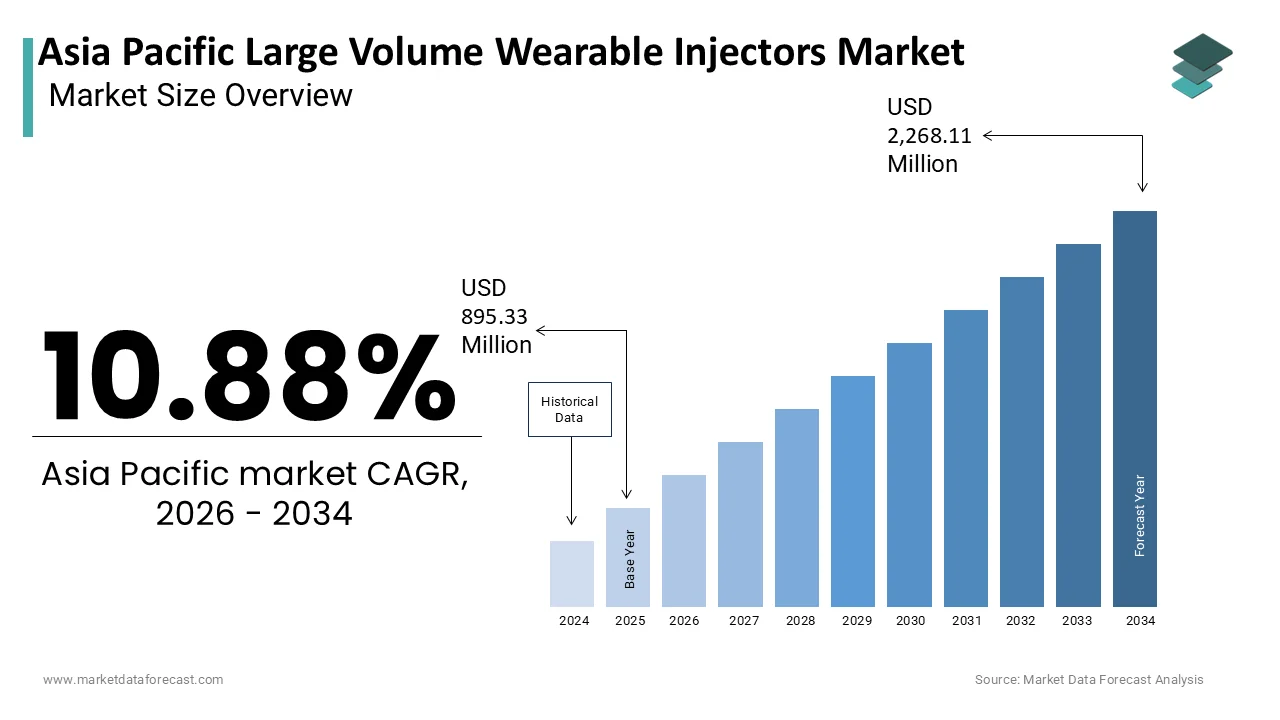
- Market Valuation: Valued at USD 895.33 million in 2025, estimated at USD 992.75 million in 2026, and projected to reach USD 2,268.11 million by 2034, registering a strong CAGR of 10.88% from 2026 to 2034.
- Primary Growth Drivers: Escalating burden of chronic conditions requiring high-viscosity biologic therapies, expansion of biosimilar approvals and cost-effective treatment pathways, and systemic shifts toward decentralized home-based care models.
Key Market Segment Metrics (2026–2034)
| Category | Leading Segment (2025 Position) | Fastest-Growing / Preferred Segment |
|---|---|---|
| By Application | Home Care Settings (captured 48.2% of market share in 2025 driven by decentralized care and elderly domiciliary policies) | Home Care Settings (projected to expand with a CAGR of 14.6% supported by government-backed de-hospitalization policies) |
| By Wearable Injector Type | On-Body (Adhesive Patch) (occupied 52.3% of market share in 2025 due to direct skin adhesion and urban mobility) | Off-Body (Belt Clip) (growing with a CAGR of 13.8% driven by ultra-high-volume requirements and thermal resilience) |
| By Therapeutic Area | Auto-Immune Disorders (held 39.2% of market share in 2025 anchored by rising prevalence of rheumatoid arthritis and IBD) | Oncology (projected to grow with a CAGR of 15.2% driven by subcutaneous delivery shifts for monoclonal antibodies) |
| By Mechanism of Injection | Spring-Based Expanding Mechanism (dominated with 41.3% share in 2025 due to mechanical reliability and simplicity) | Battery-Powered Motor-Driven (witnessing a CAGR of 16.3% due to precise programmable dosing and digital connectivity) |
| By Country | Japan (top performer with 28.3% of market share in 2025 backed by high adoption and advanced domestic medtech R&D) | China & South Korea (high-growth hubs scaling rapidly through government healthcare modernization and regulatory agility) |
Major Market Players & Market Structure
Market Structure: Highly competitive regional landscape featuring global medtech leaders and regional innovators focusing on strategic co-development with pharmaceutical firms, localized manufacturing, and user-centric digital integration.
Key Companies: Ypsomed AG, West Pharmaceutical Services Inc., SHL Medical, Sensile Medical AG, Becton Dickinson and Company, Amgen Inc., Enable Injections Inc., Unilife Corporation, and Insulet Corporation.
Asia Pacific Large Volume Wearable Injectors Market Size
The Asia Pacific Large Volume Wearable Injectors Market is projected to grow from USD 895.33 million in 2025 to USD 992.75 million in 2026 and reach USD 2,268.11 million by 2034, registering a CAGR of 10.88% from 2026 to 2034.
The Large Volume Wearable Injectors (LVWI) are advanced drug delivery systems designed to administer biologics and high-viscosity therapeutics exceeding 1 mL subcutaneously over extended durations, typically ranging from minutes to hours. These compact, patient-operated devices are increasingly deployed in managing chronic conditions such as rheumatoid arthritis, multiple sclerosis, and oncology, where conventional injection methods fall short due to volume limitations or patient discomfort. As per the World Health Organization, non-communicable diseases account for nearly 8 million premature deaths annually in the Western Pacific and South-East Asia regions combined. The expansion of home-based care models, particularly in countries like Japan and Australia, reflects systemic shifts toward decentralized healthcare delivery, which is reinforcing the clinical relevance of wearable injectors. Regulatory advancements, including Japan’s Pharmaceuticals and Medical Devices Agency (PMDA) fast-tracking of digital health tools, further validate the integration of these devices into mainstream treatment pathways.
MARKER DRIVERS
Escalating Prevalence of Chronic Diseases Requiring Biologic Therapies
The accelerating burden of chronic diseases across the Asia Pacific region has become a pivotal factor for the adoption of large volume wearable injectors is accelerating the growth of the Asia Pacific Large Volume Wearable Injectors (LVWI) market. Conditions such as psoriasis, inflammatory bowel disease (IBD), and hemophilia necessitate frequent administration of high-molecular-weight biologics, often exceeding the volume capacity of standard syringes or pen injectors. For instance, treatments like infliximab or factor VIII replacement can require doses upwards of 5–10 mL, making wearable injectors an essential alternative to clinic-based intravenous infusions. According to the Asian Organisation for Crohn's and Colitis, the incidence of IBD in urban centers such as Seoul, Singapore, and Hong Kong has increased by more than 10% annually over the past decade, mirroring Western epidemiological trends. This surge correlates directly with growing demand for outpatient-compatible delivery platforms. Moreover, Japan’s National Institute of Public Health reports that autoimmune disorders affect approximately one in twelve adults, intensifying pressure on healthcare systems to adopt self-administered solutions.
Expansion of Biosimilar Approvals and Cost-Effective Treatment Pathways
The proliferation of biosimilars is reshaping access to high-cost biologic therapies, thereby amplifying the feasibility of integrating large volume wearable injectors into routine care is also fuelling the growth of the Asia Pacific Large Volume Wearable Injectors (LVWI) market. Countries such as South Korea, Australia, and India have established robust regulatory frameworks for biosimilar approval, reducing treatment costs by up to 30–40% compared to originator biologics, as noted in a 2023 analysis by the Asia Pacific Group on Immunology and Therapeutics. This cost reduction lowers the barrier to entry for advanced drug delivery systems, making wearable injectors economically viable for both payers and providers. Additionally, India’s Central Drugs Standard Control Organization approved its first trastuzumab biosimilar for home-based administration trials using wearable injectors in 2023, signaling a strategic shift toward integrated, patient-centric delivery ecosystems.
MARKET RESTRAINTS
Limited Reimbursement Frameworks for Wearable Delivery Devices
The absence of comprehensive reimbursement mechanisms for these advanced drug-device combination systems is restricting the growth of the Asia Pacific Large Volume Wearable Injectors (LVWI) market. In Thailand, for example, despite increasing demand for biologic therapies, the National List of Essential Medicines does not include wearable injectors, leaving patients to bear out-of-pocket expenses that can exceed $500 per unit, as indicated by a 2023 survey conducted by the Thai Health Intervention and Technology Assessment Program. Similarly, in Indonesia, only 22% of private insurance plans offer partial coverage for home-based injection technologies, according to the Indonesian Medical Device Association. Even in relatively advanced markets like Japan, while the government covers certain biologics under the NHI scheme, the associated delivery devices are often categorized separately, leading to fragmented funding and delayed patient access. A 2022 report by the Asia Pacific MedTech Forum revealed that fewer than 30% of hospitals in Malaysia and the Philippines have procurement budgets allocated for wearable injectors, primarily due to unclear reimbursement guidelines.
Technical Limitations in Handling High-Viscosity Formulations
The current generations of large volume wearable injectors in reliably delivering highly viscous biologic formulations is a factor limiting the growth of the Asia Pacific Large Volume Wearable Injectors (LVWI) market. Many monoclonal antibodies and fusion proteins exhibit viscosities exceeding 50 centipoise, which strain the mechanical capabilities of wearable pumps reliant on elastomeric or spring-driven mechanisms. A 2023 technical evaluation by the National University of Singapore’s Biopharmaceutical Engineering Unit found that 40% of commercially available wearable injectors failed to maintain consistent flow rates when handling formulations above 60 cP, leading to incomplete dosing or prolonged administration times beyond two hours. Additionally, a joint study by Australia’s Therapeutic Goods Administration and CSIRO in 2022 demonstrated that shear stress within microfluidic channels of wearable injectors could degrade sensitive molecules like immunoglobulin G, potentially affecting therapeutic efficacy.
MARKET OPPORTUNITIES
Integration of Digital Health Platforms and Remote Patient Monitoring
The rapid digitization of healthcare infrastructure across the Asia Pacific presents a transformative opportunity for the growth of the Asia Pacific Large Volume Wearable Injectors (LVWI) market. Governments and private providers are increasingly investing in telemedicine, electronic health records, and remote monitoring tools, creating fertile ground for smart injectors equipped with Bluetooth, sensors, and mobile applications. This initiative enables seamless transmission of injection data such as dose completion, adherence patterns, and adverse events from wearable devices directly to physician dashboards. Smart wearable injectors can leverage this infrastructure to improve treatment compliance, which remains suboptimal; a 2022 study by the Chinese Medical Association revealed that adherence to biologic regimens in rheumatoid arthritis patients averages just 58% without digital support. Australia’s MyHealth Record system, used by over 23 million citizens, further supports interoperability with medical devices.
Strategic Collaborations Between Local Manufacturers and Global Pharma Firms
Partnerships between indigenous medical device manufacturers and multinational pharmaceutical companies is unlocking new commercial pathways is specifically degrading the growth of the Asia Pacific Large Volume Wearable Injectors (LVWI) market. Domestic firms in China, India, and South Korea possess deep manufacturing expertise, cost efficiency, and regulatory familiarity, while global pharma giants bring proprietary biologics and clinical validation. In 2023, Shanghai-based Owen Mumford partnered with a European biopharma leader to co-develop a wearable injector specifically calibrated for a high-concentration monoclonal antibody targeting lung cancer prevalent in East Asia. According to the Confederation of Indian Industry, such alliances have accelerated product launch timelines by an average of 14 months compared to standalone development.
MARKET CHALLENGES
Regulatory Fragmentation Across National Jurisdictions
The complex and heterogeneous regulatory landscape that poses substantial hurdles to the harmonized approval and commercialization of large volume wearable injectors may also impede the growth of the Asia Pacific Large Volume Wearable Injectors (LVWI) market. Each country maintains distinct classification systems, clinical evaluation requirements, and post-market surveillance protocols for combination products, leading to protracted timelines and increased compliance burdens. Australia’s Therapeutic Goods Administration employs a risk-based categorization system that demands extensive human factors testing, while Southeast Asian nations like the Philippines and Vietnam lack dedicated guidelines for wearable injectors altogether, forcing manufacturers to rely on ad hoc submissions. According to the Asia Regulatory Affairs Association, the average duration for securing marketing authorization for a wearable injector varies from 10 months in Singapore to over 28 months in Indonesia. This inconsistency deters investment, particularly from small and mid-sized developers lacking multi-country regulatory teams. Furthermore, divergent labeling, cybersecurity, and software validation standards complicate device interoperability and digital feature integration.
Patient Hesitancy Stemming from Usability and Training Deficiencies
A large volume wearable injectors encounter resistance from end-users due to concerns surrounding ease of use, fear of malfunction, and inadequate training protocols among elderly and technologically inexperienced populations. A 2023 multi-country usability study conducted by the University of Sydney’s Centre for Medical Psychology found that 41% of first-time users in Australia, Malaysia, and Taiwan experienced anxiety related to device setup, including site preparation, priming, and activation. In rural India, where literacy rates remain below 75% in certain states, as per the National Statistical Office, instructional materials in English or complex visual guides prove ineffective, leading to incorrect usage and potential underdosing. Additionally, a survey by the Japanese Society of Home Healthcare Technology revealed that 30% of patients discontinued wearable injector use within three months due to skin irritation, noise during operation, or difficulty removing the device post-infusion. These experiential challenges are exacerbated by inconsistent clinician-led education; in public hospitals across Indonesia and Vietnam, fewer than 40% of prescribing physicians received formal training on wearable injector protocols, according to the ASEAN Working Group on Primary Care.
REPORT COVERAGE
| REPORT METRIC | DETAILS |
| Market Size Available | 2025 to 2034 |
| Base Year | 2025 |
| Forecast Period | 2026 to 2034 |
| Segments Covered | By Type, Wearable Injector TypeTherapeutic Area, Mechanism of Injection and Country. |
| Various Analyses Covered | Global, Regional and Country-Level Analysis, Segment-Level Analysis, Drivers, Restraints, Opportunities, Challenges; PESTLE Analysis; Porter’s Five Forces Analysis, Competitive Landscape, Analyst Overview of Investment Opportunities |
| Countries Covered | India, China, Japan, South Korea, Australia, New Zealand, Thailand, Malaysia, Vietnam, Philippines, Indonesia, Singapore, Rest of APAC |
| Market Leaders Profiled | Ypsomed AG, West Pharmaceutical Services Inc., Sensile Medical AG, Becton Dickinson and Company, Amgen Inc., Enable Injections Inc., Unilife Corporation, and Insulet Corporation. |
SEGMENTAL ANALYSIS
By Application Insights

The home care settings segment was the largest by capturing 48.2% of the Asia Pacific Large Volume Wearable Injectors (LVWI) market share in 2025 with a systemic shift toward decentralized healthcare delivery models across the region, where chronic disease management is increasingly transitioning from institutional environments to patient-centric domiciliary care. Furthermore, Japan’s Ministry of Health, Labour and Welfare revealed in 2023 that its national "Community-Based Integrated Care System" now supports over 7 million elderly individuals receiving medical therapies at home, including subcutaneous biologics delivered via wearable injectors. The psychological comfort associated with familiar surroundings further enhances adherence; a longitudinal study by Seoul National University Hospital found that patients using LVWIs at home demonstrated 27% higher compliance rates compared to clinic-based cohorts.
The home care settings segment is projected to expand with a CAGR of 14.6% from 2025 to 2033 owing to the government-backed de-hospitalization policies aimed at alleviating strain on overstretched healthcare infrastructures. For instance, China’s National Health Commission launched the “Healthy China 2030” initiative, which includes a directive to increase home-based care services by 50% by 2025 already resulting in a tripling of home infusion referrals in Guangdong and Jiangsu provinces since 2021, as documented by Peking Union Medical College Hospital.
By Wearable Injector Type Insights
The on body (adhesive patch) segment was the largest by occupying 52.3% of the Asia Pacific Large Volume Wearable Injectors market share in 2025. Unlike off body or hand held systems that require belt clips or manual handling during infusion, on body patches adhere directly to the skin, allowing unrestricted mobility and discretion attributes highly valued in densely populated urban environments across East and Southeast Asia. Additionally, these devices minimize dosing errors through automatic initiation upon adhesion, reducing reliance on user coordination a crucial advantage for elderly or physically impaired patients. Regulatory validation has further boosted their position where Japan’s Pharmaceuticals and Medical Devices Agency approved five new on body injector platforms between 2021 and 2023, including devices co developed with Takeda and Chugai Pharmaceutical, signaling strong industry confidence.
The off body (belt clip) segment is anticipated to grow with a CAGR of 13.8% throughout the forecast period with its adaptability in delivering ultra high volume formulations exceeding 15 mL a niche not efficiently served by on body patches constrained by size and adhesion limitations. In oncology applications, particularly for subcutaneous delivery of chemotherapy combinations like daratumumab hyaluronidase, off body systems offer scalable reservoir capacity and extended wear times without compromising stability. A 2023 clinical assessment at Tata Memorial Centre in Mumbai demonstrated that off body injectors successfully administered full dose regimens averaging 20 mL over 45 minutes with zero flow interruptions, whereas on body variants required re dosing in 18% of cases. According to the Indian Council of Medical Research, average daytime temperatures in Chennai and Kolkata exceeded 38°C for 120 days in 2022, which is severely limiting the viability of skin adhered systems.
By Therapeutic Area Insight
The auto immune disorders segment was the largest and held 39.2% of the Asia Pacific Large Volume Wearable Injectors market share in 2025 with the escalating prevalence of immune mediated conditions such as psoriasis, Crohn’s disease, and lupus, which necessitate prolonged administration of biologic agents like TNF alpha inhibitors and interleukin antagonists many of which exceed 10 mL per dose and are unsuitable for conventional injection methods. Urban epidemiological studies reveal a sharp uptick in autoimmune incidence across developed and emerging economies alike. As reported by the Asia Pacific League of Associations for Rheumatology, the number of diagnosed rheumatoid arthritis cases in metropolitan areas of South Korea, China, and Australia rose by 12.4% annually between 2018 and 2023, reaching over 9 million individuals.
The oncology segment is anticipated to grow with a CAGR of 15.2% from 2025 to 2033 with a paradigm shift in cancer treatment modalities, particularly the move toward subcutaneous administration of monoclonal antibodies and antibody drug conjugates previously restricted to intravenous routes. Drugs such as trastuzumab and rituximab are now being reformulated for large volume wearable delivery, drastically shortening treatment duration from hours to under 30 minutes while improving patient throughput in overwhelmed oncology centers.
By Mechanism of Injection Insights
The spring based expanding mechanism segment dominated the Asia Pacific Large Volume Wearable Injectors market with 41.3% of share in 2025 with its mechanical simplicity, reliability, and absence of electronic components by making it particularly suitable for regions with variable climatic conditions and limited access to technical support infrastructure. The spring driven system operates on stored mechanical energy released gradually to push drug content through the delivery pathway, ensuring consistent flow rates without dependency on batteries or software controls. Additionally, their compactness and lightweight nature improve patient compliance; a field study by Vietnam’s Ministry of Health found that 89% of users reported no interference with daily movement during spring based infusions lasting up to two hours.
The battery powered motor driven mechanism segment is likely to witness a CAGR of 16.3% throughout the forecast period with its ability to deliver precise, programmable dosing profiles essential for next generation biologics with narrow therapeutic windows. This capability is increasingly vital for novel therapeutics such as bispecific antibodies and RNA based drugs, which require controlled, multi phase delivery sequences. Another transformative feature is connectivity; these devices integrate Bluetooth and cloud based monitoring, transmitting real time data to clinicians. Singapore’s National University Hospital implemented a pilot program in 2023 linking motor driven injectors to its electronic health record system, reducing missed doses by 34% in autoimmune patients. Energy efficiency improvements have also addressed earlier concerns about battery life; Samsung Medison’s latest lithium polymer module sustains operation for up to 72 hours on a single charge, sufficient for multi day infusion protocols.
COUNTRY LEVEL ANALYSIS
Japan Large Volume Wearable Injectors Market Insights
Japan was the top performer of the Asia pacific large volume wearable injectors market with 28.3% of the share in 2025. As per Japan Pharmaceutical Manufacturers Association, the adoption surged over 120,000 patients received prescriptions for wearable injectors in 2022 alone. Domestic innovation further strengthens the ecosystem; companies like Terumo and Nipro have co developed injectors compatible with high concentration formulations from Takeda and Eisai. Clinical validation is extensive; a nationwide registry maintained by the Japanese Society of Therapeutic Drug Monitoring shows that 84% of patients using wearable injectors reported improved quality of life metrics.
China Large Volume Wearable Injectors Market Insights
China LVWI market was next with 23.4% of the share in 2024. While still in a developmental phase compared to Japan, China’s market is distinguished by its sheer scale, state driven healthcare modernization, and rapidly evolving regulatory environment. The country is home to over 130 million patients with autoimmune and oncological conditions requiring biologic therapies, according to the Chinese Center for Disease Control and Prevention, creating immense latent demand. The National Medical Products Administration (NMPA) fast tracked approval of seven wearable injector platforms between 2021 and 2023, reducing review timelines by 40% compared to previous cycles. Infrastructure development is accelerating; Huawei and Sinopharm launched a joint digital health platform in 2023 that links wearable injectors to AI powered monitoring systems in 500 tier 2 and tier 3 hospitals. Rural accessibility remains a focus; under the “Digital Villages Initiative,” 30,000 township clinics were equipped with teleconsultation tools by 2023, enabling remote prescription and follow up for wearable injector users. Manufacturing prowess also fuels growth Shenzhen based firms produce over 60% of global elastomeric pump components, giving local developers cost and supply chain advantages.
Australia Large Volume Wearable Injectors Market Insights
Australia LVWI market growth is specifically to grow with country’s strength lies in its well integrated public private healthcare system, high patient awareness, and progressive reimbursement policies. With one of the highest concentrations of biologic users per capita over 250,000 Australians receive biologics annually, as per the Australian Institute of Health and Welfare demand for alternative delivery methods is pronounced. The Pharmaceutical Benefits Scheme (PBS) subsidizes several wearable injector compatible therapies, including subcutaneous rituximab and tocilizumab, reducing out of pocket costs to under AUD 40 per cycle. Research leadership also contributes CSIRO and the University of Melbourne are developing temperature stable formulations specifically for wearable delivery in remote Indigenous communities. Furthermore, private health insurers such as Medibank and Bupa now offer bundled home therapy packages, including nurse training and device supply.
South Korea Large Volume Wearable Injectors Market Insights
South Korea LVWI market is growing with the nation distinguishes itself through cutting edge R&D capabilities, digital health readiness, and strong public health infrastructure. The Ministry of Health and Welfare allocated KRW 1.8 trillion ($1.3 billion) in 2023 for digital therapeutics and connected medical devices, including wearable injectors. Regulatory agility is evident; the Korean Ministry of Food and Drug Safety approved eight wearable injector platforms between 2021 and 2023, leveraging harmonized standards with the U.S. FDA and EU MDR.
India Large Volume Wearable Injectors Market Insights
India LVWI market growth is with the increasing number of patient population. Over 45 million people living with autoimmune and oncological disorders, as per the Indian Council of Medical Research. Local players such as Halocorp and Zydus Cadila have developed low cost wearable injectors priced 40% below imported models, enhancing accessibility. Government schemes like Ayushman Bharat are beginning to explore inclusion of wearable injectors in specialty care packages for tertiary referrals. However, challenges persist only 28% of urban hospitals have dedicated home infusion programs, according to the Federation of Indian Chambers of Commerce & Industry. Nevertheless, partnerships with global pharma firms and increasing venture capital interest in medtech startups signal transformative potential.
KEY MARKET PLAYERS
Companied dominating the APAC large volume wearable injectors market profiled in this report are Ypsomed AG, West Pharmaceutical Services Inc., Sensile Medical AG, Becton Dickinson and Company, Amgen Inc., Enable Injections Inc., Unilife Corporation, and Insulet Corporation.
TOP LEADING PLAYERS IN THE MARKET
Ypsomed Holding AG
Ypsomed Holding AG is a pioneering force in advanced drug delivery systems, with a strong emphasis on wearable injector innovation. The company has established itself as a trusted partner for global pharmaceutical firms by delivering reliable, patient centric injection platforms tailored for large volume biologics. Ypsomed’s expertise lies in integrating precision engineering with intuitive design, ensuring seamless administration across chronic disease therapies. Its presence in the Asia Pacific region is bolstered by strategic collaborations with regional healthcare providers and regulatory alignment with local standards.
West Pharmaceutical Services, Inc
West Pharmaceutical Services, Inc. is a leader in containment and delivery solutions for injectable medications, with an extensive portfolio that includes cutting edge wearable injector platforms. The company combines deep scientific knowledge with end to end development capabilities, supporting pharmaceutical clients from concept to commercialization. West’s commitment to quality and regulatory compliance has made its devices integral to numerous high profile biologic launches worldwide. In the Asia Pacific market, the company plays a key role in advancing subcutaneous delivery adoption through localized support and technology transfer initiatives. Its focus on integrated drug device systems positions it as a key enabler of next generation therapeutic regimens.
SHL Medical
SHL Medical is renowned for its innovative approach to wearable drug delivery, offering customizable, high performance platforms designed for complex biologics. With a global footprint and dedicated centers of excellence in engineering and human factors, SHL ensures its devices meet the highest clinical and ergonomic standards. The company actively partners with biopharmaceutical innovators to co develop solutions that enhance patient adherence and therapeutic outcomes. In Asia Pacific, SHL leverages regional manufacturing capabilities and deep market insights to deliver culturally adapted, scalable technologies. Its forward thinking designs, emphasizing connectivity and user experience, have set new benchmarks in wearable injector performance and reliability.
TOP STRATEGIES USED BY KEY MARKET PARTICIPANTS
One major strategy employed by leading companies is strategic co development with biopharmaceutical firms, where device manufacturers collaborate early in the drug development lifecycle to engineer customized wearable injectors compatible with specific biologics. This integration ensures optimal formulation delivery, accelerates regulatory approval, and strengthens commercial exclusivity. Another pivotal approach is regional localization of production and regulatory engagement by enabling companies to align with diverse Asia Pacific standards, reduce time to market, and build trust with local health authorities. Firms are also prioritizing human centered design and digital integration, incorporating smart features such as dose tracking, connectivity, and real time feedback to improve patient adherence and generate actionable clinical insights, thereby enhancing the overall value proposition of their delivery systems.
COMPETITION OVERVIEW
The competitive landscape of the Asia Pacific Large Volume Wearable Injectors Market is defined by a convergence of technological innovation, strategic alliances, and evolving patient expectations. Established medical device manufacturers dominate the space, leveraging deep engineering expertise and global regulatory experience to maintain leadership. However, rising competition comes from regional players investing in cost effective, locally adapted solutions tailored to diverse healthcare infrastructures. Differentiation increasingly hinges on user experience, with companies focusing on discreet, comfortable, and intuitive designs that support long term adherence. Intense collaboration between device developers and pharmaceutical companies shapes product development, ensuring compatibility with emerging biologic pipelines. While Western firms bring proven platforms and robust quality systems, Asian manufacturers counter with agility, lower costs, and proximity to growing patient populations. Regulatory heterogeneity across countries adds complexity, requiring nuanced market entry strategies.
RECENT MARKET DEVELOPMENTS
- In March 2023, Ypsomed partnered with a leading Japanese pharmaceutical company to co develop a wearable injector specifically designed for a novel immunology biologic by enhancing its foothold in East Asia's specialty care sector.
- In June 2023, West Pharmaceutical Services inaugurated a new applications development center in Singapore that aimed at accelerating device customization and regulatory support for clients across Southeast Asia and Oceania.
- In November 2023, SHL Medical launched a next generation on body wearable platform featuring adaptive flow control and Bluetooth enabled monitoring, which is targeting high viscosity oncology therapeutics in the Australian and South Korean markets.
- In February 2024, Becton, Dickinson and Company expanded its collaboration with an Indian biosimilars developer to integrate BD’s wearable injector technology with a pipeline of monoclonal antibodies for autoimmune diseases.
- In May 2024, Medtronic announced a joint initiative with a telehealth provider in Thailand to pilot connected wearable injectors within a national homecare program for chronic disease patients.
MARKET SEGMENTATION
This research report on the Asia Pacific Large Volume Wearable Injectors Market has been segmented and sub-segmented into the following categories:
By Application
- Hospitals
- Ambulatory Surgery Centers
- Home Care Settings
- Clinics
- Others
By Wearable Injector Type
- Hand-Held
- Off-Body (Belt Clip)
- On-Body (Adhesive Patch)
By Therapeutic Area
- Infectious Diseases
- Diabetes
- Oncology
- Cardiovascular
- Auto-Immune Disorders
- Others
By Mechanism of Injection
- Collapsible Reservoir Rotary Pump
- Spring-Based Expanding Battery
- Motor-Driven
- Pressurized Gas
By Usage
- Semi-Reusable
- Disposable
By Country
- India
- China
- Japan
- South Korea
- Australia
- New Zealand
- Thailand
- Malaysia
- Vietnam
- Philippines
- Indonesia
- Singapore
- Rest of APAC