- Product Description Description
- Table of Contents TOC
- List of Table & Figure LOT
- Get Free Sample PDF Sample PDF
Market Size, 2025
$17.4 BnMarket Estimate, 2026
$19.67 BnMarket Forecast, 2034
$52.48 BnCAGR, 2026–2034
13.05%Asia Pacific Transgenic Seeds Market Size, Share, Trends & Forecast (2026–2034)
- Market Scope: Comprehensive Asia-Pacific transgenic (genetically modified) seeds industry analysis covering crop segments, genetic traits, country-level breakdowns, and agricultural biotechnology drivers.
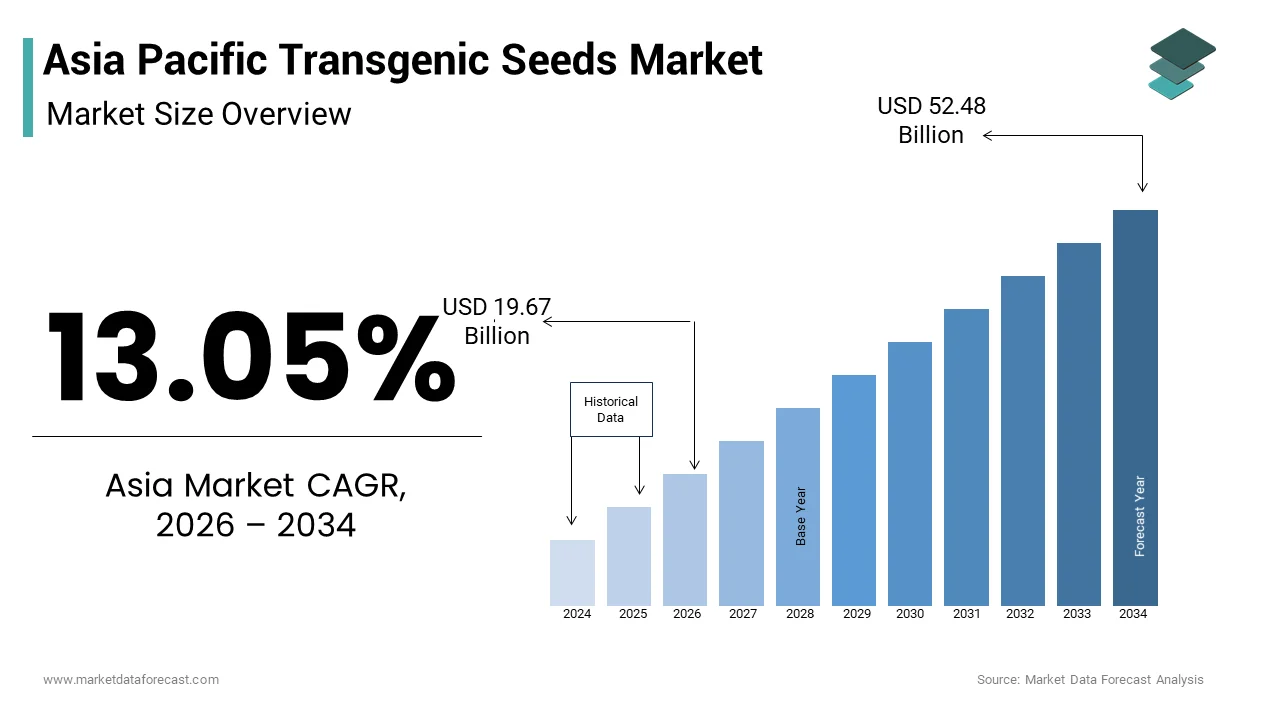
- Market Valuation: Valued at USD 17.40 billion in 2025, estimated at USD 19.67 billion in 2026, and projected to reach USD 52.48 billion by 2034, registering a strong CAGR of 13.05% from 2026 to 2034.
- Primary Growth Drivers: Rising agricultural demand due to rapid population growth, food security challenges, adoption of biotech crops to combat climate change and pest infestations, and government-backed initiatives promoting sustainable farming in key economies like India, China, and the Philippines.
Asia-Pacific Transgenic Seeds Market Segment Metrics (2026–2034)
| Category | Leading Segment (2025 Position) | Fastest-Growing Segment |
|---|---|---|
| By Crops | Cotton (commanding 53.2% of total revenue, driven by Bt cotton in India and China) | Corn (projected to expand at a CAGR of 8.4%) |
| By Trait | Insecticide Resistance (capturing a 60.1% share via Bt adoption) | Herbicide Tolerance (expanding at a CAGR of 7.9%) |
| By Country | India (holding 45.3% regional sales share) and China | Emerging Southeast Asian markets (Philippines and Vietnam) |
Major Transgenic Seeds Market Players & Competitive Landscape
Market Structure: Highly competitive regional market combining multinational agro-biotech giants with domestic seed enterprises and public research organizations focusing on gene-editing, climate resilience, and local regulatory compliance.
Key Market Players: Syngenta AG, E.I. Du Pont De Nemours and Company, BASF SE, Corteva Agriscience, Vilmorin & Cie (Limagrain Group), Dow Chemical Company, Suntory Holdings Limited, Monsanto, J.R. Simplot Company, Bayer CropScience AG, and Bejo Zaden B.V.
Asia Pacific Transgenic Seeds Market Size
The Asia Pacific Transgenic seeds market size will reach 17.4 billion in 2025 and is anticipated to reach USD 19.67 billion in 2026 and to reach USD 52.48 billion by 2034, growing at a CAGR of 13.05% during the forecast period from 2026 to 2034.
Transgenic seeds are genetically modified (GM) seeds that are engineered for enhanced traits such as pest resistance, herbicide tolerance, drought resilience, and improved yield potential. These seeds are developed using advanced biotechnological techniques that introduce specific genes from other organisms to confer desirable characteristics not found in conventional varieties. As per the International Service for the Acquisition of Agri-biotech Applications (ISAAA), transgenic crops have played a pivotal role in addressing food security concerns and improving agricultural productivity across several countries in the region.
Although adoption varies significantly across the Asia-Pacific region, countries like India, China, and the Philippines have made notable strides in cultivating transgenic cotton, maize, and rice.
Despite regulatory hurdles and public skepticism in certain areas, scientific institutions and agribusiness firms continue to invest in research and development aimed at expanding the scope of transgenic seed applications. The push for sustainable agriculture and resource-efficient farming practices has further fueled interest in transgenic solutions, especially in regions facing rapid population growth and arable land degradation. Moreover, government-backed initiatives promoting biotech crop cultivation in Indonesia and Vietnam indicate a gradual shift toward broader acceptance.
MARKET DRIVERS
Rising Agricultural Demand Due to Population Growth and Food Security Concerns
The increasing pressure to enhance agricultural output in response to rapid population growth and food security challenges is one of the primary drivers of the Asia-Pacific transgenic seeds market. This surge in population necessitates higher food production without significant expansion of arable land, prompting governments and agricultural stakeholders to adopt high-yielding transgenic crops. For instance, in India, the adoption of Bt cotton, which is engineered to resist bollworm infestation, has led to a dramatic increase in lint yields while reducing pesticide usage.
According to the Indian Council of Agricultural Research (ICAR), Bt cotton now covers over 90% of the country’s cotton-growing area, demonstrating the effectiveness of transgenic technology in boosting productivity under constrained resources. Similarly, in China, the government has supported field trials and limited commercialization of transgenic rice and maize to address grain supply gaps. As per the Chinese Academy of Agricultural Sciences (CAAS), transgenic rice strains have shown up to 15% higher yields compared to conventional varieties under similar growing conditions.
Adoption of Biotech Crops to Combat Climate Change and Pest Infestations
The increasing need to counteract climate variability and pest outbreaks using genetically engineered crops is also a critical driver of the Asia-Pacific transgenic seeds market.
As per the Intergovernmental Panel on Climate Change (IPCC), the Asia-Pacific region has experienced more frequent extreme weather events, including prolonged droughts, erratic monsoons, and rising temperatures, all of which threaten traditional farming systems.
Transgenic seeds offer a viable solution by introducing traits such as drought tolerance, salt resistance, and pest immunity, enabling farmers to maintain productivity despite adverse environmental conditions.
In Bangladesh, the introduction of Bt brinjal (eggplant) has significantly reduced insecticide applications and improved harvest consistency. According to the Bangladesh Agricultural Research Institute (BARI), farmers using Bt brinjal reported a 40% reduction in pesticide costs and a 20% increase in yield compared to conventional varieties. Apart from these, the spread of invasive pests such as the fall armyworm has prompted several countries to explore transgenic maize varieties that incorporate built-in insect protection.
MARKET RESTRAINTS
Regulatory Restrictions and Policy Uncertainty Across Key Markets
The presence of stringent regulatory frameworks and inconsistent policy positions across key agricultural economies is a major restraint affecting the Asia-Pacific transgenic seeds market. Several countries in the region, including Thailand, Sri Lanka, and parts of Australia, maintain restrictive or outright bans on the commercial cultivation of genetically modified (GM) crops due to political, social, and environmental concerns. According to the International Service for the Acquisition of Agri-biotech Applications (ISAAA), policy uncertainty has hindered large-scale adoption in markets where regulatory approval processes remain protracted or subject to frequent changes. For example, in the Philippines, the Supreme Court temporarily suspended the commercialization of Bt eggplant in 2022 following legal challenges from environmental groups, delaying potential benefits for local farmers.
As per the Food and Agriculture Organization (FAO), inconsistent biosafety laws and labeling requirements also complicate cross-border trade and seed distribution within the region. These regulatory barriers limit investment in research and development by multinational seed companies.
Public Opposition and Ethical Concerns Regarding GMOs
Public skepticism and ethical concerns surrounding genetically modified organisms (GMOs) represent a significant challenge to the growth of the Asia-Pacific transgenic seeds market. As per a survey conducted by the Pew Research Center, nearly 60% of respondents in Japan and South Korea expressed reservations about consuming GM foods, citing health, environmental, and corporate control issues as primary concerns. This sentiment extends to other parts of the region, influencing policymaking and slowing down regulatory approvals.
Activist groups and non-governmental organizations have played a crucial role in shaping public perception against transgenic crops. In India, protests against GM mustard and genetically engineered rice have delayed government approvals despite favorable scientific assessments from institutions like the Indian Agricultural Research Institute (ICAR). According to Greenpeace, campaigns highlighting potential biodiversity loss and farmer dependency on multinational seed corporations have gained traction, particularly among rural communities.
Apart from these, misinformation and lack of awareness contribute to widespread apprehension. As per the Asia Pacific Seed Association (APSA), misconceptions about genetic modification often overshadow scientific evidence supporting the safety and efficacy of transgenic crops.
MARKET OPPORTUNITY
Expansion of Biotech Cotton and Rice Cultivation in India and China
The expansion of biotech cotton and rice cultivation, particularly in India and China, presents an emerging opportunity in the Asia-Pacific transgenic seeds market. According to the Chinese Academy of Agricultural Sciences (CAAS), China has already approved limited commercial planting of transgenic rice, which resists bacterial blight and yellow stem borers. These are two major yield-limiting factors in rice production.
India, which remains one of the top producers and consumers of cotton globally, continues to benefit from Bt cotton, which currently dominates over 90% of the cotton acreage. As per the Indian Council of Agricultural Research (ICAR), new generations of transgenic cotton with stacked traits for multiple pest resistance and drought tolerance are undergoing field evaluations, offering potential for further yield improvements and reduced input costs for farmers.
Moreover, the Government of India is considering the commercialization of transgenic mustard, a move that could open new avenues for oilseed production and reduce dependency on imports. According to the Directorate of Rapeseed-Mustard Research (DRMR), the proposed DMH-11 variety has demonstrated a 25–30% yield advantage in controlled trials.
Development of Climate-Resilient Seeds for Sustainable Farming
The development of climate-resilient transgenic seeds offers a substantial growth avenue for the Asia-Pacific market, driven by the increasing frequency of extreme weather events and soil degradation. As per the Intergovernmental Panel on Climate Change (IPCC), many parts of the Asia-Pacific region are experiencing prolonged droughts, erratic rainfall patterns, and rising soil salinity, ty which threaten food production sustainability.
To address these issues, researchers and agro-biotech firms are developing transgenic seed varieties tailored for adverse climatic conditions. For example, scientists at the Philippine Rice Research Institute (PhilRice) have been evaluating transgenic rice lines engineered for flood tolerance and nitrogen-use efficiency, aiming to reduce input dependency and improve yield stability.
In China, the Ministry of Agriculture and Rural Affairs has supported the development of transgenic wheat and maize with improved drought resistance. According to the Chinese Academy of Agricultural Sciences (CAAS), field trials have shown promising results, with some transgenic maize varieties exhibiting up to 20% higher yields under water-stressed conditions.
MARKET CHALLENGES
Intellectual Property Rights and Dependence on Multinational Seed Companies
The issue of intellectual property rights (IPRs) and the dominance of multinational seed corporations in the sector is one of the most pressing challenges in the Asia-Pacific transgenic seeds market. As per the Food and Agriculture Organization (FAO), a handful of global agro-biotech firms hold patents on key genetic modifications used in widely adopted transgenic crops such as Bt cotton and HT soybean.
This concentration of ownership limits access for domestic seed companies and smallholder farmers, who often face licensing fees and royalty payments that raise the cost of transgenic seeds beyond affordable levels. According to the Centre for Science and Environment (CSE), in India, seed companies must negotiate technology agreements with international firms before marketing Bt cotton seeds, resulting in higher retail prices for farmers.
Furthermore, dependence on foreign-developed technologies creates concerns about long-term self-sufficiency in seed production. As per the National Academy of Agricultural Sciences (NAAS), local breeding programs are often constrained by limited access to proprietary gene constructs, hindering the development of region-specific transgenic varieties adapted to local agro-climatic conditions.
Limited Access to Technology and Infrastructure in Smallholder Farming Systems
The limited access to biotech innovations among smallholder farmers, who constitute most agricultural producers in the region, is a persistent challenge in the Asia-Pacific transgenic seeds market. According to the International Fund for Agricultural Development (IFAD), over 80% of farms in countries like Nepal, Cambodia, and Laos are operated by smallholders, many of whom lack the financial capacity and technical knowledge required to adopt transgenic seeds.
Access barriers include high initial seed costs, inadequate extension services, and insufficient credit availability. As per the Asian Development Bank (ADB), many small-scale farmers in Vietnam and the Philippines continue to rely on traditional seed-saving practices, limiting the reach of certified transgenic varieties. Moreover, the absence of well-established supply chains and distribution networks in remote and rural areas hampers effective seed delivery.
REPORT COVERAGE
| REPORT METRIC | DETAILS |
| Market Size Available | 2025 to 2034 |
| Base Year | 2025 |
| Forecast Period | 2026 to 2034 |
| CAGR | 13.05% |
| Segments Covered | By Crops, Trait, And Region. |
| Various Analyses Covered | Global, Regional and Country Level Analysis, Segment-Level Analysis, DROC, PESTLE Analysis, Porter’s Five Forces Analysis, Competitive Landscape, Analyst Overview of Investment Opportunities |
| Regions Covered | India, China, Japan, South Korea, Australia, New Zealand, Thailand, Malaysia, Vietnam, Philippines, Indonesia, Singapore, and the Rest of APAC |
| Market Leaders Profiled | Syngenta AG, E.I. Du Pont De Nemours and Company, BASF SE, Vilmorin & Cie (Limagrain Group), Dow Chemical Company, Suntory Holdings Limited, Monsanto, J.R. Simplot Company, Bayer Cropscience AG, Bejo Zaden B.V. |
SEGMENTAL ANALYSIS
By Crop Insights
Cotton
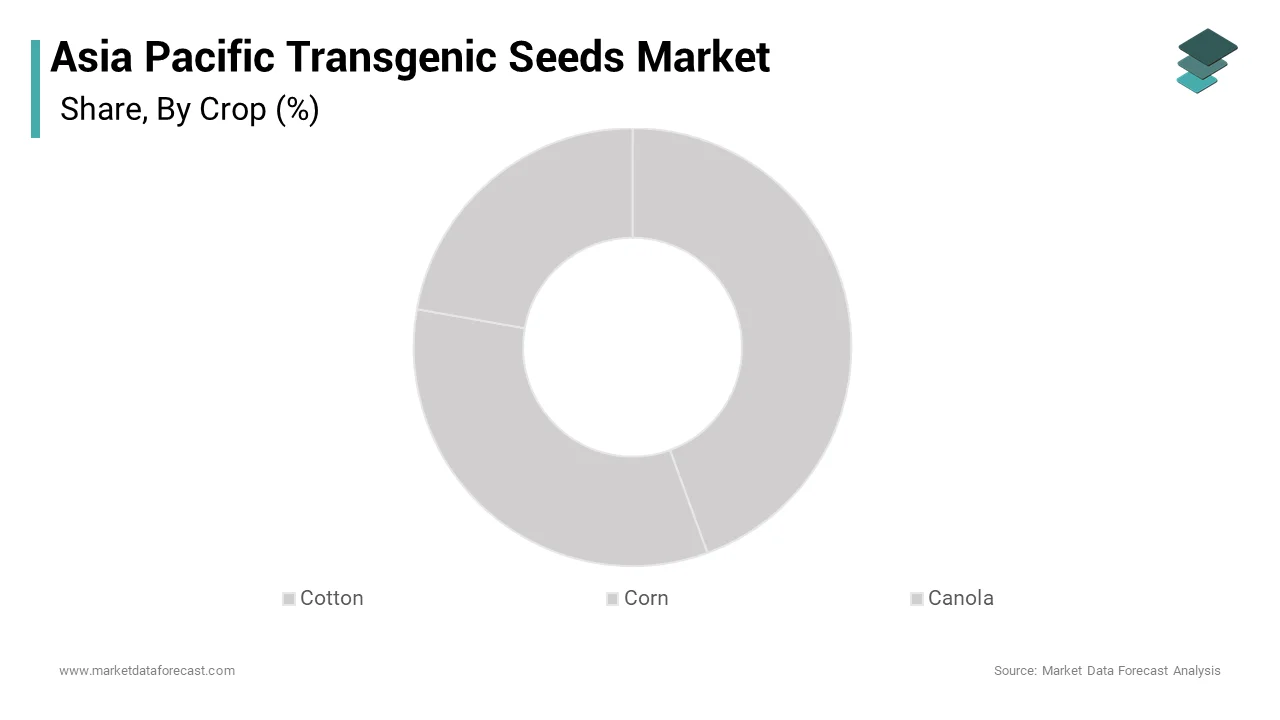
The cotton segment commanded the Asia-Pacific transgenic seeds market by accounting for 53.2% of total revenue in 2024. This growth of the segment is propelled by the successful integration of insect-resistant transgenic cotton varieties in India and China, which together account for more than 60% of global Bt cotton cultivation. As per the International Service for the Acquisition of Agri-biotech Applications (ISAAA), India alone planted over 12 million hectares of Bt cotton in 2023, covering nearly 95% of its total cotton area.
In addition, the economic benefits associated with reduced pesticide use and higher yields have reinforced farmer adoption. According to the Indian Council of Agricultural Research (ICAR), Bt cotton has helped reduce pest-related losses by up to 40% while increasing farm incomes by 20–30%. In China, government-backed extension programs have ensured sustained growth in biotech cotton adoption, particularly among smallholder farmers facing bollworm infestations.
Corn
The corn segment is emerging as the fastest-growing category in the Asia-Pacific transgenic seeds market, projected to expand at a CAGR of 8.4% during the forecast period. The growth rate of this segment significantly outpaces others due to increasing demand for high-yield and pest-resistant maize varieties. Also, the expansion of transgenic corn cultivation in China and the Philippines, where fall armyworm infestations have severely impacted traditional maize production, is the primary factor driving this surge. According to the Food and Agriculture Organization (FAO), the fall armyworm has caused annual yield losses exceeding USD 3 billion in South and Southeast Asia since its arrival in 2018.
Moreover, government support for biotech corn development is gaining momentum, particularly in Indonesia and Vietnam, where food security concerns are prompting policy shifts. As per the Chinese Academy of Agricultural Sciences (CAAS), China approved limited commercial planting of insect-resistant transgenic maize in 2023, signaling a major regulatory breakthrough after years of restrictions. Apart from these, rising livestock feed demand and industrial applications such as bioethanol production are further boosting corn seed adoption.
By Trait Insights
Insecticide Resistance
The insecticide resistance trait segment led the Asia-Pacific transgenic seeds market by capturing 60.1% share in 2024. The expansion of the insecticide resistance trait segment is propelled by the significant reduction in chemical pesticide usage and increased yield protection offered by insect-resistant transgenic crops. As per the International Maize and Wheat Improvement Center (CIMMYT), fall armyworm infestations alone have caused an estimated 20–40% yield loss in conventional maize fields across Southeast Asia, making Bt corn an attractive solution for farmers.
In addition, Bt cotton continues to be the most adopted insect-resistant crop in India and China, where bollworms have historically been a major constraint to productivity. According to the Indian Institute of Farming Systems Research (IIFSR), Bt cotton adoption has led to a 35% reduction in pesticide costs and a 25% increase in lint yield compared to non-Bt varieties.
Herbicide Tolerance
The herbicide tolerance segment is the fastest-growing trait in the Asia-Pacific transgenic seeds market, expanding at a CAGR of 7.9% from 2025 to 2033. The growth of this segment is due to the rising need for efficient weed management in large-scale mechanized farming systems. As per the Australian Weed Management Association, herbicide-tolerant crops allow farmers to adopt "no-till" or "reduced-till" practices, lowering labor costs and improving soil health. This shift is particularly evident in Australian canola farming, where glyphosate-tolerant varieties now cover over 70% of the sown area.
Besides, the introduction of new herbicide-tolerant rice varieties in China and Vietnam is contributing to rising demand. According to the Chinese Ministry of Agriculture, field trials of HT rice have demonstrated improved weed control efficiency and yield consistency under variable climatic conditions, prompting discussions on potential commercialization.
COUNTRY ANALYSIS
India Trasgenic Seeds Market Analysis
India held the top position in the Asia-Pacific transgenic seeds market by contributing 45.3% of total regional sales in 2024. This lead position is because of the high adoption rate of genetically modified cotton, which covers a large share of the nation's cotton-growing area. As per the Indian Council of Agricultural Research (ICAR), Bt cotton has significantly reduced pest-related losses and pesticide expenditures, delivering economic and environmental benefits to millions of smallholder farmers.
Besides, ongoing research and policy discussions regarding the approval of new transgenic crops such as mustard and brinjal are creating opportunities for future expansion. According to the Directorate of Rapeseed-Mustard Research (DRMR), the proposed DMH-11 mustard variety has shown promising results in field trials, potentially opening new avenues for oilseed self-sufficiency.
China Trasgenic Seeds Market Analysis
China commands a significant share of the Asia-Pacific transgenic seeds market. A major growth driver is the Chinese government’s gradual but increasing support for biotech crop development, particularly in staple crops such as rice, maize, and soybean. As per the Ministry of Agriculture and Rural Affairs, China approved limited commercial planting of two transgenic maize varieties in 2023, marking a significant policy shift after years of restrictive regulations.
Moreover, research institutions and domestic seed companies are advancing indigenous transgenic technologies, reducing reliance on foreign intellectual property. According to the Biotechnology Research Institute of CAAS, over 100 transgenic crop lines were undergoing field evaluations in 2023, including nitrogen-use-efficient rice and virus-resistant wheat.
Philippines Trasgenic Seeds Market Analysis
The Philippines is positioning itself as one of the region’s most progressive adopters of biotech crops. A supportive regulatory environment and successful field implementation of biotech crops are key factors behind this growth. As per the Philippine Rice Research Institute (PhilRice), the government has been conducting extensive trials on transgenic rice varieties resistant to bacterial blight and yellow stem borer, indicating potential for broader adoption shortly.
Also, strong collaboration between public research institutions and private seed companies has facilitated the rapid dissemination of Bt maize across major agricultural regions. According to the University of the Philippines, Los Baños, farmers cultivating Bt maize reported a 25% increase in yield and a 30% reduction in pesticide use compared to conventional hybrids.
Australia Trasgenic Seeds Market Analysis
Australia is another major player in the Asia-Pacific transgenic seeds market, with an emphasis on herbicide-tolerant canola and cotton. An important reason for this growth is the widespread adoption of glyphosate-tolerant canola, which supports conservation agriculture and reduces labor-intensive weeding. In addition, Australia’s stringent regulatory framework ensures rigorous safety assessments before commercialization, fostering scientific credibility and international trade acceptance. According to the Office of the Gene Technology Regulator (OGTR), Australia maintains strict monitoring mechanisms, allowing controlled cultivation without compromising export markets.
Vietnam – Strategic Shift Toward Biotech Crops
Vietnam is witnessing a growing focus on biotech maize and rice varieties in the Asia-Pacific transgenic seeds market. A key factor supporting this growth is the government’s increasing openness to biotech solutions in response to pest outbreaks and climate challenges. As per the Vietnamese Ministry of Agriculture and Rural Development (MARD), several transgenic maize varieties have been approved for confined field trials, with plans for commercial release pending further biosafety evaluations.
Moreover, fall armyworm infestations have prompted urgent action to adopt insect-resistant maize, especially in the northern provinces where maize is a critical cash crop. According to the International Maize and Wheat Improvement Center (CIMMYT), transgenic maize trials in Vietnam showed a 30% yield advantage over conventional varieties under heavy pest pressure.
Japan Trasgenic Seeds Market Analysis
Japan contributes a smaller portion of the Asia-Pacific transgenic seeds market, with no commercial cultivation of GM crops within its borders. However, its influence is notable due to its role as a major importer of biotech grains and its impact on regional trade standards. The strict import labeling requirements and consumer resistance to GMOs, despite scientific consensus on their safety, are one of the primary reasons for Japan’s minimal direct contribution. According to the Japanese Ministry of Health, Labour and Welfare, all imported GM soybeans and corn must undergo mandatory labeling, influencing purchasing behavior and import policies across neighboring countries.
Besides, Japan’s regulatory framework sets high biosafety benchmarks, affecting the approval process for biotech crops in ASEAN nations seeking access to Japanese markets. As per the Secretariat of the Convention on Biological Diversity (CBD), Japan’s precautionary stance influences biosafety protocols in several Asia-Pacific economies, indirectly shaping the regulatory landscape for transgenic seed adoption.
COMPETITIVE LANDSCAPE
- The competition in the Asia-Pacific transgenic seeds market is shaped by a mix of multinational agro-biotech firms, domestic seed enterprises, and public-sector research organizations. Global giants such as Corteva, Bayer CropScience, and Syngenta dominate due to their technological expertise, extensive R&D infrastructure, and established distribution networks. These companies have been instrumental in driving the adoption of insect-resistant cotton and maize, particularly in India and China.
- However, the market is also witnessing growing influence from domestic players who leverage cost-effective breeding techniques and better alignment with local regulatory frameworks. In China, state-backed institutions and affiliated seed companies are advancing indigenous transgenic rice and maize varieties, reducing reliance on foreign-developed technologies.
- In India, while multinational corporations initially led Bt cotton adoption, increasing localization and policy-driven restrictions have prompted a shift toward homegrown seed companies. Meanwhile, Southeast Asian nations like Vietnam and the Philippines are emerging as new battlegrounds, with both international and regional firms vying for early-mover advantages in biotech crop development.
- Despite varying regulatory landscapes and public sentiment, the competition continues to evolve with advancements in gene-editing, shifting government policies, and increasing pressure to meet food production demands under climate-stressed conditions.
KEY MARKET PLAYERS
These are the market players that are dominating the Asia Pacific transgenic seeds market.
- Syngenta AG
- E.I. Du Pont De Nemours and Company
- BASF SE
- Corteva Agriscience
- Vilmorin & Cie (Limagrain Group)
- Dow Chemical Company
- Suntory Holdings Limited
- Monsanto
- J.R. Simplot Company
- Bayer Cropscience AG
- Bejo Zaden B.V
Top Players In the Market
- Corteva Agriscience is a leading global agribusiness company formed from the merger of Dow Chemical and DuPont, specializing in seed technologies and crop protection solutions. In the Asia-Pacific transgenic seeds market, Corteva plays a key role through its advanced biotech maize hybrids tailored for pest resistance and yield optimization. The company collaborates with local research institutions and regulatory bodies to support sustainable agricultural development across countries like China, Vietnam, and the Philippines.
- Bayer CropScience, following the integration of Monsanto, remains a dominant force in the transgenic seeds industry. The company offers a wide range of genetically engineered cotton and corn varieties that are widely adopted in India and China. With strong R&D capabilities and extensive farmer outreach programs, Bayer has significantly influenced biotech seed adoption in the Asia-Pacific region, despite regulatory and public scrutiny regarding GMOs.
- Syngenta is a major player in the Asia-Pacific transgenic seeds market, particularly in China, where it supports the development and commercialization of insect-resistant rice and maize. As part of ChemChina, Syngenta leverages its global expertise in biotechnology to align with China’s strategic goals for food security and sustainable agriculture. The company's commitment to innovation and biosafety testing positions it as a key contributor to the growth of transgenic crops in the region.
Top Strategies Used By Key Market Participants
- One of the primary strategies employed by key players in the Asia-Pacific transgenic seeds market is intensifying partnerships with national agricultural research institutions and local seed companies. By collaborating with government-backed agencies, firms like Bayer and Syngenta can accelerate field trials, gain regulatory approvals, and tailor product development to regional climatic and agronomic conditions.
- Another critical approach is investing heavily in public awareness campaigns and stakeholder engagement initiatives. Given the sensitivity surrounding GMOs in many parts of the Asia-Pacific, companies are increasingly engaging with farmers, policymakers, and consumer groups to build trust and promote science-based understanding of biotech crops.
- Lastly, expanding intellectual property portfolios and localized breeding programs allow leading firms to maintain a competitive advantage. Companies are developing proprietary traits suited to local pests and environmental stressors, ensuring relevance and performance in specific markets while securing long-term market access through licensing agreements and technology transfers.
RECENT MARKET NEWS
- In January 2024, Corteva Agriscience announced a joint research initiative with the Philippine Rice Research Institute to develop locally adapted transgenic rice varieties resistant to stem borers, aiming to enhance food security and reduce pesticide use in Southeast Asia.
- In March 2024, Bayer CropScience launched a farmer education campaign in India focusing on sustainable practices for managing biotech cotton cultivation, including integrated pest management and seed stewardship, to reinforce long-term acceptance of transgenic crops.
- In June 2024, Syngenta expanded its biotech seed testing facility in Hainan, China, to fast-track the evaluation of drought-tolerant and nitrogen-use-efficient transgenic maize lines, aligning with national priorities for climate-resilient agriculture.
- In September 2024, Nuziveedu Seeds, an Indian agri-tech firm, partnered with a U.S.-based biotech institute to co-develop next-generation insect-resistant cotton traits, aiming to diversify intellectual property ownership and reduce dependence on multinational trait providers.
- In November 2024, Mahyco (a subsidiary of UPL Limited) initiated pilot programs in Vietnam to assess the adaptability of Bt maize under local farming conditions, laying the groundwork for potential future collaborations and regulatory submissions in the country.
MARKET SEGMENTATION
This research report on the Asia Pacific transgenic seeds market is segmented and sub-segmented into the following categories.
By Crops
- Cotton
- Corn
- Canola
By Trait
- Insecticide Resistance
- Herbicide Tolerance
By Country
- India
- China
- Japan
- South Korea
- Australia
- New Zealand
- Thailand
- Malaysia
- Vietnam
- Philippines
- Indonesia
- Singapore
- Rest of APAC