- Product Description Description
- Table of Contents TOC
- List of Table & Figure LOT
- Get Free Sample PDF Sample PDF
Market Size, 2025
$23.30 BnMarket Estimate, 2026
$25.58 BnMarket Forecast, 2034
$55.85 BnCAGR, 2026–2034
10.2%Executive Summary: Global Artificial Lift Market
- Market Scope: Comprehensive evaluation of the global artificial lift market, analyzing product types (Electrical Submersible Pumps, Rod Lift, Progressive Cavity Pumps, Gas Lift, and others), operational mechanisms (Onshore, Offshore), and regional performance across North America, Europe, Asia-Pacific, Latin America, and the Middle East & Africa.
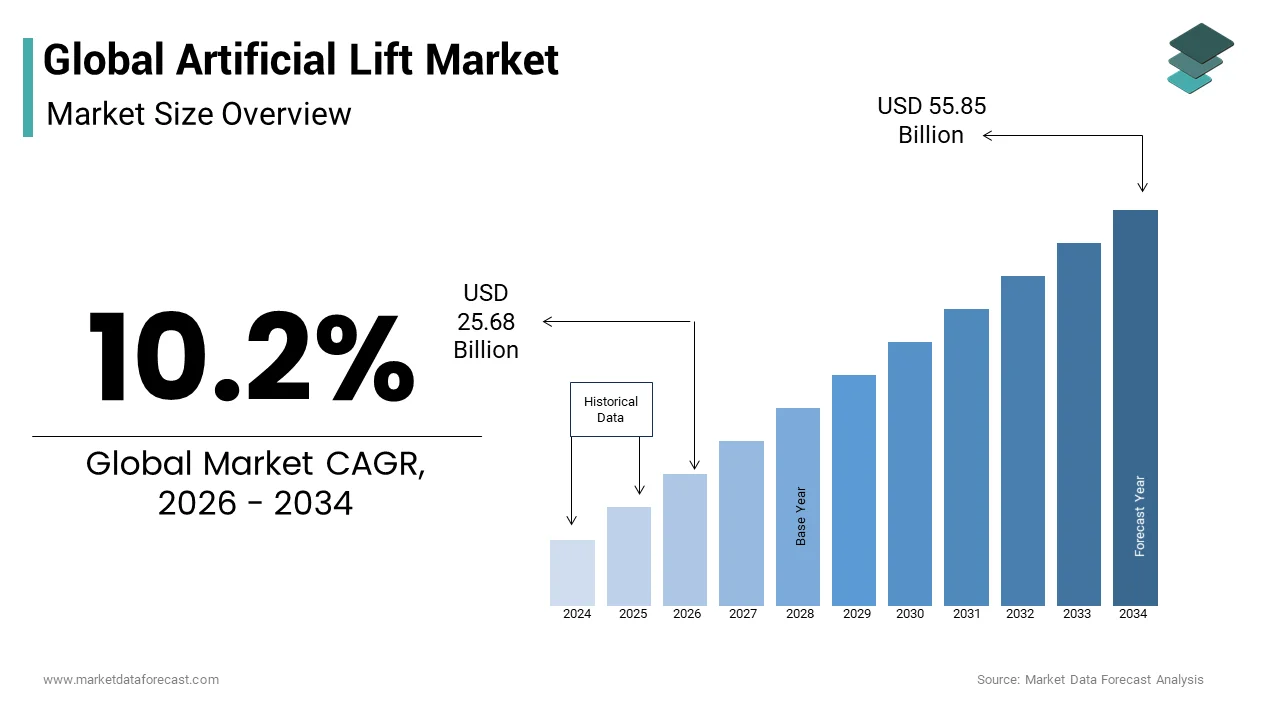
- Market Valuation: Valued at USD 23.30 billion in 2025, reaching USD 25.68 billion in 2026, and projected to surge to USD 55.85 billion by 2034, registering a robust CAGR of 10.2% throughout the forecast period from 2026 to 2034.
- Primary Growth Drivers: Steady global hydrocarbon consumption coupled with declining natural reservoir pressure across aging wells (necessitating artificial lift assistance in 85–90% of global wells), expanding onshore/offshore exploration activities, and the high versatility and temperature tolerance of Electric Submersible Pumps (ESPs).
Key Market Segment Metrics
| Category | Leading Segment (Base Year Position) | Fastest-Growing / High-Impact Segment |
|---|---|---|
| By Type & Mechanism | Electrical Submersible Pumps (ESPs) (dominates with >40% market share due to high volume handling) & Onshore Mechanism (dominates overall global oil and gas output) | Offshore Mechanism (projected to expand at the fastest rate due to vast unexplored deepwater reserves and high-demand projects in regions like the Gulf of Mexico and North Sea) |
| By Region | North America (accounts for >40% of global deployments, driven heavily by US shale basins such as the Permian, Texas, and Oklahoma) | Latin America (notably Brazil, projected to expand rapidly as non-OPEC production targets scale toward multi-million barrels per day) |
Major Market Players & Market Structure
Market Structure: A concentrated global marketplace dominated by established oilfield service giants and specialized pump manufacturers focusing on advanced digital automation, edge analytics integration, and emissions reduction.
Key Companies: Halliburton Co, Weatherford International Ltd, Baker Hughes Co, Dover Corp, United Drilling Tools Ltd, Borets International, National Oilwell Varco, Oilserv, Novomet, Apergy, and JJ Tech.
Global Artificial Lift Market Size
The global artificial lift market size was valued at USD 23.30 billion in 2025 and is anticipated to reach USD 25.68 billion in 2026 to reach USD 55.85 billion by 2034, growing at a CAGR of 10.2% during the forecast period from 2026 to 2034.
The worldwide oil consumption market has been increasing steadily in recent decades as a result of potential expansion in the industrial and transportation sectors. To fulfill the increased demand for hydrocarbons, several operators throughout the world are drilling constaconstantly drilling pressure in existing wells; on the other hand, this is insufficient to bring fluids to the surface. To bring the hydrocarbon surface, the majority of wells throughout the world require some assistance.
The artificial lift system is a well-established and well-proven technology for assisting oil wells in increasing reservoir pressure. Artificial lift assistance is required in 85-90 per cent of wells to supplement reservoir pressure. Various types of artificial lifts are used depending on the well's features and technology, resulting in global market expansion in the coming years.
MARKET DRIVERS
Global population growth and urbanization are driving up oil demand around the world. Increasing advancements in major oil-producing countries, including Saudi Arabia, Kuwait, and Egypt, among others, are boosting the market's expansion.
Electrical submersible pumps are also becoming more popular due to their versatility and availability in all high-production countries. They can handle a wide range of flow rates and extremely high downhole temperatures, making them perfect for oil wells as countries focus on oil reservoirs, propelling the artificial lift market expansion. Furthermore, during the projection period, onshore exploration and production are assisting global oil output and boosting the artificial lift industry's expansion.
MARKET RESTRAINTS
The Artificial Lift market growth is being hampered by factors such as exorbitant capital and maintenance costs, as well as a shortage of experienced labour to operate the equipment.
REPORT COVERAGE
| REPORT METRIC | DETAILS |
| Market Size Available | 2025 to 2034 |
| Base Year | 2025 |
| Forecast Period | 2026 to 2034 |
| CAGR | 10.2% |
| Segments Covered | By Type, Mechanism, and Region. |
| Various Analyses Covered | Global, Regional, & Country Level Analysis, Segment-Level Analysis, DROC, PESTLE Analysis, Porter’s Five Forces Analysis, Competitive Landscape, Analyst Overview on Investment Opportunities |
| Regions Covered | North America, Europe, APAC, Latin America, Middle East & Africa |
| Market Leaders Profiled | Halliburton Co (US), Weatherford International Ltd (Switzerland), Baker Hughes Co (US), Dover Corp (US), United Drilling Tools Ltd (India), Borets International (Russia), National Oilwell Varco (US), Oilserv (UAE), Novomet (Russia), Apergy (US), JJ Tech (US) and Others. |
SEGMENTAL ANALYSIS
By Type Insights
Electric submersible pumps are regarded as the most versatile and commonly utilised pumps by pump operators all over the world. It can handle a huge volume, a wide range of flow rates, and operate in challenging conditions. In an environmentally sensitive area, ESP is the only option for artificial lift deployment. The electric submersible pump enjoys a fictitious market share of above 40%.
Rod lift is a form of artificial lift system in which a surface power source drives a downhole pump assembly. The unit is made up of a variety of components that are used both above and below ground. Depending on the size of the equipment, this hoisting mechanism can pump up to 1,000 BPD. Rod lifts provide a high salvage value for downhole equipment and can handle gas and corrosion well during the artificial lift operation. Such advantages are likely to enhance the demand for artificial lift during the trial phase. As a result, the increased necessity to minimise gas and corrosion management during artificial lift operations is driving the rod lift industry.
By Mechanism Insights
Onshore exploration and production dominate global oil output, although the recent movement of North America and Europe to offshore exploration has raised offshore exploration's prospective growth. Onshore exploration activities are a major contributor to the expansion of artificial in North America, Europe, MEA, and APAC.
During the projected period, the offshore segment is expected to increase at the fastest rate. Because offshore regions have vast unexplored reserves, corporations have started seeking offshore regions for oil and gas development. As a result, the offshore market requires more money than the onshore market. The Gulf of Mexico and the North Sea have the most developed fields, which means artificial lift systems are in significant demand.
REGIONAL ANALYSIS
Currently, the US market accounts for more than 40% of all artificial lifts deployed around the world. Artificial lift system market share in North America has increased as a result of technological advancements and increased exploration activities. Oil output increased in 2014 as a result of new projects and expansion in the Gulf of Mexico basin. Texas, the Permian Basin, Oklahoma, Alaska, and North Dakota are significant counties where production is at an all-time high, indicating that the market in North America is expected to rise.
Exploration efforts in the North Sea region, which are led by Norway, Germany, the United Kingdom, and others, are expected to fuel major expansion in Europe. When it comes to adopting and creating novel technologies, European countries are ahead of the pack, which drives the ESP business. As a result, Sucker Rod Pump will play a vital part in Europe's artificial market. In APAC, Chinese oil exploration is the most common, followed by Indonesia and the Philippines.
The artificial lift system market in Latin America is estimated to grow at a CAGR of more than 2.78 per cent between 2023 and 2026. Brazil is expected to be one of the leading markets for artificial lift systems. The country is predicted to produce 5 million barrels of oil per day by 2026, making it one of the world's top non-OPEC producers of petroleum.
KEY MARKET PLAYERS
The global artificial market is concentrated with well establishedwell-establishedayers in the market include
- Halliburton Co (US)
- Weatherford International Ltd (Switzerland)
- Baker Hughes Co (US)
- Dover Corp (US)
- United Drilling Tools Ltd (India)
- Borets International (Russia)
- National Oilwell Varco (US)
- Oilserv (UAE)
- Novomet (Russia)
- Apergy (US)
- JJ Tech (US)
RECENT MARKET NEWS
-
Schlumberger and AVEVA have formed a cooperation to help operators improve digital solutions for oil and gas production by integrating edge, AI, and cloud digital technologies. By streamlining how they acquire, process, and act on field data, the companies will work together to help energy operators enhance well-swell-siteiency and performance. The collaboration's initial focus is on linking edge systems to applications in the DELFI cognitive E&P environment so that equipment health and performance may be better controlled. (Source:
-
Turkish Petroleum has awarded Schlumberger a significant contract for engineering, procurement, construction, and installation (EPCI) of end-to-end production solutions for Turkey's largest gas reserve, the Sakarya gas field. Well completions, subsea production systems (SPS), subsea umbilicals, risers, flowlines (SURF), and an early production facility, as well as subsurface solutions to onshore production, will be covered under the integrated project (EPF).
-
Halliburton's iStar platform for drilling measurement is on the list of oilfield technologies. The organization has updated the downhole equipment required to provide a wide range of important downhole data collecting services, taking advantage of advances in electronic technology.
-
Vine Energy, a natural gas producer, has agreed to use Baker Hughes' ProductionLink Edge artificial lift technology in 100 natural gas wells in Louisiana's Haynesville Shale. The automation system uses advanced analytics and "smart" edge technologies to improve output and reduce associated methane emissions from oil and gas wells.
MARKET SEGMENTATION
This research report on the global artificial lift has been segmented and sub-segmented based on type, mechanism, and region.n
By, Ty.pe
- Electrical Submersible Pumps
- Rod Lift
- Progressive Crafty Pumps
- Gas Lift
- Others
By Mechanism
- Onshore
- Offshore
By Region
- North America
- Europe
- Asia-Pacific
- Latin America
- The Middle East and Africa