- Product Description Description
- Table of Contents TOC
- List of Table & Figure LOT
- Get Free Sample PDF Sample PDF
Market Size, 2025
$1347 MnMarket Estimate, 2026
$1444 MnMarket Forecast, 2034
$2518 MnCAGR, 2026–2034
7.20%Asia-Pacific Agricultural Testing Market Size, Growth, Trends & Forecast (2026–2034)
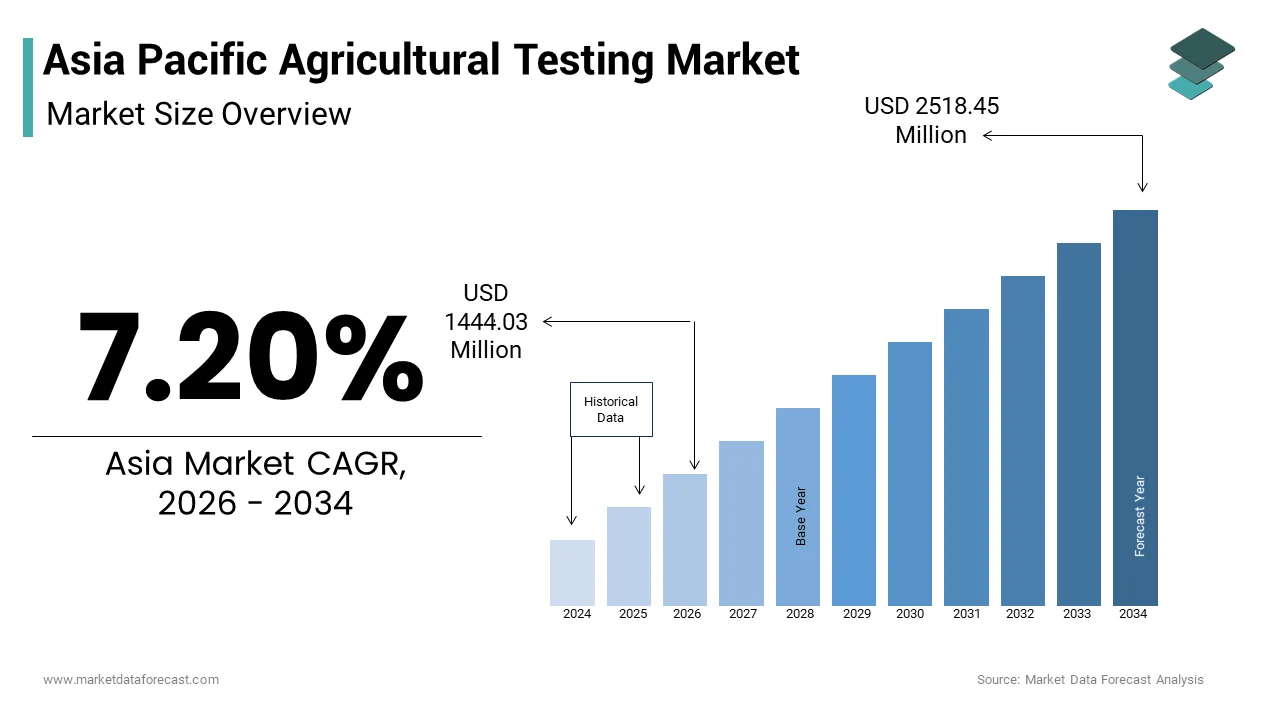
The Asia-Pacific agricultural testing market size was valued at USD 1347.04 million in 2025, is anticipated to reach USD 1444.03 million in 2026, and is projected to scale up to USD 2518.45 million by 2034, registering a compound annual growth rate (CAGR) of 7.20% during the forecast period from 2026 to 2034. Driven by food security priorities, export compliance obligations, and the rising adoption of precision agriculture, the regional market continues to experience rapid expansion.
Key Executive Metrics (At-a-Glance)
- 2025 Base Valuation: USD 1347.04 Million
- 2026 Current Valuation: USD 1444.03 Million
- 2034 Forecast Valuation: USD 2518.45 Million
- Compound Annual Growth Rate (CAGR): 7.20% (2026–2034)
- Dominant Contaminant Segment: Chemical Residues (accounting for 34.8% of the market share in 2025 due to extensive pesticide and fertilizer usage)
- Fastest-Growing Contaminant Segment: Toxins / Mycotoxins (expanding at an 8.5% CAGR driven by climate shifts and fungal proliferation)
- Dominant Sample Segment: Soil (holding 38.6% of the 2025 market share backed by nutrient management and national Soil Health Card schemes)
- Fastest-Growing Sample Segment: Water (registering a 7.9% CAGR due to scarcity concerns and irrigation requirements)
- Dominant Country Market: China (capturing 29.2% of the market share in 2025 supported by its massive agricultural output and the Revised Food Safety Law)
Core Market Drivers
- Stringent Export & Regulatory Compliance: Strict sanitary and phytosanitary (SPS) barriers imposed by importing regions like the EU, US, and Japan requiring comprehensive certificates of analysis.
- Precision Agriculture Adoption: Increasing utilization of soil and tissue testing by growers to optimize nutrient use efficiency, lower operational costs, and align with sustainability goals.
- Organic and Premium Food Growth: Surging demand among health-conscious consumers for certified residue-free and organic produce.
Primary Market Restraints & Challenges
- High Technology and Service Costs: Prohibitive expenses for advanced analytical instruments (such as LC-MS/MS) and testing fees that limit adoption among smallholder farmers.
- Infrastructure & Skill Gaps: Shortages of technical personnel, cold-chain limitations, and uneven distribution of ISO 17025 accredited laboratories in rural areas.
Asia-Pacific Agricultural Testing Market Segmentation Breakdown
| Segment Category | Leading Sub-Segment | Fastest-Growing Sub-Segment |
|---|---|---|
| By Sample Type | Soil (38.6% share in 2025 for precision nutrient mapping) | Water (7.9% CAGR driven by water stress and irrigation quality controls) |
| By Contaminants / Application | Chemical Residues (34.8% share due to heavy agrochemical usage) | Toxins / Mycotoxins (8.5% CAGR driven by climate-induced fungal risks) |
| By Country | China (29.2% share) and India (21.2% share) | Japan (driven by strict import residue limits and technological integration) |
Major Industry Players Profiled
Key enterprises shaping the competitive Asia-Pacific agricultural testing market include Eurofins Scientific, SGS SA, Bureau Veritas S.A., Agilent Technologies, Inc., ALS Limited, SCS Global Services, and R J Hill Laboratories Ltd.
Asia Pacific Agricultural Testing Market Size
The Asia-Pacific agricultural testing market size was valued at USD 1347.04 million in 2025 and is anticipated to reach USD 1444.03 million in 2026 to reach USD 2518.45 million by 2034, growing at a CAGR of 7.20% from 2026 to 2034.
Introduction to the Asia Pacific Agricultural Testing Market
The agricultural testing is designed to evaluate the quality, safety, and composition of soil, water, seeds, and harvested crops. This sector plays a pivotal role in ensuring food security, optimizing crop yields, and complying with stringent international trade standards. According to the Food and Agriculture Organization of the United Nations, Asia accounts for approximately 90% of the world’s rice production and over 50% of its wheat, necessitating rigorous monitoring of contaminants such as heavy metals and pesticide residues. Rapid industrialization and urbanization have led to increased soil degradation and water pollution, further driving the need for regular environmental assessments. Governments across countries like China, India, and Australia are implementing stricter regulations on maximum residue limits for exports, compelling producers to adopt robust testing protocols. The rise of organic farming and sustainable agricultural practices also contributes to the demand for certification and verification services.
MARKET DRIVERS
Stringent Food Safety Regulations and Export Compliance Requirements
The implementation of stringent food safety regulations and export compliance requirements is amplifying the growth of the Asia Pacific agricultural testing market. Countries in the region are major exporters of agricultural commodities, including fruits, vegetables, grains, and seafood, to strict areas, such as the European Union, Japan, and the United States. The non-tariff barriers related to sanitary and phytosanitary measures are increasingly common by requiring exporters to provide detailed certificates of analysis for pesticide residues, mycotoxins, and heavy metals. For instance, Japan enforces some of the toughest maximum residue limits globally, prompting Asian suppliers to invest heavily in pre shipment testing to avoid rejection at borders. Thousands of tons of imported food are inspected annually, with violations leading to significant financial losses for exporters. In China, the revised Food Safety Law mandates stricter oversight of agricultural inputs and outputs, driving domestic demand for third party testing services. The European Union’s rapid alert system for food and feed frequently identifies issues with imports from Asia by reinforcing the need for rigorous internal controls. Consequently, the legal imperative to meet international standards creates a sustained and growing demand for accredited laboratory services across the region.
Adoption of Precision Agriculture and Sustainable Farming Practices
The widespread adoption of precision agriculture and sustainable farming practices significantly boosting the growth of the Asia Pacific agricultural testing market. Farmers are increasingly utilizing data driven insights to optimize input usage, improve crop health, and minimize environmental impact. Soil testing is a fundamental component of precision agriculture, allowing growers to determine exact nutrient requirements and avoid over fertilization. The nutrient use efficiency in Asia remains lower than global averages, leading to substantial economic losses and environmental degradation. By conducting regular soil and tissue tests, farmers can apply fertilizers more precisely, reducing costs and preventing soil acidification. Furthermore, the shift toward organic farming requires continuous monitoring of soil health and contamination levels to maintain certification. Governments in countries like Australia and New Zealand promote sustainable practices through subsidies and extension services that encourage regular testing. The integration of digital platforms with testing laboratories allows for real time data access, enabling faster decision making.
MARKET RESTRAINTS
High Costs Associated with Advanced Testing Technologies
The high costs associated with advanced testing technologies, particularly for smallholder farmers is degrading the growth of the Asia pacific agricultural testing market. Sophisticated analytical instruments, such as gas chromatography, mass spectrometry, and liquid chromatography, tandem mass spectrometry, require substantial capital investment, skilled personnel, and ongoing maintenance. The cost of sending samples to accredited laboratories can be prohibitive, especially when multiple tests are required for different contaminants. Many farmers rely on visual inspection or informal advice rather than scientific testing due to budget constraints. Additionally, the lack of economies of scale in rural areas leads to higher logistics and service fees. Private laboratories often prioritize large commercial clients who can guarantee volume, leaving smallholders underserved. The absence of affordable, portable testing solutions further exacerbates this issue. While government subsidies exist in some countries, they are often insufficient to cover the full cost of comprehensive testing programs. This financial barrier limits the widespread adoption of high-quality testing services, resulting in inconsistent data quality and potential risks to food safety and environmental health in the region.
Shortage of Skilled Technical Personnel and Infrastructure Gaps
The shortage of skilled technical personnel and infrastructure gaps is hindering the growth of the Asia Pacific agricultural testing market. Accurate agricultural testing requires highly trained analysts who can operate complex instruments and interpret data correctly. There is a significant skills mismatch in the agricultural sector, with a lack of qualified scientists and technicians in many developing countries. Rural areas often lack basic infrastructure, such as reliable electricity, internet connectivity, and cold chain facilities necessary for sample preservation and transport. The number of ISO 17025 accredited laboratories is concentrated in urban centers by leaving remote agricultural regions with limited access to quality testing services. The turnaround time for results can be delayed due to logistical challenges by reducing the usefulness of the data for timely decision making. Furthermore, the retention of skilled staff in remote locations is challenging, leading to high turnover rates and inconsistent service quality. The lack of standardized training programs and certification processes across different countries further complicates the issue. Without a robust workforce and adequate infrastructure, the capacity of the testing market to meet growing demand is constrained.
MARKET OPPORTUNITIES
Expansion of Organic and Premium Food Markets
The expansion of organic and premium food areas is creating new opportunities for the growth of the Asia Pacific agricultural testing market. Consumers in the region are becoming increasingly health conscious and willing to pay a premium for certified organic and residue free products. Asia Pacific has grown by double digits annually, driven by rising middle class incomes and awareness of health benefits. Certification bodies require rigorous testing of soil, water, and final products to verify compliance with organic standards by creating a steady demand for specialized testing services. As per data from retail surveys in countries like South Korea and Singapore, labels indicating pesticide free or non genetically modified status significantly influence purchasing decisions. This trend encourages farmers to adopt organic practices and seek verification through regular testing. Additionally, the growth of e commerce platforms for fresh produce allows consumers to trace the origin and quality of their food, further emphasizing the need for transparent testing data. Laboratories can capitalize on this trend by offering bundled services that include certification support and detailed reporting. The differentiation provided by testing results allows producers to command higher prices, justifying the investment in quality assurance.
Integration of Digital Technologies and Remote Sensing
The integration of digital technologies and remote sensing is another factor to bolster the growth of the Asia Pacific agricultural testing market. Innovations, such as drone based multispectral imaging and portable handheld sensors enable rapid, on site assessment of crop health and soil conditions. The use of drones in farming has increased significantly by allowing for real time data collection over large areas. These technologies complement traditional laboratory testing by providing immediate insights that guide sampling strategies and identify problem areas quickly. This democratization of testing reduces reliance on centralized laboratories and lowers costs for end users. Furthermore, the aggregation of data from various sources enables the development of predictive models for disease outbreaks and yield forecasting. Cloud based platforms facilitate the sharing of test results among stakeholders, improving supply chain transparency. This technological synergy enhances the value proposition of agricultural testing, making it more accessible and actionable for a broader range of users in the Asia Pacific region.
MARKET CHALLENGES
Complexity of Regulatory Frameworks Across Countries
The complexity of regulatory frameworks is to hinder the growth of the Asia Pacific agricultural testing market. Each nation has its own set of standards for maximum residue limits, acceptable contaminants, and testing methodologies by creating a fragmented compliance areas. According to the Asia Pacific Economic Cooperation forum, harmonizing food safety standards remains a significant hurdle due to varying levels of economic development and regulatory capacity. For multinational agribusinesses and testing laboratories, navigating these diverse requirements increases operational costs and administrative burdens. The inconsistencies in testing protocols can lead to disputes over result validity in cross border trade. Smaller laboratories may struggle to maintain accreditations for multiple jurisdictions by limiting their service offerings. Furthermore, frequent changes in regulations require continuous updates to testing procedures and staff training, straining resources. The lack of mutual recognition agreements for test results between certain countries means that products may need to be tested multiple times for different markets. This regulatory fragmentation hinders the efficiency of the testing ecosystem and creates uncertainty for stakeholders.
Environmental Variability and Sample Integrity Issues
The environmental variability and sample integrity issues is additionally to impede the growth of the Asia Pacific agricultural testing market. The diverse climatic conditions, ranging from tropical humidity to arid deserts, affect the stability of biological and chemical samples during collection and transport. The extreme weather events, such as floods and heatwaves are becoming more frequent, complicating logistics and increasing the risk of sample degradation. High temperatures and humidity can accelerate the breakdown of pesticides and nutrients, leading to inaccurate test results if samples are not preserved properly. The improper handling and delayed transportation are common causes of sample spoilage in rural areas with poor infrastructure. The lack of standardized protocols for sample collection among farmers further exacerbates this issue, leading to heterogeneous and unrepresentative samples. Contamination from external sources during transit is also a concern, particularly for sensitive analyses like mycotoxin detection. Ensuring sample integrity requires robust cold chain infrastructure and trained personnel, which are often lacking in remote regions. These challenges undermine the credibility of testing services and can lead to incorrect agricultural recommendations.
REPORT COVERAGE
| REPORT METRIC | DETAILS |
| Market Size Available | 2025 to 2034 |
| Base Year | 2025 |
| Forecast Period | 2026 to 2034 |
| CAGR | 7.20% |
| Segments Covered | By Type of Sample, Application, and Region |
| Various Analyses Covered | Global, Regional & Country Level Analysis, Segment-Level Analysis, DROC, PESTLE Analysis, Porter’s Five Forces Analysis, Competitive Landscape, Analyst Overview on Investment Opportunities |
| Regions Covered | India, China, Japan, South Korea and Australia, South Africa, New Zealand, Thailand, Malaysia, Vietnam, Philippines, Indonesia, Singapore, and the Rest of the Asia Pacific |
| Market Leaders Profiled | R J Hill Laboratories Ltd., Eurofins Scientific, SCS Global Services, Bureau Veritas S.A., Agilent Technologies, Inc., ALS Limited, etc. |
SEGMENTAL ANALYSIS
By Contaminants Insights
The chemical residues segment was the largest by accounting for 34.8% of the Asia Pacific agricultural testing market share in 2025 with the extensive use of pesticides and fertilizers to maximize crop yields in a region with limited arable land. The intensive farming practices prevalent in countries like China and India necessitate rigorous monitoring of pesticide residues to ensure food safety and comply with international export standards. According to the Food and Agriculture Organization of the United Nations, Asia accounts for more than 50% of global pesticide consumption, creating a substantial baseline demand for residue testing services. Regulatory bodies such as the Codex Alimentarius Commission set strict maximum residue limits for various crops, compelling exporters to conduct comprehensive testing before shipment. The pesticide violations remain one of the most common reasons for the rejection of Asian agricultural imports, reinforcing the need for robust pre-export screening. Additionally, domestic consumers are becoming increasingly aware of health risks associated with chemical exposure, driving demand for residue free produce in local markets. The complexity of modern agrochemicals requires advanced analytical techniques such as liquid chromatography tandem mass spectrometry, which supports the high value of this segment.
The toxins segment is expected to expand at a CAGR of 8.5% during the forecast period owing to the increasing awareness of the health hazards posed by mycotoxins such as aflatoxin, which are produced by fungi in crops like corn, peanuts, and spices under warm and humid conditions. According to the World Health Organization, millions of people in developing countries are exposed to unsafe levels of mycotoxins through contaminated staple foods, which are leading to chronic health issues and economic losses. Climate change has exacerbated fungal growth patterns, making toxin contamination a more frequent and severe problem across the region. The aflatoxin is a potent carcinogen linked to liver cancer by prompting stricter regulatory enforcement in countries like Vietnam and Thailand. The export of high value crops such as nuts and dried fruits to stringent markets like Japan and Australia requires rigorous toxin screening to avoid trade barriers. Advances in rapid testing kits and portable detection devices have made toxin testing more accessible to small and medium sized enterprises.
By Sample Insights
The soil segment was accounted in holding 38.6% of the Asia Pacific agricultural testing market share in 2025 due to its role in determining crop productivity and nutrient management. Soil health is foundational to sustainable agriculture, and regular testing allows farmers to optimize fertilizer application, prevent nutrient depletion, and mitigate soil degradation. The nutrient use efficiency in Asia is significantly lower than in other regions by leading to widespread soil acidification and salinization that require precise diagnostic interventions. Governments in major agricultural economies like India and China have launched national soil health card schemes that mandate regular testing for millions of farmers to promote balanced fertilization. The shift toward precision agriculture relies heavily on spatial soil data to create variable rate application maps, enhancing the economic viability of testing services. Furthermore, concerns about heavy metal contamination from industrial pollution have increased the scope of soil testing beyond nutrients to include toxic elements.
The water segment is ascribed to register a fastest CAGR of 7.9% during the forecast period with the increasing water scarcity and contamination concerns. Agricultural activities are major consumers of freshwater resources, and the quality of irrigation water directly impacts crop yield and food safety. Water stress in Asia is intensifying due to climate change and over extraction, necessitating regular monitoring of water sources for salinity, heavy metals, and microbial contaminants. The rise of hydroponics and controlled environment agriculture in countries like Singapore and Japan requires precise water quality management to ensure optimal plant growth. The industrial discharge and agricultural runoff have polluted many water bodies, forcing farmers to test irrigation water to prevent crop damage and soil contamination. Regulatory frameworks in countries like Australia and New Zealand impose strict limits on water usage and quality, driving compliance testing among large scale agribusinesses. The integration of smart irrigation systems with real time water quality sensors is also contributing to market growth.
COUNTRY LEVEL ANALYSIS
China Agricultural Testing Market Analysis
China was the top performer in the Asia Pacific agricultural testing market by capturing 29.2% of share in 2025 with its massive agricultural output and stringent food safety regulations. The world’s largest producer and consumer of agricultural products by creating an immense demand for quality assurance services. According to the study, the government has implemented the Revised Food Safety Law, which mandates rigorous testing of agricultural inputs and outputs to protect public health. The establishment of a national network of testing laboratories has standardized procedures and increased accessibility for farmers and exporters. As per data from the Ministry of Agriculture and Rural Affairs, initiatives to reduce pesticide and fertilizer use rely heavily on testing data to monitor progress and enforce compliance. The export-oriented nature of Chinese agriculture, particularly for vegetables and fruits, requires adherence to international standards, further boosting demand for accredited testing services. Domestic consumer awareness regarding food safety scandals has also spurred private sector investment in testing infrastructure.
India Agricultural Testing Market Analysis
India agricultural testing market held a second position by holding 21.2% of share in 2025 with the vast smallholder farming base and government led initiatives to improve soil health. The major exporter of spices, rice, and marine products, which require strict compliance with international residue limits. According to the Ministry of Commerce and Industry, agricultural exports from India have grown steadily, necessitating robust testing infrastructure to maintain market access. The Soil Health Card Scheme launched by the government aims to provide every farmer with a detailed report on their soil nutrient status, driving unprecedented volume in soil testing laboratories. As per data from the Agricultural and Processed Food Products Export Development Authority, mandatory testing for certain export commodities has increased the utilization of accredited labs. The rising middle class in urban areas is demanding safer and higher quality food, prompting retailers to source from certified suppliers who undergo regular testing.
Japan Agricultural Testing Market Analysis
Japan agricultural testing market is likely to witness a fastest CAGR in coming years with the strict food safety standards and advanced technological adoption. The country relies heavily on food imports, requiring rigorous inspection of incoming agricultural products to ensure compliance with domestic safety laws. Japan enforces some of the strictest maximum residue limits for pesticides globally, driving demand for high precision testing services. The domestic agricultural sector focuses on high value premium products, where quality certification is essential for brand reputation and pricing. The promotion of smart agriculture includes the use of digital tools for monitoring crop health and soil conditions, which is integrating testing into broader farm management systems. Consumer trust is paramount in Japan, and any safety incident can have severe repercussions, motivating producers to invest in comprehensive testing protocols. The presence of sophisticated laboratory infrastructure and skilled personnel supports the high standards required by the Japanese market.
South Korea Agricultural Testing Market Analysis
South Korea agricultural testing market growth is driven by its focus on food safety and the popularity of organic and eco-friendly agricultural products. The country has implemented strict regulations on pesticide residues and genetically modified organisms by requiring thorough testing of both domestic and imported produce. The government supports the expansion of eco-friendly farming practices, which involve regular soil and water testing to maintain certification. The rise of well being trends among consumers has increased demand for verified safe and nutritious food items. The export opportunities for Korean agricultural products depend on meeting international safety standards, necessitating reliable testing services. The integration of information technology in agriculture allows for efficient tracking and management of test results by enhancing transparency.
Australia Agricultural Testing Market Analysis
Australia agricultural testing market growth is likely to grow with the large-scale commercial farming and strong export orientation. The country is a major supplier of beef, wheat, and dairy products to global markets, requiring adherence to strict biosecurity and quality standards. Australia maintains a robust system of surveillance and testing to prevent the entry of pests and diseases and to ensure product integrity. The National Residue Survey monitors pesticide and veterinary chemical residues in agricultural commodities, providing data that supports market access and consumer confidence. The industry levies fund research and testing initiatives that help producers meet buyer specifications.
COMPETITIVE LANDSCAPE
The competition in the Asia Pacific agricultural testing market is characterized by a mix of global testing giants and specialized regional laboratories vying for dominance through service quality and technological capability. Multinational corporations leverage their extensive networks and brand recognition to offer comprehensive testing solutions for diverse agricultural commodities. These companies often compete on speed, accuracy, and regulatory expertise to secure contracts with large exporters and government agencies. Local players counter with cost effective services and deep understanding of regional crop specific challenges. Regulatory compliance serves as a significant barrier to entry favoring established players with accredited facilities. Competitive dynamics are further influenced by the rising demand for sustainability certification prompting firms to expand their service portfolios. Strategic collaborations with technology providers and academic institutions are common as companies seek to innovate and enhance their analytical capabilities.
KEY MARKET PLAYERS
Some of the major companies dominating the market with their products and services include
- R J Hill Laboratories Ltd.
- Eurofins Scientific
- SGS SA
- SCS Global Services
- Bureau Veritas S.A.
- Agilent Technologies, Inc.
- ALS Limited, etc.
Top Players In The Market
- Eurofins Scientific SE maintains a dominant presence in the Asia Pacific agricultural testing market through its extensive network of specialized laboratories and comprehensive service portfolio. The company provides advanced analytical solutions for pesticide residues, mycotoxins, and soil health across major agricultural hubs. Eurofins recently expanded its laboratory capacity in China and India to address the growing demand for food safety compliance and export certification. They have introduced rapid testing kits tailored for local crops, enhancing accessibility for smallholder farmers. The company invests heavily in digital platforms that allow clients to track samples and access results in real time. This focus on technological integration and localized service delivery strengthens their position as a trusted partner for agribusinesses seeking reliable and efficient testing solutions in the diverse Asia Pacific region.
- SGS SA contributes significantly to the Asia Pacific agricultural testing market by leveraging its global reputation for quality assurance and inspection services. The company offers end to end testing solutions for seeds, soil, water, and harvested crops, ensuring compliance with international standards. SGS recently strengthened its operations in Southeast Asia by acquiring local testing firms to expand its geographic reach and technical capabilities. They have launched specialized programs for organic certification and sustainable agriculture verification, catering to the rising consumer demand for eco-friendly products. These strategic initiatives demonstrate their commitment to supporting the agricultural sector through rigorous quality control and innovative testing methodologies.
- Bureau Veritas SA plays a pivotal role in the Asia Pacific agricultural testing market with its strong focus on trade facilitation and regulatory compliance. The company provides comprehensive testing and certification services for agricultural commodities destined for global markets. Bureau Veritas recently enhanced its digital inspection tools to improve efficiency and transparency in sample collection and analysis. They have expanded their presence in Australia and New Zealand to support the robust export sectors in these countries. The company actively engages with regulatory bodies to stay ahead of changing maximum residue limits and safety standards. By offering integrated solutions that combine testing with advisory services, Bureau Veritas helps clients navigate complex regulatory landscapes. Their emphasis on speed and accuracy ensures that agricultural producers can meet tight shipping schedules, while maintaining high quality standards.
Top Strategies Used By Key Market Participants
Key players in the Asia Pacific agricultural testing market primarily employ strategic acquisitions and technological innovation to maintain competitive advantage. Companies invest heavily in expanding their laboratory networks across emerging economies to improve accessibility and reduce turnaround times. This includes adopting automated testing systems and artificial intelligence to enhance accuracy and efficiency. Strategic partnerships with local governments and agricultural cooperatives facilitate market penetration and build trust among smallholder farmers. Manufacturers also focus on developing rapid and portable testing devices that allow for on site analysis. Digital platforms for data management and reporting are increasingly used to provide real time insights to clients. Additionally, firms pursue accreditation from multiple international bodies to ensure their results are recognized globally.
MARKET SEGMENTATION
This research report on the Asia-Pacific Agricultural Testing Market is segmented and sub-segmented into the following categories.
By Type of Sample
- water
- seed
- bio-solids
- manures
- soil
- others
By Application
- contaminants
- Toxins
- Chemical Residues
- Pathogens
- Others
- quality affirmation
By Country
- India
- China
- Japan
- South Korea
- Australia
- New Zealand
- Thailand
- Malaysia
- Vietnam
- Philippines
- Indonesia
- Singapore
- Rest of APAC