Asia Pacific Aircraft Health Monitoring System Market Size, Share, Growth, Trends, And Forecast Research Report, Segmented By vehicle Type, And Country (India, China, Japan, South Korea, Australia, New Zealand, Thailand, Malaysia, Vietnam, Philippines, Indonesia, Singapore and Rest of APAC), Industry Analysis From (2026 to 2034)
Market Size, 2025
$7.01 BnMarket Estimate, 2026
$7.48 BnMarket Forecast, 2034
$12.56 BnCAGR, 2026–2034
6.69%Asia Pacific Aircraft Health Monitoring System Market Size
The Asia Pacific aircraft health monitoring system market was valued at USD 7.01 billion in 2025 and is anticipated to reach a valuation of USD 7.48 billion in 2026 and USD 12.56 billion by 2034, growing at a CAGR of 6.69%, from 2026 to 2034.
The aircraft health monitoring system (AHMS) is centered around advanced diagnostic and prognostic technologies designed to continuously assess the condition of aircraft components and systems. These systems utilize onboard sensors, data analytics, and communication networks to provide real-time insights into aircraft performance, enabling predictive maintenance, enhancing safety, and reducing operational costs. AHMS plays a crucial role in both commercial aviation and defense sectors, where fleet reliability and mission readiness are paramount.
According to the International Air Transport Association (IATA), the Asia Pacific accounted for nearly 31.7% of global air passenger traffic in 2023, driven by rapid urbanization, economic growth, and increasing air travel demand. In China, as per the Civil Aviation Administration, the number of commercial aircraft in operation surpassed 4,270 units in 2023, with growing adoption of digital health monitoring platforms across major carriers.
These developments show the growing reliance on aircraft health monitoring systems as a cornerstone of modern aviation management in the Asia Pacific, underpinned by expanding fleets, regulatory mandates, and technological advancements.
MARKET DRIVERS
Expansion of Commercial Aviation Fleets
Rapid expansion of commercial aviation fleets across the region is one of the primary drivers of the Asia Pacific aircraft health monitoring system (AHMS) market. With rising disposable incomes, growing tourism, and increasing cross-border trade, countries such as China, India, Indonesia, and Vietnam have seen a surge in air travel demand, leading to significant fleet additions and modernization programs.
In China alone, as per the Civil Aviation Administration, the country added over 350 new commercial aircraft in 2023, bringing the total fleet size to 4270 units. Each of these aircraft requires advanced health monitoring capabilities to ensure operational efficiency and compliance with international aviation safety standards.
As per the indications by India’s Directorate General of Civil Aviation (DGCA), domestic airlines placed orders for more than 1,000 new aircraft between 2020 and 2023, many of which are equipped with AHMS as part of factory-fitted avionics suites. The Indian government’s "Ude Desh ka Aam Nagrik" (UDAN) scheme also contributed to increased regional aircraft deployment, further boosting the need for real-time diagnostics and predictive maintenance solutions.
Moreover, low-cost carriers such as AirAsia and Lion Air have adopted AHMS to reduce unplanned maintenance events and improve turnaround times at airports. This trend underscores the critical role of aircraft health monitoring in supporting the region's booming aviation industry.
Modernization of Military and Defense Aircraft Fleets
The ongoing modernization of military and defense aircraft fleets is another key driver of the Asia Pacific aircraft health monitoring system (AHMS) market. Governments across the region are investing heavily in upgrading legacy platforms and acquiring next-generation fighter jets, transport aircraft, and helicopters, all of which incorporate advanced health monitoring technologies to enhance mission readiness and reduce lifecycle costs.
According to the Stockholm International Peace Research Institute (SIPRI), defense spending in the Asia Pacific increased by 6.3% in 2023, with countries like Japan, South Korea, India, and Australia prioritizing aerospace modernization. As per Japan’s Ministry of Defense, it allocated ¥1.2 trillion (USD 8.3 billion) in 2023 for upgrades to its F-15J fighter fleet, including the integration of digital health monitoring systems to extend service life and improve combat effectiveness.
As per India’s Ministry of Defence reported that in 2023, it signed contracts worth over USD 15 billion for the procurement and upgrade of fighter aircraft, including the indigenous Tejas Light Combat Aircraft and Sukhoi Su-30MKI fleet. These platforms now feature embedded HUMS (Health and Usage Monitoring Systems) modules to track structural fatigue, engine performance, and rotor dynamics in real time.
South Korea’s Defense Acquisition Program Administration (DAPA) also highlighted that its KF-21 Boramae stealth fighter program includes comprehensive AHMS integration for enhanced situational awareness and maintenance planning.
MARKET RESTRAINTS
High Initial Investment and Maintenance Costs
The high initial investment and ongoing maintenance costs associated with these sophisticated systems are a major restraint affecting the Asia Pacific aircraft health monitoring system (AHMS) market. AHMS typically involves complex sensor networks, onboard data processing units, and cloud-based analytics platforms, all of which require substantial capital outlay and technical expertise to deploy effectively. This cost barrier is particularly challenging for budget-constrained regional airlines, smaller defense forces, and private aviation operators.
For airlines operating in price-sensitive markets such as Indonesia, the Philippines, and parts of South Asia, this represents a significant portion of their annual maintenance budgets. As per the Confederation of Indian Industry (CII), nearly 60% of Indian regional carriers cited cost concerns as a deterrent to adopting full-scale AHMS solutions in 2023.
Moreover, the complexity of system integration and the need for specialized personnel add to the financial burden. As per a report by PwC, annual maintenance and software licensing fees for AHMS can account for up to 25% of total lifecycle cost, especially for older aircraft retrofitted with digital monitoring systems. This economic reality hampers the widespread deployment of aircraft health monitoring systems, particularly among smaller players, limiting overall market penetration.
Data Security and Regulatory Compliance Challenges
The growing concern around data security and regulatory compliance is another critical restraint impacting the Asia Pacific aircraft health monitoring system (AHMS) market. AHMS relies heavily on real-time data transmission, cloud computing, and networked communication systems, making it vulnerable to cyber threats and unauthorized access. Ensuring secure data handling while complying with evolving aviation regulations poses a significant challenge for manufacturers and operators alike.
As per South Korea’s Korea Internet & Security Agency (KISA), ransomware attacks on transportation and logistics entities increased by 45% in 2023, with aircraft monitoring systems serving as potential entry points for broader network infiltration. In one notable case, an unauthorized breach into a regional airline’s AHMS database disrupted scheduled maintenance alerts, leading to delays and increased risk exposure.
Further, the lack of standardized regulatory frameworks across the Asia Pacific countries complicates AHMS deployment. Also, there are over 15 different regulatory bodies governing aircraft data protocols in the APAC, each with varying requirements for encryption, data retention, and cross-border information sharing.
MARKET OPPORTUNITY
Adoption of Predictive Maintenance in Unmanned Aerial Vehicles (UAVs)
The growing adoption of predictive maintenance technologies in unmanned aerial vehicles (UAVs) or drones is a significant opportunity emerging in the Asia Pacific aircraft health monitoring system (AHMS) market. With the increasing use of UAVs in defense reconnaissance, cargo delivery, agriculture, and disaster response, there is a rising need for real-time health diagnostics to ensure reliability and prevent in-flight failures.
As per the China Civil Aviation Administration, over 90,000 commercial drones were registered in 2023, many of which are being equipped with AHMS-like diagnostics to monitor battery health, propulsion systems, and navigation stability.
India’s Ministry of Civil Aviation introduced the “Drone Rules 2.0” in 2023, mandating the use of remote identification and health monitoring features for BVLOS (Beyond Visual Line of Sight) operations. As part of this initiative, Hindustan Aeronautics Limited (HAL) integrated lightweight AHMS modules into its indigenous drone platforms to support extended missions and autonomous flight operations.
South Korea’s Agency for Defense Development (ADD) also launched a UAV health monitoring project in 2023, focusing on AI-powered anomaly detection for propulsion and control systems. Similarly, Japan’s NEC Corporation partnered with a defense agency to develop edge-computing-based AHMS for surveillance drones deployed in remote areas.
This shift toward predictive maintenance not only supports operational efficiency but also opens a new growth avenue for AHMS providers in the region.
Integration of Artificial Intelligence and Big Data Analytics
The integration of artificial intelligence (AI) and big data analytics into aircraft health monitoring systems (AHMS) presents a transformative opportunity for the Asia Pacific market. As airlines and defense agencies seek to optimize aircraft uptime and reduce maintenance costs, AI-driven predictive analytics are becoming essential tools for interpreting vast volumes of sensor data generated during flights.
Airlines in China, Japan, and South Korea are leveraging machine learning algorithms to analyze engine performance trends, detect early signs of component wear, and predict maintenance intervals with greater accuracy.
In China, Comac and Avicopter have incorporated AI-enhanced AHMS into their regional jet and helicopter programs, allowing for adaptive diagnostics based on real-time environmental conditions. These intelligent systems have improved fault prediction rates, reducing unplanned groundings and repair costs.
As per Japan’s Ministry of Economy, Trade and Industry (METI), ANA Holdings and Japan Airlines invested heavily in AI-based AHMS platforms in 2023, integrating them with their enterprise resource planning (ERP) systems to streamline maintenance workflows.
South Korea’s Korea Aerospace Industries (KAI) has also partnered with local tech firms to embed AI models into the HUMS of its next-generation trainers and transport aircraft.
This convergence of AI and AHMS is reshaping traditional maintenance practices, offering a compelling growth opportunity for market participants across the region.
MARKET CHALLENGE
Cybersecurity Vulnerabilities in Connected Aircraft Monitoring Systems
The growing risk of cybersecurity threats targeting connected aircraft monitoring systems is a pressing challenge confronting the Asia Pacific aircraft health monitoring system (AHMS) market. As AHMS becomes increasingly reliant on real-time data transmission, cloud-based analytics, and satellite communication, vulnerabilities emerge that malicious actors can exploit to disrupt flight operations, manipulate sensor readings, or compromise maintenance records.
In one notable case, an unauthorized breach into a regional airline’s AHMS database disrupted scheduled maintenance alerts, leading to delays and increased risk exposure.
Moreover, the growing use of wireless and cloud-connected AHMS introduces further exposure to eavesdropping and data manipulation. In India, the Data Security Council of India warned that inadequate cybersecurity measures in digital aircraft monitoring systems could lead to severe operational and financial consequences.
Addressing these vulnerabilities requires significant investment in secure firmware updates, network segmentation, and intrusion detection systems, adding complexity and cost to AHMS deployment strategies. As cyber threats evolve, ensuring the resilience of connected aircraft monitoring systems remains a formidable challenge for market participants across the region.
Technical Complexity and Integration Issues with Legacy Aircraft
The technical complexity and integration difficulties associated with retrofitting legacy aircraft are another major challenge facing the Asia Pacific aircraft health monitoring system (AHMS) market. While newer aircraft models come with built-in AHMS capabilities, a significant portion of the regional fleet consists of older-generation planes that require extensive modifications to support real-time diagnostics and digital health monitoring.
According to the International Air Transport Association (IATA), the average age of aircraft fleets in the Asia Pacific region was around 10 years old in 2023. Retrofitting these aircraft involves redesigning onboard electrical systems, installing additional sensors, and updating avionics to enable seamless data transmission—all of which increase project timelines and costs.
Many regional airlines, particularly in Southeast Asia, found this financially burdensome, delaying full-scale implementation.
As per India’s Directorate General of Civil Aviation (DGCA), in 2023, several airlines faced technical setbacks during AHMS installations on aging ATR turboprop aircraft, citing software incompatibility and insufficient onboard processing power as key obstacles. Similarly, Japan’s Ministry of Defense encountered delays in upgrading its Kawasaki C-2 transport fleet due to the need for customized AHMS integration with existing mission computers.
REPORT COVERAGE
| REPORT METRIC | DETAILS |
| Market Size Available | 2025 to 2034 |
| Base Year | 2025 |
| Forecast Period | 2026 to 2034 |
| CAGR | 6.69% |
| Segments Covered | By End-User, Subsystem, Component, And Region. |
| Various Analyses Covered | Global, Regional, and Country-Level Analysis, Segment-Level Analysis, DROC, PESTLE Analysis, Porter’s Five Forces Analysis, Competitive Landscape, Analyst Overview of Investment Opportunities |
| Regions Covered | India, China, Japan, South Korea, Australia, New Zealand, Thailand, Malaysia, Vietnam, Philippines, Indonesia, Singapore, and the Rest of APAC |
| Market Leaders Profiled | The Boeing Company, General Electric Company, RTX Corporation, Honeywell International Inc., Safran SA, Rolls-Royce plc, Meggitt PLC, Curtiss-Wright Corporation, FLYHT Aerospace Solutions Ltd., Lufthansa Technik AG, MTU Aero Engines AG, Ultra Precision Control Systems (Ultra Group), Eve Holding, Inc., Airbus SE, EXSYN Aviation Solutions, RSL Electronics Ltd. |
SEGMENTAL ANALYSIS
By End User Insights
Airlines
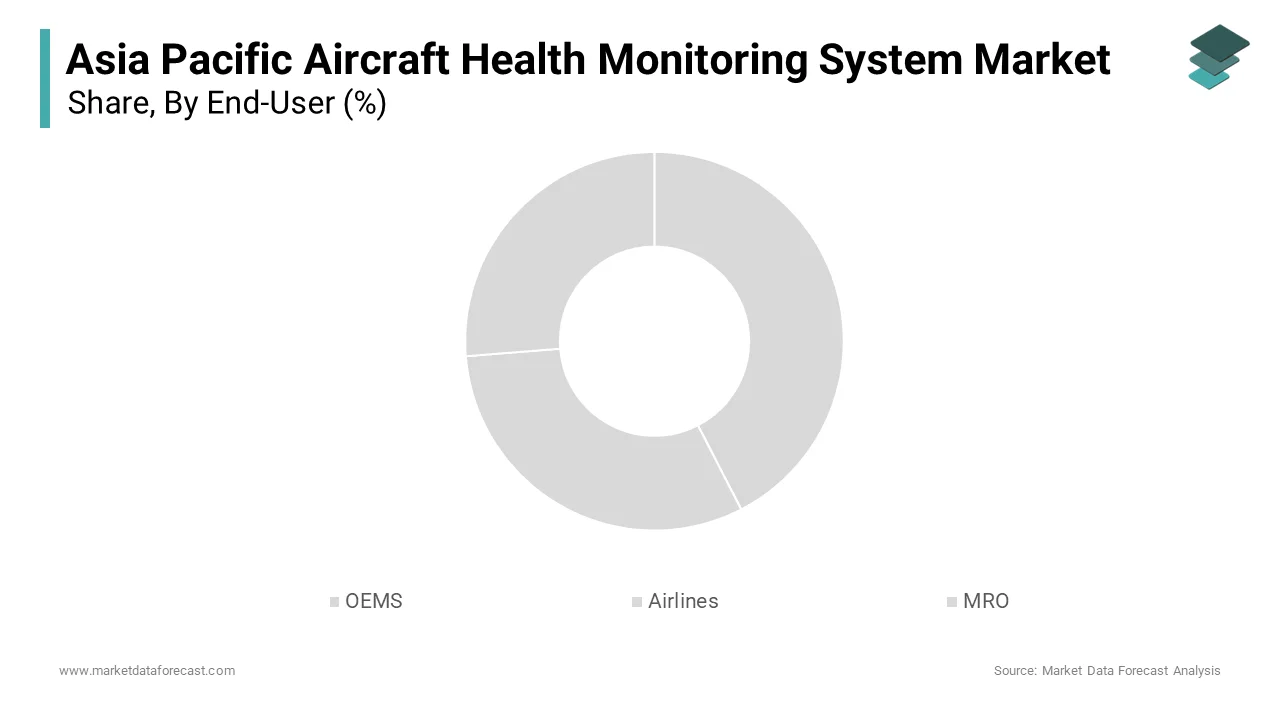
The Airlines segment led the Asia Pacific aircraft health monitoring system (AHMS) market by capturing 48.5% of total market revenue in 2025. The surge in air travel demand across the region, particularly in China, India, and Southeast Asia, is one key driver behind airline adoption of AHMS. This dominance is also attributed to the rapid expansion of commercial aviation fleets, increasing maintenance costs, and the need for predictive diagnostics to minimize unscheduled downtime.
The cost-saving potential of AHMS in reducing unplanned maintenance events is another significant factor. Indian carriers such as IndiGo and SpiceJet have also integrated digital health monitoring systems into their fleet management strategies, resulting in improved aircraft turnaround times and lower repair costs.
Besides, regulatory mandates are pushing airlines toward real-time aircraft diagnostics. The Directorate General of Civil Aviation (DGCA) in India introduced guidelines mandating condition-based maintenance practices for major operators, reinforcing the shift from reactive to proactive maintenance models.
MROs
The Maintenance, Repair, and Overhaul (MRO) segment is projected to grow at the highest CAGR of 11.6% between 2025 and 2033 in the Asia Pacific AHMS market. The increasing outsourcing of aircraft maintenance activities and the proliferation of independent MRO facilities catering to both commercial and defense sectors are primarily driving the rapid expansion of the MRO segment.
In India, as per the Ministry of Civil Aviation, over 60% of regional airlines now outsource major aircraft checks to certified MRO centers, many of which have adopted AHMS platforms for real-time diagnostics and repair planning.
As per the China Civil Aviation Administration, the number of independent MRO service providers grew by 25% in 2023, with companies like GAMECO and Ameco Beijing investing in AI-powered AHMS tools to enhance service delivery and reduce aircraft on-ground (AOG) time.
Moreover, the adoption of data-driven maintenance contracts is boosting MRO-led AHMS deployment.
By Subsystem Insights
Engines
The engine subsystem segment dominated the Asia Pacific aircraft health monitoring system (AHMS) market by contributing 53.5% of the total value in 2025. The Increasing complexity and cost of modern jet engines, especially those used in next-generation aircraft such as the Boeing 787 Dreamliner and Airbus A350, is one of the primary factors behind the growth of the engine subsystem segment. This dominance is also due to the critical role engines play in aircraft performance, reliability, and fuel efficiency, making them a prime focus for real-time diagnostics and predictive maintenance. According to Rolls-Royce’s Annual Report, the average cost of a high-thrust turbofan engine exceeds USD 20 million, necessitating continuous monitoring to prevent costly failures and extend overhaul intervals.
In China, the Commercial Aircraft Corporation of China (COMAC) has mandated full integration of Engine Health Monitoring (EHM) systems in its C919 narrow-body jet program.
The expansion of engine leasing and power-by-the-hour (PBH) maintenance models is another significant factor. Indian low-cost carrier IndiGo, for example, signed multi-year PBH contracts with CFM International, incorporating real-time engine diagnostics to optimize performance and cost.
Avionics and Structural Monitoring
The avionics and structural monitoring systems segment is emerging as the fastest-growing segment in the Asia Pacific AHMS market and is recording a CAGR of 10.8% in the future. Increasing use of composite materials in aircraft structures and the growing reliance on digital avionics for flight control and navigation are primarily driving the surge of the avionics and structural monitoring systems segment.
Like, aircraft manufacturers are using up to 50% composite materials in newer models, including the Boeing 787 and Airbus A350. These materials, while lighter and stronger, require advanced monitoring techniques to detect micro-fractures, delamination, and fatigue damage, driving demand for embedded AHMS sensors.
South Korea’s Korea Aerospace Industries (KAI) also incorporated avionics-based AHMS modules into its KF-21 Boramae stealth fighter program, enabling real-time feedback on flight control surfaces and radar-absorbing structures. Apart from these, Australia’s Department of Defence initiated Project AIR 6500 Phase 1, which involves retrofitting existing P-8A Poseidon maritime patrol aircraft with enhanced avionics monitoring capabilities.
By Component Insights
Hardware
The Hardware segment led the Asia Pacific aircraft health monitoring system (AHMS) market by accounting for 58.2% of total revenue in 2025. The foundational role of onboard sensors, processors, and communication modules in enabling real-time aircraft diagnostics and data transmission is largely propelling the hardware segment.
The widespread integration of onboard sensor networks in new aircraft builds is among the key factors driving hardware demand. The Indian Air Force emphasized hardware upgrades under its "Make in India" defense manufacturing initiative, supporting local production of aerospace-grade monitoring components.
The retrofitting of legacy aircraft with modern AHMS hardware, particularly in the defense sector, is another major contributor. With aircraft manufacturers and defense agencies continuing to prioritize hardware integration for real-time diagnostics, the hardware segment remains central to the AHMS ecosystem in the Asia Pacific.
Software
The software solutions segment is projected to register the highest CAGR of 12.4% between 2025 and 2033 in the Asia Pacific AHMS market. Growing adoption of cloud-based analytics, artificial intelligence (AI), and predictive maintenance algorithms across commercial and military aviation sectors is propelling the swift rise of the software solutions segment.
Airlines in China, Japan, and South Korea are leveraging machine learning algorithms to analyze engine performance trends, detect early signs of component wear, and predict maintenance intervals with greater accuracy.
As per Japan’s Ministry of Economy, Trade and Industry (METI), ANA Holdings and Japan Airlines invested heavily in AI-based AHMS platforms in 2023, integrating them with their enterprise resource planning (ERP) systems to streamline maintenance workflows.
South Korea’s Korea Aerospace Industries (KAI) has also partnered with local tech firms to embed AI models into the HUMS of its next-generation trainers and transport aircraft.
This convergence of AI and AHMS software is reshaping traditional maintenance practices, offering a compelling growth opportunity for market participants across the region.
COUNTRY-LEVEL ANALYSIS
China Aircraft Health Monitoring System Market Analysis
China stands as the largest contributor to the Asia Pacific aircraft health monitoring system (AHMS) market with a 37.2% share in 2025. This lead position is underpinned by the country’s expanding commercial aviation fleet, robust defense modernization efforts, and strong domestic aerospace manufacturing capabilities.
According to the Civil Aviation Administration of China (CAAC), the country added over 350 new commercial aircraft in 2023, bringing the total fleet size to more than 4270 units. Each of these aircraft requires advanced health monitoring capabilities to ensure operational efficiency and compliance with international aviation safety standards. Airlines such as China Southern and Air China have adopted full-suite AHMS solutions, integrating real-time diagnostics with cloud-based analytics platforms.
In the defense sector, the People's Liberation Army Air Force (PLAAF) has accelerated its modernization drive, commissioning several squadrons of J-20 stealth fighters and Y-20 strategic transport aircraft, all equipped with embedded AHMS modules. The China National Aero-Technology Import & Export Corporation (CATIC) has been instrumental in supplying these systems, emphasizing self-reliance in avionics and maintenance technologies.
Further, China’s indigenous aircraft development programs, including the C919 and ARJ21 regional jet projects, mandate full AHMS integration. These programs are being supported by partnerships with GE Aviation and Rockwell Collins to ensure cutting-edge diagnostic capabilities.
India Aircraft Health Monitoring System Market Analysis
India holds a significant position in the Asia Pacific AHMS market. The country’s market is being propelled by rapid fleet expansion, increasing defense spending, and government initiatives aimed at strengthening aerospace manufacturing and maintenance capabilities.
According to the Directorate General of Civil Aviation (DGCA), domestic air traffic grew by 8.34% in fiscal year 20, prompting airline operators to invest in condition-based maintenance systems to optimize aircraft availability. IndiGo, Vistara, and Akasa Air have all integrated AHMS into their fleet management strategies, leveraging real-time diagnostics to reduce unplanned groundings and improve turnaround times.
In the defense sector, fighter aircraft, including the indigenous Tejas Light Combat Aircraft and Sukhoi Su-30MKI fleet, these platforms now feature embedded HUMS modules to track structural fatigue, engine performance, and rotor dynamics in real time.
The Indian government’s “Make in India” initiative has also catalyzed growth in domestic AHMS manufacturing. Hindustan Aeronautics Limited (HAL) and Bharat Electronics Limited (BEL) have partnered with global OEMs such as Rolls-Royce and Honeywell to localize AHMS component production, reducing import dependency and enhancing supply chain resilience.
Japan Aircraft Health Monitoring System Market Analysis
Japan is known for its advanced aerospace engineering capabilities and stringent safety protocols. Japan continues to be a key market for high-performance aircraft health monitoring systems in both civil and military applications.
Moreover, Mitsubishi Heavy Industries launched an upgraded version of its F-X next-generation fighter program, featuring advanced onboard diagnostics and structural monitoring capabilities.
Japan’s aerospace research institutions, including the Japan Aerospace Exploration Agency (JAXA), are also advancing the development of autonomous AHMS solutions for future spaceplanes and hypersonic aircraft.
South Korea Aircraft Health Monitoring System Market Analysis
South Korea accounts for a notable share of the Asia Pacific AHMS market. The country’s advanced aerospace industry, growing defense budget, and expanding commercial aviation sector are key drivers of AHMS adoption.
As per South Korea’s Defense Acquisition Program Administration (DAPA), in 2023, the country initiated the KF-21 Boramae stealth fighter mass production phase, which includes comprehensive AHMS integration for enhanced situational awareness and maintenance planning. Besides, the Republic of Korea Air Force began retrofitting older F-16 fighter jets with digital monitoring systems to improve operational readiness.
As part of the country’s broader push for Industry 4.0 adoption, the government has encouraged the localization of AHMS components, supporting domestic semiconductor and sensor manufacturers.
Australia Aircraft Health Monitoring System Market Analysis
Australia’s AHMS demand is characterized by high-value applications in defense, commercial aviation, and regional air transport.
Apart from these, the Royal Australian Air Force (RAAF) commenced upgrades to its C-130J Hercules transport fleet, incorporating digital health monitoring systems to improve mission readiness and reduce maintenance cycles.
Australia’s aerospace research institutions, including the Cooperative Research Centre for Aviation Safety (CRC-AVS), are also exploring the integration of AI and edge computing into AHMS for long-range flights and cargo operations.
COMPETITIVE LANDSCAPE
- The competition in the Asia Pacific aircraft health monitoring system (AHMS) market is marked by a dynamic mix of global aerospace giants and emerging regional players striving to capture market share through technological innovation, strategic expansion, and customized service offerings. As air travel demand continues to rise and defense modernization programs gain momentum, the need for advanced diagnostic tools has intensified, prompting manufacturers and service providers to differentiate themselves through superior analytics, integration capabilities, and customer-centric support models.
- Global players like Honeywell, GE Aviation, and Rolls-Royce lead the market with their extensive R&D resources, established distribution networks, and long-standing relationships with aircraft OEMs and airline operators. However, domestic companies in countries such as China and India are increasingly gaining traction by offering cost-effective, locally adapted AHMS solutions supported by government-backed aerospace initiatives.
- In addition to product differentiation, competition is also intensifying in areas such as data security, interoperability with legacy systems, and predictive analytics accuracy. Companies are investing heavily in AI-powered diagnostics, cybersecurity enhancements, and platform scalability to meet evolving industry needs. As regulatory standards evolve and digital transformation accelerates, the competitive landscape will continue to shift toward those who can deliver reliable, scalable, and future-ready AHMS ecosystems.
KEY MARKET PLAYERS
These are the market players that are dominating the Asia Pacific aircraft health monitoring system (AHMS) market.
- The Boeing Company
- General Electric Company
- RTX Corporation
- Honeywell International Inc.
- Safran SA
- Rolls-Royce plc
- Meggitt PLC
- Curtiss-Wright Corporation
- FLYHT Aerospace Solutions Ltd.
- Lufthansa Technik AG
- MTU Aero Engines AG
- Ultra Precision Control Systems (Ultra Group)
- Eve Holding, Inc.
- Airbus SE
- EXSYN Aviation Solutions
- RSL Electronics Ltd.
Top Players In The Market
- One of the leading players in the Asia Pacific aircraft health monitoring system (AHMS) market is Honeywell Aerospace. The company offers a comprehensive suite of digital health monitoring solutions for both commercial and military aircraft, with a strong presence across key markets such as China, Japan, and India. Honeywell’s AHMS platforms are widely integrated into modern aircraft avionics, enabling real-time diagnostics, predictive maintenance, and fleet-wide performance tracking.
- Another major player is Rolls-Royce plc, known for its advanced engine health monitoring systems used by airlines and defense operators across the region. Rolls-Royce provides TotalCare® services that combine sensor data, analytics, and expert support to optimize engine reliability and reduce lifecycle costs. The company has deep partnerships with regional MRO providers and leasing firms, enhancing its service footprint in the Asia Pacific.
- The third key player is GE Aviation, a global leader in aircraft propulsion and digital aviation solutions. GE’s Predix-based AHMS offerings are extensively used in Boeing and Airbus fleets operating in the Asia Pacific. With a focus on data-driven maintenance and AI-enabled diagnostics, GE supports major carriers and lessors in improving aircraft availability and reducing downtime through proactive health monitoring strategies.
Top Strategies Used By Key Market Participants
A primary strategy adopted by leading players in the Asia Pacific aircraft health monitoring system (AHMS) market is product innovation and digital integration. Companies are continuously investing in research and development to design more intelligent, connected, and adaptive AHMS solutions that leverage artificial intelligence, cloud computing, and edge analytics for real-time diagnostics and predictive maintenance.
Another critical approach is expanding regional presence through localized service centers and partnerships. Key players are strengthening their after-sales support networks by establishing technical hubs, collaborating with local MRO providers, and integrating their systems with regional aviation authorities’ requirements. This enhances customer responsiveness and ensures compliance with diverse regulatory frameworks.
Lastly, strategic acquisitions and technology collaborations are being leveraged to enhance product portfolios and accelerate time-to-market. Major companies are acquiring software startups, partnering with aerospace engineering firms, and co-developing next-generation AHMS modules tailored for emerging aircraft platforms. These efforts allow firms to offer end-to-end solutions and maintain a competitive edge in a rapidly evolving market landscape.
RECENT MARKET NEWS
- In February 2025, Honeywell announced the launch of its next-generation digital aircraft health monitoring platform, specifically designed for regional jet operators in the Asia Pacific. This solution enables real-time diagnostics, fuel efficiency tracking, and remote troubleshooting, reinforcing Honeywell’s leadership in predictive aviation maintenance technologies.
- In April 2025, Rolls-Royce expanded its collaboration with a leading Indian MRO provider, aiming to enhance engine health monitoring services for regional airlines. This partnership supports faster turnaround times, improved fault detection, and better integration with airline maintenance planning systems.
- In July 2025, GE Aviation entered into a joint venture with a Singapore-based aerospace analytics firm, focusing on AI-driven aircraft diagnostics tailored for Southeast Asian carriers. This initiative aligns with the broader trend of digital transformation in aviation maintenance and fleet management.
- In October 2025, Honeywell partnered with a Chinese avionics manufacturer to integrate its AHMS suite into indigenous regional aircraft, supporting China’s push for self-reliance in aerospace technology and expanding Honeywell’s reach in the domestic market.
- In December 2025, Rolls-Royce acquired a local aircraft data analytics startup in South Korea, allowing it to enhance its Total Care services with localized insights and improve predictive maintenance capabilities for airlines operating in Northeast Asia.
MARKET SEGMENTATION
This research report on the Asia Pacific air craft health monitoring systems market is segmented and sub-segmented into the following categories.
By End User
- OEMS
- Airlines
- MRO
By Sub-system
- Engines
- Avionics
- Aircraft Structures
- Environmental Control and Ancillary Systems
By Component
- Hardware
- Sensors
- Avionics
- Flight Data Management Systems
- Connected Aircraft Solutions
- Ground Services
- Software
- Onboard Software
- Diagnostics Analytics
- Prognostics Analytics
- Services
- Integration and Customisation
- MRO/Condition-Monitoring Services
By Country
- India
- China
- Japan
- South Korea
- Australia
- New Zealand
- Thailand
- Malaysia
- Vietnam
- Philippines
- Indonesia
- Singapore
- Rest of APAC
Frequently Asked Questions
What is the Asia Pacific aircraft health monitoring system market?
The Asia Pacific aircraft health monitoring system market focuses on digital tools and sensor-based technologies that track an aircraft’s structural, mechanical, and system health in real time to improve safety and maintenance efficiency.
What drives growth in the Asia Pacific aircraft health monitoring system market?
Rising air traffic, fleet expansion, increased focus on predictive maintenance, and airlines seeking to reduce downtime and maintenance costs.
Why are aircraft health monitoring systems important in the Asia Pacific market?
They help detect faults early, optimize maintenance schedules, enhance operational reliability, and support data-driven decision-making for airlines and MRO providers.
Which countries lead the Asia Pacific aircraft health monitoring system market?
China, India, Japan, and Singapore lead due to rapid aviation growth, modernizing fleets, and investments in digital aviation infrastructure.
What technologies are commonly used in the Asia Pacific aircraft health monitoring system market?
IoT sensors, cloud-based analytics, machine learning models, vibration monitoring, structural health sensors, and real-time data communication systems.
What challenges affect the Asia Pacific aircraft health monitoring system market?
High installation costs, data integration complexity, cybersecurity concerns, and varying digital maturity among regional airlines.
How does fleet expansion influence the Asia Pacific aircraft health monitoring system market?
New aircraft deliveries and increasing regional connectivity push airlines to adopt advanced monitoring technologies to manage larger, more complex fleets.
Which aircraft types benefit most from aircraft health monitoring systems in Asia Pacific?
Commercial airplanes, regional jets, cargo aircraft, and a growing number of business jets use AHMS technologies for enhanced operational safety.
Who are the key users of the Asia Pacific aircraft health monitoring system market?
Airlines, aircraft manufacturers, MRO companies, and aviation regulators aiming to improve safety and maintenance standards.
What is the outlook for the Asia Pacific aircraft health monitoring system market?
The market is expected to grow strongly as aviation expands, digital transformation accelerates, and airlines prioritize predictive maintenance to reduce operational costs.
Access the study in MULTIPLE FORMATS
Purchase options starting from
$ 2000
Didn’t find what you’re looking for?
TALK TO OUR ANALYST TEAM
Need something within your budget?
NO WORRIES! WE GOT YOU COVERED!
Call us on: +1 888 702 9696 (U.S Toll Free)
Write to us: sales@marketdataforecast.com