Asia Pacific Aluminum Cans Market Size, Share, Growth, Trends, and Forecast Report – Segmented By Type (Standard, Sleek, Slim, other), End-User, Capacity, and Region (India, China, Japan, South Korea, Australia & New Zealand, Thailand) - Industry Analysis from 2026 to 2034
Market Size, 2025
$14.46 BnMarket Estimate, 2026
$15.60 BnMarket Forecast, 2034
$28.56 BnCAGR, 2026–2034
7.85%Asia Pacific Aluminum Cans Market Size
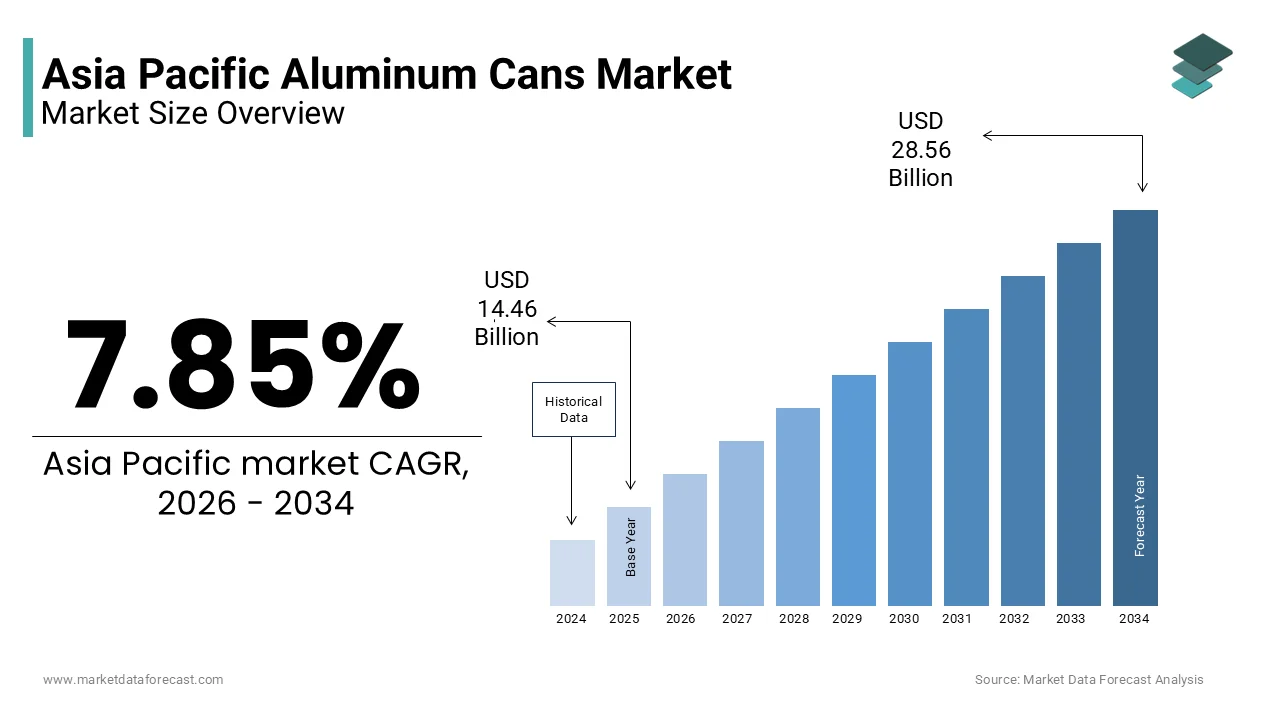
The Asia Pacific aluminum cans market size was valued at USD 14.46 billion in 2025, and is expected to reach USD 28.56 billion by 2034 from USD 15.60 billion in 2026. The market's promising CAGR for the predicted period is 7.85%.
Aluminum cans are lightweight metal containers primarily used for packaging carbonated beverages, beer, energy drinks, and increasingly, non-carbonated functional beverages. These cans, typically made from 3004 or 3104 Aluminum alloys, are valued for their high recyclability, thermal conductivity, and barrier properties that preserve product integrity. Unlike steel or plastic alternatives, Aluminum cans offer superior form retention and rapid chilling, making them ideal for on-the-go consumption in tropical and densely populated regions. As per the International Aluminum Institute, over 75% of all Aluminum ever produced remains in use today due to closed-loop recycling, a factor reinforcing its role in circular economy models.
MARKET DRIVERS
Surge in Consumption of Ready-to-Drink Beverages Across Urban Centres
The proliferation of urban lifestyles and rising disposable incomes have catalyzed a shift toward packaged, on-the-go beverages, directly fueling demand for Aluminum cans. In countries like India, Indonesia, and Vietnam, urban populations are increasingly opting for convenience over traditional unpackaged drinks, with carbonated soft drinks and energy beverages leading the trend. According to the World Bank, urban population growth in the Asia Pacific region reached 56% in 2023, up from 48% in 2015, creating a vast consumer base for ready-to-drink products. In India, there was an increase in packaged beverage sales between 2021 and 2023, driven by youth demographics and retail modernization. Beverage companies such as Coca-Cola and PepsiCo have responded by expanding canning lines across the region, leveraging the material’s portability and chill efficiency.
Expansion of Cold Chain Infrastructure and Retail Modernization
The development of temperature-controlled logistics and the rise of organized retail and e-commerce platforms have significantly enhanced the viability of Aluminum cans in the Asia Pacific. Unlike glass or PET, Aluminum cans are lightweight, stackable, and resistant to breakage, making them ideal for cold storage and last-mile delivery. Moreover, cold chain coverage in India improved between 2020 and 2023, enabling wider distribution of chilled beverages. In Indonesia, the number of modern supermarkets and convenience stores increased 2021 to 2023, with canned beverages occupying prominent shelf space due to their long shelf life and brand visibility. Furthermore, e-commerce platforms reported a rise in canned beverage sales through online grocery channels in 2023. This infrastructure evolution supports consistent product availability and reduces spoilage, reinforcing Aluminum’s dominance in beverage packaging.
MARKET RESTRAINTS
Volatility in Primary Aluminum Prices Due to Energy Dependency
The production of primary Aluminum is highly energy-intensive, requiring approximately 13,500 kWh of electricity per metric ton, as per the International Energy Agency. This dependence on electricity, particularly in coal-powered grids across China and India, exposes Aluminum can manufacturers to price fluctuations driven by energy market dynamics. In 2022, China’s Yunnan province curtailed Aluminum output due to hydropower shortages, causing regional Aluminum prices to spike within three months. These cost instabilities directly impact can production margins, especially for small and mid-sized converters lacking hedging mechanisms. Hence, the limited collection infrastructure in many Asia Pacific countries constrains its supply, perpetuating reliance on volatile primary metal sources.
Fragmented Waste Collection and Low Recycling Rates in Developing Economies
Despite Aluminum’s inherent recyclability, inefficient waste management systems in several Asia Pacific nations hinder post-consumer recovery. In Southeast Asia, only limited share of Aluminum cans are collected for recycling. In the Philippines, informal waste pickers recover much of the recyclable material, but lack of standardized sorting facilities results in contamination and downcycling. Even in more developed markets like Thailand, deposit return schemes are absent, reducing consumer incentive to return cans. This fragmented recovery landscape undermines the economic and environmental advantages of Aluminum, increasing pressure on producers to source primary metal and raising sustainability concerns among regulators and brand owners.
MARKET OPPORTUNITIES
Adoption of Lightweighting and Design Innovation to Enhance Efficiency
Aluminum can manufacturers are increasingly investing in lightweighting technologies to reduce material use without compromising structural integrity, thereby improving cost efficiency and sustainability. This reduction is achieved through advanced alloy formulations and improved necking and flanging techniques. In Japan, Toyo Seikan has implemented ultra-thin wall technology, cutting can weight while maintaining pressure resistance. These innovations not only lower transportation emissions but also increase production yield per ton of Aluminum. Also, lightweighting has contributed to a reduction in the carbon footprint of beverage cans since 2015, making them more attractive to environmentally conscious brands.
Growth of Craft Beverages and Premiumization in Emerging Markets
The rise of craft beer, functional drinks, and premium non-alcoholic beverages is creating new demand for Aluminum cans as a preferred packaging format. Consumers in South Korea, Australia, and Thailand are increasingly associating canned formats with modernity, portability, and design appeal. In South Korea, craft beer sales is growing, with most packaged in Aluminum cans due to superior oxygen barrier properties. The format’s compatibility with vibrant, full-body printing allows brands to differentiate themselves on crowded shelves. Moreover, in Australia, most of new beverage launches in 2023 opted for cans over glass, citing lower distribution costs and higher shelf impact. This premiumization trend is expanding the application of Aluminum beyond mass-market sodas into high-margin niche segments.
MARKET CHALLENGES
Geopolitical Disruptions in Bauxite Supply Chains
The Asia Pacific Aluminum can industry faces growing vulnerability due to geopolitical tensions affecting bauxite supply, the raw material for primary Aluminum. In 2023, Indonesia implemented a ban on unprocessed bauxite exports to promote domestic smelting, reducing availability for Chinese refineries that previously relied on Indonesian ore for 30% of their feedstock, as per the China Nonferrous Metals Industry Association. This forced Chinese producers to shift to Guinea-sourced bauxite, increasing shipping distances and logistics costs. Meanwhile, environmental protests in Vietnam’s Lam Dong province delayed bauxite mining operations in early 2025, affecting downstream alumina output. These supply instabilities create uncertainty for can manufacturers dependent on consistent metal supply.
Workforce Skill Gaps in Advanced Can Manufacturing Technologies
The transition to high-speed, digitally integrated can production lines requires specialized technical expertise that is currently in short supply across much of the Asia Pacific. Modern can plants operate at speeds exceeding 2,000 cans per minute, utilizing precision welding, coating, and quality control systems that demand skilled engineers and technicians. Also, only limited share of technical graduates in Indonesia and the Philippines possess the competencies required for advanced manufacturing roles. In India, the vacancy rate in metal fabrication and automation positions within the packaging sector is high. This deficit delays plant commissioning, increases downtime, and limits the adoption of Industry 4.0 technologies such as predictive maintenance and AI-driven quality inspection. Without targeted vocational training and industry-academia collaboration, the region risks falling behind global productivity benchmarks, constraining the scalability of Aluminum can production.
REPORT COVERAGE
| REPORT METRIC | DETAILS |
| Market Size Available | 2025 to 2034 |
| Base Year | 2025 |
| Forecast Period | 2026 to 2034 |
| CAGR | 7.85% |
| Segments Covered | By Type, End-User Industry, Capacity, and Region |
| Various Analyses Covered | Regional & Country Level Analysis, Segment-Level Analysis, DROC, PESTLE Analysis, Porter’s Five Forces Analysis, Competitive Landscape, Analyst Overview on Investment Opportunities |
| Regions Covered | India, China, Japan, South Korea, Australia, New Zealand, Thailand, Malaysia, Vietnam, Philippines, Indonesia, Singapore, and the Rest of Asia-Pacific |
| Market Leaders Profiled | Ball Corp, Crown Holdings Inc, Ardagh Metal Packaging SA Ordinary Shares, Toyo Seikan Group Holdings Ltd, CANPACK, Kian Joo Can Factory, and others |
SEGMENTAL ANALYSIS
By Type Insights
The Standard can segment dominated the Asia Pacific Aluminum cans market by capturing 64.6% of total unit volume in 2025. This dominance is primarily driven by its entrenched use in mass-market carbonated soft drinks and beer, where compatibility with high-speed filling lines and legacy packaging infrastructure ensures continued preference. The 330ml standard can remains the benchmark format across beverage production facilities in China, India, and Indonesia, with most of Coca-Cola and PepsiCo bottling plants in the region optimized for this size, according to the Asia Beverage Association. Besides, its structural design offers optimal pressure resistance for carbonated products, minimizing rupture risks during transportation and storage. Standard cans exhibit the lowest defect rate in automated handling systems, reinforcing their reliability. Economies of scale further reduce production costs, making it the most cost-efficient option for large-volume beverage producers.
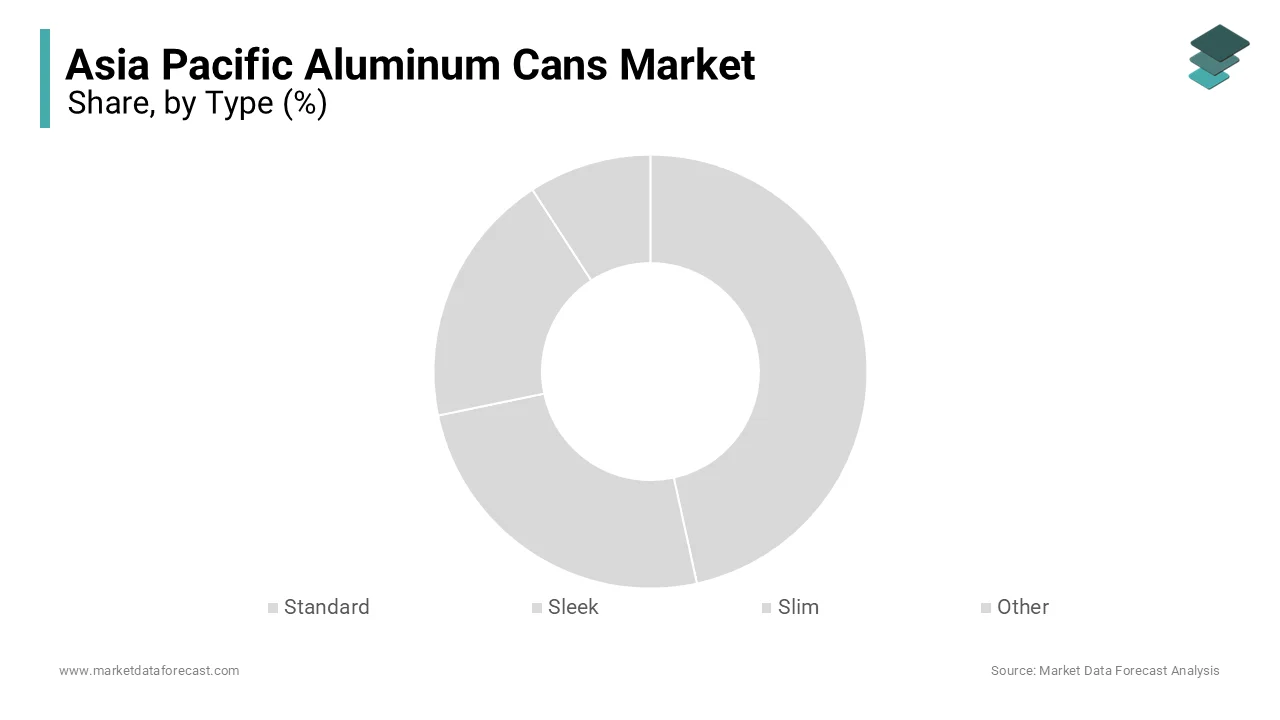
The Slim can segment is experiencing the fastest growth and is projected at a CAGR of 10.7% from 2026 to 2034. It is due to its alignment with premiumization and on-the-go consumption trends. Typically ranging from 250ml to 300ml, slim cans are increasingly adopted by energy drink, flavoured water, and ready-to-drink tea brands targeting urban youth and health-conscious consumers. In South Korea, sales of slim canned beverages surged in 2023, driven by brands like Lotte and Orion leveraging the format’s ergonomic design and shelf visibility. In Japan, slim cans is used new beverage launches in the functional drink category. Their narrow profile enhances portability, fitting easily into car cup holders and backpacks. Beverage giants such as Red Bull and Monster have expanded slim can production in Vietnam and Malaysia to meet rising regional demand.
By End-User Industry Insights
The Non-Alcoholic Beverages segment led the Asia Pacific Aluminum cans market by accounting for a substantial share of total consumption in 2025. This dominance is anchored in the region’s massive carbonated soft drink industry and the rapid expansion of energy and functional beverages. In India, non-alcoholic beverage can usage grew is increasing, fueled by rising urbanization and youth-driven consumption. China consumed billions of Aluminum cans for soft drinks, with brands shifting from PET to cans for improved shelf life and branding impact. The lightweight nature and rapid chilling properties of Aluminum make it ideal for hot-climate markets, where consumers prioritize immediate refreshment. Additionally, the format’s compatibility with vending machines further solidifies its dominance in daily consumption channels.
The Alcoholic Beverages segment is expanding at the fastest rate, with a projected CAGR of 9.3% from 2026 to 2034. It is driven by the premiumization of beer and the rise of ready-to-drink (RTD) alcoholic products. Craft beer, in particular, has embraced Aluminum cans due to their superior light and oxygen barrier properties, preserving flavour integrity. In Australia, most of independent breweries package their products in cans, an increase since 2020. Japan saw a year-on-year increase in canned beer imports, reflecting growing consumer preference for portable, premium options. Urban millennials and Gen Z consumers favour canned alcoholic drinks for their convenience, discreteness, and recyclability, accelerating the shift from glass bottles to metal formats.
The Aerosol segment prevailed among non-beverage applications by representing 56.3% of non-beverage Aluminum can usage in the Asia Pacific in 2025. This lead position is because of the widespread use of Aluminum cans in personal care, household, and automotive products, including deodorants, hair sprays, insecticides, and lubricants. Aluminum’s resistance to corrosion and ability to withstand internal pressure make it ideal for pressurized formulations. In India, aerosol product sales grew. China produces large number of aerosol cans annually with Guangdong and Zhejiang provinces serving as major manufacturing hubs. The material’s compatibility with valve systems and recyclability enhances its appeal among multinational FMCG brands seeking sustainable packaging solutions in competitive consumer markets.
The Pet Food segment is witnessing the fastest growth within the food category and is projected at a CAGR of 8.9% in the coming years which is due to rising pet ownership and premiumization of pet nutrition. Also, the number of urban pet owners in China and South Korea is increasing, driving demand for high-quality, convenient pet food formats. Aluminum cans offer superior barrier protection against moisture and oxygen, preserving the freshness and aroma of wet pet food. In Japan, a share of premium wet cat food is packaged in Aluminum due to its sterility and ease of opening. Global brands like Nestlé Purina and Mars have established dedicated canning lines in Malaysia and Vietnam, leveraging regional cost efficiencies and growing export infrastructure.
By Capacity Insights
The 251–500 ml capacity segment dominates the Asia Pacific Aluminum cans market, representing 65% of total volume in 2023, as per the International Can Manufacturers Institute. This range includes the standard 330ml and 500ml formats, which are the most widely adopted for carbonated beverages, beer, and energy drinks across the region. The 330ml can is the default choice for soft drinks in countries like China, Indonesia, and India, where it aligns with consumer expectations for portion size and affordability. In Thailand, 78% of all canned beverages sold in convenience stores fall within this range, according to the Thai Retail Trade Association. The 500ml format is particularly popular for beer in Japan and South Korea, where it is associated with value and social drinking. The Australian Packaging Council notes that this capacity range offers optimal balance between material efficiency, stacking density, and consumer ergonomics, making it ideal for both retail and vending machine distribution.
The Up To 250 ml segment is growing at the fastest rate, with a projected CAGR of 11.2% from 2023 to 2030, driven by the rise of single-serve, low-calorie, and functional beverages. This capacity is increasingly used for energy drinks, flavoured sparkling water, and RTD cocktails targeting health-conscious and mobile consumers. The compact size reduces Aluminum usage per unit, aligning with corporate sustainability goals. Additionally, e-commerce platforms like JD.com and Lazada report higher conversion rates for multi-packs of small-format cans, indicating strong consumer preference for variety and convenience.
REGIONAL ANALYSIS
China
China stood as the largest producer and consumer of Aluminum cans in the Asia Pacific at 42.5% of the regional market in 2025. The country’s dominance is underpinned by its vast beverage industry, extensive manufacturing infrastructure, and integration into global supply chains. China produced tens of billions of Aluminum cans, primarily for domestic soft drink and beer brands. Major international players like Ball Corporation and Crown Holdings operate multiple can plants in Guangdong, Zhejiang, and Shandong provinces. The government’s push for circular economy models has led to an increase in Aluminum recycling capacity since 2020. Urbanization and rising middle-class consumption continue to drive demand, with canned beverages now a staple in both modern retail and street vending ecosystems.
India
India holds a strong position in the regional market. The country’s market is experiencing rapid expansion due to growing urbanization, rising disposable incomes, and a shift from glass and PET to metal packaging. Canned beverage sales grew between 2021 and 2023, with carbonated drinks and energy beverages leading the surge. Hindalco and UACJ have expanded can manufacturing capacity in Maharashtra and Tamil Nadu to meet demand from Coca-Cola, PepsiCo, and domestic brands. E-commerce and quick commerce platforms are further accelerating market penetration in tier-2 and tier-3 cities.
Japan
Japan remains a high-value, technologically advanced market. The country’s mature beverage sector relies heavily on Aluminum for canned tea, coffee, beer, and RTD cocktails, with vending machines dispensing canned beverages annually. Innovation in can design, such as easy-open lids and full-body printing, is widespread. Domestic producers like Toyo Seikan and Daiwa Can have adopted Industry 4.0 technologies to enhance precision and reduce waste. Despite stagnant population growth, premiumization and functional beverage trends sustain demand, positioning Japan as a leader in sustainable and high-performance packaging.
South Korea
South Korea occupies a strategic position in the regional market. The country’s market is characterized by strong brand innovation, high urban density, and a culture of convenience consumption. The rise of canned cocktails and low-alcohol beverages has further expanded usage beyond traditional soft drinks. Major retailers operate a large number of convenience stores, many equipped with heated and chilled can displays, driving impulse purchases. Domestic can manufacturers are investing in lightweighting and digital printing to meet evolving brand demands.
Thailand
Thailand plays a pivotal role as a regional manufacturing and export hub. The country hosts production facilities for global can makers like CPMC and Nippon Light Metal, serving both domestic and export markets. Thailand’s Eastern Economic Corridor has attracted significant investment in metal packaging. Thailand is also a major supplier of canned pet food to Europe and North America, utilizing Aluminum for its sterility and shelf stability. The Ministry of Natural Resources and Environment has introduced extended producer responsibility (EPR) regulations, aiming to raise Aluminum recycling rates, further enhancing the sustainability profile of the sector.
COMPETITIVE LANDSCAPE
Competition in the Asia Pacific Aluminum cans market is intensifying as global and regional players vie for dominance amid rising demand and sustainability pressures. Established multinationals leverage technological superiority and global supply chain integration, while local manufacturers capitalize on cost efficiency and proximity to emerging consumer bases. The market is characterized by rapid innovation in can design, material efficiency, and digital branding, driven by evolving beverage trends and environmental regulations. Differentiation is increasingly achieved through sustainability credentials, including recycled content, lightweighting, and participation in circular economy initiatives. Regulatory frameworks on single-use plastics are indirectly benefiting Aluminum, but competition for scrap supply and recycling infrastructure is escalating. The convergence of urbanization, e-commerce, and premiumization is reshaping competitive dynamics, favoring agile, integrated, and environmentally responsible packaging providers across the region.
KEY MARKET PLAYERS
Some of the key players in the Asia Pacific aluminum cans market are
- Ball Corp
- Crown Holdings Inc
- Ardagh Metal Packaging SA (Ordinary Shares)
- Toyo Seikan Group Holdings Ltd
- CANPACK
- Kian Joo Can Factory
TOP PLAYERS IN THE MARKET
- Ball Corporation operates as a leading innovator in sustainable metal packaging, with a strong footprint across the Asia Pacific region. The company supplies Aluminum cans to major beverage brands including Coca-Cola, Asahi, and San Miguel, supporting their transition to lightweight, recyclable formats. Ball has invested heavily in advanced manufacturing technologies, such as digital printing and micro-thin wall cans, to meet rising demand for premium and eco-efficient packaging. In recent years, it has expanded its production network in Vietnam and India, integrating closed-loop water systems and renewable energy to reduce environmental impact. The company collaborates with local recyclers and governments to enhance collection infrastructure, particularly in emerging markets. Its focus on lifecycle sustainability and design innovation positions Ball as a strategic partner for brands aiming to meet circular economy targets while maintaining high performance in distribution and consumer appeal.
- Crown Holdings, Inc. is a global leader in metal packaging with significant influence in the Asia Pacific Aluminum can sector, particularly in China, Japan, and Southeast Asia. The company supplies high-integrity cans for carbonated drinks, beer, and functional beverages, leveraging its expertise in material science and high-speed production. Crown has modernized its facilities in Shanghai and Bangkok with Industry 4.0 automation, improving precision and reducing scrap rates. It introduced ultra-lightweight cans in 2023 to help clients lower carbon emissions and transportation costs. The company also launched a digital branding platform in Japan, enabling dynamic label customization for limited-edition beverage launches. Crown actively engages in sustainability initiatives, partnering with the Asia Aluminum Forum to promote recycling education and collection efficiency. Its emphasis on operational excellence and customer-specific innovation strengthens its role in serving both multinational and regional beverage producers across diverse market segments.
- Toyo Seikan Group Holdings Ltd. is a dominant force in Japan’s metal packaging industry and a key player in the broader Asia Pacific market. Specializing in high-barrier Aluminum and steel cans, the company serves premium beverage, food, and aerosol sectors with technologically advanced solutions. Toyo Seikan pioneered the development of eco-cans with reduced material use and enhanced recyclability, now widely adopted by Japanese tea and coffee brands. In 2023, it launched a new generation of easy-open ends with improved safety and opening force, enhancing consumer experience. The company has also expanded its footprint in Southeast Asia through joint ventures in Thailand and Indonesia, targeting growth in canned functional drinks and pet food. By integrating smart manufacturing systems and investing in closed-loop recycling partnerships, Toyo Seikan is advancing the region’s transition toward sustainable, high-performance packaging ecosystems.
TOP STRATEGIES USED BY THE KEY MARKET PLAYERS
Key players in the Asia Pacific Aluminum cans market are deploying vertical integration to secure raw material supply and enhance production efficiency. Companies are investing in lightweighting technologies to reduce material consumption and carbon footprint per can. Expansion into high-growth markets such as India and Vietnam is accelerating through greenfield plants and joint ventures. Strategic partnerships with beverage brands enable co-development of innovative can designs and limited-edition packaging. Digital printing and smart manufacturing systems are being adopted to improve customization and operational agility. Sustainability is a core focus, with firms increasing recycled Aluminum content and collaborating on collection infrastructure. Additionally, companies are strengthening logistics networks to ensure just-in-time delivery and support rapid response to shifting consumer demand across diverse regional markets.
RECENT HAPPENINGS IN THE MARKET
- In February 2023, Ball Corporation inaugurated a new Aluminum can manufacturing plant in Bac Ninh, Vietnam, with an annual capacity of 1.2 billion cans, strengthening its supply chain for Southeast Asian beverage brands.
- In July 2023, Crown Holdings launched a digital printing pilot line in its Shanghai facility, enabling full-body customization for limited-edition beverage cans and enhancing brand engagement in the Chinese market.
- In October 2023, Toyo Seikan partnered with Thailand’s Siam Cement Group to establish a joint recycling facility in Rayong, aimed at increasing post-consumer Aluminum recovery and closed-loop production.
- In January 2025, Hindalco Industries commissioned a state-of-the-art can sheet rolling mill in Gujarat, India, to supply high-quality Aluminum coil to domestic canmakers and reduce import dependency.
- In March 2025, Nippon Steel & Sumikin Aluminum expanded its can production line in Chonburi, Thailand, adding 800 million units of annual capacity to meet rising demand from RTD and energy drink manufacturers.
MARKET SEGMENTATION
This research report on the Asia Pacific aluminum cans market has been segmented and sub-segmented based on the following categories.
By Type
- Standard
- Sleek
- Slim
- Other
By End-user Industry
- Beverage
- Alcoholic Beverages
- Non-alcoholic Beverages
- Food
- Canned Food
- Pet Food (Wet and Treats)
- Aerosol
- Other End-user Industries
By Capacity
- Up to 250 ml
- 251 - 500 ml
- More than 500 ml
By Country
- India
- China
- Japan
- South Korea
- Australia
- New Zealand
- Thailand
- Malaysia
- Vietnam
- Philippines
- Indonesia
- Singapore
- Rest of Asia-Pacific
Frequently Asked Questions
1. What is the Asia Pacific aluminum cans market?
It refers to the production, distribution, and consumption of aluminum cans for beverages, food, and other applications across Asia Pacific.
2. Which countries dominate the aluminum cans market in Asia Pacific?
China, India, Japan, and South Korea are the leading markets in the region.
3. What drives the growth of aluminum cans in Asia Pacific?
Growing beverage consumption, rising demand for sustainable packaging, and increasing recycling initiatives.
4. Why are aluminum cans preferred over plastic packaging?
They are lightweight, 100% recyclable, eco-friendly, and have a longer shelf life for beverages.
5. Which industries use aluminum cans the most in Asia Pacific?
Major industries include beverages (carbonated drinks, beer, energy drinks), food, pharmaceuticals, and cosmetics.
6. What challenges does the Asia Pacific aluminum cans market face?
Challenges include fluctuating raw material prices, high energy costs, and competition from alternative packaging.
7. Which segment dominates the aluminum cans market in Asia Pacific?
The beverage segment, especially carbonated soft drinks and alcoholic beverages, holds the largest share.
8. What innovations are happening in the Asia Pacific aluminum cans market?
Lightweight cans, smart packaging, resealable cans, and designs for improved recyclability are key innovations.
Related Reports
Access the study in MULTIPLE FORMATS
Purchase options starting from
$ 2000
Didn’t find what you’re looking for?
TALK TO OUR ANALYST TEAM
Need something within your budget?
NO WORRIES! WE GOT YOU COVERED!
Call us on: +1 888 702 9696 (U.S Toll Free)
Write to us: sales@marketdataforecast.com