- Product Description Description
- Table of Contents TOC
- List of Table & Figure LOT
- Get Free Sample PDF Sample PDF
Market Size, 2025
$180.96 MnMarket Estimate, 2026
$210.82 MnMarket Forecast, 2034
$715.35 MnCAGR, 2026–2034
16.5%Executive Summary: Asia Pacific Aquaponics System Market
- Market Scope: Comprehensive regional analysis of the Asia Pacific aquaponics system market covering equipment categories (aeration systems, water quality testing), production types (fish, herbs), applications (commercial, education and research), and country-level developments across China, India, Japan, South Korea, and Australia.
- Market Valuation: Valued at USD 180.96 million in 2025, reaching USD 210.82 million in 2026, and projected to hit USD 715.35 million by 2034, registering a strong CAGR of 16.5% from 2026 to 2034.
- Primary Growth Drivers: Salinity intrusion and deltaic land degradation driving salt-tolerant production alternatives, and urban protein security demands coupled with cold chain deficits. Key restraints include energy cost volatility, grid reliability issues, and technical knowledge gaps among operators.
Key Market Segment Metrics (2026–2034)
| Category | Leading Segment (2025 Position) | Fastest-Growing Segment |
|---|---|---|
| By Equipment | Aeration Systems (held a substantial share due to elevated dissolved oxygen requirements in warm tropical climates) | Water Quality Testing (projected at a 16.3% CAGR driven by IoT sensor cost reductions and automated monitoring demand) |
| By Production Type | Fish (captured a significant share supported by regional dietary preferences and extensive aquaculture expertise) | Herbs (fastest CAGR of 19.7% powered by urban middle-class demand for fresh culinary greens and medicinal plants) |
| By Application | Commercial (held over 60% of installed capacity driven by revenue needs and high-cost urban agricultural setups) | Education and Research (fastest CAGR of 22.4% fueled by STEM curriculum integration and workforce training) |
| By Country / Region | China (led with a 35.2% share backed by massive aquaculture infrastructure and advanced manufacturing capacity) | India (strong government mission-mode backing) and Australia (arid climate adaptation & technology focus) |
Major Market Participants & Market Structure
Market Structure: Fragmented competitive landscape featuring multinational equipment suppliers, regional system integrators, local manufacturers, and development-funded nonprofits competing across diverse economic zones.
Key Companies: Nelson & Pade Inc., Urban Farms AG, Pentair AES, AquaMaof, ECF Farm systems GmbH, Backyard Aquaponics Pty Ltd, and My Aquaponics.
 Download Free Sample Report
Asia Pacific Aquaponics System Market Size
The Asia Pacific aquaponics system market was valued at USD 180.96 million in 2025 and is anticipated to reach USD 210.82 million in 2026 to reach USD 715.35 million by 2034, growing at a CAGR of 16.5% from 2026 to 2034.
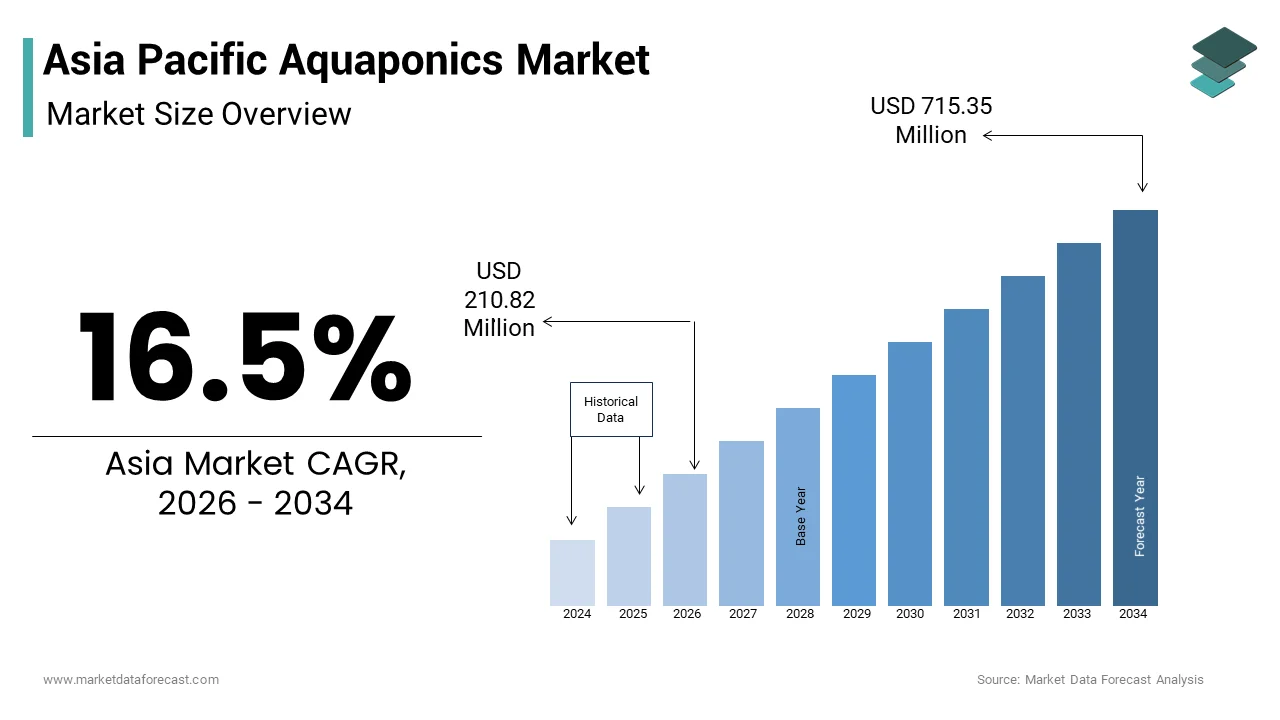
An aquaponics system is a sustainable food production method that links aquaculture (raising fish) with hydroponics (growing plants without soil) in one continuous loop. Fish waste feeds the plants, and the plants clean the water for the fish. This regional market is distinct due to its deep cultural roots in polyculture and its current role as a primary testing ground for climate resilient food production in monsoon dependent and deltaic geographies. According to the Food and Agriculture Organization, Asia accounts for over 90% of global aquaculture production, establishing a major aquatic value chain that accelerates commercial technology integration across regional food systems. As per the Asian Development Bank, developing countries in Asia face a doubling of demand for food and animal feed crops over the next 50 years alongside shrinking land and water resources, driving investments in rural infrastructure and climate-resilient farming techniques. According to the World Bank, East Asia and the Pacific is the world's most vulnerable region to sea-level rise, facing extreme coastal flooding that disrupts agriculture, fisheries, and tourism sectors.
MARKET DRIVERS
Salinity Intrusion and Deltaic Land Degradation
Coastal Agricultural Collapse Necessitates Salt Tolerant Production Alternatives
Rising sea levels and saltwater intrusion in major river deltas across South and Southeast Asia are rendering millions of hectares of traditional farmland unproductive, which drives the growth of the Asia Pacific aquaponics systems market. This creates existential demand for aquaponics systems that operate independently of soil quality. According to the International Rice Research Institute, Vietnam has expanded a sustainable development project targeting one million hectares of high-quality, low-emission rice in the Mekong Delta to transform production mindsets and establish rigorous greenhouse gas measurement protocols. As per the World Bank, coastal lands in Bangladesh are highly affected by soil salinity, prompting collaborative investments in climate-smart agriculture and microloans to scale environmentally sustainable practices across rural enterprises. According to the Food and Agriculture Organization, integrated agro-aquaculture practices combine rice and fish farming to optimize nutrient reuse, improve rural livelihoods, and enhance food security across small-scale Asian farming systems. The environmental pressure transforms aquaponics from optional innovation into survival mechanism for coastal communities facing irreversible land degradation.
Urban Protein Security and Cold Chain Deficits
Periurban Integration Addresses Postharvest Losses and Freshness Demands
Chronic cold chain deficiencies and rapid urbanization across the region create strong economic incentives for periurban aquaponics, which further accelerates the expansion of the Asia Pacific aquaponics system market. This farming method delivers fresh protein and vegetables directly to consumers without refrigerated transport. According to the United Nations Environment Programme, food systems in Southeast Asia require integrated waste valorization strategies and fish value chain tracking to reduce widespread losses and transform traditional small-scale processing models. As per the Asian Development Bank, sub-national cooperation and targeted enterprise management training are being implemented to accelerate private sector development and build technical capacities across the Greater Mekong Subregion. According to the Food and Agriculture Organization, sustainable urbanization in Southeast Asia poses direct challenges to population health, land use patterns, and environmental safety, requiring comprehensive regional policy adjustments. This convergence of logistics failure, consumer preference for freshness, and policy support creates demand dynamics unique to developing Asian megacities.
MARKET RESTRAINTS
Energy Cost Volatility and Grid Reliability Issues
Unstable Power Infrastructure Undermines Operational Viability in Key Markets
Aquaponics systems demand continuous power to maintain water circulation and aeration, which limits the growth of the Asia Pacific aquaponics system market. This requirement creates severe vulnerabilities in developing economies in the region, where grid infrastructure is often unreliable and energy costs are high. According to the Asian Development Bank, expanding regional power infrastructure and grid interconnections across Southeast Asia remains crucial for lowering industrial energy costs, accelerating renewable energy deployment, and enhancing industrial competitiveness. As per the World Bank, severe power shortages and power quality issues across developing Asian territories present major obstacles to manufacturing and business operations, highlighting the urgent need for structural investments in reliable grid networks. According to the International Energy Agency, rural electrification initiatives across developing countries emphasize off-grid solar mini-grids and decentralized energy technologies to establish modern energy services for households lacking stable grid infrastructure. The energy constraint creates a bifurcated market where technology thrives only in wealthy enclaves or subsidized projects while remaining inaccessible to broader populations who could benefit most from resource efficient food production.
Technical Knowledge Gaps and Extension Service Limitations
Human Capital Deficits Cause High Failure Rates Despite Technology Availability
A widespread lack of specialized training in integrated system management causes catastrophic failure rates, which inhibits the expansion of the Asia Pacific aquaponics system market. This deters investment and suppresses adoption across the region despite abundant aquaculture expertise. According to the Food and Agriculture Organization, commercial aquaculture development in developing regions requires comprehensive technical assistance, biosecurity training, and efficient natural resource management to ensure long-term farm productivity and economic sustainability. As per the Asian Fisheries Society, collaborative regional research networks, technical workshops, and regular scientific symposiums are vital for sharing validated data and improving environmental management practices among aquaculture operators across Asia. According to the World Bank, educational and vocational training institutions in developing nations must realign their technical skill programs with emerging labor market demands to cultivate cross-disciplinary technical capacities among young graduates. This human capital deficit means technology availability does not translate to successful deployment, suppressing market growth regardless of favorable environmental or economic conditions.
MARKET OPPORTUNITIES
Integration with Traditional Rice Fish Culture Systems
Modernizing Indigenous Practices Creates Scalable Hybrid Models
The region’s ancient tradition of integrated rice-fish farming provides a unique opportunity to modernize existing practices with aquaponics principles, which is anticipated to propel the growth of the Asia Pacific aquaponics system market by leveraging cultural acceptance and established farmer knowledge bases. According to the Food and Agriculture Organization, integrated rice-fish systems combine crop and aquatic farming to enhance local ecosystem services, naturally reduce pest pressures, and diversify smallholder farming incomes across rural Asian ecosystems. As per the International Rice Research Institute, regional agricultural modernization strategies utilize advanced crop analytics, pest management guidelines, and optimized resource inputs to systematically scale high-yield and low-emission rice production throughout sub-national farm zones. As per the Asian Development Bank, environmental and community-focused climate-smart agriculture programs prioritize the restoration of vulnerable seasonal floodplains and regional water canals to build systemic climate resilience for small-scale rural producers. This pathway avoids greenfield adoption barriers by building on millennia of cultural practice, enabling faster scaling than importing entirely foreign production models.
Solar Powered Off Grid Systems for Remote Communities
Renewable Energy Convergence Unlocks Underserved Geographic Markets
Declining solar photovoltaic costs and a bright tropical sun create new opportunities for the Asia Pacific aquaponics system market. These factors allow for off-grid aquaponics on remote islands, in mountains, and in rural areas once limited by power shortages. According to the International Renewable Energy Agency, the global weighted average levelized cost of electricity from utility-scale solar photovoltaic systems fell by approximately 90% between 2010 and 2024, maintaining a massive cost advantage over fossil fuel alternatives worldwide. As per the Asian Development Bank, structural climate resilience programs across small island developing states deploy specialized regional disaster grants, community-led infrastructure funds, and localized clean energy transitions to protect vulnerable remote populations. The energy independence expands addressable market beyond grid connected urban centers to include millions of rural and island residents currently dependent on expensive imported foods.
MARKET CHALLENGES
Monsoon Climate Extremes and Temperature Management
Seasonal Variability Exceeds Biological Tolerance Thresholds Without Expensive Controls
Extreme seasonal temperature fluctuations and monsoon rainfall patterns across much of the region create harsh environmental conditions, which hamper the growth of the Asia Pacific aquaponics system market. These conditions frequently exceed optimal ranges for aquaponics organisms, requiring costly mitigation measures. According to the World Meteorological Organization, extreme heatwaves and escalating ambient temperatures across South and Southeast Asia intensify heat stress, disrupt inland fisheries, and reduce overall crop and livestock productivity. As per the International Rice Research Institute, regional food security programs deploy climate-resilient rice varieties, alternate wetting and drying methods, and automated weather monitoring systems to help smallholders adapt to shifting monsoon precipitation patterns. These climatic extremes mean that temperate zone system designs frequently fail in tropical Asian contexts without substantial modification, limiting technology transfer and increasing localization costs.
Regulatory Fragmentation Across Aquaculture and Agriculture Sectors
Jurisdictional Silos Create Permitting Barriers and Compliance Uncertainty
Commercial rollout faces delays because regional aquaponics operations fall between separate farming and fishing laws rather than a unified legal framework, which slows down the expansion of the Asia pacific aquaponics system market. According to the Food and Agriculture Organization, scaling up integrated agro-aquaculture practices requires cross-sectoral policy harmonization, technical farmer field schools, and optimized nutrient recycling to improve rural smallholder incomes safely. As per the Asian Development Bank, multi-sectoral technical assistance programs support municipal water utility reforms and collaborative watershed protection projects to ensure equitable distribution between agricultural and commercial users. This regulatory fragmentation increases transaction costs, deters institutional investment, and perpetuates informal sector operations that cannot access formal financing or export markets.
REPORT COVERAGE
| REPORT METRIC | DETAILS |
| Market Size Available | 2025 to 2034 |
| Base Year | 2025 |
| Forecast Period | 2026 to 2034 |
| CAGR | 16.5% |
| Segments Covered | By Equipment, Production Type, Component, Application, and Region |
| Various Analyses Covered | Global, Regional & Country Level Analysis, Segment-Level Analysis, DROC, PESTLE Analysis, Porter’s Five Forces Analysis, Competitive Landscape, Analyst Overview on Investment Opportunities |
| Regions Covered | India, China, Japan, South Korea and Australia, South Africa, New Zealand, Thailand, Malaysia, Vietnam, Philippines, Indonesia, Singapore, and the Rest of the Asia Pacific |
| Market Leaders Profiled | Nelson & Pade Inc., Urban Farms AG, ECF Farm systems GmbH, Backyard Aquaponics Pty Ltd, My Aquaponics, Colorado Aquaponics, and Green Life Aquaponics. |
SEGMENTAL ANALYSIS
By Equipment Insights
Aeration Systems
The aeration systems segment dominated the Asia Pacific aquaponics system market and accounted for a substantial share in 2025. This segment dominated because high ambient temperatures in tropical and subtropical regions reduce dissolved oxygen solubility while simultaneously accelerating metabolic rates of fish and nitrifying bacteria, creating elevated aeration requirements compared to temperate zones. According to the Food and Agriculture Organization, water management in tropical aquaculture requires careful monitoring of water quality parameters, nutrient ratios, and seasonal shifts to support smallholder integrated production across developing regions. As per the Asian Development Bank, environmental and technical assistance programs across vulnerable river basins prioritize climate-resilient farming techniques, public infrastructure investments, and localized technical training to safeguard regional food supply networks. According to the World Bank, severe power supply shortages and infrastructure deficits across developing territories act as critical obstacles to agribusiness operations, highlighting the urgent need for targeted structural investments in reliable energy distribution networks. This climatic and infrastructural reality ensures aeration maintains equipment segment leadership regardless of innovation in other categories.
Fueling this segment's ongoing lead is the linear relationship between production volume and aeration capacity, that prevents achieving the consolidation efficiencies achievable with lighting or testing equipment. According to Wageningen University and Research, upscaling integrated closed-loop farming setups requires a thorough analysis of nutrient mass balances, technical system configurations, and cross-disciplinary biological parameters to guarantee economic feasibility. As per the International Centre for Integrated Mountain Development, mountain-based farming communities rely on climate-resilient water management systems, diversified local crop varieties, and landscape-level adaptation strategies to safeguard food security against extreme weather volatility. This scaling dynamic means aeration revenue grows proportionally with market expansion rather than being displaced by technological consolidation, sustaining segment leadership through all growth phases unique to Asia Pacific’s diverse operational contexts.
Water Quality Testing
The water quality testing equipment segment is on the rise and is expected to be the fastest growing segment in the market by witnessing a CAGR of 16.3% from 2026 to 2034 due to dramatic cost reductions in IoT-enabled sensors, making continuous monitoring accessible to mid-scale operators previously limited to manual spot testing. As per the Asian Development Bank, digital agriculture initiatives and sub-national agritech projects deploy smart water sensors, automated data loggers, and localized weather tools to help smallholder farmers build climate resilience. According to the United Nations Economic and Social Commission for Asia and the Pacific, young entrepreneurs and tech-driven agribusiness enterprises leverage smart digital solutions to modernize regional food value chains and establish sustainable rural livelihoods. This convergence of manufacturing cost reduction, development subsidy, and proven risk mitigation creates adoption velocity exceeding traditional equipment categories.
The swift expansion of this segment gains further momentum from the emergence of export market access and insurance underwriting requirements that transform continuous monitoring from optional best practice to mandatory compliance infrastructure. According to the Global Seafood Alliance, the Best Aquaculture Practices certification standard releases updated biosecurity, environmental, and social responsibility modules to systematically improve traceability across international seafood supply chains. As per major international insurance exchanges, corporate climate risk mitigation frameworks and sustainable investment tools enable businesses to hedge against extreme environmental shocks and align operations with global environmental metrics. These commercial and regulatory drivers decouple testing equipment growth from discretionary spending cycles, ensuring sustained expansion even during economic downturns affecting other equipment categories.
By Production Insights
Fish
The fish production segment led the Asia Pacific aquaponics system market and captured a significant share in 2025. This leading position of the segment was attributed to regional dietary patterns that prioritize aquatic protein, as well as existing aquaculture expertise that provides a ready-made knowledge base, lowering adoption barriers compared to the plant-centric systems common elsewhere. According to the Food and Agriculture Organization, Asia continues to be the dominant global leader in aquaculture, contributing approximately 90% of total farmed aquatic animals and plants to international markets. As per the Asian Development Bank, expanding cross-border energy infrastructure, financing rural smart-grids, and building capacity for agribusiness associations are vital to protect smallholders from structural resource deficits. This biological efficiency combined with cultural acceptance and existing skill sets ensures fish maintains production type leadership despite vegetables generating higher revenue per unit weight in many markets.
The foremost factor securing this segment's leading position is the explicit prioritization of aquatic protein in national food security strategies across Asia-Pacific, that channel public investment toward fish-centric aquaponics systems. According to the Food and Agriculture Organization, commercial aquaculture management guidelines focus on scaling up biosecurity frameworks, technical field schools, and optimized nutrient recycling to improve farm yield stability safely. As per the Asian Development Bank, environmental risk mitigation and regional watershed loans support building physical flood control assets and automated water systems to shield vulnerable deltaic ecosystems. The policy frameworks effectively subsidize fish production components while treating plant outputs as supplementary, reinforcing segment dominance through public expenditure patterns aligned with regional nutritional priorities.
Herbs
The herbs segment is likely to experience the fastest CAGR of 19.7% during the forecast period owing to expanding urban middle class demand for fresh culinary herbs and traditional medicinal plants that command exceptional price premiums. According to the United Nations Economic and Social Commission for Asia and the Pacific, accelerating digital innovation hubs and funding youth-led agribusiness startups helps modernize regional food supply logistics and build sustainable rural pathways. As per the Food and Agriculture Organization, hyper-urbanization in rapid growth zones threatens environmental safety and changes land patterns, creating a pressing need for structural municipal regulatory updates. This convergence of culinary trend, policy incentive, and industrial sourcing creates growth dynamics exceeding broader vegetable category averages.
The fast development of this segment is heightened by the development of value added processing pathways and export opportunities that extend market reach beyond perishable fresh sales to local urban consumers. According to the International Trade Centre, global commerce networks expand by integrating small-scale producers into verified green value chains, standardizing trade documentation, and lowering cross-border regulatory barriers. As per the United Nations Industrial Development Organization, accelerating private sector development in developing regions requires enhancing manufacturing automation, upgrading local product standards, and scaling green technologies. These processing and export pathways diversify revenue streams beyond perishable fresh sales, supporting sustained expansion even as urban fresh herb markets mature in established metropolitan centers.
By Application Insights
Commercial
In 2025, the commercial segment held the majority share in the Asia Pacific aquaponics system market. This segment accounts for over 60 percent of total installed capacity and equipment expenditure, driven by revenue needs that justify high-cost urban infrastructure. According to the Asian Development Bank, expanding regional controlled environment agriculture networks and investing in vertical farming systems help optimize resource efficiency, counter arable land constraints, and enhance urban food security. As per the Food and Agriculture Organization, commercial urban farming models use vertical racks, hydroponic technology, and circular water loops to increase localized food sufficiency in compact, land-constrained cities. This concentration of capital, market integration, and production volume ensures commercial segment maintains market leadership despite visibility of smaller educational and household installations.
The leading position of this segment is bolstered by the alignment of aquaponics with national green economy strategies and sustainable finance frameworks that channel institutional capital toward commercial scale deployments. According to the Asian Development Bank, green financing models and sustainability bond guidelines help mobilize private sector investments toward low-carbon transport systems, renewable energy grids, and climate-resilient water infrastructure. As per the United Nations Environment Programme, cities require structural waste valorization models, circular food systems, and targeted public policies to mitigate urban environmental stress and protect localized biodiversity networks. These policy and finance tailwinds create structural advantages for commercial operators that household and community segments cannot access, sustaining dominance through institutional support ecosystems.
Education and Research
The education and research applications segment is predicted to witness the highest CAGR of 22.4% between 2026 and 2034. This swift expansion of the segment is propelled by government mandated STEM curriculum integration and vocational training programs addressing agricultural workforce shortages. According to the United Nations Educational, Scientific and Cultural Organization, integrating technical science education models and digital literacy frameworks into regional school standards equips students with essential sustainable development competencies. As per the Asian Development Bank, Technical and Vocational Education and Training upgrades utilize localized public-private partnerships and enterprise training programs to reduce youth employment deficits and expand modern technology-supported business skills. This convergence of education policy, workforce development, and regional cooperation creates growth dynamics decoupled from commercial viability metrics, enabling expansion even during economic downturns.
Growth in this segment is propelled by the recognition of aquaponics as an essential platform for technology transfer to smallholders and extension service capacity building across developing Asia Pacific. According to the Food and Agriculture Organization, scaling up sustainable agricultural techniques requires expanding cross-sectoral policy integration, implementing localized farmer field schools, and improving nutrient management to elevate rural smallholder incomes safely. As per the Asian Development Bank, climate-smart community development programs prioritize the rehabilitation of fragile river catchments, automated watershed networks, and resilient rural utilities to guard against extreme environmental variability. These human capital development imperatives create sustained institutional demand that persists through economic cycles and commercial market fluctuations, ensuring segment growth continues regardless of private sector investment sentiment.
REGIONAL ANALYSIS
China Aquaponics System Market Analysis
China was the top performer in the Asia Pacific aquaponics system market and accounted for a 35.2% share in 2025. This dominance of the Chinese market was driven by massive scale of existing aquaculture infrastructure, strong government policy support, and advanced manufacturing capacity for system components. According to the Food and Agriculture Organization, China remains the world's leading producer of farmed aquatic animals and plants, accounting for over 56% of global aquaculture production and dominating the international seafood trade. As per the Ministry of Agriculture and Rural Affairs, China's 14th Five-Year Plan for National Fishery Development prioritizes building a strong aquaculture production base, stabilizing the supply of aquatic products, and driving high-quality modern agricultural transformations. According to the World Bank, China's advanced manufacturing supply chains and low-carbon industrial upgrades provide affordable technological components and solar hardware to support global sustainable development across developing regions. This combination of scale, policy, and manufacturing establishes China as undisputed regional leader whose technology trajectories and pricing benchmarks shape entire Asia Pacific market dynamics.
India Aquaponics System Market Analysis
India was positioned second in the Asia Pacific aquaponics system market and captured an 18.1% share in 2025. This position of the Indian market was supported by strong government mission mode promotion, vast smallholder base, and emerging commercial sector serving urban middle class. According to the National Fisheries Development Board, India’s Pradhan Mantri Matsya Sampada Yojana implements a comprehensive investment of over 20,000 crore rupees to modernize fisheries infrastructure, strengthen domestic value chains, and boost marine export value. According to the Food and Agriculture Organization, India represents the world's second-largest aquaculture producer, utilizing extensive inland networks and smallholder aquatic production systems to drive local economic growth. This combination of policy ambition, demographic scale, and commercial emergence creates distinctive market dynamics where growth occurs simultaneously across subsistence, commercial, and institutional segments.
Japan Aquaponics System Market Analysis
Japan occupies a significant share of the Asia Pacific aquaponics system market due to advanced technology integration, aging rural workforce challenges, and premium domestic market orientation. According to the Ministry of Agriculture, Forestry and Fisheries, Japan's structured agricultural frameworks prioritize expanding smart farming applications, automated greenhouse technologies, and remote monitoring tools to systematically counter rural labor deficits. As per the Food and Agriculture Organization, Japan's domestic seafood sector relies heavily on international imports to satisfy substantial household demand, remaining a major global seafood market despite an overall downward trend in domestic wild-capture production. This combination of technological sophistication, demographic necessity, and diplomatic outreach creates premium market position where quality and automation outweigh cost considerations.
South Korea Aquaponics System Market Analysis
South Korea grew steadily in the Asia Pacific aquaponics system market owing to urban agriculture policies, smart farm initiatives, and strong consumer preference for safe locally produced food. According to the Ministry of Agriculture, Food and Rural Affairs, South Korea's Smart Farm Innovation Valleys establish integrated multi-sectoral hubs to train young entrepreneurs, advance greenhouse technology testing, and expand data-driven agricultural ecosystems. As per the Food and Agriculture Organization, hyper-urbanized metropolitan areas in East Asia drive distinct global shifts in food consumption behavior, necessitating comprehensive spatial supply adjustments and optimized regional cold chain infrastructure. The policy driven ecosystem prioritizes technology intensity and social objectives over pure commercial returns, creating distinctive market dynamics aligned with national development strategy.
Australia Aquaponics System Market Analysis
Australia is expected to grow notably in the Asia Pacific aquaponics system market from 2026 to 2034 due to a focus on arid climate adaptation, strong research infrastructure, and export-oriented technology development. According to the Murray-Darling Basin Authority, Australia's market-based water trading frameworks govern the allocation and transfer of water entitlements to optimize resource distribution efficiency across competing agricultural and regional baseline needs. As per the Commonwealth Scientific and Industrial Research Organisation, agricultural scenario projections focus on building long-term climate resilience, mitigating environmental stresses, and expanding automated digital solutions to protect domestic farming yields through 2050. This combination of environmental necessity, research excellence, and export orientation creates niche but influential market position where innovation drives regional leadership despite smaller absolute scale.
COMPETITIVE LANDSCAPE
Competition in the Asia Pacific aquaponics system market features fragmented rivalry between multinational equipment suppliers regional system integrators local manufacturers and development funded nonprofit organizations vying for position across vastly different economic and geographic contexts. Global leaders compete on technological sophistication and certification compliance while Chinese and Indian manufacturers leverage cost advantages and domestic supply chains to capture volume in price sensitive segments. Differentiation occurs through climate adaptation capability operator training depth and regulatory navigation support rather than specifications alone due to biological system variability undermining standardized comparisons. Commercial operators in developed markets compete on premium product positioning and automation while developing country players emphasize affordability and appropriate technology design. New entrants face barriers including lengthy biological validation periods absent actuarial data for financing and operator dependency preventing pure technology plays from succeeding without service components. Regional competition varies dramatically with Singapore and Japan favoring venture backed high tech facilities while Pacific Islands prioritize donor funded community systems. Ultimately sustainable advantage derives from balancing technical excellence with cultural sensitivity and institutional engagement in this uniquely complex environment where environmental social and policy dimensions intersect requiring multidisciplinary competencies beyond traditional agricultural or aquaculture industry boundaries.
KEY MARKET PLAYERS
The key players dominating the market are
- Nelson & Pade Inc.
- Urban Farms AG
- Pentair AES
- AquaMaof
- Nelson and Pade Inc
- ECF Farm systems GmbH
- Backyard Aquaponics Pty Ltd
- My Aquaponics
- Colorado Aquaponics
- Green Life Aquaponics.
Top Players In The Market
- Pentair AES maintains extensive involvement in the Asia Pacific aquaponics system market through industrial grade water treatment components and integrated recirculating solutions designed for tropical climate reliability. The company recently strengthened its regional position by launching energy efficient regenerative blowers specifically calibrated for high temperature Asian operations reducing aeration compared to conventional equipment. Its digital monitoring platform integration enables remote system management addressing operator skill gaps prevalent in developing markets. These strategic initiatives demonstrate commitment to solving infrastructure constraints unique to Asia Pacific while building regulatory compliance frameworks essential for institutional investment and technology transfer across diverse geographic and economic contexts throughout the region.
- Nelson and Pade Inc contributes significantly to the Asia Pacific aquaponics landscape through standardized system designs and comprehensive training programs adapted for tropical species and monsoon climate challenges. The company recently expanded virtual reality operator training modules in Bahasa Indonesia and Vietnamese languages addressing critical knowledge transfer barriers in key growth markets. Its Master Class certification program now includes Asia Pacific specific curriculum covering native fish species and local regulatory requirements. These actions reinforce positioning as knowledge provider enabling successful technology adoption beyond equipment sales while building human capital infrastructure essential for sustainable industry development across culturally and environmentally diverse contexts.
- AquaMaof serves the Asia Pacific aquaponics system market through modular RAS based integrated systems targeting commercial scale deployments in land constrained urban environments. The company recently completed flagship facility in Singapore serving as regional demonstration site validating technology performance under tropical conditions for prospective buyers across Southeast Asia. Its proprietary biofiltration technology achieves stable nitrification at temperatures exceeding 30 degrees Celsius overcoming biological limitations of temperate zone designs in Asian climates. These targeted expansions demonstrate strategy of premium positioning in developed Asia Pacific markets while leveraging demonstration effects for broader regional influence through proven operational excellence rather than cost competition against local manufacturers.
Top Strategies Used By Key Market Participants
Key players in the Asia Pacific aquaponics system market prioritize localization of system designs and training materials to address diverse climatic conditions cultural preferences and regulatory frameworks across the region. Companies invest heavily in operator education programs delivered in local languages to overcome critical skill gaps that cause widespread system failures and undermine investor confidence. Strategic partnerships with government agencies and research institutions enable access to public funding streams and validation platforms that de risk private sector adoption. Manufacturing hubs in China and India are leveraged to reduce equipment costs making technology accessible across income levels while maintaining quality standards. Integration with renewable energy systems expands addressable markets to off grid locations where conventional agriculture cannot function due to energy constraints. Certification and standardization initiatives create regulatory clarity that accelerates permitting and enables cross border trade within ASEAN frameworks. Commercial operators focus on high value herb and vegetable production aligned with urban middle class dietary trends rather than competing with low cost commodity aquaculture. These multifaceted strategies reflect adaptation to uniquely Asia Pacific combination of environmental diversity developmental heterogeneity and cultural specificity requiring balanced approaches to technology transfer and market development simultaneously.
MARKET SEGMENTATION
This research report on the Asia Pacific Aquaponics systems market is segmented and sub-segmented into the following categories.
By Equipment
- pumps and valves
- water heaters
- grow lights
- fish purge systems
- water quality testing
- aeration systems
- others
By Production Type
- fish
- vegetables & fruits
- herbs
- others
By Component
- rearing tanks
- biofilter
- settling basin
- sump
- hydroponics subsystem
- others
By Application
- commercial
- education & research
- household
- community
- others
By Country
- India
- China
- Japan
- South Korea
- Australia
- New Zealand
- Thailand
- Malaysia
- Vietnam
- Philippines
- Indonesia
- Singapore
- Rest of APAC