Asia Pacific Automotive Heat Shield Market Research Report – Segmented By Product( Single Shell Heat Shields, Double Shell Heat Shields ) Application, Material, Vehicle Type and Country (India, China, Japan, South Korea, Australia, New Zealand, Thailand, Malaysia, Vietnam, Philippines, Indonesia, Singapore and Rest of APAC) - Industry Analysis on Size, Share, Trends& Growth Forecast from 2025 to 2033
Asia Pacific Automotive Heat Shield Market Size
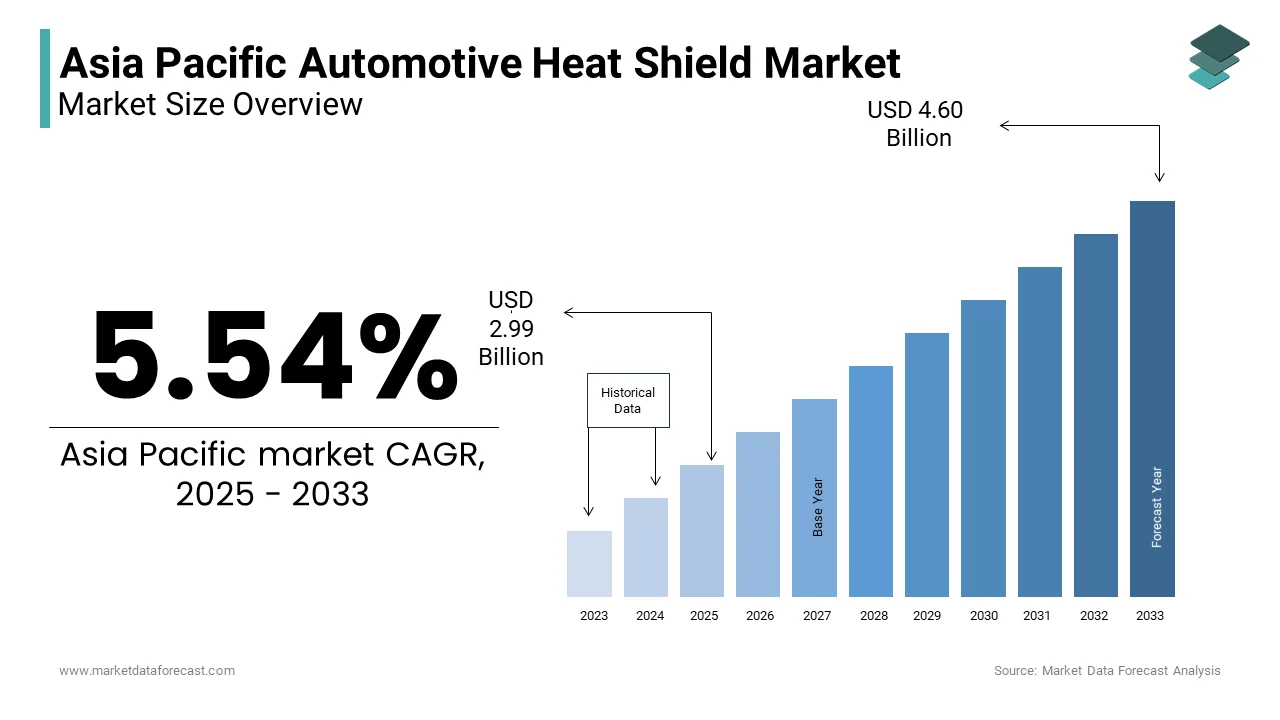
The Asia Pacific Automotive Heat Shield Market Size was valued at USD 2.83 billion in 2024. The Asia Pacific Automotive Heat Shield Market Size is expected to have 5.54% CAGR from 2025 to 2033 and be worth USD 4.60 billion by 2033 from USD 2.99 billion in 2025.
The automotive heat shield market in the Asia Pacific region refers to the specialized segment involved in the production, development, and supply of thermal insulation materials designed to protect vehicle components from excessive heat generated by engines, exhaust systems, and other high-temperature zones. These shields are typically made from advanced composite materials such as aluminum alloys, stainless steel, ceramic composites, and synthetic fiber-based laminates. As vehicles become more technologically sophisticated and compact in design, managing heat dissipation has become a critical engineering priority. This is especially relevant in the context of rising engine performance standards and the proliferation of electric and hybrid vehicles, where battery temperature control plays a pivotal role.
According to the International Organization of Motor Vehicle Manufacturers (OICA), China alone produced more than 27 million passenger cars, contributing significantly to the demand for advanced automotive components like heat shields. The increasing complexity of under-hood environments due to downsized turbocharged engines and electrified powertrains has further intensified the need for effective thermal management solutions across the region.
MARKET DRIVERS
Rise in Demand for High-Performance Vehicles and Turbocharged Engines
One of the key drivers of the Asia Pacific automotive heat shield market is the growing adoption of high-performance vehicles equipped with turbocharged engines. Turbochargers significantly increase engine efficiency and power output but also elevate under-hood temperatures, necessitating robust thermal protection mechanisms. This trend is particularly pronounced in South Korea and Japan, where automakers like Hyundai and Toyota have aggressively integrated turbocharging technologies into their mainstream models. As turbocharged engines generate exhaust gas temperatures exceeding 1,000°C, traditional insulation methods are no longer sufficient. This has led to increased investment in advanced heat shielding materials such as aluminized steel and multi-layered composite foils. In India, for instance, the Society of Indian Automobile Manufacturers (SIAM) reported that turbocharged variants accounted for over 40% of all SUV sales in 2023, directly boosting demand for high-efficiency heat shields. Furthermore, regulatory mandates on emissions and fuel efficiency, especially in China, have pushed automakers to adopt smaller, more efficient engines, which inherently produce higher thermal loads.
Expansion of Electric Vehicle Production and Battery Thermal Management Needs
Another significant driver shaping the Asia Pacific automotive heat shield market is the rapid expansion of electric vehicle (EV) production, which requires specialized thermal management systems to ensure battery safety and longevity. Unlike internal combustion engines, EVs rely on lithium-ion batteries that operate optimally within a narrow temperature range typically between 20°C and 40°C. Exceeding this range can degrade battery performance and pose safety risks, making heat shielding an essential component in EV design. According to BloombergNEF, the Asia Pacific region accounted for approximately 60% of global EV sales in 2023, with China leading the charge at over 9 million units sold. The Chinese Ministry of Industry and Information Technology reported that domestic EV production surpassed 8.7 million units in the same year, underscoring the scale of demand for thermal protection components. In Japan and South Korea, major battery manufacturers such as Panasonic and LG Energy Solution have been integrating advanced heat-resistant materials into battery packs to enhance thermal stability. These developments have spurred demand for customized heat shields that can be embedded within battery modules or placed around high-voltage components. Also, governments across Southeast Asia have introduced incentives to promote EV adoption, further stimulating regional production capacity. Thailand’s Department of Alternative Energy Development and Efficiency noted that local EV production tripled in 2023 compared to the previous year. This surge in EV manufacturing has created a parallel demand for heat shields tailored to electric drivetrains, thereby reinforcing the growth trajectory of the automotive heat shield market in the Asia Pacific.
MARKET RESTRAINTS
Volatility in Raw Material Prices Affecting Production Costs
A significant restraint impacting the Asia Pacific automotive heat shield market is the volatility in raw material prices, particularly for metals such as aluminum and stainless steel, which form the core of most heat shielding products. These materials are subject to fluctuating global commodity markets influenced by geopolitical tensions, trade policies, and supply chain disruptions. This price instability places pressure on manufacturers to either absorb the additional costs or pass them on to automotive OEMs, both of which affect profitability and competitiveness. In India, the Steel Authority of India Limited reported that stainless steel prices rose by nearly 20% in the second half of 2023, citing increased coal and nickel input costs. Such fluctuations make it difficult for heat shield producers to maintain consistent pricing structures, potentially discouraging long-term contracts with automakers who seek stable cost projections. Moreover, the reliance on imported raw materials in countries like Thailand and Indonesia exacerbates vulnerability to exchange rate fluctuations and import duties. The Reserve Bank of India's 2023 economic survey highlighted how currency depreciation against the US dollar increased the landed cost of imported metals, adding another layer of financial burden on local manufacturers.
Stringent Environmental Regulations Impacting Material Choices
Stringent environmental regulations across the Asia Pacific region are increasingly influencing material choices in automotive component manufacturing, including heat shields. Governments are enforcing tighter norms on emissions, recyclability, and hazardous substance usage, which has prompted a shift away from certain conventional materials used in heat shielding. For instance, the European Union’s End-of-Life Vehicle (ELV) Directive, while not directly applicable in Asia, has influenced regional automakers exporting to Europe to adopt cleaner and more sustainable materials. In response, companies in Japan and South Korea have begun phasing out hexavalent chromium-based coatings commonly used in heat shields due to their toxic properties. According to the Environment Ministry of Japan, the country updated its Green Procurement Law in 2023, mandating stricter limits on heavy metal content in automotive components. This has forced heat shield manufacturers to explore alternative surface treatments, which often come with higher production costs and extended development cycles. Similarly, in China, the Ministry of Ecology and Environment introduced new guidelines in 2023 requiring auto part suppliers to disclose chemical compositions and environmental impact assessments, further complicating the sourcing and approval process for traditional heat shield materials. India’s Bureau of Indian Standards (BIS) also revised its automotive material compliance norms in early 2024, aligning them more closely with global sustainability benchmarks. While these changes support broader environmental goals, they create short-to-medium term challenges for heat shield manufacturers adapting to new specifications.
MARKET OPPORTUNITIES
Growth in Lightweight Material Adoption for Fuel-Efficient Vehicles
A promising opportunity emerging in the Asia Pacific automotive heat shield market is the increasing adoption of lightweight materials aimed at improving fuel efficiency and reducing vehicle emissions. Automakers across the region are prioritizing weight reduction strategies to comply with tightening fuel economy standards and consumer demand for better mileage. Traditional metallic heat shields, while effective, add considerable weight to vehicle systems. In contrast, newer alternatives such as aramid fiber composites, ceramic-coated fabrics, and thermoplastic elastomers offer comparable thermal resistance with significantly lower mass.
According to the Japan Automobile Research Institute (JARI), replacing conventional steel heat shields with lightweight composites can reduce under-hood weight by up to 30%, contributing to overall vehicle efficiency gains. Similarly, in India, Maruti Suzuki announced a partnership with domestic material suppliers to develop ultra-lightweight heat shields for its compact car lineup, aiming to achieve a improvement in fuel efficiency.
China’s Ministry of Industry and Information Technology also emphasized lightweighting as a strategic objective in its 2023 automotive development roadmap, encouraging the use of advanced polymers and aerogel-based insulations in next-generation vehicles.
Expansion of Aftermarket and Customization Trends in Performance Vehicles
An emerging opportunity in the Asia Pacific automotive heat shield market lies in the growing aftermarket segment, particularly among enthusiasts of performance and modified vehicles. As consumer interest in vehicle customization increases, especially in countries like Japan, Australia, and Thailand, there is a rising demand for premium heat shielding solutions that enhance engine performance, aesthetics, and durability. Unlike original equipment manufacturer (OEM) applications, aftermarket heat shields allow for greater flexibility in design, material selection, and installation, catering to niche audiences seeking optimized thermal management. According to the Specialty Equipment Market Association (SEMA), the Asia Pacific aftermarket industry grew by over 8% in 2023, with performance tuning and thermal protection products accounting for a significant share. This expanding aftermarket ecosystem provides a lucrative avenue for heat shield manufacturers to diversify their revenue streams beyond OEM partnerships.
MARKET CHALLENGES
Complexity in Meeting Diverse Regional Regulatory Standards
A notable challenge facing the Asia Pacific automotive heat shield market is the complexity of complying with diverse regional regulatory standards across different countries. Each nation in the region has its own set of automotive safety, emissions, and material certification requirements, making it difficult for manufacturers to standardize product designs and streamline production processes. For example, Japan follows the Automotive Technical Regulations enforced by the Ministry of Land, Infrastructure, Transport and Tourism (MLIT), while India adheres to the Automotive Industry Standard (AIS) norms issued by the Bureau of Indian Standards (BIS). These differing protocols often require separate testing, documentation, and approval procedures, increasing time-to-market and operational costs. According to the Asian Productivity Organization (APO), harmonization of technical regulations across the region remains incomplete, with over 40% of automotive component manufacturers citing regulatory divergence as a major barrier to cross-border expansion. This regulatory fragmentation forces multinational suppliers to invest heavily in localized compliance teams and facility modifications. Furthermore, evolving standards related to electromagnetic interference (EMI) shielding in electric vehicles have added another layer of complexity. South Korea’s Korea Agency for Technology and Standards (KATS) introduced new EMI compliance norms in 2023, affecting the design of metallic heat shields used near high-voltage components.
Supply Chain Disruptions Due to Geopolitical Tensions and Natural Disasters
Geopolitical tensions and frequent natural disasters in the Asia Pacific region present a persistent challenge to the stability of the automotive heat shield supply chain. Countries like China, Japan, and South Korea serve as major hubs for raw material processing and component manufacturing, yet they remain vulnerable to external shocks such as trade disputes, pandemics, and climate-related events. For instance, the ongoing U.S.-China trade conflict has led to increased tariffs on aluminum and steel imports, raising procurement costs for downstream industries, including heat shield producers. Natural disasters further compound these issues. Similarly, Thailand’s automotive industry was affected by severe monsoon flooding in late 2023, which impacted transport routes and delayed raw material deliveries to local heat shield manufacturers. These disruptions lead to extended lead times, inventory shortages, and increased production costs, ultimately affecting the availability and pricing of heat shielding products across the region.
REPORT COVERAGE
| REPORT METRIC | DETAILS |
| Market Size Available | 2024 to 2033 |
| Base Year | 2024 |
| Forecast Period | 2025 to 2033 |
| CAGR | 5.54 % |
| Segments Covered | By Product, Application, Material, Vehicle Type and Country. |
| Various Analyses Covered | Global, Regional & Country Level Analysis, Segment-Level Analysis; DROC, PESTLE Analysis, Porter's Five Forces Analysis, Competitive Landscape, Analyst Overview of Investment Opportunities |
| Country Covered | China, India, Japan, South Korea, Australia, New Zealand, Thailand, Indonesia, Philippines, Vietnam, Singapore, Rest of APAC. |
| Market Leader Profiled | DuPont, Dana Limited, Zircotec Ltd, Morgan Advanced Materials, Autoneum, ElringKlinger AG |
SEGMENTAL ANALYSIS
By Product Insights
In 2024, the single shell heat shield segment accounted for a 58.5% of the Asia Pacific automotive heat shield market, making it the dominant product category. This dominance is primarily attributed to its widespread use in mainstream passenger cars and light commercial vehicles where cost efficiency and moderate thermal protection are prioritized over advanced insulation. According to the International Organization of Motor Vehicle Manufacturers (OICA), Asia Pacific produced over 52 million vehicles in 2023, with a majority being compact and mid-sized cars that typically employ single-shell shielding solutions due to their simpler design and lower manufacturing costs. Additionally, regulatory mandates across ASEAN countries favor cost-effective components that meet minimum safety and emissions standards.
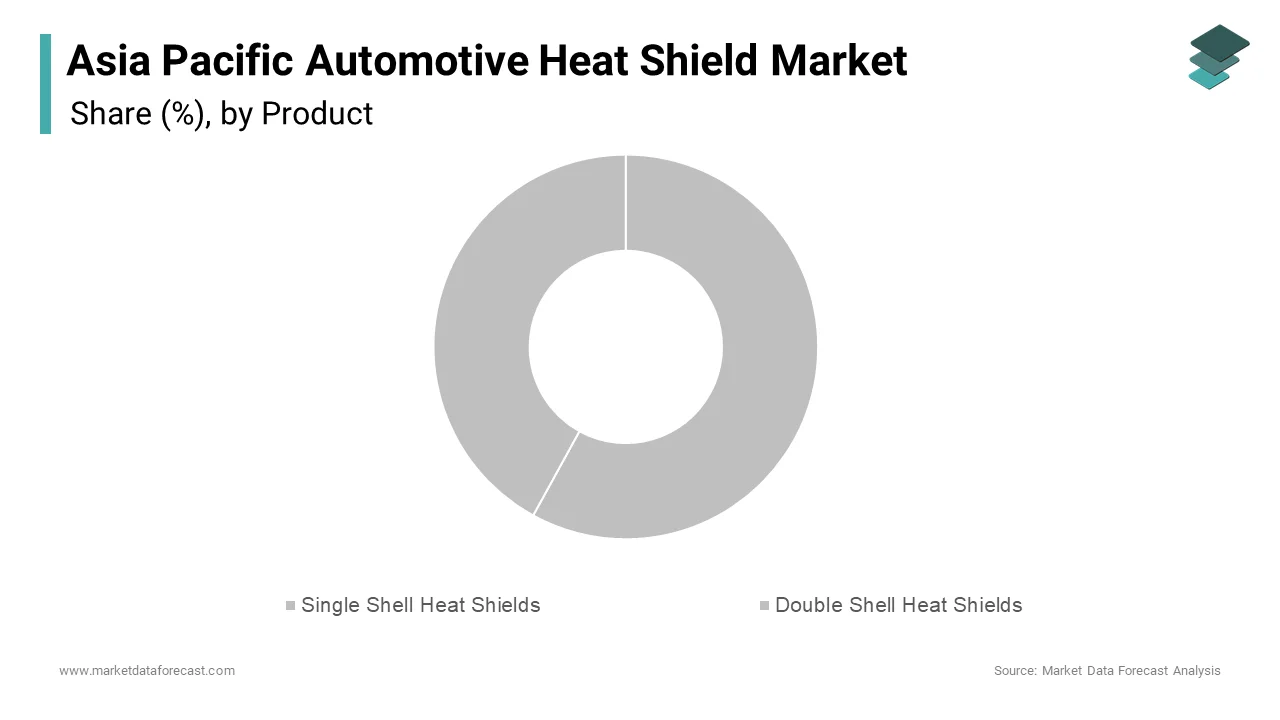
The double shell heat shield segment is projected to register the highest CAGR of 9.6% during the forecast. This rapid growth is driven by increasing adoption in high-performance engines, electric vehicles, and premium automotive segments where superior thermal insulation is critical. One key factor fueling this expansion is the growing penetration of turbocharged and hybrid powertrains in Asia Pacific markets. These shields provide enhanced protection by creating an air gap between two metallic layers, significantly reducing heat transfer to surrounding components. Another major driver is the surge in electric vehicle (EV) production, particularly in China. BloombergNEF reported that China accounted for over 60% of global EV sales in 2023, with manufacturers such as BYD and NIO integrating double-shell shielding into battery enclosures to prevent thermal runaway and improve system longevity. The Chinese Ministry of Industry and Information Technology also introduced stricter thermal safety regulations for EVs in 2023, further reinforcing the need for multi-layered insulation systems.
By Application Insights
The exhaust system application had the largest share of the Asia Pacific automotive heat shield market by accounting for a 41.2% of total demand in 2024. This is primarily due to the extensive usage of heat shields in exhaust manifolds, catalytic converters, and mufflers, where temperatures often exceed 700°C, necessitating robust thermal insulation to protect adjacent components and enhance vehicle durability. In China, it was reported that government emission norms have led to increased complexity in exhaust after-treatment systems, requiring additional layers of thermal protection to ensure optimal functioning of particulate filters and catalytic converters. Furthermore, in India, the Bureau of Indian Standards (BIS) updated its Bharat Stage VI (BS-VI) emission norms in 2023, mandating higher thermal resistance in exhaust components. As a result, local manufacturers such as Bosch and Mahindra have incorporated multi-layered heat shields in their exhaust modules to comply with these stringent regulations.
In the other hand, the turbocharger segment is anticipated to grow at the fastest CAGR of 10.4% which is driven by the increasing adoption of downsized, turbocharged engines across the Asia Pacific region. Turbochargers operate under extreme thermal conditions, often reaching temperatures above 1,000°C, necessitating high-performance heat shielding to maintain engine reliability and efficiency. This shift has been largely influenced by consumer preference for improved fuel economy without compromising performance, prompting automakers like Toyota and Hyundai to integrate advanced heat shielding materials such as ceramic-coated steel and composite wraps around turbo housings. In China, turbocharged variants accounted for over 50% of all passenger car sales in 2023, with domestic brands leading the charge in adopting dual-shell heat shields to manage thermal stress on nearby electronics and wiring harnesses.
By Material Insights
The metallic heat shields segment accounted for the biggest material segment in the Asia Pacific automotive industry, capturing a 67.2% of the market in 2024. This is due to their superior thermal conductivity, mechanical strength, and cost-effectiveness, making them ideal for high-temperature applications such as exhaust systems and engine compartments. India’s Automotive Component Manufacturers Association (ACMA) also highlighted that metallic heat shields remain the preferred choice among original equipment manufacturers (OEMs) due to their compatibility with existing production lines and ease of integration with traditional manufacturing processes. Moreover, in South Korea, companies such as Hyundai Mobis have continued to rely on stamped and formed metal shields for both internal combustion engine (ICE) and hybrid electric vehicles (HEVs), citing durability and long-term performance benefits.
The non-metallic heat shield segment is projected to grow at the highest CAGR of 11.2% and is fueled by the increasing demand for lightweight, thermally efficient materials in electric vehicles (EVs), performance cars, and next-generation automotive architectures. One of the primary drivers of this growth is the rise in EV production across the Asia Pacific region. According to BloombergNEF, China alone manufactured over 9 million electric vehicles in 2023, representing nearly 60% of global EV output. Unlike traditional internal combustion engines, EVs require highly specialized thermal management systems to regulate battery pack temperatures, prompting manufacturers to adopt non-metallic alternatives such as aramid fiber composites, aerogel-insulated fabrics, and polymer-based coatings. Similarly, in South Korea, LG Energy Solution announced in early 2024 that it had transitioned to non-conductive, fire-retardant insulation materials to enhance battery safety and longevity. Also, regulatory pressure to reduce vehicle emissions and improve fuel efficiency has accelerated the shift toward lighter materials.
By Vehicle Type Insights
The passenger cars are spearheaded the Asia Pacific automotive heat shield market by accounting for a 54.5% of total demand in 2024. This is primarily driven by the sheer volume of passenger vehicle production across the region, especially in China, India, and Southeast Asia, where urbanization and rising disposable incomes have fueled mass-market automobile adoption. According to the International Organization of Motor Vehicle Manufacturers (OICA), China alone produced over 27 million passenger cars in 2023, representing nearly one-third of global output. This massive production base translates into significant demand for heat shielding components, particularly in turbocharged and hybrid models where thermal management is critical. —vehicles that extensively use heat shields in exhaust systems and engine compartments. Moreover, Japan and South Korea continue to be major exporters of premium passenger vehicles, many of which incorporate advanced heat shielding technologies to enhance engine performance and cabin comfort.
The Light Commercial Vehicle (LCV) segment is anticipated to exhibit the swiftest expansion in the Asia Pacific automotive heat shield market, registering a CAGR of 9.8%. This acceleration is primarily attributed to the expanding logistics and e-commerce sectors, which have spurred demand for delivery vans, pickup trucks, and small cargo carriers across the region. Many of these vehicles, including electric LCVs from Tata Motors and Mahindra Electric, incorporate advanced heat shielding materials to protect battery packs and exhaust components from thermal degradation.
In China, the China Association of Automobile Manufacturers (CAAM) reported that LCV production exceeded 5 million units in 2023, with state-backed logistics firms investing heavily in modernized fleets equipped with turbocharged diesel engines. These engines generate higher under-hood temperatures, necessitating enhanced thermal protection through dual-shell and ceramic-coated heat shields.
COUNTRY LEVEL ANALYSIS
China held the largest share of the Asia Pacific automotive heat shield market by accounting for a 38.8% of total demand in 2024 . As the world’s largest automotive manufacturer and exporter, China's dominance stems from its vast production capacity, extensive supply chain infrastructure, and rapid adoption of electric vehicles (EVs). According to the China Association of Automobile Manufacturers (CAAM), the country produced over 27 million passenger cars and 5 million commercial vehicles in 2023, generating immense demand for heat shielding components in exhaust systems, turbochargers, and battery enclosures. Additionally, BloombergNEF reported that China accounted for nearly 60% of global EV sales in 2023, with manufacturers such as BYD and XPeng integrating advanced thermal protection systems to enhance battery safety and longevity. Government policies, including subsidies for green energy vehicles and strict emission norms, have further intensified the need for high-performance heat shields.
Japan is positioning it as the second-largest contributor in the region. The country’s well-established automotive industry, characterized by high-quality engineering and technological innovation, drives consistent demand for advanced thermal protection systems. According to the Japan Automobile Manufacturers Association (JAMA), domestic vehicle production reached over 8 million units in 2023, with major automakers like Toyota, Honda, and Nissan incorporating sophisticated heat shielding solutions in both internal combustion engine (ICE) and hybrid electric vehicles (HEVs). Additionally, the Ministry of Economy, Trade and Industry (METI) emphasized the importance of thermal management in next-generation mobility solutions, supporting research initiatives focused on lightweight and high-temperature resistant materials. In the EV segment, Panasonic Energy and Denso have integrated advanced non-metallic heat barriers within battery modules to optimize thermal regulation.
India is emerging as a rapidly growing contributor due to its expanding automotive manufacturing base and rising demand for fuel-efficient vehicles. The country’s thriving passenger car and commercial vehicle industries, coupled with evolving emission norms, have intensified the need for effective thermal insulation solutions. A significant portion of these vehicles featured turbocharged engines and hybrid variants, which require enhanced heat shielding to manage increased under-hood temperatures. The Bureau of Indian Standards (BIS) also reinforced stricter Bharat Stage VI (BS-VI) emission norms in 2023, compelling manufacturers to adopt advanced shielding materials to protect sensitive engine components.
South Korea market is driven by its strong presence in high-end automotive manufacturing and advanced thermal management technologies. The country is home to globally recognized automakers such as Hyundai and Kia, which integrate sophisticated heat shielding solutions in both conventional and electrified powertrains. These vehicles increasingly feature dual-shell and ceramic-coated heat shields designed to protect electronic control units, exhaust systems, and turbocharger assemblies from excessive thermal exposure. Also, the South Korean government has actively promoted electric vehicle (EV) development through subsidies and infrastructure investments.
Thailand is emerging as a key production hub for both traditional and electric vehicles in Southeast Asia. The country’s automotive industry, supported by strong foreign investments and government incentives, has seen a steady increase in demand for thermal protection components. Major automakers such as Toyota, Honda, and Ford operate large-scale manufacturing facilities in the country, producing a wide range of passenger cars and commercial vehicles that incorporate heat shielding in exhaust systems, engine compartments, and turbocharger assemblies. Companies such as Denso Thailand and Sumec Auto Components have expanded their production capacities to meet the rising demand for customized shielding solutions tailored to both ICE and electric powertrains.
KEY MARKET PLAYERS AND COMPETITIVE LANDSCAPE
Companies playing a prominent role in the Asia Pacific automotive heat shield market are DuPont, Dana Limited, Zircotec Ltd, Morgan Advanced Materials, Autoneum, ElringKlinger AG, Lydall, Inc., Tenneco Inc., CARCOUSTICS, UGN Inc.
The Asia Pacific automotive heat shield market features a dynamic and highly competitive environment, shaped by the presence of global and regional players striving to maintain technological leadership and market dominance. Competition is primarily driven by innovation in material science, customization capabilities, and strategic positioning within key automotive manufacturing hubs. As vehicle design becomes increasingly complex, particularly with the rise of electrification and downsized turbocharged engines, manufacturers must continuously refine their offerings to meet stringent thermal management requirements. This has led to intensified rivalry among suppliers who are investing heavily in R&D to develop advanced heat shielding solutions that provide superior protection without compromising weight or cost efficiency. Additionally, customer relationships play a crucial role, with leading firms securing long-term contracts with major automakers to ensure stable revenue streams. At the same time, emerging local players are gaining traction by offering cost-effective alternatives, further intensifying competition.
Top Players in the Market
Dana Incorporated
Dana Incorporated is a leading global supplier of drivetrain, sealing, and thermal management solutions, playing a pivotal role in the automotive heat shield market. In the Asia Pacific region, Dana has established a strong presence through its advanced product portfolio tailored for internal combustion engines and electric vehicles. The company’s focus on developing high-performance heat shielding materials ensures durability and efficiency across diverse automotive applications. Dana's continuous investment in R&D enables it to stay ahead in innovation, meeting evolving industry demands while supporting major automakers in enhancing vehicle performance and thermal safety.
Marelli Holdings Co., Ltd.
Marelli is a renowned automotive systems supplier with a significant footprint in the Asia Pacific market. Known for its comprehensive range of thermal protection components, Marelli offers customized heat shield solutions that cater to both conventional and hybrid powertrains. The company leverages its engineering expertise to design lightweight yet robust shields that enhance engine efficiency and reduce emissions. With manufacturing facilities across Japan, China, and Southeast Asia, Marelli plays a crucial role in supplying heat shielding systems to major OEMs, contributing to safer and more efficient vehicle designs across the region.
ElringKlinger AG (Asia Pacific Operations)
ElringKlinger is a globally recognized manufacturer of functional components for the automotive industry, including advanced heat shielding systems. In the Asia Pacific region, the company has expanded its operations to meet rising demand from local and international automakers seeking high-quality thermal protection. ElringKlinger emphasizes material innovation and precision engineering to deliver heat shields that offer superior insulation properties and long-term reliability. Its commitment to sustainability and compliance with stringent environmental regulations makes it a preferred partner for automotive manufacturers aiming to optimize thermal management in next-generation vehicles.
Top Strategies Used by Key Market Participants
One of the primary strategies employed by key players in the Asia Pacific automotive heat shield market is product innovation and material advancement . Companies are continuously investing in research and development to create lightweight, durable, and thermally efficient shielding solutions. By leveraging new composite materials and surface treatments, manufacturers aim to enhance performance while complying with stricter emission norms and fuel efficiency standards.
Another critical strategy is strategic partnerships and collaborations with automotive OEMs . Leading suppliers work closely with original equipment manufacturers to co-develop customized heat shielding systems that integrate seamlessly into new vehicle platforms. These collaborations allow for early involvement in design processes, ensuring alignment with evolving automotive technologies such as electrification and downsized turbocharged engines.
Lastly, companies are focusing on regional expansion and localized production capabilities . Establishing manufacturing units and distribution networks within key markets like China, India, and Thailand helps firms reduce costs, improve supply chain efficiency, and respond swiftly to regional demand fluctuations. This localization strategy strengthens their competitive edge and ensures better service delivery across the Asia Pacific region.
RECENT HAPPENINGS IN THE MARKET
In February 2024, Dana Incorporated launched a new line of high-temperature resistant heat shields specifically designed for hybrid and electric vehicles, expanding its thermal management portfolio in the Asia Pacific region. This move was aimed at strengthening its position in the growing EV market by providing innovative solutions that enhance battery safety and efficiency.
In May 2024, Marelli announced a strategic partnership with a leading Japanese automaker to co-develop next-generation heat shielding systems for turbocharged gasoline engines. The collaboration focused on integrating advanced materials to improve under-hood thermal protection while reducing overall vehicle weight, aligning with the automaker’s fuel efficiency goals.
In July 2024, ElringKlinger opened a new production facility in Thailand to support increasing demand from local automotive manufacturers. This expansion enabled faster response times to regional clients and reinforced the company’s ability to supply customized heat shielding solutions tailored to specific vehicle architectures.
In September 2024, a prominent Indian heat shield manufacturer entered into a joint venture with a South Korean material technology firm to develop lightweight composite-based thermal barriers. The partnership aimed to introduce high-performance, cost-effective heat shielding products suitable for mass-market passenger vehicles in emerging Asian economies.
In November 2024, a leading Chinese automotive component supplier introduced an automated heat shield manufacturing unit in Guangzhou, enhancing production efficiency and quality consistency. This initiative supported the company’s goal of scaling up output to meet the rising demand from domestic EV producers and global OEMs operating in China.
MARKET SEGMENTATION
This research report on the asia pacific automotive heat shield market has been segmented and sub-segmented into the following.
By Product
- Single Shell Heat Shields
- Double Shell Heat Shields
By Application
- Exhaust System
- Turbocharger
By Material
- Metallic Heat Shields
- Non-Metallic Heat Shields
By Vehicle Type
- Passenger Cars
- Light Commercial Vehicles (LCVs)
By Country
- China
- India
- Japan
- South Korea
- Australia
- New Zealand
- Thailand
- Indonesia
- Philippines
- Vietnam
- Singapore
- Rest of APAC
Frequently Asked Questions
Who are the major players in the Asia Pacific automotive heat shield market?
Prominent companies operating in this market include are ElringKlinger AG Federal-Mogul LLC Dana Incorporated Tenneco Inc.
What is the current size and growth rate of the Asia Pacific automotive heat shield market?
Understanding the market's current value, growth trends, and projected future size.
Which countries in the Asia Pacific region are the largest markets for automotive heat shields?
Insights into leading markets like China, Japan, India, South Korea, and Southeast Asian countries.
Access the study in MULTIPLE FORMATS
Purchase options starting from
$ 2000
Didn’t find what you’re looking for?
TALK TO OUR ANALYST TEAM
Need something within your budget?
NO WORRIES! WE GOT YOU COVERED!
Call us on: +1 888 702 9696 (U.S Toll Free)
Write to us: sales@marketdataforecast.com