- Product Description Description
- Table of Contents TOC
- List of Table & Figure LOT
- Get Free Sample PDF Sample PDF
Market Size, 2025
$13.24 BnMarket Estimate, 2026
$13.99 BnMarket Forecast, 2034
$21.75 BnCAGR, 2026–2034
5.67%Asia Pacific Automotive Lead Acid Batteries Market Size, Growth, Trends & Forecast (2025–2033)
The Asia Pacific automotive lead acid batteries market size was valued at USD 13.24 billion in 2025, is anticipated to reach USD 13.99 billion in 2026, and is projected to scale up to USD 21.75 billion by 2034, registering a compound annual growth rate (CAGR) of 7% during the forecast period from 2026 to 2034. Driven by the expansion of aftermarket networks and rising demand for stop-start vehicle technology, the industry continues to expand steadily across the region.
Key Executive Metrics (At-a-Glance)
- 2025 Base Valuation: USD 13.24 Billion
- 2026 Current Valuation: USD 13.99 Billion
- 2034 Forecast Valuation: USD 21.75 Billion
- Compound Annual Growth Rate (CAGR): 7% (2026–2034)
- Dominant Product Type: SLI (Starting, Lighting, and Ignition) Batteries (capturing 58.5% market share in 2024 due to essential functions in ICE vehicles)
- Dominant Application Segment: Passenger Cars (accounting for 43.7% of total demand in 2024)
- Fastest-Growing Segment: Micro Hybrid Batteries / EFB (expanding at a CAGR of 10.1% to 11.5% driven by emission standards)
- Dominant Region: China (holding 30.4% of regional demand in 2024)
Core Market Drivers
- Aftermarket Network Expansion: Rapid growth of post-sale replacements fueled by aging vehicle populations in India, Indonesia, and the Philippines.
- Stop-Start Vehicle Technology: Increasing adoption of idle-stop systems in internal combustion engine (ICE) vehicles to reduce fuel consumption.
Primary Market Restraints & Challenges
- Environmental & Raw Material Pressures: Tightening regulations on lead usage, recycling challenges, and high price volatility of raw materials.
Asia Pacific Automotive Lead Acid Batteries Market Segmentation Breakdown
| Segment Category | Leading Sub-Segment (2025 Base) | Fastest-Growing Sub-Segment (2025–2034) |
|---|---|---|
| By Product | SLI Batteries (holding 58.5% share in 2024) | Micro Hybrid / EFB Batteries (growing at a CAGR of 10.1% to 11.5%) |
| By Vehicle Type | Passenger Cars (accounting for 43.7% share) | Hybrid Electric Vehicles / HEVs (projected at a CAGR of 9.2%) |
| By Customer Segment | Replacement Segment (holding 62.4% share) | OEM Segment (growing at a CAGR of 8.4%) |
| By Region | China (holding 30.4% regional demand) | India (rapidly expanding across aftermarket and OEM sectors) |
Major Industry Players Profiled
Key enterprises shaping the competitive Asia Pacific automotive lead acid batteries market include C&D Technologies, Inc., CSB Battery Co., Ltd., Hitachi Chemical Energy Technology Co. Ltd., East Penn Manufacturing Company, Enersys Inc., Exide Industries Ltd., Exide Technologies Inc., GS Yuasa Corporation, and Johnson Controls Inc.
Asia Pacific Automotive Lead Acid Batteries Market Size
The Asia Pacific automotive lead acid batteries market size was valued at USD 13.24 billion in 2025 and is anticipated to reach a valuation of USD 13.99 billion in 2026 and USD 21.75 billion by 2034, growing at a CAGR of 7% from 2026 to 2034.
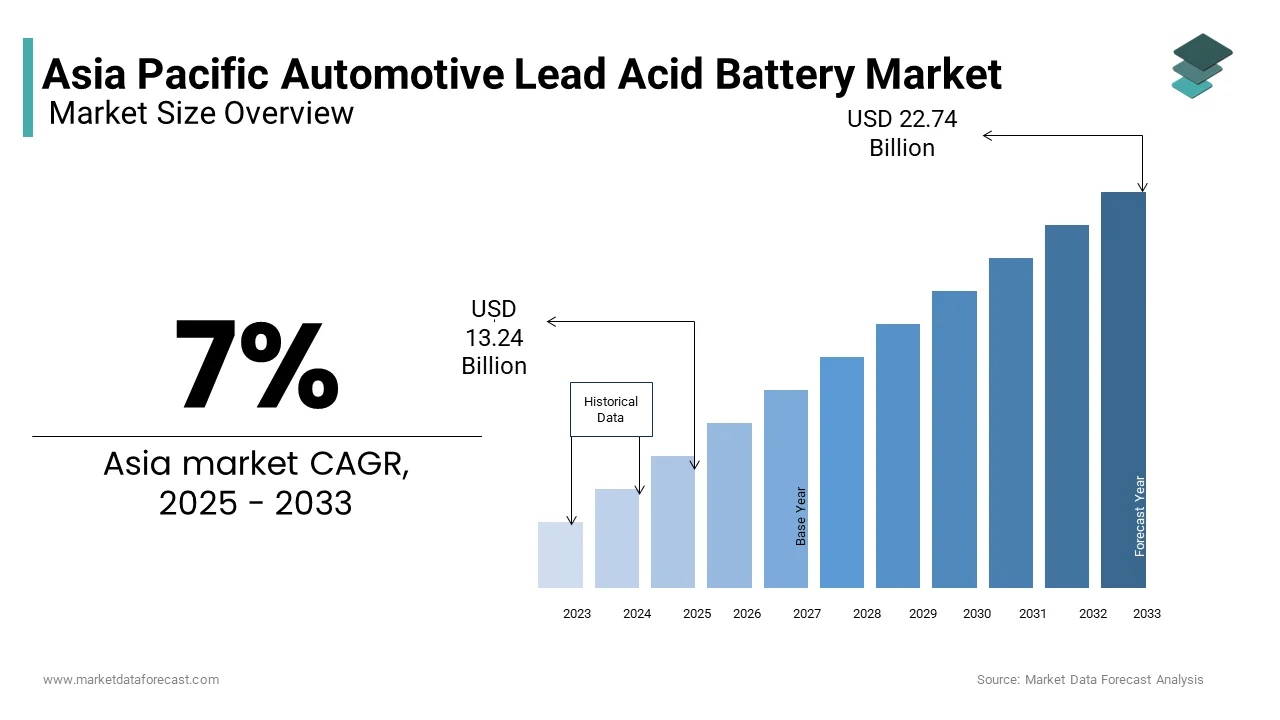
The Asia Pacific automotive lead acid battery market involves the production, distribution, and utilization of lead-acid batteries for use in various types of vehicles, primarily internal combustion engine (ICE) vehicles. These batteries are essential components for powering ignition systems, lighting, electronic accessories, and auxiliary systems within automobiles. Despite the global shift toward lithium-ion batteries due to electric vehicle adoption, lead-acid batteries remain dominant in applications requiring reliable starting, lighting, and ignition (SLI) power.
MARKET DRIVERS
Expansion of the Aftermarket Distribution Network
One of the key drivers fueling the Asia Pacific automotive lead acid battery market is the rapid expansion of the aftermarket distribution network. Unlike original equipment manufacturer (OEM) channels, where battery installation occurs at the point of vehicle assembly, the aftermarket segment involves post-sale replacements, which represent a significant portion of total demand. This trend is largely fueled by the rising number of aging vehicles on the road, especially in emerging markets like India, Indonesia, and the Philippines. For instance, in India alone, there were over 180 million registered vehicles in 2023, with an average age exceeding 12 years. As lead acid batteries typically have a lifespan of 3 to 5 years, the frequency of replacements increases proportionally with the growth in vehicle population. Moreover, the presence of well-established battery distributors and service-oriented retailers has made it easier for consumers to access affordable and readily available replacements. Local manufacturers, including Exide Industries and GS Yuasa, have capitalized on this opportunity by strengthening their dealer networks and offering value-added services such as doorstep battery replacement and free diagnostics. As per McKinsey & Company, after-sales battery services grew notably year-on-year between 2022 and 2024 in Southeast Asia, reflecting a shift in consumer preference toward cost-effective, locally available solutions over premium OEM offerings.
Rising Demand for Stop-Start Vehicle Technology
Another major driver of the Asia Pacific automotive lead acid battery market is the increasing adoption of stop-start technology in internal combustion engine (ICE) vehicles. This system automatically shuts off the engine when the vehicle is stationary and restarts it when the driver engages the accelerator or clutch, thereby reducing fuel consumption and emissions. The majority of vehicles equipped with this feature rely on advanced flooded lead acid (AFLA) batteries or enhanced flooded batteries (EFB), which offer improved cycling performance compared to conventional lead acid batteries. In China specifically, government mandates aimed at improving fleet-level fuel efficiency have encouraged automakers to integrate mild hybrid technologies that depend heavily on EFB-based systems. By 2024, a significant percentage of new light-duty vehicles sold in India incorporated some form of start-stop functionality, further boosting the demand for high-performance lead acid batteries. As per the Society of Indian Automobile Manufacturers, this shift contributed to a 15% increase in EFB battery shipments between 2022 and 2024.
MARKET RESTRAINT
Environmental Regulations and Recycling Challenges
A significant restraint facing the Asia Pacific automotive lead acid battery market is the tightening of environmental regulations concerning lead usage and battery disposal. Although lead acid batteries are among the most recycled consumer products globally, improper handling during the recycling process can result in severe ecological damage. In response, several governments in the region have imposed stricter guidelines for the collection, transportation, and processing of used lead acid (ULA) batteries. The enforcement of mandatory licensing requirements and higher operational standards has led to the closure of numerous small-scale recyclers, creating supply chain disruptions for raw material sourcing.
Similarly, in India, the Ministry of Environment, Forest and Climate Change introduced amendments to the Batteries (Management and Handling) Rules in 2022, mandating formalized recycling practices and extended producer responsibility (EPR) for manufacturers. As per a study conducted by TERI (The Energy and Resources Institute), only about 55% of lead acid batteries were officially recycled in India in 2023, down from 65% in 2020 due to implementation challenges. These regulatory hurdles not only increase compliance costs for companies but also reduce the availability of recycled lead, impacting overall production economics.
Competition from Alternative Battery Chemistries
The Asia Pacific automotive lead acid battery market faces growing competition from alternative battery chemistries, particularly lithium-ion and absorbed glass mat (AGM) variants. While lead acid batteries remain dominant in traditional ICE vehicles due to their low cost and established infrastructure, the gradual shift toward electric mobility and advanced energy storage systems is eroding their market share.
Lithium-ion batteries, widely adopted in hybrid and fully electric vehicles, offer superior energy density, longer lifecycles, and faster charging capabilities. In 2024, China alone accounted for over 60% of global lithium-ion battery production capacity, giving domestic automakers an edge in transitioning away from lead-based systems.
In addition, AGM batteries often considered an upgraded version of lead acid technology are gaining traction in high-end ICE vehicles and micro-hybrid applications due to their ability to support stop-start functions more efficiently than standard EFB units. However, their higher cost relative to conventional lead acid batteries limits mass-market penetration.
MARKET OPPORTUNITY
Growth in Micro-Hybrid Vehicle Production
One of the emerging opportunities for the Asia Pacific automotive lead acid battery market lies in the increasing production of micro-hybrid vehicles, which utilize 12V or 48V electrical systems powered primarily by enhanced flooded batteries (EFB) or absorbed glass mat (AGM) batteries. These systems enable fuel-saving features such as regenerative braking, torque assistance, and idle-stop mechanisms without the complexity and cost associated with full hybrid or electric drivetrains. In 2024, over 25% of new passenger vehicles produced in China integrated 12V or 48V micro-hybrid systems, according to data released by LMC Automotive. This trend is being supported by stringent emission norms and the need for automakers to meet fuel efficiency targets without a full transition to electric propulsion. India has also witnessed a surge in micro-hybrid integration, particularly among compact and mid-sized sedans. Maruti Suzuki, the country's largest carmaker, introduced its SHVS (Smart Hybrid Vehicle by Suzuki) technology in over 30 models by 2023, relying on AGM batteries to deliver improved fuel economy. As per the Automotive Research Association of India (ARAI), these systems contribute to a 5–8% reduction in fuel consumption, making them attractive for both manufacturers and consumers. With the lack of widespread EV charging infrastructure and affordability concerns still influencing buyer decisions, micro-hybrids present a viable middle-ground solution.
Expansion of Rural Mobility and Off-Road Applications
Another significant opportunity for the Asia Pacific automotive lead acid battery market lies in the expansion of rural mobility and off-road vehicle applications. Many remote and semi-urban regions across countries such as India, Indonesia, Vietnam, and the Philippines rely heavily on rugged transport solutions suited for unpaved roads and limited infrastructure. This growing demand is being met by a proliferation of utility vehicles, three-wheelers, agricultural machinery, and construction equipment, all of which predominantly operate on internal combustion engines and require dependable SLI (starting, lighting, ignition) batteries. According to the Federation of Indian Chambers of Commerce and Industry (FICCI), the Indian three-wheeler market alone recorded over 500,000 unit sales in 2023, with a majority being gas-powered rickshaws and cargo carriers operating in rural and peri-urban areas. Lead acid batteries remain the preferred choice for these applications due to their durability under harsh conditions, ease of replacement, and lower upfront costs compared to lithium-ion alternatives. Local battery manufacturers such as Exide Industries and Amara Raja Batteries have expanded their product lines to cater specifically to rural transport and off-grid mobility needs.
MARKET CHALLENGE
Volatility in Raw Material Prices
A critical challenge facing the Asia Pacific automotive lead acid battery market is the volatility in raw material prices, particularly lead and plastic components. Lead constitutes a significant share of a lead acid battery’s weight, making fluctuations in its price a direct determinant of manufacturing costs. Over the past few years, the global lead market has experienced sharp swings due to geopolitical tensions, supply chain disruptions, and fluctuating mine outputs. In 2023, the London Metal Exchange (LME) recorded a 20% increase in refined lead prices compared to the previous year, driven by reduced Chinese exports and supply bottlenecks in Australia and Peru. As per CRU Group, a UK-based metals consultancy, these price surges were exacerbated by stricter environmental policies in China, which curtailed smelting operations and limited secondary lead recovery.
The impact of this volatility is particularly pronounced in price-sensitive markets such as India and Bangladesh, where end-users are highly sensitive to battery pricing changes. According to data from the Indian Bureau of Mines, domestic lead imports rose notably in 2023, pushing up production costs for local battery manufacturers. Exide Industries reported a 10% revenue margin compression in its automotive segment during the same period due to elevated raw material expenses.
Infrastructure Gaps in Battery Recycling Systems
Another pressing challenge confronting the Asia Pacific automotive lead acid battery market is the inadequate infrastructure for battery recycling across many developing nations in the region. While lead acid batteries are theoretically 99% recyclable, inefficient collection networks, unregulated informal recycling, and outdated processing facilities hinder the effective recovery of materials. According to a report by the United Nations Industrial Development Organization (UNIDO), nearly 35% of used lead acid (ULA) batteries in Southeast Asia are processed in unlicensed facilities that often disregard environmental and safety standards. This practice not only results in lead contamination of soil and water bodies but also reduces the purity of recovered metal, making it unsuitable for high-quality battery production. In India, despite revised regulatory frameworks introduced under the Batteries (Management and Handling) Rules, 2022, formal battery collection rates remained below 60%, as per TERI. The lack of centralized collection centers and poor awareness among consumers regarding safe disposal methods exacerbate the issue. Consequently, manufacturers face challenges in securing a stable supply of recycled lead, forcing them to rely more on imported primary lead.
REPORT COVERAGE
| REPORT METRIC | DETAILS |
| Market Size Available | 2024 to 2033 |
| Base Year | 2024 |
| Forecast Period | 2025 to 2033 |
| CAGR | 7% |
| Segments Covered | By Product, Type, Application, Customers, and Region. |
|
Various Analyses Covered | Global, Regional and country Level Analysis, Segment-Level Analysis, DROC, PESTLE Analysis, Porter’s Five Forces Analysis, Competitive Landscape, Analyst Overview of Investment Opportunities |
| Regions Covered | North America, Europe, APAC, Latin America, Middle East & Africa |
|
Market Leaders Profiled | C&D Technologies, Inc., CSB Battery Co., Ltd., Hitachi Chemical Energy Technology Co. Ltd., East Penn Manufacturing Company, Enersys Inc., Exide Industries Ltd., Exide Technologies Inc., GS Yuasa Corporation, Johnson Controls Inc, and Others. |
SEGMENTAL ANALYSIS
By Vehicle Type Insights
The passenger cars segment represented the largest category of the Asia Pacific automotive lead acid battery market, accounting for a 43.7% of total demand in 2024. This dominance is primarily attributed to the sheer volume of passenger vehicles on the road and the consistent need for starting, lighting, and ignition (SLI) batteries. China remains at the forefront of this segment, with over 280 million vehicles registered as of 2024, a majority of which are passenger cars powered by internal combustion engines. In India, rising disposable incomes and urbanization have fueled a similar trend. Given the relatively short lifespan of these batteries—typically 3–5 years—the replacement cycle further bolsters market stability. Also, the integration of stop-start technology in newer passenger models has increased demand for enhanced flooded batteries (EFB), which offer improved charge cycles.
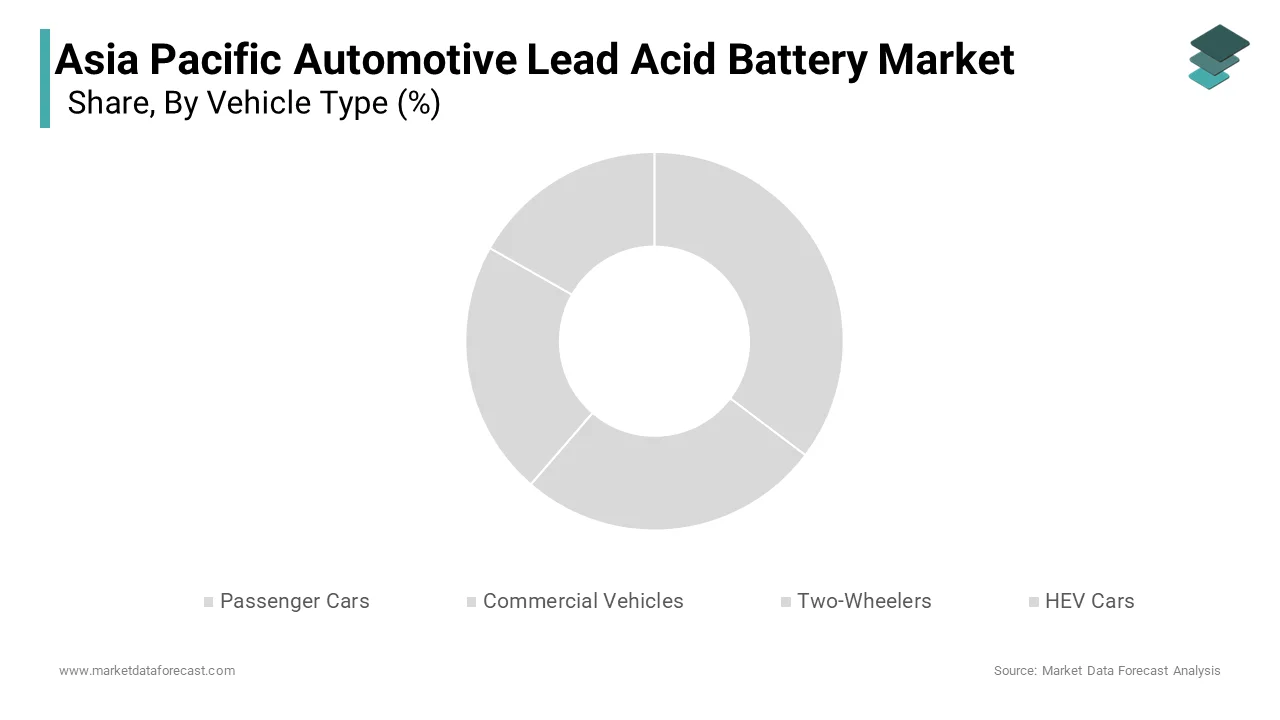
Among all vehicle types, hybrid electric vehicles (HEVs) are emerging as the rising advancing segment in the Asia Pacific automotive lead acid battery market, projected to grow at a CAGR of 9.2% from 2025 to 2033. While lithium-ion batteries power the main traction systems in HEVs, lead acid batteries continue to serve critical auxiliary roles in 12V or 48V micro-hybrid architectures. Japan leads this trend, where HEV adoption has been steadily increasing due to government incentives and strong local manufacturing capabilities. Toyota, the world's largest HEV manufacturer, accounted for over 1.6 million HEV units produced in Japan in 2023, many of which rely on AGM (absorbed glass mat) lead acid batteries for energy management functions, according to the Japan Automobile Manufacturers Association (JAMA). South Korea has also witnessed a surge in HEV penetration, supported by fuel economy regulations and consumer preference for fuel-efficient vehicles. These vehicles typically integrate dual battery systems, with lithium-ion handling propulsion and lead acid batteries supporting auxiliary loads such as infotainment, air conditioning, and safety systems. Moreover, in markets like India and Thailand, automakers are leveraging mild hybrid technologies to comply with BS-VI and Euro 5 emission norms without fully electrifying their fleets. Maruti Suzuki’s SHVS system, introduced across multiple models, relies heavily on AGM lead acid batteries, contributing to a 17% growth in AGM battery demand in India between 2022 and 2024.
By Product Insights
The SLI (Starting, Lighting, and Ignition) batteries constitute the largest product segment in the Asia Pacific automotive lead acid battery market by capturing a 58.5% of total market share in 2024. This overwhelming dominance is primarily driven by their essential function in internal combustion engine (ICE) vehicles, which still form the bulk of the automotive fleet in the region. According to the International Energy Agency (IEA), a significant portion of vehicles in operation across Asia Pacific are conventional ICE-based vehicles, all of which require SLI batteries for fundamental operations. The aftermarket plays a crucial role in sustaining SLI battery demand. In Southeast Asian countries such as Indonesia and Vietnam, informal and semi-formal distribution channels contribute significantly to replacement volumes.
Micro hybrid batteries, specifically Enhanced Flooded Batteries (EFB) and Absorbed Glass Mat (AGM) variants, are recording the highest growth rate in the Asia Pacific automotive lead acid battery market, expanding at a CAGR of 10.1%. This rapid surge is primarily driven by the increasing adoption of micro hybrid systems in ICE vehicles aimed at improving fuel efficiency and reducing carbon emissions. In China, the implementation of stricter emission standards under the China VI regulatory framework has prompted automakers to integrate 12V and 48V micro hybrid systems into mass-market models. According to LMC Automotive, a major share of new passenger cars sold in China in 2024 were equipped with some form of micro hybrid capability. India has followed suit, with major manufacturers like Maruti Suzuki introducing Smart Hybrid Vehicle by Suzuki (SHVS) technology across multiple models. Furthermore, governments across ASEAN nations are promoting fuel-efficient technologies as part of broader climate action plans.
By Battery Type Insights
The flooded batteries had the largest share of the Asia Pacific automotive lead acid battery market by commanding a 47.4% of total demand in 2024. This is due to their widespread use in conventional internal combustion engine (ICE) vehicles, particularly in low-cost passenger cars, two-wheelers, and commercial transport. China remains the epicenter of flooded battery consumption, given its massive vehicle parc and extensive OEM and aftermarket distribution networks. Like, flooded batteries accounted for over 60% of all automotive battery shipments in the country during 2023, primarily due to their affordability and compatibility with existing vehicle systems. India also exhibits heavy reliance on flooded technology, especially in rural and semi-urban regions where budget-sensitive consumers prioritize cost-effectiveness over advanced features. Exide Industries and Amara Raja Batteries continue to dominate this segment. Moreover, two-wheeler manufacturers in Southeast Asia—including Honda, Yamaha, and Hero MotoCorp—continue to equip entry-level models with flooded batteries due to their ease of maintenance and lower production costs. Despite advancements in AGM and EFB technologies, flooded batteries continue to benefit from established manufacturing ecosystems and minimal technical complexity, ensuring their entrenched position in the regional market structure.
The enhanced Flooded Batteries (EFB) are experiencing the most rapid expansion in the Asia Pacific automotive lead acid battery market, growing at a CAGR of 11.5%. This accelerated growth is primarily driven by their suitability for stop-start vehicles, which are gaining traction as automakers seek cost-effective ways to meet tightening emission standards without transitioning to full hybrid or electric platforms. Japan has emerged as a key adopter of EFB technology, particularly among compact and mid-sized sedan models designed for urban commuting. India has also seen a surge in EFB adoption, with major automakers like Hyundai, Kia, and Tata Motors integrating start-stop features into sedans and hatchbacks. The Society of Indian Automobile Manufacturers (SIAM) reported that nearly 40% of new passenger cars sold in India in 2024 offered stop-start functionality, necessitating higher durability and cycling performance found in EFB variants. In addition to OEM deployment, the aftermarket is increasingly embracing EFB batteries for replacement in older models retrofitted with idle-stop upgrades. As per ICRA Limited, EFB battery shipments in India rose by 22% year-on-year between 2022 and 2024, outpacing conventional flooded battery growth.
By Customer Segment
The replacement segment dominated the Asia Pacific automotive lead acid battery market by holding a 62.4% of total market share in 2024. This preeminence is largely attributed to the aging vehicle fleet across the region and the frequent battery replacement needs dictated by the typical 3–5-year battery lifespan. India exemplifies this trend, where the average age of registered vehicles exceeds 12 years, and the number of cars over a decade old surpasses 60 million , as reported by the Automotive Component Manufacturers Association of India (ACMA). This aging population necessitates regular battery replacements, with over 30 million automotive batteries replaced annually in the country alone. In China, despite the push for electric mobility, the sheer volume of legacy ICE vehicles ensures a robust aftermarket demand. According to the Ministry of Transport, more than 280 million vehicles were on Chinese roads in 2024, generating significant demand for post-sale battery replacements. Southeast Asia presents a comparable scenario. Additionally, e-commerce platforms like Lazada and Flipkart have facilitated easier access to branded and generic lead acid batteries, further enhancing replacement market accessibility.
The OEM (Original Equipment Manufacturer) segment is smaller in size but is growing at the fastest CAGR of 8.4% and is driven by technological advancements in ICE vehicles and increasing integration of advanced battery systems. One of the primary drivers is the incorporation of stop-start systems in new ICE vehicles, particularly in response to stricter emission norms. In China, the China VI emission standards have prompted automakers to adopt Enhanced Flooded Batteries (EFB) and Absorbed Glass Mat (AGM) units in newly manufactured models. India has mirrored this shift, with leading automakers such as Maruti Suzuki, Hyundai, and Tata Motors equipping their latest models with smart hybrid systems. The Society of Indian Automobile Manufacturers (SIAM) noted that nearly 40% of new passenger cars launched in 2024 featured SHVS or similar idle-stop enhancements, boosting OEM adoption of EFB and AGM batteries. In Japan, where hybridization strategies emphasize cost-efficiency, Toyota and Honda have actively deployed 48V micro hybrid architectures in mainstream models.
COUNTRY-LEVEL ANALYSIS
China held the top position in the Asia Pacific automotive lead acid battery market by accounting for a 30.4% of regional demand in 2024. This is underpinned by its status as the world’s largest automotive production and consumption hub, along with a well-established industrial ecosystem for battery manufacturing. Domestic battery producers such as Camel Group and Fengfan Co., Ltd. collectively supply a large portion of the OEM and replacement battery demand, benefiting from localized production and efficient distribution networks. Government policies also play a crucial role in shaping the market. It has enforced stringent environmental regulations on battery recycling, which has led to increased consolidation among small-scale recyclers. CRU Group reported that approximately 90% of used lead acid batteries are now collected through formal channels, enhancing raw material availability for domestic manufacturers. Moreover, the integration of stop-start systems in new vehicles has boosted demand for Enhanced Flooded Batteries (EFB) and Absorbed Glass Mat (AGM) units.
India saw rapid expansion in 2024. The country’s market is characterized by a large and diverse vehicle base, a thriving aftermarket sector, and rising adoption of advanced battery technologies in both OEM and replacement segments. As per the Ministry of Road Transport and Highways (MoRTH), India had over 180 million registered vehicles in 2024, with an average age exceeding 12 years. This aging vehicle stock has created a robust demand for battery replacements. The aftermarket constitutes the majority of battery sales. Companies such as Exide Industries and Amara Raja Batteries have capitalized on this opportunity by expanding their dealer networks and introducing mobile battery replacement services. In addition, the Indian government’s push for cleaner transport has influenced battery demand. With the introduction of Bharat Stage VI (BS-VI) emission norms, automakers like Maruti Suzuki and Hyundai integrated stop-start systems into several models, thereby increasing the adoption of Enhanced Flooded Batteries (EFB).
Japan maintains a stable but mature market and is driven by its focus on hybrid vehicle integration and efficient battery recycling mechanisms. According to the Japan Automobile Manufacturers Association (JAMA), Japan produced over 8 million vehicles in 2023, with a significant portion incorporating micro hybrid technologies. The Japanese government has also implemented strict battery recycling policies under the Home Appliance Recycling Law and the Resource Conservation and Recycling Act, ensuring that a large share of lead acid batteries are recycled. This high recycling rate stabilizes raw material availability and reduces dependency on imported lead, lowering overall production costs. Moreover, the aftermarket in Japan remains resilient, with battery replacement cycles influenced by the country’s long-standing vehicle retention habits.
South Korea 's market is distinguished by a growing emphasis on micro hybrid and stop-start technologies, propelled by both OEM integration and regulatory mandates aimed at improving fuel efficiency. Hyundai and Kia, the two dominant automakers, have increasingly adopted 12V and 48V micro hybrid systems in their models, which utilize Enhanced Flooded Batteries (EFB) and Absorbed Glass Mat (AGM) variants. Environmentally, South Korea maintains a structured battery recycling framework through the Korea Environmental Corporation (KECO), which enforces extended producer responsibility (EPR) laws. According to KECO, a notable share of used lead acid batteries were officially collected and processed in 2023, ensuring a reliable supply chain for secondary lead. Also, the rise in shared mobility and ride-hailing services has contributed to battery wear and tear, indirectly boosting replacement demand. Kakao Mobility, the country’s largest ride-hailing platform, reported a increase in battery-related maintenance requests in 2023, highlighting the impact of high-usage vehicles on battery lifecycles.
Thailand is expanding rural and commercial vehicle base drives growth and is supported by a burgeoning commercial vehicle sector and expanding rural transportation networks. The country remains a key automotive manufacturing hub in Southeast Asia, with major international automakers such as Toyota, Honda, and Isuzu operating large production facilities. Commercial vehicles, particularly trucks and vans used in logistics and agriculture, constitute a significant portion of this demand. Moreover, rural electrification and improved road connectivity have encouraged greater ownership of personal and utility vehicles in remote provinces.
KEY MARKET PLAYERS
Some of the major players in the Asia Pacific automotive lead acid batteries market are, C&D Technologies, Inc., CSB Battery Co., Ltd., Hitachi Chemical Energy Technology Co. Ltd., East Penn Manufacturing Company, Enersys Inc., Exide Industries Ltd., Exide Technologies Inc., GS Yuasa Corporation, Johnson Controls Inc. these are the market players that are dominating the Asia Pacific automotive lead acid batteries market.
Top Players in the Market
Exide Industries Limited
Exide Industries is one of the leading manufacturers and distributors of lead acid batteries in India and across the Asia Pacific region. With a strong presence in both OEM and aftermarket segments, the company has built a reputation for reliability and extensive distribution networks. It serves a wide range of applications including automotive, industrial, and renewable energy storage. Exide's focus on innovation, customer-centric services, and sustainability makes it a dominant player in the regional market.
GS Yuasa Corporation
GS Yuasa is a Japanese multinational company known globally for its advanced battery technologies. In the Asia Pacific market, GS Yuasa plays a crucial role through its high-quality automotive and industrial lead acid batteries. The company maintains strong partnerships with major automobile manufacturers and leverages cutting-edge research to enhance product performance. Its commitment to technological excellence and environmental responsibility positions it as a key leader in the region.
Camel Group Co., Ltd.
Camel Group is China’s largest manufacturer of lead acid batteries and holds a significant share in the Asia Pacific market. The company supplies extensively to both OEMs and the aftermarket, supported by large-scale production facilities and robust recycling capabilities. Camel Group emphasizes sustainable manufacturing practices and continuous product development, making it a formidable force in the regional and global battery industry.
Top Strategies Used by Key Market Participants
One of the primary strategies employed by leading companies in the Asia Pacific automotive lead acid battery market is expanding distribution networks . By strengthening their presence across both urban and rural markets, manufacturers ensure better accessibility and availability of products, especially in replacement segments which dominate the market.
Another key approach is product diversification , where companies are investing in advanced battery technologies such as Enhanced Flooded Batteries (EFB) and Absorbed Glass Mat (AGM) units. This allows them to cater to evolving vehicle requirements like stop-start systems while staying relevant amid rising hybridization trends.
Lastly, strategic mergers and acquisitions help companies consolidate their position, enhance R&D capabilities, and improve supply chain efficiencies.
COMPETITION OVERVIEW
The competition in the Asia Pacific automotive lead acid battery market is characterized by a mix of established players and emerging local brands vying for dominance in a rapidly evolving landscape. While global leaders maintain a strong foothold due to their technological expertise and brand recognition, regional manufacturers are aggressively expanding their production capacities and after-sales service networks. The market remains highly fragmented, particularly in the replacement segment, where pricing sensitivity and accessibility play a critical role in consumer choices. Companies are increasingly focusing on innovation to differentiate their offerings, especially in response to stricter emission norms and the integration of micro-hybrid technologies. At the same time, environmental regulations are reshaping the competitive dynamics, pushing firms toward improved recycling processes and sustainable sourcing of raw materials. Strategic investments in manufacturing localization and battery technology upgrades are becoming essential to maintaining competitiveness, especially as alternative chemistries begin to pose a long-term challenge to traditional lead acid solutions.
RECENT HAPPENINGS IN THE MARKET
- In January 2024, Exide Industries expanded its electric mobility division and launched a dedicated R&D center in Kolkata to develop next-generation battery technologies tailored for hybrid and start-stop vehicles, enhancing its technical capabilities in the evolving automotive sector.
- In March 2024, GS Yuasa partnered with Toyota Motor Corporation to co-develop advanced AGM batteries specifically designed for integration into new hybrid models being manufactured in Southeast Asia, reinforcing its position as a preferred supplier for premium OEM applications.
- In June 2024, Camel Group Co., Ltd. inaugurated a new state-of-the-art recycling facility in Hubei Province, China, aimed at improving lead recovery efficiency and reducing reliance on primary lead sources, aligning with stringent environmental policies and ensuring sustainable production.
- In September 2024, Amara Raja Batteries entered into a strategic distribution agreement with a leading Indonesian auto parts retailer, significantly expanding its reach in the ASEAN market and strengthening its presence in the fast-growing replacement battery segment.
- In November 2024, Hitachi ABB Power Grids collaborated with multiple battery manufacturers in the region to integrate smart monitoring systems into lead acid batteries, enabling real-time diagnostics and performance tracking, thereby enhancing value addition and after-sales service quality.
MARKET SEGMENTATION
This research report on the Asia Pacific lead acid battery market is segmented and sub-segmented into the following categories.
By Vehicle Type
- Passenger Cars
- Commercial Vehicles
- Two-Wheelers
- HEV Cars
By Product
- SLI Batteries
- Micro Hybrid Batteries
By Type
- Flooded Batteries
- Enhanced Flooded Batteries
- VRLA Batteries
By Customer Segment
- OEM
- Replacement
By Country
- India
- China
- Japan
- South Korea
- Australia
- New Zealand
- Thailand
- Malaysia
- Vietnam
- Philippines
- Indonesia
- Singapore
- Rest of APAC