Asia-pacific BioPesticide Market Size, Share, Trends And Growth Forecast Research Report, Segmented By Crop Type, Ingredients Type, Microorganism’s Type, Application Type and Country (India, China, Japan, South Korea and Australia, South Africa, New Zealand, Thailand, Malaysia, Vietnam, Philippines, Indonesia, Singapore and Rest of Asia - Pacific), Industry Analysis (2026 to 2034)
Market Size, 2025
$3.18 BnMarket Estimate, 2026
$3.75 BnMarket Forecast, 2034
$14.04 BnCAGR, 2026–2034
17.94%Asia-Pacific Biopesticides Market Size
The Asia-Pacific biopesticides market size was valued at USD 3.18 billion in 2025 and is anticipated to reach USD 3.75 billion in 2026 to reach USD 14.04 billion by 2034, growing at a CAGR of 17.94% during the forecast period 2026 to 2034.
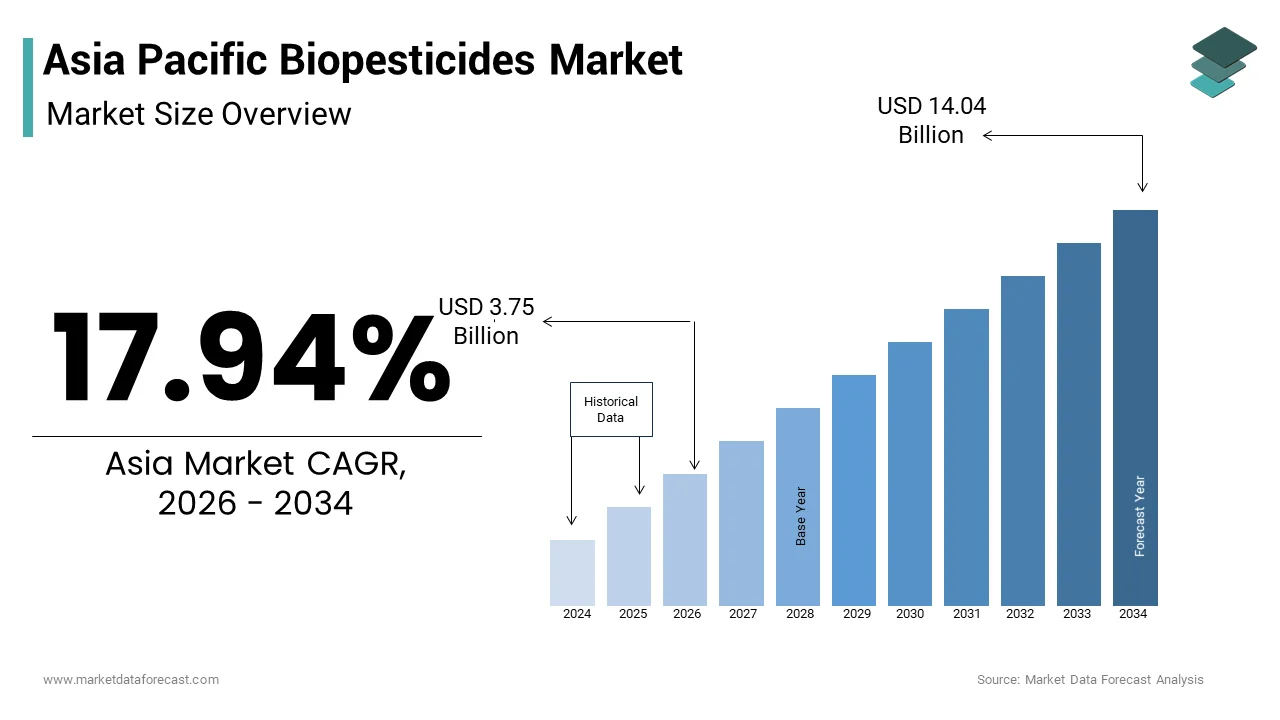
Asia-Pacific holds the second-largest market share. The market is driven by remarkable advancements in biotechnology, which has witnessed a new growth paradigm. In terms of consumption and demand for biopesticides, the Asia Pacific would remain the largest during the forecast period 2020 -2025. Asia Pacific is one of the potential markets for the growth of biopesticides. Asia-Pacific accounts for around 30% of the total land available on Earth and around 60% of the total world population. The growing demand for food crops and a large population base fuel the biopesticides market in the Asia Pacific region. Rising healthcare awareness in the Asia Pacific region leads to an increase in organic food consumption, this also becomes one of the key reasons for the growth of the biopesticides market.
Biopesticides are substances derived from naturally occurring materials like plants (plant-incorporated protectants or PIPs), micro-organisms (microbial pesticides), and certain minerals (biochemical pesticides). Biopesticides use both a broad-spectrum approach and even a selective approach to controlling diseases or pests. These are replacing conventional pesticides from the market due to their non-toxic quality and target-specific behavior.
Biopesticides are advantageous for farmers as well as for the environment. They are usually inherently less toxic than conventional biopesticides, they are comparatively cheaper and effective, decompose well without leaving any harmful residues, have a substantially nullified impact on non-targeted species, and can greatly reduce the use of conventional pesticides with high yield.
Asia Pacific market growth is driven by a rise in demand for organic food and the high prevalence of crop diseases in both developed and developing regions. Various research centers all around the world are taking initiatives to improve techniques for the augmentation and application of biopesticides. Farmers are unaware of the benefits of biopesticides and are also reluctant to change from the existing practices of chemical pesticides, which are restraining the growth of the market.
REPORT COVERAGE
| REPORT METRIC | DETAILS |
| Market Size Available | 2025 to 2034 |
| Base Year | 2025 |
| Forecast Period | 2026 to 2034 |
| CAGR | 17.94% |
| Segments Covered | By Ingredients, Microorganisms type, Crop Type, Application, Region. |
| Various Analyses Covered | Global, Regional, & Country Level Analysis, Segment-Level Analysis, DROC, PESTLE Analysis, Porter’s Five Forces Analysis, Competitive Landscape, Analyst Overview on Investment Opportunities |
| Regions Covered | India, China, Japan, South Korea, Australia, New Zealand, Thailand, Malaysia, Vietnam, Philippines, Indonesia, Singapore, and the Rest of APAC |
| Market Leaders Profiled | Parry America, Andermatt Biocontrol Ag, Marrone Bio Innovations Inc., Agbitech Pty Limited, Bioworks Inc., Som Phytopharma Limited, Camson Bio Technologies Limited, Hebei Veyong Bio-Chemical Co. Limited, Becker Underwood Inc., Agraquest Inc., Growth Products Limited, Valent Biosciences Corp, Biocare, Natural Industries, and Novoenzymes A/S. |
KEY MARKET PLAYERS
Some of the major key market players involved in the Asia-Pacific biopesticides market are
- Parry America
- Andermatt Biocontrol Ag
- Marrone Bio Innovations Inc.
- Agbitech Pty Limited
- Bioworks Inc.
- Som Phytopharma Limited
- Camson Bio Technologies Limited
- Hebei Veyong Bio-Chemical Co. Limited
- Becker Underwood Inc.
- Agraquest Inc.
- Growth Products Limited
- Valent Biosciences Corp
- Biocare
- Natural Industrie
- Novoenzymes A/S.
MARKET SEGMENTATION
This research report on the Asia-Pacific biopesticides market is segmented and sub-segmented into the following categories.
By Ingredients
- Biochemical pesticides
- Plant pesticides
- Microbial pesticides
By Microorganism’s Type
- Bioherbicides
- Bio fungicides
- Bio nematicides
- Bioinsecticides
By Crop Type
- Forage & turf grasses
- Greenhouse crops
By Application
- Seed treatment
- On-farm
- Post-harvest application
By Country
- India
- China
- Japan
- South Korea
- Australia
- New Zealand
- Thailand
- Malaysia
- Vietnam
- Philippines
- Indonesia
- Singapore
- Rest of APAC
Frequently Asked Questions
What is pushing the growth of the Asia-Pacific biopesticide market at present?
Rising demand for sustainable agriculture and reduced chemical usage is driving growth.
Why are farmers in Asia-Pacific shifting toward biopesticides?
They offer safer crop protection while minimizing environmental and health risks.
How can biopesticides be described in simple terms?
They are natural pest control products derived from biological sources like plants and microbes.
In which agricultural applications are biopesticides most commonly used?
They are widely used in fruits, vegetables, cereals, and organic farming systems.
What makes biopesticides suitable for modern farming practices?
They support eco-friendly pest control and help maintain soil and crop health.
From a grower’s perspective, are biopesticides a practical investment?
Yes, they improve crop quality and align with sustainable farming goals.
What key challenges are influencing the Asia-Pacific biopesticide market?
Limited awareness and slower action compared to chemical pesticides are key challenges.
How is government policy affecting biopesticide adoption in this region?
Supportive regulations and incentives are encouraging the use of eco-friendly solutions.
Which crop categories generate the highest demand for biopesticides?
High-value crops like fruits and vegetables are the major contributors.
Is the Asia-Pacific biopesticide market expanding consistently?
Yes, it is growing steadily with increasing focus on sustainable agriculture.
Related Reports
Access the study in MULTIPLE FORMATS
Purchase options starting from
$ 2000
Didn’t find what you’re looking for?
TALK TO OUR ANALYST TEAM
Need something within your budget?
NO WORRIES! WE GOT YOU COVERED!
Call us on: +1 888 702 9696 (U.S Toll Free)
Write to us: sales@marketdataforecast.com