- Product Description Description
- Table of Contents TOC
- List of Table & Figure LOT
- Get Free Sample PDF Sample PDF
Market Size, 2025
$560.21 MnMarket Estimate, 2026
$595.28 MnMarket Forecast, 2034
$967.56 MnCAGR, 2026–2034
6.26%Asia Pacific Biosurfactants Market Size, Share & Growth Analysis (2026–2034)
The Asia Pacific biosurfactants market was valued at USD 560.21 million in 2025, reaching USD 595.28 million in 2026, and is projected to expand to USD 967.56 million by 2034, registering a compound annual growth rate (CAGR) of 6.26%.
- Market Scope: Regional industry analysis covering product types, end-use applications, and country-level developments across China, India, Japan, South Korea, and Australia.
- Primary Growth Drivers: Stringent environmental regulations mandating biodegradable alternatives, booming demand in personal care and K-beauty cosmetics, and biotechnology advancements reducing microbial fermentation costs.
Key Market Segment Metrics
| Category | Leading Segment | Fastest-Growing Segment |
|---|---|---|
| By Product Type | Glycolipids (Captured 45.9% share in 2025; valued for superior biodegradability and versatility in cosmetics and detergents) | Polymeric Biosurfactants (Projected at a 10.5% CAGR; driven by extreme condition stability in agriculture and oil recovery) |
| By Application | Detergents and Industrial Cleaners (Commanded 35.7% share in 2024; propelled by anti-pollution regulations and eco-friendly shifts) | Cosmetics / Personal Care (Projected at a 9.8% CAGR; fueled by K-beauty, mild skin compatibility, and natural ingredients) |
| By Country | China (Led with 35.8% share in 2025; leveraging vast manufacturing hubs and advanced biotechnology infrastructure) | India & South Korea (High growth backed by green growth strategies, Ayurvedic beauty lines, and agricultural support) |
Major Market Players & Industry Landscape
Competitive Structure: A highly competitive regional landscape featuring global chemical giants and local players. Strategies focus on strategic joint acquisitions, microbial fermentation R&D investments, and localized supply chain expansions.
Leading Companies: BASF SE, Evonik Industries AG, Croda International Plc, Clariant, Givaudan, Henkel AG & Co. KGaA, and Lion Corporation.
Asia Pacific Biosurfactants Market Size
The Asia Pacific biosurfactants market size was valued at USD 560.21 million in 2025 and is anticipated to reach USD 595.28 million in 2026, to reach USD 967.56 million by 2034, growing at a CAGR of 6.26% during the forecast period from 2026 to 2034.
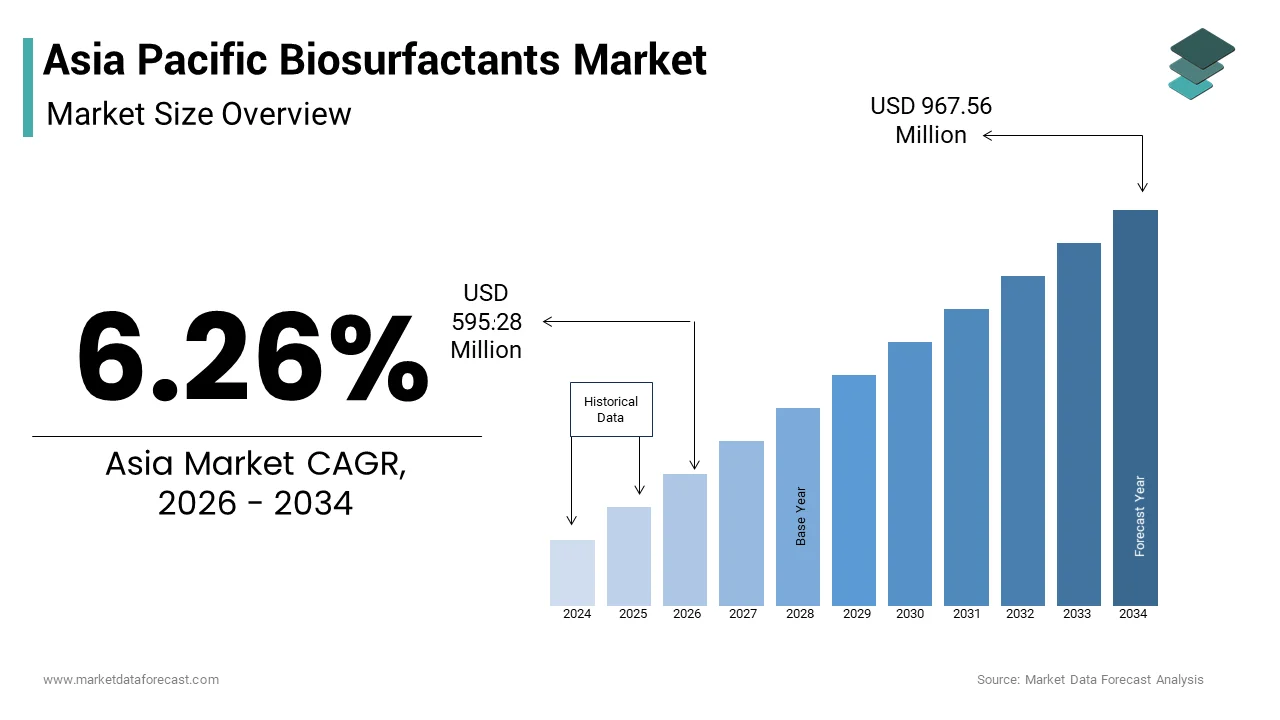
The Asia Pacific biosurfactants market is witnessing rapid growth, driven by increasing demand for sustainable and eco-friendly solutions across industries. Also, the market’s expansion is fueled by stringent environmental regulations mandating the replacement of synthetic surfactants with biodegradable alternatives. Additionally, the rise of biotechnology hubs in countries like Singapore and Australia has fostered advancements in microbial fermentation technologies, reducing production costs.
MARKET DRIVERS
Stringent Environmental Regulations
Stringent environmental regulations are a primary driver of the Asia Pacific biosurfactants market, compelling industries to adopt sustainable alternatives to synthetic surfactants. For example, Japan’s Chemical Substances Control Law mandates rigorous testing and approval processes for chemical substances, encouraging businesses to switch to biodegradable options like biosurfactants. According to the United Nations Environment Programme, the ban on non-biodegradable surfactants in Southeast Asia has led to an increase in biosurfactant usage since 2020. In Australia, the National Industrial Chemicals Notification and Assessment Scheme has introduced labeling requirements that promote transparency, further accelerating adoption. Urban consumers’ preference for eco-friendly products also amplifies demand, particularly in cities like Tokyo and Sydney.
Rising Demand in Personal Care and Cosmetics
The booming personal care and cosmetics industry serves as another significant driver for the Asia Pacific biosurfactants market. Biosurfactants, derived from renewable sources such as plant extracts and microbial fermentation, align perfectly with this trend. For instance, South Korea’s K-beauty industry has embraced biosurfactants for their mildness and skin compatibility. Similarly, India’s Ayurvedic beauty segment relies heavily on biosurfactants to enhance product formulations while ensuring safety. These factors underscore the pivotal role of personal care and cosmetics in propelling the biosurfactants market forward.
MARKET RESTRAINTS
High Production Costs
High production costs pose a significant restraint to the Asia Pacific biosurfactants market, impacting its competitiveness against synthetic alternatives. While biosurfactants offer superior environmental benefits, their production involves complex microbial fermentation processes and expensive raw materials, which can severely affect profitability. For example, the cost of producing rhamnolipids, a common type of biosurfactant, is higher than that of synthetic surfactants. This cost disparity creates financial strain, particularly for small-scale producers who lack the resources to scale operations or invest in advanced technologies. Additionally, fluctuations in feedstock prices, such as vegetable oils and sugars, exacerbate the issue. According to the Confederation of Indian Industry, rising input costs have led to a decline in profit margins for biosurfactant manufacturers in Malaysia.
Limited Consumer Awareness in Rural Areas
Limited consumer awareness about the benefits of biosurfactants in rural areas also hinders market expansion. While urban centers in the Asia Pacific region are increasingly adopting eco-friendly products, rural populations often lack access to information about sustainable alternatives. For instance, only y limited number of rural households in Southeast Asia are aware of biosurfactants, compared to those in urban areas. This knowledge gap restricts demand in agricultural and household cleaning applications, where synthetic surfactants remain dominant. Moreover, traditional practices and reliance on low-cost chemicals further impede adoption.
MARKET OPPORTUNITIES
Advancements in Microbial Fermentation Technologies
The development of advanced microbial fermentation technologies presents a lucrative opportunity for the Asia Pacific biosurfactants market, aligning with the global push toward sustainability. Innovations in genetic engineering and bioprocessing have significantly reduced production costs while enhancing yield and scalability. For example, South Korea’s investments in recombinant microorganisms for biosurfactant production have grown significantly since 2020, driven by government incentives and consumer demand. These advancements enable the production of high-performance biosurfactants tailored for specific applications, such as oil recovery and pharmaceuticals. By focusing on R&D, companies can position themselves as leaders in the sustainable biosurfactants segment.
MARKET CHALLENGES
Competition from Synthetic Surfactants
The dominance of synthetic surfactants poses a significant challenge to the Asia Pacific biosurfactants market, as they remain cost-effective and widely available despite their environmental drawbacks. Similarly, in India, synthetic surfactants account for a notable percentage of the total surfactant market, driven by their lower production costs and established supply chains. While biosurfactants offer superior eco-friendly properties, their higher pricing limits their penetration in price-sensitive markets.
REPORT COVERAGE
| REPORT METRIC | DETAILS |
| Market Size Available | 2025 to 2034 |
| Base Year | 2025 |
| Forecast Period | 2026 to 2034 |
| CAGR | 3.94% |
| Segments Covered | By Product, Application, and Region |
| Various Analyses Covered | Global, Regional & Country Level Analysis, Segment-Level Analysis, DROC, PESTLE Analysis, Porter’s Five Forces Analysis, Competitive Landscape, Analyst Overview of Investment Opportunities |
| Regions Covered | India, China, Japan, South Korea, Australia, New Zealand, Thailand, Malaysia, Vietnam, Philippines, Indonesia, Singapore, and the Rest of APAC |
| Market Leaders Profiled | Allied Carbon Solutions (ACS), BASF SE, CLARIANT, Croda International Plc, Daqing VICTEX Chemical Industries Co., Ltd, Deguan BIO, Evonik Industries AG, Givaudan, Henkel AG & Co. KGaA, Lion Corporation, Saraya Co., Ltd. |
SEGMENTAL ANALYSIS
By Product Type Insights
The glycolipids segment dominated the Asia Pacific biosurfactants market by accounting for 45.9% of the total share in 2025. This is because of their superior biodegradability and versatility across applications such as detergents, cosmetics, and oilfield chemicals. For instance, rhamnolipids, a type of glycolipid, are widely used in South Korea’s cosmetics industry due to their mildness and skin compatibility, with the reporting of a significant increase in their adoption since 2020. Also, advancements in microbial fermentation technologies have reduced production costs, making glycolipids more competitive against synthetic surfactants. The growing emphasis on sustainability has also amplified demand, particularly in urban areas where consumers prioritize eco-friendly products.
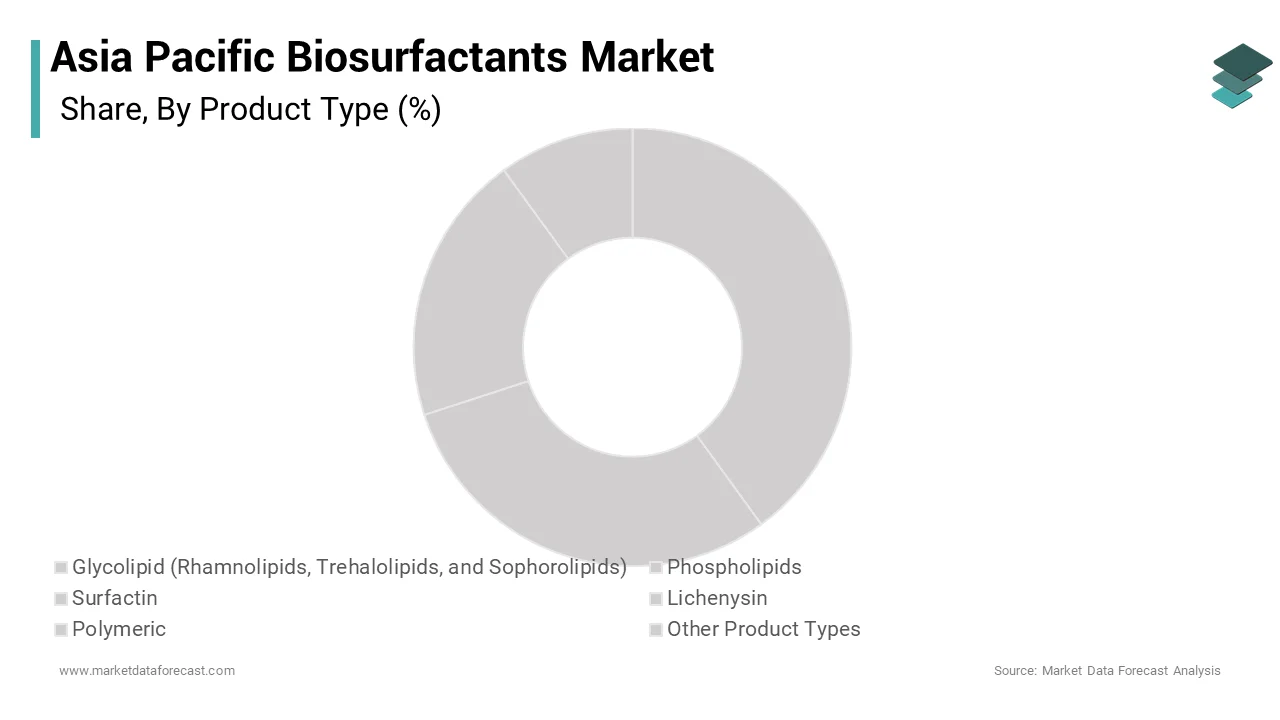
The polymeric biosurfactants segment is quickly emerging with a CAGR of 10.5%. This development is caused by their unique properties, such as high stability and compatibility with extreme conditions, making them ideal for industrial applications like oil recovery and agricultural chemicals. For example, Australia’s Department of Agriculture highlights that the use of polymeric biosurfactants in crop protection has grown by 40% annually since 2021, driven by government incentives for sustainable farming practices. Additionally, innovations in genetic engineering have enabled the development of cost-effective polymeric variants.
By Application Insights
The segment of detergents and industrial cleaners represents the largest application segment by commanding a 35.7% share of the Asia Pacific biosurfactants market in 2024. This dominance is driven by stringent environmental regulations mandating the replacement of synthetic surfactants with biodegradable alternatives. For instance, Japan’s Chemical Substances Control Law requires manufacturers to adopt eco-friendly solutions, resulting in a 25% increase in biosurfactant usage in cleaning products since 2020, according to the United Nations Environment Programme. Additionally, rising urbanization and industrialization have amplified demand. Rising disposable incomes have also fueled the adoption of premium cleaning products, making biosurfactants a critical component of the detergents sector.
The cosmetics segment is the fastest-growing application, with a projected CAGR of 9.8% through 2033. This is fueled by the booming personal care industry, particularly in urban centers like Seoul and Mumbai. For example, South Korea’s K-beauty sector relies heavily on biosurfactants for their mildness and skin compatibility. Similarly, India’s Ayurvedic beauty segment, which grew notably in 2022, prioritizes natural ingredients, driving biosurfactant adoption. Advancements in formulation technologies have also enhanced their efficacy, aligning with consumer preferences for sustainable and safe products.
COUNTRY ANALYSIS
Top Leading Countries in the Asia Pacific Market
China Biosurfactants Market Analysis
China led the Asia Pacific biosurfactants market by holding a 35.8% share in 2025. This dominance is due to its status as a global manufacturing hub, leveraging advanced biotechnology infrastructure to produce cost-effective biosurfactants. In addition, China’s investments in microbial fermentation technologies have grown significantly since 2020, enhancing production efficiency. Urbanization has further amplified demand. Rising disposable incomes have also fueled the adoption of eco-friendly products, particularly in sectors like detergents and cosmetics.
India Biosurfactants Market Analysis
India is believed to accelerate in the market. It is driven by its robust agricultural base and growing awareness about sustainability. The country’s Ayurvedic beauty segment relies heavily on biosurfactants for their natural properties. Besides, government initiatives promoting sustainable agriculture have boosted biosurfactant adoption in crop protection. India’s strategic location as a global supplier of raw materials has also facilitated international trade, positioning it as a key growth engine in the Asia Pacific market.
Japan Biosurfactants Market Analysis
Japan is a key player in the Asia Pacific market and is propelled by its advanced technological capabilities and stringent environmental regulations. The country’s emphasis on sustainability has fostered innovation in biosurfactants, with a notable portion of industries adopting eco-friendly alternatives. Additionally, Japan’s aging population has increased demand for mild and safe cosmetic formulations, amplifying biosurfactant usage. Urban consumers’ preference for green solutions further amplifies demand, particularly in cities like Tokyo and Osaka.
South Korea Biosurfactants Market Analysis
South Korea is expected to experience significant progress. This growth is driven by cutting-edge R&D and eco-conscious consumer behaviour. The country’s “Green Growth Strategy” has spurred businesses to adopt biosurfactants in cosmetics and industrial applications, resulting in a significant increase in usage since 2020. Moreover, the cosmetics industry, a key contributor to GDP, has embraced biosurfactants for product formulations.
Australia Biosurfactants Market Analysis
Australia is projected to experience steady growth and is driven by its robust regulatory framework and high consumer awareness about sustainability. The country’s agricultural sector leverages biosurfactants for crop protection. Additionally, Australia’s thriving mining industry uses biosurfactants in oil recovery, aligning with environmental goals. Urban consumers’ preference for renewable energy further amplifies demand, particularly in cities like Sydney and Melbourne.
COMPETITIVE LANDSCAPE
The Asia Pacific biosurfactants market is characterized by intense competition, driven by the presence of both global giants and regional players striving to gain a larger share of the rapidly growing sector. The market’s competitive landscape is shaped by the increasing demand for sustainable and effective alternatives to synthetic surfactants, which has prompted companies to innovate and differentiate their offerings. Global players leverage their technological expertise and economies of scale to maintain dominance, while regional players focus on customization and localized strategies to carve out niches. Sustainability remains a central theme, with companies competing to offer the most eco-friendly and cost-effective solutions. Additionally, the rise of industrialization and urbanization has intensified competition, as companies vie to secure contracts with major industries and municipalities.
KEY MARKET PLAYERS
These are the market players that are dominating the Asia Pacific biosurfactants marketAllied Carbon Solutions (ACS)
- BASF SE
- CLARIANT
- Croda International Plc
- Daqing VICTEX Chemical Industries Co., Ltd
- Deguan BIO
- Evonik Industries AG
- Givaudan
- Henkel AG & Co. KGaA
- Lion Corporation
- Saraya Co., Ltd.
Top Players in the Market
- BASF SE is a global leader in the biosurfactants market, with a strong presence in the Asia Pacific region. The company leverages its cutting-edge research and development capabilities to produce innovative biosurfactant solutions tailored to regional demands. Its focus on sustainability has led to the creation of eco-friendly products that comply with stringent environmental regulations. BASF’s strategic partnerships with local industries, such as agriculture and cosmetics, have strengthened its market position.
- Evonik Industries AG is a key player in the Asia Pacific biosurfactants market, renowned for its expertise in developing advanced microbial fermentation technologies. The company’s commitment to innovation has enabled it to address complex challenges faced by industries such as detergents, textiles, and pharmaceuticals. Evonik’s emphasis on collaboration with regional stakeholders ensures its products align with local regulatory frameworks and consumer preferences. Its robust distribution network across the region has facilitated widespread adoption of its sustainable biosurfactant solutions.
- Croda International PLC stands out for its specialization in producing biosurfactants derived from renewable resources, such as plant-based materials and microbial cultures. With a strong foothold in the Asia Pacific region, the company focuses on delivering solutions that meet the unique demands of urbanized and industrialized areas. Croda’s dedication to quality and safety has earned it recognition among leading manufacturers and regulatory bodies.
Top Strategies Used by Key Market Participants
Strategic Acquisitions and Collaborations
Key players in the Asia Pacific biosurfactants market have increasingly turned to acquisitions and collaborations to strengthen their market position. These collaborations also facilitate knowledge-sharing and innovation, enabling participants to stay ahead of evolving consumer preferences. For instance, partnerships with agricultural exporters have allowed companies to develop specialized biosurfactants for crop protection, enhancing their relevance in the region.
Investment in R&D and Innovation
Another major strategy involves substantial investments in research and development to create cutting-edge biosurfactant solutions. Companies are focusing on developing cost-effective and scalable products that comply with stringent environmental regulations. Innovations such as genetically engineered microbes and advanced fermentation techniques have been introduced to address specific industry needs.
RECENT MARKET NEWS
- In April 2024, BASF SE partnered with the Indian government to launch a nationwide initiative promoting biosurfactants as a sustainable alternative in agriculture. This move strengthened its leadership in the domestic market.
- In June 2023, Evonik Industries AG announced the acquisition of a small-scale biosurfactant production facility in Thailand to bolster its supply chain resilience and expand its footprint in Southeast Asia.
- In February 2023, Croda International PLC signed a memorandum of understanding with a South Korean cosmetics firm to co-develop next-generation biosurfactants for skincare formulations, aligning with consumer trends toward natural ingredients.
- In September 2022, BASF SE opened a state-of-the-art R&D center in Malaysia to explore innovations in microbial fermentation technologies, positioning itself as a pioneer in cost-effective biosurfactant production.
- In November 2021, Evonik Industries AG launched a joint venture with an Australian mining company to supply biosurfactants for oil recovery projects, enhancing its presence in the industrial chemicals segment.
MARKET SEGMENTATION
This research report on the Asia Pacific biosurfactants market is segmented and sub-segmented into the following categories.
By Product Type
- Glycolipid (Rhamnolipids, Trehalolipids, and Sophorolipids)
- Phospholipids
- Surfactin
- Lichenysin
- Polymeric
- Other Product Types
By Application
- Detergents and Industrial Cleaners
- Cosmetics (Personal Care)
- Food Processing
- Oilfield Chemicals
- Agricultural Chemicals
- Textiles
- Other Applications
By Country
- India
- China
- Japan
- South Korea
- Australia
- New Zealand
- Thailand
- Malaysia
- Vietnam
- Philippines
- Indonesia
- Singapore
- Rest of APAC