- Product Description Description
- Table of Contents TOC
- List of Table & Figure LOT
- Get Free Sample PDF Sample PDF
Market Size, 2025
$1.27 BnMarket Estimate, 2026
$1.34 BnMarket Forecast, 2034
$2.02 BnCAGR, 2026–2034
5.26%Executive Summary: Asia Pacific Buttercream Frosting Market
- Market Scope: Comprehensive regional buttercream frosting market analysis covering frosting types, distribution channels, dessert trends, and country-level leadership frameworks.
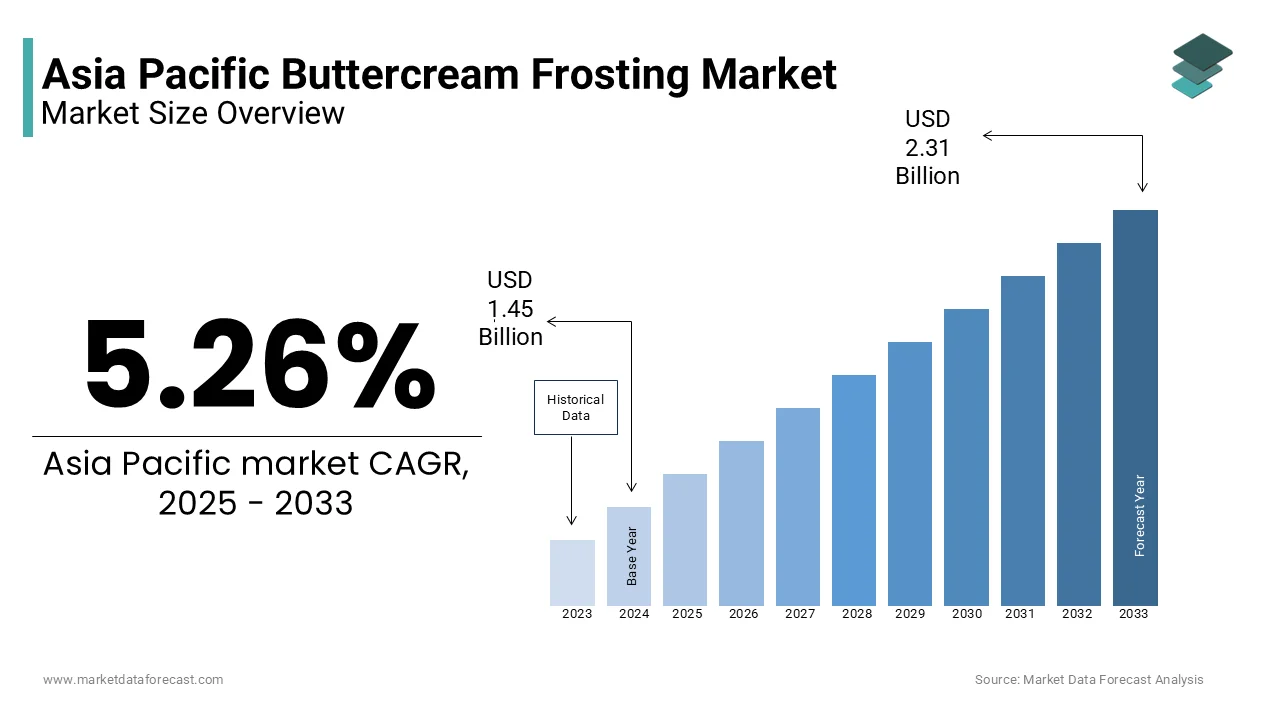
- Market Valuation: Valued at USD 1.27 billion (2025), estimated at USD 1.34 billion (2026), and projected to reach USD 2.02 billion by 2034, registering a healthy CAGR of 5.26% (2026–2034).
- Primary Growth Drivers: Rising popularity of Western-style desserts, expansion of the food service and cafe sector, and the booming home baking culture fueled by social media platforms.
Key Market Segment Metrics (2026–2034)
| Category | Leading Segment (2025 Position) | Fastest-Growing Segment (2026–2034) |
|---|---|---|
| By Type | American Buttercream (accounted for 42.5% of total market demand in 2025, driven by simplicity, affordability, and versatility) | Swiss Meringue Buttercream (projected to grow at a CAGR of 9.8% due to demand for smoother textures, reduced sweetness, and upscale bakery options) |
| By Distribution Channel | Supermarkets and Hypermarkets (captured 33.4% of total sales in 2025, offering wide product ranges and ready-to-use options) | Online Sales (fastest-growing channel at a CAGR of 11.5%, driven by e-commerce adoption among millennials and Gen Z) |
| By Country | China (commanded 25.3% of total share in 2025, supported by an expanding middle class and Western dessert exposure) | India and South Korea (experiencing rapid growth due to digital food trends, urban café culture, and modern retail expansion) |
Major Market Players & Market Structure
Market Structure: Highly competitive landscape featuring multinational corporations, regional food manufacturers, and local artisanal producers. Differentiation centers around clean labels, sustainable sourcing, flavor innovation (e.g., matcha, vegan variants), and digital engagement.
Key Companies: Puratos Group, Associated British Foods (ABF), Nestlé S.A., Rich Products, Betty Crocker, CSM Bakery Solutions, Pinnacle Foods, Wilton Industries, Dawn Foods, Real Good Food, and Lawrence Foods.
Asia Pacific Buttercream Frosting Market Size
The Asia Pacific buttercream frosting market size was valued at USD 1.27 billion in 2025 and is expected to reach USD 2.02 billion by 2034 from USD 1.34 billion in 2026. The market's promising CAGR for the predicted period is 5.26%.
Buttercream frosting is a creamy, sweet topping made primarily from butter, powdered sugar, and flavoring agents, widely used in cakes, cupcakes, pastries, and decorative confections. It serves both as a flavor enhancer and a medium for intricate cake decoration, making it an essential ingredient in both commercial bakeries and home baking. In the Asia Pacific region, buttercream frosting has gained popularity due to the rising influence of Western-style desserts and increasing consumer interest in premium baked goods.
The growth of the food service industry, particularly cafes, patisseries, and specialty dessert shops, has significantly contributed to the demand for buttercream frostings across countries like Japan, South Korea, Australia, and India.
Moreover, social media platforms such as Instagram and TikTok have played a crucial role in promoting visually appealing desserts, encouraging both professional bakers and home enthusiasts to experiment with buttercream-based designs.
In addition, convenience-driven consumption patterns, urbanization, and rising disposable incomes are further fueling the adoption of ready-to-use and pre-prepared buttercream frostings. With evolving tastes and a growing middle class, the Asia Pacific Buttercream Frosting Market is experiencing a transformation from niche indulgence to a more mainstream bakery staple.
MARKET DRIVERS
Rising Popularity of Western-Style Desserts
The growing popularity of Western-style desserts, including layer cakes, cupcakes, and gourmet pastries, is one of the most influential drivers of the Asia Pacific Buttercream Frosting Market. This shift is largely attributed to changing consumer preferences, increased exposure to global culinary trends, and the proliferation of international bakery chains across the region.
These outlets often highlight elaborate buttercream decorations as a key selling point, attracting younger consumers who value aesthetics and novelty in food experiences.
Apart from these, food influencers and lifestyle bloggers have played a significant role in promoting buttercream-decorated desserts through visually driven content on platforms like Instagram and YouTube. This digital engagement has led to increased experimentation with buttercream frostings among amateur bakers, further boosting retail sales of ready-to-use varieties.
Furthermore, organized baking competitions and food festivals such as the Tokyo Cake Show and Sydney Cake & Bake Fair have helped elevate the status of buttercream artistry, fostering a culture of premium dessert consumption that supports sustained market growth.
 Expansion of the Food Service Industry
The rapid expansion of the food service sector, particularly in quick-service restaurants (QSRs), cafes, and boutique bakeries, is another critical driver of the Asia Pacific Buttercream Frosting Market . The increasing number of food outlets offering desserts with buttercream frosting reflects broader shifts toward premiumization and customization in the F&B industry.
Many of these establishments feature buttercream-topped pastries and celebration cakes as part of their menu offerings, directly contributing to higher demand for commercial-grade buttercream frostings.
Moreover, leading QSR chains such as Starbucks, Dunkin’, and local players like Wow Momo in India and BreadTalk in Singapore have introduced seasonal or limited-time cake and cupcake promotions that prominently feature buttercream frosting.
This trend is further supported by hotel chains and upscale dining venues that offer elaborate wedding cakes, birthday cakes, and themed desserts using high-quality buttercream. With the hospitality sector recovering post-pandemic, events and celebrations have surged, reinforcing the need for premium frosting solutions. These developments show the integral role of the food service industry in driving buttercream frosting consumption across the Asia Pacific.
MARKET RESTRAINTS
High Cost of Ingredients and Production
The relatively high cost of raw materials and production inputs is a major restraint affecting the Asia Pacific Buttercream Frosting Market. Buttercream frosting typically requires dairy-based ingredients such as butter and cream cheese, which are subject to price volatility influenced by agricultural yields, import tariffs, and transportation costs.
In countries like India and Indonesia, where domestic dairy production is seasonal and fluctuates based on monsoon cycles, the cost of fresh butter can vary significantly throughout the year.
Moreover, the rise in energy and packaging material costs has added to the financial burden on manufacturers. These factors contribute to higher retail prices, limiting affordability for budget-conscious consumers in emerging markets and slowing down market penetration.
Health Concerns and Changing Consumer Preferences
Health consciousness is increasingly shaping consumer choices in the Asia Pacific bakery market, acting as a significant restraint on the growth of traditional buttercream frosting. Due to its high saturated fat and sugar content, buttercream is often perceived as unhealthy, especially among health-focused consumers and those managing dietary restrictions such as diabetes and cardiovascular conditions.
According to World Health Organization (WHO) Regional Office for the Western Pacific , obesity rates in several Asian countries have risen sharply in recent years, prompting greater scrutiny of high-calorie foods. In addition, regulatory bodies in countries like Australia and South Korea have introduced front-of-pack nutrition labeling schemes that highlight sugar and fat content, influencing consumer decisions.
Besides, there is a growing preference for alternative toppings such as fondant, whipped cream, and low-sugar frostings, which are marketed as healthier or lower-calorie options.
MARKET OPPORTUNITIES
Rise in Home Baking Culture
The growing home baking culture, particularly among millennials and Gen Z consumers who view baking as a creative hobby and a means of personal expression is a significant opportunity for the Asia Pacific Buttercream Frosting Market. Social media platforms such as Instagram, Pinterest, and TikTok have played a pivotal role in popularizing at-home cake decorating, with millions of users sharing buttercream artistry videos and DIY tutorials.
Platforms like YouTube recorded over 200 million cumulative views for buttercream tutorial videos in the same period, reflecting heightened interest in homemade confectionery.
To capitalize on this movement, manufacturers have introduced easy-to-use, ready-to-spread buttercream frostings tailored for home bakers.
Retailers and supermarkets have also expanded their frozen and chilled dessert sections to include decorator-ready frostings, making them more accessible to amateur bakers. This shift presents a strategic growth avenue for buttercream frosting suppliers, particularly those offering convenient, portion-controlled, and flavored variants that align with evolving consumer lifestyles.
Growth of Premium Bakery Cafés and Artisan Bakeries
The expanding network of premium bakery cafés and artisanal bakeries across the Asia Pacific region presents a major opportunity for the Buttercream Frosting Market. Consumers are increasingly seeking high-quality, aesthetically pleasing desserts that reflect craftsmanship and creativity, a trend that is driving demand for premium buttercream applications in both store-bought and custom-order cakes.
These establishments frequently use buttercream for detailed piping, sculpting, and thematic cake designs, positioning it as a preferred choice over other frosting types.
In Japan and South Korea, where café culture is highly developed, specialty bakeries have embraced buttercream as a signature element in their premium offerings. With rising disposable incomes and a growing appreciation for aesthetic presentation, the premium bakery segment continues to be a lucrative channel for buttercream frosting suppliers, particularly those offering restaurant-grade and decorative variants.
MARKET CHALLENGES
Supply Chain Disruptions and Ingredient Availability
Supply chain instability remains a significant challenge for the Asia Pacific Buttercream Frosting Market, particularly in countries reliant on imported dairy and sugar derivatives. Logistics bottlenecks, trade restrictions, and geopolitical tensions have disrupted the availability of essential raw materials such as butter, icing sugar, and emulsifiers used in commercial frosting production.
According to UNCTAD (United Nations Conference on Trade and Development) , global shipping delays worsened in early 2023 due to port congestion and labor strikes in major logistics hubs like Shanghai, Los Angeles, and Felixstowe. This led to extended lead times for imported butter and sugar, forcing some regional manufacturers to seek local alternatives that may compromise on quality.
In addition, export controls from dairy-producing nations have created shortages in certain parts of the region. For example, New Zealand’s dairy exports to Southeast Asia faced temporary suspensions in mid-2023 due to internal supply constraints, affecting downstream buttercream producers in Malaysia and Indonesia.
These disruptions not only increase input costs but also create inconsistency in product availability, discouraging small-scale bakers and retailers from relying on traditional buttercream. Companies must now invest in localized sourcing strategies or develop shelf-stable formulations to mitigate these risks and ensure steady market growth.
Competition from Alternative Frosting Options
The Asia Pacific Buttercream Frosting Market faces increasing competition from alternative frosting options such as fondant, ganache, glaze, and plant-based frostings. Consumers are diversifying their preferences based on texture, health considerations, and visual appeal, leading to a diversion in demand away from conventional buttercream.
Similarly, plant-based frostings made from coconut oil, almond butter, and oat milk gained traction in Australia and Japan, where clean-label and vegan diets are gaining popularity.
In addition, ready-to-use whipped cream frostings have become a favored option in tropical countries such as the Philippines and Thailand, where buttercream’s heavy texture is less suited to warm climates. As per Asia Pacific Food Industry Magazine , sales of non-dairy frostings in Southeast Asia increased in 2023, signaling a gradual shift in consumer expectations. To remain competitive, buttercream manufacturers are investing in lighter, air-whipped formulas and plant-based versions. However, adapting formulations without compromising taste and stability remains a technical and economic challenge, requiring ongoing innovation and marketing efforts to retain consumer loyalty.
REPORT COVERAGE
| REPORT METRIC | DETAILS |
| Market Size Available | 2025 to 2034 |
| Base Year | 2025 |
| Forecast Period | 2026 to 2034 |
| CAGR | 5.26% |
| Segments Covered | By Type, Distribution Channel, and Region |
|
Various Analyses Covered | Regional & Country Level Analysis, Segment-Level Analysis, DROC, PESTLE Analysis, Porter’s Five Forces Analysis, Competitive Landscape, Analyst Overview on Investment Opportunities |
| Regions Covered | India, China, Japan, South Korea, Australia, New Zealand, Thailand, Malaysia, Vietnam, Philippines, Indonesia, Singapore, and the Rest of Asia-Pacific |
| Market Leaders Profiled | Rich Product, Betty Crocker, CSM Bakery Solutions, Pinnacle Foods, Wilton Industries, Dawn Food, Real Good Food, and Lawrence Foods, and others |
SEGMENTAL ANALYSIS
By Type Insights
The American buttercream frosting segment led the Asia Pacific Buttercream Frosting Market by accounting for a 42.5% of total market demand in 2025. Its widespread use in home baking and commercial bakery applications due to its simplicity, affordability, and versatility is largely driving the dominance of American buttercream frosting segment.

American buttercream is made from butter, powdered sugar, milk or cream, and flavoring agents, making it easy to prepare and suitable for both professional bakers and amateur enthusiasts. In countries like Indonesia and the Philippines, where cake decorating as a hobby is growing rapidly, American buttercream remains the preferred choice due to its ease of handling and adaptability to different climates.
Moreover, major retail chains such as Woolworths (Australia), Big Bazaar (India), and Guardian (Singapore) have expanded their ready-to-use frosting ranges with American-style variants, catering to time-constrained consumers who prefer convenience without compromising on taste or presentation.
In addition, social media influencers frequently feature American buttercream in beginner-level cake tutorials on platforms like YouTube and TikTok, further reinforcing its popularity across the region.
The Swiss meringue buttercream frosting segment is the fastest-growing within the Asia Pacific Buttercream Frosting Market and is likely registering a CAGR of 9.8% between 2026 and 2034. This rapid expansion is largely driven by Rising consumer preference for smoother textures, reduced sweetness, and premium quality frostings that align with upscale bakery offerings is largely propelling the swift rise of Swiss meringue buttercream frosting segment.
Swiss meringue buttercream is known for its silky consistency and refined taste, making it a favorite among boutique bakeries and high-end patisseries.
In Japan and South Korea, where aesthetic appeal and texture play a crucial role in food consumption, Swiss meringue buttercream has gained traction among young professionals and affluent urbanites.
Furthermore, health-conscious consumers appreciate the lower sugar content compared to traditional American buttercream. These factors collectively reinforce its position as the fastest-growing segment in the regional market.
By Distribution Channel Insights
The supermarkets and hypermarkets distribution channel led the Asia Pacific Buttercream Frosting Market,by capturing 33.4% of total sales in 2025. This dominance is largely due to The accessibility and wide product range offered by large-format retailers, which cater to both regular shoppers and impulse buyers seeking baking ingredients and ready-to-use frostings is mainly credited to the growth of supermarkets and hypermarkets distribution channel.
Major supermarket chains such as Woolworths (Australia), Reliance Fresh (India), and AEON (Japan) have expanded their frozen and chilled dessert sections to include decorator-ready frostings, making them more accessible to amateur bakers.
Moreover, the presence of global brands like Betty Crocker and Nestlé in mainstream retail stores has boosted consumer confidence in packaged frosting products.
Retailers are also leveraging seasonal promotions and bundling strategies—such as pairing frosting with cake mixes—to enhance visibility and encourage trial among new users, reinforcing the stronghold of supermarkets in driving market growth.
The online sales channel is the fastest-growing in the Asia Pacific Buttercream Frosting Market and is likely recording a CAGR of 11.5% during the forecast period. This growth is primarily fueled by the increasing adoption of e-commerce platforms for grocery and specialty food purchases, particularly among millennials and Gen Z consumers who seek convenience and variety is among the reasons behind the rapid expansion of online sales channel.
Platforms like Amazon India, Shopee Malaysia, and Rakuten Japan have seen a surge in listings for branded and artisanal frostings, including vegan and low-sugar options tailored to evolving dietary preferences.
Social media influence has played a key role in driving online traffic, with food bloggers and YouTubers recommending specific brands and formulations for home cake decoration. With the rise of direct-to-consumer (DTC) brands offering doorstep delivery and subscription services for baking essentials, the online sales segment is expected to maintain its momentum, especially in markets like India and Indonesia, where digital commerce is expanding rapidly.
REGIONAL ANALYSIS
China
China secured the leading position in the Asia Pacific Buttercream Frosting Market by commanding 25.3% of total share in 2025. This growth is largely attributed to the country's expanding middle class, rising disposable incomes, and growing exposure to Western-style desserts through international bakery chains and social media.
Brands like BreadTalk and local franchises of Paul Bakery have integrated elaborate buttercream designs into their menu offerings, appealing to younger consumers who value aesthetics and Instagrammable food experiences.
FURTHER, the rise of e-commerce platforms such as JD.com and Taobao has facilitated easier access to both imported and domestic buttercream frostings. With continued investment in foodservice infrastructure and a growing appetite for visually appealing desserts, China remains a key growth driver for the buttercream frosting industry in the Asia Pacific.
India
India holds a notable position in the Asia Pacific Buttercream Frosting Market. The country’s market is characterized by a rapidly expanding bakery sector, increasing internet penetration, and a youthful demographic that embraces food trends shared on social media platforms.
Apart from these, the wedding and birthday confectionery segment saw a significant uptick, with urban consumers opting for custom-designed cakes that prominently feature buttercream frosting.
Digital engagement has played a pivotal role in boosting awareness and experimentation. E-commerce platforms such as Amazon India and Flipkart have also capitalized on this trend by introducing curated sections for baking essentials, including ready-to-use frostings.
Japan
Japan occupies a prominent position in the Asia Pacific Buttercream Frosting Market. The country’s demand is primarily driven by its sophisticated bakery culture, where visual appeal and intricate design are highly valued, especially in urban centers like Tokyo, Osaka, and Kyoto.
Japanese consumers, particularly women aged 20–35, view cake as an essential part of lifestyle culture, often purchasing elaborately decorated versions for birthdays, anniversaries, and gift-giving occasions.
In addition to commercial bakeries, Japan’s confectionery shops and department store bakeries frequently highlight buttercream-decorated items as premium offerings. Moreover, Japan’s robust e-commerce ecosystem, led by platforms like Rakuten and Amazon Japan, has enabled easy access to both domestic and imported buttercream products, supporting the growth of home baking communities and small-scale entrepreneurs offering customized cake services.
South Korea
South Korea maintains a strong foothold in the Asia Pacific Buttercream Frosting Market. The country’s demand is largely influenced by its well-established café culture and the rising popularity of aesthetically pleasing desserts, particularly among Gen Z and millennial consumers.
Brands such as Paris Baguette and local startups have introduced limited-edition buttercream-topped cakes to capitalize on seasonal themes and social media trends.
South Korean consumers are also highly engaged in home baking, aided by a surge in online tutorials and baking supply kits.
Besides, food influencers and K-drama aesthetics have reinforced the demand for elegant, soft-textured frostings that complement the country’s preference for delicate, photogenic desserts. With continued investment in bakery infrastructure and digital marketing, South Korea remains a key market for buttercream frosting innovation and consumption.
Australia
Australia holds a significant position in the Asia Pacific Buttercream Frosting Market. The country's demand is primarily driven by a mature bakery and café industry, along with a growing inclination toward healthier alternatives and premium dessert offerings.
Many Australian bakeries now offer lighter, air-whipped buttercream varieties to cater to health-conscious consumers who still desire indulgence in dessert form.
The rise of plant-based and low-sugar buttercream variants has also been notable in Australia.
Online platforms like Pinterest and Instagram have further reinforced this trend, with Australian food influencers frequently showcasing innovative buttercream recipes. With ongoing R&D efforts and a focus on clean-label ingredients, Australia continues to be a key innovator in the regional buttercream frosting landscape.
KEY MARKET PLAYERS AND COMPETITIVE LANDSCAPE
Rich Product, Betty Crocker, CSM Bakery Solutions, Pinnacle Foods, Wilton Industries, Dawn Food, Real Good Food, and Lawrence Foods are key players in the Asia Pacific buttercream frosting market.
The Asia Pacific Buttercream Frosting Market features a competitive mix of multinational corporations, regional food manufacturers, and local artisanal producers. Global giants like Puratos, Nestlé, and Associated British Foods dominate due to their extensive R&D capabilities, established supply chains, and strong brand recognition. These firms leverage economies of scale to offer a diverse product range, including both ready-to-use frostings and ingredient kits for homemade preparations.
At the same time, regional players and boutique brands are gaining traction by focusing on niche segments such as organic, plant-based, and low-calorie frostings. These smaller enterprises often capitalize on localized marketing, influencer endorsements, and specialty retail placements to carve out a loyal customer base.
Competition is not only based on product quality and taste but also on packaging, convenience, and alignment with emerging dietary trends. As consumer expectations evolve, companies are investing in cleaner labels, sustainable sourcing, and innovative textures to differentiate themselves in an increasingly crowded marketplace. The rise of online grocery shopping and recipe-driven content has further intensified brand rivalry, pushing players to enhance digital engagement and improve last-mile delivery systems to maintain relevance and growth.
TOP PLAYERS IN THE MARKET
Puratos Group
Puratos Group, a global leader in bakery and confectionery ingredients, plays a significant role in the Asia Pacific Buttercream Frosting Market. The company offers a wide range of high-quality frosting solutions tailored for both commercial bakeries and home baking enthusiasts. With a strong presence in Japan, Australia, and Southeast Asia, Puratos has built a reputation for innovation, product consistency, and technical support, making it a preferred supplier across professional kitchens and retail channels.
Associated British Foods (ABF)
Associated British Foods (ABF), through its subsidiary Twinings Australia and other regional subsidiaries, contributes significantly to the buttercream frosting market by offering branded and private-label products that cater to both retail consumers and foodservice operators. ABF’s focus on convenience, flavor customization, and clean-label positioning has helped drive consumer trust and brand loyalty, particularly in India and China where demand for Western-style desserts is growing rapidly.
Nestlé S.A.
Nestlé S.A. remains a dominant player in the Asia Pacific Buttercream Frosting Market due to its diversified food portfolio and well-established distribution network. Known for its ready-to-use frostings under brands like Nestlé Dessert and Carnation, the company leverages its global expertise to meet local preferences in texture and taste. Its strategic partnerships with supermarket chains and e-commerce platforms have enhanced accessibility, reinforcing its influence in both urban and suburban markets across the region.
TOP STRATEGIES USED BY KEY PLAYERS
Product Innovation and Flavor Customization
One of the primary strategies adopted by key players in the Asia Pacific Buttercream Frosting Market is continuous product innovation and flavor customization. Companies are introducing variants such as vegan buttercream, low-sugar options, and region-specific flavors like matcha, pandan, and cardamom to align with local tastes and dietary preferences.
Expansion into E-commerce and Direct-to-Consumer Channels
To capture the rising digital-savvy consumer base, leading companies are strengthening their online presence by partnering with major e-commerce platforms and launching direct-to-consumer subscription models. This approach allows them to reach home bakers more efficiently while collecting valuable consumer insights for future product development.
Strategic Collaborations with Bakery Cafés and Influencers
Major players are forming alliances with premium bakery cafés and engaging with social media influencers to promote buttercream-based recipes and cake decorating trends. These collaborations help build brand visibility and credibility among younger audiences
RECENT HAPPENINGS IN THE MARKET
- In January 2024 – Launch of Vegan Buttercream Frosting Line: A leading European ingredients supplier introduced a new line of plant-based buttercream frostings designed for vegan consumers in Asia-Pacific, aiming to align with growing health-conscious demand and expand offerings in Japan and Australia.
- In May 2023 – Expansion of Production Facility in India: An international frosting manufacturer expanded its manufacturing facility near Mumbai to better serve growing industrial and retail demand in South and Southeast Asia, particularly from independent bakeries and e-commerce platforms.
- In October 2023 – Partnership with Regional Influencer Network: A global confectionery brand partnered with a prominent Asian digital creator agency to launch a series of buttercream cake decorating tutorials, targeting Gen Z audiences in Indonesia and the Philippines to boost brand awareness and consumer engagement.
- In February 2024 – Acquisition of Local Frosting Brand in Thailand: A European baking ingredients firm acquired a mid-sized Thai buttercream brand to strengthen its foothold in Indochina and improve logistics efficiency for customers in Bangkok, Chiang Mai, and Pattaya.
- In August 2023 – Introduction of Limited-Edition Flavored Frostings: A Japanese dairy-based food company launched seasonal flavored buttercream frostings, including sakura and yuzu variants, specifically developed for premium patisseries and dessert cafes in Tokyo and Osaka.
MARKET SEGMENTATION
This research report on the Asia Pacific buttercream frosting market has been segmented and sub-segmented based on the following categories.
By Type
- American
- Swiss
- French
- Italian
By Distribution Channel
- Online Sales
- Supermarkets/Hypermarkets
- Convenience Stores
By Country
- India
- China
- Japan
- South Korea
- Australia
- New Zealand
- Thailand
- Malaysia
- Vietnam
- Philippines
- Indonesia
- Singapore
- Rest of Asia-Pacific