- Product Description Description
- Table of Contents TOC
- List of Table & Figure LOT
- Get Free Sample PDF Sample PDF
Market Size, 2025
$143 MnMarket Estimate, 2026
$163 MnMarket Forecast, 2034
$462 MnCAGR, 2026–2034
13.87%Asia Pacific Cold Chain Logistics Market Size, Growth, Trends & Forecast (2026–2034)
The Asia Pacific cold chain logistics market size was valued at USD 143.61 million in 2025, reached USD 163.53 million in 2026, and is projected to expand up to USD 462.24 million by 2034, registering a compound annual growth rate (CAGR) of 13.87% from 2026 to 2034. Driven by surging demand for perishable fresh and frozen foods, expanding pharmaceutical and vaccine distribution networks, and rising regional government investments in temperature-controlled infrastructure, the market is undergoing steady, robust modernization.
Key Executive Metrics (At-a-Glance)
- 2025 Base Valuation: USD 143.61 Million
- 2026 Current Valuation: USD 163.53 Million
- 2034 Forecast Valuation: USD 462.24 Million
- Compound Annual Growth Rate (CAGR): 13.87% (2026–2034)
- Regions & Countries Covered: India, China, Japan, South Korea, Australia, New Zealand, Thailand, Malaysia, Vietnam, Philippines, Indonesia, Singapore, and Rest of Asia-Pacific
- Leading Country Market: China (Spearheaded the sector, accounting for 27.4% of total regional revenue in 2025).
- Leading Type Segment: Refrigerated Warehouses (Constituted the largest category, accounting for 56.5% of total revenue in 2025).
- Fastest-Growing Type Segment: Refrigerated Transportation (Projected to grow at a CAGR of 14.2%).
- Leading Application Segment: Fruits & Vegetables (Led demand with a 32.5% share in 2025 due to high produce perishability).
- Fastest-Growing Application Segment: Pharmaceuticals (Projected to grow at a CAGR of 15.6% from 2026 to 2034, fueled by vaccine and biologics expansions).
Core Market Drivers
- Rising Perishable Food Demand: Rapid urbanization, growing middle-class demographics with higher disposable incomes, and the hyper-growth of e-grocery channels requiring stringent cold storage.
- Pharmaceutical & Vaccine Expansion: Scaling biopharmaceutical production, national immunization schedules, and the mandatory requirement for uninterrupted temperature tracking for sensitive medical goods.
Primary Market Restraints & Challenges
- High Capital & Operational Burdens: Substantial upfront expenses required for specialized refrigeration units, insulated assets, high ongoing energy costs, and skilled workforce maintenance.
- Regulatory Fragmentation & Infrastructure Gaps: Overlapping multi-agency mandates across different countries and a shortage of reliable rural power and infrastructure.
Asia Pacific Cold Chain Logistics Market Segmentation Highlights
| Segment Category | Largest / Dominant Segment | Fastest-Growing / Other Segments |
|---|---|---|
| By Type | Refrigerated Warehouses (56.5% share in 2025) | Refrigerated Transportation (Road, Sea, Rail, Air) |
| By Application | Fruits & Vegetables (32.5% share in 2025) | Pharmaceuticals (Fastest-growing at 15.6% CAGR), Fish/Meat/Seafood, Dairy & Frozen Desserts, Bakery & Confectionery, Processed Food, Others |
| By Country | China (27.4% share in 2025) | India, Japan, South Korea, Australia, New Zealand, Thailand, Malaysia, Vietnam, Philippines, Indonesia, Singapore, Rest of Asia-Pacific |
Major Industry Players Profiled
Key market leaders shaping the Asia Pacific cold chain logistics network include United Parcel Service of America, Inc., OOCL Logistics Limited, JWD Infologistics Public Company Ltd, Nichirei Logistics Group Inc., Deutsche Post DHL Group, X2 Logistics Networks, AIT Worldwide Logistics, Inc., CWT PTE LIMITED (CWT International Ltd), SF Express, Rokin Logistics Supply Chain Co., Ltd., Lineage Logistics, UTCold, and Pan Asia Cold Chain Logistics.
Asia Pacific Cold Chain Logistics Market Size
The Asia Pacific cold chain logistics market size was valued at USD 143.61 million in 2025, and the market size is expected to reach USD 462.24 million by 2034 from USD 163.53 million in 2026, growing at a CAGR of 13.87%.
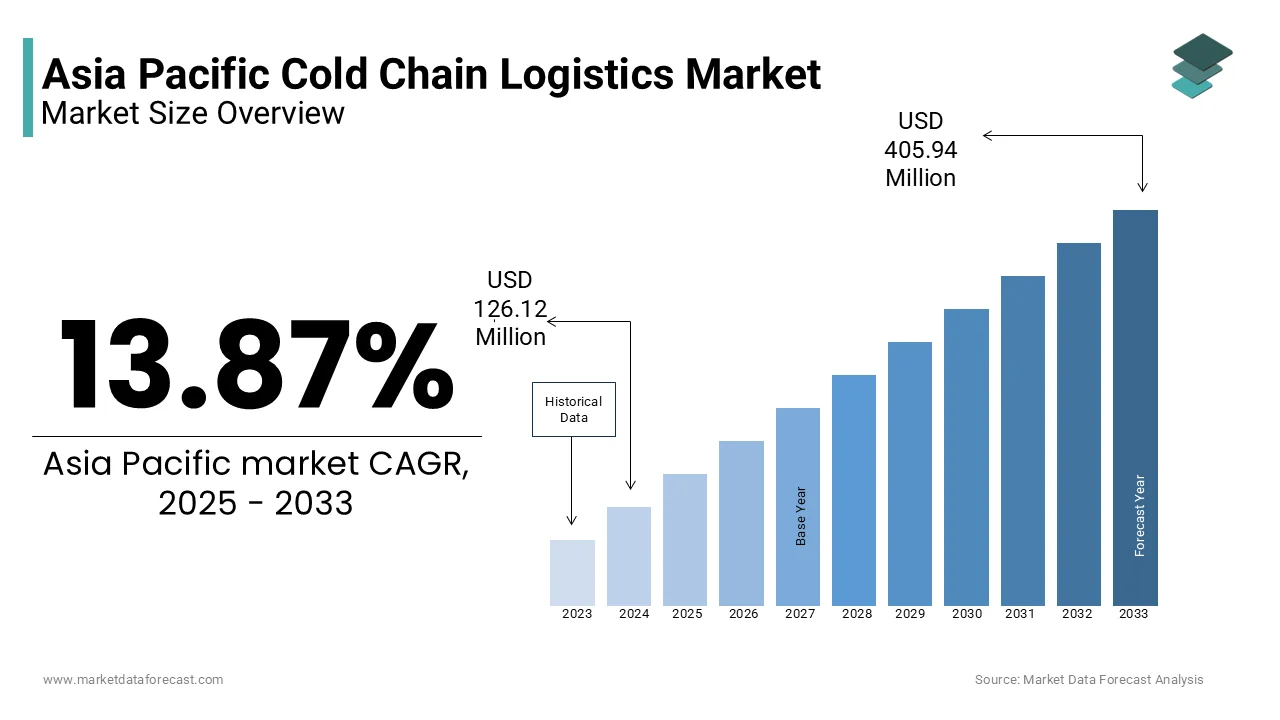
Cold chain logistics covers the infrastructure, systems, and services involved in maintaining temperature-controlled supply chains for perishable goods, including food, pharmaceuticals, and biologics. This sector has become increasingly vital due to rising demand for fresh and frozen food products, expanding vaccine distribution networks, and stricter regulatory compliance across industries. Countries such as China, India, Japan, and Australia are witnessing significant growth in cold storage infrastructure and refrigerated transport capabilities to support this demand. According to the Food and Agriculture Organization (FAO), nearly one-third of all food produced globally is wasted, with Asia accounting for a large portion due to inadequate cold storage facilities. In response, governments across the region have intensified investments in cold chain development. These developments underscore the region’s evolving logistics ecosystem and its growing integration into global supply chains.
MARKET DRIVERS
Rising Demand for Perishable Food Products
The increasing consumption of perishable food products, particularly in urban centers is one of the primary drivers of the Asia Pacific cold chain logistics market. This surge is not only driven by changing consumer preferences but also by rapid urbanization and a growing middle class with higher disposable incomes. Cold chain infrastructure ensures food safety, extends shelf life, and reduces spoilage, making it indispensable for meeting this rising demand.
Expansion of the Pharmaceutical and Vaccine Distribution Network
The pharmaceutical sector is another critical driver of the Asia Pacific cold chain logistics market, particularly in light of the region's growing healthcare infrastructure and increasing vaccine production. India’s Serum Institute, the world’s largest vaccine manufacturer, produces a substantial number of doses annually, most of which require temperature-controlled storage and transport. Additionally, the region's biopharmaceutical market is expanding rapidly. This expansion necessitates advanced cold chain solutions to ensure product integrity. The rollout of national immunization programs, such as Indonesia’s National Immunization Schedule and Japan’s expanded flu vaccination drives, further intensifies the need for efficient cold logistics. These developments underscore the critical role of cold chain systems in maintaining public health standards across the region.
MARKET RESTRAINTS
High Capital and Operational Costs
The high capital and operational costs associated with setting up and maintaining temperature-controlled infrastructure is a significant restraint on the growth of the Asia Pacific cold chain logistics market. Establishing a cold chain facility requires substantial investment in refrigeration units, insulated storage systems, and energy-efficient transport vehicles. Moreover, ongoing energy costs are a major operational burden. The cost burden is further exacerbated by the need for advanced monitoring systems, skilled labor, and regular maintenance. Many regional players struggle to absorb these expenses, limiting market expansion and delaying the adoption of modern cold chain practices. These financial constraints disproportionately affect rural and underdeveloped areas, where infrastructure gaps are most pronounced, thereby slowing the overall market growth.
Fragmented Regulatory Frameworks and Compliance Challenges
The fragmented regulatory environment across the Asia Pacific region, which complicates standardization and compliance in cold chain logistics, is another key restraint. Each country has distinct regulations governing food safety, pharmaceutical transport, and environmental standards, making it difficult for logistics providers to maintain uniform operations. In India, for example, multiple agencies such as the Food Safety and Standards Authority of India (FSSAI) and the Ministry of Food Processing Industries regulate cold storage facilities, often leading to overlapping mandates. Similarly, in Thailand, the Department of Disease Control and the Department of Internal Trade enforce separate guidelines for pharmaceutical and food logistics, respectively. This regulatory complexity increases administrative overhead and delays approvals, discouraging investment. These challenges hinder seamless logistics flow and reduce efficiency across the cold chain value chain.
MARKET OPPORTUNITIES
Growth of E-Grocery and Cold Chain E-Commerce Platforms
The rapid expansion of e-grocery and cold chain e-commerce platforms presents a significant opportunity for the Asia Pacific cold chain logistics market. With the rise of online food delivery and grocery shopping, especially in urban centers, there is an increasing need for temperature-controlled storage and last-mile delivery solutions. In China, platforms like JD.com and Freshippo have integrated cold chain logistics into their delivery systems to ensure freshness and quality. Similarly, in India, companies like BigBasket and Grofers have invested heavily in refrigerated transport fleets to support their chilled and frozen product lines. The adoption of mobile cold storage units and electric refrigerated vans is also gaining traction, especially in cities with high delivery volumes. This trend is further supported by government initiatives promoting digital infrastructure and logistics modernization, offering a conducive environment for cold chain expansion in the e-commerce sector.
Technological Advancements in Cold Chain Monitoring and Automation
Technological innovation in cold chain monitoring and automation is opening new growth avenues for the Asia Pacific cold chain logistics market. The adoption of Internet of Things (IoT), artificial intelligence (AI), and blockchain-based tracking systems is enhancing real-time visibility and control over temperature-sensitive shipments. In Japan, companies like Panasonic and Daikin have developed AI-driven refrigeration systems that optimize energy consumption while maintaining precise temperature levels. Similarly, in South Korea, logistics firms are integrating blockchain to track vaccine shipments, ensuring data integrity and traceability. In India, startups such as Stellapps and Ninjacart are deploying IoT sensors to monitor cold storage conditions remotely, reducing spoilage and improving efficiency. Such technologies have the potential to reduce cold chain losses in the food sector. Governments across the region are also incentivizing digital transformation in logistics through initiatives like Singapore’s Logistics Industry Transformation Map and India’s National Logistics Policy, further accelerating the adoption of smart cold chain solutions.
MARKET CHALLENGES
Inadequate Infrastructure in Rural and Remote Areas
The lack of infrastructure in rural and remote regions, which limits the reach and efficiency of temperature-controlled supply chains, is one of the most pressing challenges in the Asia Pacific cold chain logistics market. This infrastructure gap is particularly pronounced in countries like Indonesia, the Philippines, and Vietnam, where rugged terrain and dispersed populations make logistics more complex. Power supply issues further exacerbate the problem, with intermittent electricity affecting cold storage operations in rural areas. Developing decentralized cold storage units and investing in solar-powered refrigeration systems could mitigate some of these issues, but progress remains slow due to limited funding and technical expertise in remote regions.
Skilled Labor Shortage and Workforce Training Gaps
The shortage of skilled labor and inadequate workforce training programs is a significant challenge facing the Asia Pacific cold chain logistics market. Cold chain operations require specialized knowledge in refrigeration technology, supply chain management, and regulatory compliance, yet many countries in the region face a skills gap in these areas. This shortage affects service quality and increases the risk of product spoilage due to improper handling. Furthermore, training programs are often fragmented and lack standardization across countries. Even in developed markets like Australia and Japan, there is a growing need for continuous upskilling to keep pace with automation and digital monitoring systems.
REPORT COVERAGE
| REPORT METRIC | DETAILS |
| Market Size Available | 2025 to 2034 |
| Base Year | 2025 |
| Forecast Period | 2026 to 2034 |
| CAGR | 13.87% |
| Segments Covered | By Type, Application, and Region |
| Various Analyses Covered | Regional & Country Level Analysis, Segment-Level Analysis, DROC, PESTLE Analysis, Porter’s Five Forces Analysis, Competitive Landscape, Analyst Overview on Investment Opportunities |
| Regions Covered | India, China, Japan, South Korea, Australia, New Zealand, Thailand, Malaysia, Vietnam, Philippines, Indonesia, Singapore, and the Rest of Asia-Pacific |
| Market Leaders Profiled | United Parcel Service of America, Inc., OOCL Logistics Limited, JWD Infologistics Public Company Ltd, Nichirei Logistics Group Inc., Deutsche Post DHL Group, X2 Logistics Networks, AIT Worldwide Logistics, Inc., and others |
SEGMENTAL ANALYSIS
By Type Insights
The refrigerated warehouses segment constituted the largest category in the Asia Pacific cold chain logistics market by accounting for 56.5% of total revenue in 2025. The dominance of this segment is primarily driven by the increasing need for long-term storage of temperature-sensitive goods, especially in the food and pharmaceutical sectors.
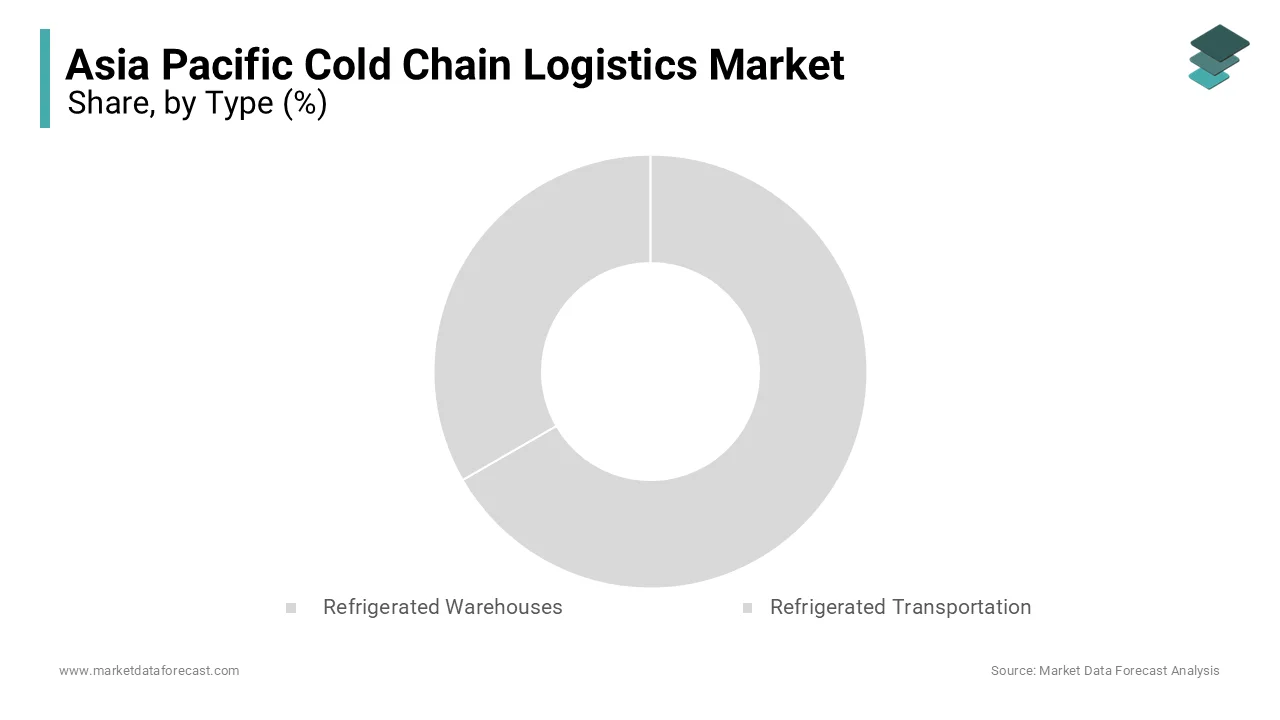
The refrigerated transportation segment is the fastest-growing in the Asia Pacific cold chain logistics market, projected to grow at a CAGR of 14.2% from 2023 to 2030. The rapid expansion of e-commerce, coupled with rising demand for fresh and frozen food deliveries, is fueling this growth. These trends show the growing reliance on refrigerated transportation to meet consumer expectations for freshness and product integrity.
By Application Insights
The fruits and vegetables segment led the Asia Pacific cold chain logistics market by accounting for a 32.5% of total demand in 2025. The dominance of this segment is attributed to the high perishability of fresh produce and the increasing need for post-harvest storage and transport solutions
The pharmaceuticals segment is the fastest-growing application area in the Asia Pacific cold chain logistics market and is projected to grow at a CAGR of 15.6% from 2026 to 2034. The growth of this segment is primarily fueled by the expansion of vaccine manufacturing, biologics production, and the rise in temperature-sensitive drug formulations. Apart from these, the rollout of national immunization programs across Southeast Asia, including Indonesia’s expanded vaccine distribution network, is further accelerating demand for temperature-controlled logistics. These developments underscore the critical importance of cold chain systems in ensuring the safety and efficacy of pharmaceutical products across the region.
REGIONAL ANALYSIS
China Cold Chain Logistics Market Analysis
China spearheaded the Asia Pacific cold chain logistics sector by accounting for a 27.4% of total regional revenue in 2025. As the world’s largest producer and consumer of food and pharmaceuticals, China’s cold chain infrastructure has expanded rapidly to support domestic and export demands. Government initiatives such as the “Cold Chain Development Action Plan” and investments in smart logistics parks have accelerated the modernization of cold chain systems, positioning China as a regional leader.
India Cold Chain Logistics Market Analysis
India is another major player in the Asia Pacific cold chain logistics market. The country’s rapid urbanization, growing middle class, and increasing demand for processed and frozen foods are key drivers of cold chain expansion. The expansion of organized retail and e-grocery platforms such as BigBasket and Grofers has further increased demand for temperature-controlled logistics. Additionally, India’s role as a global vaccine exporter, led by companies like Serum Institute and Bharat Biotech, has intensified the need for pharmaceutical cold chain solutions. Government initiatives like the Pradhan Mantri Kisan Sampada Yojana and the National Logistics Policy are expected to further boost infrastructure development.
Japan Cold Chain Logistics Market Analysis
Japan occupies a significant position in the Asia Pacific cold chain logistics market. The country’s well-developed infrastructure, high regulatory standards, and growing demand for premium perishable goods drive its strong market position. With the country’s aging population and rising demand for healthcare products, cold chain logistics are expected to play an increasingly vital role in Japan’s supply chain ecosystem.
Australia Cold Chain Logistics Market Analysis
Australia holds a notable share in the Asia Pacific cold chain logistics market. The country’s strong agricultural exports, stringent food safety regulations, and growing demand for frozen and chilled food products support its cold chain logistics expansion. Additionally, the rise of online grocery platforms such as Woolworths’ online delivery and Coles Express has increased demand for refrigerated transport. With the Australian government investing in digital logistics infrastructure and cold chain automation, the market is poised for continued growth.
South Korea Cold Chain Logistics Market Analysis
South Korea captures descent share of total share. The country’s advanced logistics infrastructure, growing food processing industry, and expanding pharmaceutical sector contribute to its strong market position. Additionally, the rise of online food delivery platforms like Baedal Minjok and Coupang Eats has significantly boosted demand for refrigerated transport. With the government’s push toward smart logistics and automation, South Korea is expected to further enhance its cold chain capabilities in the coming years.
COMPETITIVE LANDSCAPE
The Asia Pacific cold chain logistics market is highly competitive, characterized by the presence of global giants, regional specialists, and emerging local players. As demand for temperature-controlled logistics continues to rise across food, pharmaceutical, and healthcare sectors, companies are increasingly differentiating themselves through innovation, infrastructure investments, and technological integration. The competitive environment is marked by a blend of strategic expansion, digital transformation, and sustainability initiatives aimed at improving efficiency and reducing environmental impact. While multinational corporations leverage their global expertise and financial strength, regional players capitalize on localized knowledge and agile operations to capture market share. The growing emphasis on end-to-end cold chain solutions has also led to increased collaboration between logistics providers, technology firms, and government agencies to build a more integrated and resilient supply chain ecosystem across the region.
KEY MARKET PLAYERS
United Parcel Service of America, Inc., OOCL Logistics Limited, JWD Infologistics Public Company Ltd, Nichirei Logistics Group Inc., Deutsche Post DHL Group, X2 Logistics Networks, AIT Worldwide Logistics, Inc., CWT PTE LIMITED (CWT International Ltd), SF Express, and Rokin Logistics Supply Chain Co., Ltd. are key players in the Asia Pacific cold chain logistics market.
TOP PLAYERS IN THE MARKET
- Lineage Logistics has established a strong presence in the Asia Pacific cold chain logistics market through strategic acquisitions and infrastructure development. The company is known for its advanced temperature-controlled warehousing solutions and digital integration in logistics operations. Lineage contributes significantly to the global cold chain industry by setting benchmarks in energy efficiency, automation, and sustainability. Its operations in the region support a wide range of industries including food, seafood, and pharmaceuticals, helping ensure product integrity and supply chain resilience across key export and import hubs.
- UTCold plays a pivotal role in the Asia Pacific cold chain logistics sector by offering scalable, modular cold storage solutions tailored for remote and high-demand locations. The company’s innovative containerized refrigeration systems are widely adopted in agricultural and seafood supply chains. UTCold’s contribution to the global market lies in its ability to deploy rapid, cost-effective cold storage infrastructure, addressing gaps in rural and developing markets. This flexibility enhances cold chain accessibility and supports food security and export growth in the region.
- Pan Asia Cold Chain Logistics is a regional leader with a comprehensive network of cold storage facilities and transport services across Southeast Asia. The company specializes in integrated cold chain solutions that cater to both domestic and international trade. PACCL's contribution to the global cold chain market is marked by its focus on end-to-end logistics integration, compliance with international food safety standards, and investment in smart monitoring systems. Its localized expertise and scalable infrastructure make it a critical player in advancing cold chain efficiency across the Asia Pacific.
TOP STRATEGIES USED BY KEY MARKET PLAYERS
- Key players in the Asia Pacific cold chain logistics market are increasingly forming strategic partnerships to enhance service capabilities and geographic reach. These alliances allow companies to integrate their strengths, whether in infrastructure, technology, or distribution networks, thereby improving supply chain efficiency and customer service.
- Adopting advanced technologies such as IoT, AI, and blockchain for real-time monitoring and automation is a core strategy among leading firms. This shift enables greater visibility, reduces spoilage, and ensures compliance with stringent regulatory requirements across food and pharmaceutical logistics.
- Market leaders are actively acquiring regional logistics firms to expand their cold chain footprint and consolidate their market position. These acquisitions help in rapidly scaling operations, entering new markets, and enhancing service portfolios without the time and cost associated with greenfield development.
RECENT HAPPENINGS IN THE MARKET
- In January 2025, Lineage Logistics expanded its presence in Southeast Asia by acquiring a cold storage facility in Thailand, enhancing its regional distribution capabilities and supporting growing food export demand.
- In March 2025, United Temperature Corporation launched a new line of solar-powered modular cold storage units designed for rural and off-grid locations, addressing infrastructure gaps in the Asia Pacific region.
- In June 2025, Pan Asia Cold Chain Logistics partnered with a leading logistics technology firm to integrate AI-driven monitoring systems across its warehouse and transport network, improving real-time visibility and operational efficiency.
- In September 2025, a major Japanese logistics firm entered into a joint venture with an Australian cold storage provider to strengthen cross-border cold chain connectivity between Northeast and South Asia-Pacific markets.
- In November 2025, a leading Indian cold chain solutions provider inaugurated a state-of-the-art temperature-controlled logistics hub near Mumbai, aimed at serving both domestic and international perishable goods trade.
MARKET SEGMENTATION
This research report on the Asia Pacific cold chain logistics market has been segmented and sub-segmented based on the following categories.
By Type
- Refrigerated Warehouses
- Refrigerated Transportation
- Road
- Sea
- Rail
- Air
By Application
- Fruits & Vegetables
- Fish, Meat, and Seafood
- Dairy & Frozen Desserts
- Bakery & confectionery
- Processed Food
- Pharmaceuticals
- Others
By Country
- India
- China
- Japan
- South Korea
- Australia
- New Zealand
- Thailand
- Malaysia
- Vietnam
- Philippines
- Indonesia
- Singapore
- Rest of Asia-Pacific