Asia Pacific Color Concentrates Market Size, Share, Growth, Trends, and Forecast Report – Segmented By Type (solid, liquid), End User Industry, and Region (India, China, Japan, South Korea, Australia & New Zealand, Thailand) - Industry Analysis from 2025 to 2033
Asia Pacific Color Concentrates Market Size
Asia Pacific Color concentrates market size was valued at USD 2.39 billion in 2024, and the market size is expected to reach USD 5.28 billion by 2033 from USD 2.61 billion in 2025. The market's promising CAGR for the predicted period is 9.20%.
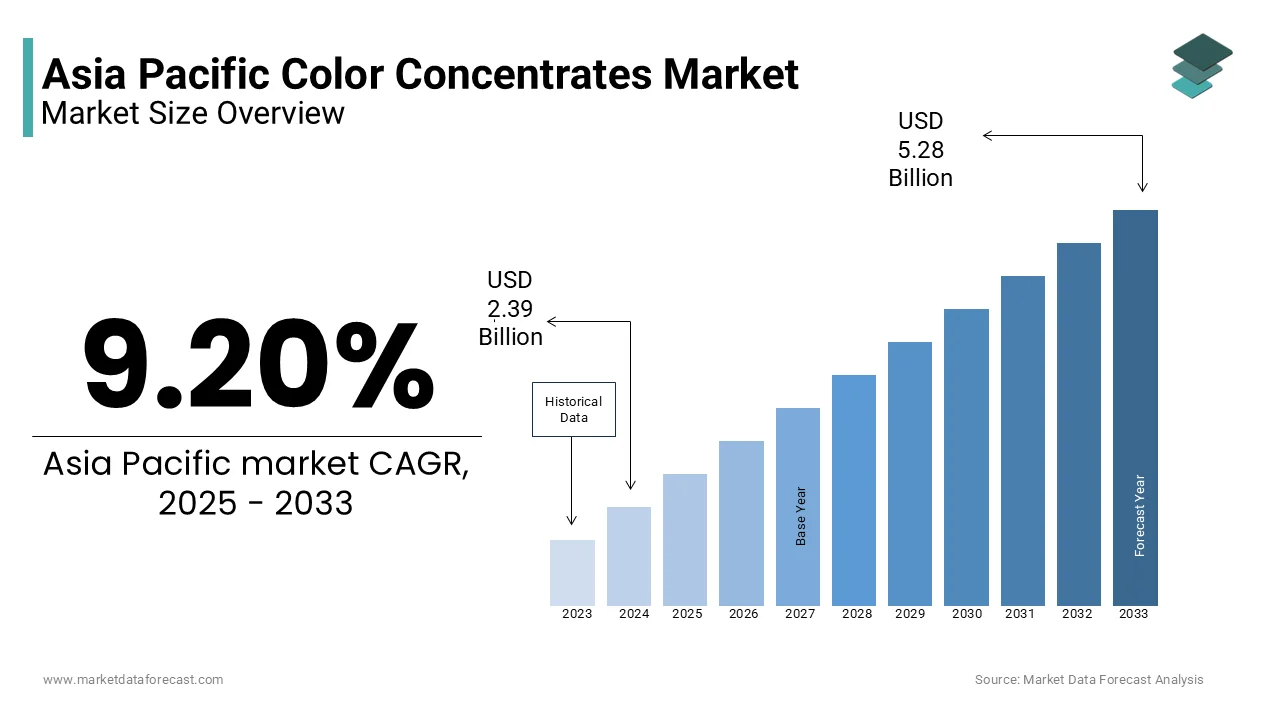
Color concentrates are masterbatch formulations used to impart color and functional properties to polymers during manufacturing. These additives are widely employed across industries such as packaging, automotive, consumer goods, and textiles to enhance aesthetic appeal, durability, and product differentiation. In the Asia Pacific region, the demand for color concentrates has surged due to the expanding plastics industry and growing emphasis on product branding and visual appeal. Countries such as China, India, Japan, and South Korea have emerged as key consumers, driven by industrialization and increasing production of plastic goods.
The Asia Pacific Color Concentrates Market is being reshaped by innovations in sustainable and high-performance colorants, including bio-based and recyclable concentrates that align with evolving environmental regulations. According to the Asian Plastic Industry Association, the region accounts for over 60% of global plastic production, making it a dominant force in the colorants market. Additionally, the rise of smart manufacturing and automation in countries like Thailand and Vietnam has increased the demand for precision-colored polymers.
 MARKET DRIVERS
Expansion of the Packaging Industry in Emerging Economies
The rapid expansion of the packaging industry, particularly in emerging economies such as India, Indonesia, and Vietnam is a key factor propelling the growth of Asia Pacific Color Concentrates Market. The increasing demand for consumer goods, food and beverage products, and e-commerce packaging has led to a surge in the use of colored plastics to enhance product visibility and brand identity. This growth has directly boosted the demand for color concentrates to meet aesthetic and functional requirements.
In Indonesia, the government has been promoting domestic packaging production to reduce reliance on imports. Apart from these, in Vietnam, where the packaging sector is expanding due to rising disposable incomes and urbanization, color concentrates are being increasingly used in flexible packaging, bottles, and containers. These trends indicate that the sustained growth of the packaging industry is a major catalyst for the expansion of the color concentrates market in the Asia Pacific region.
Rising Demand from the Automotive Sector
The rising demand from the automotive industry, particularly in countries like China, Japan, and South Korea, is another driver of the Asia Pacific Color Concentrates Market. The automotive sector extensively uses colored polymers for interior and exterior components such as dashboards, bumpers, trims, and lighting housings. As vehicle manufacturers focus on lightweight materials and design differentiation, the use of color concentrates in plastic components has increased.
In China, which is the world’s largest automotive market, the integration of color concentrates into automotive plastics has been driven by the growth of electric vehicles and the need for customized interiors. Similarly, in South Korea, automakers have adopted color concentrates to offer a wider range of interior color options, improving consumer appeal. These developments emphasize the automotive industry’s growing influence on the color concentrates market in the Asia Pacific region.
MARKET RESTRAINTS
Regulatory Restrictions on Certain Pigments and Additives
The increasing regulatory scrutiny on certain pigments and additives used in color concentrates, particularly in countries like Australia, Japan, and South Korea, is a major restraint in the Asia Pacific Color Concentrates Market. Governments and environmental agencies are imposing stricter regulations on heavy metals, volatile organic compounds (VOCs), and other potentially hazardous substances in industrial applications. According to the Australian Government’s Department of Agriculture, Water and the Environment, the use of lead-based and cadmium-based pigments has been restricted under national environmental safety guidelines, compelling manufacturers to reformulate their products.
In Japan, the Ministry of Economy, Trade and Industry (METI) has implemented stringent chemical control laws under the Chemical Substances Control Law (CSCL), requiring extensive testing and compliance for new colorant formulations. Similarly, in South Korea, the Ministry of Environment has introduced the Act on the Registration and Evaluation of Chemicals (K-REACH), which mandates the registration and safety assessment of industrial chemicals, including colorants. These regulatory developments pose challenges for market expansion by increasing compliance costs and slowing product approvals.
Volatility in Raw Material Prices and Supply Chain Disruptions
The volatility in raw material prices and supply chain disruptions, which affect production costs and availability, is another significant restraint in the Asia Pacific Color Concentrates Market. Color concentrates rely on polymers, pigments, and carrier resins, many of which are derived from petroleum-based feedstocks. Fluctuations in crude oil prices directly impact the cost of these materials.
Additionally, supply chain bottlenecks caused by geopolitical tensions and the global pandemic have disrupted the availability of key raw materials. In 2022, a shortage of pigment intermediates from China due to temporary production halts led to a price hike in color concentrates across Southeast Asia. Also, logistics delays and increased freight costs further compounded the situation, affecting small and medium-sized manufacturers disproportionately. These challenges continue to constrain market growth.
MARKET OPPORTUNITIES
Growth of the Sustainable and Biodegradable Plastics Industry
The growth of the sustainable and biodegradable plastics industry, which is creating demand for eco-friendly colorants, is a key opportunity in the Asia Pacific Color Concentrates Market. Governments and industry stakeholders across the region are pushing for reduced plastic waste and the adoption of bio-based materials. In addition, over 15 countries in the Asia Pacific region have introduced national policies promoting biodegradable and compostable plastics, offering incentives for manufacturers to shift toward greener alternatives.
In India, the Ministry of Environment, Forest and Climate Change launched the Plastic Waste Management Rules 2023, mandating the use of sustainable packaging materials, which has spurred demand for colour concentrates compatible with bio-based polymers. These progresses provide a potential opportunity for manufacturers to innovate and expand their product portfolios in line with environmental regulations.
Technological Advancements in High-Performance Color Concentrates
Technological advancements in high-performance color concentrates represent a key opportunity for the Asia Pacific Color Concentrates Market. Innovations in pigment dispersion, heat resistance, UV stability, and antimicrobial properties are enhancing the functionality of colorants, making them suitable for demanding applications in electronics, aerospace, and medical devices.
In Japan, companies are investing in R&D to develop color concentrates that can withstand extreme temperatures and maintain color integrity in electronic enclosures and automotive components. Like, as per the Japan Chemical Innovation Institute reported that advanced colorant technologies have contributed to an improvement in product durability in high-stress applications. These technological advancements are opening new avenues for market growth and enhancing the competitiveness in the evolving manufacturing landscape.
MARKET CHALLENGES
Intense Competition from Local and Regional Manufacturers
The intense competition from local and regional manufacturers, which has led to price pressures and margin erosion, is a major challenge facing the Asia Pacific Color Concentrates Market. As demand for colorants increases, a growing number of domestic producers have entered the market, offering cost-effective alternatives to global players. According to the Asian Plastics Industry Association, over 200 new color concentrate manufacturers have emerged in China and India in the past five years, intensifying competition and forcing multinational companies to adjust their pricing strategies.
In India, domestic firms have gained significant market share by offering customized color solutions at lower prices. As per indication by the Confederation of Indian Industry (CII), local manufacturers now account for nearly 60% of the domestic color concentrates market, reducing the dominance of international suppliers. Similarly, in China, the presence of numerous small-scale producers has led to fragmented market conditions, making it difficult for global players to maintain consistent profitability. So, companies are investing in differentiation through product innovation, technical support, and value-added services.
Lack of Standardization and Quality Consistency
The lack of standardization and quality consistency across different manufacturers and regions is another significant challenge in the Asia Pacific Color Concentrates Market. Unlike in Europe and North America, where colorants are subject to stringent quality certifications and testing protocols, the Asia Pacific region has varying regulatory frameworks and quality benchmarks.
In countries like Indonesia, Vietnam, and the Philippines, where many small-scale manufacturers operate, the lack of standardized testing facilities and technical expertise has resulted in inconsistent color matching and durability. This lack of uniformity not only affects product reliability but also hampers cross-border trade and adoption by multinational companies. Addressing these quality concerns requires stronger regulatory alignment and investment in testing infrastructure.
REPORT COVERAGE
| REPORT METRIC | DETAILS |
| Market Size Available | 2024 to 2033 |
| Base Year | 2024 |
| Forecast Period | 2025 to 2033 |
| CAGR | 9.20% |
| Segments Covered | By Type, End User Industry, and Region |
|
Various Analyses Covered | Regional & Country Level Analysis, Segment-Level Analysis, DROC, PESTLE Analysis, Porter’s Five Forces Analysis, Competitive Landscape, Analyst Overview on Investment Opportunities |
| Regions Covered | India, China, Japan, South Korea, Australia, New Zealand, Thailand, Malaysia, Vietnam, Philippines, Indonesia, Singapore, and the Rest of Asia-Pacific |
| Market Leaders Profiled | Ampacet Corporation, Ferro Corporation, A. Schulman, Inc., Penn Color, Inc., and PolyOne Corporation, and others |
SEGMENTAL ANALYSIS
By Type Insights
The solid color concentrates segment dominated the market by holding a substantial portion of the total share in 2024. Its compatibility with high-volume plastic manufacturing processes, which are prevalent across the Asia Pacific region, is one of the key drivers of the solid segment. Like, plastic processors in China and India solid color concentrates are widely preferred due to their ease of handling, consistent dispersion, and cost-effectiveness in large-scale production. This dominance is also attributed to the widespread use of solid masterbatches in polymer processing , particularly in injection molding, blow molding, and extrusion applications across industries such as packaging, automotive, and consumer goods. Additionally, solid concentrates offer superior thermal stability during processing, making them ideal for use in high-temperature manufacturing environments. The established supply chain infrastructure for solid colorants, particularly in countries like Japan and South Korea, where precision manufacturing is a key focus, is a further contributing aspect.
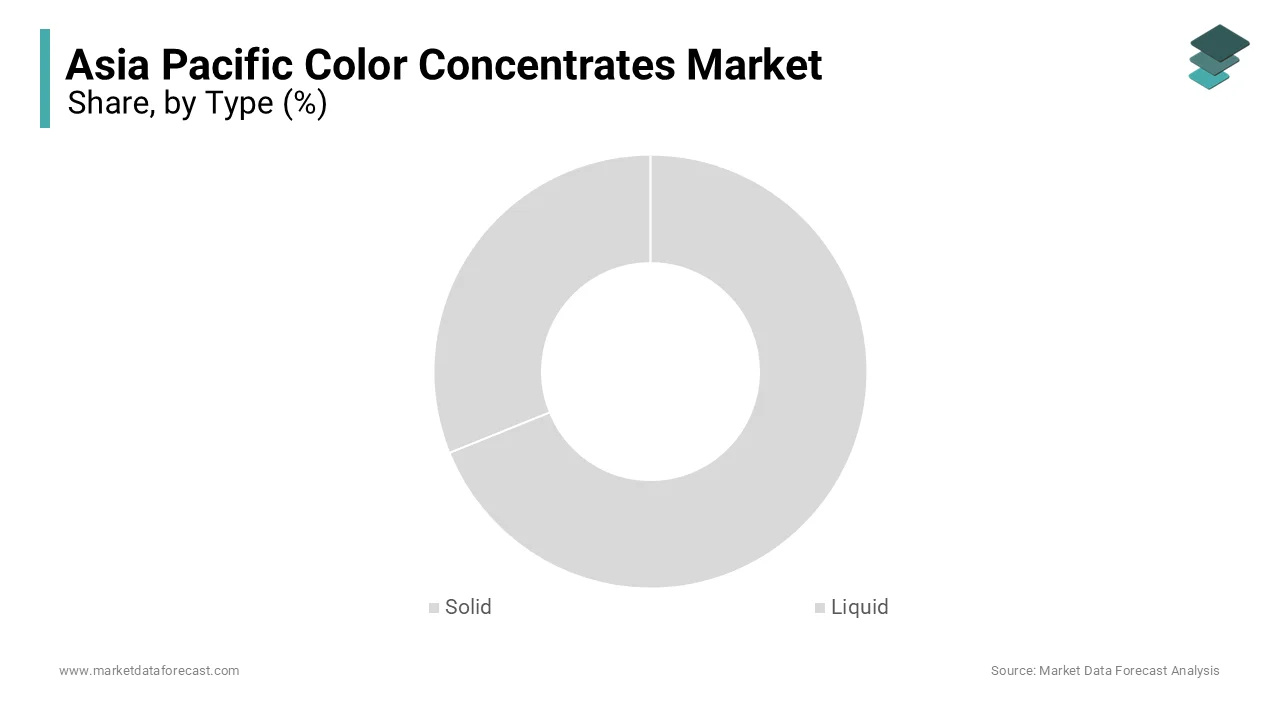
The liquid color concentrates segment is the fastest-growing segment in the Asia Pacific Color Concentrates Market and is projected to grow at a CAGR of 8.7% from 2025 to 2033. Its growth is accelerating due to increasing demand for flexible and high-performance coloring solutions in niche applications. Superior dispersion properties, which make it ideal for use in thin-wall packaging, films, and fiber applications where precise color uniformity is essential is also a growth driver for the liquid segment. Besides, the rise in demand for low-dust and environmentally friendly colorants is propelling the liquid segment’s adoption. For instance, in South Korea, the Ministry of Environment has been promoting the use of liquid colorants as a safer alternative in food packaging and medical applications.
By End User Industry Insights
The Packaging segment held the largest market share with 34.2% of total demand in 2024. Rising consumption of packaged goods across the region, particularly in countries like India, Indonesia, and Vietnam, where urbanization and disposable incomes are on the rise is a major factor driving the packaging segment’s dominance. The progress of this segment is also due to the explosive growth of the food and beverage, personal care, and e-commerce packaging sectors, which rely heavily on colored plastics for branding, shelf appeal, and product differentiation. The increasing use of color concentrates in flexible packaging, bottles, and containers is a further key contributor to this growth. The adoption of sustainable packaging solutions , which require specialized colorants that are compatible with recyclable and bio-based materials, is Another major driver. In China, the National Development and Reform Commission (NDRC) has mandated the use of eco-friendly packaging materials, prompting manufacturers to invest in color concentrates that meet environmental standards.
The automotive sector is the swiftest expanding in the Asia Pacific Color Concentrates Market and is expected to grow at a CAGR of 9.2% during the forecast period. Increasing use of plastic components in vehicle interiors and exteriors, particularly in electric and hybrid vehicles is among the main reasons behind the rapid expansion of automotive sector. The shift toward lightweight materials to improve fuel efficiency and reduce emissions is a different growth driver for the automotive segment. In Japan, over 70% of modern vehicle interiors are made from polymer-based components, many of which incorporate color concentrates for aesthetic and functional purposes. The growing demand for customized interiors and color-matched components is further boosting the adoption of colorants in the automotive sector. Apart from these, the expansion of electric vehicle (EV) manufacturing in countries like China and South Korea is contributing to increased demand for color concentrates. The China Association of Automobile Manufacturers drew attention that EV production grew in 2023 , with colorants playing a key role in enhancing cabin aesthetics and user experience. Also, liquid and high-performance color concentrates are increasingly used in EV interiors due to their ability to withstand temperature variations and UV exposure.
REGIONAL ANALYSIS
China
China spearheaded the Asia Pacific Color Concentrates Market by accounting for a 32.5% of total demand in 2024. As the world’s largest plastics producer and a major manufacturing hub, China’s demand for color concentrates is driven by its massive industrial output , particularly in packaging, consumer goods, and automotive sectors. A major driver of color concentrate use in China is the government’s push toward industrial modernization and automation , which has increased the demand for precision-colored polymer components. According to the China Plastics Processing Industry Association (CPPIA), the country’s plastic production reached over 120 million metric tons in 2023 , with colorants playing a crucial role in product differentiation and quality enhancement. Additionally, the expansion of the e-commerce sector has led to a surge in demand for colorful and visually appealing packaging materials. Moreover, the presence of domestic and international colorant manufacturers has facilitated the local production and affordability of color concentrates.
India
India witnessed rapid expansion in the Asia Pacific Color Concentrates Market. The country’s growing plastics industry, coupled with increasing investments in packaging and consumer goods manufacturing, has fueled the demand for color concentrates, particularly in food packaging, textiles, and home appliances. One of the key drivers of market growth in India is the rising disposable income and urbanization , which has led to increased consumption of packaged products and branded consumer goods. Moreover, the Make in India initiative has attracted significant foreign investment in manufacturing, particularly in the automotive and electronics sectors, where color concentrates are extensively used. These factors underline India’s strong position in the regional color concentrates market.
Japan
Japan remains a key player due to its focus on advanced polymer applications and product differentiation. A key factor supporting the market in Japan is the expansion of the electric vehicle and electronics industries, where colorants are used to enhance aesthetics and functionality. Additionally, the growing use of colorants in medical and healthcare plastics has contributed to market growth. These trends show Japan’s unique position as a high-value, innovation-driven market for color concentrates.
South Korea
South Korea accounts for a significant portion of the Asia Pacific Color Concentrates Market which is driven by its focus on precision manufacturing and export-oriented industries. The country’s limited natural resources and high labor costs have led to the adoption of advanced polymer technologies, where colorants play a crucial role in product differentiation and quality control. One of the major growth drivers is the use of color concentrates in automotive and electronics manufacturing , particularly in companies like Hyundai, Kia, and Samsung. Additionally, the integration of colorants into smart manufacturing systems has gained momentum in recent years.
Australia
Australia holds a notable share of the Asia Pacific Color Concentrates Market and is supported by its strong regulatory framework and growing emphasis on sustainable manufacturing and packaging. The country’s plastics industry is highly regulated, with increasing demand for eco-friendly and recyclable colorants that meet environmental safety standards. A key driver in Australia is the use of color concentrates in food packaging and healthcare plastics, particularly in applications requiring compliance with strict safety regulations. Additionally, the Australian government has been promoting the use of bio-based colorants as part of its national plastic waste reduction strategy.
KEY MARKET PLAYERS AND COMPETITIVE LANDSCAPE
Major companies plying their trade in the Asia Pacific Color Concentrates Market include Ampacet Corporation, Ferro Corporation, A. Schulman, Inc., Penn Color, Inc., and PolyOne Corporation.
The Asia Pacific Color Concentrates Market is highly competitive, characterized by the presence of both global chemical giants and strong regional players. The market landscape is shaped by continuous innovation, evolving customer demands, and increasing regulatory scrutiny around sustainability and chemical safety. As industries across the region prioritize product differentiation and environmental compliance, companies are intensifying their focus on developing high-performance, eco-friendly color solutions. The competition is further intensified by the growing influence of local manufacturers offering cost-effective alternatives, which has led to price pressures and margin constraints for international players. In response, global firms are strengthening their regional supply chains, investing in advanced color technologies, and forming strategic alliances to maintain market relevance. Additionally, the rise of smart manufacturing and digital color management systems is influencing market dynamics, requiring companies to adapt to new production paradigms. This evolving competitive environment is fostering a dynamic and innovation-driven marketplace where technical expertise, sustainability, and localized market understanding are key to gaining a competitive advantage.
TOP PLAYERS IN THE MARKET
Clariant AG
One of the leading players in the Asia Pacific Color Concentrates Market is Clariant AG, a global specialty chemicals company. Clariant has a strong presence in the region, offering a wide range of color masterbatches and additives tailored for the plastics industry. The company is known for its innovative and sustainable color solutions, including bio-based and recyclable concentrates. Clariant's focus on product development and customer-specific formulations has enabled it to maintain a competitive edge in key markets such as China, India, and Southeast Asia.
PolyOne Corporation
Another key player is PolyOne Corporation, now part of Avient Corporation, which has a well-established footprint in the Asia Pacific region. Avient provides high-performance color concentrates for industries such as packaging, healthcare, and automotive. The company emphasizes technical expertise, regulatory compliance, and sustainability, positioning itself as a preferred partner for multinational manufacturers seeking consistent color quality and performance.
Alok Industries
Alok Industries is a major regional player, particularly in India, where it has built a strong reputation for producing cost-effective and high-quality color concentrates. The company serves a wide range of industries, including textiles, packaging, and consumer goods. Alok Industries focuses on customization, local sourcing, and rapid response to customer needs, making it a key supplier in the domestic and export markets.
TOP STRATEGIES USED BY KEY PLAYERS
One of the primary strategies adopted by key players in the Asia Pacific Color Concentrates Market is product innovation and sustainability development . Companies are continuously investing in R&D to create eco-friendly, high-performance colorants that meet evolving industry standards and environmental regulations. This includes developing recyclable and bio-based concentrates that align with global sustainability goals.
Another key strategy is expanding regional presence through localized manufacturing and distribution centers . By establishing production facilities in high-growth markets such as India, Vietnam, and Indonesia, companies can reduce lead times, lower costs, and better serve regional customers. These localized operations also help in adapting formulations to meet specific industry and regulatory requirements.
Lastly, strategic partnerships and collaborations with polymer producers and end-use industries are being leveraged to enhance market penetration. Companies are working closely with plastic manufacturers, packaging firms, and automotive OEMs to co-develop color solutions that improve product aesthetics and functionality while ensuring process efficiency and compliance.
RECENT HAPPENINGS IN THE MARKET
- In March 2024, Clariant AG launched a new line of bio-based color concentrates tailored for flexible packaging applications in Southeast Asia. The launch was aimed at supporting sustainable packaging initiatives and aligning with regional environmental regulations.
- In July 2023, Avient Corporation expanded its color concentrates production facility in Shanghai, China, to meet growing demand from the automotive and electronics sectors. The expansion was intended to enhance supply chain efficiency and provide faster delivery to key industrial customers.
- In November 2023, Alok Industries introduced a digital color matching platform for its clients in India and export markets. The platform was designed to improve color accuracy and reduce lead times, enhancing customer satisfaction and brand consistency.
- In January 2024, a leading Japanese colorant manufacturer partnered with a South Korean polymer producer to develop customized color concentrates for electric vehicle components. The collaboration focused on improving heat resistance and UV stability in automotive plastics.
- In September 2023, a major Thai plastics processor collaborated with a European color concentrate supplier to integrate sustainable colorants into its production of food packaging films. The initiative was aimed at meeting international sustainability standards and expanding export opportunities.
MARKET SEGMENTATION
This research report on the Asia Pacific color concentrates market has been segmented and sub-segmented based on the following categories.
By Type
- Solid
- Liquid
By End Use Industry
- Consumer Goods
- Packaging
- Construction
- Automotive
By Country
- India
- China
- Japan
- South Korea
- Australia
- New Zealand
- Thailand
- Malaysia
- Vietnam
- Philippines
- Indonesia
- Singapore
- Rest of Asia-Pacific
Frequently Asked Questions
1. What is the Asia Pacific color concentrates market?
It refers to the market for pigment-based additives used to color plastics and other materials across Asia Pacific.
2. What industries use color concentrates in Asia Pacific?
Major industries include packaging, automotive, consumer goods, construction, and textiles.
3. What types of color concentrates are popular in the region?
Masterbatches such as solid, liquid, and combination color concentrates are widely used.
4. What is driving the demand for color concentrates in Asia Pacific?
Rapid industrialization, urbanization, and rising plastic product consumption are key drivers.
5. Which countries lead the market in Asia Pacific?
China, India, Japan, and South Korea are major contributors to regional demand.
6. Who are the key players in the Asia Pacific color concentrates market?
Major companies include Clariant, Avient Corporation, Ampacet Corporation, and Plastiblends India.
7. What are the trends in the Asia Pacific color concentrates market?
Trends include demand for custom colors, sustainable formulations, and automation in production.
8. What is the future outlook for this market?
The market is expected to grow steadily due to expanding end-use industries and rising demand for colored plastics.
Access the study in MULTIPLE FORMATS
Purchase options starting from
$ 2000
Didn’t find what you’re looking for?
TALK TO OUR ANALYST TEAM
Need something within your budget?
NO WORRIES! WE GOT YOU COVERED!
Call us on: +1 888 702 9696 (U.S Toll Free)
Write to us: sales@marketdataforecast.com