- Product Description Description
- Table of Contents TOC
- List of Table & Figure LOT
- Get Free Sample PDF Sample PDF
Market Size, 2025
$6.57 BnMarket Estimate, 2026
$7.02 BnMarket Forecast, 2034
$12.02 BnCAGR, 2026–2034
6.95%Asia Pacific Contraceptives Market Report Summary
The Asia Pacific Contraceptives Market was valued at USD 6.57 billion in 2025 and is projected to reach USD 12.02 billion by 2034, growing from USD 7.02 billion in 2026 at a CAGR of 6.95% during the forecast period. Growth is driven by government-sponsored family planning initiatives, rising female educational attainment, increasing awareness of reproductive health, and expanding digital healthcare access. However, sociocultural stigma, regulatory fragmentation, and supply chain disruptions continue to restrain market growth.
Key Market Trends
- Increasing adoption of digital health platforms and telemedicine for contraceptive counseling and home delivery.
- Growing preference for self-care contraceptive models that enhance privacy and consumer autonomy.
- Rising demand for non-hormonal and topical contraceptive products.
- Expansion of e-commerce and online pharmacy channels for reproductive healthcare products.
- Increasing regulatory support for over-the-counter contraceptive access across several APAC countries.
Segmental Insights
- Based on drug type, contraceptive pills held the largest market share in 2025, driven by widespread clinical acceptance, affordability, strong government support, and extensive availability through public healthcare programs.
- Based on medical devices, male condoms dominated the market in 2025, supported by their dual protection against pregnancy and sexually transmitted infections, extensive government distribution programs, and broad public health adoption.
- Topical contraceptives are the fastest-growing drug type segment, projected to register a CAGR of 12.55%, driven by increasing consumer preference for non-hormonal, self-managed, and convenient contraceptive solutions.
Regional Insights
- India led the market in 2025, accounting for 26.9% of the regional market, supported by large-scale government family planning initiatives, domestic pharmaceutical manufacturing, and expanding contraceptive awareness programs.
- China holds a significant share, driven by high contraceptive prevalence, strong domestic manufacturing capabilities, and increasing adoption of premium contraceptive products.
- Japan is a prominent market, supported by regulatory reforms, gradual method diversification, and growing acceptance of hormonal contraceptives.
- South Korea contributes notably through rising youth adoption of female-controlled contraceptive methods, regulatory modernization, and increasing demand for premium formulations.
- Australia remains a key market, driven by comprehensive public subsidies, progressive reproductive health policies, and rapid adoption of innovative contraceptive technologies.
Competitive Landscape
The market is highly competitive, with multinational pharmaceutical companies and regional generic manufacturers competing through product innovation, regulatory expertise, digital health partnerships, local manufacturing, and government procurement programs. Companies are investing in provider training, telehealth integration, e-commerce expansion, localized product development, and strategic public-private partnerships to strengthen their presence across the Asia Pacific region.Prominent players in the market include Bayer HealthCare AG, Teva Pharmaceutical Industries Limited, Medisafe Distribution Inc., Pace Pharmaceuticals Inc., Medicines360, Church & Dwight Co., Inc., Actavis, Inc., CooperSurgical, Inc., Merck & Co., Inc., Reckitt Benckiser plc, Mayer Laboratories, Inc., and Pfizer Inc.
APAC Contraceptives Market Size
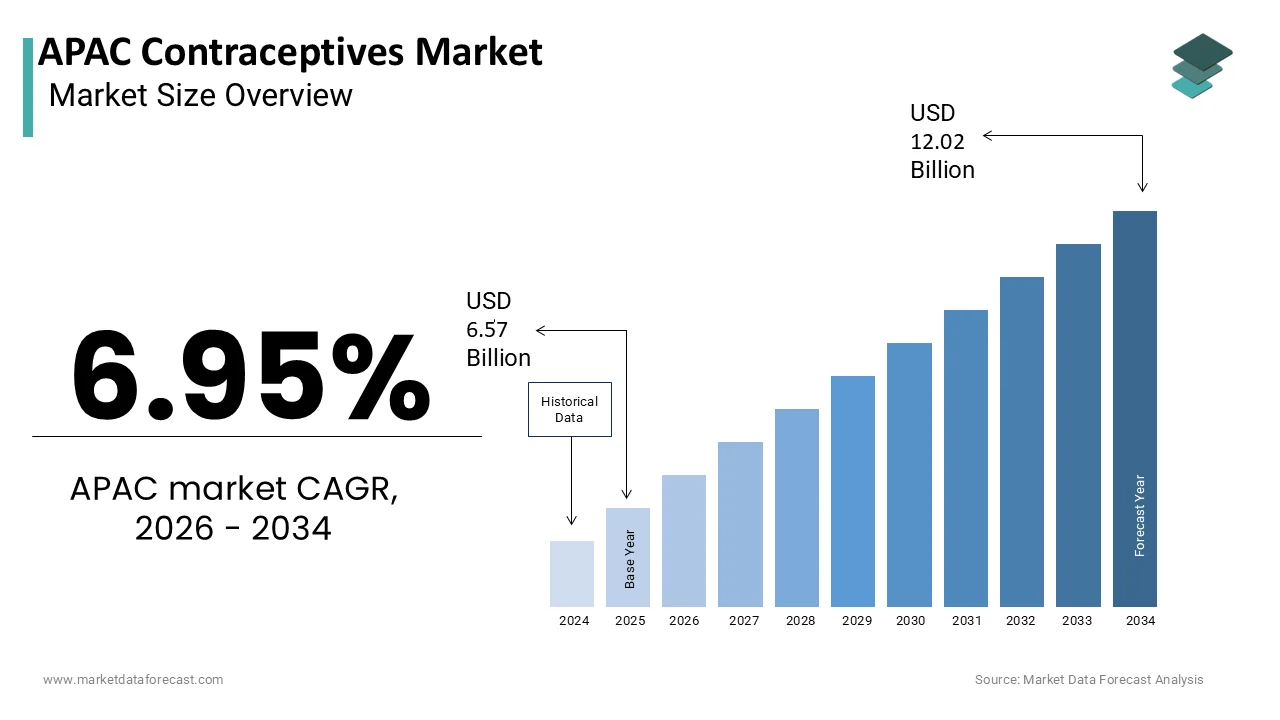
The APAC Contraceptives Market is projected to grow from USD 6.57 billion in 2025 to USD 7.02 billion in 2026 and reach USD 12.02 billion by 2034, registering a CAGR of 6.95% from 2026 to 2034.
According to the United Nations Population Fund, approximately 63% of married or in-union women aged 15 to 49 in the Asia Pacific region currently use some form of contraception, yet this aggregate figure masks profound subregional disparities ranging from 82% in East Asia to below 40% in parts of Oceania. According to the World Health Organization, an estimated 19 million women in Southeast Asia alone have an unmet need for modern family planning, representing a critical gap between reproductive intent and accessible healthcare infrastructure. As per the Asian Development Bank, female labor force participation in the region has reached 56%, creating a direct socioeconomic correlation between workforce engagement and voluntary fertility management. This market therefore functions as a vital barometer for broader developmental indicators including maternal health outcomes, educational attainment, and economic mobility across one of the most demographically complex regions globally.
MARKET DRIVERS
Government-Sponsored Family Planning Initiatives Accelerate Access
National public health programs are primarily fuelling contraceptive adoption across developing Asia Pacific economies where out-of-pocket expenditure remains prohibitive for low-income populations, which is a significant driver for the Asia-Pacific contraceptives market growth. According to the United Nations Population Division, government-funded family planning programs in countries like Indonesia and Bangladesh account for over 70% of all modern contraceptive distribution, effectively subsidizing access for millions of underserved women. According to the Ministry of Health and Family Welfare in India, the Mission Parivar Vikas initiative successfully increased modern contraceptive prevalence in 146 high-fertility districts by 15 percentage points between 2019 and 2023 through targeted community outreach and free distribution networks. These state-led interventions are not merely charitable endeavors but strategic demographic investments, and the National Institute of Population and Social Security Research in Japan estimates that every dollar spent on publicly subsidized contraception yields 9 dollars in savings related to maternal healthcare and child education costs. Consequently, when governments in Vietnam, the Philippines, or Pakistan expand their reproductive health budgets, they directly catalyze market volume independent of private sector marketing efforts. This public sector dominance creates a stable demand floor that buffers the market against economic volatility while simultaneously establishing supply chains and provider networks that eventually benefit commercial products as disposable incomes rise.
Rising Female Educational Attainment Correlates With Modern Method Adoption
The unprecedented expansion of female secondary and tertiary education across Asia Pacific is further propelling the regional market growth. According to UNESCO Institute for Statistics, female secondary school enrollment in South Asia increased from 58% in 2010 to 74% in 2023, a demographic shift that consistently correlates with delayed marriage and increased contraceptive agency. As per research published in The Lancet Global Health, women in Cambodia and Myanmar with secondary education are 3.2 times more likely to use modern contraceptives compared to those with no formal schooling, primarily due to enhanced health literacy and reduced susceptibility to misinformation. Education empowers women to navigate healthcare systems independently and negotiate reproductive decisions within household structures that historically restricted female autonomy. According to the Demographic and Health Survey in Nepal, contraceptive prevalence among educated urban women reached 68% versus only 34% among uneducated rural counterparts, illustrating how educational gradients create distinct market segments. As cohorts of educated women enter peak reproductive years across Laos, Timor-Leste, and Papua New Guinea, they generate sustained organic demand for quality branded contraceptives that transcends temporary donor-funded campaigns, embedding contraceptive use as a normative behavior linked to personal development aspirations.
MARKET RESTRAINTS
Persistent Sociocultural Stigma Limits Open Discussion and Access
Deep-rooted cultural taboos surrounding sexuality and reproductive health continue to suppress contraceptive uptake across significant portions of Asia Pacific despite decades of awareness campaigns, which is likely to impede the regional market growth. According to a multi-country study by the Guttmacher Institute, 42% of unmarried young women in Southeast Asia cite fear of social judgment or family disapproval as the primary reason for non-use of contraception, even when services are physically available and affordable. In many communities across Afghanistan, Papua New Guinea, and rural Pakistan, contraceptive use is erroneously associated with promiscuity rather than responsible family planning, leading women to avoid clinics entirely or rely on less effective traditional methods to maintain social standing. According to the United Nations Population Fund, in several Pacific Island nations, religious leaders actively discourage modern contraception, resulting in contraceptive prevalence rates stagnating below 30% for over two decades despite international aid availability. This stigma operates at multiple levels, preventing adolescents from seeking information, discouraging healthcare providers from offering counseling proactively, and inhibiting policymakers from allocating adequate resources. Unlike price barriers,s which can be addressed through subsidies, sociocultural resistance requires generational attitude shifts that unfold over decades rather than fiscal quarters, making it a structural restraint that limits market potential regardless of product innovation or distribution expansion efforts.
Regulatory Fragmentation Delays Product Launches Across Jurisdictions
The absence of harmonized regulatory frameworks across Asia Pacific creates substantial delays and costs for manufacturers seeking regional market access, which is effectively fragmenting what could be a unified commercial opportunity. According to the Asia Pacific Economic Cooperation Regulatory Harmonization Steering Committee, obtaining contraceptive registration approval takes an average of 18 months in Thailand, 24 months in Indonesia, and 36 months in China, with each jurisdiction requiring separate clinical data packages and local testing despite identical active ingredients. This lack of mutual recognition means a novel long-acting reversible contraceptive approved in Australia may not reach Vietnamese patients for another three to five years, during which time patent exclusivity erodes, and generic competition emerges. According to the Therapeutic Goods Administration of Australia, regulatory compliance costs for entering a single new ASEAN market can exceed 500000 USD, a prohibitive sum for smaller innovators or social enterprises focused on affordable products. Consequently, many global manufacturers prioritize larger Western markets first, leaving Asia Pacific patients with outdated formulations or limited method choice. This regulatory friction disproportionately affects newer technologies like hormonal intrauterine systems or contraceptive rings that require complex evaluation, perpetuating reliance on older oral pills and injectables even when superior options exist globally.
MARKET OPPORTUNITIES
Digital Health Platforms Enable Discreet Access and Counseling
The rapid proliferation of mobile internet and telemedicine platforms across Asia Pacific presents a promising opportunity for the Asia-Pacific contraceptives market. According to the International Telecommunication Union, mobile internet penetration in Southeast Asia reached 78% in 2024, enabling digital health startups to deliver contraceptive counseling and prescriptions directly to users’ devices without requiring clinic visits. According to platforms like Halodoc and Alodokter in Indonesia, there was a 215% year-on-year increase in reproductive health consultations during 2023, demonstrating pent-up demand for private, judgment-free information channels. Similarly, in the Philippines, where physical pharmacy access remains limited in rural areas, telehealth services now facilitate home delivery of oral contraceptives following online physician consultation, reaching populations previously excluded from formal healthcare systems. As per World Bank estimates, digital health interventions can reduce per capita reproductive healthcare delivery costs by 40% compared to facility-based models, making sustainable scaling financially viable even in lower-income settings. As smartphone adoption continues climbing across Myanmar, Laos, and Pacific Island states, digital platforms offer a scalable infrastructure for both education and commerce that circumvents entrenched sociocultural and logistical constraints limiting traditional distribution channels.
Self-Care Contraceptive Models Align With Consumer Autonomy Trends
The global shift toward self-care health models resonates strongly with Asia Pacific consumers seeking greater control over reproductive decisions without mandatory healthcare provider gatekeeping, which is another notable opportunity for the regional market. According to the World Health Organization’s 2023 guideline on self-care interventions, evidence supports the safety and effectiveness of self-administered injectable contraceptives, over-the-counter oral pills, and self-insertion of vaginal rings, opening regulatory pathways for non-prescription access. According to the Food and Drug Administration in Thailand, certain emergency contraceptives were reclassified as pharmacy-only medicines in 2024, removing the previous requirement for physician consultation and resulting in immediate sales uplift according to industry monitoring data. Australia became the first Asia Pacific nation to approve over-the-counter access to a daily oral contraceptive in late 2023, setting a precedent that regulators in New Zealand, Malaysia, and Singapore are actively evaluating. This trend aligns with broader consumer preferences for convenience and privacy, and a survey by the Asia Pacific Sexual and Reproductive Health Alliance found that 67% of young women across six countries would prefer self-managed contraceptive options if available. Manufacturers developing user-friendly self-care formats positioned for regulatory submission stand to capture a significant share as policy environments evolve to support autonomous reproductive health management.
MARKET CHALLENGES
Supply Chain Vulnerabilities Disrupt Consistent Product Availability
Geographic fragmentation and inadequate cold chain infrastructure across Asia Pacific create persistent stockouts that undermine contraceptive continuity and erode user trust in modern methods, which is a notable challenge to the regional market. According to the United Nations Population Fund’s commodity security assessments, 34% of public health facilities in Pacific Island nations experienced at least one stockout of preferred contraceptives lasting more than 30 days during 2023, forcing women to switch methods involuntarily or discontinue use entirely. In archipelagic nations like Indonesia and the Philippines, last-mile distribution to remote islands depends on irregular boat schedules vulnerable to weather disruptions, causing rural clinics to remain undersupplied for extended periods despite adequate national-level inventory. According to Asian Development Bank estimates, logistics costs for pharmaceutical distribution in Pacific Island countries represent 25% to 30% of total product value, compared to under 5% in continental markets, making consistent supply economically challenging without perpetual donor subsidy. Temperature excursions during transit further compromise product efficacy for heat-sensitive items like implants and injectables, and a study in Papua New Guinea found that 18% of sampled contraceptives at peripheral facilities had been exposed to temperatures exceeding recommended ranges. These systemic supply weaknesses mean that even when demand exists and products are registered, physical availability remains unreliable, constraining market realization regardless of policy commitment or consumer willingness.
Misinformation and Myth Propagation Undermine Confidence in Modern Methods
Widespread circulation of inaccurate beliefs about contraceptive side effects and health risks is further challenging the regional market. According to the Performance Monitoring for Action project, 52% of women in Rajasthan, India, and 48% in Sindh, Pakistan, who discontinued modern contraception cited fear of infertility, cancer, or permanent harm as primary reasons, none of which are supported by scientific evidence for approved methods. Social media amplification exacerbates this challenge, and a content analysis published in BMJ Sexual and Reproductive Health found that contraceptive misinformation videos on TikTok and Facebook received 12 times more engagement in Southeast Asia than official health authority content during 2023. In Vietnam, rumors linking IUDs to uterine damage persist despite decades of safe use, contributing to the country’s unusually high abortion rate relative to contraceptive prevalence. Healthcare providers themselves sometimes reinforce myths due to outdated training, and a survey in Cambodia revealed that 31% of midwives incorrectly believed hormonal contraceptives could cause long-term fertility impairment. Correcting these deeply embedded misconceptions requires sustained, culturally nuanced communication strategies that compete against algorithmically amplified falsehoods, representing a resource-intensive challenge that no single stakeholder can solve.
REPORT COVERAGE
| REPORT METRIC | DETAILS |
| Market Size Available | 2025 to 2034 |
| Base Year | 2025 |
| Forecast Period | 2026 to 2034 |
| Segments Covered | By Drug Type, Medical Devices, End User, and Region. |
| Various Analyses Covered | Global, Regional and Country-Level Analysis, Segment-Level Analysis, Drivers, Restraints, Opportunities, Challenges; PESTLE Analysis; Porter’s Five Forces Analysis, Competitive Landscape, Analyst Overview of Investment Opportunities |
| Countries Covered | India, China, Japan, South Korea, Australia, New Zealand, Thailand, Malaysia, Vietnam, Philippines, Indonesia, Singapore, Rest of APAC |
| Market Leaders Profiled | Bayer HealthCare AG, Teva Pharmaceutical Industries Limited, Medisafe Distribution Inc., Pace Pharmaceuticals Inc., Medicines360, Church & Dwight Co., Inc., Actavis, Inc., CooperSurgical, Inc., Merck & Co., Inc., Reckitt Benckiser plc, Mayer Laboratories, Inc., Pfizer Inc. |
SEGMENTAL ANALYSIS
By Drug Type Insights
The contraceptive pills segment captured the dominant share of the regional market in 2025 and is expected to maintain its position as the leading pharmaceutical segment in Asia Pacific over the forecast period due to decades of clinical integration and widespread provider comfort with prescribing oral hormonal regimens over newer formulations. According to the United Nations Department of Economic and Social Affairs, oral contraceptives account for 28% of all modern contraceptive use among married women aged 15 to 49 across the Asia Pacific region, representing the single largest method category after female sterilization. In countries like Thailand and Vietnam, national family planning guidelines have included combined oral contraceptives as first-line reversible methods since the 1980s, creating generational familiarity among both healthcare workers and patients that newer drug types cannot replicate quickly. According to the World Health Organization’s prequalification program, over 40 oral contraceptive products have been approved for procurement in developing Asia Pacific nations, ensuring consistent supply through public sector channels at subsidized prices that injectables or implants often cannot match due to higher unit costs and cold chain requirements. Furthermore, according to a multi-country analysis published in the Contraception journal, 72% of family planning providers in Bangladesh and Nepal reported feeling most confident counseling on oral pills compared to only 34% for newer progestin-only formulations, directly influencing method mix offered during consultations. This entrenched clinical ecosystem creates substantial inertia favoring continued pill dominance despite the emergence of alternative delivery mechanisms.

However, the topical contraceptives segment is estimated to record a promising CAGR of 12.55 over the forecast period as consumers increasingly seek non-hormonal options that avoid systemic side effects associated with oral and injectable methods. According to a 2024 consumer preference survey conducted by the Asia Pacific Sexual and Reproductive Health Alliance across six countries, 43% of women aged 18 to 35 expressed interest in trying non-hormonal contraceptive methods if available without prescription, citing concerns about weight gain, mood changes, and fertility return delays linked to hormonal options. In Australia and New Zealand, where health literacy is high and out-of-pocket spending is common, sales of pH-modifying vaginal gels grew 28% year on year in 2023 according to IQVIA pharmacy audit data, reflecting willingness to pay premium prices for perceived safety and autonomy. According to the World Health Organization’s 2023 guideline update, topical spermicides were explicitly endorsed as acceptable standalone methods for women unable or unwilling to use hormones, providing normative backing that encourages retailer stocking and provider recommendation in previously hesitant markets like Japan and South Korea. Unlike long-acting methods requiring clinical insertion, topical products can be purchased discreetly online or in pharmacies without consultation, aligning perfectly with digital health trends and self-care preferences accelerating across urban Asia Pacific. This convergence of safety perception, accessibility, and user agency creates structural growth drivers distinct from traditional hormonal segments constrained by medicalization and provider dependency.
By Medical Devices Insights
The male condoms segment led the market with the largest share of the regional market in 2025. The leading position of the male condoms segment in the regional market is because they uniquely address both pregnancy prevention and sexually transmitted infection protection simultaneously, making them indispensable in public health programming and commercial retail alike. According to UNAIDS 2024 Global AIDS Update, male condom distribution in Asia Pacific reached 3.2 billion units annually, driven primarily by HIV and STI prevention campaigns that prioritize barrier methods over hormonal alternatives, which offer no disease protection. In Papua New Guinea andTimor-Leste,e where HIV prevalence exceeds 1% among adults, government procurement budgets allocate over 80% of contraceptive device spending exclusively to condoms according to Ministry of Health expenditure reviews, reflecting epidemiological priorities that override fertility management considerations. Even in lower prevalence settings like Thailand and Vietnam, integrated sexual health clinics routinely dispense condoms alongside STI testing services, embedding usage patterns that persist beyond immediate clinical encounters. According to World Health Organization notes, male condoms are the only contraceptive method recommended for dual protection in all WHO guidelines regardless of patient profile, ensuring universal applicability across age groups, parity status, and medical contraindications that limit other device categories. This irreplaceable public health function guarantees baseline demand insulated from commercial market fluctuations, cultural resistance to female-controlled methods, or competitive pressure from pharmaceutical innovations focused solely on pregnancy prevention.
However, the female condoms segment is expected to witness a CAGR of 14.4% over the forecast period in the regional market as reproductive rights organizations and feminist movements successfully frame female-controlled barrier methods as tools of bodily autonomy and negotiation power in relationships where male cooperation is unreliable or coercive. According to the International Planned Parenthood Federation Asia Pacific Region, female condom promotion programs expanded to 18 countries in 2024, reaching 2.4 million women through empowerment-focused messaging that resonates particularly with sex workers, adolescent girls, and intimate partner violence survivors who cannot negotiate male condom use safely. In the Philippines, the Commission on Population and Development integrated female condoms into gender based violence response protocols in 2023, resulting in clinic-based distribution increasing 185% year on year according to Department of Health monitoring data. As per research published in Culture Health and Sexuality, women in Myanmar and Cambodia who received female condoms alongside empowerment counseling reported 3 times higher consistent usage rates compared to those receiving products alone, validating the linkage between psychosocial support and sustained adoption. Unlike male condoms positioned primarily as disease prevention tools, female condoms carry symbolic value as tangible expressions of reproductive agency that attract funding from gender equity donors, including UN Women and bilateral aid agencies prioritizing women’s empowerment metrics. This narrative alignment transforms female condoms from niche medical devices into vehicles for social change, accessing funding streams and distribution networks unavailable to purely clinical products and sustaining growth trajectories independent of traditional contraceptive market dynamics.
By End User Insights
The hospitals and specialized reproductive health clinics segment had the leading share of the Asia-Pacific contraceptives market in 2025. The growth of the hospitals and specialized reproductive health clinics segment is expected to maintain end-user segment leadership because insertion and removal procedures for intrauterine devices and contraceptive implants require trained clinicians and sterile environments unavailable in home or retail settings. According to the Guttmacher Institute’s 2024 Asia Pacific Contraceptive Service Provision Assessment, 89% of IUD insertions and 94% of implant placements across 15 surveyed countries occur in hospital or clinic facilities, reflecting technical dependencies that cannot be decentralized without compromising safety standards. In China, where IUDs remain the most prevalent reversible contraceptive method with 23 million current users according to National Health Commission statistics, virtually all insertions take place in county-level maternal and child health hospitals equipped with ultrasound guidance and emergency backup capabilities mandated by national technical service regulations. Similarly, according to Australia’s Royal Australian and New Zealand College of Obstetricians and Gynaecologists, accredited training and facility certification are required for practitioners performing LARC procedures, concentrating service provision in hospital outpatient departments and specialized women’s health clinics rather than general practice settings. According to the World Health Organization’s Medical Eligibility Criteria for Contraceptive Use, facility-based delivery is further reinforced by specifying conditions requiring clinical assessment before LARC initiation, including undiagnosed abnormal bleeding and pelvic inflammatory disease history prevalent across Asia Pacific populations. Until task-shifting policies expand midwife and nurse practitioner scope of practice combined with simplified insertion technologies, procedural requirements will continue anchoring contraceptive service delivery within formal healthcare facilities despite growing consumer preference for decentralized access models.
However, the home care contraceptive access segment is anticipated to register a CAGR of 20.2% over the forecast period in the regional market as telemedicine platforms and e-commerce logistics enable complete contraceptive journeys from consultation to delivery without physical clinic attendance. According to the Asia Pacific Telehealth Market Observatory, reproductive health teleconsultations grew 310% between 2022 and 2024 across eight major markets, with 67% of consultations resulting in home-delivered contraceptive prescriptions according to platform-aggregated data. In the Philippines, where geographic barriers limit clinic access for island populations, telehealth startups like NowServing and KonsultaMD facilitated 890000 home-delivered oral contraceptive cycles in 2023, serving municipalities with no resident gynecologist according to the Department of Information and Communications Technology digital health registry. According to Australia’s Medicare Benefits Schedule, permanent telehealth item numbers for contraceptive consultations were introduced in July 2023, enabling bulk-billed video appointments and subsequent pharmacy home delivery for rural patients previously traveling hours for face-to-face visits, according to Department of Health utilization statistics. TheCOVID-199 pandemic normalized remote healthcare acceptance across Asia Pacific, and unlike acute care needs, contraceptive management proves exceptionally suitable for virtual delivery due to standardized screening algorithms and low complication rates. As regulatory frameworks permanently embed telehealth reimbursement and cross-border e-commerce agreements facilitate regional product fulfillment, home-based contraceptive access transitions from pandemic contingency to permanent structural component of reproductive healthcare delivery, sustaining growth well beyond initial adoption surge.
COUNTRY LEVEL ANALYSIS
India Contraceptives Market Analysis
India led the market in Asia-Pacific with 26.9% of the regional market share in 2025 and is poised for robust expansion over the next few years, driven by ongoing retail chain growth, expanding government-funded family planning initiatives, and increasing demand for reversible contraceptive methods. According to the National Family Health Survey 5 conducted in 2021, modern contraceptive prevalence among currently married women reached 56.5%, representing an increase of 8.5 percentage points from the previous survey and translating to approximately 145 million current users nationwide. The Ministry of Health and Family Welfare’s Mission Parivar Vikas targets 146 high fertility districts with intensified outreach, distributing over 200 million oral contraceptive cycles and 45 million condoms annually through ASHA community health workers according to 2023 program performance data. Female sterilization remains dominant at 38% of all contraceptive use, though spacing methods are growing rapidly as government incentives shift toward reversible options. Domestic generic manufacturing ensures near-complete self-sufficiency in oral pills and condoms, with Indian pharmaceutical companies supplying 90% of public sector procurement according to Central Drugs Standard Control Organization records. However, significant interstate disparities persist, and Bihar and Uttar Pradesh show modern contraceptive prevalence below 40% while Tamil Nadu and Kerala exceed 65%, reflecting uneven development and cultural variation that prevents uniform national market maturation despite aggregate volume leadership.
China Contraceptives Market Analysis
China is expected to experience steady evolution and product premiumization in its contraceptives market over the coming years as state-directed policies transition toward voluntary choice amid demographic shifts. According to the National Bureau of Statistics 2023 China Statistical Yearbook, contraceptive prevalence among married women aged 15 to 49 stands at 81%, among the highest globally, though method mix is shifting dramatically away from IUDs and sterilization toward short-acting reversible methods as coercive enforcement mechanisms dissolve. The National Health Commission reports that IUD prevalence declined from 41% in 2010 to 28% in 2023, while oral contraceptive and condom use increased by 12 and 18 percentage points, respectively,y during the same period, reflecting newfound reproductive autonomy following the three-child policy liberalization. Domestic manufacturers including Shanghai Xinyi and Zhejiang Xianju dominate supply chains, producing over 1.5 billion condoms and 800 million oral contraceptive tablets annually according to National Medical Products Administration production licensing data. However, market growth faces headwinds from declining marriage rates and shrinking reproductive age cohorts, and the number of women aged 20 to 34 fell by 14% between 2015 and 2023 according to census projections, creating structural volume contraction despite rising per capita spending on premium branded products as consumers upgrade from basic public sector commodities to imported or domestically produced higher quality alternatives aligned with personal preference rather than policy mandate.
Japan Contraceptives Market Analysis
Japan is projected to see gradual modernization and method diversification over the next few years as regulatory reforms address super-aged society pressures and shifting cultural preferences. According to the National Institute of Population and Social Security Research 2023 Fertility Survey, male condoms account for 82% of contraceptive use among married couples, while oral contraceptives represent only 6% despite being available since 1999, reflecting lingering stigma associating hormonal methods with promiscuity rather than responsible family planning. Emergency contraception remained prescription-only until April 2024, when select pharmacies began dispensing without physician consultation under pilot programs, marking significant regulatory liberalization expected to gradually diversify the method mix according to Ministry of Health, Labour and Welfare announcements. The domestic market is served primarily by Japanese pharmaceutical companies including Takeda and Fuji Pharma alongside global players like Bayer and Organon, though foreign market penetration remains limited by stringent approval requirements and conservative prescribing practices among obstetricians trained during decades of hormonal method restriction. The low birth rate crisis is intensifying, with the total fertility rate reaching 1.20 in 2023, according to MHLW vital statistics, prompting government reconsideration of reproductive health policy, potentially unlocking public funding for broader contraceptive access previously excluded from national health insurance coverage, creating a latent opportunity for market expansion if policy reforms materialize.
South Korea Contraceptives Market Analysis
South Korea is anticipated to maintain a dynamic contraceptive adoption trend in the near future driven by rising youth acceptance of hormonal methods and supportive regulatory updates. According to Statistics Korea's 2023 Social Survey on Fertility and Family Planning, condom use stands at 71% among married couples aged 20 to 44, yet oral contraceptive uptake among unmarried women aged 20 to 29 tripled between 2018 and 2023, reaching 18% according to Korean Society of Obstetrics and Gynecology clinical survey data, reflecting a generational shift toward female-controlled contraception. The Ministry of Food and Drug Safety approved over-the-counter emergency contraception in 2023 and expedited review pathways for novel combined oral contraceptives in 2024, signaling regulatory openness responding to youth advocacy and declining fertility pressures. Domestic manufacturer Dong Kook Pharmaceutical and global brands including Merck Sharp and Dohme and Exeltis compete in an increasingly segmented market where premium low-dose formulations command price premiums over older generics. However, persistent gender inequality and workplace discrimination against mothers suppress overall contraceptive demand as many women delay or forego sexual relationships entirely rather than navigate reproductive challenges within unsupportive social structures, and the marriage rate fell to 3.8 per 1000 population in 2023 according to Statistics Korea, the lowest ever recorded, creating a demographic ceiling constraining market growth despite favorable per capita indicators among sexually active populations.
Australia Contraceptives Market Analysis
Australia is poised for continued steady growth and high innovation adoption over the next few years, backed by comprehensive public subsidies and progressive regulatory frameworks. Australia comprises approximately 6% of the Asia Pacific contraceptives market share, functioning as the region’s most mature and diversified market with comprehensive public subsidies, broad method availability, and a progressive regulatory environment enabling rapid adoption of innovations. According to national health authorities, robust pharmaceutical benefit schemes ensure widespread access to both oral and long-acting reversible contraceptives. Clinical guidelines and digital integration further streamline patient care, making Australia a leading adopter of advanced reproductive health technologies across the region.
COMPETITIVE LANDSCAPE
Competition in the Asia Pacific contraceptives market is characterized by intense rivalry between multinational pharmaceutical companies and regional generic manufacturers operating within highly regulated and culturally sensitive environments. Multinational players leverage clinical evidence, brand trust, and regulatory expertise to dominate premium segments and long-acting reversible contraceptive categories requiring complex manufacturing and provider training. Regional generics producers compete aggressively on price and supply reliability, capturing public sector tenders and price-sensitive private markets across South and Southeast Asia where affordability determines access. Competition increasingly shifts from product differentiation to access innovation as companies vie for partnerships with telehealth platforms, e-commerce retailers, and government programs that control distribution channels in stigma-constrained markets. Regulatory approval timelines and local manufacturing requirements create significant entry barriers protecting incumbents while favoring companies with established regional infrastructure over new entrants. Public sector procurement dominates volume in many countries, making government relationship management as critical as commercial marketing capabilities. Cultural adaptation emerges as a key competitive dimension, as uniform global strategies consistently underperform compared to locally informed approaches respecting religious sensitivities, gender norms, and healthcare system structures unique to each Asia Pacific jurisdiction, making deep contextual understanding indispensable for sustained competitive advantage.
KEY MARKET PLAYERS
Some of the companies that are playing a dominating role in the Asia Pacific Contraceptives Market include:
- Bayer HealthCare AG
- Teva Pharmaceutical Industries Limited
- Medisafe Distribution Inc.
- Pace Pharmaceuticals Inc.
- Medicines360
- Church & Dwight Co., Inc.
- Actavis, Inc.
- CooperSurgical, Inc.
- Merck & Co., Inc.
- Reckitt Benckiser plc
- Mayer Laboratories, Inc.
- Pfizer Inc.
TOP LEADING PLAYERS IN THE MARKET
- Bayer AG maintains significant influence across Asia Pacific through its extensive portfolio of hormonal contraceptives and intrauterine systems tailored to diverse regulatory environments. The company strengthened its regional position by launching a next-generation levonorgestrel-releasing IUD with simplified insertion technology in Australia and New Zealand during early 2024, reducing provider training barriers and expanding access to long-acting reversible contraception. Bayer actively partners with government family planning programs in Thailand and Vietnam to supply subsidized products, ensuring broad population coverage beyond commercial channels. Its manufacturing facility in Indonesia serves as a regional supply hub for ASEAN markets, enhancing supply chain resilience against global disruptions. Digital health initiatives, including telemedicine partnerships in the Philippines and India, enable discreet access to prescription contraceptives, addressing stigma-related barriers while capturing growing self-care demand among urban consumers seeking convenient reproductive health solutions aligned with modern lifestyles.
- Merck & Co Inc contributes substantially to the Asia Pacific contraceptives market through its established implant and injectable product lines that anchor public sector family planning programs across developing nations. The company reinforced its market presence by securing WHO prequalification for its etonogestrel implant in late 2023, enabling procurement by UNFPA and national governments in Papua New Guinea, Timor-Leste, and Pacific Island states previously dependent on limited supplier options. Merck operates dedicated training programs for healthcare providers across South and Southeast Asia, building clinical capacity for long-acting method insertion and removal that sustains product adoption beyond initial distribution. Strategic collaborations with local manufacturers in India and China facilitate technology transfer and generic licensing, improving affordability and supply security for lower-income markets. Research partnerships with academic institutions in Japan and South Korea investigate cultural acceptability and user preferences, informing product development and marketing strategies responsive to regional nuances rather than applying uniform global approaches that often fail in culturally distinct Asia Pacific contexts.
- Organon LLC focuses exclusively on women’s health and has rapidly expanded its Asia Pacific footprint since spinning off from Merck, leveraging specialized expertise in contraceptive innovation and market access. The company strengthened its position by introducing a novel combined oral contraceptive with reduced hormone dosage in Singapore and Malaysia during mid 2024, targeting safety-conscious consumers concerned about side effects associated with traditional formulations. Organon established regional headquarters in Shanghai in early 2024 to accelerate regulatory submissions and commercial operations across Greater China and Southeast Asia, signaling long-term commitment to high-growth markets. Partnerships with e-commerce platforms in Australia and South Korea enable direct-to-consumer sales channels bypassing traditional pharmacy gatekeepers and reaching younger demographics comfortable with digital health purchasing. Clinical trials conducted in Thailand and Vietnam generate region-specific efficacy and safety data supporting regulatory approvals and provider confidence in new products. This focused women’s health strategy differentiates Organon from diversified pharmaceutical competitors and enables agile response to evolving reproductive health needs across heterogeneous Asia Pacific markets.
TOP STRATEGIES USED BY KEY MARKET PARTICIPANTS
Key players pursue regulatory harmonization strategies, submitting synchronized dossiers across multiple Asia Pacific jurisdictions to accelerate product launches and reduce compliance costs in fragmented markets. Companies increasingly establish local manufacturing or technology transfer agreements with domestic producers to ensure supply security, meet local content requirements, and achieve price points compatible with public sector procurement budgets. Vendors invest heavily in healthcare provider training programs,s building clinical capacity for long-acting reversible contraceptive insertion and counseling, recognizing that method adoption depends more on provider confidence than consumer awareness alone. Strategic partnerships with telehealth platforms and e-commerce retailers enable discreet access channels addressing stigma and geographic barriers limiting traditional clinic-based distribution models. Market leaders develop region-specific product variants, including lower-dose formulations and culturally adapted packaging, responding to local safety concerns and preferences rather than offering uniform global portfolios. Public-private partnerships with government family planning agencies secure volume commitments and subsidy eligibility while embedding commercial products within national health systems, creating sustainable demand bases independent of pure retail dynamics and donor funding volatility affecting developing Asia Pacific markets.
MARKET SEGMENTATION
This research report on the APAC Contraceptives Market has been segmented & sub-segmented into the following categories.
By Drug Type
- Contraceptive Pills
- Topical Contraceptives
- Contraceptive Injectable
- Others (Contraceptive Gels, Jellies, and Creams)
By Medical Devices
- Male Contraceptive Devices (Condoms)
- Female Contraceptive Devices
- Female Condoms
- Intrauterine Devices
- Hormonal IUD’s
- Copper IUD’s
- Contraceptive Sponges
- Contraceptive Diaphragms
- Subdermal Contraceptive Implants
- Contraceptive Patches
- Non-Surgical Permanent Contraceptive Devices
By End User
- Hospitals
- Home Care
- Clinics
- Ambulatory Surgical Centres
By Country
- India
- China
- Japan
- South Korea
- Australia
- New Zealand
- Thailand
- Malaysia
- Vietnam
- Philippines
- Indonesia
- Singapore
- Rest of APAC