- Product Description Description
- Table of Contents TOC
- List of Table & Figure LOT
- Get Free Sample PDF Sample PDF
Market Size, 2025
$1.49 BnMarket Estimate, 2026
$1.36 BnMarket Forecast, 2034
$0.64 BnCAGR, 2026–2034
-3.63%Asia Pacific COVID-19 Detection Kits Market Size
The Asia Pacific COVID-19 detection kits market was valued at USD 1.49 billion in 2024, is estimated to reach USD 1.36 billion in 2025, and is projected to reach USD 0.64 billion by 2034, growing at a CAGR of -3.63% from 2026 to 2034.
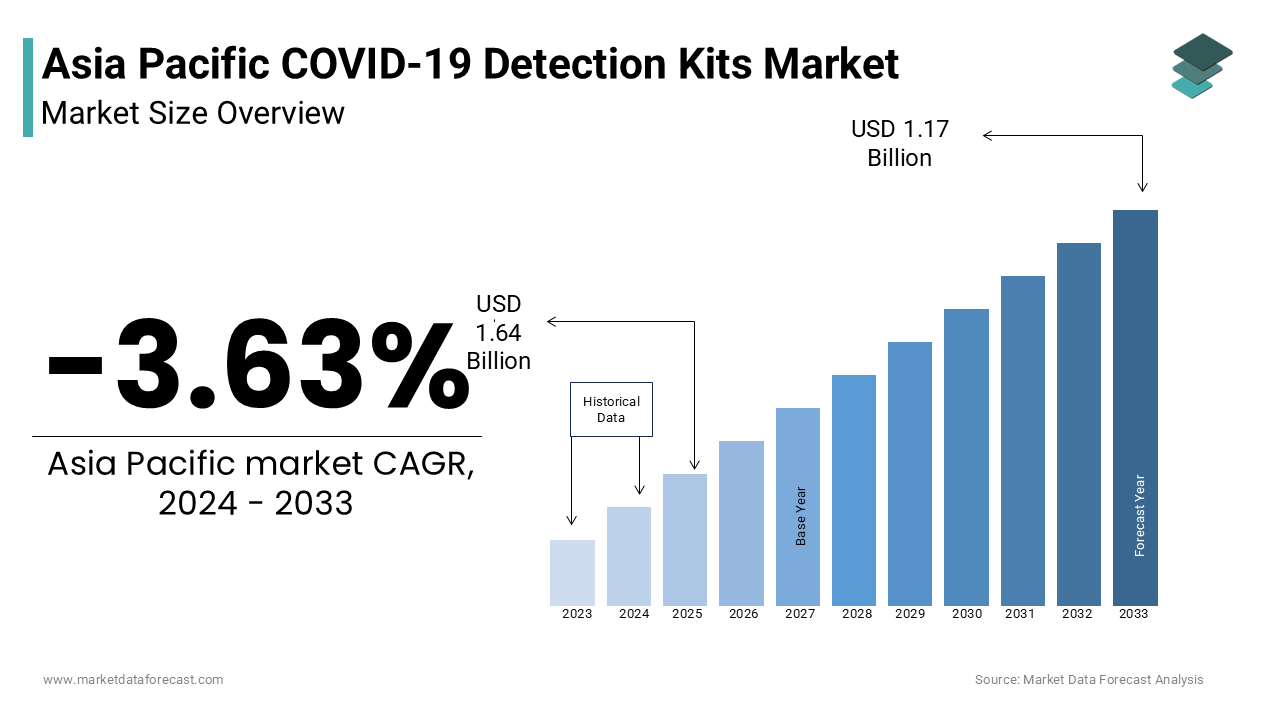
COVID-19 detection kits are a range of diagnostic tools designed to identify the presence of the SARS-CoV-2 virus in clinical samples. These include molecular diagnostic kits such as RT-PCR, antigen rapid test kits, and serological antibody detection assays. The outbreak of the pandemic in 2020 triggered an unprecedented surge in demand for these diagnostic solutions across the region, compelling governments and healthcare institutions to scale up testing infrastructure. Countries like China, India, Japan, and South Korea emerged as both major consumers and producers of detection kits, with domestic manufacturers playing a pivotal role in ensuring supply stability. Beyond government-led initiatives, private laboratories and academic institutions have also contributed significantly to expanding testing capabilities. For instance, India’s Indian Council of Medical Research authorized more than 2,500 testing centers nationwide, enhancing accessibility to diagnostics. While the urgency has somewhat declined post-pandemic, surveillance and screening programs continue to sustain the relevance of the detection kit market. Moreover, the development of multiplex diagnostic platforms that can differentiate between SARS-CoV-2 and other respiratory viruses is further shaping the future trajectory of this market in the Asia Pacific.
MARKET DRIVERS
Government-Led Mass Testing Initiatives
The widespread implementation of government-backed mass testing campaigns is one of the primary drivers of the Asia Pacific COVID-19 detection kits market. National health authorities across the region have prioritized large-scale testing as a key strategy to curb viral transmission and monitor outbreaks effectively. In China, the government implemented stringent zero-COVID policies until late 2022, which necessitated regular and extensive testing across cities. This massive volume directly fueled demand for detection kits and spurred domestic manufacturing capabilities. Similarly, in India, the Ministry of Health and Family Welfare established thousands of testing centers across urban and rural areas. The government's aggressive push for community-level testing, including mobile testing units and self-test kits, played a crucial role in sustaining high consumption levels of diagnostic products. These large-scale public health interventions are strengthening the regional supply chain and reinforcing the importance of diagnostic readiness.
Expansion of Diagnostic Infrastructure and Private Sector Participation
The expansion of diagnostic infrastructure and the increasing involvement of private healthcare providers in testing services are other significant drivers of the Asia Pacific COVID-19 detection kits market. Governments across the region have actively encouraged private labs and hospitals to participate in national testing programs, thereby diversifying and decentralizing diagnostic capacity. Japan exemplifies this trend through its collaboration with private entities to enhance testing efficiency. This shift not only reduced the burden on public hospitals but also accelerated turnaround times for results. In Australia, private pathology companies such as Sonic Healthcare and Laverty Pathology played a critical role in scaling up testing during the Delta and Omicron waves. This growing network of private diagnostic centers has created a sustained demand for detection kits beyond the initial emergency phases. Moreover, the integration of telemedicine and home-testing services has further expanded access, ensuring continued usage of these diagnostic tools even after the formal pandemic period.
MARKET RESTRAINTS
Supply Chain Disruptions and Raw Material Shortages
The persistent disruption of global supply chains and shortages of essential raw materials required for kit production are significant restraints affecting the Asia Pacific COVID-19 detection kits market. The pandemic-induced lockdowns, geopolitical tensions, and logistical bottlenecks severely impacted the availability of critical components such as reagents, enzymes, and swabs used in diagnostic tests. This led to intermittent shortages of RT-PCR test kits, particularly in smaller economies such as Vietnam and the Philippines. Many domestic producers rely on imports for these inputs, making them vulnerable to price volatility and delivery delays. Furthermore, fluctuating exchange rates and inflationary pressures added to the cost burden for manufacturers, limiting their ability to maintain consistent production levels. These supply-side challenges have hindered the seamless distribution of detection kits and constrained market growth, especially in lower-income nations where affordability remains a concern.
Regulatory Hurdles and Quality Control Issues
Stringent regulatory requirements and inconsistent quality control standards across the Asia Pacific region have posed considerable challenges for the sustainable growth of the COVID-19 detection kits market. While some countries have streamlined approval processes for diagnostic products, others continue to impose lengthy evaluations that delay market entry. Besides, reports of substandard or inaccurate test kits entering the market have raised concerns about reliability. Such incidents eroded consumer confidence and prompted stricter oversight measures. Moreover, varying certification norms across countries complicate the harmonization of product specifications, forcing manufacturers to tailor offerings for individual markets. These regulatory complexities are acting as a major barrier to the broader proliferation of high-quality detection kits across the region.
MARKET OPPORTUNITIES
Integration of Multiplex Diagnostic Platforms
The adoption of multiplex diagnostic platforms capable of identifying multiple pathogens simultaneously presents an emerging opportunity in the Asia Pacific COVID-19 detection kits market. As the region transitions into a post-pandemic phase, there is growing emphasis on differentiating SARS-CoV-2 infections from other respiratory illnesses such as influenza, dengue, and respiratory syncytial virus (RSV). Moreover, co-infections and overlapping symptoms have complicated diagnosis, prompting healthcare providers to adopt advanced molecular assays that offer broader pathogen coverage. These platforms provide faster, more accurate results while reducing the need for multiple individual tests. South Korea has been at the forefront of integrating multiplex diagnostics into routine testing protocols. These innovations are reshaping the diagnostic landscape and creating a niche yet rapidly expanding segment within the detection kits market. As governments and healthcare institutions increasingly prioritize efficient, comprehensive diagnostics, the integration of multiplex platforms presents a substantial growth avenue for manufacturers in the Asia Pacific region.
Rise of Point-of-Care and Self-Testing Solutions
The growing acceptance of point-of-care (POC) and self-testing solutions represents a significant opportunity for the Asia Pacific COVID-19 detection kits market. With shifting consumer preferences toward convenience and rapid results, there has been a surge in demand for easy-to-use, portable diagnostic tools that can be deployed outside traditional laboratory settings. Singapore is actively promoting self-testing as part of its public health strategy. Like, Singapore distributed millions of antigen rapid test kits to households in 2022, encouraging individuals to conduct home-based screenings before visiting healthcare facilities. In Japan, the Pharmaceuticals and Medical Devices Agency (PMDA) approved several over-the-counter antigen test kits, enabling pharmacies and retail outlets to sell them directly to consumers. In addition, in India, e-commerce platforms such as Flipkart and Amazon witnessed a spike in online sales of home-based test kits during surges in infection rates. This shift toward decentralized testing models is opening new revenue streams for manufacturers and distributors, positioning POC and self-testing solutions as a transformative force in the evolving dynamics of the detection kits market.
MARKET CHALLENGES
Declining Demand Post-Pandemic
The declining demand following the easing of pandemic-related restrictions and the transition to endemic management strategies is one of the most pressing challenges facing the Asia Pacific COVID-19 detection kits market. As vaccination coverage increased and case severity diminished, many governments scaled back mass testing initiatives, leading to a sharp drop in procurement volumes. China, once the largest consumer of detection kits in the region, drastically reduced its testing frequency after abandoning its zero-COVID policy in late 2022. With fewer institutional mandates and reduced public anxiety around infection, end-user demand has also waned. This decline poses a significant challenge for manufacturers who must now pivot toward alternative applications or diversified diagnostic portfolios to sustain business viability in the region.
Price Erosion Due to Oversupply and Competitive Pressures
The persistent erosion of pricing due to oversupply and intense competitive pressures is another significant challenge impacting the Asia Pacific COVID-19 detection kits market. During the height of the pandemic, numerous manufacturers entered the market, ramping up production to meet soaring demand. However, as case numbers stabilized and testing frequency declined, excess capacity led to a surplus of diagnostic products. In India, the government’s decision to cap prices on certain diagnostic kits further exacerbated margin compression for manufacturers. As per the Confederation of Indian Industry, several small and mid-sized diagnostic firms struggled to remain profitable under these conditions, leading to consolidation and exit from the market. Price competition has also intensified due to the influx of low-cost Chinese-made kits into markets such as the Philippines and Indonesia. As per the ASEAN Economic Community report, imported antigen kits accounted for over 60% of total sales in some countries, displacing domestic brands unless they offered superior differentiation. This pricing pressure continues to pose a major challenge for industry players seeking sustainable profitability.
SEGMENTAL ANALYSIS
By Product Insights
The RT-PCR assay kits segment held the largest share of the Asia Pacific COVID-19 detection kits market and accounting for 58.5% of total market revenue in 2024. The dominance of RT-PCR assay kits segment is primarily attributed to the high accuracy and reliability of RT-PCR-based diagnostics, which are considered the gold standard for confirming SARS-CoV-2 infections. Governments across the region have historically prioritized RT-PCR testing for surveillance, contact tracing, and border control measures. Also, the expansion of government-funded diagnostic labs, such as those under the Integrated Disease Surveillance Programme (IDSP), further supported widespread adoption. Moreover, countries like Japan and South Korea integrated RT-PCR into their hospital-based diagnostic workflows due to its ability to detect low viral loads with precision.

The antigen rapid test kits segment is projected to grow at the fastest CAGR of early 14%. The accelerated growth of antigen rapid test kits segment is driven by the increasing preference for quick, cost-effective, and decentralized testing solutions that do not require specialized laboratory infrastructure. One of the key factors fueling this trend is the rising adoption of self-testing models, particularly in urban centers where convenience and accessibility are paramount. Similarly, in Australia, the Therapeutic Goods Administration approved numerous over-the-counter antigen tests, facilitating broad retail availability. Besides, governments in Indonesia and the Philippines encouraged the use of antigen tests for mass screening in schools, offices, and public transport hubs due to their ease of use and rapid results.
By Sample Type Insights
The nasopharyngeal swabs segment constitutes the biggest sample type in the Asia Pacific COVID-19 detection kits market by holding an estimated 65.5% share in 2024. The dominance of the nasopharyngeal swabs segment is primarily due to the high viral load concentration found in the nasopharynx, making it the most effective site for detecting early-stage infections. Throughout the pandemic, NP swabs were the preferred method for collecting samples in centralized testing facilities, especially in government-run laboratories. China also relied heavily on NP swabs for large-scale testing campaigns, particularly during lockdowns and quarantine enforcement. Furthermore, NP swabs demonstrated a high detection accuracy in symptomatic individuals, reinforcing their continued use despite procedural discomfort.
The nasal swabs segment is emerging as the fastest-growing sample type segment in the Asia Pacific COVID-19 detection kits market, projected to expand at a CAGR of 16.6% through 2033. The swift growth of the nasal swabs segment is driven by the increasing adoption of self-collection methods, particularly for antigen rapid tests and home-based diagnostics. One major factor behind this trend is the ease of use associated with nasal swabs, which allow individuals to collect samples without medical supervision. Similarly, in Australia, nasal swabs became the preferred option for school-based screening programs. Additionally, manufacturers have optimized nasal swab designs to enhance comfort and improve specimen yield. This growing validation has further fueled their adoption in both public health initiatives and commercial diagnostic offerings.
By Mode Insights
The centralized testing segment remained the dominant mode of operation in the Asia Pacific COVID-19 detection kits market by capturing 60.6% in 2024. The lead position of the centralized testing segment is largely attributed to the historical reliance on government-led laboratory networks for confirmatory diagnosis and large-scale surveillance activities. During the peak of the pandemic, countries such as China and India established extensive centralized testing infrastructures, including mobile labs and mega-testing centers. India followed a similar model, expanding its network of government and private labs under the ICMR framework. By 2022, the country had accredited more than 2,500 centralized testing centers, ensuring widespread access to high-throughput diagnostics. Japan and South Korea also maintained robust centralized systems, integrating automation and AI-assisted diagnostics to streamline operations.
The decentralized or point-of-care (PoC) testing segment is the fastest-growing mode in the Asia Pacific COVID-19 detection kits market and is expected to register a CAGR of 18%. The surge of decentralized or point-of-care (PoC) testing segment is driven by the increasing emphasis on rapid, accessible, and community-level diagnostics, particularly in rural and semi-urban areas. A key driver is the rise in workplace and institutional testing mandates, especially in sectors such as education, manufacturing, and aviation. In addition, mobile testing units equipped with portable analyzers have gained traction in remote regions of the Philippines and Indonesia. Moreover, the integration of PoC devices with digital reporting systems has improved efficiency and traceability. These advancements collectively position decentralized testing as a transformative force, reshaping how diagnostic services are delivered across the Asia Pacific region.
By End-use Insights
The laboratories segment remained the largest end-use in the Asia Pacific COVID-19 detection kits market by commanding 55.5% of the total market share in 2024. The development of the laboratories segment is attributed to the reliance on lab-based diagnostics for confirmatory testing, genomic sequencing, and large-scale surveillance programs. Government and private laboratories played a pivotal role in scaling up testing capacities during the pandemic. India saw a dramatic expansion in laboratory infrastructure. In Japan, academic and research institutions collaborated with public health authorities to strengthen diagnostic capabilities. These developments show the critical function of laboratories in maintaining diagnostic integrity and driving sustained demand for detection kits across the Asia Pacific.
The diagnostic centers and clinics segment represents the fastest-growing end-use segment in the Asia Pacific COVID-19 detection kits market and is projected to expand at a CAGR of 17.7% through 2033. The quick ascent of the diagnostic centers and clinics segment is driven by the increasing decentralization of diagnostic services and the proliferation of private healthcare providers offering outpatient testing. An additional key factor is the growing preference for walk-in diagnostic centers that provide faster turnaround times and flexible pricing. In addition, the integration of telemedicine platforms with diagnostic services has enhanced accessibility. This evolving landscape underscores the rising influence of diagnostic centers and clinics in shaping the future of the detection kits market across the Asia Pacific.
REGIONAL ANALYSIS
China COVID-19 Detection Kits Market Analysis
China led the Asia Pacific home improvement market by contributing 32.3% of total regional revenue in 2024. The country's strong economic growth, coupled with rapid urbanization and a booming middle class, has fueled consistent demand for residential renovations and interior upgrades. In addition, government policies promoting sustainable construction and smart living have encouraged homeowners to invest in energy-efficient appliances and modern décor. E-commerce has also transformed purchasing behavior, with platforms like Alibaba and JD.com offering a wide range of DIY tools, paints, and furniture. With ongoing investments in smart cities and green building certifications, China continues to lead the region in both scale and innovation within the home improvement sector.
India COVID-19 Detection Kits Market Analysis
India is a lucrative region in the Asia Pacific home improvement market. The country’s rapidly expanding population, increasing disposable incomes, and growing real estate activity have positioned it as a key growth hub in the market. Urbanization in India has accelerated. This shift has led to higher demand for renovation, modular kitchens, and bathroom fittings, particularly among first-time homeowners and young professionals. The government’s "Housing for All" initiative aims to provide affordable homes to millions, indirectly stimulating home improvement spending. Moreover, the rise of online shopping and social media-driven interior design trends has reshaped consumer preferences. With increasing awareness of aesthetics and functionality, India’s home improvement market is poised for sustained growth.
Japan COVID-19 Detection Kits Market Analysis
Japan is a mature landscape in the Asia Pacific home improvement market and is maintaining a stable yet sophisticated presence. Unlike the high-growth economies of China and India, Japan’s market is characterized by a focus on quality, durability, and sustainability rather than sheer volume. Government subsidies for seismic reinforcement and insulation upgrades have further stimulated demand for home improvement products. Japan leads in smart home integration, with companies like Panasonic and Mitsubishi Electric offering connected home solutions. Despite a declining population, the emphasis on longevity and eco-friendly materials ensures that Japan remains a significant player in the regional home improvement landscape.
South Korea COVID-19 Detection Kits Market Analysis
South Korea is distinguished by a strong culture of innovation and compact urban living in the market. The country’s dense metropolitan areas and rising interest in minimalist and functional interiors drive steady demand for renovation and decor products. Additionally, the rise of apartment remodeling, known locally as “gapjilgu,” has created a thriving secondary market for flooring, paint, and kitchen upgrades. With a well-developed retail network and growing digital transformation in home décor shopping, South Korea continues to evolve as a dynamic hub for home improvement in the region.
Australia COVID-19 Detection Kits Market Analysis
Australia is recognized for its premium product offerings and high standards of living. The country’s strong housing market and emphasis on property value enhancement drive consistent demand for renovation and outdoor improvements. Also, stringent building codes and environmental regulations encourage the use of eco-friendly materials and energy-efficient designs. Major retailers such as Bunnings Warehouse maintain a dominant presence, offering a wide range of products and expert advice. Supported by a stable economy and high homeownership rates, Australia’s home improvement market remains a key contributor to regional growth.
KEY MARKET PLAYERS
Some of the key market players in the market include
- Siemens AG
- Hitachi Ltd.
- Bombardier Inc. (now part of Alstom)
- Alstom SA
- Thales Group
- Toshiba Corporation
- Huawei Technologies Co., Ltd.
- Cisco Systems, Inc.
- IBM Corporation
- Indra Sistemas, S.A.
COMPETITIVE LANDSCAPE
The competition in the Asia Pacific COVID-19 detection kits market is shaped by a mix of global leaders and emerging domestic players, each striving to secure a stronger foothold in a rapidly evolving landscape. While multinational corporations continue to dominate with their established brand reputation and technological expertise, local manufacturers have gained traction by offering cost-effective alternatives tailored to regional needs. This dual dynamic has intensified market rivalry, especially as demand patterns shift from emergency procurement to more structured, long-term diagnostic planning.
Regulatory environments across the region vary significantly, influencing how quickly new products can be introduced and adopted. Companies are increasingly focusing on securing approvals in multiple jurisdictions to broaden their reach. Additionally, with the decline in mass testing mandates, competition has shifted toward value-added services such as digital integration, home testing solutions, and multiplex diagnostic capabilities. Innovation remains a key battleground, with firms investing heavily in R&D to develop next-generation testing platforms that offer superior performance and ease of use. As the market matures, agility, adaptability, and strategic positioning will determine which players emerge as long-term winners in the region.
Top Players in the Asia Pacific COVID-19 Detection Kits Market
One of the leading players in the Asia Pacific COVID-19 detection kits market is Roche Diagnostics, a division of F. Hoffmann-La Roche Ltd. Known for its expertise in molecular diagnostics, Roche has played a pivotal role in supplying high-quality RT-PCR test kits across the region. The company’s commitment to innovation and reliability has made its diagnostic solutions a preferred choice among government health agencies and private laboratories. By collaborating with regulatory bodies and local partners, Roche has ensured the rapid deployment of testing solutions during critical phases of the pandemic.
Becton, Dickinson and Company (BD) is another major contributor to the regional market. BD has focused on expanding access to both molecular and antigen-based detection kits through strategic partnerships and supply chain optimization. The company has been instrumental in supporting public health initiatives by enabling decentralized testing models that improve diagnostic reach in both urban and rural settings across the Asia Pacific.
Thermo Fisher Scientific stands out as a global leader in life sciences and diagnostics, significantly impacting the Asia Pacific detection kits market. The company has consistently delivered scalable diagnostic solutions, including reagents and instruments for RT-PCR testing. Its strong distribution network and collaborations with research institutions have helped maintain a steady supply of detection kits even under challenging circumstances, reinforcing its leadership position in the region.
Top Strategies Used by Key Market Participants
A primary strategy employed by key players in the Asia Pacific COVID-19 detection kits market is product diversification and innovation. Companies are continuously developing advanced diagnostic platforms that offer faster results, higher accuracy, and compatibility with multiple sample types. This helps them cater to evolving healthcare needs and maintain a competitive edge.
Another crucial approach is strategic collaborations and partnerships. Major manufacturers are aligning with governments, academic institutions, and local distributors to enhance product accessibility and streamline supply chains. These alliances also support clinical validation and regulatory approvals across different markets in the region.
Lastly, expansion into decentralized testing models has become a focal point for industry leaders. By promoting point-of-care and self-testing solutions, companies are adapting to shifting consumer preferences and increasing demand for convenient diagnostic options. This strategy allows them to capture new customer segments and sustain growth beyond the peak pandemic phase.
RECENT MARKET DEVELOPMENTS
- In March 2024, Roche Diagnostics announced a collaboration with a leading university hospital in Singapore to evaluate the performance of its next-generation SARS-CoV-2 detection platform designed for multiplex respiratory virus identification. This initiative aims to enhance diagnostic precision and support regional public health preparedness beyond the current pandemic.
- In February 2024, Becton, Dickinson and Company launched a mobile diagnostic unit in partnership with a major Indian healthcare provider to expand testing access in underserved rural communities. This initiative reflects BD’s commitment to improving diagnostic equity and strengthening community-level response capabilities.
- In January 2024, Thermo Fisher Scientific received regulatory approval in South Korea for an updated version of its automated PCR testing system, designed to streamline laboratory workflows and reduce turnaround times. The company also initiated training programs for lab technicians to ensure smooth adoption of the new technology.
- In December 2023, Abbott expanded its portfolio in the Asia Pacific region by introducing a new generation of self-test antigen kits tailored for workplace screening and travel requirements. The launch was supported by digital verification tools to enhance user convenience and result tracking.
- In November 2023, Qiagen entered into a co-development agreement with a Japanese biotech firm to integrate AI-driven analytics into its molecular diagnostic platforms. This move strengthens Qiagen’s position in the region by combining advanced genomics with real-time data interpretation for improved outbreak monitoring.
MARKET SEGMENTATION
This research report on the Asia Pacific COVID-19 detection kits market is segmented and sub-segmented into the following categories.
By Product
- RT-PCR Assay Kits
- Immunoassay Test Strips/Cassettes
By Sample Type
- Nasopharyngeal (NP) Swab
- Oropharyngeal (OP) Swab
- Nasal SwabsOthers
By Mode
- Decentralized or Point-of-Care (PoC) Testing
- Centralized Testing (Non-PoC)
By End-use
- Laboratories
- Hospitals
- Diagnostic Centers and Clinics
- Others
By Country
- India
- China
- Japan
- South Korea
- Australia
- New Zealand
- Thailand
- Malaysia
- Vietnam
- Philippines
- Indonesia
- Singapore
- Rest of APAC