- Product Description Description
- Table of Contents TOC
- List of Table & Figure LOT
- Get Free Sample PDF Sample PDF
Market Size, 2025
$1.04 BnMarket Estimate, 2026
$1.14 BnMarket Forecast, 2034
$2.34 BnCAGR, 2026–2034
9.43%Executive Summary: Asia Pacific Dairy Herd Management Market
- Market Scope: Comprehensive regional industry analysis of the Asia Pacific dairy herd management sector covering hardware and software product types, core application areas, and country-level developments.
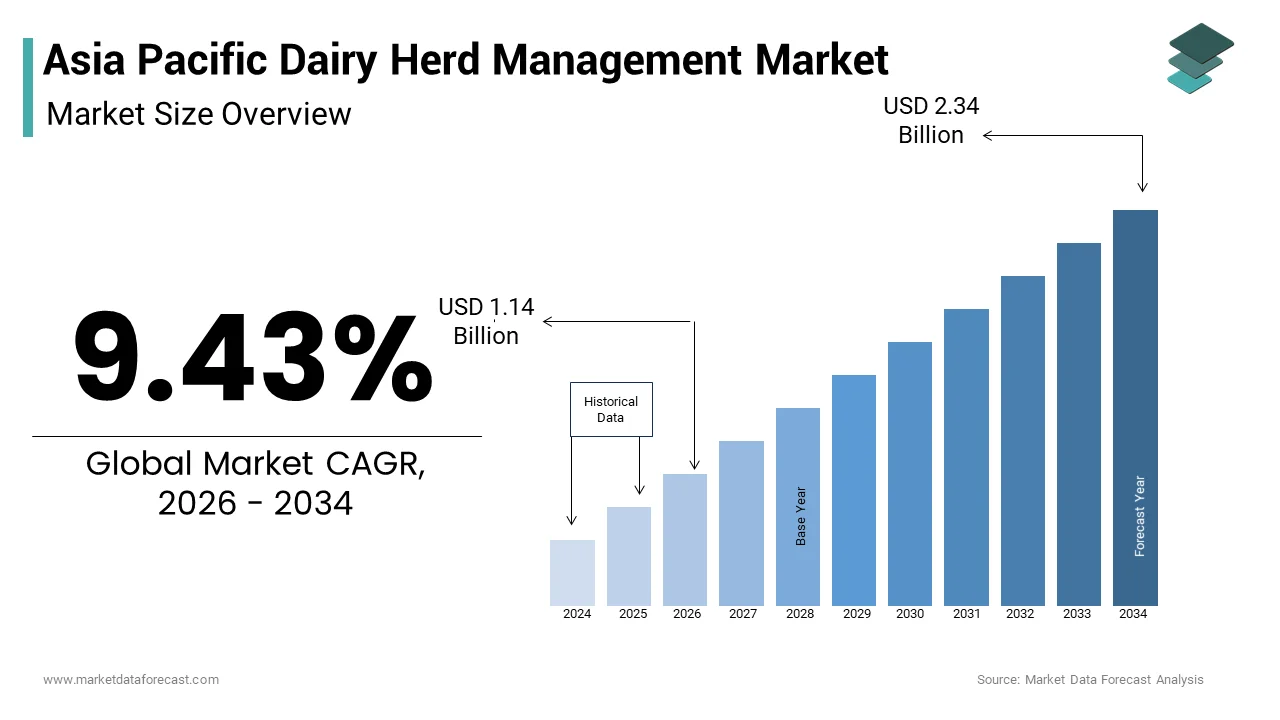
- Market Valuation: Valued at USD 1.04 billion in 2025, anticipated to reach USD 1.14 billion in 2026, and projected to expand to USD 2.34 billion by 2034, registering a dynamic CAGR of 9.43% from 2026 to 2034.
- Primary Growth Drivers: Rapidly growing populations, rising disposable incomes, and urbanization boosting regional milk and dairy product demand; increasing labor costs driving adoption of smart farming automation; and supportive government initiatives for the dairy farming industry.
Key Market Segment Metrics (2026–2034)
| Category | Leading Segment / Core Focus | Fastest-Growing / Key Segments |
|---|---|---|
| By Product | Hardware Systems (held the largest market share due to extensive demand for milk management equipment) | Standalone Software Systems (projected to record the highest growth rate driven by automated milking solutions and cost reduction) |
| By Application | Milk Harvesting (anticipated to account for the largest share, supported by automated systems and milk yield optimization) | Reproduction Management (projected to register the highest CAGR backed by AI and gestation tracking technologies) |
| By Country | India, China, Japan, Australia, and South Korea (leading regional markets showing the highest growth rates and dairy industry expansion) | Southeast Asian & Rest of APAC Markets (emerging fast as modern livestock farming gains momentum) |
Major Market Players & Market Structure
Market Structure: Highly competitive landscape comprising major global agricultural machinery enterprises and precision dairy technology providers scaling automated farm infrastructure across fast-growing Asian markets.
Key Companies: Afimilk Ltd., BouMatic, Dairy Master, DeLaval, GEA Group AG, Infovet, Lely Holdings S.A.R.L., SCR Dairy Inc., Sum-It Computer Systems, Ltd, and Valley Agriculture Software.
Asia Pacific Dairy Herd Management Market Size
The Asia Pacific dairy herd management market size was valued at USD 1.04 billion in 2025 and is anticipated to reach a valuation of USD 1.14 billion in 2026 and USD 2.34 billion by 2034, growing at a CAGR of 9.43% from 2026 to 2034.
Introduction and Market Definition
Dairy herd management is the practice of overseeing and coordinating the health, nutrition, breeding, and daily care of a group of dairy cows to maximise milk production and farm profit. It combines daily farm work with data tracking to keep animals healthy. This market encompasses a suite of technologies including automated milking systems, wearable health sensors, and data analytics platforms designed to optimize herd productivity and animal welfare. As per the Food and Agriculture Organization of the United Nations, global milk production reaches nearly 979 million tonnes, with major output driven principally by rising dairy cow numbers and expanding large-scale dairy farms in Asia. The transition from smallholder subsistence farming to large-scale commercial operations is accelerating the adoption of digital management tools. According to the International Dairy Federation, robust domestic demand in China and India accounts for 50% of global milk consumption, creating strong expansion across regional dairy markets. Furthermore, stringent food safety regulations and growing consumer awareness regarding antibiotic residues compel farmers to implement precise monitoring systems that ensure traceability and compliance. The integration of Internet of Things devices allows for real time tracking of estrus cycles, feed intake, and disease detection, which is critical for maintaining profitability in a competitive landscape. Labour shortages are becoming acute in rural areas across the region. Consequently, automation through herd management systems has become a strategic imperative for sustaining growth and meeting the escalating demand for high-quality dairy products.
MARKET DRIVERS
Rising Milk Consumption and Urbanisation Drive Demand for Efficiency
The exponential growth in milk consumption across the region, fueled by rapid urbanization and changing dietary habits, is a key factor driving the growth of the Asia Pacific dairy herd management market. According to the International Dairy Federation, milk production in Asia grew at an average annual rate of 3.8%, outpacing global averages and generating two-thirds of the absolute global increase in milk output. This demand surge necessitates higher operational efficiency, which traditional manual methods cannot sustain, prompting a shift toward automated monitoring and management solutions. As per the United Nations, more than 2.2 billion people live in urban areas across Asia, comprising 54% of the global urban population, driving rapid demographic and structural transformations across the region's urban centers. Herd management systems enable producers to monitor individual cow performance, optimise feed conversion ratios, and detect health issues early, thereby maximising output per animal. The ability to produce consistent high quality milk is crucial for supplying large urban markets and processing plants that operate on tight schedules. Furthermore, the economic viability of larger herds, which are increasingly common in countries like China and Australia, depends heavily on data-driven decision-making to manage complexity. Consequently, the direct correlation between rising consumer demand and the need for scalable, efficient production methods drives substantial investment in digital herd management technologies across the region.
Government Initiatives and Subsidies for Agricultural Modernisation
Strong government support and financial incentives aimed at modernising the agricultural sector are significantly propelling the growth of the Asia Pacific dairy herd management market. According to the Ministry of Agriculture and Rural Affairs in China, government regulations moderate the adoption of smart farming technologies on dairy farms, driving systemic shifts toward tech integration and increased carbon efficiency across production systems. These policies are designed to reduce reliance on imports and enhance domestic food security by improving local production capabilities. As per the Department of Agriculture in Australia, grants and low interest loans are available for farmers adopting precision agriculture technologies, encouraging the uptake of sensor based systems that improve resource efficiency and environmental sustainability. In India, the National Dairy Plan provides funding for infrastructure development and technology upgradation in cooperative societies, facilitating the spread of digital tools among smallholder farmers. These governmental efforts lower the financial barriers to entry for expensive technologies, making them accessible to a broader range of producers. Additionally, regulatory frameworks emphasizing food safety and traceability mandate the use of record keeping systems that are best managed through digital platforms. The alignment of national economic goals with technological adoption creates a favorable environment for market expansion, ensuring sustained growth in the deployment of advanced herd management solutions.
MARKET RESTRAINTS
Fragmented Smallholder Dominance and Limited Capital Access
The predominance of smallholder dairy farmers in many countries in the region is a significant constraint to the Asia Pacific dairy herd management market. This limits the widespread adoption of advanced herd management systems due to scarce financial resources and fragmented land holdings. As per the Food and Agriculture Organization of the United Nations, smallholders maintaining between two and five cows supply more than 80 percent of the milk in the region, driving steady structural and volume transformations in the dairy market. The cost of implementing comprehensive monitoring solutions, including hardware, software, and installation, can exceed the annual income of these small operations, creating a substantial barrier to entry. According to the Asian Development Bank, financial institutions target specific credit product rollouts to address the persistent smallholder financing gap across regional value chains. This financial constraint limits the market to large commercial entities and cooperatives, leaving a vast majority of producers reliant on traditional, less efficient methods. Furthermore, the fragmented nature of smallholder production complicates the implementation of standardised management practices and data collection, reducing the overall impact of digital interventions. Without innovative financing models or cooperative purchasing structures, the high cost relative to farm size will continue to hinder mass market penetration. Consequently, this will slow the technological transformation of the region’s dairy sector.
Inadequate Rural Infrastructure and Connectivity Issues
The lack of robust digital infrastructure and reliable internet connectivity in rural areas is a major hindrance to the expansion of the Asia Pacific dairy herd management market. This deficit directly impedes the effective deployment of cloud-based dairy herd management systems in the region. According to the International Telecommunication Union, internet usage among the rural population in the Asia & Pacific region reached 65.9% by 2025, reflecting expanding digital integration across rural communities. This connectivity gap prevents farmers from utilising advanced features such as remote monitoring, predictive analytics, and instant alerts, limiting the functionality of sophisticated herd management tools. As per the World Bank, the cost of expanding high speed internet infrastructure to remote agricultural zones is prohibitively high, leading to significant disparities in digital access between urban and rural areas. Many dairy farms are located in regions with intermittent power supply and poor network coverage, causing data loss and system downtime that undermine trust in the technology. Furthermore, the lack of technical support and maintenance services in these isolated areas means that hardware failures often go unresolved, discouraging long-term adoption. The full potential of connected herd management systems will remain unrealised until significant improvements are made in rural telecommunications and power infrastructure. This deficit restricts their scalability and effectiveness in key production hubs across the region.
MARKET OPPORTUNITIES
Integration of Artificial Intelligence for Predictive Analytics
The integration of artificial intelligence and machine learning into dairy herd management platforms offers a transformative opportunity for the Asia Pacific market. This technology will significantly enhance decision-making and operational efficiency for producers across the region. According to the McKinsey Global Institute, digital dairy technologies can boost farm productivity by up to 30 percent, altering operating models across agricultural economies. By analysing vast amounts of historical and real-time data from sensors, AI algorithms can predict diseases such as mastitis or lameness days before clinical symptoms appear, allowing for early intervention and reduced treatment costs. As per Wageningen University and Research, genomic selection and marker-assisted selection models drive an estimated 45% genetic gain across diverse local European cattle breeds. The precision approach reduces the number of unsuccessful inseminations and shortens calving intervals, directly boosting profitability. Furthermore, AI can optimize feed rations based on individual animal needs and local ingredient availability, minimizing waste and enhancing nutrient efficiency. The ability to automate complex analytical tasks empowers farmers to make data-driven decisions with greater confidence and speed. As computing power becomes more accessible and algorithms more sophisticated, the integration of AI offers a clear pathway for Asia Pacific dairy producers. This technology will allow them to achieve unprecedented efficiency and sustainability while securing their competitive edge in the global market.
Expansion of Organic and Premium Dairy Segments
The growing demand for organic and premium dairy products unlocks potential for the expansion of precision livestock farming technologies, which are predicted to fuel the growth of the Asia Pacific dairy herd management market. This development is driven by consumers and retailers who increasingly require verifiable proof of animal welfare and sustainable production practices. According to the Research Institute of Organic Agriculture FiBL, the global organic market value expanded significantly, with eleven Asian nations registering 10 per cent or more of their total agricultural land area under certified organic management. Herd management systems provide the detailed records necessary for organic certification, tracking antibiotic usage, grazing times, and feed sources with immutable accuracy. As per the European Commission, producer price premiums for organic milk routinely exceed 20% compared to conventional baseline market rates across diverse member networks. Wearable sensors and automated monitoring tools allow farmers to maintain high animal welfare standards without relying on prophylactic medications, aligning with consumer expectations for ethical production. Furthermore, blockchain integration with herd management data enables end-to-end traceability, allowing consumers to scan QR codes and view the history of the milk they purchase. This transparency builds brand loyalty and opens access to premium retail channels. Asia Pacific dairy producers can leverage precision technologies to substantiate their sustainability credentials. By doing so, they can differentiate their products and capture higher value in an increasingly conscious marketplace.
MARKET CHALLENGES
Data Privacy Concerns and Lack of Standardised Regulations
The ambiguity surrounding data ownership and privacy rights is a major impediment to the Asia Pacific Dairy Herd Management Market. This lack of clarity creates uncertainty and hesitation among farmers regarding the sharing of sensitive operational information. As per the Asia-Pacific Economic Cooperation, member economies expand public sector frameworks to manage data privacy and security risks arising from structural digital agriculture technologies. Farmers often fear that their proprietary data on herd performance and management practices could be exploited by technology providers or third parties for commercial gain without adequate compensation or consent. According to the Centre for Strategic and International Studies, fears of losing operational control over shared metrics lower farmers' overall willingness to adopt digital agriculture systems. The absence of standardized contracts and clear legal frameworks for data sharing agreements exacerbates this issue, leaving producers vulnerable to unfavorable terms. Furthermore, concerns about cybersecurity threats and potential data breaches add another layer of risk, as compromised data could reveal competitive weaknesses or disrupt operations. Until harmonized regulations and industry standards establish clear rights and protections for agricultural data, skepticism will persist, impeding the collaborative innovation and data pooling necessary for advancing the sector.
Shortage of Technical Skills and Digital Literacy
The acute shortage of skilled personnel capable of operating and maintaining sophisticated dairy herd management systems is a significant challenge to the growth of the Asia Pacific market. According to the International Labour Organization, digital innovations rapidly alter specialized skill demands, requiring regional technical training institutions to deliver flexible upskilling pathways for vulnerable rural workers. The deficiency means that even when farmers invest in monitoring systems, they often struggle to interpret the data correctly or troubleshoot technical issues, leading to underutilization and frustration. As per the United Nations Educational, Scientific and Cultural Organization, global development organizations expand targeted funding, tech transfers, and institutional capacity-building to bridge human capital shortages in developing countries. The absence of local technical support networks further exacerbates this problem, as farmers in remote areas may wait weeks for specialised technicians to arrive, during which time the monitoring system remains nonfunctional. This reliance on external expertise increases operational costs and reduces the reliability of the technology, discouraging long-term adoption. Moreover, the rapid pace of technological advancement means that existing skills quickly become obsolete, requiring continuous training and upskilling that is rarely available in rural communities. The human capital deficit will remain a persistent bottleneck without comprehensive educational programs and vocational training initiatives focused on digital agriculture. This ongoing shortage will directly limit the effectiveness and scalability of livestock monitoring systems across the region.
REPORT COVERAGE
| REPORT METRIC | DETAILS |
| Market Size Available | 2025 to 2034 |
| Base Year | 2025 |
| Forecast Period | 2026 to 2034 |
| CAGR | 9.43% |
| Segments Covered | By Product, Application, and By Country |
| Various Analyses Covered | Global, Regional & Country Level Analysis, Segment-Level Analysis, DROC, PESTLE Analysis, Porter’s Five Forces Analysis, Competitive Landscape, Analyst Overview on Investment Opportunities |
| Regions Covered | India, China, Japan, South Korea, Australia, New Zealand, Thailand, Malaysia, Vietnam, Philippines, Indonesia, Singapore, and the Rest of APAC |
| Market Leaders Profiled | Afimilk Ltd., BouMatic, Dairy Master, DeLaval, GEA Group AG, Infovet, Lely Holdings S.A.R.L., SCR Dairy Inc., Sum-It Computer Systems, Ltd, and Valley Agriculture Software. |
SEGMENTAL ANALYSIS
By Product Insights
Hardware
The hardware segment held the majority share of the Asia Pacific Dairy Herd Management Market in 2025 because physical devices, such as robotic milking units, wearable sensors, and automated feeders, form the foundational layer required for any digital monitoring initiative. As per the Food and Agriculture Organization of the United Nations, large-scale commercial processors accelerate mechanical automation to stabilize seasonal field labor gaps and improve operational consistency across intensive production cycles. The structural shift ensures that hardware remains the primary revenue generator as farms modernise their infrastructure. According to the International Dairy Federation, multi-million-dollar capital investments expand global processing assets and dry dairy ingredient factories to meet surging consumption requirements in Asia. The durability and necessity of hardware in harsh outdoor environments mean that replacements and upgrades occur regularly, sustaining consistent demand. Furthermore, the proliferation of low cost sensor technologies has made basic hardware accessible to medium sized farms, expanding the total addressable market significantly. Without these physical components, the collection of biological and locational data is impossible, making hardware the indispensable backbone of the entire monitoring ecosystem. The sheer volume of animals in the region necessitates millions of individual hardware units, thereby securing its position as the leading segment in terms of both volume and value within the market structure.
Web-Based Software
The web based software segment is on the rise and is expected to be the fastest growing segment in the market by witnessing a CAGR of 16.5% during the forecast period. This rapid expansion of the segment is propelled by the increasing need for scalable, accessible, and real-time data processing capabilities that transcend local server limitations. According to sources, farm-management software yields the highest adoption rate among agtech submarkets at 21 percent, followed by a 15 percent utilization of remote-sensing and precision hardware. The transition allows producers to access herd data from mobile devices anywhere, enhancing decision-making speed and operational flexibility. As per the Asian Development Bank, targeted digitalization frameworks contract regional income inequality by generating employment and commercial business opportunities for disadvantaged rural populations. The scalability of web-based platforms means that farms can easily add features or integrate new devices without significant hardware upgrades, offering a cost-effective pathway for expansion. Additionally, cloud-based systems facilitate data aggregation and benchmarking across multiple farms, providing valuable insights into best practices and performance metrics. Consequently, as connectivity improves and trust in cloud security grows, the demand for intelligent web based software solutions that can optimize complex farming operations is outpacing the growth of on premise systems, marking it as the fastest expanding component of the market.
By Application Insights
Milk Harvesting
The milk harvesting segment was the largest in 2025 and occupied a commanding share of the Asia Pacific Dairy Herd Management Market. This supremacy of the segment was credited to its direct correlation with farm revenue and its critical role in addressing acute labor shortages across the region. According to the International Dairy Federation, global dairy sector stakeholders prioritize long-term infrastructure and sustainable processing solutions to meet surging agricultural consumption demands across emerging markets. Automated milking systems not only increase milking frequency and consistency but also provide real-time quality metrics that enable premium pricing for high-grade milk. As per Wageningen University and Research, automatic milking systems alter dairy herd traffic patterns and feed intake intervals across intensive farming operations. The application also directly addresses the labour crisis, with automated systems reducing milking labour requirements, allowing farmers to reallocate human resources to higher-value tasks such as animal care and breeding. Furthermore, regulatory requirements for milk hygiene and traceability mandate precise recording of harvest data, which automated systems provide seamlessly. The convergence of economic necessity, labour substitution, and regulatory compliance ensures that milk harvesting remains the largest and most mature application segment in the Asia Pacific market.
Heat Stress Management
The heat stress management segment is likely to experience the fastest CAGR of 18.2% from 2026 to 2034, owing to rising temperatures in tropical and subtropical regions of the Asia-Pacific region and the resulting impact on dairy productivity. According to the Copernicus Climate Change Service, population exposure to very strong heat stress intensifies rapidly across sub-Saharan Africa, South and Southeast Asia, and the Arabian Peninsula. As per the Food and Agriculture Organization, global joint assessments with the World Meteorological Organisation project that up to 75% of global livestock will face dangerous heat conditions by 2100. Advanced systems now integrate environmental sensors with physiological data from wearables to predict heat stress before clinical signs appear, enabling proactive cooling interventions. The growing emphasis on animal welfare standards in export markets also drives adoption, as retailers increasingly require proof of ethical treatment and environmental control. Furthermore, insurance providers are beginning to offer premium discounts for farms with certified heat stress mitigation systems, adding another financial incentive. The combination of climate urgency, regulatory pressure, and measurable economic protection positions heat stress management as the most dynamic growth area in the Asia Pacific dairy technology sector.
REGIONAL ANALYSIS
India Dairy Herd Management Market Analysis
India dominated the Asia Pacific Dairy Herd Management Market and accounted for a substantial share in 2025. This dominance of the Indian market was driven by its status as the world’s largest milk producer and the ongoing modernisation of its fragmented smallholder sector. According to the National Dairy Development Board, India produces over 239 million tonnes of milk annually, accelerating its status as the world's largest dairy nation through extensive grassroots cooperative expansions. The government’s National Dairy Plan provides substantial funding for technology upgradation, encouraging the use of automated milk collection centres and basic herd monitoring systems. As per the Ministry of Fisheries, Animal Husbandry and Dairying, over 47,000 automatic milk collection units have been established across rural areas to digitize regional farmer payment infrastructures. The rise of private dairy players and tech startups offering affordable mobile based solutions is further accelerating adoption among smallholders. Despite challenges related to scale and connectivity, the sheer volume of production and strong policy support ensure India’s dominance in the regional market.
China Dairy Herd Management Market Analysis
China is a rapidly growing country in the Asia Pacific Dairy Herd Management Market because of large-scale industrial farms and strong government mandates for food security and technological self-sufficiency. According to the Ministry of Agriculture and Rural Affairs, Chinese authorities implement targeted loan extensions and feed-cost stabilization measures to protect domestic dairy operations navigating localized market oversupply cycles. The government’s rural revitalisation strategy includes subsidies for smart agriculture, driving the adoption of robotic milking and precision feeding systems. As per the Chinese Academy of Agricultural Sciences, researchers scale high-quality standardized dairy engineering systems across dozens of localized enterprises to enhance nutrition control and product safety verification. Major domestic and international technology providers are expanding their presence, offering integrated solutions tailored to Chinese operational needs. The focus on quality and safety following past scandals also drives demand for traceability and monitoring systems, ensuring robust market growth.
Japan Dairy Herd Management Market Analysis
Japan maintains a strong presence in the Asia Pacific Dairy Herd Management Market. The country’s position is distinguished by high labor costs and an aging farmer demographic, both of which necessitate extensive automation. According to the Ministry of Agriculture, Forestry and Fisheries, long-term projections estimate robotic milking adoption could potentially reach 30 percent of Japanese dairy operations to address chronic labor shortages. The country’s focus on high-quality premium milk products drives demand for precise monitoring systems that ensure consistent quality and animal welfare. As per the Japan Dairy Association, the lack of generational farm successors prompts rapid operational consolidation, driving an increase in average herd sizes across remaining farms. Government grants support the adoption of smart farming technologies, particularly in Hokkaido, the primary dairy region. The integration of IoT and AI in dairy farming is well established, with a strong emphasis on sustainability and resource efficiency. Japan’s mature market serves as a testing ground for innovative technologies before they are adapted for other Asian markets.
South Korea Dairy Herd Management Market Analysis
South Korea holds a significant niche in the Asia Pacific Dairy Herd Management Market. This prominent position is driven by its highly digitised infrastructure and strong consumer demand for safe, high-quality dairy products. According to the Korean Rural Economic Institute, smart farming tech integration is actively promoted to enhance the underlying sustainability and competitiveness of the domestic dairy industry against global market shifts. The government’s smart farm initiative provides financial support for the adoption of IoT-based monitoring systems, particularly for health and reproduction management. As per the Ministry of Agriculture, Food and Rural Affairs, South Korea operates approximately 700 automatic milking machine systems, prioritizing targeted precision dairy control. The prevalence of chronic diseases in consumers has increased demand for functional dairy products, requiring precise control over feed and animal health, which is facilitated by advanced herd management software. The strong technological ecosystem and supportive policies ensure steady growth in the adoption of precision dairy technologies.
Australia Dairy Herd Management Market Analysis
Australia is also a key player in the Asia Pacific dairy herd management market. It stands as a leader in export-oriented dairy technology adoption in the region, leveraging its large-scale pasture-based systems and focus on efficiency. According to Dairy Australia, the industry has invested heavily in precision agriculture tools to optimise pasture utilisation and manage large herds with minimal labour. The adoption of virtual fencing and satellite-based monitoring is gaining traction, supported by robust rural connectivity and research initiatives. As per the Australian Bureau of Agricultural and Resource Economics and Sciences, long-term dairy industry productivity growth slowed to an average of around negative 0.1 percent per year since 2000–01. Export markets demand strict traceability and quality standards, driving the use of integrated herd management systems that record every aspect of production. The focus on sustainability and carbon neutrality also promotes the use of technologies that monitor methane emissions and feed efficiency, positioning Australia at the forefront of sustainable dairy tech.
COMPETITIVE LANDSCAPE
The competition in the Asia Pacific Dairy Herd Management Market is characterized by a mix of global technology leaders and specialized regional providers vying for market dominance through innovation and localization. Global players leverage their extensive research capabilities and broad product portfolios to offer comprehensive solutions while local firms capitalize on their deep understanding of regional agricultural practices and regulatory environments. The market exhibits moderate fragmentation with no single entity holding absolute control leading to intense rivalry in terms of pricing and feature differentiation. Companies are increasingly focusing on forming strategic alliances with local distributors and agricultural cooperatives to enhance their reach and credibility among farmers. The entry of new startups offering niche solutions such as artificial intelligence driven analytics further intensifies competitive pressure by introducing disruptive technologies. Established firms respond by acquiring innovative startups or integrating advanced features into their existing platforms to maintain relevance. Customer loyalty is largely driven by the reliability of hardware and the quality of after sales support making service excellence a critical competitive factor. As connectivity improves and digital literacy rises the barrier to entry lowers attracting more participants and fostering a dynamic competitive landscape focused on delivering tangible value to producers.
KEY MARKET PLAYERS
The major Asia Pacific Dairy Herd Management Market leaders are
- Afimilk Ltd.
- BouMatic
- Dairy Master
- GEA Group
- Lely International
- DeLaval
- GEA Group AG
- Infovet
- Lely Holdings S.A.R.L.
- SCR Dairy Inc.
- Sum-It Computer Systems, Ltd
- Valley Agriculture Software.
Top Players In The Market
- DeLaval maintains a robust presence in the Asia Pacific Dairy Herd Management Market by providing comprehensive automated milking and herd management solutions tailored to diverse farm sizes. The company focuses on integrating advanced sensors with user friendly software to enhance animal welfare and operational efficiency. Recently DeLaval expanded its service network in China and India to offer localized technical support and training programs for farmers. This strategic move enhances customer retention and ensures optimal utilization of their monitoring technologies. The company also launched new cloud based analytics platforms designed for tropical climates which help producers manage heat stress and optimize feeding strategies. By emphasizing sustainability and data driven insights DeLaval strengthens its brand reputation as a trusted partner for modernizing dairy operations across the region.
- GEA Group is a leading provider of process technology and components for the dairy industry offering sophisticated herd management systems that integrate seamlessly with milking and processing equipment. The company leverages its engineering expertise to develop durable and efficient solutions for large scale commercial farms in Australia and New Zealand. Recently GEA introduced advanced robotic milking units with improved hygiene features and real time health monitoring capabilities to meet stringent quality standards. The company also partnered with local distributors in Southeast Asia to expand its reach and provide better after sales service. By focusing on innovation and reliability GEA enables farmers to achieve higher productivity and compliance with international export requirements. Their commitment to digital transformation solidifies their position as a key enabler of smart farming practices in the Asia Pacific region.
- Lely International specializes in robotic milking systems and farm management software playing a pivotal role in addressing labor shortages and improving efficiency in the Asia Pacific dairy sector. The company provides autonomous solutions that allow cows to be milked at their own pace reducing stress and increasing yield. Recently Lely strengthened its market position by launching the Astronaut A5 robotic milker in Japan and South Korea featuring enhanced camera technology and predictive maintenance algorithms. The company also invested in digital platforms that provide farmers with actionable insights on herd health and performance. By focusing on animal centric design and ease of use Lely empowers farmers to manage larger herds with less manual intervention. Their proactive approach to technological advancement and customer support drives widespread adoption of automation in the region.
Top Strategies Used By Key Market Participants
Key players in the Asia Pacific Dairy Herd Management Market primarily employ product localization and strategic partnerships to strengthen their competitive position. Companies invest heavily in research and development to create solutions tailored to regional challenges such as tropical heat stress and smallholder farm structures. They frequently collaborate with local agricultural institutions and government bodies to promote digital adoption and ensure regulatory compliance. Another common strategy is the expansion of service networks to provide timely technical support and training which enhances customer satisfaction and retention. Manufacturers also focus on developing interoperable systems that integrate with existing farm management software allowing for seamless data flow and comprehensive analytics. Pricing strategies often include flexible payment models or leasing options to make technology accessible to smallholder farmers. Additionally companies engage in educational initiatives to improve digital literacy among rural populations thereby creating a more receptive market for advanced monitoring technologies. These multifaceted approaches enable firms to navigate complex market dynamics and drive sustainable growth in the region.
MARKET SEGMENTATION
This research report on the Asia Pacific dairy herd management market is segmented and sub-segmented into the following categories.
By Product
- Hardware
- Milk
- Fertility
- Feeding
- Cattle Management Systems
- Software
- On-Premise
- Web-Based
By Applications
- Milk Harvesting
- Reproduction
- Heat Stress
- Calf Management
By Country
- UK
- France
- Spain
- Germany
- Italy
- Russia
- Sweden
- Denmark
- Switzerland
- Netherlands
- Turkey
- Czech Republic
- Rest of Asia Pacific