- Product Description Description
- Table of Contents TOC
- List of Table & Figure LOT
- Get Free Sample PDF Sample PDF
Market Size, 2025
$20.18 BnMarket Estimate, 2026
$21.61 BnMarket Forecast, 2034
$38.14 BnCAGR, 2026–2034
7.36%Executive Summary: Asia Pacific Diesel Gensets Market
- Market Scope: Comprehensive regional market analysis covering power capacities, end-user sectors, application types, country-level leadership frameworks, and grid instability/backup power metrics for the Asia-Pacific diesel gensets sector.
- Market Valuation: Valued at USD 20.18 billion (2025), estimated at USD 21.61 billion (2026), and projected to reach USD 38.14 billion by 2034, registering a robust CAGR of 7.36% (2026–2034).
- Primary Growth Drivers: Persistent grid instability in developing economies, industrial/construction sector expansion, infrastructure backup power needs, and telecom/data center prime power demand. Market challenges include stringent emission regulations and diesel fuel price volatility, while opportunities lie in hybrid power system integration, off-grid applications, and fuel-efficient emissions technology.
Key Market Segment Metrics (2026–2034)
| Category | Leading Segment Position | Fastest-Growing Segment |
|---|---|---|
| By Capacity / End-User / Application | 75–350 kVA segment (accounted for 45.3% revenue in 2025) & Industrial segment (held largest share with 45.8% demand in 2025) & Standby Backup Power (captured 65.6% in 2025) | Above 350 kVA segment (projected CAGR of 6.8% from 2025–2033) & Commercial segment (expected CAGR of 7.2%) & Prime/Continuous Power segment (projected CAGR of 7.5%) |
| By Region / Country | India (largest national market commanding 28% of regional revenue in 2025 supported by industrial base and grid challenges) | Asia-Pacific regional scope with strong developing economy expansion and infrastructure-driven demand |
Major Market Players & Market Structure
Market Structure: Highly competitive Asia-Pacific diesel gensets landscape centering on localized manufacturing, digital integration via platforms like PowerCommand, circular economy remanufacturing facilities, IoT-enabled smart series expansions, and hybrid-ready deployment partnerships.
Key Companies: Cummins Inc., Mitsubishi Heavy Industries Engine & Turbocharger, Ltd, Yanmar Holding Co., Ltd, Caterpillar Inc, Mahindra Powerol Ltd, Generac Power Systems, Doosan Corporation, Honda Siel Power Products Ltd, Kohler Co., Kirloskar Electric, and Rolls-Royce Power Systems.
Asia Pacific Diesel Gensets Market Size
The Asia Pacific Diesel gensets market was valued at USD 20.13 billion in 2025 and is anticipated to reach a valuation of USD 21.61 billion in 2026 and USD 38.14 billion by 2034, growing at a CAGR of 7.36%, from 2026 to 2034.
Diesel gensets refer to the internal combustion engine-based power generation systems that utilize diesel fuel to produce electricity, primarily serving as primary or backup power sources across industrial, commercial, residential, and infrastructure sectors. These gensets range from small portable units under 50 kVA to large industrial systems exceeding 2,000 kVA, tailored to meet diverse regional energy demands. The market's relevance is amplified by the region’s uneven grid reliability, rapid urbanization, and growing industrial activity, particularly in emerging economies such as India, Indonesia, and the Philippines.
Moreover, diesel gensets remain integral in critical infrastructure, including hospitals and data centers, where uninterrupted power is non-negotiable. The region’s construction boom further intensifies demand, with the Asian Development Bank noting that infrastructure investment needs in Asia exceed $1.7 trillion annually through 2030. Given the persistent gaps in grid resilience and the slow rollout of renewable integration in remote areas, diesel-powered generation continues to occupy a strategic niche. Technological advancements have also improved fuel efficiency and emissions profiles, extending the operational viability of diesel gensets despite increasing environmental scrutiny.
MARKET DRIVERS
Persistent Grid Instability and Power Deficits Across Developing Economies
The chronic inadequacy and instability of national power grids, particularly in South and Southeast Asia, are a primary catalyst for the sustained demand for diesel gensets in the Asia Pacific region. Countries such as Myanmar, Bangladesh, and Papua New Guinea face acute electricity shortages, with load-shedding remaining a daily reality for both households and businesses. This unreliability compels enterprises to deploy diesel gensets as primary or backup power sources to maintain continuity. The situation is exacerbated by aging transmission infrastructure. These inefficiencies reduce the effective power supply, necessitating localized generation. Industrial zones in Vietnam and India increasingly rely on diesel gensets during peak demand periods when grid supply falters. The absence of immediate large-scale grid modernization in many countries ensures that diesel-powered generation remains a pragmatic, short-to-medium-term solution, reinforcing market growth despite environmental concerns.
Expansion of Energy-Intensive Industrial and Construction Sectors
The rapid industrialization and infrastructural development across the Asia Pacific region have significantly amplified the demand for reliable on-site power, positioning diesel gensets as indispensable assets. China, India, and Indonesia are spearheading massive infrastructure projects, including smart cities, industrial parks, and transportation networks, many of which are located in remote or under-electrified regions where grid connectivity is either absent or insufficient. These projects require continuous power for construction machinery, lighting, and site operations, making diesel gensets a preferred choice due to their portability, quick deployment, and high power density. In India, the National Infrastructure Pipeline includes over 7,400 projects valued at $1.4 trillion. The manufacturing sector in Vietnam increasingly integrates diesel gensets to mitigate production halts during grid fluctuations. This deep integration of gensets into industrial workflows underscores their critical role in sustaining economic expansion.
MARKET RESTRAINTS
Stringent Emission Regulations and Environmental Policies
The tightening of environmental regulations aimed at curbing air pollution and greenhouse gas emissions is one of the most significant impediments to the expansion of the diesel gensets market in the Asia Pacific. Governments across the region are adopting stricter emission standards modeled after European and U.S. norms, directly affecting the operation and sale of diesel-powered equipment. In Japan and South Korea, financial penalties and usage limitations on high-emission generators have discouraged new installations. Moreover, cities like Bangkok and Jakarta have begun restricting diesel genset operations during high-pollution episodes. These regulatory pressures increase compliance costs for end-users and manufacturers alike, dampening market enthusiasm and accelerating the shift toward cleaner alternatives such as battery storage and hybrid systems.
Volatility in Diesel Fuel Prices and Supply Chain Disruptions
The economic viability of diesel gensets is heavily contingent on the stability of fuel supply and pricing, both of which have exhibited pronounced volatility in recent years, undermining long-term operational planning. The Asia Pacific region is highly dependent on imported crude oil, with countries like India and Japan importing over 85% of their oil needs, as reported by the International Energy Agency in 2023. This dependency exposes end-users of diesel gensets to global market fluctuations; for instance, the average diesel price in India surged between 2021 and 2022 due to geopolitical tensions and supply chain bottlenecks. In the Philippines, businesses relying on diesel gensets for backup power witnessed an increase in operational costs during the same period. Additionally, logistical challenges in remote areas, such as in Indonesia’s archipelago or Papua New Guinea, lead to inconsistent fuel availability, with delivery delays sometimes exceeding two weeks. This unreliability increases the risk of power failure despite genset ownership. In Australia, mining operators in Western Australia have reported fuel supply disruptions during cyclone seasons, forcing temporary shutdowns. The rising cost of ownership, coupled with unpredictable fuel access, discourages long-term investment in diesel-based power systems, particularly when alternatives like solar-diesel hybrids offer more predictable lifecycle costs.
MARKET OPPORTUNITY
Integration with Hybrid Power Systems in Off-Grid and Remote Applications
Their integration into hybrid power systems, combining diesel generation with renewable energy sources such as solar and battery storage, is a transformative opportunity within the Asia Pacific diesel gensets market. This configuration optimizes reliability while reducing fuel consumption and emissions, making it particularly suitable for remote communities, mining sites, and island grids where grid connectivity is unfeasible. These systems reduce diesel consumption. The Australian Renewable Energy Agency reported that hybrid systems in remote mining operations cut fuel costs, enhancing economic feasibility. Moreover, technological advancements in smart controllers now enable seamless load balancing between diesel and renewables, minimizing genset runtime. In the Pacific Islands, where diesel accounts for up to 90% of power generation, nations like Fiji and Vanuatu are piloting hybrid projects funded by the Asian Development Bank to reduce dependency on imported fuel. This evolving application model extends the lifecycle of diesel gensets by repositioning them as complementary rather than primary power sources, opening a new growth trajectory amid the energy transition.
Rising Demand for Prime Power in Telecom and Data Infrastructure
The exponential growth of digital infrastructure across the Asia Pacific region is creating a robust demand for prime power solutions, with diesel gensets playing a pivotal role in ensuring uninterrupted operations for telecom towers and data centers. As 5G networks expand and internet penetration deepens, the number of telecom base stations has surged, particularly in rural and semi-urban areas where grid reliability is poor. According to the Global System for Mobile Communications Association, India alone operates over 700,000 telecom towers, a significant share of which rely on diesel gensets as primary power sources due to frequent outages. The data center boom further amplifies this trend. These facilities require N+1 redundancy, with diesel gensets providing critical backup during utility failures. With telecom and data sectors prioritizing uptime over cost, diesel gensets remain a trusted solution, especially in regions where alternative backup technologies like hydrogen or large-scale batteries are not yet commercially viable. This digital dependency ensures sustained demand, even as environmental pressures mount.
MARKET CHALLENGES
Accelerating Shift Toward Electrification and Renewable Energy Alternatives
The Asia Pacific region is witnessing a structural shift in energy policy and investment toward electrification and renewable energy, posing a fundamental challenge to the long-term dominance of diesel gensets. National governments are prioritizing decarbonization, with China aiming for 33% of electricity from non-fossil sources by 2025 and India targeting 500 GW of renewable capacity by 2030, as stated by their respective energy ministries. This transition is accompanied by aggressive subsidies for solar, wind, and battery storage, reducing the economic advantage of diesel-based power. The rise of utility-scale battery storage is particularly disruptive. Moreover, advancements in green hydrogen and fuel cells are being piloted in Japan and Singapore for backup power, signaling a future alternative. This economic and policy-driven momentum toward clean energy undermines the traditional value proposition of diesel gensets, compelling manufacturers to innovate or risk obsolescence.
Technological Obsolescence and Lack of Modernization in Existing Installations
The prevalence of outdated, inefficient units that fail to meet modern performance, emissions, and maintenance standards is a critical challenge facing the Asia Pacific diesel gensets market. A substantial portion of the installed base, particularly in small and medium enterprises, comprises gensets over 15 years old, operating below 30% efficiency, and emitting high levels of pollutants. These legacy systems are prone to frequent breakdowns, consume more fuel than modern counterparts, and contribute disproportionately to urban air pollution. The reluctance to upgrade stems from high upfront costs and limited access to financing, especially among small businesses. Additionally, skilled technicians for servicing advanced gensets are scarce in rural areas, leading to improper maintenance and shortened lifespans. Without widespread modernization, the market risks fragmentation, with newer, compliant units competing against a vast pool of inefficient, low-cost alternatives. This dichotomy hampers standardization, complicates regulatory enforcement, and limits the adoption of smart monitoring and IoT-enabled gensets, stalling technological progress across the sector.
REPORT COVERAGE
| REPORT METRIC | DETAILS |
| Market Size Available | 2025 to 2034 |
| Base Year | 2025 |
| Forecast Period | 2026 to 2034 |
| CAGR | 7.36% |
| Segments Covered | By Capacity, Function, End-User, Country |
| Various Analyses Covered | Global, Regional and Country Level Analysis; Segment-Level Analysis; DROC; PESTLE Analysis; Porter’s Five Forces Analysis; Competitive Landscape; Analyst Overview of Investment Opportunities |
| Regions Covered | India, China, Japan, South Korea, Australia, New Zealand, Thailand, Malaysia, Vietnam, Philippines, Indonesia, Singapore, and the Rest of APAC |
| Market Leaders Profiled | CumminInc. NC, Mitsubishi Heavy Industries Engine & Turbocharger, Ltd, Yanmar Holding Co., Ltd, Caterpillar Inc, Mahindra Powerol Ltd, Generac Power Systems, Doosan Corporation, Honda Siel Power Products Ltd, Kohler Co. |
SEGMENTAL ANALYSIS
By Capacity Insights
The 75–350 kVA segment dominated the Asia Pacific diesel gensets market by accounting for 45.3% of total revenue in 2025. This mid-capacity range strikes an optimal balance between power output and operational flexibility, making it the preferred choice across a broad spectrum of critical applications. Its dominance is primarily driven by the widespread deployment in commercial and industrial facilities that require reliable, continuous power without the complexity and cost associated with larger systems.
The proliferation of mid-sized manufacturing units, shopping complexes, hospitals, and data centers across emerging economies is a key force behind the dominance of the 75–350 kVA segment. Also, in Vietnam, the industrial production index rose in 2023, fueling demand for reliable on-site power in mid-capacity gensets, as reported by the General Statistics Office of Vietnam. These facilities require uninterrupted power for life-support systems and diagnostics, making diesel gensets indispensable. The commercial real estate boom in cities like Bangkok and Manila. These buildings typically install multiple 150–300 kVA units for redundancy, reinforcing the centrality of this capacity band in the regional power ecosystem. The 75–350 kVA gensets offer a superior cost-to-performance ratio compared to both smaller and larger units, making them economically viable for a wide range of end-users. These units typically operate at 38–42% thermal efficiency, significantly higher than sub-75 kVA models. Moreover, their modular design allows for easy integration into existing power systems and scalability through parallel operation. The availability of skilled technicians for servicing this capacity range is also higher, particularly in urban centers across Southeast Asia, reducing downtime.
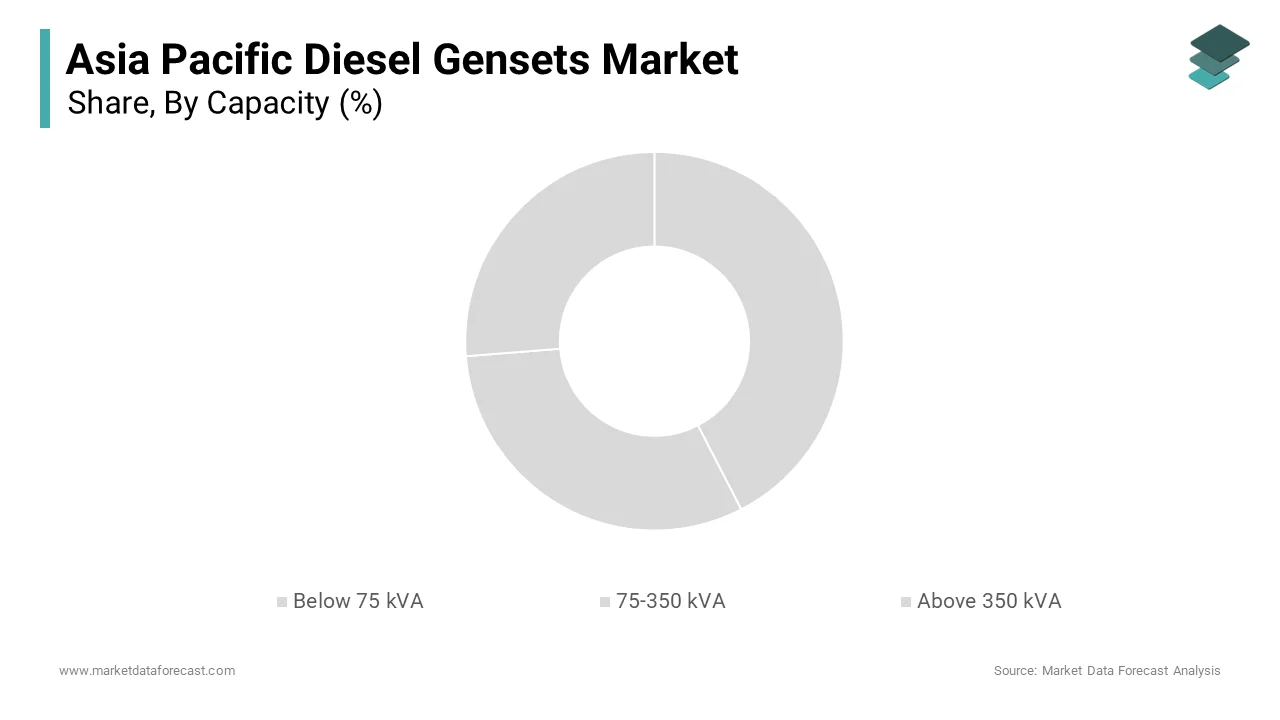
The Above 350 kVA segment is the fastest-growing in the Asia Pacific diesel gensets market and is projected to expand at a CAGR of 6.8% from 2025 to 2033. This rapid growth is fueled by the increasing need for high-capacity, prime power solutions in energy-intensive industries and large-scale infrastructure projects, where grid supply is either insufficient or absent. The surge in heavy industrial and extractive activities in geographically isolated regions has necessitated the deployment of high-capacity diesel gensets as primary power sources. These installations often use gensets exceeding 1,000 kVA in parallel configurations to meet continuous load demands. The absence of grid connectivity in such locations makes diesel the only viable option for uninterrupted operations. This trend is further amplified by the long lead times for grid extension, ensuring sustained demand for high-power diesel solutions. Large-capacity diesel gensets are increasingly being used in temporary power solutions for grid stabilization, disaster recovery, and major public events, driving their rapid adoption. Similarly, during the 2023 ASEAN Summit in Indonesia, a 120 MW temporary power plant composed of 400 kVA+ gensets was installed to ensure uninterrupted operations, according to the Ministry of Energy and Mineral Resources. These gensets offer rapid deployment and can be scaled based on need, making them ideal for dynamic power requirements. The flexibility, scalability, and immediate availability of high-capacity gensets in emergency and peak-load scenarios are accelerating their integration into national power resilience strategies, propelling market growth.
By End-User Insights
The Industrial segment holds the largest share of the Asia Pacific diesel gensets market with 45.8% of total demand in 2025. This dominance is rooted in the sector’s high energy intensity, operational continuity requirements, and the prevalence of manufacturing and extractive activities across the region. The region has become the epicenter of global manufacturing, attracting significant foreign direct investment due to competitive labor costs and expanding supply chains. This industrial expansion necessitates robust backup and prime power systems, particularly in sectors such as textiles, automotive, and electronics, where even brief power interruptions can result in substantial financial losses. The country’s export-oriented manufacturing base, which includes major facilities by Samsung and Intel, relies heavily on diesel gensets to maintain uninterrupted operations. The industrial sector’s dependence on continuous power, combined with the uneven reliability of grid supply in developing economies, ensures that diesel gensets remain a critical component of operational resilience. Many industrial operations in the Asia Pacific are located in remote or under-electrified regions where grid connectivity is either absent or insufficient to meet operational loads. These installations require gensets above 500 kVA to support heavy machinery, conveyor systems, and processing units. The inability of renewable microgrids to provide consistent, high-load power in extreme environments further entrenches reliance on diesel. The industrial sector’s need for prime power rather than just backup positions diesel gensets as essential infrastructure, reinforcing their market dominance.
The Commercial segment is the fastest-growing end-user category in the Asia Pacific diesel gensets market and is projected to grow at a CAGR of 7.2% from 2025 to 2033. This acceleration is driven by the digitalization of services, expansion of urban infrastructure, and rising demand for uninterrupted power in commercial establishments. The exponential growth of cloud computing, e-commerce, and digital banking has led to a surge in data center construction across the region, each requiring high-reliability backup power. These facilities mandate N+1 or 2N redundancy, with diesel gensets serving as the final line of defense during grid failures. These facilities typically install gensets in the 500–2,000 kVA range, contributing significantly to commercial segment demand. The rise of edge data centers in retail malls and business parks further amplifies this trend, as they require localized, high-availability power. Given the financial and reputational risks of downtime, commercial operators prioritize diesel gensets for their proven reliability, fueling rapid market growth. The commercial real estate boom across the Asia Pacific, particularly in urban centers, has led to a surge in demand for backup power in malls, hotels, and private hospitals. In Thailand, the number of international hotel brands increased between 2020 and 2023, with new properties in Phuket and Pattaya mandating 24/7 power for HVAC, security, and guest services. The healthcare sector is another major contributor. These establishments cannot afford power interruptions, especially in critical care units. The convergence of urbanization, consumer upgrade, and service sector expansion is creating a sustained and growing demand for commercial-grade gensets, positioning this segment for the highest growth trajectory.
By Application Insights
The Standby Backup Power application dominated the Asia Pacific diesel gensets market by capturing 65.6% of the total demand in 2025. This overwhelming share is attributable to the widespread use of diesel gensets as emergency power sources across residential, commercial, and industrial sectors, where grid instability remains a persistent challenge. Across much of the Asia Pacific, particularly in South and Southeast Asia, electricity grids are plagued by frequent outages, forcing organizations and households to rely on standby power systems. This unreliability compels hospitals, telecom towers, and financial institutions to install diesel gensets as mandatory backup. Even in more developed markets like Thailand, sudden grid failures during monsoon seasons necessitate emergency power. The economic cost of downtime is substantial. As a result, standby gensets are treated as essential insurance against operational risk. Their role in ensuring business continuity, data integrity, and safety compliance makes them indispensable, solidifying their position as the largest application segment. Governments and regulatory bodies across the region have institutionalized the use of standby diesel gensets in critical facilities through mandatory codes and safety regulations. These regulations are strictly enforced, particularly after incidents like the 2022 Mumbai hospital blackout that resulted in patient fatalities, prompting stricter compliance. The legal and reputational risks of non-compliance ensure that standby power remains a non-negotiable investment, reinforcing its market dominance.
The Prime/Continuous Power application is the fastest-growing segment and is projected to expand at a CAGR of 7.5% from 2025 to 2033. This growth is driven by the increasing use of diesel gensets as primary power sources in off-grid and grid-constrained regions. Millions of people in rural and island regions across the Asia Pacific lack access to a stable grid, making diesel gensets the primary source of electricity. These systems provide 24/7 power for households, schools, and small businesses. The slow pace of grid extension in geographically challenging areas ensures continued reliance on diesel, driving sustained demand growth in this application segment. Large-scale industrial and mining projects in remote areas often operate entirely on diesel-generated power due to the absence of grid infrastructure. These operations require uninterrupted power for processing, ventilation, and safety systems, making diesel the only viable option. As exploration expands into more remote regions, the demand for prime power gensets is set to rise, positioning this segment for the highest growth rate.
COUNTRY-LEVEL ANALYSIS
India stood as the largest national market for diesel gensets in the Asia Pacific by commanding 28% of regional revenue in 2025. The country’s dominance is underpinned by its vast industrial base, widespread grid instability, and rapidly expanding commercial infrastructure. With a notable share of manufacturing units located in areas with unreliable power supply, diesel gensets are a necessity rather than a luxury. Moreover, the government’s push for healthcare infrastructure under the Ayushman Bharat scheme has led to the installation of backup gensets in a large number of primary health centers. The residential segment is also growing, with urban homeowners increasingly installing sub-75 kVA units due to frequent load-shedding. Despite policy pushes for renewables, the intermittent nature of solar and wind ensures that diesel remains a critical component of India’s energy security, sustaining market leadership.
China held a notable share of the regional market. While grid reliability is relatively high in urban centers, the country’s massive industrial and construction sectors continue to drive demand for diesel gensets. China’s manufacturing output, which contributes notably to global production, requires uninterrupted power, particularly in export-oriented zones. The construction of new smart cities and special economic zones in western provinces, where grid infrastructure lags, has led to widespread use of prime power gensets. In Xinjiang and Yunnan, remote industrial parks rely on diesel for continuous operations. The country’s leadership in genset manufacturing, with firms like Weichai and Cummins China dominating supply, further consolidates its market position.
Indonesia is another key player in the market. As an archipelagic nation with over 17,000 islands, Indonesia faces unique energy access challenges, making diesel gensets a cornerstone of its electrification strategy. The government’s electrification rate reached 99.5% in 2023, but much of this is achieved through diesel. In the commercial sector, Jakarta’s skyscrapers and shopping malls mandate backup power due to frequent grid fluctuations. With limited alternatives in remote regions and strong industrial demand, diesel gensets remain indispensable, ensuring Indonesia’s prominent market position.
Japan has advanced grid infrastructure and maintains a robust diesel genset market due to its vulnerability to natural disasters and stringent safety regulations. The country experiences a large number of earthquakes annually, necessitating reliable backup power in critical facilities. After the 2011 Fukushima disaster, the government mandated that all hospitals, nuclear plants, and transportation hubs install diesel gensets with 72-hour fuel reserves. Additionally, Japan’s aging population has led to a surge in elderly care facilities, all of which require uninterrupted power. The country’s focus on disaster resilience, rather than grid instability, defines its genset demand, distinguishing it from other regional markets.
Australia accounts for a notable share of the market. The country’s demand is driven by its vast mining sector and remote communities. With 80% of mining operations located in off-grid areas, diesel gensets are the primary power source. In the Northern Territory and Western Australia, entire towns like Newman and Telfer rely on diesel microgrids. Additionally, Australia’s data center boom in Sydney and Melbourne has increased demand for high-capacity backup systems. The combination of geographic isolation, energy-intensive industries, and climate-related grid risks ensures sustained demand, solidifying Australia’s position as a key market.
KEY MARKET PLAYERS
Cummins Inc., Mitsubishi Heavy Industries Engine & Turbocharger, Ltd, Yanmar Holdings Co., Ltd, Caterpillar Inc., Mahindra Powerol Ltd, Generac Power Systems, Doosan Corporation, Honda Siel Power Products Ltd, Kohler Co. are the market players that are dominating the Asia Pacific diesel gensets market.
Top Players In The Market
Cummins Inc.
Cummins Inc. remains a dominant force in the Asia Pacific diesel gensets market, leveraging its decades-long engineering expertise and localized manufacturing footprint. The company offers a comprehensive range of diesel generators from 5 kVA to over 2,500 kVA, tailored for industrial, commercial, and infrastructure applications across the region. In recent years, Cummins has intensified its focus on digital integration, introducing remote monitoring systems and predictive maintenance solutions through its PowerCommand platform. It has expanded service networks in India, Indonesia, and Vietnam to enhance after-sales support. In 2023, Cummins launched a new fuel-efficient QSK95-based genset series in Australia, targeting mining and data center clients. The company has also invested in localized R&D centers in Pune and Shanghai to develop emission-compliant engines aligned with regional regulations. Cummins’ strategic partnerships with local distributors and infrastructure developers have strengthened its responsiveness to regional demands, ensuring reliability and rapid deployment in critical operations, thereby solidifying its leadership in diverse power segments.
Caterpillar Inc.
Caterpillar Inc. holds a prominent position in the Asia Pacific diesel gensets market through its robust product portfolio and strong reputation for durability in harsh operating environments. Its gensets, powered by Cat diesel engines, are widely deployed in mining, oil & gas, and large-scale industrial projects across remote regions of Australia, Indonesia, and Mongolia. The company has prioritized technological resilience, integrating its gensets with Cat Connect intelligence systems for real-time performance tracking and fuel optimization. In 2022, Caterpillar launched the Cat G3500 series in Southeast Asia, designed for prime and continuous power in off-grid applications. It has also enhanced its service footprint through Cat Reman centers in Thailand and India, promoting sustainability via remanufactured components. Caterpillar’s collaboration with local energy firms in the Philippines and Papua New Guinea has enabled customized power solutions for island grids. The company’s emphasis on lifecycle cost reduction, operational uptime, and compliance with emission standards has reinforced its appeal among heavy-industrial clients, ensuring sustained influence in mission-critical power sectors across the region.
Kirloskar Electric Company Limited
Kirloskar Electric, an Indian industrial powerhouse, plays a pivotal role in shaping the diesel genset landscape across South and Southeast Asia. Known for its rugged, cost-effective gensets ranging from 5 kVA to 2,000 kVA, the company caters extensively to industrial, commercial, and telecom sectors in markets with inconsistent grid supply. In recent years, Kirloskar has modernized its engine platforms to meet Bharat Stage and IMO Tier II equivalent emissions standards, enhancing environmental compliance. It launched the KOEL SmartGen series in 2023, featuring IoT-enabled monitoring and auto-start capabilities, targeting data centers and healthcare facilities. The company has expanded its export presence in Bangladesh, Nepal, and Myanmar through strategic dealer networks. Additionally, Kirloskar has invested in digital service platforms to streamline maintenance and reduce downtime. Its localized manufacturing in Karnataka ensures faster delivery and customization, while partnerships with infrastructure developers support large-scale project deployments. By combining affordability with technological upgrades, Kirloskar Electric continues to strengthen its relevance in both urban and rural power ecosystems across the Asia Pacific.
Top Strategies Used by Key Market Participants
Key players in the Asia Pacific diesel gensets market are deploying multifaceted strategies to consolidate their presence and respond to evolving demand. Product innovation remains central, with companies developing fuel-efficient, low-emission gensets compliant with regional environmental standards. Firms are integrating IoT and remote monitoring technologies to enhance operational visibility and predictive maintenance. Strategic localization is another critical approach—manufacturers are establishing regional production hubs and service centers in India, Thailand, and Indonesia to reduce lead times and improve after-sales support. Partnerships with local distributors and engineering firms enable better market penetration in remote and underserved areas. Capacity expansion through new production lines and remanufacturing facilities supports sustainability and cost efficiency. Additionally, companies are focusing on hybrid-ready gensets that can synchronize with solar and battery systems, aligning with the region’s energy transition. Customer-centric offerings, including extended warranties and energy-as-a-service models, are gaining traction. These strategies collectively enhance competitiveness, ensuring resilience against regulatory changes and shifting energy dynamics across the diverse Asia Pacific landscape.
COMPETITION OVERVIEW
The competition in the Asia Pacific diesel gensets market is intense, characterized by the coexistence of global engineering leaders and regionally entrenched manufacturers. Multinational corporations such as Cummins, Caterpillar, and Kohler compete with domestic powerhouses like Kirloskar, Mahindra Powerol, and FG Wilson’s regional affiliates, creating a dynamic and fragmented landscape. Differentiation is achieved through technological sophistication, service responsiveness, and adaptability to local regulatory and operational conditions. While global players leverage brand reputation and advanced R&D, regional firms capitalize on cost efficiency, localized distribution, and deep market understanding. The rise of emission regulations in China, India, and Southeast Asia has intensified competition, pushing companies to innovate in engine efficiency and after-treatment systems. Service networks and lifecycle support have become critical battlegrounds, as end-users prioritize uptime and operational continuity. Furthermore, the shift toward hybrid and smart gensets has prompted strategic alliances with renewable energy firms. Price sensitivity in emerging markets contrasts with the premium segment’s demand for reliability and compliance, leading to segmented competition. Overall, the market rewards agility, technical adaptability, and strong after-sales ecosystems, ensuring that no single player dominates uniformly across all sub-regions and applications.
RECENT HAPPENINGS IN THE MARKET
- In March 2023, Cummins Inc. launched its new QSK95-based diesel genset series in Australia, specifically engineered for high-load mining and data center applications, enhancing its technological edge in prime power solutions across remote industrial sites.
- In July 2022, Caterpillar Inc. expanded its remanufacturing facility in Bangkok, enabling localized production of reconditioned genset components, reducing costs and delivery times while promoting circular economy practices in Southeast Asian markets.
- In January 2025, Kirloskar Electric introduced the KOEL SmartGen series in India, featuring IoT-enabled remote monitoring and automatic load management, targeting commercial and healthcare sectors requiring high-availability backup power.
- In September 2023, Kohler Co. established a new service and distribution hub in Jakarta, strengthening its after-sales network across Indonesia and improving response times for industrial and infrastructure clients in the archipelago.
- In May 2022, Rolls-Royce Power Systems (MTU) partnered with a Singapore-based energy solutions provider to deploy hybrid-ready diesel gensets in data centers, integrating them with battery storage to reduce fuel consumption and emissions.
MARKET SEGMENTATION
This research report on the Asia Pacific diesel gensets market is segmented and sub-segmented into the following categories.
By Capacity
- Below 75 kVA
- 75-350 kVA
- Above 350 kVA
By End-User
- Residential
- Commercial
- Industrial
By Application
- Standby Backup Power
- Prime/Continuous Power
- Peak Shaving Power
By Country
- India
- China
- Japan
- South Korea
- Australia
- New Zealand
- Thailand
- Malaysia
- Vietnam
- Philippines
- Indonesia
- Singapore
- Rest of APAC