- Product Description Description
- Table of Contents TOC
- List of Table & Figure LOT
- Get Free Sample PDF Sample PDF
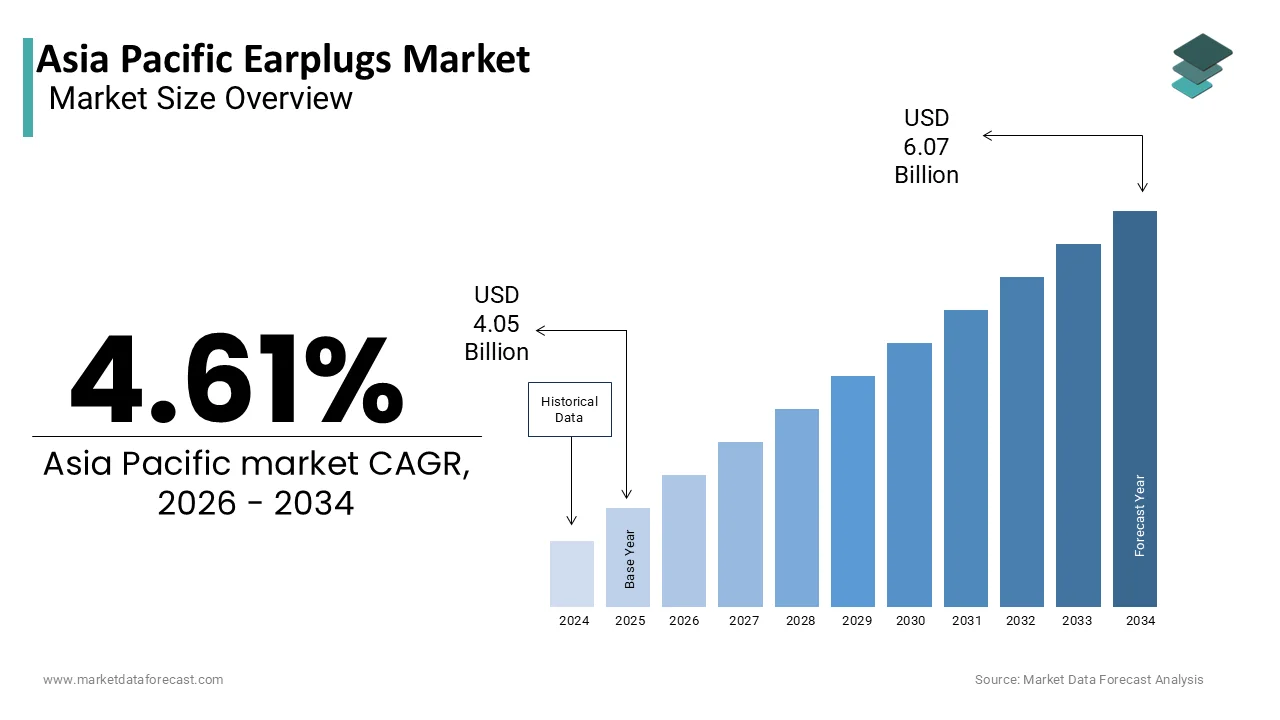
Market Size, 2025
$4.05 BnMarket Estimate, 2026
$4.24 BnMarket Forecast, 2034
$6.07 BnCAGR, 2026–2034
4.61%Asia Pacific Earplugs Market Size
The Asia Pacific Earplugs market size was valued at USD 4.05 billion in 2025, and the market size is expected to reach USD 6.07 billion by 2034 from USD 4.24 billion in 2026, growing at a CAGR of 4.61%.
Earplugs are hearing protection devices designed to reduce noise exposure in various environments, including industrial workplaces, aviation, healthcare, construction, and consumer applications. Earplugs are used both for occupational safety compliance and personal comfort, available in disposable, reusable, custom-molded, and electronic variants. The growing awareness about noise-induced hearing loss (NIHL) and increasing regulatory focus on workplace safety have significantly influenced market dynamics.
In recent years, rapid industrialization across countries like China, India, and South Korea has led to heightened demand for personal protective equipment (PPE), including high-performance earplugs. Apart from these, the rising popularity of music festivals, concerts, and recreational activities involving loud environments has expanded the consumer segment of the market.
MARKET DRIVERS
Increasing Industrialization and Occupational Safety Regulations
The rapid pace of industrialization and the corresponding implementation of occupational health and safety regulations aimed at protecting workers from noise-induced hearing loss (NIHL) is a key growth factor of the Asia Pacific earplugs market. Countries such as India, Indonesia, and Vietnam have experienced significant growth in manufacturing and construction sectors, where prolonged exposure to high decibel levels is common. In addition, governments have introduced or updated labor laws requiring employers to provide personal protective equipment (PPE), including certified earplugs, to employees working in noisy environments. China, which remains a global manufacturing hub, has enforced stricter OSHA-like guidelines under its Ministry of Emergency Management, compelling factories to adopt standardized PPE protocols.
Rising Awareness About Noise-Induced Hearing Loss (NIHL)
The growing awareness about noise-induced hearing loss (NIHL) among both professionals and consumers is also a key driver fueling the growth of the Asia Pacific earplugs market. Public health campaigns, educational initiatives, and media outreach have played a crucial role in highlighting the long-term consequences of unprotected exposure to loud sounds in occupational and recreational settings.
In Japan, where hearing conservation programs have been well-established, the Ministry of Health, Labour and Welfare has actively promoted the use of earplugs in industrial and entertainment sectors. Similarly, in Australia, the National Acoustics Laboratory has collaborated with universities to conduct studies demonstrating NIHL risks in concertgoers and motor sports enthusiasts, leading to an uptick in consumer-grade earplug adoption.
South Korea has also seen a surge in demand for musician’s earplugs and swim plugs, driven by younger demographics who prioritize preventive health measures.
MARKET RESTRAINTS
Low Compliance and Improper Usage in SMEs and Informal Sectors
The low compliance rate and improper usage of hearing protection devices, particularly in small and medium enterprises (SMEs) and informal labor sectors is a major restraint affecting the Asia Pacific earplugs market. Despite the existence of occupational safety regulations, enforcement remains weak in many parts of the region, especially in countries like India, Bangladesh, and the Philippines.
Many small-scale manufacturers prioritize immediate operational costs over long-term health investments, leading to minimal or inconsistent earplug usage.
Further, lack of awareness and training contributes to improper fitting and misuse of earplugs, reducing their effectiveness. As per the Indian Institute of Occupational Health, a significant share of surveyed workers either did not wear earplugs correctly or removed them frequently due to discomfort or communication difficulties.
These challenges hinder market expansion, as the potential user base remains underutilized.
Availability of Substandard and Counterfeit Products
The widespread availability of substandard and counterfeit earplug products, which undermine consumer trust and compromise hearing protection efficacy, is another significant constraint facing the Asia Pacific earplugs market. In several emerging markets, unregulated supply chains allow low-quality imitations to flood local markets at lower prices, often without meeting international safety standards.
In China and India, customs authorities have seized thousands of counterfeit earplug shipments annually due to non-compliance with noise reduction rating (NRR) benchmarks set by bodies like ANSI and ISO.
These inferior products not only expose users to preventable hearing damage but also discourage repeat purchases, as consumers associate poor experiences with the category itself rather than individual brands.
Regulatory agencies such as the Australian Competition and Consumer Commission (ACCC) have issued warnings about misleading labeling and inadequate noise attenuation in some imported earplug models.
MARKET OPPORTUNITIES
Growth in Recreational and Lifestyle Applications
The expanding use of earplugs beyond industrial settings into recreational and lifestyle domains is a major opportunity for the Asia Pacific earplugs market. As awareness of hearing health increases, consumers are adopting earplugs for activities such as concerts, nightclubs, swimming, sleep improvement, and travel noise reduction.
In Japan and South Korea, the demand for musician’s earplugs has surged, driven by a thriving live music culture and a growing youth demographic invested in preserving auditory health.
Australia has also witnessed a strong uptake of custom-fit swim plugs and sleep-enhancing earplugs, particularly among middle-aged and elderly populations dealing with tinnitus and insomnia.
Moreover, with the rise of remote work and shared living spaces, there is growing demand for noise-isolating earplugs tailored for concentration and relaxation. These lifestyle-driven applications present lucrative opportunities for market expansion.
Expansion of Custom-Molded Earplug Solutions
The increasing adoption of custom-molded earplugs, which offer superior fit, comfort, and acoustic performance compared to generic disposable or reusable options is an emerging opportunity in the Asia Pacific earplugs market. This shift is being driven by advancements in digital ear scanning technology, improved accessibility through audiologist networks, and growing consumer preference for personalized health products.
In Australia, custom-molded earplugs have gained traction among professional musicians, pilots, and swimmers seeking durable and precisely fitted solutions.
Japan has also embraced this trend, with audiology clinics partnering with hearing aid manufacturers to offer premium molded ear protection tailored to specific lifestyles. In India, private audiology centers in metropolitan cities are promoting custom-molded earplugs for fitness enthusiasts, frequent travelers, and office professionals exposed to prolonged ambient noise.
MARKET CHALLENGES
Lack of Standardization and Certification Across Regional Markets
The lack of uniform product certification standards across different countries, complicating compliance efforts for manufacturers and importers is one of the foremost challenges confronting the Asia Pacific earplugs market. Unlike Europe and North America, which follow harmonized frameworks such as CE marking and ANSI standards, the Asia Pacific region features varying national regulations, testing procedures, and approval requirements.
In China, the GB/T standard governs earplug performance, while India follows BIS-certified guidelines. However, these standards differ in terms of noise reduction ratings (NRR), testing methodologies, and labeling conventions.
This fragmentation leads to inconsistencies in product quality and reliability, posing challenges for multinational companies aiming to streamline distribution. Moreover, limited enforcement of quality control measures allows subpar products to enter the market unchecked, eroding consumer confidence.
Limited Consumer Awareness and Education
The relatively low level of consumer awareness regarding the importance of hearing protection and proper earplug usage is a critical challenge affecting the Asia Pacific earplugs market. While industrial buyers may be guided by occupational safety mandates, general consumers often remain uninformed about the risks of noise-induced hearing loss (NIHL) and the benefits of protective devices. Misconceptions also persist regarding comfort, hygiene, and effectiveness. Many potential users avoid earplugs due to concerns about discomfort, improper fit, or perceived muffling of sound. So, companies must invest in targeted consumer education campaigns, collaborate with audiologists, and leverage digital marketing to enhance public understanding of hearing health and the role of earplugs in preventing long-term damage
REPORT COVERAGE
| REPORT METRIC | DETAILS |
| Market Size Available | 2025 to 2034 |
| Base Year | 2025 |
| Forecast Period | 2026 to 2034 |
| Segments Covered | By Material, Application, End-Use, and Region |
| Various Analyses Covered | Regional & Country Level Analysis, Segment-Level Analysis, DROC, PESTLE Analysis, Porter’s Five Forces Analysis, Competitive Landscape, Analyst Overview on Investment Opportunities |
| Regions Covered | India, China, Japan, South Korea, Australia, New Zealand, Thailand, Malaysia, Vietnam, Philippines, Indonesia, Singapore, and the Rest of Asia-Pacific |
| Market Leaders Profiled | Wavy Ocean earplugs, Moldex-Metric, Honeywell International Inc., Etymotic, HEAROS, EARJOBS, 3M, uvex group, Speedo International Limited, and others |
SEGMENTAL ANALYSIS
By Material Insights
The foam earplugs segment dominated the Asia Pacific earplugs market by capturing 45% of total sales in 2025. Its affordability, widespread availability, and ease of use, making it the preferred choice for both industrial workers and general consumers is propelling the lead position of foam earplugs segment. In China, foam earplugs are extensively used in construction, manufacturing, and mining sectors due to their cost-effectiveness and compliance with basic noise reduction standards. India has also seen high adoption rates, particularly among small-scale industries and informal labor sectors where budget constraints limit investment in premium alternatives. Besides, their comfort and adaptability make them popular in consumer applications such as sleep and travel.
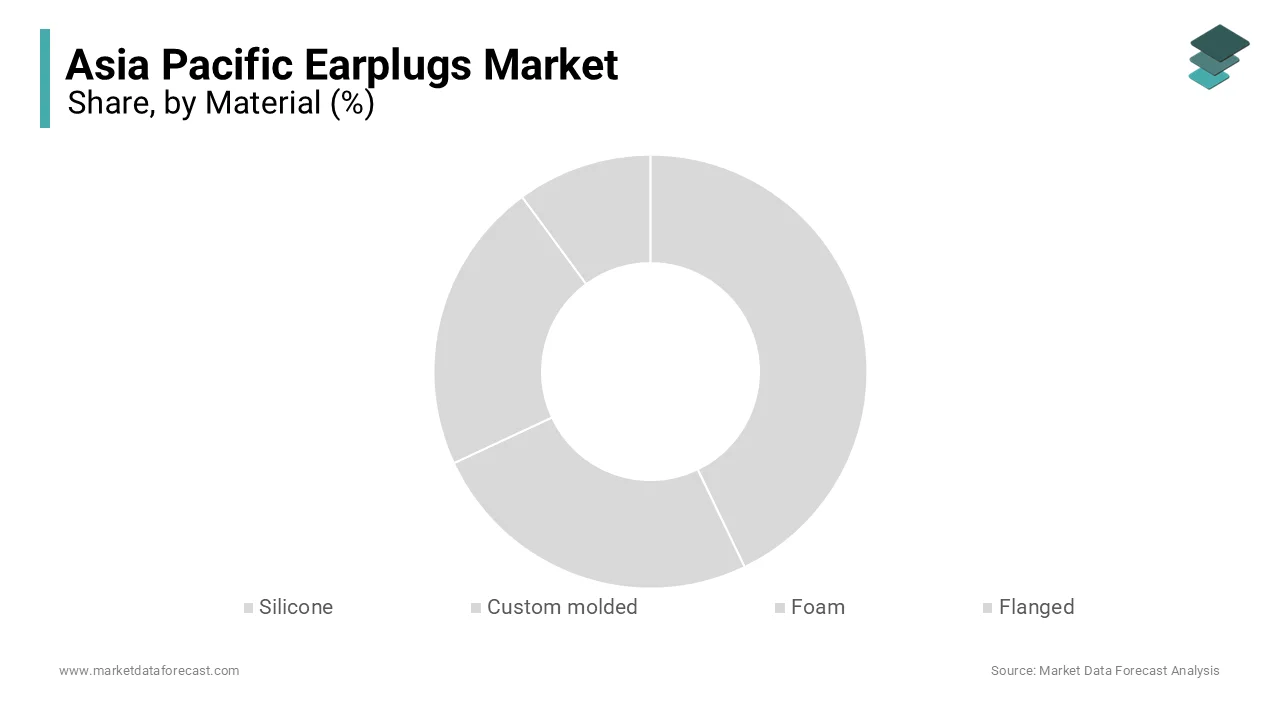
The custom-molded earplugs segment is emerging as the fastest-growing category in the Asia Pacific earplugs market and is likely expanding at a CAGR of 11.6% between 2025 and 2033. Increasing demand for personalized, long-lasting, and high-performance hearing protection solutions across professional and lifestyle applications is driving the growth of custom-molded earplugs segment.
Japan leads this trend, with audiologists and hearing aid centers offering precision-molded earplugs tailored for musicians, pilots, swimmers, and frequent travelers.
South Korea has also witnessed growing interest, particularly among concertgoers and fitness enthusiasts seeking comfortable yet effective noise isolation.
Australia is another key contributor, with audiology clinics integrating digital scanning and 3D printing technologies to offer customized options.
By Application Insights
The noise reduction segment remained the largest application in the Asia Pacific earplugs market by accounting for 52.2% of total usage in 2025. Stringent occupational health and safety regulations mandating the use of hearing protection in high-noise environments such as manufacturing, construction, and aviation is fuelling the surge of noise reduction segment.
China, being a global manufacturing hub, accounts for a significant portion of this demand. In India, enforcement of labor laws requiring noise protection in textile mills, steel plants, and infrastructure projects has further reinforced demand, as highlighted by the Indian Society for Industrial Safety.
Beyond occupational use, noise pollution in densely populated cities has spurred consumer adoption.
The sleep improvement application segment is experiencing the highest growth in the Asia Pacific earplugs market and is likely expanding at a CAGR of 12.8% between 2025 and 2033. Increasing awareness of sleep hygiene, rising cases of insomnia, and growing urbanization leading to persistent environmental noise disturbances is driving the surge of sleep improvement application segment. Japan has also seen a rise in demand, particularly among elderly populations suffering from tinnitus or age-related sleep disturbances. Moreover, with the rise of co-living spaces, shared accommodations, and remote work setups, younger demographics are increasingly adopting earplugs for better concentration and restful sleep.
By End-Use Insights
The manufacturing segment led the Asia Pacific earplugs market by contributing around 30.4% of total end-use demand in 2025. Extensive presence of heavy industries such as automotive, electronics, textiles, and metal processing, which expose workers to high-decibel environments, propelling the growth of manufacturing segment.
China, the world’s largest manufacturing base, mandates the use of hearing protection in factories under revised occupational safety regulations enforced by the Ministry of Emergency Management.
India has also strengthened its labor laws, requiring employers to provide certified earplugs in high-noise zones.
Apart from these, South Korea's industrial sector has embraced advanced reusable and filtered earplugs to enhance communication while maintaining hearing safety.
The healthcare segment is the fastest-growing end-use category in the Asia Pacific earplugs market, projected to expand at a CAGR of 14.2% through 2033. This growth is primarily driven by the Increasing use of earplugs in hospitals, rehabilitation centers, and long-term care facilities to improve patient sleep quality and reduce stress caused by hospital noise is a key catalyst of the healthcare segment.
In Australia, research conducted by the George Institute for Global Health found that hospital wards consistently recorded nighttime noise levels above 55 dB, prompting widespread adoption of disposable foam earplugs for patients.
Japan has also embraced this practice, particularly in geriatric and intensive care units.
Further, in Singapore, private medical institutions have started providing custom-molded earplugs to patients undergoing extended stays or recovering from surgeries.
REGIONAL ANALYSIS
China
China led the Asia Pacific earplugs market by holding 32.5% of regional sales in 2025. As the world’s largest manufacturing economy, the country’s demand for industrial-grade hearing protection is immense, driven by strict occupational safety policies and large-scale workforce requirements.
Moreover, the rise of domestic personal protective equipment manufacturers has made earplugs more affordable and accessible across various economic strata.
Urbanization and rising awareness about noise pollution have further expanded consumer applications, particularly in residential and transport sectors.
India
India holds a significant share of the Asia Pacific earplugs market. The country’s market growth is primarily driven by the expansion of industrial sectors such as textiles, construction, and metal fabrication, where exposure to hazardous noise levels is common. In addition, state governments and labor departments have intensified enforcement of personal protective equipment (PPE) mandates, resulting in higher procurement of foam and reusable earplugs. Besides, urban noise pollution has contributed to a rise in consumer-driven earplug usage.
Japan
Japan holds a notable share of the Asia Pacific earplugs market. The country’s market is characterized by a mature industrial safety framework and a growing consumer preference for premium and specialized earplug solutions. The Ministry of Health, Labour and Welfare mandates the use of certified hearing protection in noisy workplaces, particularly in automotive, shipbuilding, and electronics assembly sectors. Simultaneously, Japan’s aging population has led to increased use of earplugs for sleep and tinnitus management. Innovations in custom-molded and electronic earplugs have further boosted market sophistication. With a blend of industrial necessity and lifestyle-driven demand, Japan remains a critical contributor to the Asia Pacific earplugs industry.
South Korea (Market Share – ~9%)
South Korea occupies the fourth-largest position in the Asia Pacific earplugs market, contributing approximately 9% of total revenue in 2023. The country’s market is shaped by a highly regulated industrial landscape and an emerging consumer focus on lifestyle-driven auditory protection. South Korea’s Ministry of Employment and Labor enforces strict noise exposure limits in manufacturing, construction, and aviation sectors. Beyond occupational use, there is a growing trend in consumer-driven adoption, particularly among young professionals and music enthusiasts. Apart from these, audiologists and hearing aid centers are promoting custom-molded earplugs for noise-sensitive professions and recreational activities.
Australia
Australia remained a key player of the Asia Pacific earplugs market. The country’s strong occupational health and safety standards, combined with a proactive approach to noise-induced hearing loss (NIHL) prevention, have fostered a robust demand for high-quality earplugs. In addition, companies are increasingly procuring certified noise-reducing earplugs that meet AS/NZS 1274 standards. Beyond occupational use, Australia has seen a notable rise in consumer-driven applications.
KEY MARKET PLAYERS AND COMPETITIVE LANDSCAPE
The major key players in the Asia-Pacific earplugs market are
Wavy Ocean earplugs, Moldex-Metric, Honeywell International Inc., Etymotic, HEAROS, EARJOBS, 3M, uvex group, Speedo International Limited and others.
The competition in the Asia Pacific earplugs market is shaped by a mix of global safety equipment giants, regional PPE manufacturers, and emerging niche players specializing in customized and lifestyle-focused hearing protection solutions. While multinational corporations like 3M and Honeywell dominate the industrial segment with certified, high-performance products, domestic and regional firms are increasingly capturing market share through cost-effective alternatives and localized supply chains. This dynamic creates a fragmented yet highly competitive landscape where differentiation hinges on product quality, comfort, and targeted branding strategies.
Consumer awareness is gradually shifting the market beyond occupational use toward lifestyle applications such as sleep, travel, and recreational noise reduction. As a result, new entrants are entering the space with innovative offerings, including molded earplugs, filtered models, and smart audio-integrated variants. This expansion into non-traditional applications is intensifying competition, particularly in urban centers and among younger demographics seeking personalized wellness products.
Regulatory enforcement varies across countries, influencing the pace of market growth and standardization efforts. In markets with stringent safety laws—such as Japan and Australia—global brands maintain a strong foothold, while in less regulated economies, price-sensitive consumers favor locally produced or generic alternatives. To remain competitive, industry leaders are focusing on educational outreach, technological advancements, and strategic alliances to reinforce product credibility and long-term market positioning.
TOP PLAYERS IN THE MARKET
3M Company (Global with Strong Presence in Asia Pacific)
3M is a leading global manufacturer of personal protective equipment, including high-performance earplugs tailored for industrial and consumer applications. The company offers a diverse range of noise-reducing earplugs that meet international safety standards, making them widely adopted across manufacturing, construction, and aviation sectors in the Asia Pacific region. 3M plays a crucial role in setting benchmarks for hearing protection technology through continuous innovation and strategic partnerships with local distributors. Its strong brand reputation, backed by decades of research and development, has made it a trusted name among both occupational health professionals and end users.
Honeywell International Inc. (Global with Strategic Reach in Asia Pacific)
Honeywell is a major contributor to the Asia Pacific earplugs market, offering advanced hearing protection solutions designed for industrial environments. The company provides a broad portfolio of disposable, reusable, and electronic earplugs that cater to the needs of workers exposed to hazardous noise levels in sectors such as mining, oil and gas, and heavy manufacturing. Honeywell’s commitment to product durability, comfort, and compliance with global safety norms has reinforced its position in the regional market. Through localized distribution networks and collaborations with government agencies, Honeywell continues to expand its influence in workplace safety initiatives across the Asia Pacific.
Moldex-Metric, Inc. (Expanding Influence in the Region)
Moldex-Metric has established a growing presence in the Asia Pacific earplugs market by delivering innovative, user-friendly hearing protection products. Known for its ergonomic foam earplug designs and custom-molded options, the company has been expanding its reach through partnerships with local safety suppliers and healthcare providers. Moldex-Metric emphasizes sustainability and hygiene in product design, aligning with evolving consumer expectations in both occupational and lifestyle segments. By focusing on comfort, performance, and education-driven marketing, the company is strengthening its foothold in key markets such as Japan, Australia, and South Korea, contributing to broader awareness and adoption of effective hearing protection solutions.
TOP STRATEGIES USED BY THE KEY MARKET PLAYERS
One of the primary strategies employed by leading players in the Asia Pacific earplugs market is product diversification and innovation , where companies are developing specialized earplugs tailored for different applications such as sleep, travel, music, and industrial use. This allows brands to capture multiple consumer segments and enhance market penetration beyond traditional occupational settings.
Another key approach is strategic collaborations with local distributors and safety agencies , enabling manufacturers to navigate regulatory landscapes more efficiently while ensuring widespread availability of their products. These partnerships also facilitate training programs and awareness campaigns aimed at improving workplace safety compliance and consumer understanding of hearing protection benefits.
Lastly, brand education and digital marketing initiatives play a crucial role in strengthening market presence. Companies are investing in online platforms, audiologist endorsements, and social media engagement to build trust, improve customer retention, and drive demand across both professional and lifestyle-oriented consumer groups.
RECENT HAPPENINGS IN THE MARKET
- In March 2025, 3M expanded its regional distribution network by partnering with a leading Indonesian safety equipment supplier, aiming to increase accessibility of certified industrial earplugs in fast-growing manufacturing hubs across Southeast Asia.
- In February 2025, Honeywell launched an online auditory health awareness campaign in India, collaborating with occupational safety organizations to educate SMEs and labor unions about the importance of consistent earplug usage in noisy work environments.
- In January 2025, Moldex-Metric introduced a line of biodegradable foam earplugs in Japan and South Korea, aligning with the region's increasing emphasis on sustainable product development and eco-conscious consumer preferences.
- In December 2023, Decibullz, known for custom-molded earplugs, entered the Australian market through an exclusive retail partnership with a major pharmacy chain, targeting the growing demand for premium, personalized hearing protection in lifestyle and medical contexts.
- In November 2023, JSP Safety, a UK-based firm with a strong presence in the Asia Pacific, established a new regional headquarters in Singapore to streamline product sourcing, compliance management, and technical support services for corporate clients across the region.
MARKET SEGMENTATION
This research report on the Asia Pacific earplugs market has been segmented and sub-segmented based on the following categories.
By Material
- Silicone
- Custom molded
- Foam
- Flanged
By Application
- Sleeping
- Noise reduction
- Swimming
- Travel
- Others
By End-User
- Construction
- Consumer
- Forestry
- Military
- Mining
- Manufacturing
- Healthcare
- Others
By Country
- India
- China
- Japan
- South Korea
- Australia
- New Zealand
- Thailand
- Malaysia
- Vietnam
- Philippines
- Indonesia
- Singapore
- Rest of Asia-Pacific