- Product Description Description
- Table of Contents TOC
- List of Table & Figure LOT
- Get Free Sample PDF Sample PDF
Market Size, 2025
$3.11 BnMarket Estimate, 2026
$3.28 BnMarket Forecast, 2034
$8.62 BnCAGR, 2026–2034
12.00%Asia Pacific Electric Boiler Market Insights
The Asia Pacific Electric Boiler Market size was valued at USD 3.11 billion in 2025 and is anticipated to reach USD 3.48 billion in 2026 from USD 8.62 billion by 2034, growing at a CAGR of 12.00% during the forecast period from 2026 to 2034.
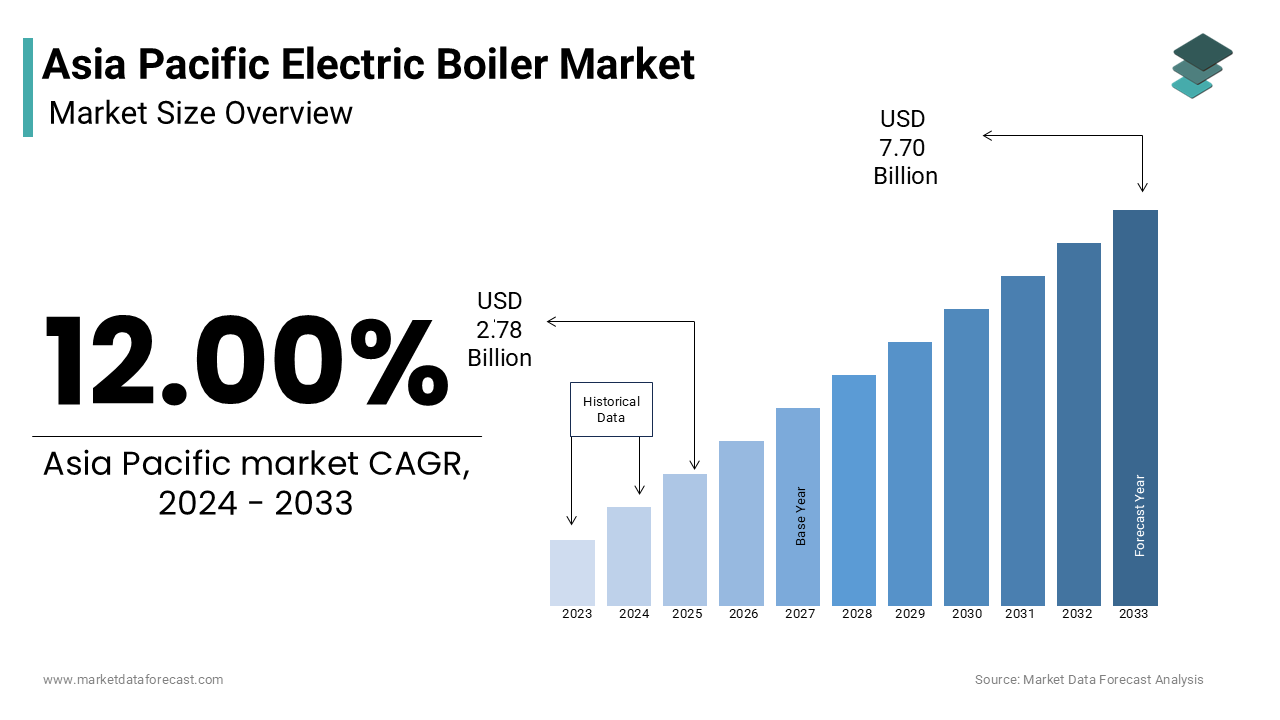
Electric boiler refers to the electrically heated steam and hot water generation systems used across residential, commercial, and industrial applications. Electric boilers are increasingly being adopted as a cleaner alternative to fossil fuel-based heating systems, particularly in urban areas where air quality and emissions regulations are tightening. Countries such as China, India, Japan, and South Korea are witnessing growing interest in electric boilers due to their efficiency, ease of integration with renewable energy sources, and compliance with environmental policies. With governments across the region promoting electrification of heating systems and offering subsidies for clean energy technologies, the electric boiler market is gaining traction as a sustainable alternative to traditional boilers.
MARKET DRIVERS
Increasing Adoption of Clean Energy and Decarbonization Policies
The growing emphasis on clean energy adoption and decarbonization initiatives across the region is one of the primary drivers of the Asia Pacific electric boiler market. Governments in countries such as Japan, South Korea, and China have introduced stringent emissions regulations and financial incentives to phase out coal and gas-based heating systems. This shift toward clean electricity is making electric boilers a viable and environmentally friendly alternative for industrial and residential heating. In Japan, the Ministry of Economy, Trade and Industry (METI) has mandated the use of electric heating systems in new commercial buildings to reduce carbon emissions. Additionally, in China, the National Development and Reform Commission has set targets to reduce coal consumption in urban heating, encouraging industries to adopt electric boilers. These policy-driven initiatives are accelerating the adoption of electric boilers across the Asia Pacific region.
Growth of Urbanization and Residential Heating Demand
The rapid pace of urbanization and the corresponding increase in residential and commercial heating demand is another key driver of the Asia Pacific electric boiler market. According to the United Nations, the urban population in the Asia Pacific region is projected to grow by over 1.2 billion people by 2050. This demographic shift is driving the demand for modern, space-efficient, and low-emission heating solutions, particularly in multi-family housing and commercial buildings. Additionally, in Australia, the government has been promoting the use of high-efficiency electric boilers to reduce energy consumption and emissions. As urban infrastructure expands and environmental concerns intensify, electric boilers are becoming an increasingly attractive option for modern heating needs across the Asia Pacific region.
MARKET RESTRAINTS
High Initial Investment and Operating Costs
The high initial investment and operating costs associated with electric heating systems is a major restraint affecting the Asia Pacific electric boiler market. Compared to conventional gas or coal-fired boilers, electric boilers often require a higher upfront capital outlay, particularly for industrial-grade models with high thermal efficiency and advanced control systems. These economic barriers limit the widespread adoption of electric boilers, particularly in price-sensitive markets across the Asia Pacific region.
Limited Awareness and Technical Expertise
The limited awareness and technical expertise regarding the benefits and operational efficiency of electric boilers, particularly in rural and semi-urban areas, is another key restraint in the Asia Pacific electric boiler market. Many potential users, including small-scale industrial operators and residential builders, lack sufficient knowledge about the advantages of electric boilers over traditional heating systems. The lack of technical support and awareness hinders the adoption of electric boilers, particularly in small and medium-sized enterprises where operational reliability and maintenance accessibility are critical decision factors.
MARKET OPPORTUNITIES
Expansion of Renewable Energy Integration in Heating Systems
The expanding integration of renewable energy sources into heating systems is a major opportunity for the Asia Pacific electric boiler market. As governments and industries increasingly shift toward decarbonization, electric boilers are being positioned as a key enabler for utilizing surplus renewable electricity in thermal applications. In China, the National Energy Administration has launched pilot programs to integrate electric boilers with wind and solar farms, allowing excess renewable energy to be stored in the form of thermal energy. Besides, in Japan, the Ministry of Economy, Trade and Industry (METI) has been promoting the use of electric boilers in combination with heat pumps to optimize energy efficiency in commercial buildings. As renewable energy penetration increases, electric boilers are expected to play a crucial role in balancing energy demand and supply across the Asia Pacific region.
Growth of Smart Building and District Heating Networks
The increasing adoption of smart building technologies and district heating networks is another significant opportunity for the Asia Pacific electric boiler market. With rapid urbanization and the rise of smart city initiatives, there is a growing demand for integrated, energy-efficient heating solutions that can be centrally controlled and optimized. Additionally, in South Korea, the government has been promoting the use of electric boilers in apartment complexes equipped with smart energy grids. As smart infrastructure continues to evolve, the demand for electric boilers in district heating and intelligent building applications is expected to rise significantly across the Asia Pacific region.
MARKET CHALLENGES
Grid Reliability and Electricity Supply Constraints
The issue of grid reliability and electricity supply constraints in certain parts of the region is one of the foremost challenges facing the Asia Pacific electric boiler market. Countries such as Indonesia, the Philippines, and parts of India continue to experience frequent power outages and voltage fluctuations, which can affect the performance and longevity of electric boilers. Additionally, in India, power shortages in several states, including Bihar and Odisha, have hindered the adoption of electric boilers in industrial applications. In response, some governments have launched initiatives to improve grid infrastructure, but progress remains uneven across the region. These grid reliability issues create uncertainty for potential electric boiler users, particularly in industrial and commercial sectors where uninterrupted heating is critical.
Competition from Alternative Heating Technologies
The strong competition from alternative heating technologies, particularly gas-fired and biomass boilers, is another significant challenge in the Asia Pacific electric boiler market. In countries where natural gas infrastructure is well-established, such as Japan and South Korea, gas boilers remain a popular choice due to their lower operating costs and established service networks. As a result, despite growing environmental concerns, alternative heating technologies continue to pose a challenge to the widespread adoption of electric boilers in the Asia Pacific region.
REPORT COVERAGE
| REPORT METRIC | DETAILS |
| Market Size Available | 2025 to 2034 |
| Base Year | 2025 |
| Forecast Period | 2026 to 2034 |
| CAGR | 12.00% |
| Segments Covered | By Capacity, Voltage Rate, Application and Country |
| Various Analyses Covered | Regional & Country Level Analysis, Segment-Level Analysis, DROC, PESTLE Analysis, Porter’s Five Forces Analysis, Competitive Landscape, Analyst Overview on Investment Opportunities |
| Countries Covered | India, China, Japan, South Korea, Australia, New Zealand, Thailand, Malaysia, Vietnam, the Philippines, Indonesia, Singapore, and the Rest of APAC. |
| Market Leaders Profiled | Cleaver-Brooks, Thermax Limited, Fulton Boiler Works, Inc., Bosch Industriekessel GmbH, Acme Engineering Products Ltd., Chromalox, Inc., Precision Boilers, Vapor Power International, Eaton Corporation, and General Electric (GE) |
SEGMENTAL ANALYSIS
By Capacity Insights
The ≤ 10 MMBtu/hr capacity segment held the largest share of the Asia Pacific electric boiler market of 42.5% of total revenue in 2025. The dominance of this segment is primarily attributed to the widespread adoption of small-scale electric boilers in residential and light commercial applications across the region.
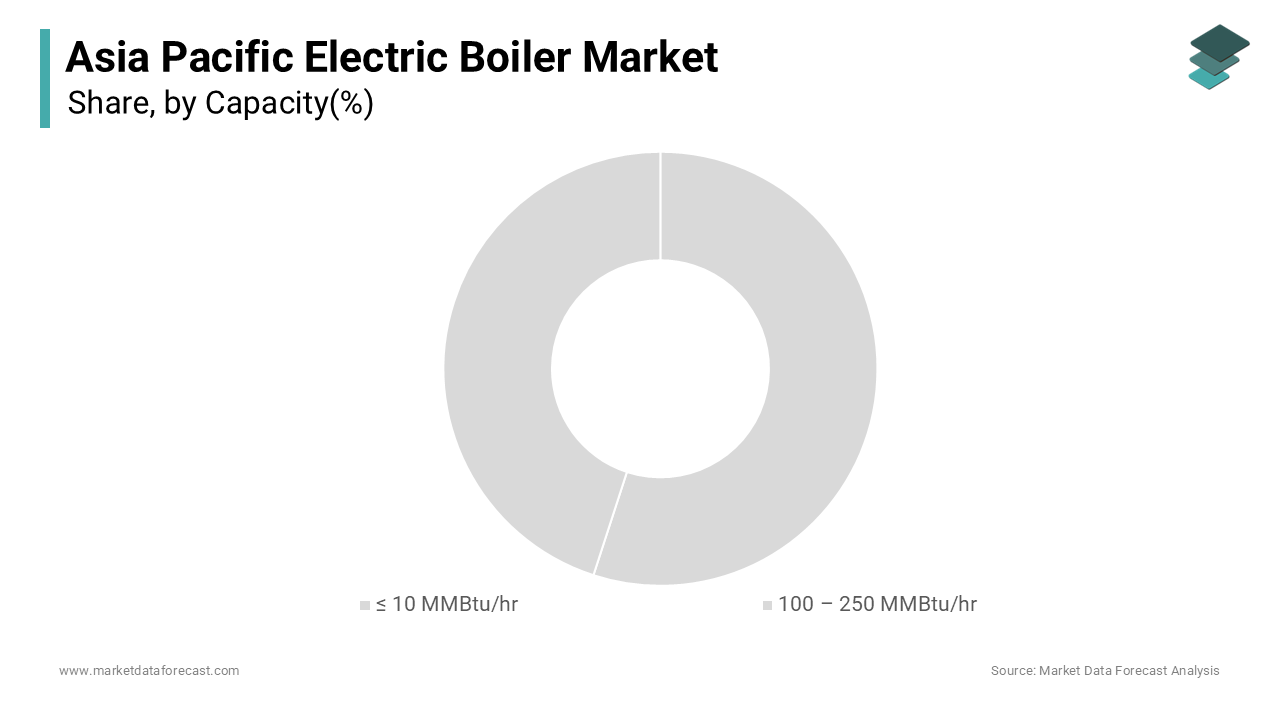
The > 100 – 250 MMBtu/hr capacity segment is projected to grow at the fastest rate in the Asia Pacific electric boiler market, with a CAGR of 9.6% from 2026 to 2034. The rapid growth of this segment is driven by the increasing adoption of medium to large electric boilers in industrial and district heating applications, particularly in countries with strong renewable energy policies. As industrial electrification and smart city initiatives gain momentum, the > 100 – 250 MMBtu/hr segment is expected to experience sustained high growth.
By Voltage Rating Insights
The low voltage electric boiler segment led the Asia Pacific electric boiler market by capturing a substantial portion of total revenue in 2025. The dominance of this segment is primarily due to the widespread deployment of low voltage boilers in residential, commercial, and small-scale industrial applications, where standard electrical infrastructure is sufficient to support operations. The widespread availability of standard electrical infrastructure and the growing adoption of electric heating in urban areas ensure the continued dominance of the low voltage segment in the region.
The medium voltage electric boiler segment is projected to grow at the fastest rate in the Asia Pacific market, with a CAGR of 8.9% from 2026 to 2034. The growth of this segment is primarily driven by the increasing adoption of medium voltage boilers in large-scale industrial and utility applications, where high thermal output and grid compatibility are essential. As the demand for grid-integrated thermal solutions grows, the medium voltage segment is expected to expand rapidly across the Asia Pacific region.
By Application Insights
The residential application segment commanded the Asia Pacific electric boiler market by contributing a 45.3% of total revenue in 2025. The dominance of this segment is primarily due to the rising demand for clean and efficient heating solutions in urban and semi-urban residential complexes, particularly in countries with growing middle-class populations. The combination of urbanization, environmental regulations, and increasing disposable incomes ensures the continued dominance of the residential application segment in the Asia Pacific electric boiler market.
The industrial application segment is projected to grow at the fastest rate in the Asia Pacific electric boiler market, with a CAGR of 9.3%. This rapid growth is driven by the increasing adoption of electric boilers in manufacturing, food processing, textile, and pharmaceutical industries, where clean steam and precise temperature control are critical. As industrial electrification gains momentum and governments push for cleaner production methods, the industrial application segment is expected to experience sustained high growth.
REGIONAL ANALYSIS
China Electric Boiler Market Insights
China led the Asia Pacific electric boiler market by accounting for a 30.1% of total revenue in 2024. As the world’s largest electricity consumer and a leader in renewable energy adoption, China has been actively promoting electric boilers as a clean alternative to coal-fired heating systems. With continued investment in clean energy and industrial electrification, China remains the dominant force in the regional electric boiler market.
India Electric Boiler Market Insights
India is also a key player in the Asia Pacific electric boiler market. The country’s rapid urbanization, government incentives, and push for clean energy have driven significant demand for electric boilers in residential and industrial applications. With continued investment in smart infrastructure and renewable energy, India is expected to maintain strong growth in the electric boiler market.
Japan Electric Boiler Market Insights
Japan holds a significant share of the Asia Pacific electric boiler market, driven by its strong focus on energy efficiency and environmental sustainability. Additionally, METI has supported the integration of electric boilers with renewable energy sources to enhance grid stability and reduce carbon emissions. In industrial applications, the Japan Industrial Federation has promoted the use of electric boilers in food processing and pharmaceutical manufacturing due to their precise temperature control and clean operation. With continued investment in smart building technologies and renewable energy integration, Japan remains a key player in the regional electric boiler market.
South Korea Electric Boiler Market Insights
South Korea accounts for notable portion of the Asia Pacific electric boiler market, supported by its strong industrial base and government-backed green energy initiatives. With continued investment in electrification and sustainable heating solutions, South Korea is expected to maintain steady growth in the electric boiler market.
Australia Electric Boiler Market Insights
Australia holds a significant share of the Asia Pacific electric boiler market, driven by its expanding residential and commercial heating demand and growing emphasis on clean energy solutions. Also,new residential developments in cities like Sydney and Melbourne increasingly incorporate electric boilers for domestic hot water and space heating. Additionally, the Australian government has been promoting the use of electric boilers in district heating networks to enhance energy efficiency and reduce emissions. With continued investment in electrification and renewable energy integration, Australia is expected to maintain a strong presence in the regional electric boiler market.
COMPETITIVE LANDSCAPE
The Asia Pacific electric boiler market is characterized by a mix of global technology leaders and regional manufacturers striving to capture a larger market share. Multinational corporations such as Siemens, ABB, and Mitsubishi dominate due to their advanced product portfolios, strong R&D capabilities, and established partnerships with utilities and industrial clients. However, regional players, particularly from India and China, are gaining momentum by offering cost-effective and application-specific solutions tailored to local market needs. Competition is primarily driven by product innovation, system integration capabilities, and compliance with environmental regulations. Companies are increasingly focusing on smart and energy-efficient boiler technologies that align with regional energy transition goals. Strategic partnerships, localized manufacturing, and participation in government-led decarbonization programs are commonly used to strengthen market presence. Additionally, players are investing in customer education and after-sales support to differentiate themselves in a price-sensitive and rapidly evolving market. As the demand for clean and efficient heating solutions continues to grow, the competitive landscape is expected to evolve further, with innovation and strategic positioning playing a crucial role in long-term success.
KEY MARKET PLAYERS
Some of the key players in the Asia Pacific Electric Boiler Market include
- Cleaver-Brooks
- Thermax Limited
- Fulton Boiler Works, Inc.
- Bosch Industriekessel GmbH
- Acme Engineering Products Ltd.
- Chromalox, Inc.
- Precision Boilers
- Vapor Power International
- Eaton Corporation
- General Electric (GE)
Top Players in the Asia Pacific Electric Boiler Market
Siemens Energy (Germany – Strong APAC Presence)
Siemens Energy is a global leader in energy technology and plays a pivotal role in the electric boiler market through its advanced industrial heating solutions. The company offers high-efficiency electric boilers tailored for industrial and district heating applications, particularly in countries with strong decarbonization policies. Siemens contributes to the global market by integrating electric boilers with digital energy management systems, enhancing performance, and enabling smart grid compatibility. In the Asia Pacific region, Siemens has been actively involved in supporting industrial electrification initiatives, particularly in China, Japan, and South Korea, where it collaborates with utilities and government agencies to promote clean heating technologies.
ABB Ltd. (Switzerland – Expanding in APAC)
ABB is a major player in power and automation technologies and has a growing presence in the electric boiler market across the Asia Pacific region. The company specializes in medium voltage electric boilers integrated with smart control systems, making them ideal for large-scale industrial and utility applications. ABB contributes to the global market by offering energy-efficient and digitally enabled boiler solutions that support renewable energy integration and grid stability. In the Asia Pacific market, ABB has been working closely with governments and energy providers to deploy electric boilers in industrial parks and district heating systems, particularly in China and India, where industrial electrification is gaining momentum.
Thermax Limited (India – Regional Leader)
Thermax is a leading Indian manufacturer of industrial heating and cooling systems and holds a strong position in the Asia Pacific electric boiler market. The company provides a wide range of electric boilers for industrial applications, including process heating, steam generation, and thermal fluid heating. Thermax contributes to the global market by offering cost-effective and environmentally sustainable boiler solutions tailored for emerging economies. In the Asia Pacific region, Thermax has been instrumental in supporting India’s clean energy transition and industrial decarbonization efforts. The company’s deep understanding of regional energy needs and strong distribution network make it a key player in the regional electric boiler landscape.
Top Strategies Used by Key Market Participants
Emphasis on Technological Innovation and Smart Integration
Key players in the Asia Pacific electric boiler market are focusing on technological advancements such as smart controls, IoT-enabled monitoring, and integration with renewable energy systems. Companies are developing electric boilers that can be remotely managed, optimized for energy efficiency, and synchronized with grid demand to enhance performance and reduce operational costs.
Expansion of Local Manufacturing and Distribution Networks
To better serve the diverse and growing Asia Pacific market, leading companies are expanding their regional presence through localized manufacturing, service centers, and partnerships with local distributors. This strategy allows for faster delivery, cost-effective production, and improved after-sales service, which is crucial for maintaining long-term relationships with industrial and commercial clients.
Strategic Collaborations with Government and Utility Providers
Major players are increasingly engaging with government agencies and utility providers to align with regional decarbonization goals and secure large-scale deployment opportunities. These collaborations facilitate policy-driven adoption, funding support, and integration with smart grid and district heating initiatives, ensuring sustained market growth and relevance.
RECENT MARKET DEVELOPMENTS
- In February 2023, Siemens Energy launched a new line of smart electric boilers designed for industrial process heating, targeting the growing demand for clean energy solutions in China and South Korea.
- In September 2023, ABB Ltd. established a regional R&D center in Bangalore, India, to develop electric boiler systems integrated with digital energy management platforms tailored for industrial applications.
- In January 2024, Thermax Limited partnered with a leading Indian state utility to deploy electric boilers in district heating projects, supporting the government’s initiative to reduce coal dependency in urban areas.
- In May 2024, Mitsubishi Heavy Industries expanded its electric boiler production facility in Japan to meet increasing demand from commercial and residential sectors seeking low-emission heating solutions.
- In November 2024, Schneider Electric introduced a new series of compact electric boilers for residential and small commercial applications, targeting the growing smart city and green building markets across Southeast Asia.
MARKET SEGMENTATION
This research report on the Asia Pacific Electric Boiler Market is segmented and sub-segmented into the following categories.
By Capacity
- ≤ 10 MMBtu/hr
- 100 – 250 MMBtu/hr
By Voltage Rating
- Low Voltage Electric Boilers
- Medium Voltage Electric Boilers
By Application
- Residential Application
- Industrial Application
By Country
- India
- China
- Japan
- South Korea
- Australia
- New Zealand
- Thailand
- Malaysia
- Vietnam
- Philippines
- Indonesia
- Singapore
- Rest of APAC