- Product Description Description
- Table of Contents TOC
- List of Table & Figure LOT
- Get Free Sample PDF Sample PDF
Market Size, 2025
$0.35 BnMarket Estimate, 2026
$0.36 BnMarket Forecast, 2034
$0.50 BnCAGR, 2026–2034
4.10%Asia Pacific Electric 3-Wheeler Market Size, Share & Growth Analysis (2026–2034)
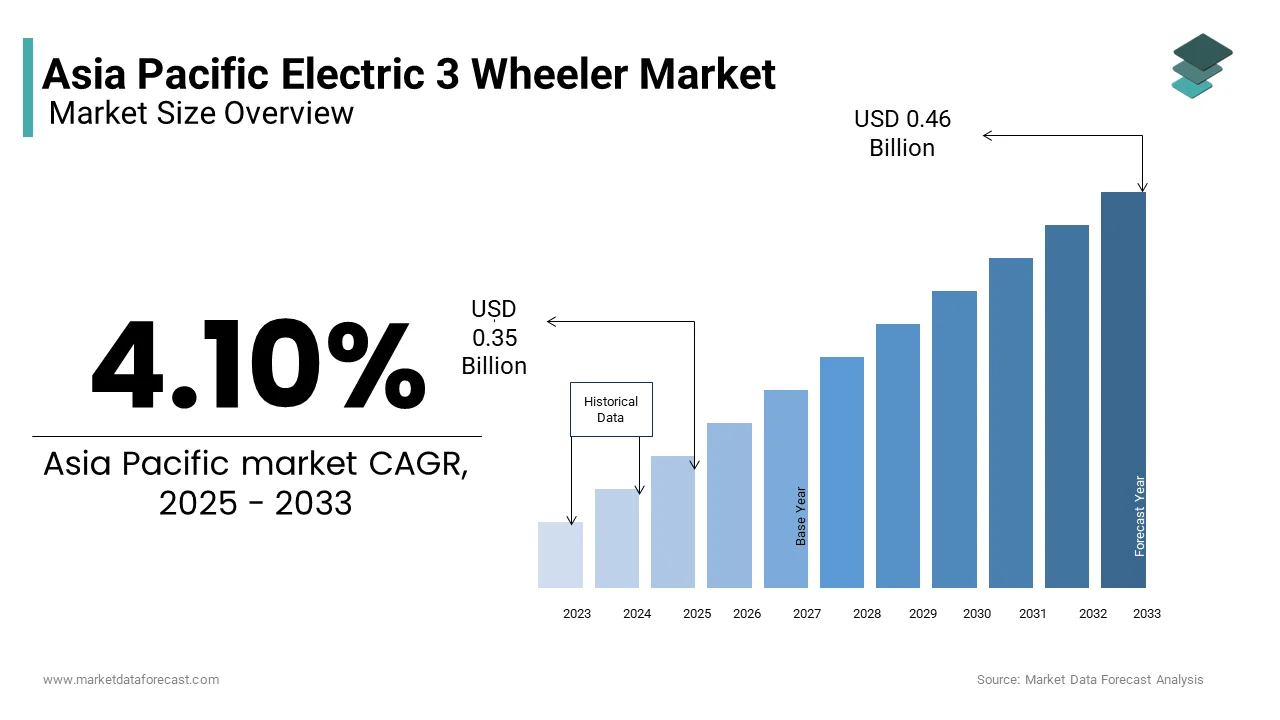
The Asia Pacific electric 3-wheeler market was valued at USD 0.35 billion in 2025, reaching USD 0.36 billion in 2026, and is projected to expand to USD 0.50 billion by 2034, registering a compound annual growth rate (CAGR) of 4.10% during the forecast period from 2026 to 2034.
- Market Scope: Comprehensive regional assessment spanning end-use applications (passenger vs. load carriers), range metrics, battery technologies (lead-acid vs. lithium-ion), and key country markets across India, China, Indonesia, Thailand, Vietnam, and the Rest of APAC.
- Primary Growth Drivers: Rapid urbanization creating heavy demand for last-mile connectivity, favorable government subsidies and regulatory support, and the surge of e-commerce logistics and shared mobility platforms.
Key Market Segment Metrics
| Category | Leading Segment | Fastest-Growing / Promising Segment |
|---|---|---|
| By End-Use & Range | Passenger Carriers (62.6% share in 2025) & Less Than 50 Miles Range (58.6% share in 2024 for urban commutes) | Load Carriers (Projected at an 18.3% CAGR) & Above 50 Miles Range (Expanding at a high 21.6% CAGR for logistics) |
| By Battery Type & Country | Lead-Acid Batteries (65.6% installation share in 2024 due to cost advantages) & India (top regional contributor holding 38% share) | Lithium-Ion Batteries (Expanding at a 24.1% CAGR) & China / Indonesia accelerating commercial and green fleet adoption |
Major Market Players & Industry Landscape
Competitive Structure: A dynamic market featuring established traditional three-wheeler giants transitioning to electrification alongside specialized EV-focused manufacturers leveraging strategic digital financing and local assembly.
Leading Companies: Mahindra & Mahindra Ltd., Bajaj Auto Limited, Zongshen Industry Group, Kinetic Green Energy & Power Solutions Ltd, YC Electric Vehicle, Saera Electric Auto Pvt. Ltd., Piaggio Group, and Citylife Electric Vehicles.
Asia Pacific Electric 3 Wheeler Market Size
The Asia Pacific Electric 3 Wheeler market size was valued at USD 0.35 billion in 2025 and is anticipated to reach USD 0.36 billion in 2026 to reach USD 0.50 billion by 2034, growing at a CAGR of 4.10% during the forecast period from 2026 to 2034.
Electric 3-wheelers are three-wheeled electric vehicles (E-3Ws) designed for both passenger and cargo applications. These vehicles, typically powered by lithium-ion or lead-acid batteries, serve as eco-friendly alternatives to conventional internal combustion engine-based three-wheelers. They are widely used in urban mobility, last-mile delivery, and shared transport systems across the region.
In recent years, the market has gained momentum due to rising environmental concerns, government initiatives promoting clean energy transportation, and growing demand for cost-effective mobility solutions. Countries like India, China, Thailand, and Indonesia have emerged as key markets driven by rapid urbanization and a large informal transport sector. Besides, the increasing integration of advanced battery technologies and supportive regulatory frameworks further reinforces the growth trajectory of the Asia Pacific electric 3-wheeler market.
MARKET DRIVERS
Urbanization and Last-Mile Connectivity Demand
The rapid pace of urbanization and the resulting surge in demand for efficient last-mile connectivity solutions are one of the primary drivers of the Asia Pacific electric 3-wheeler market. This demographic shift has significantly increased pressure on public and private transportation systems, especially in densely populated cities such as Jakarta, Mumbai, and Manila, where traditional transport modes struggle to meet commuter demands.
Electric three-wheelers offer an agile and cost-efficient solution to this challenge. Their compact design allows them to navigate congested city streets more effectively than larger vehicles, while their low operating costs make them attractive to both commercial operators and individual users. Moreover, these vehicles contribute to reducing vehicular emissions in urban centers. With cities like Bangkok and Delhi frequently ranked among the most polluted globally, governments are increasingly incentivizing cleaner transport alternatives. The convergence of urbanization, economic affordability, and environmental consciousness makes electric three-wheelers a compelling choice for addressing last-mile logistics and commuting needs across the Asia Pacific region.
Government Subsidies and Regulatory Support
Robust government support through subsidies, tax incentives, and favorable regulatory policies is a critical factor fueling the expansion of the Asia Pacific electric 3-wheeler market. Several countries in the region have introduced targeted financial assistance programs aimed at accelerating the adoption of electric vehicles (EVs), particularly in the three-wheeler segment.
Also, the policy interventions not only reduce the upfront cost burden on consumers but also encourage manufacturers to scale production and innovate in terms of battery efficiency and vehicle performance. The sustained focus on electrification by regional policymakers underscores the strategic importance of electric three-wheelers in achieving broader climate goals and sustainable urban mobility targets.
MARKET RESTRAINTS
Limited Charging Infrastructure
The inadequate availability of dedicated charging infrastructure is one of the most pressing restraints facing the Asia Pacific electric 3-wheeler market. Despite growing adoption rates, the lack of accessible and standardized charging stations remains a significant barrier to widespread consumer confidence and operational efficiency. This deficiency forces drivers to rely on home-based charging, which is often impractical for commercial fleet operators who require frequent and rapid recharging cycles.
In Southeast Asia, the situation is similarly challenging. This scarcity leads to prolonged downtime for commercial vehicles, reducing earning potential and discouraging new entrants into the market. Moreover, inconsistent charging standards across different models and brands create confusion and inefficiencies in infrastructure planning.
China stands out as a relative exception, having invested heavily in nationwide EV infrastructure. However, even there, rural and semi-urban regions lag behind major cities in terms of accessibility.
High Battery Replacement Costs and Supply Chain Disruptions
The relatively high cost of battery replacement, coupled with supply chain vulnerability, is another significant restraint affecting the Asia Pacific electric 3-wheeler market. While initial purchase incentives and lower operating costs have boosted adoption, the long-term financial burden of battery degradation remains a deterrent for many consumers. Lithium-ion batteries, which power most modern electric three-wheelers, typically have a lifespan of 3 to 5 years, ars depending on usage intensity.
Supply chain disruptions have further exacerbated this issue. The ongoing global semiconductor shortage and logistical bottlenecks have led to delays in battery component imports, particularly affecting nations like India, Thailand, and Malaysia that rely heavily on imported materials.
Apart from these, recycling infrastructure for spent EV batteries remains underdeveloped in much of the region.
MARKET OPPORTUNITY
Expansion of the E-Commerce and Logistics Sector
The rapid expansion of the e-commerce and logistics sector presents a substantial opportunity, driving the Asia Pacific electric 3-wheeler market. As online retail continues to grow exponentially, so does the need for efficient, cost-effective, and environmentally friendly delivery solutions. This surge in digital commerce has intensified demand for last-mile delivery vehicles, particularly in urban areas where traffic congestion and emission regulations limit the use of conventional delivery vans.
Electric three-wheelers offer a compelling alternative for logistics companies seeking to optimize delivery times while minimizing operational costs and carbon footprints. Their compact size allows for easy maneuverability in crowded cityscapes, and their lower maintenance and fueling expenses make them economically viable for high-frequency delivery routes.
Moreover, governments across the region are encouraging green logistics through policy incentives. This regulatory push, combined with growing corporate sustainability goals, positions electric three-wheelers as a strategic asset for the burgeoning logistics ecosystem in the Asia Pacific.
Rise in Shared Mobility Platforms and Ride-Hailing Services
The proliferation of shared mobility platforms and ride-hailing services presents another significant opportunity for the Asia Pacific electric 3-wheeler market. As urban populations seek flexible and affordable transport options, app-based mobility services have witnessed exponential growth. This trend creates a fertile ground for electric three-wheelers, which combine affordability, ease of operation, and environmental benefits.
In India, companies such as Ola Electric and Yulu have deployed thousands of electric three-wheelers across major cities like Bengaluru, Delhi, and Hyderabad. These platforms benefit from reduced operational costs, with per-kilometer running expenses significantly lower than those of petrol or diesel equivalents.
Furthermore, the integration of electric three-wheelers into shared mobility ecosystems aligns with national clean transport goals. For example, the Philippines’ Department of Transportation has encouraged ride-hailing firms to adopt electric vehicles under its Sustainable Urban Mobility Framework. Such initiatives not only expand the user base for electric three-wheelers but also accelerate the transition toward cleaner, smarter urban transport systems across the Asia Pacific.
MARKET CHALLENGES
Consumer Awareness and Perception Barriers
Limited consumer awareness and prevailing misconceptions regarding performance, reliability, and after-sales service are a major challenge confronting the Asia Pacific electric 3-wheeler market. Many potential buyers, particularly in rural and semi-urban areas, remain skeptical about switching from conventional fuel-based vehicles due to concerns over battery life, range limitations, and perceived maintenance complexity.
Misconceptions around slow charging speeds and insufficient repair infrastructure further deter adoption, despite advancements in fast-charging capabilities and expanding service networks.
Addressing this challenge requires targeted education campaigns, test-drive programs, and partnerships between manufacturers, dealers, and local authorities. In Thailand, for instance, the Electric Vehicle Association of Thailand (EVAT) collaborated with provincial governments to conduct roadshows demonstrating electric three-wheeler performance under varied conditions. These efforts helped improve perception and contributed to an increase in trial conversions, highlighting the importance of consumer engagement in overcoming awareness gaps.
Fragmented Manufacturing and Quality Control Standards
The fragmented nature of manufacturing and inconsistent quality control standards across the region a persistent challenges in the Asia Pacific electric 3-wheeler market. Unlike the automobile industry, which follows stringent international certification protocols, the electric three-wheeler segment—especially in emerging markets—is characterized by numerous small-scale producers offering products with varying levels of safety, durability, and performance. Substandard components, including inferior batteries and motor controllers, pose risks not only to riders but also to the broader acceptance of electric mobility.
In addition, inconsistent manufacturing practices hinder economies of scale, making it difficult for smaller players to compete with larger OEMs that invest in research and development. The lack of standardization also complicates after-sales service and spare parts availability, leading to higher maintenance costs and customer dissatisfaction.
Efforts to address this issue are underway, such as the introduction of AIS 097 safety norms in India, which mandate compliance testing for electric vehicles. However, enforcement remains weak, especially in unorganized segments. Strengthening regulatory frameworks and promoting industry consolidation will be crucial in ensuring product reliability and fostering long-term consumer confidence in the Asia Pacific electric 3-wheeler market.
REPORT COVERAGE
| REPORT METRIC | DETAILS |
| Market Size Available | 2025 to 2034 |
| Base Year | 2025 |
| Forecast Period | 2026 to 2034 |
| CAGR | 4.10% |
| Segments Covered | By End-User, Range, Battery, and By Country |
| Various Analyses Covered | Global, Regional & Country Level Analysis, Segment-Level Analysis, DROC, PESTLE Analysis, Porter’s Five Forces Analysis, Competitive Landscape, Analyst Overview on Investment Opportunities |
| Regions Covered | India, China, Japan, South Korea, Australia, New Zealand, Thailand, Malaysia, Vietnam, Philippines, Indonesia, Singapore, and the Rest of APAC |
| Market Leaders Profiled | Mahindra&Mahindra Ltd. (India), YC Electric Vehicle (India), Saera Electric Auto Pvt. Ltd. (India), Piaggio Group (Italy), and Citylife Electric Vehicles (India) |
SEGMENTAL ANALYSIS
By End Use Insights
Passenger Carriers
The passenger carriers segment dominated the Asia Pacific electric 3-wheeler market by accounting for 62.6% of total sales in 2025. Widespread use of electric three-wheelers as shared mobility and public transport options across densely populated urban centers is largely propelling the growth of the passenger carriers segment. Urbanization and the need for affordable commuting alternatives are key demand drivers. The segment is further supported by government-backed electrification programs targeting traditional auto-rickshaw fleets, reinforcing its leading position in the regional market.
Load Carriers
The load carriers segment is emerging as the fastest-growing category in the Asia Pacific electric 3-wheeler market and is projected to grow at a CAGR of 18.3% between 2025 and 2033. The burgeoning logistics and e-commerce sectors, which require cost-effective, zero-emission delivery solutions for last-mile transportation, are fuelling the surge of the load carriers segment. China leads this shift, with cities like Shenzhen and Shanghai integrating thousands of electric cargo trikes into urban delivery networks. Government incentives targeting green logistics, coupled with rising environmental awareness among businesses, are accelerating adoption.
By Range Insights
Less Than 50 Miles
The “less than 50 miles” range segment held the largest share of the Asia Pacific electric 3-wheeler market with 58.6% of total unit sales in 2024. This dominance is attributed to the operational nature of these vehicles, which are predominantly used for short-distance urban travel and intra-city logistics.
In India, where the majority of electric three-wheelers serve as auto-rickshaws, daily average trip distances rarely exceed 40 miles. As per the data from NITI Aayog, over 80% of electric rickshaw operators in Delhi and Mumbai operate within a 3040-mile daily range, making shorter-range models both practical and economically viable. Similarly, in Indonesia, the Ministry of Transportation observed that most electric three-wheeler deployments in Jakarta and Surabaya were confined to routes under 35 miles.
Affordability is another critical factor. Shorter-range models typically feature smaller battery packs, resulting in lower upfront costs.
Above 50 Miles
The above 50-mile range segment is experiencing the highest growth in the Asia Pacific electric 3-wheeler market and is expanding at a CAGR of 21.6% between 2025 and 2033. Increasing demand for intercity transport and long-haul logistics applications, where an extended range is essential for uninterrupted operations, is propelling the accelerated growth of the above 50 miles range segment.
China has been at the forefront of this trend, with provinces such as Zhejiang and Guangdong witnessing a surge in electric cargo trikes capable of traveling over 60 miles on a single charge. In India, the launch of advanced lithium-ion variants with improved battery efficiency has enabled longer operational hours, particularly among fleet operators serving peri-urban corridors.
Further, advancements in fast-charging infrastructure and declining battery costs are making high-range models more viable. These developments are propelling the adoption of higher-range electric three-wheelers, positioning this segment for robust future growth.
By Battery Insights
Lead Acid Batteries
The lead acid batteries segment continued to hold the largest share of the Asia Pacific electric 3-wheeler market by capturing 65.6% of total battery type installations in 2024. Their cost-effectiveness and widespread availability, especially in price-sensitive markets such as India and Southeast Asia, are primarily driving the surge of the lead acid battery segment. Also, their affordability makes them an attractive option for small business owners and individual drivers who prioritize upfront cost savings over long-term performance benefits. Moreover, the existing after-sales service ecosystem for lead-acid technology is well-established, ensuring ease of replacement and repair. However, despite their current dominance, lead-acid batteries face limitations in terms of weight, lifespan, and energy density. Nevertheless, until lithium-ion alternatives become more financially accessible across broader demographic segments, lead-acid batteries will remain the preferred choice for a significant portion of the Asia Pacific electric three-wheeler market.
Lithium-Ion Batteries
The lithium-ion batteries segment is the fastest-growing in the Asia Pacific electric-wheeler market and is projected to expand at a CAGR of 24.1% through 2030. Technological advancements, superior performance characteristics, and increasing government support for cleaner, longer-lasting energy storage solutions are fuelling the growth of the thium-ion batteries segment.
China leads this transition. The country’s extensive domestic production capacity for lithium-ion cells, coupled with aggressive policy incentives, has made it easier for manufacturers to adopt this technology.
In India, the push toward lithium-ion is evident in the rise of premium electric auto-rickshaws offering better range and faster charging. Battery recycling initiatives and falling raw material costs are further supporting adoption.
COUNTRY-LEVEL ANALYSIS
India Electric 3 Wheeler Market Analysis
India stood as the largest contributor to the Asia Pacific electric 3-wheeler market by holding 38% of total regional sales in 2023. The country's dominance stems from a combination of supportive government policies, a vast informal transport sector, and growing urban mobility demands.
The Faster Adoption and Manufacturing of Electric Vehicles (FAME II) scheme, which provided direct subsidies to manufacturers and buyers, played a pivotal role in boosting adoption.
Cities like Delhi, Bengaluru, and Hyderabad have integrated electric auto-rickshaws into public transport ecosystems, reducing reliance on fossil fuels. Further, the rise of shared mobility platforms such as Yulu and Ola Electric has expanded the user base beyond traditional operators.
China Electric 3 Wheeler Market Analysis
China has seen a steady rise in the adoption of electric three-wheelers, particularly in logistics and micro-mobility applications. Cities such as Shenzhen and Hangzhou have actively promoted electric cargo trikes as part of smart city initiatives aimed at reducing congestion and emissions. Local manufacturers like Xinri and Luyuan have capitalized on domestic demand while also exporting to neighboring Southeast Asian countries. Furthermore, China’s extensive lithium-ion battery supply chain enables cost-efficient production, enhancing competitiveness.
Indonesia Electric 3 Wheeler Market Analysis
Indonesia holds a significant position in the Asia Pacific electric 3-wheeler market. The country’s growing urban population and increasing traffic congestion have created a favorable environment for electric three-wheelers, particularly in passenger transport and goods delivery. Jakarta and Surabaya have emerged as early adopters, with pilot programs introducing electric auto-rickshaws and cargo trikes into municipal transport fleets. The government has introduced tax exemptions and import duty reductions under the National Electric Mobility Program to accelerate adoption. Moreover, partnerships between local startups and international EV firms have spurred innovation and investment in the sector.
Thailand Electric 3 Wheeler Market Analysis
Thailand occupies a key position in the Asia Pacific electric 3-wheeler market. The country’s strategic push towards sustainable mobility has led to increased deployment of electric three-wheelers in both urban and tourist-heavy areas. Under the “EV 3.0” strategy, the Thai government offers customs duty exemptions, registration fee waivers, and financial incentives for manufacturers and consumers. Tourism hubs have embraced electric tuk-tuks as a cleaner alternative to conventional models, aligning with national sustainability goals. Moreover, state-owned enterprises are collaborating with private players to establish standardized charging networks, improving operational feasibility.
Vietnam Electric 3 Wheeler Market Analysis
Vietnam is a key player in the Asia Pacific electric 3-wheeler. The country’s evolving transportation ecosystem, combined with proactive climate policies, has positioned electric three-wheelers as a viable solution for urban mobility and logistics. Ho Chi Minh City and Hanoi have initiated pilot projects deploying electric trikes for public transport and parcel delivery. The government has introduced preferential loans and tax breaks for electric vehicle producers under the Green Growth Strategy. Besides, local automakers such as VinFast have begun developing compact electric cargo trikes tailored for dense urban environments.
COMPETITIVE LANDSCAPE
The competition in the Asia Pacific electric 3-wheeler market is intensifying as both established automotive manufacturers and new entrants vie for market share. The landscape is characterized by a mix of traditional three-wheeler producers transitioning to electric platforms and new-age EV-focused firms leveraging technological advancements. Product differentiation, pricing strategies, and brand positioning play a crucial role in determining competitive advantage. Companies are increasingly focusing on innovation in battery technology, vehicle design, and smart mobility integration to stand out in a crowded marketplace. Apart from these, customer-centric approaches such as after-sales service networks and financing schemes are being deployed to strengthen brand loyalty. As governments continue to push for sustainable transport, competition is expected to evolve further, with an emphasis on scalability, localization, and ecosystem development.
KEY MARKET PLAYERS
A few of the market players in the Asia Pacific electric 3-wheeler market are
- Mahindra & Mahindra Ltd. (India)
- Bajaj Auto Limited (India)
- Zongshen Industry Group (China)
- Kinetic Green Energy & Power Solutions Ltd (India)
- YC Electric Vehicle (India)
- Saera Electric Auto Pvt. Ltd. (India)
- Piaggio Group (Italy)
- Citylife Electric Vehicles (India)
Top Players In The Market
- Bajaj Auto is a dominant player in the Asia Pacific electric 3-wheeler market, known for its strong engineering expertise and wide distribution network. The company has been instrumental in transitioning traditional internal combustion engine three-wheelers to electric variants. With a focus on innovation and affordability, Bajaj Auto has played a crucial role in shaping India’s e-mobility ecosystem, influencing similar transitions across Southeast Asia.
- Kinetic Green is one of the pioneers in electric three-wheelers in India. The company offers a diverse range of passenger and cargo models, emphasizing sustainability and performance. Their early adoption of electric mobility solutions has positioned them as a key contributor to the regional market. Kinetic Green continues to influence policy and consumer behavior through consistent product development and advocacy for clean transport.
- Zongshen is a leading Chinese manufacturer with a strong presence in both domestic and international markets. The company leverages advanced manufacturing capabilities and R&D investments to develop efficient and durable electric three-wheelers. Zongshen plays a strategic role in expanding electric mobility beyond China into neighboring Asian countries, contributing significantly to global EV adoption trends.
Top Strategies Used By Key Market Participants
- One major strategy employed by key players is product diversification, where companies are expanding their portfolio to include both passenger and load carrier variants tailored to local needs. This allows manufacturers to cater to multiple user segments and enhances market penetration across different applications.
- Another widely adopted approach is strategic partnerships and collaborations with battery suppliers, charging infrastructure providers, and government bodies. These alliances help streamline operations, reduce costs, and align with regulatory frameworks, ensuring smoother adoption of electric three-wheelers.
- Lastly, localized manufacturing and supply chain optimization have become essential strategies. Companies are setting up regional production units to reduce dependency on imports, improve after-sales service, and respond more effectively to regional demand dynamics and policy incentives.
RECENT MARKET NEWS
- In March 2024, Bajaj Auto launched a new lithium-ion battery-powered three-wheeler designed specifically for urban commuting and last-mile delivery services, enhancing its product portfolio.
- In February 2024, Kinetic Green announced a partnership with a leading Indian state-run bank to offer exclusive financing schemes for electric three-wheeler buyers, improving accessibility for small entrepreneurs.
- In January 2024, Zongshen Industry expanded its manufacturing facility in Vietnam to increase localized production capacity and reduce import dependencies in the Southeast Asian market.
- In December 2023, Mahindra Electric initiated a pilot program in Indonesia to test its electric auto-rickshaw model under varying terrain and climatic conditions ahead of a full-scale launch.
- In November 2023, Hero Electric entered into a joint venture with a South Korean battery manufacturer to secure a stable supply of high-efficiency lithium-ion cells for its upcoming line of electric three-wheelers.
MARKET SEGMENTATION
This research report on the Asia Pacific electric 3-wheeler market is segmented and sub-segmented into the following categories.
By End Use
- Passenger Carriers
- Load Carriers
- Range
- Less Than 50 Miles
- Above 50 Miles
By Battery Type
- Lead Acid
- Lithium-ion
By Battery Capacity
- Motor Type
- Motor Power
- Payload Capacity
By Country
- India
- China
- Japan
- South Korea
- Australia
- New Zealand
- Thailand
- Malaysia
- Vietnam
- Philippines
- Indonesia
- Singapore
- Rest of APAC