Asia Pacific Extruded MS Polymer Market Size, Share, Growth, Trends, and Forecast Report – Segmented By Type (One-part, Two-part, UV-resistant, Fire-retardant, Fast-cure), Application, and Region (India, China, Japan, South Korea, Australia & New Zealand, Thailand) - Industry Analysis from 2025 to 2033
Asia Pacific Extruded MS Polymer Market Size
The Asia Pacific Extruded MS polymer market size was valued at USD 52.76 million in 2024, and the market size is expected to reach USD 93.62 million by 2033 from USD 56.23 million in 2025. The market's promising CAGR for the predicted period is 6.58%.

Extruded MS polymer refers to the moisture-curing silane-terminated polymers processed through extrusion techniques for use in high-performance sealants, adhesives, and construction profiles. Unlike conventional polyurethane or silicone-based systems, extruded MS polymers offer superior adhesion to unprimed substrates, low VOC emissions, and exceptional resistance to weathering and mechanical stress. These attributes make them ideal for structural glazing, façade sealing, and prefabricated building components.
MARKET DRIVERS
Accelerated Urbanization and High-Rise Construction in Megacities
The surge in vertical urban development across the Asia Pacific is significantly increasing demand for advanced sealing and bonding materials capable of withstanding structural movement and environmental exposure. These structures require long-lasting, flexible sealants that maintain integrity under thermal expansion, wind load, and seismic stress—conditions where extruded MS polymers outperform traditional alternatives. Similarly, in Indonesia, the new capital city Nusantara is incorporating sustainable materials.
Regulatory Push for Low-VOC and Sustainable Building Materials
Stringent environmental regulations across the Asia Pacific are accelerating the displacement of solvent-based adhesives and sealants with eco-friendly alternatives such as extruded MS polymers. In South Korea, the Ministry of Environment enforces the Eco-Labeling Program, which restricts VOC content in construction chemicals to below 100 g/L, a standard that MS polymers easily meet due to their solvent-free formulation. This regulatory momentum is institutionalizing extruded MS polymers as a standard in sustainable building practices.
MARKET RESTRAINTS
High Raw Material Costs and Supply Chain Volatility
The production of extruded MS polymers relies on specialized silane-terminated prepolymers and catalysts, many of which are imported from Europe or North America, exposing manufacturers to price fluctuations and logistical delays. Additionally, geopolitical disruptions and shipping bottlenecks have extended lead times for critical inputs.
Limited Local Manufacturing Capacity and Technical Expertise
The Asia Pacific region lacks sufficient localized production infrastructure for MS polymer resin synthesis, resulting in dependency on a few global suppliers such as Sika AG, Momentive, and Kaneka. In Southeast Asia, most extrusion processors rely on imported resin pellets, increasing costs and reducing supply agility. Furthermore, the extrusion process requires precise temperature control and curing protocols, which many regional fabricators lack the technical expertise to manage.
MARKET OPPORTUNITIES
Expansion of Prefabricated and Modular Construction
The growing adoption of off-site construction methods presents a significant opportunity for extruded MS polymers, which are ideal for sealing joints in prefabricated panels, façades, and modular units. In Singapore, over 40% of public housing projects now use prefabricated prefinished volumetric construction (PPVC), where MS polymer sealants ensure watertight, durable connections between modules, as per the Building and Construction Authority. These materials offer superior bond strength to concrete, aluminum, and fiber cement, common substrates in modular units, without requiring primers. According to the McKinsey Global Institute, the Asia Pacific will account for 60% of global modular construction growth by 2030, creating a scalable avenue for MS polymer integration in factory-built environments.
Penetration into Transportation and Automotive Glazing
The automotive and rail sectors in the Asia Pacific are increasingly adopting extruded MS polymers for structural bonding and glazing due to their vibration resistance, adhesion to diverse substrates, and compliance with emission standards. In India, the Ministry of Railways mandated the use of high-performance sealants in Vande Bharat trainsets. Additionally, electric vehicle (EV) manufacturers are utilizing MS polymers for battery housing seals and panoramic roof bonding to enhance safety and durability. As per the China Association of Automobile Manufacturers, over 7.5 million EVs were produced in 2023, creating a high-growth niche for extruded MS polymer applications.
MARKET CHALLENGES
Technical Misalignment Between Resin Suppliers and Extrusion Processors
A critical bottleneck in the Asia Pacific market is the lack of standardized technical collaboration between MS polymer resin producers and downstream extrusion manufacturers, leading to inconsistencies in curing, adhesion, and final product performance. This disconnect arises because resin suppliers often provide generic processing guidelines, while extrusion parameters vary widely across regional machinery and ambient conditions. Without integrated technical support and localized formulation adjustments, even high-quality resins underperform, eroding end-user confidence and limiting market scalability.
Competition from Established Silicone and Polyurethane Alternatives
Despite their superior performance, extruded MS polymers face entrenched competition from silicone and polyurethane-based sealants, which dominate due to lower prices and long-standing industry familiarity. Polyurethanes remain preferred in flooring and industrial joints due to aggressive pricing and widespread distribution networks. While MS polymers offer better long-term durability and lower maintenance, their higher upfront cost and limited brand recognition hinder adoption, particularly in price-driven markets across South and Southeast Asia.
REPORT COVERAGE
| REPORT METRIC | DETAILS |
| Market Size Available | 2024 to 2033 |
| Base Year | 2024 |
| Forecast Period | 2025 to 2033 |
| CAGR | 6.58% |
| Segments Covered | By Type, Application, and Region |
| Various Analyses Covered | Regional & Country Level Analysis, Segment-Level Analysis, DROC, PESTLE Analysis, Porter’s Five Forces Analysis, Competitive Landscape, Analyst Overview on Investment Opportunities |
| Regions Covered | India, China, Japan, South Korea, Australia, New Zealand, Thailand, Malaysia, Vietnam, Philippines, Indonesia, Singapore, and the Rest of Asia-Pacific |
| Market Leaders Profiled | LG Chem, Denka Company Limited, Supreme Petrochem Ltd, INEOS Styrolution Group GmbH, Chi Mei Corporation, and Deltech Polymers Corporation, and others |
SEGMENTAL ANALYSIS
By Type Insights
The one-part extruded MS polymer segment was the dominant type in the Asia Pacific market by accounting for an estimated 55.6% of total consumption in 2024. This dominance is due to its operational simplicity, requiring no mixing and curing upon exposure to atmospheric moisture—ideal for on-site construction and industrial applications. Unlike two-part systems, one-part formulations eliminate the risk of incorrect ratios and pot-life limitations, significantly reducing labor errors. Their shelf stability, often exceeding 12 months under ambient conditions, further enhances logistics efficiency.
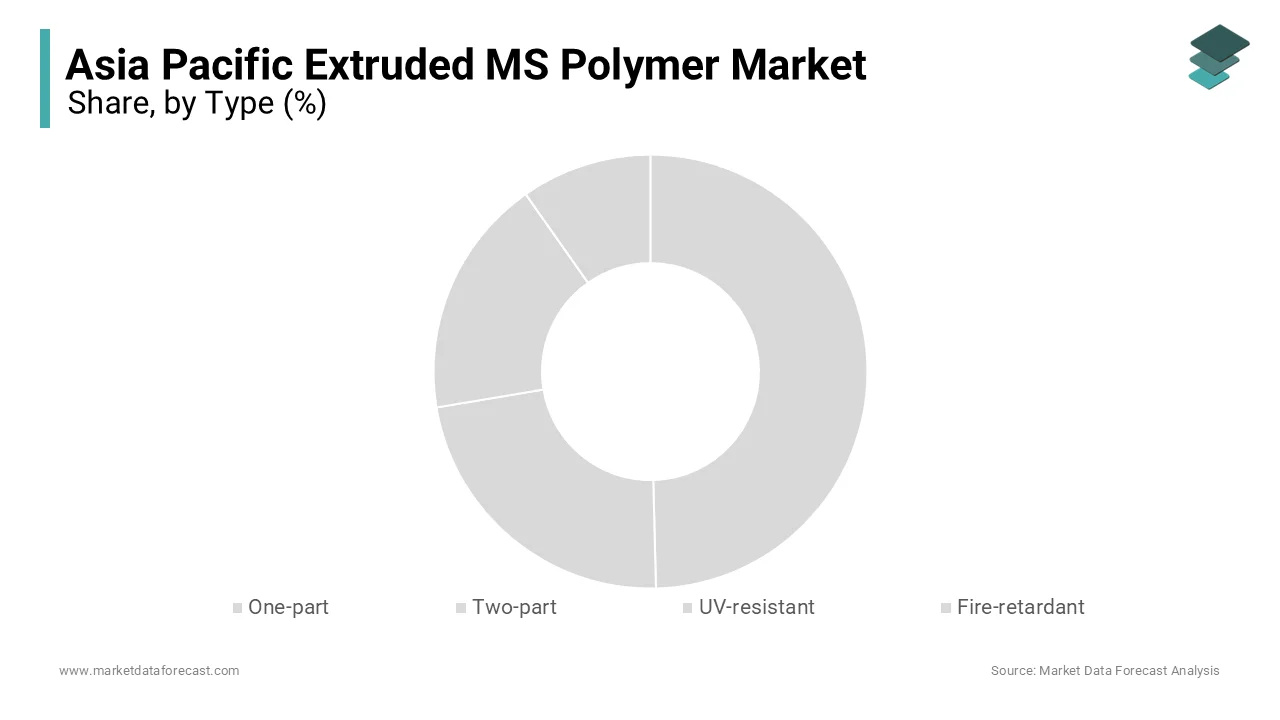
The fast-cure extruded MS polymer variant is the fastest-growing type segment and is registering a CAGR of 12.8% from 2025 to 2033. This growth is driven by the need for accelerated construction timelines and faster production cycles in manufacturing. Fast-cure formulations reduce tack-free time from 30–60 minutes to under 15 minutes, enabling quicker handling and reduced downtime. In Japan, Panasonic Housing and Daiwa House have integrated fast-cure MS polymers into their prefabricated bathroom pod assembly lines, cutting sealing cycle time. The development of advanced tin-free catalysts by Kaneka and Sika has improved cure kinetics without compromising longevity, making these variants increasingly viable for high-speed industrial applications across the region.
By Application Insights
The Façade sealing segment was the prominent application in the Asia Pacific extruded MS polymer market by commanding a 42.5% of total demand in 2024. This dominance is driven by the region’s aggressive high-rise construction boom, particularly in urban centers where architectural envelopes require durable, flexible, and weather-resistant joint solutions. In China, hundreds of new high-rise buildings were completed between 2018 and 2023, according to the Council on Tall Buildings and Urban Habitat, each requiring extensive perimeter sealing to prevent water ingress and structural fatigue. MS polymers are preferred over traditional silicones due to their superior adhesion to aluminum composite panels and glass without primers. Their resistance to UV degradation and thermal cycling ensures performance beyond 20 years, reducing lifecycle costs.
The automotive adhesives segment is emerging as the fastest-growing application and is projected to expand at a CAGR of 13.6% from 2025 to 2033. This surge is fueled by the rapid electrification of transportation and the increasing use of lightweight materials in vehicle design. In Japan, many new passenger vehicles now incorporate aluminum or composite body panels, which require high-strength, flexible bonding agents compatible with dissimilar substrates. MS polymers offer superior vibration damping and thermal stability compared to epoxies or polyurethanes, making them ideal for bonding battery housings, panoramic roofs, and structural glazing.
REGIONAL ANALYSIS
China Extruded MS Polymer Market Insights
China spearheaded the Asia Pacific extruded MS polymer market by capturing 38.3% of regional demand in 2024. The country’s position is anchored in its vast construction and manufacturing sectors, where rapid urbanization and infrastructure modernization drive demand for high-performance sealants. The government’s “dual carbon” policy has further incentivized low-VOC materials, aligning with MS polymer advantages. In the automotive sector, over 25 million vehicles were produced in 2023, including 9.6 million new energy vehicles, each incorporating advanced bonding systems. Domestic producers like Wacker Chemie (via its Nanjing facility) and Jiangsu Jinhong Chemical have scaled production to meet localized demand, supported by policy-driven green building standards and smart city development.
Japan Extruded MS Polymer Market Insights
Japan is another key player in the Asia Pacific extruded MS polymer market. The country’s mature construction industry prioritizes durability, seismic resilience, and sustainability, factors that favor MS polymer adoption. Japan’s leadership in prefabricated housing further amplifies demand for reliable, fast-bonding materials. Additionally, Japanese automakers such as Toyota and Honda have standardized MS polymers in structural glazing and battery sealing for hybrid and electric models.
India Extruded MS Polymer Market Insights
India is positioning it as the major consumer in the market. The market is expanding rapidly due to the proliferation of smart cities, metro rail projects, and industrial corridors under the National Infrastructure Pipeline. The government’s push for sustainable construction through the Energy Conservation Building Code has accelerated the shift from solvent-based sealants. In the automotive sector, MS polymers are increasingly used in premium passenger vehicles and electric rickshaws for window and battery sealing. Domestic players such as Pidilite Industries have launched MS polymer-based product lines, while foreign manufacturers like Sika and Henkel have expanded production in Gujarat and Tamil Nadu to serve the growing industrial base.
South Korea Extruded MS Polymer Market Insights
South Korea holds a significant share of the regional extruded MS polymer market. The country’s advanced construction and electronics manufacturing sectors demand high-precision, environmentally compliant materials. The rise of modular data centers and smart buildings has further increased demand for durable, fire-resistant sealing solutions. In the automotive industry, Hyundai and Kia have adopted MS polymers in their electric vehicle platforms to enhance safety and reduce weight. This cross-sectoral integration underscores South Korea’s role as a high-value adopter of advanced polymer technologies.
Australia Extruded MS Polymer Market Insights
Australia captures notable of the Asia Pacific extruded MS polymer market. The market is characterized by a strong emphasis on sustainable and resilient construction, particularly in coastal and bushfire-prone regions. The country’s National Construction Code mandates improved energy efficiency and weather resistance, driving adoption in high-performance building envelopes. In infrastructure, MS polymers are used in bridge expansion joints and rail track bonding due to their long service life.
COMPETITIVE LANDSCAPE
The competition in the Asia Pacific extruded MS polymer market is evolving into a dual-tier landscape where global specialty chemical leaders coexist with regionally adaptive manufacturers. Multinational firms such as Sika and Kaneka leverage technological superiority and compliance with international standards to dominate high-end construction and automotive applications. At the same time, domestic players like Pidilite and Jiangsu Jinhong are gaining ground by offering cost-optimized, climate-specific formulations for rapidly urbanizing economies. Differentiation is increasingly based on curing performance, substrate compatibility, and environmental compliance rather than price alone. The absence of standardized testing protocols across countries allows multiple players to compete on niche advantages. Continuous R&D, localized support, and alignment with sustainability mandates are becoming decisive factors in market positioning.
KEY MARKET PLAYERS
Some of the key players in the Asia Pacific extruded MS polymer market are
- LG Chem
- Denka Company Limited
- Supreme Petrochem Ltd
- INEOS Styrolution Group GmbH
- Chi Mei Corporation
- Deltech Polymers Corporation
TOP PLAYERS IN THE MARKET
- Sika AG has established a dominant technical and operational footprint across the Asia Pacific extruded MS polymer market through its innovation-driven product portfolio and localized manufacturing network. The company produces high-performance MS polymer sealants and adhesives tailored for façade, transportation, and industrial applications, with production facilities in China, India, and Singapore. It also expanded its technical service teams in Indonesia and Vietnam to support contractors with on-site training and application guidance. Collaborations with major developers like CapitaLand and Hyundai Engineering have integrated Sika’s extruded MS systems into high-rise and smart city projects. By aligning with green building standards and investing in R&D partnerships with institutions like CSIRO, Sika continues to reinforce its reputation for reliability and sustainability.
- Kaneka Corporation plays a pivotal role in the Asia Pacific extruded MS polymer market as both a resin supplier and application developer, leveraging its proprietary silane-terminated polymer technology. Based in Japan, Kaneka supplies MS polymer resins to sealant manufacturers across South Korea, Thailand, and Australia, enabling localized production of high-quality extrusions. It also partnered with Japanese prefabricated housing leaders such as Daiwa House to optimize bonding performance in modular units. Kaneka’s investment in UV-resistant and fire-retardant variants has expanded its use in transportation and high-safety infrastructure. By maintaining tight integration between material science and end-use engineering, Kaneka has positioned itself as a technology enabler across construction and industrial sectors.
- Pidilite Industries has emerged as a key regional player by driving the localization of MS polymer technology for cost-sensitive yet performance-demanding markets in India and Southeast Asia. The company launched its Dr. Fixit Neo range of MS-based sealants in 2022, specifically formulated for tropical humidity and high-temperature exposure common in South Asian climates. It has also collaborated with the Indian Green Building Council to promote low-VOC construction materials in smart city projects. Through extensive distributor networks and contractor training programs, Pidilite has accelerated market adoption in mid-tier commercial and residential developments. Its focus on affordability without compromising durability has made MS polymer technology accessible beyond premium construction, fostering broader industry transformation.
TOP STRATEGIES USED BY KEY MARKET PLAYERS
Key players in the Asia Pacific extruded MS polymer market are focusing on product differentiation through advanced formulations such as fast-cure, fire-retardant, and UV-stable variants. Companies are expanding regional manufacturing and compounding facilities to reduce lead times and import dependency. Strategic collaborations with construction firms, automotive OEMs, and government bodies are enhancing integration into large-scale infrastructure and industrial projects. Investment in technical support teams and application engineering ensures proper field implementation. Additionally, firms are aligning with green building certifications and environmental regulations to strengthen value proposition. Digital engagement and contractor training programs are being deployed to overcome knowledge gaps and accelerate adoption in emerging markets.
RECENT HAPPENINGS IN THE MARKET
- In March 2023, Sika AG launched a fast-cure modified silane polymer formulation at its Shanghai Innovation Center, designed for rapid application in prefabricated construction and high-humidity environments across Southeast Asia.
- In June 2023, Kaneka Corporation introduced a tin-free catalyst system for its MS polymer resins, reducing environmental impact and improving curing efficiency for industrial and transportation applications in Japan and South Korea.
- In September 2023, Pidilite Industries commissioned a dedicated MS polymer compounding facility in Gujarat, enhancing domestic production capacity and reducing reliance on imported raw materials for the Indian construction sector.
- In November 2023, Sika expanded its technical service network into Vietnam and Indonesia, deploying field engineers to support contractors on proper extrusion and curing techniques for façade sealing projects.
- In January 2024, Kaneka partnered with Daiwa House to integrate advanced MS polymer extrusions into Japan’s modular housing units, improving joint durability and seismic resilience in factory-built homes.
MARKET SEGMENTATION
This research report on the Asia Pacific extruded ms polymer market has been segmented and sub-segmented based on the following categories.
By Type
- One-part
- Two-part
- UV-resistant
- Fire-retardant
By Application
- Façade sealing
- Industrial bonding
- Automotive adhesives
- Flooring
- Waterproofing
By Country
- India
- China
- Japan
- South Korea
- Australia
- New Zealand
- Thailand
- Malaysia
- Vietnam
- Philippines
- Indonesia
- Singapore
- Rest of Asia Pacific
Frequently Asked Questions
1. What is driving the growth of the Asia Pacific Extruded MS Polymer Market?
The Asia Pacific Extruded MS Polymer Market is driven by rising demand in construction, automotive, and industrial applications.
2. Which country dominates the Asia Pacific Extruded MS Polymer Market?
China holds the largest share of the Asia Pacific Extruded MS Polymer Market, supported by rapid infrastructure and automotive industry growth.
3. How does the construction sector impact the Asia Pacific Extruded MS Polymer Market?
The construction sector boosts the Asia Pacific Extruded MS Polymer Market as the material is widely used in sealants, adhesives, and waterproofing.
4. What role does the automotive industry play in the Asia Pacific Extruded MS Polymer Market?
The automotive industry fuels the Asia Pacific Extruded MS Polymer Market with applications in bonding, sealing, and vibration resistance.
5. What are the key advantages of extruded MS polymers in the Asia Pacific market?
The Asia Pacific Extruded MS Polymer Market benefits from their flexibility, strong adhesion, weather resistance, and eco-friendly properties.
6. What challenges does the Asia Pacific Extruded MS Polymer Market face?
Challenges include fluctuating raw material costs, competition from alternative adhesives, and regulatory compliance in the Asia Pacific Extruded MS Polymer Market.
7. How do sustainability trends influence the Asia Pacific Extruded MS Polymer Market?
Sustainability trends drive the Asia Pacific Extruded MS Polymer Market toward eco-friendly, solvent-free, and recyclable polymer solutions.
8. Who are the leading players in the Asia Pacific Extruded MS Polymer Market?
Leading companies in the Asia Pacific Extruded MS Polymer Market include Kaneka Corporation, Bostik, Sika AG, and Henkel.
9. How is technology shaping the Asia Pacific Extruded MS Polymer Market?
Technological advancements in formulations and processing methods are expanding applications in the Asia Pacific Extruded MS Polymer Market.
10. What future opportunities exist in the Asia Pacific Extruded MS Polymer Market?
Future opportunities lie in green construction materials, lightweight automotive designs, and advanced industrial adhesives in the Asia Pacific Extruded MS Polymer Market.
Related Reports
Access the study in MULTIPLE FORMATS
Purchase options starting from
$ 2000
Didn’t find what you’re looking for?
TALK TO OUR ANALYST TEAM
Need something within your budget?
NO WORRIES! WE GOT YOU COVERED!
Call us on: +1 888 702 9696 (U.S Toll Free)
Write to us: sales@marketdataforecast.com