- Product Description Description
- Table of Contents TOC
- List of Table & Figure LOT
- Get Free Sample PDF Sample PDF
Market Size, 2025
$1.92 BnMarket Estimate, 2026
$1.97 BnMarket Forecast, 2034
$2.51 BnCAGR, 2026–2034
3.04%Executive Summary: Asia Pacific Fire Truck Market
- Market Scope: Comprehensive Asia Pacific fire truck industry analysis covering vehicle types (pumpers, aerial platforms), application sectors (residential, commercial, enterprise, airports), regional leadership frameworks (China, Japan, India, Australia, South Korea), strategic corporate developments, and competitive landscapes.
- Market Valuation: Valued at USD 1.92 billion (2025), estimated at USD 1.97 billion (2026), and projected to reach USD 2.51 billion by 2034, registering a steady CAGR of 3.04% (2026–2034).
- Primary Growth Drivers: Rapid urbanization, high-rise fire safety regulations, government emergency response investments, electric and hybrid vehicle transitions, and smart firefighting technologies (real-time diagnostics, AI dispatch). Restraints include high procurement costs and inconsistent country certification standards.
Key Market Segment Metrics (2026–2034)
| Category | Leading Segment / Region (Position) | Fastest-Growing Segment |
|---|---|---|
| By Vehicle Type & Application | Pumpers (largest segment capturing 38.3% market share in 2025 via urban operational versatility) & Residential/commercial applications (largest share at approx. 36% in 2025) | Aerial platform segment (highest CAGR of 9.4% via high-rise metropolitan growth) & Enterprise and airports application (highest CAGR of 10.2%) |
| By Technology & Innovation | Smart firefighting tech, real-time diagnostics, AI dispatch systems, and modular maintenance design options | Electric and hybrid fire truck models adapted to tropical climates and green mobility initiatives |
| By Region / Country | China (largest regional share accounting for 28.4% demand in 2025 via government spending and manufacturing policies) | ASEAN and East Asian infrastructure expansion markets boosting industrial park and airport emergency preparedness |
Major Market Players & Market Structure
Market Structure: Highly competitive Asia Pacific emergency vehicle landscape characterized by regional R&D center establishments, cross-border distribution partnerships, green mobility pilot testing, and localized manufacturing plant expansions.
Key Companies: Rosenbauer International AG, Oshkosh Corporation, Magirus GmbH (Iveco Group NV), Weihai Guangtai Airport Equipment Co., Ltd., Danko Emergency Equipment, E-ONE (REV Group, Inc.), The Shyft Group, Inc., Xuzhou Handler Special Vehicle Co Ltd, Morita Holdings Corporation, Zoomlion Heavy Industry Science & Technology Co., Ltd., Pierce Manufacturing Inc., Tata Motors, and Hyundai Rotem.
Asia Pacific Fire Truck Market Size
The Asia Pacific Fire Truck Market is projected to grow from USD 1.92 billion in 2025 to USD 1.97 billion in 2026 and reach USD 2.51 billion by 2034, registering a CAGR of 3.04% from 2026 to 2034.
The Asia Pacific fire truck market encompasses the production, distribution, and deployment of specialized firefighting vehicles designed to combat urban, industrial, and rural fire hazards across the region. These vehicles range from conventional pumper trucks and aerial ladder trucks to advanced foam-based suppression units and rescue vehicles tailored for specific operational environments. The demand for fire trucks in the region is being driven by increasing urbanization, growing industrial activity, and stricter regulatory enforcement concerning fire safety compliance. Like, a significant percentage of the population in the region now resides in urban centers, with this figure expected to rise by 2050. This rapid urban expansion has amplified the need for modernized emergency response infrastructure, including high-performance fire trucks. In addition, countries such as China, India, and Indonesia are witnessing a surge in construction projects and industrial parks, which further necessitates the deployment of upgraded firefighting fleets.
MARKET DRIVERS
Rising Urbanization and Industrial Expansion
One of the primary drivers fueling the Asia Pacific fire truck market is the rapid pace of urbanization coupled with industrial expansion. As per data from the Asian Development Bank (ADB), the region accounts for more than half of the world’s urban population growth, with cities like Jakarta, Mumbai, and Ho Chi Minh City experiencing significant infrastructural development. This urban sprawl has led to higher population density, increased property value concentration, and greater risk exposure to fire-related incidents. Consequently, municipal authorities and private industrial operators are prioritizing enhanced fire protection measures. Each of these facilities requires robust fire safety infrastructure, including on-site fire trucks or access to nearby fire stations equipped with modern firefighting vehicles. Furthermore, the World Bank estimates that by 2030, Asia will be home to 21 of the world's 37 megacities, intensifying the pressure on governments to upgrade emergency services. As a result, public investment in fire safety infrastructure, particularly in fire truck procurement, has surged.
Strengthening Regulatory Frameworks and Fire Safety Norms
Another significant driver shaping the Asia Pacific fire truck market is the strengthening of regulatory frameworks and mandatory fire safety norms across several countries. Governments in the region have increasingly recognized the importance of structured fire prevention protocols, especially following catastrophic incidents in densely populated areas. Notably, Australia updated its National Construction Code in 2022 to include mandatory provisions for fire truck accessibility in high-rise buildings, while Japan’s Fire and Disaster Management Agency mandated all newly constructed commercial complexes to maintain on-site fire suppression equipment, including mini fire trucks. These developments have not only heightened awareness but also created a pressing need for fire departments and private enterprises to invest in compliant firefighting equipment, directly boosting the regional fire truck market.
MARKET RESTRAINTS
High Procurement and Maintenance Costs
A key restraint impeding the growth of the Asia Pacific fire truck market is the substantial cost associated with procuring and maintaining advanced firefighting vehicles. Modern fire trucks, particularly those equipped with aerial ladders, water cannons, and foam suppression systems, require significant capital investment. For developing economies in South and Southeast Asia, where municipal budgets are often constrained, such costs pose a considerable barrier. In India, for example, a government audit conducted by the Comptroller and Auditor General (CAG) in 2023 revealed that nearly 40% of urban local bodies were unable to replace aging fire trucks due to budgetary limitations. Beyond procurement, maintenance expenses further strain financial resources.
Lack of Trained Personnel and Operational Expertise
Another critical restraint affecting the Asia Pacific fire truck market is the shortage of trained personnel capable of operating advanced firefighting equipment efficiently. Despite rising investments in fire safety infrastructure, many countries in the region struggle with inadequate training programs and low firefighter-to-population ratios. According to the International Association of Fire Fighters (IAFF), the average firefighter-to-population ratio in developed nations like Australia and New Zealand is around 1:1,000. The situation is even more acute in rural areas, where volunteer firefighters often lack formal education in vehicle operation and fire suppression techniques. This skills gap discourages procurement agencies from investing in sophisticated fire trucks, as the absence of qualified operators increases the risk of equipment misuse and operational inefficiencies.
MARKET OPPORTUNITIES
Increasing Adoption of Electric and Hybrid Fire Trucks
A promising opportunity emerging in the Asia Pacific fire truck market is the increasing adoption of electric and hybrid fire trucks, driven by environmental regulations and the global push for sustainable emergency response solutions. Several governments in the region have introduced stringent emissions standards and incentives for green technology adoption in public fleets. Countries like Singapore and South Korea have taken the lead in piloting zero-emission fire trucks. In 2023, the Singapore Civil Defence Force (SCDF) deployed its first electric fire truck at Changi Airport, marking a milestone in clean-energy firefighting. These developments indicate a growing appetite for eco-friendly fire trucks, opening new avenues for manufacturers specializing in electric propulsion systems.
Expansion of Smart City Projects and Intelligent Firefighting Systems
The proliferation of smart city initiatives across the Asia Pacific region presents a significant opportunity for the fire truck market, particularly through the integration of intelligent firefighting technologies. As urban centers adopt IoT-enabled infrastructure, there is a parallel demand for connected fire trucks equipped with real-time data analytics, GPS navigation, and remote diagnostics. These projects emphasize integrated command centers and automated emergency response networks, where fire trucks play a crucial role in executing rapid interventions based on sensor-triggered alerts. In Malaysia, the Kuala Lumpur Smart City project includes a digital fire management system that interfaces directly with fire department dispatchers, allowing optimized route mapping and resource allocation during emergencies. Similarly, in China, Shenzhen’s fire service has deployed AI-powered fire trucks that analyze building blueprints and weather conditions to enhance suppression strategies.
MARKET CHALLENGES
Inconsistent Standards and Certification Requirements Across Countries
One of the foremost challenges confronting the Asia Pacific fire truck market is the lack of standardized certification and technical specifications across different countries. Unlike Europe or North America, where harmonized fire truck standards facilitate cross-border procurement, the Asia Pacific region exhibits significant variation in regulatory frameworks. In some cases, countries like Vietnam and the Philippines impose additional local testing procedures beyond international norms, delaying product approvals and increasing compliance costs. Similarly, in Indonesia, the Directorate General of Mechanical Engineering under the Ministry of Industry enforces unique chassis and pump performance criteria that differ from ASEAN-wide benchmarks. This fragmented landscape complicates supply chain logistics and deters foreign manufacturers from entering smaller markets. Without regional standardization efforts, manufacturers face persistent hurdles in scaling operations and achieving cost efficiencies, thereby limiting market expansion potential.
Supply Chain Disruptions and Component Shortages
Another pressing challenge affecting the Asia Pacific fire truck market is the ongoing volatility in global supply chains, particularly concerning critical components such as fire pumps, hydraulic systems, and electronic control units. The automotive and defense sectors, which share many component suppliers with the fire truck industry, have experienced prolonged delays due to semiconductor shortages and geopolitical tensions. Similarly, in Australia, the country’s largest fire truck supplier, Rosenbauer Asia Pacific, faced production halts after disruptions in lithium battery shipments from China. These bottlenecks have forced buyers to delay procurement schedules and reconsider long-term fleet planning. The impact is particularly severe in island nations like the Philippines and Fiji, where logistical complexities further exacerbate delivery timelines.
REPORT COVERAGE
| REPORT METRIC | DETAILS |
| Market Size Available | 2025 to 2034 |
| Base Year | 2025 |
| Forecast Period | 2026 to 2034 |
| Segments Covered | By Type, Application and Country. |
| Various Analyses Covered | Global, Regional & Country Level Analysis, Segment-Level Analysis; DROC, PESTLE Analysis, Porter's Five Forces Analysis, Competitive Landscape, Analyst Overview of Investment Opportunities |
| Country Covered | China, India, Japan, South Korea, Australia, New Zealand, Thailand, Indonesia, Philippines, Vietnam, Singapore, Rest of APAC. |
| Market Leader Profiled | Rosenbauer International AG, Oshkosh Corporation, Magirus GmbH (Iveco Group NV) |
SEGMENTAL ANALYSIS
By Type Insights
The pumpers accounted for the largest segment, capturing a 38.3% of the total market share in 2025. Pumpers dominate due to their versatility and critical role in urban firefighting operations where water supply infrastructure is well established. These vehicles are equipped with high-capacity water pumps and onboard water tanks, making them ideal for immediate response in densely populated cities. One key driver behind the dominance of pumpers is the expansion of municipal fire departments across emerging economies. Another significant factor contributing to the popularity of pumpers is the growing number of commercial and residential fire incidents. This rising threat has necessitated rapid deployment capabilities, which pumpers provide effectively.
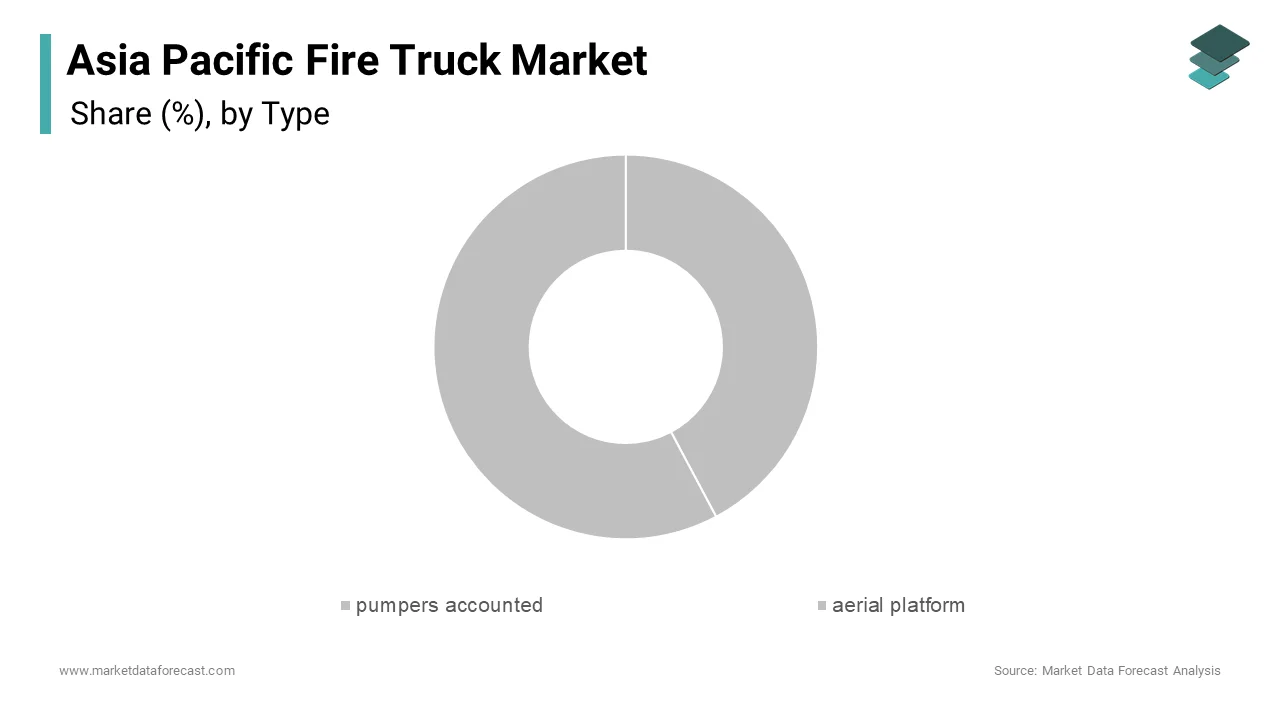
The aerial platform segment is projected to register the highest CAGR of 9.4%. This accelerated growth trajectory stems from increasing demand for elevated firefighting solutions, particularly in rapidly expanding metropolitan areas characterized by high-rise construction and complex urban landscapes. A primary reason for the surge in aerial platform adoption is the escalating development of high-rise buildings, especially in countries like China, South Korea, and Singapore. Additionally, government initiatives aimed at enhancing urban emergency preparedness are fueling the demand for aerial platforms. These policy-driven investments, combined with evolving architectural trends, position the aerial platform segment as the fastest-growing within the Asia Pacific fire truck market.
By Application Insights
The residential & commercial application segment held the largest market share of approximately 36%. This dominance is attributed to the increasing frequency of fire incidents in urban residential complexes and commercial establishments, prompting governments and private entities to invest heavily in localized firefighting infrastructure. A key driver behind the prominence of this segment is the accelerated pace of urban real estate development , particularly in Tier-1 and Tier-2 cities across the region. Moreover, rising awareness regarding fire safety compliance among property developers and tenants is reinforcing demand. With growing regulatory scrutiny and public awareness, the residential & commercial application segment remains central to the expansion of the Asia Pacific fire truck market.
The enterprise & airports application segment is anticipated to grow at the highest CAGR of 10.2% during the forecast period. This rapid rise is primarily driven by the expansion of industrial parks, logistics hubs, and international airports across the Asia Pacific region, all of which require robust on-site firefighting capabilities. One major factor propelling this segment is the surge in airport infrastructure development , particularly in emerging economies. In addition, the expansion of large-scale manufacturing and logistics enterprises is further boosting demand. Many multinational corporations now include fire truck procurement as part of their risk management protocols.
COUNTRY LEVEL ANALYSIS
China held the largest share of the Asia Pacific fire truck market, accounting for a 28.4% of total regional demand in 2025. The country's growth in this sector is underpinned by extensive government spending on urban fire safety and industrial emergency preparedness. Rapid urbanization has been a key catalyst—by 2023, over 65% of China’s population resided in cities , many of which have introduced mandatory fire truck deployment regulations for high-density developments. Furthermore, Beijing’s push for domestic manufacturing through policies like "Made in China 2025" has enabled local companies such as Sinotruk and Weichai Power to scale production and reduce import dependency, thereby strengthening the domestic fire truck ecosystem.
India is an emerging growth hub with strong policy support. The country’s fire truck demand is being driven by aggressive urbanization, coupled with a series of national fire safety reforms. The introduction of stricter fire safety norms by state governments—such as Maharashtra’s mandate for high-rise buildings to maintain on-site fire suppression units—has further stimulated procurement activity. As urban fire incidents continue to rise, India’s fire truck market is poised for sustained growth.
Japan is mature market with high standards and technological integration and is distinguished by its focus on advanced technology and regulatory excellence. Despite a relatively stable urban landscape, Japan continues to invest in upgrading its fire services due to its susceptibility to natural disasters such as earthquakes and tsunamis. Moreover, Japan enforces stringent certification standards, ensuring that only high-performance, locally manufactured fire trucks are deployed. Companies like TATRA Trucks and Morita Holdings play a dominant role in supplying technologically superior firefighting equipment.
Australia is robust infrastructure and wildfire preparedness drive demand and is driven by its need for specialized firefighting equipment due to frequent bushfires and extreme weather events. Moreover. With climate change intensifying fire risks, Australia is expected to sustain its strong presence in the Asia Pacific fire truck market.
South Korea is technology-driven procurement and smart city integration and distinguished by its emphasis on smart firefighting technologies and digital integration. The country’s fire service agencies have increasingly adopted IoT-enabled fire trucks equipped with real-time monitoring systems and remote diagnostics. Additionally, South Korea’s commitment to green mobility has spurred interest in electric fire trucks. Supported by government incentives and smart city initiatives, South Korea continues to be a progressive market for advanced fire truck solutions.
KEY MARKET PLAYERS AND COMPETITIVE LANDSCAPE
Companies playing a prominent role in the Asia Pacific Fire Truck Market are Rosenbauer International AG, Oshkosh Corporation, Magirus GmbH (Iveco Group NV), Weihai Guangtai Airport Equipment Co., Ltd., Danko Emergency Equipment, E-ONE (REV Group, Inc.), The Shyft Group, Inc., Xuzhou Handler Special Vehicle Co Ltd, Morita Holdings Corporation and Zoomlion Heavy Industry Science & Technology Co., Ltd.
The Asia Pacific fire truck market exhibits a competitive landscape characterized by the coexistence of global OEMs and regional manufacturers. While international brands bring advanced engineering and cutting-edge technology, local producers leverage cost advantages and deep-rooted distribution networks. The competition is not only about pricing but also revolves around product performance, after-sales service, and compliance with evolving fire safety regulations. As urbanization accelerates and disaster preparedness becomes a priority, fire departments and industrial operators are increasingly demanding customized, high-performance solutions. This dynamic environment encourages continuous innovation and strategic positioning among manufacturers. Companies are investing in research and development to introduce next-generation fire trucks equipped with intelligent systems and eco-friendly propulsion options. Additionally, collaborations between foreign suppliers and domestic partners are reshaping market access and distribution models, further intensifying the competition. With growing procurement budgets and policy-driven mandates, the market remains highly active, fostering a race for technological leadership and regional dominance.
Top Players in the Market
One of the leading players in the Asia Pacific fire truck market is Rosenbauer Group , an Austrian company with a strong regional presence. Rosenbauer has established itself as a key supplier by offering technologically advanced fire trucks tailored to meet diverse operational needs across urban, industrial, and airport firefighting applications. The company’s focus on innovation, particularly in electric and hybrid fire truck development, has positioned it at the forefront of sustainable emergency response solutions in the region.
Another major contributor is Pierce Manufacturing Inc. , a subsidiary of Oshkosh Corporation based in the United States. Pierce has expanded its footprint in Asia through strategic partnerships and localized manufacturing support, enabling it to deliver high-performance fire trucks suited for the region's varied infrastructure and climatic conditions. The company is known for its aerial platforms and custom-built fire apparatus that cater to both public fire departments and private enterprises.
The third key player is Tata Motors (India) , a dominant force in the domestic fire truck manufacturing segment. Tata provides cost-effective, durable, and locally adaptable fire trucks that align with the budgetary and operational requirements of municipal and industrial clients across South and Southeast Asia. Its ability to customize vehicles to local specifications has made it a preferred choice among government agencies seeking reliable and scalable firefighting fleets.
Top Strategies Used by Key Market Participants
A primary strategy adopted by leading companies in the Asia Pacific fire truck market is product localization and customization . Manufacturers are tailoring their fire truck designs to suit regional infrastructure, climate conditions, and regulatory standards. This approach allows them to better serve diverse customer needs while improving deployment efficiency and serviceability.
Another crucial strategy is technology integration and digital transformation . Companies are incorporating smart features such as real-time diagnostics, GPS tracking, and AI-based dispatch systems into fire trucks. These enhancements improve operational responsiveness and support modern emergency management frameworks being adopted across urban centers in the region.
Lastly, strategic partnerships and joint ventures play a vital role in strengthening market position. International manufacturers are collaborating with local firms to streamline production, reduce costs, and navigate regulatory complexities. These alliances also facilitate after-sales services and long-term maintenance contracts, ensuring sustained customer engagement and brand loyalty.
RECENT HAPPENINGS IN THE MARKET
In February 2025, Rosenbauer Group launched a dedicated regional R&D center in Singapore focused on developing electric and hybrid fire truck models adapted to tropical climates. This initiative was aimed at reinforcing the company’s leadership in sustainable firefighting technologies within the Asia Pacific region.
In July 2023, Pierce Manufacturing signed a strategic partnership agreement with a leading Japanese fire equipment distributor to enhance its supply chain and after-sales service network. This collaboration was intended to improve customer support and expand Pierce’s reach in East Asia.
In May 2025, Tata Motors introduced a new line of modular fire trucks designed specifically for Southeast Asian markets. These vehicles were engineered for ease of maintenance, adaptability to local road conditions, and affordability, making them attractive to municipal fire departments across the region.
In September 2023, Hyundai Rotem announced the initiation of pilot testing for its first domestically developed electric fire truck in Seoul. This move marked a significant step toward green mobility adoption in public safety vehicles and demonstrated the company’s commitment to future-ready emergency response solutions.
In March 2025, Morita Holdings expanded its manufacturing facility in Thailand to increase production capacity for aerial platform fire trucks. The expansion was aimed at catering to rising demand from ASEAN countries and strengthening the company’s foothold in the Southeast Asian market.
MARKET SEGMENTATION
This research report on the asia pacific fire truck market has been segmented and sub-segmented into the following.
By Type
pumpers accounted
aerial platform
By Application
residential & commercial application
enterprise & airports application
By Country
- China
- India
- Japan
- South Korea
- Australia
- New Zealand
- Thailand
- Indonesia
- Philippines
- Vietnam
- Singapore
- Rest of APAC