- Product Description Description
- Table of Contents TOC
- List of Table & Figure LOT
- Get Free Sample PDF Sample PDF
Market Size, 2025
$0.52 BnMarket Estimate, 2026
$0.57 BnMarket Forecast, 2034
$1.16 BnCAGR, 2026–2034
9.24%Asia Pacific FMD Vaccine Market Size
The Asia Pacific FMD Vaccine Market size was valued at USD 0.52 billion in 2025 and is anticipated to reach USD 0.57 billion in 2026 from USD 1.16 billion by 2034, growing at a CAGR of 9.24% during the forecast period from 2026 to 2034.
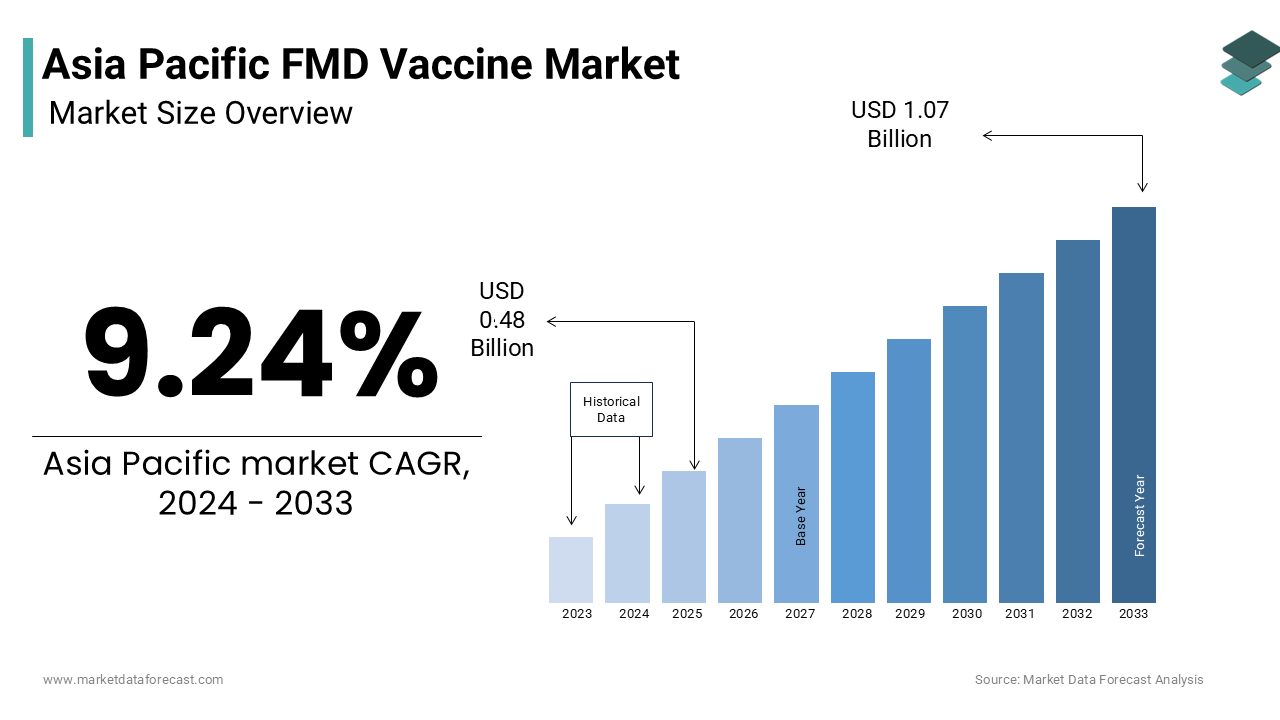
The Asia Pacific FMD vaccine market pertains to the development, distribution, and administration of vaccines targeting Foot-and-Mouth Disease (FMD), a highly contagious viral infection affecting cloven-hoofed livestock such as cattle, buffalo, sheep, and pigs. FMD does not pose a direct threat to human health but inflicts severe economic damage through reduced milk yield, weight loss, and trade restrictions. Countries such as India, Indonesia, and Vietnam conduct mass vaccination campaigns annually, often deploying billions of doses to contain serotype O, A, and Asia-1 strains.
MARKET DRIVERS
Rising Livestock Intensification and Commercial Dairy Expansion
The rapid expansion of commercial livestock farming, particularly in India and Southeast Asia, has intensified the need for preventive veterinary interventions, including FMD vaccination. With dairy output reaching 221 million metric tons in 2023, according to the Indian Ministry of Fisheries, Animal Husbandry and Dairying, the economic stakes of an FMD outbreak are immense. Smallholder farmers are increasingly adopting vaccination due to supply chain pressures from organized dairies.
Government-Led National Vaccination Programs and Disease Eradication Goals
Several Asia Pacific nations have institutionalized FMD vaccination as a core component of national animal health strategy, aligning with WOAH’s Progressive Pathway for FMD Control. These programs are supported by international funding. The political impetus to achieve FMD-free statuscritical for exporting meat and dairy has accelerated vaccine demand.
MARKET RESTRAINTS
Cold Chain Infrastructure Deficiencies in Remote and Rural Areas
A critical barrier to effective FMD vaccination coverage is the lack of reliable cold chain logistics, particularly in geographically dispersed and underdeveloped regions. FMD vaccines are typically temperature-sensitive, requiring storage between 2°C and 8°C. Power outages and poor road networks further compromise vaccine integrity during transit. These logistical gaps result in suboptimal herd immunity and recurrent outbreaks despite high procurement volumes.
Serotype Diversity and Antigenic Drift Requiring Frequent Vaccine Updates
The genetic variability of the FMD virus across the Asia Pacific complicates vaccine efficacy, as immunity is serotype-specific and often short-lived. The region hosts multiple lineages of serotypes O, A, and Asia-1, with new variants emerging regularly. In Vietnam, a 2022 outbreak was caused by a novel sublineage of serotype O (SEA-MYA98), which showed poor cross-protection against existing vaccine strains, as confirmed by the National Veterinary Research Institute. This necessitates continuous surveillance and strain-matching, delaying vaccine deployment.
MARKET OPPORTUNITIES
Adoption of Marker Vaccines and DIVA Strategies for Trade-Ready Herds
The transition from conventional to marker vaccinescompatible with Differentiating Infected from Vaccinated Animals (DIVA) strategies presents a transformative opportunity for FMD control and international market access. Marker vaccines allow countries to maintain vaccination while proving disease-free status, a prerequisite for meat and live animal exports. In South Korea, the use of marker vaccines enabled the country to regain FMD-free status in 2023 after a 2022 outbreak. With global demand for safe livestock products rising, such vaccines offer a pathway to premium markets and long-term economic resilience.
Regional Collaboration and Cross-Border Vaccination Initiatives
Transboundary cooperation is emerging as a pivotal enabler of FMD control, particularly in ecologically interconnected regions like the Mekong Basin and South Asia. In 2023, Cambodia, Laos, and Vietnam conducted a joint vaccination campaign along their shared borders, covering over 12 million livestock. These initiatives reduce duplication, enhance epidemiological intelligence, and build regional credibility for disease-free certification.
MARKET CHALLENGES
Farmer Awareness Gaps and Low Vaccination Compliance in Informal Sector
Despite widespread vaccination programs, a significant portion of smallholder livestock owners in the Asia Pacific remain inconsistent in vaccine uptake due to limited awareness and economic disincentives. In remote areas of the Philippines, cultural beliefs often prioritize traditional remedies over veterinary interventions. Without sustained education and behavioral outreach, mass vaccination campaigns risk achieving only partial coverage, leaving pockets of susceptibility that enable viral persistence and regional spread.
Dependence on Imported Vaccine Antigens and Limited Regional Manufacturing Capacity
The Asia Pacific remains heavily reliant on imported FMD vaccine antigens, creating supply vulnerabilities and cost inefficiencies. Australia’s commitment to maintaining an FMD antigen bank is a rare exception; most nations lack strategic reserves. This dependency hampers rapid response to emerging strains and increases procurement costs, limiting scalability in low-income settings.
REPORT COVERAGE
| REPORT METRIC | DETAILS |
| Market Size Available | 2025 to 2034 |
| Base Year | 2025 |
| Forecast Period | 2026 to 2034 |
| CAGR | 9.24% |
| Segments Covered | By Animal, Vaccine Type and Country |
| Various Analyses Covered | Regional & Country Level Analysis, Segment-Level Analysis, DROC, PESTLE Analysis, Porter’s Five Forces Analysis, Competitive Landscape, Analyst Overview on Investment Opportunities |
| Countries Covered | India, China, Japan, South Korea, Australia, New Zealand, Thailand, Malaysia, Vietnam, the Philippines, Indonesia, Singapore, and the rest of APAC. |
| Market Leaders Profiled | Indian Immunologicals Ltd., Hester Biosciences Ltd., Brilliant Bio Pharma Ltd., Inner Mongolia Biwei Antai Biotechnology Co. Ltd., CAHIC, Jinyu Group, Tecon Group, Shen Lian Biopharmaceutical, Boehringer Ingelheim International GmbH, MSD Animal Health (Merck & Co., Inc.), Zoetis Inc., Biogénesis Bagó, Ceva Santé Animale, Bayer AG, VECOL S.A., and VETAL Animal Health Products. |
SEGMENTAL ANALYSIS
By Animal Insights
The Cattle segment represented the largest animal in the Asia Pacific FMD vaccine market by accounting for a 66.2% of total vaccine volume administered in 2025. This dominance is primarily driven by the region’s vast bovine population and the central role of cattle in dairy and draft-based agricultural economies. India alone maintains a bovine herd exceeding 305 million, the largest in the world, according to its 2023 National Livestock Census, necessitating mass vaccination to protect milk production and farmer livelihoods. FMD infection in cattle can reduce milk yield by up to 50% during acute phases, as per the International Livestock Research Institute, making preventive vaccination economically imperative. Additionally, cattle are frequently traded across districts and borders, increasing transmission risk and reinforcing the need for widespread immunization to maintain regional disease control.
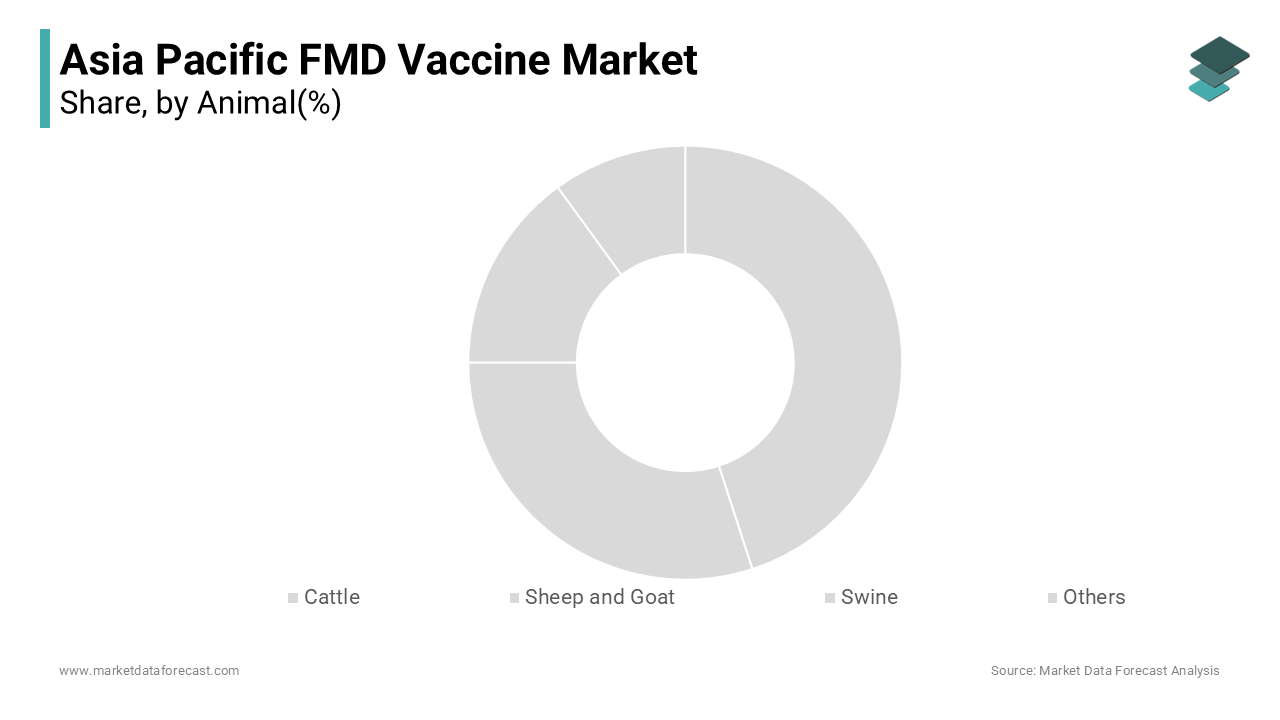
The swine segment is emerging as the fastest-growing animal category in the Asia Pacific FMD vaccine market and is projected to expand at a CAGR of 9.4% from 2026 to 2034. This acceleration is fueled by the rapid industrialization of pig farming in countries like China and the Philippines, where rising protein demand has spurred large-scale commercial operations. China is creating dense animal populations highly susceptible to FMD outbreaks. Enhanced cold chain access in peri-urban pig farms is also improving vaccine delivery efficiency.
By Vaccine Type Insights
The modified or attenuated live vaccines segment constituted the prominent part in the Asia Pacific FMD vaccine market by capturing an estimated 61.3% of total vaccine volume in 2025. This preference is due to their cost-effectiveness and robust immune stimulation, critical for mass vaccination in resource-constrained settings. These vaccines are typically produced at lower costs than inactivated alternatives, enabling large-scale procurement by government programs. They induce both humoral and cell-mediated immunity, offering broader protection in field conditions. However, their use requires careful handling to prevent reversion to virulence. Despite biosafety concerns, their proven field efficacy in reducing clinical outbreaks continues to justify their dominance.
The inactivated (killed) vaccines segment is the fastest-growing within the Asia Pacific FMD vaccine market and is anticipated to grow at a CAGR of 11.2% from 2026 to 2034. This growth is driven by increasing demand for trade-compatible vaccination strategies, particularly in countries seeking FMD-free status with vaccination. Unlike live vaccines, inactivated formulations do not carry the risk of viral shedding or accidental infection, making them suitable for use in high-biosecurity zones and export-oriented farms. Australia, which maintains an FMD-free status and uses inactivated vaccines only in contingency stockpiles, has supported regional adoption through technical partnerships. Additionally, their compatibility with DIVA (Differentiating Infected from Vaccinated Animals) diagnostics enhances surveillance precision, a factor accelerating adoption in Thailand and Malaysia.
REGIONAL ANALYSIS
India led the Asia Pacific FMD vaccine market by accounting for 36.3% of regional demand in 2025. The country’s dominance is anchored in its massive livestock base and institutionalized national vaccination program, which aims to cover all susceptible animals biannually. With over 305 million cattle and buffalo, India faces persistent FMD circulation, particularly in smallholder farming systems where animal movement is frequent and unregulated. Despite challenges in cold chain maintenance, the integration of digital tracking has improved dose accountability and coverage monitoring.
China is also a key player in the Asia Pacific FMD vaccine market. The country’s approach combines centralized vaccine production with provincial-level deployment, focusing on high-density livestock zones and export corridors. The 2022 outbreak in Guangdong and Henan provinces triggered a nationwide review of vaccination protocols, leading to increased use of inactivated and multivalent vaccines. With pork and dairy exports expanding, regulatory pressure to minimize FMD risk has intensified, driving investment in next-generation vaccines and surveillance infrastructure.
Indonesia is positioning it as major consumer. The archipelago’s fragmented geography and high livestock density create persistent transmission risks, particularly in Java and Sumatra, where cattle populations. The government conducts biannual vaccination campaigns. A key driver is the cultural and religious significance of cattle, necessitating preemptive immunization.
Japan holds a significant share of the regional FMD vaccine market. While Japan maintains an FMD-free status, it sustains a strategic reserve of inactivated vaccines for emergency use, primarily targeting cattle and swine. The country’s 2010 FMD outbreak, which affected farms and led to the culling of animals, prompted the establishment of a national contingency stockpile capable of covering millions of doses. Japan also supports regional preparedness through technical assistance and vaccine donations to Southeast Asian nations. This proactive stance, combined with strict import controls and farmer education, underpins Japan’s leadership in disease prevention and vaccine readiness.
Australia accounts for a notable share of the Asia Pacific FMD vaccine market. Despite being FMD-free, Australia maintains a comprehensive preparedness strategy. The country also collaborates with Indonesia and Papua New Guinea on cross-border monitoring and farmer training. While no routine vaccination occurs, the strategic stockpiling of inactivated, DIVA-compatible vaccines ensures rapid containment capacity, reinforcing Australia’s role as a regional leader in veterinary preparedness.
COMPETITIVE LANDSCAPE
The competition in the Asia Pacific FMD vaccine market is shaped by a dichotomy between domestically focused producers and multinational innovators. State-supported manufacturers in India and China dominate volume-based supply, driven by national procurement programs and cost-efficient production. In contrast, global firms like Ceva and MSD Animal Health emphasize technology differentiation, offering DIVA-compatible and cold chain-resilient vaccines for high-readiness markets. Regional governments increasingly prioritize vaccine efficacy over price, fostering competition based on strain relevance and compliance with international standards. Local producers are enhancing biosafety and traceability to compete with imported formulations. The market remains fragmented, with no single entity controlling distribution uniformly across the region, allowing space for both scale-driven and innovation-led players to coexist.
KEY MARKET PLAYERS
Some of the companies that are playing a dominating role in the Asia Pacific FMD Vaccine Market include
- Indian Immunologicals Ltd.
- Hester Biosciences Ltd.
- Brilliant Bio Pharma Ltd.
- Inner Mongolia Biwei Antai Biotechnology Co. Ltd.
- CAHIC
- Jinyu Group
- Tecon Group
- Shen Lian Biopharmaceutical
- Boehringer Ingelheim International GmbH
- MSD Animal Health (Merck & Co., Inc.)
- Zoetis Inc.
- Biogénesis Bagó
- Ceva Santé Animale
- Bayer AG
- VECOL S.A.
- VETAL Animal Health Products
Top Players in the Asia Pacific FMD Vaccine Market
Indian Immunologicals Limited (IIL) is a leading veterinary vaccine manufacturer with deep integration into the Asia Pacific’s FMD control infrastructure, particularly in India and neighboring countries. The company operates one of the largest FMD vaccine production facilities in Hyderabad, producing over 200 million doses annually using indigenous virus strains matched to regional serotypes. IIL supplies vaccines under the National FMD Control Program and has developed thermostable formulations to address cold chain limitations in rural areas. In 2023, the company launched a bivalent live-attenuated vaccine targeting serotypes O and A, validated by the Indian Veterinary Research Institute for efficacy in tropical conditions. IIL also partnered with state governments to deploy mobile vaccination units in Assam and Bihar, improving last-mile delivery. Its collaboration with the FAO on antigen characterization has strengthened regional surveillance, positioning IIL as a key enabler of sustainable FMD control.
Qingdao Yebio Biological Co., Ltd. has emerged as a pivotal player in the Asia Pacific FMD vaccine landscape through its large-scale production capacity and alignment with China’s national animal health strategy. The company produces both inactivated and live vaccines, with an annual output exceeding 300 million doses, supporting government-led immunization campaigns across swine and bovine populations. Yebio’s vaccines are designed to match prevalent field strains in East and Southeast Asia, including the MYA-98 lineage of serotype O. In 2023, the company upgraded its biosafety level-3 facilities to enhance antigen purity and batch consistency, as verified by the China Veterinary Drug Inspection Institute. It also initiated a digital traceability system for vaccine distribution, reducing counterfeiting risks. Yebio’s participation in regional disease monitoring networks and export of vaccines to Mongolia and Cambodia has expanded its influence beyond domestic borders, reinforcing its role in regional FMD mitigation.
Ceva Santé Animale holds a strategic position in the Asia Pacific FMD vaccine market through its focus on innovative, DIVA-compatible inactivated vaccines and technical partnerships with governments and international agencies. While not a volume leader, Ceva contributes advanced vaccine technology, including its FMD Vac portfolio, which supports differentiation between infected and vaccinated animalscritical for trade continuity. The company supplied emergency vaccine doses to Vietnam during a 2022 outbreak and collaborated with Australia’s CSIRO on antigen stabilization research. In 2023, Ceva launched a regional training initiative for veterinarians in Indonesia and the Philippines on cold chain management and outbreak response. Its vaccines are used in high-value livestock operations and contingency stockpiles across Japan, South Korea, and Malaysia. By aligning with WOAH standards and supporting regional eradication roadmaps, Ceva has established itself as a provider of premium, compliance-ready FMD solutions.
Top Strategies Used by Key Market Participants
Key players in the Asia Pacific FMD vaccine market are leveraging strain-specific antigen development, thermostable formulations, and public-private partnerships to enhance reach and efficacy. Companies are investing in regional virus surveillance networks to ensure vaccine-variant alignment and reduce antigenic mismatch. Strategic collaborations with national veterinary authorities enable direct integration into government immunization programs. Firms are also adopting digital tracking systems for dose traceability and cold chain monitoring. Expansion into emergency stockpiling and technical training strengthens engagement with FMD-free nations. Additionally, manufacturers are developing DIVA-compatible and multivalent vaccines to meet evolving regulatory and trade requirements across diverse ecological and economic zones.
RECENT MARKET DEVELOPMENTS
- In January 2023, Indian Immunologicals Limited launched a thermostable bivalent FMD vaccine targeting serotypes O and A, enabling extended cold chain flexibility for rural vaccination campaigns across India and Nepal.
- In May 2023, Qingdao Yebio upgraded its biosafety level-3 manufacturing facility in Qingdao, improving antigen purity and batch consistency for inactivated FMD vaccines used in China and exported to Mongolia.
- In August 2023, Ceva Santé Animale initiated a veterinary training program in Indonesia and the Philippines, enhancing field-level capacity in FMD outbreak response and vaccine handling.
- In October 2023, Indian Immunologicals partnered with the Assam state government to deploy mobile vaccination units, increasing FMD vaccine coverage in flood-prone and remote districts.
- In February 2025, Qingdao Yebio supplied emergency FMD vaccine doses to Cambodia following a cross-border outbreak, reinforcing its role in regional disease containment and technical cooperation
MARKET SEGMENTATION
This Asia Pacific FMD Vaccine Market research report is segmented and sub-segmented into the following categories.
By Animal
- Cattle
- Sheep and Goat
- Swine
- Others
By Vaccine Type
- Modified/ Attenuated Live
- Inactivated (Killed)
- Other Vaccines
By Distribution Channel
- Veterinary Hospitals & Clinics
- Government Institutions
- Others
By Country
- India
- China
- Japan
- South Korea
- Australia
- New Zealand
- Thailand
- Malaysia
- Vietnam
- Philippines
- Indonesia
- Singapore
- Rest of APAC