- Product Description Description
- Table of Contents TOC
- List of Table & Figure LOT
- Get Free Sample PDF Sample PDF
Market Size, 2025
$6.71 BnMarket Estimate, 2026
$7.26 BnMarket Forecast, 2034
$13.78 BnCAGR, 2026–2034
8.33%Asia Pacific Furniture Market Size, Growth, Trends & Forecast (2026–2034)
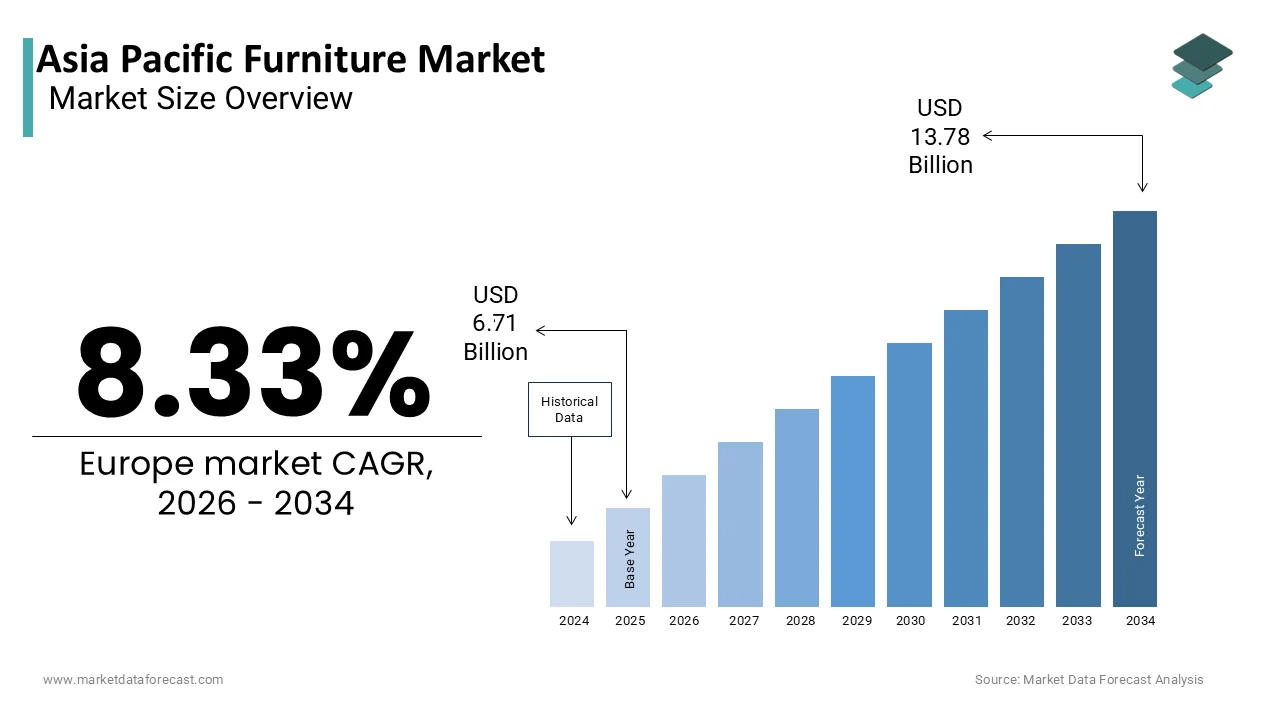
The Asia Pacific furniture market size was valued at USD 6.71 billion in 2025, is estimated to reach USD 7.26 billion in 2026, and is projected to reach USD 13.78 billion by 2034, registering a compound annual growth rate (CAGR) of 8.33% during the forecast period from 2026 to 2034. Driven by rapid urbanization, expanding e-commerce infrastructure, and rising consumer demand for modular and sustainable living solutions, the market continues to expand dynamically across residential and commercial sectors.
Key Executive Metrics (At-a-Glance)
- 2025 Base Valuation: USD 6.71 Billion
- 2026 Current Valuation: USD 7.26 Billion
- 2034 Forecast Valuation: USD 13.78 Billion
- Compound Annual Growth Rate (CAGR): 8.33% (2026–2034)
- Leading Country Market: China (32% regional revenue share in 2025)
- Core Product Offerings: Residential, commercial, and outdoor furniture manufactured from wood, metal, plastic, and composite materials.
Core Market Drivers
- Rapid Urbanization & Housing Demand: Surging urban population and housing construction/renovation activities across emerging economies like India, Indonesia, and the Philippines.
- E-Commerce & Digital Integration: Proliferation of online retail channels, augmented reality (AR) virtual showrooms, and omnichannel shopping experiences driving accessibility.
Primary Market Restraints & Challenges
- Raw Material Volatility: Persistent fluctuations in timber, steel, and polymer prices driven by supply chain bottlenecks, export controls, and stricter environmental logging bans.
- Intense Competitive Pressure: Fierce market rivalry between dominant global multinational brands and localized manufacturers fighting for price-sensitive consumer segments.
Asia Pacific Furniture Market Segmentation Breakdown
| Segment Category | Largest Segment | Fastest-Growing Segment |
|---|---|---|
| By Application | Home Furniture (over 45% share in 2025) | Office Furniture (CAGR 7.8%) |
| By Material | Wood (approx. 58% share in 2025) | Metal Furniture (CAGR 9.2%) |
| By Price Range | Mid-Range (approx. 42% share in 2025) | Premium Furniture (CAGR 8.5%) |
| By Distribution Channel | B2C / Retail (approx. 60% share in 2025) | B2B / Project Sales (CAGR 10.2%) |
| By Region | China (32% share) | India / Vietnam |
Major Industry Players Profiled
Key market participants shaping the Asia Pacific furniture landscape include IKEA (Inter IKEA Systems B.V.), Ashley Furniture Industries, Godrej Interio, Zuari Furniture, Foliage, Hülsta, B&B Italia, DEDON, Daiken Corporation, KOKUYO Co., Ltd., Haworth Inc., Herman Miller Inc., Okamura Corporation, and Steelcase Inc.
Asia Pacific Furniture Market Size
The Asia Pacific furniture market was valued at USD 6.71 billion in 2025, is estimated to reach USD 7.26 billion in 2026, and is projected to reach USD 13.78 billion by 2034, growing at a CAGR of 8.33% from 2026 to 2034
The furniture products includes residential, commercial, and outdoor furniture made from materials such as wood, metal, plastic, and composites. The sustainability has become a core focus area, with consumers in Australia and Japan increasingly preferring eco-friendly and modular furniture solutions. Green building certifications such as LEED and WELL have further reinforced this shift.
MARKET DRIVERS
Rising Urbanization and Housing Demand
One of the most significant drivers of the Asia Pacific furniture market is the rapid pace of urbanization, particularly in emerging economies such as India, Indonesia, and the Philippines. As per the United Nations' World Urbanization Prospects 2022 report, approximately 50% of Asia’s population now resides in urban areas, a figure projected to reach 60% by 2040. This demographic shift has triggered a surge in housing construction and renovation activities, directly stimulating furniture demand. In India, for instance, the Ministry of Housing and Urban Affairs reported that urban housing completions increased by 18% in fiscal year 2025compared to the previous year. Additionally, governments across the region are launching affordable housing schemes to accommodate growing urban populations.
E-commerce Expansion and Digital Transformation
Another pivotal driver shaping the Asia Pacific furniture market is the rapid expansion of e-commerce platforms and digital retail infrastructure. This digital shift has significantly altered consumer purchasing behaviors, making furniture more accessible to a broader demographic. Countries like South Korea and Singapore lead in digital adoption, with online furniture sales contributing over 30% of total retail revenue in 2023, as reported by NielsenIQ. Even in traditionally offline markets such as India and Vietnam, e-commerce is gaining momentum. Moreover, augmented reality (AR) tools and virtual showrooms are enhancing customer experience. IKEA's AR app, for example, saw a 55% increase in user engagement in the Asia Pacific region in 2023, according to internal company reports. These innovations reduce purchase hesitancy and enable consumers to visualize furniture in their living spaces before buying.
MARKET RESTRAINTS
Supply Chain Disruptions and Raw Material Volatility
A major restraint affecting the Asia Pacific furniture market is the persistent volatility in raw material prices and supply chain disruptions. The furniture industry is heavily reliant on commodities such as wood, steel, aluminum, and polymers, all of which have experienced price fluctuations due to geopolitical tensions and environmental regulations. According to the Food and Agriculture Organization (FAO), global timber prices rose by 18% in 2025compared to the previous year, largely due to reduced forest harvesting in China and stricter export controls in Myanmar and Laos. Furthermore, logistics bottlenecks have added pressure on manufacturers. The Drewry World Container Index recorded a 22% increase in freight costs in early 2023, impacting furniture exporters from Vietnam and Indonesia who rely heavily on sea transport. Additionally, environmental policies restricting logging and deforestation have limited the availability of raw materials. In Indonesia, the government imposed a ban on raw timber exports in 2022 to promote domestic processing, which inadvertently increased input costs for local furniture producers.
Regulatory Compliance and Labor Cost Pressures
Regulatory compliance and rising labor costs are increasingly acting as restraints on the growth of the Asia Pacific furniture market. Governments across the region are implementing stringent environmental and labor laws aimed at ensuring sustainable practices and fair wages. In China, for example, the Ministry of Ecology and Environment introduced tighter emissions standards for woodworking industries in 2023, requiring factories to install advanced air filtration systems. Simultaneously, labor costs have been on the rise.
MARKET OPPORTUNITIES
Growth of Smart and Modular Furniture Demand
A significant opportunity emerging in the Asia Pacific furniture market is the rising demand for smart and modular furniture, driven by evolving consumer lifestyles and space constraints in densely populated cities. In Japan, where apartment sizes are among the smallest globally, companies like Sony and MUJI have introduced voice-activated and sensor-based furniture that integrates seamlessly with smart home ecosystems. Similarly, modular furniture is gaining traction in India and Indonesia, where young, tech-savvy consumers prioritize customization and convenience. As per NielsenIQ, modular furniture sales in India grew by 22% in 2025compared to the previous year, reflecting strong market potential.
Expansion of Rural and Tier-II City Markets
An untapped yet promising opportunity within the Asia Pacific furniture market lies in the expanding consumer base in rural and tier-II cities. As economic development spreads beyond major metropolitan centers, disposable incomes in these regions are rising, leading to increased spending on home furnishings. In India, the Rural Development Ministry reported that rural consumer spending on durable goods, including furniture, increased by 14% in 2023. This growth is attributed to improved access to credit, better transportation networks, and enhanced digital connectivity. Companies like Pepperfry and Godrej Interio have expanded their distribution channels into smaller towns and villages, leveraging mobile commerce and last-mile delivery partnerships to capture this growing demand.
MARKET CHALLENGES
Intensifying Competition from Local and Global Players
One of the foremost challenges facing the Asia Pacific furniture market is the intensifying competition between local manufacturers and global players seeking to capitalize on the region’s growth potential. According to Euromonitor International, the top five furniture retailers in China collectively accounted for over 25% of total market revenue in 2025by leaving smaller firms struggling to maintain profitability. Moreover, global brands benefit from economies of scale, superior supply chain efficiencies, and strong brand recognition, enabling them to undercut local competitors on price. Vietnam’s furniture sector, despite being a major exporter, faces similar pressures. The Vietnam Furniture Association reported that domestic companies often lose bids to multinational corporations due to higher production costs and less sophisticated branding. Additionally, e-commerce platforms such as Alibaba and Amazon have further intensified competition by offering third-party sellers direct access to consumers without the need for physical retail infrastructure.
Environmental Regulations and Sustainable Sourcing Constraints
Environmental regulations and the challenge of sourcing sustainable materials present a growing hurdle for furniture manufacturers in the Asia Pacific. Governments in the region are increasingly enforcing stricter environmental norms to curb deforestation, reduce carbon footprints, and promote circular economy principles. For instance, China’s Ministry of Ecology and Environment mandated that all wooden furniture producers must use low-VOC (volatile organic compound) finishes by 2025, as part of its broader air pollution control strategy. Similarly, Indonesia has tightened restrictions on logging and wood exports to combat illegal deforestation. As per the Center for International Forestry Research (CIFOR), the country’s enforcement of the SVLK (Sistem Verifikasi Legalitas Kayu) certification system has reduced the availability of non-certified timber, forcing manufacturers to source more expensive FSC-certified wood.
REPORT COVERAGE
| REPORT METRIC | DETAILS |
| Market Size Available | 2025 to 2034 |
| Base Year | 2025 |
| Forecast Period | 2026 to 2034 |
| Segments Covered | By Application, Material, Price Range, Distribution Channel, And Region |
| Various Analyses Covered | Global, Regional & Country Level Analysis; Segment-Level Analysis; DROC, PESTLE Analysis; Porter’s Five Forces Analysis; Competitive Landscape; Analyst Overview of Investment Opportunities |
| Regions Covered | India, China, Japan, South Korea, Australia, New Zealand, Thailand, Malaysia, Vietnam, Philippines, Indonesia, Singapore, And the Rest Of Asia-Pacific |
| Market Leaders Profiled | IKEA, Ashley Furniture Industries, Godrej Interio, Zuari Furniture, Foliage, Hulsta, B&B Italia, DEDON, Daiken Corporation, KOKUYO Co., Ltd., Haworth Inc., Herman Miller Inc., Okamura Corporation, Steelcase Inc., Inter IKEA Systems B.V. |
SEGMENTAL ANALYSIS
By Application Insights
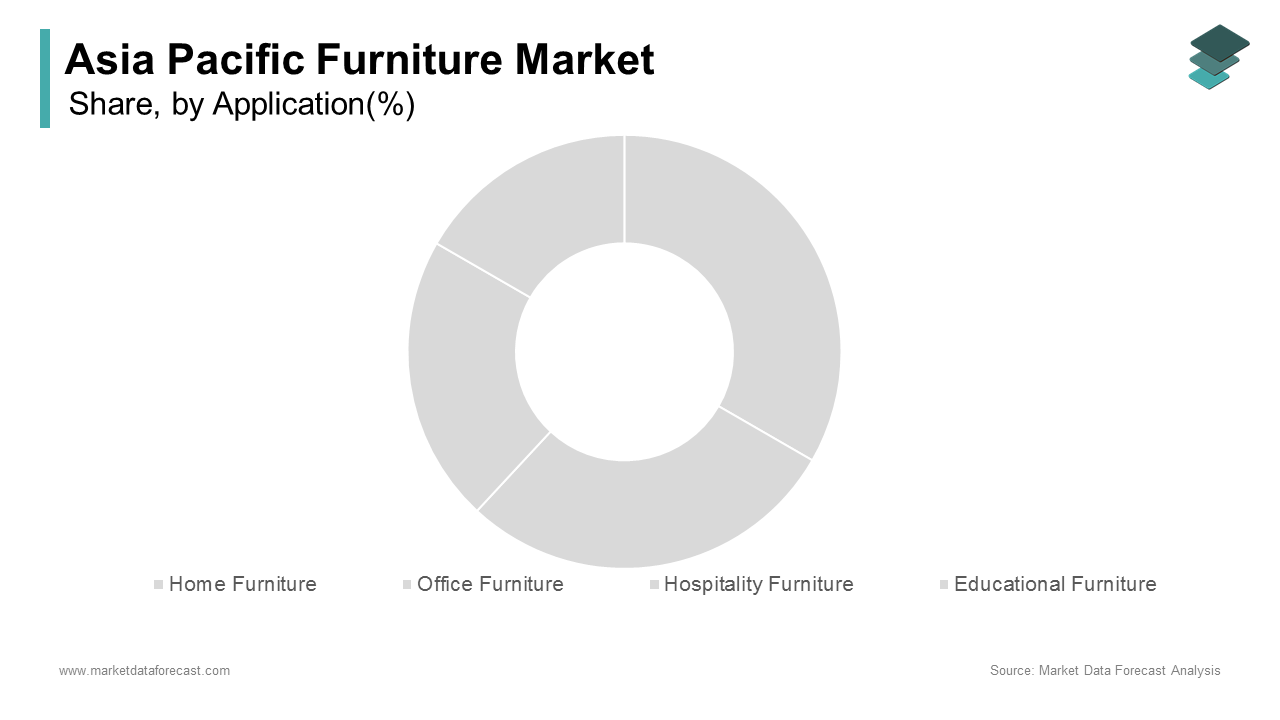
The home furniture segment holds the largest share of the Asia Pacific furniture market, accounting for over 45% of total industry revenue in 2025, as per data from Market Data Forecast. This dominance is primarily driven by rising homeownership rates and a growing middle class across emerging economies such as India, Indonesia, and Vietnam.
According to the Asian Development Bank, urban household formations in Southeast Asia are expected to grow by 3.5% annually through 2030, directly stimulating demand for residential furnishings. In India alone, the Ministry of Housing and Urban Affairs reported that housing completions in urban areas increased by 18% in fiscal year 2025compared to the previous year, reinforcing the need for interior décor and furniture purchases.
Additionally, shifting consumer preferences toward aesthetic and functional home interiors have boosted sales. NielsenIQ noted that online furniture sales in South Korea grew by 25% in 2023, with modular and space-saving designs leading the trend. As more consumers invest in personal living spaces post-pandemic, the home furniture segment continues to maintain its stronghold in the Asia Pacific furniture market.
The office furniture segment is the fastest-growing within the Asia Pacific furniture market, projected to expand at a CAGR of 7.8% between 2025and 2030 , according to Market Data Forecast. This growth is fueled by the rapid expansion of co-working spaces and hybrid work models across major metropolitan cities like Singapore, Tokyo, and Sydney.
As per Colliers International, the number of co-working facilities in Southeast Asia increased by 22% in 2023, driven by startups and multinational corporations seeking flexible leasing options. These spaces require high-quality, ergonomic furniture to attract professionals, boosting demand for office chairs, desks, and modular seating.
Moreover, corporate investments in workplace modernization are accelerating this growth. The Japan Business Federation (Keidanren) reported that Japanese firms allocated an additional JPY 120 billion in 2025for office renovations to support remote and hybrid working setups. Similarly, in Australia, the Property Council of Australia recorded a 16% rise in office fit-out projects during the same period.
With increasing digital transformation and evolving workspace dynamics, the office furniture segment is poised for sustained growth across the Asia Pacific region.
By Material Insights
Wood remains the dominant material in the Asia Pacific furniture market, capturing approximately 58% of the overall market share in 2025, as per reports from Statista. This leadership is largely attributed to the region’s deep-rooted preference for traditional craftsmanship and natural aesthetics, particularly in countries like China, India, and Japan.
China, being the world’s largest producer and exporter of wooden furniture, contributed nearly 30% of global exports in 2023, according to the Food and Agriculture Organization (FAO). Domestic demand has also surged due to government initiatives promoting sustainable forestry practices and eco-friendly wood processing techniques.
In India, the Ministry of Commerce and Industry reported a 14% increase in domestic wood furniture production in 2023, driven by growing consumer inclination towards durable and long-lasting materials. Additionally, the popularity of teak and rosewood indigenous to Southeast Asia continues to bolster regional manufacturing capabilities.
With cultural affinity, availability of raw materials, and strong export potential, wood remains the preferred choice among both manufacturers and consumers across the Asia Pacific furniture landscape.
The metal furniture segment is experiencing the highest growth rate in the Asia Pacific furniture market, expanding at a CAGR of 9.2% from 2025to 2030 , as per data from Market Data Forecast. This surge is primarily driven by increasing demand for industrial-style interiors and commercial applications in sectors such as retail, hospitality, and healthcare.
Urbanization trends in Southeast Asia are significantly contributing to this growth. According to the World Bank, infrastructure investment in Indonesia reached USD 50 billion in 2023, with a focus on commercial building construction, which requires durable and cost-effective furniture solutions. Metal furniture, known for its strength and longevity, is increasingly favored in such settings.
In addition, environmental awareness is pushing manufacturers to adopt recycled metals. The Japan Iron and Steel Federation reported that in 2023, over 70% of steel used in furniture production was sourced from recycled materials, aligning with sustainability goals. This shift not only reduces production costs but also appeals to environmentally conscious consumers and businesses.
With ongoing infrastructural development and design evolution, the metal furniture segment is witnessing robust momentum across the Asia Pacific.
By Price Range Insights
The mid-range furniture segment accounts for the largest portion of the Asia Pacific furniture market, representing approximately 42% of total sales in 2025, according to Euromonitor International. This dominance is attributed to the expanding middle-class population across countries like Thailand, Malaysia, and the Philippines, where consumers seek quality products at affordable prices.
A report from the Asian Development Bank indicates that disposable incomes in Southeast Asia grew by an average of 5.8% in 2023, enabling households to invest in durable goods without compromising on comfort or aesthetics. In Thailand, the National Economic and Social Development Council reported a 12% rise in furniture purchases from mid-income earners during the same period.
Furthermore, brands are increasingly focusing on value-for-money offerings tailored to local tastes. For instance, Pepperfry in India launched a new line of mid-priced modular sofas in early 2023, which saw a 25% spike in sales within six months. Such strategic product positioning reinforces the appeal of mid-range furniture among budget-conscious yet style-aware consumers.
With balanced affordability and quality, the mid-range segment continues to drive mass-market consumption across the Asia Pacific furniture industry.
The premium furniture segment is emerging as the fastest-growing category in the Asia Pacific furniture market, expanding at a CAGR of 8.5% between 2025and 2030 , as per Market Data Forecast. This growth is propelled by rising affluence among urban elites, especially in developed markets such as Australia, Japan, and Singapore, where there is a growing appetite for luxury interiors.
According to Knight Frank's Wealth Report 2023, the number of ultra-high-net-worth individuals (UHNIs) in the Asia Pacific region surpassed 950,000, marking a 6.3% increase from the previous year. These affluent consumers are increasingly investing in bespoke and designer furniture to reflect their lifestyle and status.
Japan’s Ministry of Economy, Trade and Industry reported that imports of high-end European furniture surged by 18% in 2023, indicating strong demand for international luxury brands. Similarly, in Australia, the Housing Industry Association noted a 14% rise in custom-built homes, often accompanied by premium interior fittings.
With rising wealth concentration and a growing culture of personalized living, the premium furniture segment is gaining significant traction across the Asia Pacific.
By Distribution Channel Insights
The B2C/retail channel dominates the Asia Pacific furniture market, accounting for approximately 60% of total sales in 2025, as per NielsenIQ. This dominance is driven by the proliferation of large-format hypermarkets, specialty stores, and departmental chains that offer immersive shopping experiences and after-sales services.
In China, the China Chain Store & Franchise Association reported that physical furniture retail outlets expanded by 7% in 2023, with brands like Red Star Macalline and Moon Lake Furniture enhancing customer engagement through in-store visualization tools and interactive displays.
Similarly, in India, the Retailers Association of India noted that organized retail accounted for 35% of furniture sales in 2023, up from 28% in 2020, reflecting improved consumer trust in branded retail environments. Offline channels remain crucial for high-involvement purchases where tactile experience and immediate delivery play a key role.
Despite e-commerce growth, the B2C/retail segment maintains its stronghold by blending convenience, service, and experiential marketing, making it the most preferred distribution channel in the Asia Pacific furniture market.
The B2B/project sales segment is the fastest-growing distribution channel in the Asia Pacific furniture market, projected to grow at a CAGR of 10.2% between 2025and 2030 , as per Market Data Forecast. This growth is driven by large-scale infrastructure development and the expansion of commercial real estate, particularly in sectors such as hospitality, education, and healthcare.
According to Colliers International, hotel construction projects in Southeast Asia increased by 19% in 2023, with major chains like Marriott and Hilton investing heavily in new properties across Vietnam, Thailand, and Indonesia. These developments necessitate bulk furniture procurement, boosting B2B sales.
In addition, the education sector is witnessing significant investment. UNESCO reported that public spending on school infrastructure in the Asia Pacific grew by 8.4% in 2023, particularly in countries like India and the Philippines, where new institutions require standardized furniture supplies.
With institutional buyers prioritizing efficiency, customization, and volume discounts, the B2B/project channel is rapidly outpacing other distribution modes, offering lucrative opportunities for furniture suppliers across the Asia Pacific.
REGIONAL ANALYSIS
China Furniture Market Insights
China stands at the forefront of the Asia Pacific furniture market, commanding around 32% of total regional revenue in 2025, as per Statista. It is both the largest manufacturer and exporter of furniture globally, leveraging advanced production capabilities and a vast supply chain network.
The country’s domestic market is equally robust, driven by urbanization and rising disposable incomes. According to the National Bureau of Statistics of China, urban household consumption expenditure on furniture rose by 9.5% in 2023. Government-led initiatives such as the "Housing for All" program have further stimulated demand by increasing homeownership rates.
Moreover, Chinese furniture brands like IKEA China and Huari Furniture are expanding into smart and modular furniture segments, capitalizing on tech-savvy consumer preferences. With strong export linkages and a dynamic domestic market, China continues to dominate the Asia Pacific furniture landscape.
India Furniture Market Insights
India ranks second in the Asia Pacific furniture market, holding approximately 14% of regional market share in 2025, as reported by Euromonitor International. The country's furniture industry is experiencing rapid growth due to a burgeoning middle class, increasing urbanization, and government initiatives aimed at boosting infrastructure and housing.
According to the Ministry of Housing and Urban Affairs, India added over 1.2 million new housing units in 2025under the Pradhan Mantri Awas Yojana scheme. This expansion has directly spurred demand for home furnishings, particularly in tier-II and tier-III cities where purchasing power is rising.
E-commerce platforms such as Flipkart and Pepperfry have played a pivotal role in expanding access to furniture, reporting a combined 30% growth in furniture category sales in 2023, as per NielsenIQ. With a young population and increasing disposable income, India is emerging as a key growth engine in the Asia Pacific furniture market.
Japan Furniture Market Insights
Japan occupies the third-largest position in the Asia Pacific furniture market, accounting for around 10% of total market share in 2025, as per Market Data Forecast. The country's furniture sector is distinguished by a strong preference for premium, ergonomic, and sustainable products.
According to the Japan Furniture Confederation, imports of high-end European furniture surged by 18% in 2023, reflecting growing consumer interest in luxury and design-oriented furnishings. Additionally, the adoption of green certifications such as FSC and LEED is influencing purchasing decisions, particularly in the corporate and hospitality sectors.
The Ministry of Economy, Trade and Industry reported that furniture sales in the smart home category grew by 14% in 2023, driven by integration with IoT-enabled devices. With a mature consumer base and high emphasis on quality, Japan remains a critical market for premium furniture players in the Asia Pacific.
Vietnam Furniture Market Insights
Vietnam holds the fourth-largest share of the Asia Pacific furniture market, contributing approximately 7% of regional revenue in 2025, as per data from the Vietnam Furniture Association. The country has emerged as a leading exporter, benefiting from low labor costs, favorable trade agreements, and proximity to raw materials.
According to Vietnam Customs, furniture exports reached USD 14.2 billion in 2023, marking a 6.4% increase from the previous year. The U.S., Japan, and South Korea remain key export destinations, with American buyers alone accounting for nearly 35% of Vietnamese furniture shipments.
Government policies supporting foreign direct investment (FDI) have also played a role in the sector's growth. The Ministry of Planning and Investment reported that over USD 1.2 billion in FDI flowed into Vietnam’s furniture industry in 2023. With continued investment and export diversification, Vietnam is strengthening its position as a key player in the regional furniture market.
Australia Furniture Market Insights
Australia ranks fifth in the Asia Pacific furniture market, capturing around 5% of total market share in 2025, as per Market Data Forecast. The country’s furniture industry is characterized by a growing preference for sustainable and technologically integrated products.
According to the Australian Bureau of Statistics, household expenditure on furniture and household equipment increased by 8.2% in 2023, driven by rising property ownership and renovation activities. Consumers are increasingly opting for energy-efficient and ethically sourced furniture, aligning with national sustainability goals.
The Green Building Council of Australia reported that certified green buildings grew by 15% in 2023, boosting demand for eco-friendly furniture in both residential and commercial settings. Additionally, smart furniture adoption is on the rise, with companies like IKEA Australia launching voice-controlled and sensor-based products.
With a well-established retail ecosystem and evolving consumer preferences, Australia continues to be a key contributor to the Asia Pacific furniture market.
LEADING PLAYERS IN THE ASIA PACIFIC FURNITURE MARKET
IKEA (Inter IKEA Group)
IKEA is a dominant force in the global and Asia Pacific furniture market, known for its ready-to-assemble, functional, and affordable home furnishings. The company has significantly expanded its footprint across the region, particularly in China, India, Japan, and Southeast Asia. Its emphasis on sustainability, modular design, and omnichannel retailing has allowed it to capture a diverse consumer base. In the Asia Pacific, IKEA plays a pivotal role in shaping consumer trends through localized product offerings and digital innovations such as augmented reality-based shopping tools.
Ashley Furniture Industries
Ashley Furniture is one of the world's largest furniture manufacturers and retailers, with a strong presence in the Asia Pacific region. The company leverages its extensive supply chain and manufacturing capabilities to offer a wide range of products at competitive prices. In markets like China and Australia, Ashley has established numerous retail outlets and distribution centers to enhance accessibility. Its focus on blending traditional craftsmanship with modern aesthetics has enabled it to maintain a loyal customer base while expanding its influence across the region.
Godrej Interio (Godrej Group)
Godrej Interio is a leading Indian furniture brand and a key player in the Asia Pacific market. Known for its innovative and sustainable product designs, the company has successfully catered to both residential and commercial segments. With a deep understanding of local consumer behavior, Godrej Interio has expanded beyond India into countries like Sri Lanka, Bangladesh, and parts of Southeast Asia. Its commitment to digital transformation and eco-friendly materials has positioned it as a preferred choice among urban consumers seeking quality and affordability.
TOP STRATEGIES USED BY KEY MARKET PARTICIPANTS
One major strategy employed by key players in the Asia Pacific furniture market is product innovation and customization . Companies are increasingly focusing on developing modular, space-saving, and smart furniture to meet evolving consumer preferences. This includes integrating technology into furniture for added functionality and convenience.
Another critical approach is expanding omnichannel retailing , where brands blend online and offline sales platforms to provide seamless customer experiences. E-commerce integration, virtual showrooms, and augmented reality tools have become essential components of this strategy, allowing consumers to explore and purchase furniture more efficiently.
Lastly, sustainability-driven initiatives are gaining prominence. Leading companies are investing in eco-friendly materials, energy-efficient production methods, and green certifications to align with regulatory standards and consumer demand for responsible sourcing and environmental stewardship.
KEY MARKET PLAYERS AND COMPETITION OVERVIEW
Major Players of the Asia Pacific Furniture Market include
- IKEA
- Ashley Furniture Industries
- Godrej Interio
- Zuari Furniture
- Foliage Outdoors
- Hülsta
- B&B Italia
- DEDON
- Daiken Corporation
- KOKUYO Co., Ltd.
- Haworth Inc.
- Herman Miller, Inc.
- Okamura Corporation
- Steelcase Inc.
- Inter IKEA Systems B.V.
The competition in the Asia Pacific furniture market is highly dynamic and multifaceted, driven by the presence of both global giants and regional manufacturers vying for market share. Domestic players leverage their cost advantages and deep-rooted supply chains, while international brands bring innovation, branding expertise, and premium positioning to the table. The growing influence of e-commerce has further intensified rivalry, enabling new entrants and direct-to-consumer models to disrupt traditional retail structures. Consumer expectations around personalization, sustainability, and digital engagement have forced companies to continuously evolve their offerings and business strategies. Additionally, fluctuating raw material costs, regulatory pressures, and shifting urban lifestyles add layers of complexity to the competitive landscape. As a result, firms must balance between affordability and quality while maintaining agility in response to market changes. This intense environment fosters both collaboration and consolidation, as companies seek partnerships, acquisitions, and strategic expansions to strengthen their foothold and differentiate themselves in an increasingly fragmented yet lucrative regional market.
RECENT HAPPENINGS IN THE MARKET
- In February 2024, IKEA launched a new line of compact, modular furniture tailored specifically for small urban apartments in Tokyo and Singapore , aiming to cater to the rising demand for space-efficient solutions in densely populated cities.
- In May 2024, Godrej Interio partnered with a leading Indian real estate developer to supply customized furniture for upcoming residential projects , enhancing its B2B footprint and strengthening its presence in the organized housing sector.
- In July 2024, Ashley Furniture expanded its manufacturing facility in Vietnam , increasing production capacity to meet growing export demand from North America and Europe while also serving local Asian markets more efficiently.
- In September 2024, Herman Miller entered into a joint venture with a Chinese tech firm to develop smart office chairs equipped with posture-sensing technology , targeting the booming hybrid workspaces in the Asia Pacific region.
- In November 2024, Pepperfry acquired a regional logistics startup specializing in last-mile delivery for bulky goods , improving its fulfillment capabilities and customer experience across tier-II and tier-III cities in India.
MARKET SEGMENTATION
This research report on the Asia Pacific Furniture Market has been segmented and sub-segmented based on composition of application, material, price range, distribution channel, and region.
By Application
- Home Furniture
- Office Furniture
- Hospitality Furniture
- Educational Furniture
By Material
- Wood
- Metal
By Price Range
- Economy
- Mid-Range
- Premium
By Distribution Channel
- B2C/Retail
- B2B/Project
By Region
- India
- China
- Japan
- South Korea
- Australia
- New Zealand
- Thailand
- Malaysia
- Vietnam
- Philippines
- Indonesia
- Singapore
- Rest Of Asia-Pacific