- Product Description Description
- Table of Contents TOC
- List of Table & Figure LOT
- Get Free Sample PDF Sample PDF
Asia Pacific Fusion Splicer Market Size
The Asia Pacific Fusion Splicer Market is anticipated to rise from USD 259.34 million in 2024 to USD 1390.07 million in 2033, growing at a CAGR of 4.64%.
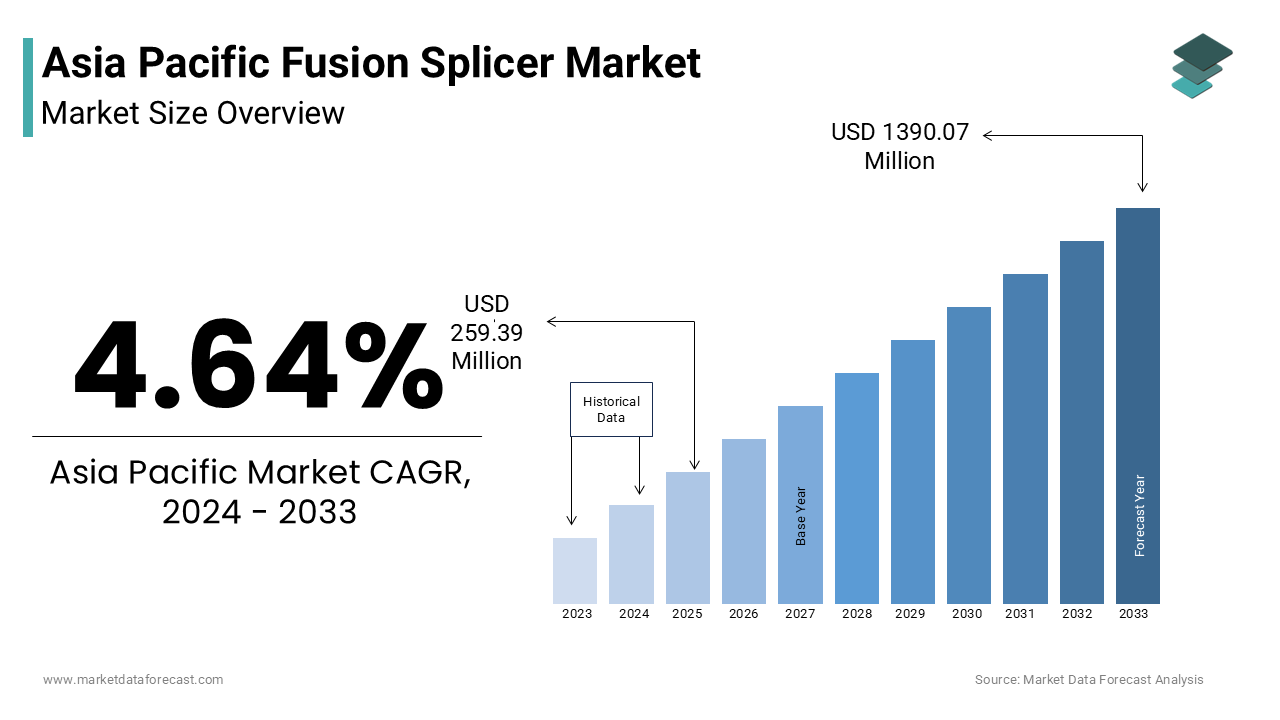
Fusion splicer is a precision equipment used to permanently join optical fibers by melting their ends together using an electric arc. These devices are crucial for deploying and maintaining high-speed fiber optic communication networks, which underpin broadband internet, 5G infrastructure, and data center connectivity across the region. As digital transformation accelerates, the demand for seamless, high-capacity data transmission has led to widespread deployment of fiber optic cables, directly boosting the need for advanced fusion splicing tools.
According to the International Telecommunication Union (ITU), broadband penetration in the Asia Pacific region has surpassed 70%, driven by rapid urbanization and government-led fiber-to-the-home (FTTH) initiatives. Countries like China, Japan, and South Korea have been at the forefront of next-generation network rollouts, necessitating reliable and efficient fiber splicing solutions to ensure minimal signal loss and maximum network performance.
As per the United Nations Economic and Social Commission for Asia and the Pacific (UNESCAP), over 200 smart city projects are currently underway across the region, many of which integrate fiber-based backbone infrastructure for smart utilities, surveillance systems, and real-time data analytics. This expansion reinforces the strategic importance of fusion splicers in enabling robust fiber connectivity.
Besides, with rising investments in submarine cable networks and rural broadband expansion programs, the role of fusion splicers extends beyond urban centers to support national digital inclusion efforts.
MARKET DRIVERS
Expansion of Fiber Optic Infrastructure Across Urban and Rural Areas
The rapid expansion of fiber optic infrastructure across both urban and rural areas is one of the primary drivers of the Asia Pacific fusion splicer market. Governments in countries such as India, Indonesia, and the Philippines have launched extensive fiber deployment initiatives aimed at bridging the digital divide and enhancing broadband access for remote populations. In China, the Ministry of Industry and Information Technology reported that national fiber rollout programs added over 100 million new fixed broadband connections in 2023 alone, reinforcing the need for reliable splicing technology to maintain signal integrity and network efficiency. These large-scale deployments require thousands of splice points, each needing specialized equipment and trained technicians to ensure optimal performance. Moreover, in Australia and New Zealand, the National Broadband Network (NBN) and Ultra-Fast Broadband (UFB) initiatives continue to drive fiber installation, further strengthening the demand for fusion splicers.
Growth of 5G and Data Center Connectivity Requirements
The accelerated rollout of 5G networks and expanding data center infrastructure, which heavily rely on high-capacity fiber backhaul and interconnectivity, is another significant driver of the Asia Pacific fusion splicer market. As mobile operators deploy dense 5G small cells and fronthaul architectures, the demand for fiber optic links—and consequently, fusion splicers—has surged. China has emerged as a global leader in 5G deployment, with the Ministry of Industry and Information Technology (MIIT) reporting that over 2 million 5G base stations were operational nationwide in 2023, each requiring fiber backhaul connectivity. This massive infrastructure build-out has created a strong demand for fusion splicers capable of ensuring seamless fiber connections with minimal insertion loss and maximum durability. Also, in South Korea, where 5G adoption has reached saturation levels in major cities, telecom providers are investing in fiber-dense fronthaul and midhaul architectures to support ultra-reliable low-latency communications (URLLC).
MARKET RESTRAINTS
High Cost and Complexity of Advanced Fusion Splicers
The high cost and technical complexity associated with advanced fusion splicing equipment is a major restraint affecting the Asia Pacific fusion splicer market. High-precision splicers, particularly those equipped with automated alignment, real-time monitoring, and low-loss capabilities, making them inaccessible to smaller telecom contractors and rural service providers. Moreover, in price-sensitive markets such as Bangladesh, Vietnam, and Nepal, this financial burden limits the ability of local operators to invest in modern fiber deployment technologies. Furthermore, the operation of fusion splicers requires specialized skills, adding another layer of complexity. As per the Telecom Regulatory Authority of India (TRAI), a shortage of certified fiber technicians remains a key challenge in rural connectivity projects, delaying network rollouts and limiting the effective use of available equipment.
Limited Availability of Skilled Technicians and Training Facilities
The limited availability of skilled technicians and structured training facilities to operate and maintain advanced fusion splicing equipment is another critical constraint facing the Asia Pacific fusion splicer market. Unlike traditional copper-based networks, fiber optic installations demand precise handling and specialized expertise to ensure minimal signal loss and long-term reliability. In countries like Cambodia and Laos, the scarcity of accredited training centers results in prolonged project timelines and inconsistent splicing quality. Moreover, in Indonesia and the Philippines, where rugged terrain and dispersed island geography complicate fiber installation, the lack of adequately trained personnel exacerbates delays and increases maintenance costs.
MARKET OPPORTUNITIES
Surge in Submarine Cable Deployment Projects
The surge of submarine cable deployment projects connecting the region to global data networks is one of the most promising opportunities for the Asia Pacific fusion splicer market. With the exponential growth of cross-border data traffic, especially in cloud services and international financial transactions, countries are investing heavily in undersea fiber optic cables to enhance connectivity and reduce latency.
Also, Asia accounts for over 40% of all new submarine cable investments globally, with major projects such as the Bifrost Cable System linking Southeast Asia to the U.S. and Europe. These transoceanic cables require thousands of fusion splices during installation and maintenance, significantly boosting demand for high-precision splicing equipment.
In Japan, as per the Ministry of Internal Affairs and Communications, new submarine cable investments exceeded ¥50 billion ($330 million) in 2023, with NEC and Fujitsu leading domestic participation in international consortiums. These projects involve extensive fiber jointing operations, reinforcing the need for durable and accurate fusion splicers capable of withstanding marine conditions.
Also, in Singapore, a major hub for undersea cable landing stations, telecom operators are upgrading existing infrastructure to support higher bandwidth requirements.
Integration with Smart Grid and Industrial Automation Systems
The growing integration of fiber optics into smart grid and industrial automation systems is another emerging opportunity for the Asia Pacific fusion splicer market. As power utilities and manufacturing sectors digitize operations, the demand for secure, high-speed, and interference-free communication networks has surged, driving fiber optic deployment in energy grids, factory automation, and railway signaling systems.
According to the International Energy Agency (IEA), smart grid investments in the Asia Pacific region grew by over 20% in 2023, with countries like China, India, and South Korea prioritizing digital transformation in power distribution. These smart grids rely on fiber-optic networks for real-time data exchange, fault detection, and remote control, all of which depend on reliable fusion splicing for uninterrupted connectivity. In India, the Power Grid Corporation has been rolling out fiber-based communication systems under its Smart Grid Mission, requiring thousands of fusion splices for grid stability and load balancing. As per the Ministry of Power, over 50,000 km of fiber was deployed in utility networks between 2020 and 2023, creating substantial demand for fusion splicers tailored to industrial environments. Apart from these, in South Korea, automotive and semiconductor manufacturers are adopting fiber-based sensor networks for real-time machine diagnostics and process control.
MARKET CHALLENGES
Intense Competition from Pre-Terminated Fiber Solutions
The growing popularity of pre-terminated fiber solutions, which eliminate the need for on-site splicing in certain applications, is a pressing challenge confronting the Asia Pacific fusion splicer market. These plug-and-play fiber assemblies are gaining traction in enterprise networks, commercial buildings, and temporary communication setups due to their ease of deployment and reduced labor dependency. In China, tech firms setting up pop-up server farms and edge computing nodes are increasingly opting for factory-terminated fiber links to accelerate deployment timelines. In Japan, the Ministry of Economy, Trade and Industry (METI) observed that prefabricated fiber solutions are being integrated into smart building infrastructures, reducing the demand for field fusion splicing in metropolitan zones. This trend is also evident in Singapore, where greenfield developments favor pre-engineered fiber systems to streamline construction and commissioning processes.
Supply Chain Disruptions and Component Shortages
The ongoing disruption in global supply chains and shortages of critical components such as precision motors, microscopes, and laser diodes is another significant challenge for the Asia Pacific fusion splicer market. The semiconductor shortage that began in 2021 continues to affect the production of high-end fusion splicers, leading to extended lead times and increased costs.
In South Korea, major telecom equipment suppliers faced delays in delivering splicers to domestic carriers due to unavailability of imported optical sensors and imaging modules.
In addition, geopolitical tensions and trade restrictions have affected the flow of raw materials and precision components from the U.S., Germany, and Taiwan to Chinese and Southeast Asian manufacturers.
Standardization and Interoperability Issues
The lack of standardization and interoperability across different fiber types, splicing technologies, and manufacturer-specific equipment is a major challenge facing the Asia Pacific fusion splicer market. As fiber optic networks become more complex and diverse, ensuring compatibility between splicers, fiber coatings, and connector types has become increasingly difficult.
In countries like Thailand and Malaysia, variations in fiber specifications and vendor-specific software can hinder seamless integration, especially in multi-vendor environments.
Further, in India, the Telecom Engineering Centre (TEC) has called for standardized guidelines to govern fiber splicing procedures in national broadband projects. The absence of uniformity has resulted in varying splice loss rates, complicating network performance assessments and increasing rework costs.
In response, industry associations such as the Optical Internetworking Forum (OIF) and regional telecom regulators are pushing for harmonized standards. However, until comprehensive frameworks are adopted and enforced, interoperability issues will remain a persistent barrier to market expansion in the Asia Pacific.
SEGMENTAL ANALYSIS
By Offering Insights
The hardware segment dominated the Asia Pacific fusion splicer market by capturing 68% of total revenue in 2024. This dominance is primarily driven by The fundamental requirement for physical splicing equipment in fiber optic network deployment and maintenance is driving the dominance of hardware segment. Unlike software or service-based offerings, hardware specifically fusion splicers remains an indispensable component for establishing permanent and low-loss fiber connections. Countries like China, India, and Japan have been expanding their fiber infrastructure at a rapid pace, necessitating large-scale procurement of fusion splicers by telecom operators, utility companies, and government agencies. Moreover, as per the Ministry of Industry and Information Technology (MIIT) in China, more than 2 million kilometers of fiber were deployed nationwide in 2023, requiring thousands of splice points across urban and rural networks. In India, the BharatNet program has mandated the use of certified fusion splicers to ensure minimal signal loss and long-term reliability in national broadband initiatives. In addition, manufacturers are introducing ruggedized and automated splicers tailored for field conditions, further boosting adoption.
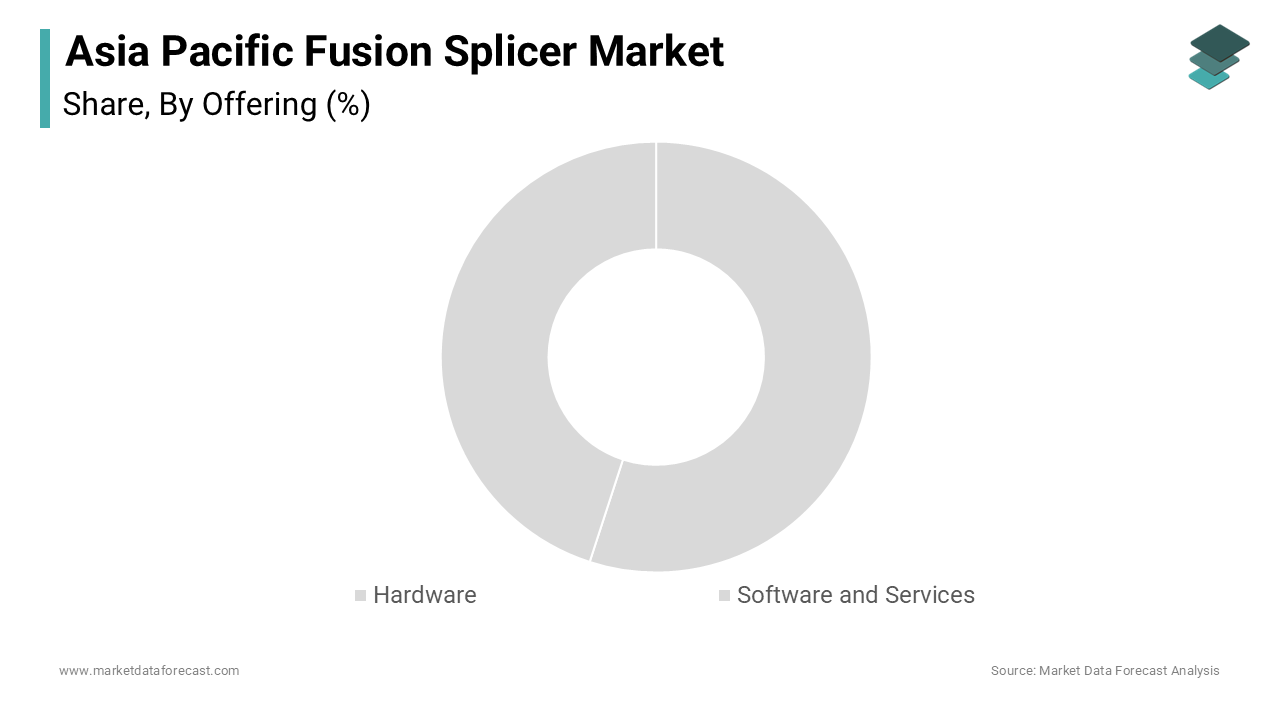
The services segment is growing at the fastest rate in the Asia Pacific fusion splicer market and is projected to expand at a CAGR of 10.4% between 2025 and 2033. This growth is driven by Increasing demand for technical support, training, calibration, and maintenance services that accompany advanced fusion splicing equipment is fuelling the services segment. In countries like South Korea and Singapore, where precision and network uptime are paramount, telecom providers are increasingly opting for managed service contracts to ensure optimal performance of splicing equipment. Furthermore, as governments and private enterprises invest in submarine cable systems and industrial automation, the need for specialized splicing services has surged.
By Product Insights
The single fiber fusion splicer segment led the Asia Pacific fusion splicer market by accounting for 62.6% of total revenue in 2024. This dominance is attributed to Its widespread use in point-to-point fiber connections, which remain the most common deployment model in both telecommunications and enterprise networks is driving the growth of single fiber fusion splicer segment. According to the Asia-Pacific Economic Cooperation (APEC), single fiber deployments continue to be the preferred method for FTTH (Fiber to the Home) and FTTx applications across the region, particularly in countries like India, Indonesia, and the Philippines. These markets rely heavily on reliable, low-loss splices for residential broadband expansion, making single fiber splicers the go-to solution for local contractors and telecom providers. Moreover, in Japan and South Korea, where network upgrades and dense 5G backhaul requirements drive fiber investments, single fiber splicers are favored for their precision and consistency.
The ribbon fiber fusion splicer segment is experiencing the fastest growth in the Asia Pacific fusion splicer market and is projected to grow at a CAGR of 11.8% from 2025 to 2033. Increasing demand for high-density fiber networks in data centers, cloud infrastructure, and large-scale metro backbones is propelling the surge of ribbon fiber fusion splicer segment. In addition, data center investment in the Asia Pacific region reached $30 billion in 2023, with hyperscale operators such as Alibaba Cloud, Tencent, and Google expanding their regional presence. These facilities require mass fiber termination solutions to support high-capacity interconnectivity, driving demand for ribbon splicers capable of fusing multiple fibers simultaneously. Furthermore, advancements in ribbon splicer technology, including faster splice times and improved alignment accuracy, have enhanced productivity for large-scale deployments. The Optical Society (OSA) noted that modern ribbon splicers can fuse up to 12 fibers in less than 10 seconds, making them highly attractive for high-volume fiber integration projects.
By Alignment Type Insights
The core alignment type segment accounted for the largest share of the Asia Pacific fusion splicer market with 58.5% of total sales in 2024. The superior splice quality achieved through precise alignment of the fiber’s core, ensuring minimal signal loss and maximum transmission efficiency is credited to the preference for core alignment type segment. In Japan, leading manufacturers such as Fujikura and Sumitomo Electric have integrated advanced imaging and motorized alignment systems to enhance precision and repeatability. Besides, in India, the National Broadband Mission mandates the use of core alignment splicers for national fiber grid projects to meet stringent loss thresholds set by the Telecom Engineering Centre (TEC).
The cladding alignment segment is emerging as the fastest-growing category in the Asia Pacific fusion splicer market and is projected to expand at a CAGR of 9.5% in the future. This growth is driven by its cost-effectiveness and suitability for applications where ultra-low splice loss is not a primary requirement, making it ideal for budget-constrained deployments in rural and secondary markets. In countries like Vietnam, Bangladesh, and Nepal, where fiber rollout is still in early stages, these splicers are being widely adopted for basic FTTH and last-mile connectivity projects. Apart from these, in Southeast Asia, where rugged terrain and dispersed populations complicate fiber deployment, cladding alignment splicers are often used in emergency restoration efforts and remote site installations.
By Application Insights
The telecommunication application segment dominated the Asia Pacific fusion splicer market by capturing 54.3% of total revenue in 2024. The extensive rollout of fiber optic networks aimed at supporting fixed broadband, mobile backhaul, and next-generation communication infrastructure is primarily attributed to the lead position of telecommunication application segment. In China alone, the Ministry of Industry and Information Technology (MIIT) reported that over 2 million 5G base stations were installed in 2023, each requiring fiber connectivity and precision splicing for stable and low-latency communication. Similarly, in South Korea, where 5G penetration has surpassed 80%, telecom operators are upgrading existing fiber backbones using high-efficiency fusion splicers.
The enterprise application segment is growing at the fastest pace in the Asia Pacific fusion splicer market and is expanding at a CAGR of 10.9% between 2023 and 2030. This rapid growth is driven by the Increasing reliance on high-speed internal networks for data centers, campus connectivity, and industrial automation is driving the rapid expansion of enterprise application segment. In Singapore, as per the Infocomm Media Development Authority (IMDA), enterprise-grade fiber installations in business parks grew by 30%, reflecting heightened demand for secure and scalable network infrastructure. Moreover, as edge computing gains traction, enterprises are setting up localized data hubs, increasing the need for reliable fiber connectivity.
REGIONAL ANALYSIS
China Fusion Splicer Market Insights
China led the Asia Pacific fusion splicer market by contributing 26.2% of total regional revenue in 2024. The country's leadership in fiber optic deployment, driven by state-backed digital infrastructure initiatives, positions it as the primary growth engine for fusion splicer adoption. Further, the Chinese government's push for 5G and data center expansion has reinforced the need for high-efficiency splicing solutions.
India Fusion Splicer Market Insights
India is a significant player in the Asia Pacific fusion splicer market which is driven by one of the world’s largest fiber optic expansion programs. The Bharat Broadband Network Limited (BBNL) has made fusion splicers a mandatory requirement for fiber jointing in rural broadband projects, ensuring compliance with international standards. In addition, the rise of private data centers and enterprise-grade fiber networks has expanded the user base beyond public infrastructure. Moreover, skill development programs such as the Pradhan Mantri Kaushal Vikas Yojana (PMKVY) are addressing the shortage of trained splicing professionals.
Japan Fusion Splicer Market Insights
Japan is characterized by a mature telecommunications ecosystem and a strong emphasis on high-precision fiber connectivity. The country’s prowess in industrial automation and high-tech manufacturing has also driven demand for fusion splicers in factory networks and research facilities. Moreover, Japan is a global leader in submarine cable infrastructure, with companies like NEC and Fujikura playing pivotal roles in international undersea fiber projects. Moreover, academic institutions and telecom carriers are investing in next-generation splicing technologies to support quantum communication and high-capacity optical networking. With a focus on innovation and infrastructure resilience, Japan continues to play a strategic role in the regional fusion splicer market.
South Korea Fusion Splicer Market Insights
South Korea holds a notable share of the Asia Pacific fusion splicer market, driven by its leadership in 5G deployment and digital infrastructure development. This high level of fiber saturation requires continuous network expansion, maintenance, and splicing operations, particularly in multi-dwelling units and corporate campuses. In addition, the country is advancing in industrial fiber applications, particularly in smart factories and autonomous vehicle testing grounds. Telecom operators such as SK Broadband and KT are also investing in future-ready fiber networks, incorporating automated splicers and real-time monitoring tools to enhance operational efficiency. With its forward-looking policies and technological sophistication, South Korea remains a key contributor to fusion splicer demand in the Asia Pacific.
Australia Fusion Splicer Market Insights
Australia contributes a descent share of the Asia Pacific fusion splicer market driven by its extensive National Broadband Network (NBN) upgrade program and growing investments in submarine cable infrastructure. In regional areas, fiber extensions for rural communities have further boosted splicer demand. Besides, Australia is a key landing point for transoceanic submarine cables connecting Asia to North America and Europe. Universities and research institutions are also adopting fusion splicers for advanced optical experiments and quantum communication trials. With continued investment in fiber infrastructure and international data corridors, Australia remains a significant player in the regional fusion splicer market.
KEY MARKET PLAYERS AND COMPETITIVE LANDSCAPE
The key market players in the Asia Pacific Fusion Splicer Market include Fujikura Ltd., Sumitomo Electric Industries, Furukawa Electric Co. (Fitel), INNO Instrument Inc., Ilsintech (UCL Swift), China Electronics Technology Group Corporation, Nanjing Jilong Optical Communication, Signal Fire Technology, Fiberfox Inc., and GAO Tek Inc.
The competition in the Asia Pacific fusion splicer market is characterized by a mix of global technology leaders, regional specialists, and domestic manufacturers striving to capture market share through innovation, localization, and customer-centric offerings. While established players like Fujikura and Sumitomo Electric dominate with their legacy of precision engineering and product reliability, emerging vendors are gaining traction by offering cost-effective alternatives tailored to budget-conscious customers and rural deployment needs.
Innovation remains a central battleground, with companies investing heavily in automation, core alignment advancements, and ruggedized designs suitable for field conditions. Apart from these, differentiation through after-sales service, technical support, and integrated software tools for splice analysis and documentation is shaping competitive strategies. As governments push for digital transformation and universal broadband access, firms are aligning their offerings with national fiber rollout programs and industry-specific applications such as smart grids and undersea cables.
The market also sees increasing interest from telecom equipment providers expanding into fiber management solutions, further intensifying competition. With diverse players vying for dominance, success will depend on strategic collaborations, localized product adaptation, and the ability to deliver consistent performance in mission-critical applications across the region
Top Players in the Asia Pacific Fusion Splicer Market
One of the leading players in the Asia Pacific fusion splicer market is Fujikura Ltd, a Japanese multinational known for its cutting-edge fiber optic solutions. Fujikura has a strong presence across the region, offering high-precision fusion splicers tailored for telecom, industrial, and submarine cable applications. The company's commitment to innovation and reliability has made it a preferred choice among network operators and infrastructure developers.
Another key player is Sumitomo Electric Industries, which plays a pivotal role in shaping the fusion splicer landscape in APAC. The company provides advanced core alignment splicers that are widely used in high-performance networks, including 5G backhaul and enterprise data centers. Its integration of automation and real-time monitoring features has set new benchmarks in splice accuracy and efficiency.
Infinera Corporation, an international player with significant operations in the Asia Pacific, is also a major contributor to the fusion splicer ecosystem. Infinera supports large-scale fiber deployments through strategic partnerships and customized solutions for long-haul and metro networks. Its focus on enabling ultra-high-speed optical communication aligns well with regional digital infrastructure goals, reinforcing its relevance in the evolving APAC market.
Top Strategies Used by Key Market Participants
A major strategy employed by key players in the Asia Pacific fusion splicer market is product innovation and technological differentiation. Companies are continuously developing next-generation splicers with enhanced precision, faster splice times, and improved durability to meet the evolving demands of fiber deployment in urban and remote locations.
Another critical approach is expanding local partnerships and distribution networks. Leading manufacturers are collaborating with regional telecom agencies, system integrators, and training institutions to improve after-sales support, service availability, and technician readiness, ensuring seamless adoption of advanced splicing technologies.
Lastly, investing in workforce development and certification programs is gaining prominence. As fiber networks expand, companies are launching training initiatives and certification courses to address the shortage of skilled technicians, particularly in emerging markets where rapid broadband expansion is underway.
RECENT MARKET DEVELOPMENTS
- In January 2024, Fujikura launched a next-generation automated core alignment fusion splicer designed specifically for high-density 5G backhaul networks, targeting telecom operators in South Korea and Japan seeking superior splice quality and operational efficiency.
- In March 2024, Sumitomo Electric partnered with a leading Indian fiber optic cable manufacturer to provide bundled fusion splicing and cabling solutions, aimed at accelerating broadband deployment in rural and semi-urban areas under India’s National Broadband Mission.
- In June 2024, Infinera expanded its technical support center in Singapore to offer on-site calibration services, training workshops, and equipment leasing options, strengthening its foothold in Southeast Asia’s growing fiber infrastructure sector.
- In September 2024, a Chinese fusion splicer manufacturer introduced a low-cost cladding alignment model tailored for small telecom contractors, addressing affordability concerns in Indonesia and the Philippines while supporting rural connectivity projects.
- In November 2024, a South Korean telecom equipment supplier collaborated with a university research lab to develop AI-assisted splice monitoring software, enhancing real-time diagnostics and reducing human error in field operations across dense urban environments.
MARKET SEGMENTATION
This research report on the Asia Pacific fusion splicer market has been segmented and sub-segmented into the following categories.
By Offering
- Hardware
- Software and Services
By Product
- Single Fiber Fusion Splicer
- Ribbon Fiber Fusion Splicer
- Special Fiber Fusion Splicer
By Alignment Type
- Core Alignment
- Cladding Alignment
By Application
- Telecommunication
- Cable TV
- Enterprises
- Aerospace & Defense
- Others
By Country
- India
- China
- Japan
- South Korea
- Australia
- New Zealand
- Thailand
- Malaysia
- Vietnam
- Philippines
- Indonesia
- Singapore
- Rest of APAC