- Product Description Description
- Table of Contents TOC
- List of Table & Figure LOT
- Get Free Sample PDF Sample PDF
Market Size, 2025
$12.36 BnMarket Estimate, 2026
$13.58 BnMarket Forecast, 2034
$28.91 BnCAGR, 2026–2034
9.9%Asia-Pacific Genetically Modified Seeds Market Size, Share, Trends & Forecast (2026–2034)
- Market Scope: Comprehensive regional analysis of the Asia-Pacific genetically modified (GM) seeds market, detailing crop-specific adoption, trait technologies, country-level regulatory frameworks, and agricultural development drivers.
- Market Valuation: Valued at USD 12.36 billion (2025), estimated at USD 13.58 billion (2026), and projected to reach USD 28.91 billion by 2034, growing at a strong compound annual growth rate (CAGR) of 9.9% (2026–2034).
- Primary Growth Drivers: Surging regional population growth and escalating food security demands, rising consumption of animal feed and biofuels, preference for industrial oleo-chemicals, and the rapid uptake of high-yield and drought-tolerant biotech crops.
Asia-Pacific Genetically Modified Seeds Market Segment Metrics (2026–2034)
| Category | Leading Segment (2025 Position) | Fastest-Growing Segment |
|---|---|---|
| By Crop Type | Corn & Cotton (holding significant regional shares due to large-scale feed and commercial textile production) | Soybean & Specialty Oilseeds (expanding through rising vegetable oil and protein meal demands) |
| By Trait Type | Insect Resistance (dominant in countries like India and China for protecting major row crops against heavy pest pressure) | Herbicide Tolerance & Stacked Traits (gaining momentum as labor shortages push automated weed control) |
| By Country / Region | China & India (leading the market due to massive agricultural landscapes and government modernization pushes) | Southeast Asia (Vietnam, Philippines, and Rest of APAC showcasing fast-paced emerging adoption rates) |
Major Industry Players & Market Structure
Market Structure: Highly disjointed and competitive regional network featuring a mix of global life-science leaders and localized seed entities engaging in strategic R&D and regulatory compliance pathways.
Key Companies: Bayer CropScience, DowDuPont, Groupe Limagrain, Monsanto and Syngenta, BASF, DLF Seeds and Science, Kleinwanzlebener Saatzuch SAAT SE, Land O'Lakes, Sakata Seed, and Takii Seed.
Asia Pacific Genetically Modified Seeds Market Size
The Asia Pacific genetically modified seeds market size was valued at USD 12.36 billion in 2025 and is anticipated to reach USD 13.58 billion in 2026 to reach USD 28.91 billion by 2034, growing at a CAGR of 9.9% from 2026 to 2034.
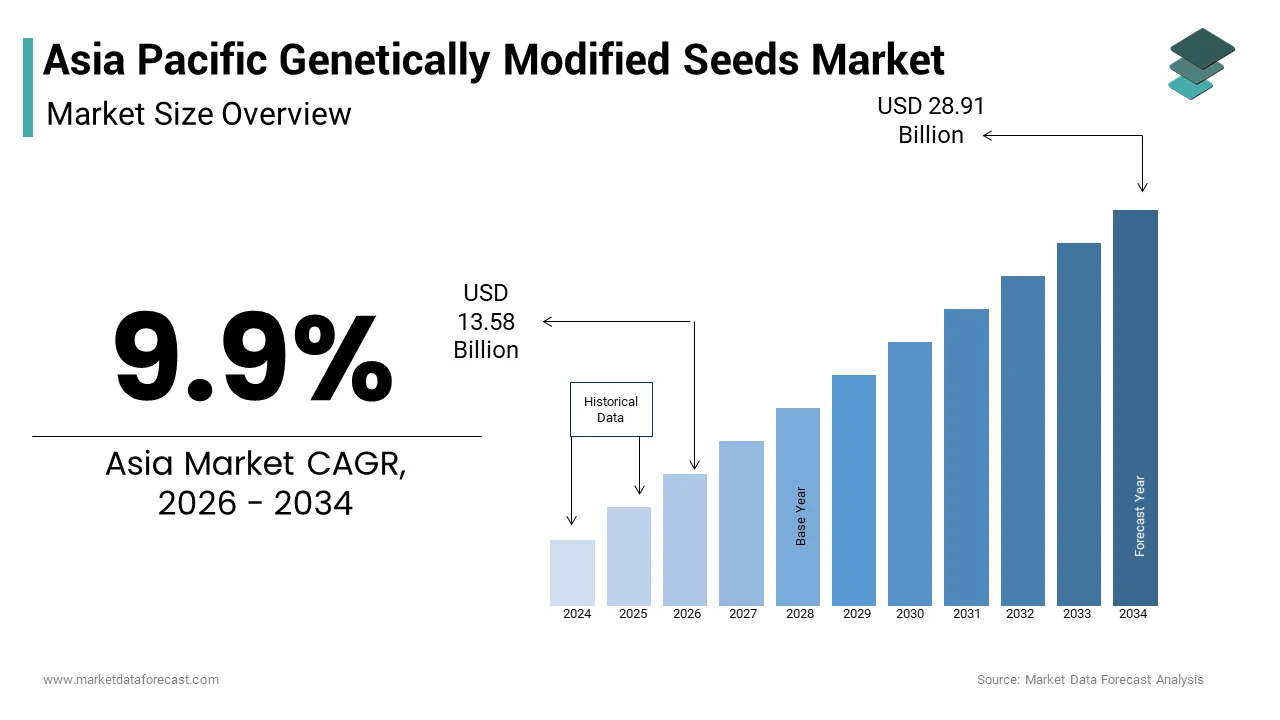
Genetically modified seeds are seeds that are used in farming. Their DNA is modified by using genetic engineering procedures. Mostly, the target is to induce a new trait into the crop that is usually absent in the species.
The growth of the genetically modified seeds market can be attributed to the increase in adoption of biofuels, the growth of the Asia Pacific population and the consequent food demand, growing demand for animal feed, and preference for oleo-chemicals. Growing acceptance of biotech drought-tolerant plants and increasing demand for high-yield crops are also considered to be the driving factors of this market.
REPORT COVERAGE
| REPORT METRIC | DETAILS |
| Market Size Available | 2025 to 2034 |
| Base Year | 2025 |
| Forecast Period | 2026 to 2034 |
| CAGR | 9.9% |
| Segments Covered | By Crop Type, Trait Type, Region |
| Various Analyses Covered | Global, Regional & Country Level Analysis, Segment-Level Analysis, DROC, PESTLE Analysis, Porter’s Five Forces Analysis, Competitive Landscape, Analyst Overview on Investment Opportunities |
| Regions Covered | India, China, Japan, South Korea and Australia, South Africa, New Zealand, Thailand, Malaysia, Vietnam, Philippines, Indonesia, Singapore, and the Rest of the Asia Pacific |
| Market Leaders Profiled | Bayer CropScience, DowDuPont, Groupe Limagrain, Monsanto and Syngenta, BASF, DLF Seeds and Science, Kleinwanzlebener Saatzuch SAAT SE, Land O'Lakes, Sakata Seed, and Takii Seed. |
KEY MARKET PLAYERS
This market is extremely disjointed, with numerous big and developing players operating in the business. The major companies dominating the Asia Pacific Genetically Modified Seeds Market are
- Bayer CropScience
- DowDuPont
- Groupe Limagrain
- Monsanto and Syngenta
- BASF
- DLF Seeds and Science
- Kleinwanzlebener Saatzuch SAAT SE
- Land O'Lakes
- Sakata Seed,
- Takii Seed.
MARKET SEGMENTATION
This research report on the Asia Pacific genetically modified seeds market is segmented and sub-segmented into the following categories.
By Crop Type
- Corn
- Soybean
- Cotton
- Canola
- Others
By Trait Type
- Herbicide Tolerance
- Insect Resistance
- Others
By Country
- India
- China
- Japan
- South Korea
- Australia
- New Zealand
- Thailand
- Malaysia
- Vietnam
- Philippines
- Indonesia
- Singapore
- Rest of APAC