Asia Pacific Geofoam Market Research Report – Segmented By Product (Expanded Polystyrene (EPS) Geofoams, Extruded Polystyrene (XPS) Geofoams), Application, Country (India, China, Japan, South Korea, Australia, New Zealand, Thailand, Malaysia, Vietnam, Philippines, Indonesia, Singapore and Rest of APAC) - Industry Analysis From 2026 to 2034
Market Size, 2025
$0.28 BnMarket Estimate, 2026
$0.30 BnMarket Forecast, 2034
$0.48 BnCAGR, 2026–2034
6.00%Asia Pacific Geofoam Market Size
The Asia Pacific Geofoam Market size was valued at USD 0.28 billion in 2025 and is anticipated to reach USD 0.30 billion in 2026 from USD 0.48 billion by 2034, growing at a CAGR of 6.00% during the forecast period from 2026 to 2034.
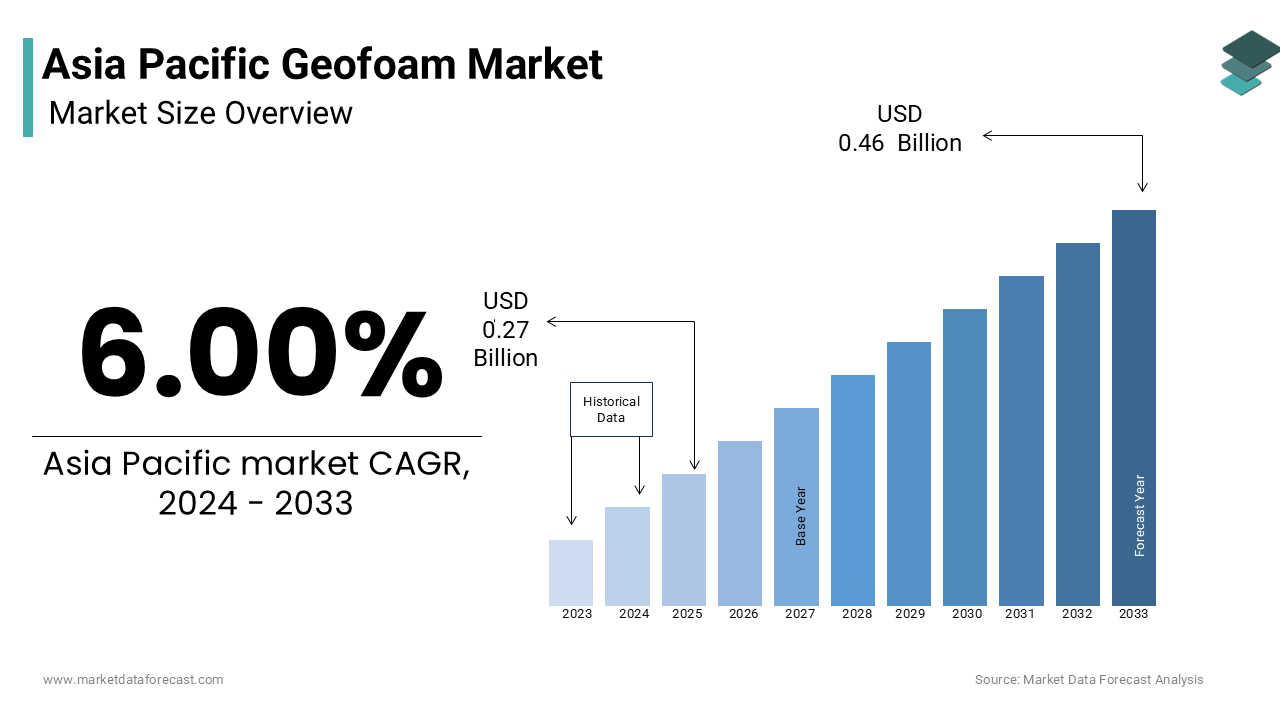
The geofoam is a rigid cellular plastic foams that are expanded polystyrene (EPS) and extruded polystyrene (XPS) used as engineered fill materials in infrastructure projects. Geofoam serves as a high-performance alternative to conventional soil and aggregate fills by offering exceptional compressive strength, thermal insulation, and load reduction properties. Its adoption is increasingly in regions prone to seismic activity and soil instability, where structural lightweighting is essential. Across the Asia Pacific region, geofoam has found growing utility in transportation infrastructure, including highway embankments, bridge abutments, tunnel linings, and airport runways. Countries such as Japan, South Korea, and Australia have institutionalized geofoam use in geotechnical design standards due to its proven performance in minimizing settlement and lateral pressure on retaining structures. As urban densification accelerates and land reclamation projects expand, particularly in coastal megacities like Shanghai, Jakarta, and Manila, the demand for innovative ground stabilization solutions intensifies. The integration of geofoam in green building initiatives further amplifies its relevance, given its recyclability and energy-efficient manufacturing cycle. According to the Asia-Pacific Economic Cooperation (APEC) Transportation Working Group, over 60% of new transport infrastructure developments in member economies now incorporate advanced lightweight fill technologies, reflecting a paradigm shift in civil engineering practices.
MARKET DRIVERS
Accelerated Urban Infrastructure Development in Seismically Active Zones
The proliferation of large-scale urban infrastructure projects in seismically vulnerable areas across the Asia Pacific region has significantly elevated the demand for geofoam as a geotechnical stabilizing agent. Countries such as Japan, Indonesia, the Philippines, and Nepal face persistent seismic risks, with the United States Geological Survey indicating that over 75% of global earthquakes occur along the Pacific Ring of Fire, which traverses much of the region. In response, engineering authorities are prioritizing construction materials that reduce structural load and enhance seismic resilience. For instance, Japan’s Ministry of Land, Infrastructure, Transport and Tourism has mandated the use of lightweight fills in over 40% of highway rehabilitation projects since 2020, particularly in mountainous and liquefaction-prone areas. In Nepal, following the 2015 Gorkha earthquake, the National Society for Earthquake Technology reported that reconstruction efforts incorporated geofoam in 15 major road realignment projects to stabilize slopes and reduce mass-induced stress. Similarly, in Indonesia, where rapid urbanization collides with high seismicity, the Ministry of Public Works and Housing has endorsed geofoam use in the development of the new capital city, Nusantara, to mitigate ground deformation risks. The material’s ease of installation and minimal site disruption further enhance its appeal in densely populated urban corridors.
Expansion of High-Speed Rail and Mass Transit Networks
The aggressive expansion of high-speed rail (HSR) and urban mass transit systems across the Asia Pacific region is also fuelling the growth of the Asia Pacific geofoam market. Governments are investing heavily in rail infrastructure to alleviate urban congestion, reduce carbon emissions, and connect rapidly growing metropolitan regions. China operates over 40,000 kilometers of high-speed rail, accounting for nearly 70% of the world’s total HSR network, as confirmed by the International Union of Railways. These systems require stable, lightweight foundations to prevent track deformation, especially in soft soil zones and reclaimed land. Geofoam’s ability to reduce vertical and lateral loads makes it ideal for constructing elevated rail corridors and tunnel approaches. In India, the National High-Speed Rail Corporation is utilizing geofoam in the Mumbai-Ahmedabad bullet train project, particularly in areas with high water tables and weak subsoil, to minimize settlement risks. Similarly, in Thailand, the Eastern Economic Corridor’s rail development includes geofoam applications in embankments to support rapid transit lines connecting industrial zones. The material’s prefabricated nature allows for accelerated construction timelines, a prominent factor in large-scale rail projects where delays incur substantial economic costs. As per the International Energy Agency, urban rail networks in Asia are expected to expand by 50% by 2030, which is rising urban populations and government commitments to sustainable mobility. Furthermore, its compatibility with modular construction techniques aligns with the industry’s shift toward industrialized building processes, enhancing efficiency and safety on complex transit sites.
MARKET RESTRAINTS
Limited Awareness and Technical Expertise in Emerging Economies
The lack of technical understanding and engineering familiarity in emerging economies such as Vietnam, Bangladesh, and Papua New Guinea is restraining the growth of the Asia Pacific geofoam market. Civil engineering curricula in many regional institutions do not include advanced geosynthetic or lightweight fill technologies, resulting in a knowledge gap among practicing engineers and project consultants. According to UNESCO’s Asia-Pacific Centre of Education for International Understanding, fewer than 30% of civil engineering programs in Southeast Asia incorporate modern geotechnical materials into their core syllabi. This educational deficit translates into conservative design practices that favor traditional soil and aggregate fills, even in geotechnically challenging environments. In Bangladesh, for example, where over 70% of the land is classified as soft alluvial soil by the Bangladesh Water Development Board, geofoam remains underutilized due to unfamiliarity among public works departments. Similarly, in Myanmar, infrastructure projects continue to rely on conventional backfill methods despite recurring issues with embankment failure and settlement. The absence of localized design codes and performance databases further discourages adoption.
Environmental Concerns Regarding Polystyrene-Based Materials
The environmental footprint of polystyrene-based geofoam, particularly expanded polystyrene (EPS), presents a growing constraint to its market expansion in environmentally conscious Asia Pacific markets. While geofoam reduces construction-related emissions through lighter transportation loads and faster installation, concerns persist about its non-biodegradability and end-of-life disposal. In 2022, the United Nations Environment Programme reported that only 9% of all plastic waste generated globally was recycled, with much of the remainder ending up in landfills or ecosystems. In countries like Indonesia and the Philippines, which are among the world’s top marine plastic polluters as per data from the Ocean Conservancy, regulatory scrutiny of plastic-based construction materials is intensifying. Some local governments have imposed restrictions on non-essential polystyrene use, which is creating uncertainty for geofoam applications. Additionally, although EPS is chemically inert and does not leach toxins, its visual similarity to general plastic waste often leads to public misperception. In Australia, the National Plastics Plan has initiated a phase-down of polystyrene in packaging, raising concerns about potential spillover effects on construction-grade EPS. While geofoam is technically recyclable, recycling infrastructure for construction plastics remains underdeveloped across much of the region.
MARKET OPPORTUNITIES
Integration in Land Reclamation and Coastal Resilience Projects
The escalating threat of sea-level rise and coastal erosion is creating a strategic opportunity for geofoam in land reclamation and shoreline protection initiatives across the Asia Pacific region. Traditional reclamation methods using sand and rock are becoming unsustainable due to resource scarcity and high settlement risks. Geofoam offers a transformative solution by providing ultra-lightweight fill that minimizes subsidence and reduces pressure on weak marine soils. Similarly, in the Maldives, where average ground elevation is just 1.5 meters above sea level as reported by the Maldives Ministry of Environment, geofoam is being evaluated for use in artificial island construction to enhance buoyancy and structural stability. Japan has already deployed geofoam in the Yokohama waterfront expansion to stabilize reclaimed land without triggering excessive consolidation.
Adoption in Green Building and Energy-Efficient Infrastructure
The rising emphasis on energy-efficient and sustainable construction is also to promote new opportunities for the growth of the Asia Pacific geofoam market. Geofoam is increasingly incorporated into insulated concrete form (ICF) systems and basement wall assemblies to reduce heating and cooling loads. In Australia, the National Construction Code now requires a 6-star energy rating for new homes, prompting builders to adopt advanced insulation solutions. According to the Global Buildings Performance Network, buildings account for nearly 40% of total energy consumption in the Asia Pacific, with space conditioning being the largest contributor. Geofoam’s dual functionality as both structural fill and insulation allows for space optimization and reduced material layers by enhancing design efficiency.
MARKET CHALLENGES
Fragmented Regulatory Frameworks and Standardization Gaps
The absence of harmonized regulatory standards and technical specifications is a challenging factor for the growth of the Asia Pacific geofoam market. This regulatory vacuum forces engineers to rely on international standards such as ASTM or ISO, which may not fully address regional geotechnical conditions. In India, although the Indian Road Congress has begun evaluating geofoam for highway applications, no binding specifications have been issued, creating uncertainty for contractors and consultants. As per the Pacific Regional Environment Programme, only 14 of the 21 Asia Pacific economies have established national standards for geosynthetic materials, and none have comprehensive frameworks specifically for geofoam. This fragmentation complicates cross-border infrastructure projects and discourages investment in local manufacturing. Moreover, the lack of standardized testing protocols for long-term performance under tropical humidity and seismic stress undermines confidence in material durability. In the absence of region-wide certification mechanisms, procurement decisions often default to conventional materials, slowing innovation.
Supply Chain Vulnerabilities and Raw Material Dependency
The supply chain disruptions due to its reliance on petrochemical feedstocks and concentrated production hubs. Expanded polystyrene, the primary material used in geofoam, is derived from styrene monomer, a petroleum-based chemical whose price fluctuates with global crude oil markets. According to the International Energy Agency, styrene prices in Asia surged by 27% in 2022 due to supply constraints from China and geopolitical tensions affecting shipping routes. China accounts for over 50% of Asia’s EPS production capacity, creating a single-point dependency that affects downstream industries across Southeast Asia and Oceania. Furthermore, environmental regulations in China, such as the Blue Sky Campaign, have led to periodic shutdowns of petrochemical plants, exacerbating supply instability. Additionally, the limited number of certified geofoam producers in the region fewer than 20 with international quality accreditation—restricts competition and inflates costs.
REPORT COVERAGE
SEGMENTAL ANALYSIS
By Product Insights
The Expanded Polystyrene (EPS) segment was accounted in holding a dominant share of the Asia Pacific geofoam market. This overwhelming dominance stems primarily from its cost-effectiveness and widespread adaptability across civil engineering applications. EPS is significantly more economical than Extruded Polystyrene (XPS), with raw material production costs averaging USD 1,150 per ton compared to USD 1,620 for XPS, according to data from the Asian Petrochemical Industry Conference. Moreover, EPS can be manufactured in large block sizes up to 4 meters in length with minimal joints, enhancing structural continuity in embankments and retaining walls. In Japan, over 90% of geofoam used in highway slope stabilization projects between 2018 and 2023 was EPS, as confirmed by the Japan Society of Civil Engineers, due to its proven long-term performance under cyclic loading and seismic stress.
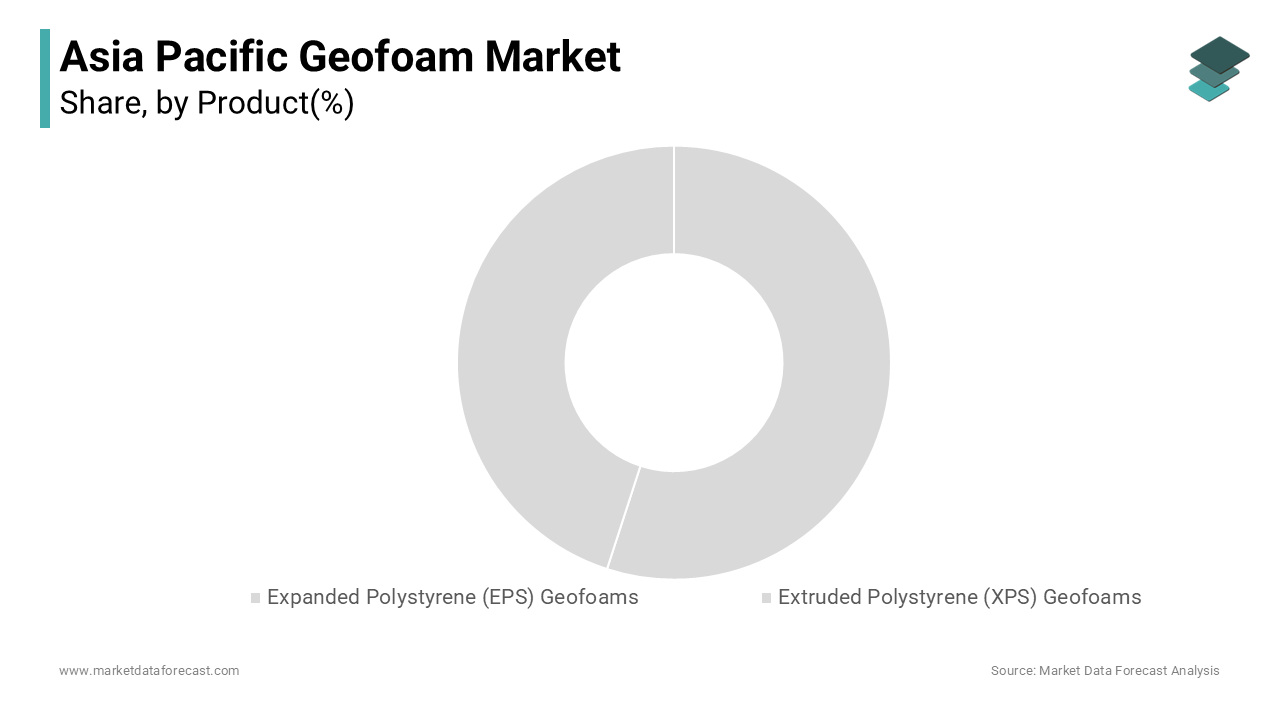
The Extruded Polystyrene (XPS) segment is likely to grow with an expected CAGR of 9.4% from 2026 to 2034 with its superior moisture resistance and higher compressive strength, which is making it increasingly preferred in high-performance and submerged applications. In Singapore, where over 30% of new underground utility tunnels are constructed in waterlogged reclaimed land, XPS has become the default geofoam choice for lining and backfill, as reported by the Public Utilities Board. Furthermore, XPS maintains structural integrity under sustained loads, with compressive strengths ranging from 250 to 700 kPa by enabling its use in airport runways and heavy-duty industrial pads.
By Application Insights
The road and highway construction segment was the largest and held a prominent share of the Asia Pacific geofoam market. This preeminence is underpinned by the region’s relentless push to modernize and expand its transportation networks amid rapid urbanization and rising freight demands. Governments across Asia are prioritizing highway connectivity to stimulate economic integration and reduce logistics bottlenecks. Geofoam is increasingly deployed in bridge approach embankments, slope stabilization, and culvert backfilling to mitigate differential settlement a persistent issue in areas with soft alluvial soils. In India, where 45% of national highways traverse regions with poor subgrade conditions, as classified by the Central Road Research Institute, geofoam has been adopted in over 120 km of the Delhi-Mumbai Expressway to prevent post-construction sinking. Similarly, in Indonesia, the Trans-Sumatra Highway project has utilized geofoam in swampy sections to reduce embankment load and accelerate construction timelines. The material’s prefabricated nature allows for installation without heavy compaction equipment, minimizing disruption in congested corridors.
The airport runways and taxiways segment is esteemed to grow with CAGR of 10.2% from 2026 to 2034 owing to the region’s unprecedented expansion of air transport infrastructure to accommodate rising passenger volumes and cargo logistics. The Airports Council International forecasts that Asia Pacific will account for nearly 45% of global air passenger traffic by 2035, up from 37% in 2022. Geofoam is increasingly integrated into runway sub-base systems to reduce settlement on weak subsoils and to insulate permafrost-affected foundations in high-altitude airports. The material’s ability to withstand loads exceeding 200 kPa while reducing vertical stress by up to 90% makes it ideal for airfield applications where pavement integrity is non-negotiable. In Japan, the Ministry of Land, Infrastructure, Transport and Tourism has endorsed geofoam for use in 12 regional airport upgrades under its Regional Revitalization Program, citing its rapid deployment and minimal maintenance requirements.
REGIONAL ANALYSIS
China Geofoam Market Insights
China was the top performer of the Asia Pacific geofoam market with 38.3% of share in 2025 due to its colossal infrastructure development agenda, which includes the world’s most extensive high-speed rail network and a continuous expansion of urban expressways. According to the National Bureau of Statistics of China, fixed asset investment in transportation infrastructure reached USD 480 billion in 2023 alone, with a significant portion allocated to soft-ground engineering solutions. Geofoam is increasingly specified in bridge abutments, tunnel portals, and metro line extensions, particularly in cities like Shanghai and Guangzhou, where subsidence risks are high due to deep alluvial deposits. Moreover, China hosts over 60% of the region’s EPS manufacturing capacity, with major producers such as Zhenjiang Xingfa and Shandong Baicheng scaling output to meet domestic and export demand. Environmental regulations under the 14th Five-Year Plan have also encouraged the use of lightweight, energy-efficient materials by aligning with geofoam’s low embodied carbon profile.
Japan Geofoam Market Insights
Japan geofoam market is gearing up with new opportunities in the next coming years. Its mountainous terrain, high seismic activity, and dense urban fabric have necessitated innovative geotechnical solutions, which is making geofoam a standard component in highway, railway, and slope stabilization works. Japan also leads in R&D, with institutions like the Public Works Research Institute conducting long-term performance studies on geofoam under cyclic loading and freeze-thaw conditions. Recycling infrastructure is highly developed, with the Japan Styrene Foam Association reporting a 78% recovery rate for construction EPS in 2023.
India Geofoam Market Insights
India geofoam market growth is having prominent growth opportunities during the forecast period. While geofoam usage was minimal a decade ago, recent flagship projects like the Mumbai-Ahmedabad High-Speed Rail and the Delhi-Mumbai Expressway have incorporated EPS geofoam in soft soil zones to prevent post-construction settlement. The Central Road Research Institute has validated geofoam’s performance in reducing embankment loads by up to 95% in deltaic regions of West Bengal and Odisha. State public works departments in Gujarat and Tamil Nadu have begun including geofoam in technical specifications for bridge approaches. However, widespread adoption is still constrained by limited local manufacturing and reliance on imported blocks. As per the Indian Petrochemicals Association, only three domestic facilities currently produce construction-grade EPS blocks, leading to supply bottlenecks.
Australia Geofoam Market Insights
Australia geofoam market growth is driven by the focus on sustainable engineering and regulatory maturity. According to the Australian Bureau of Statistics, over 60% of new commercial buildings in New South Wales and Victoria now incorporate EPS geofoam in below-slab insulation systems. In infrastructure, the material is widely used in road upgrades across Queensland and Western Australia, where reactive soils cause frequent pavement cracking. The Queensland Department of Transport and Main Roads has deployed geofoam in over 35 bridge approach projects since 2020 to eliminate differential settlement. Australia also leads in recycling, with the Plastics Recyclers Association of Australia reporting a 70% recovery rate for construction EPS in 2023. The country’s Green Building Council promotes geofoam use in Green Star-rated projects by enhancing its appeal in sustainable development.
South Korea Geofoam Market Insights
South Korea geofoam market growth is likely with its advanced engineering integration and focus on smart infrastructure. The country’s adoption is concentrated in high-speed rail, urban transit, and airport projects, where precision and durability are paramount. The Ministry of Land, Infrastructure and Transport has incorporated geofoam into design manuals for subway station construction, particularly in Seoul, where deep excavations in dense urban areas require minimal lateral displacement. The Incheon International Airport’s third terminal expansion utilized XPS geofoam beneath taxiway slabs to reduce load on reclaimed land while maintaining thermal stability. South Korea’s emphasis on Building Information Modeling (BIM) and modular construction aligns seamlessly with geofoam’s prefabricated nature, enabling digital design-to-fabrication workflows.
COMPETITIVE LANDSCAPE
The competition in the Asia Pacific geofoam market is evolving from a product-centric to a solutions-driven landscape, characterized by technological differentiation and regional specialization. While multinational corporations leverage global R&D and sustainability credentials, regional manufacturers compete on cost efficiency and localized service delivery. The market lacks intense price wars due to the technical nature of applications, where performance and reliability outweigh cost alone. Instead, competition centers on engineering support, customization, and compliance with national construction standards. Multinationals such as Dow and BASF emphasize innovation and environmental stewardship, integrating geofoam into broader sustainable infrastructure narratives. Domestic players in China and India focus on scalability and affordability, capturing public sector contracts through competitive bidding and proximity to project sites.
KEY MARKET PLAYERS
Some of the companies that are playing a dominating role in the Asia Pacific Geofoam Market include
- Carlisle Construction Materials
- Atlas Roofing / Atlas Molded Products
- ACH Foam Technologies
- Insulfoam
- Benchmark Foam
- Expol Ltd.
- Foamex
- Beaver Plastics Ltd.
- Mega Packaging Corporation
- Galaxy Polystyrene LLC
- Isolite
- Amvic Building Systems
- Jablite
- ThermaFoam LLC
- Pacific Allied Products Ltd.
- Airfoam
- Harbor Foam
- Drew Foam
- Plasti-Fab Ltd.
- Groupe Legerlite Inc.
- Poly Molding LLC
- StarRFoam
Top Players in the Asia Pacific Geofoam Market
Dow Inc.
Dow Inc. has established a formidable presence in the Asia Pacific geofoam market through its high-performance STYRAFOAM™ XPS products, widely used in infrastructure and building applications across Japan, South Korea, and Australia. The company has deepened its regional engagement by collaborating with civil engineering firms on technical design support and sustainability certifications. In 2023, Dow launched a dedicated geofoam solutions hub in Shanghai to provide localized R&D and application engineering for transportation projects. It has also partnered with government agencies in Thailand and Vietnam to promote resilient construction practices in flood-prone areas. Dow’s integration of circular economy principles, including pilot programs for EPS recycling in collaboration with Australian waste management firms, strengthens its environmental credibility. By aligning with green building standards such as Green Star and CASBEE, Dow positions its materials as essential components in low-carbon infrastructure. Its investment in digital tools for load simulation and lifecycle analysis enables engineers to optimize geofoam usage, enhancing project efficiency.
BASF SE
BASF has significantly advanced its footprint in the Asia Pacific geofoam market through its NEOPOR® graphite-enhanced EPS technology, which combines lightweight structural performance with superior thermal insulation. The company has positioned itself as a solutions provider by integrating geofoam into broader system offerings for green buildings and energy-efficient infrastructure. In 2022, BASF collaborated with the National University of Singapore to study the long-term durability of geofoam in tropical marine environments, reinforcing technical confidence among regional engineers. It has also supported large-scale projects in India’s Delhi-Mumbai Industrial Corridor, supplying customized EPS blocks for embankment stabilization. BASF’s regional innovation center in Mumbai provides on-site technical training for contractors and design consultants, addressing knowledge gaps in emerging markets. The company has further strengthened its position by aligning with India’s Smart Cities Mission and Indonesia’s Nusantara capital development, offering engineered fill solutions that reduce construction time and environmental impact. Through its “Smart Construction” initiative, BASF promotes digital modeling tools that simulate geofoam performance under seismic and hydrological stress.
Kunshan Xingzhong New Materials Co., Ltd.
Kunshan Xingzhong New Materials has emerged as a pivotal regional player by focusing on cost-effective, high-volume production of EPS geofoam tailored to the infrastructure demands of China and Southeast Asia. The company supplies standardized and custom-cut blocks to major transportation projects, including high-speed rail corridors and highway expansions in Jiangsu and Guangdong provinces. In 2023, it expanded its production capacity by 40% to meet rising demand from state-owned construction enterprises. Kunshan Xingzhong has also invested in CNC cutting technology to improve precision and reduce installation time, enhancing its appeal to contractors under tight project deadlines. It actively participates in industry exhibitions across ASEAN nations, promoting geofoam adoption in countries like Malaysia and the Philippines. The company has collaborated with the China Highway Planning and Design Institute to develop technical guidelines for geofoam use in soft soil zones.
Top Strategies Used by the Key Market Participants
Key players in the Asia Pacific geofoam market are deploying multifaceted strategies to consolidate their positions and drive adoption. Vertical integration is prevalent, with companies expanding from raw material production to finished block manufacturing and on-site technical support. Strategic collaborations with government agencies and engineering consultancies are accelerating specification into public infrastructure projects. Firms are investing in regional innovation centers to tailor products to local geotechnical conditions, particularly in seismic and tropical environments. Capacity expansion is a common tactic, with producers in China and Southeast Asia scaling output to meet rising demand. Digital enablement, including BIM integration and load simulation software, is being leveraged to enhance design accuracy and contractor confidence. Sustainability initiatives, such as recycling programs and low-carbon manufacturing, are increasingly used to align with green building certifications. Market education through workshops and university partnerships addresses the technical knowledge gap in emerging economies. Additionally, companies are pursuing project-specific customization, offering pre-cut, labeled blocks for rapid deployment. These strategies collectively enhance product relevance, reduce adoption barriers, and strengthen long-term competitiveness in a technically driven, infrastructure-dependent market.
RECENT MARKET DEVELOPMENTS
- In March 2023, Dow Inc. launched a geofoam application engineering center in Shanghai to provide technical design support and accelerate adoption in transportation infrastructure projects across China and Southeast Asia.
- In August 2022, BASF SE partnered with the National University of Singapore to conduct long-term durability studies on NEOPOR® geofoam in tropical marine environments, enhancing credibility among regional engineers and contractors.
- In January 2025, Kunshan Xingzhong New Materials expanded its EPS geofoam production capacity by 40% at its Jiangsu facility to meet rising demand from high-speed rail and highway projects in China and ASEAN markets.
- In June 2023, Dow Inc. collaborated with the Thailand Department of Highways to implement STYRAFOAM™ in a pilot project for embankment stabilization on soft clay soils along the Northeast Expressway.
- In November 2022, BASF launched a technical training initiative in Mumbai, offering workshops for civil engineers and contractors on the design and installation of EPS geofoam in India’s Smart Cities projects.
MARKET SEGMENTATION
This research report on the Asia Pacific Geofoam Market is segmented and sub-segmented into the following categories.
By Product
- Expanded Polystyrene (EPS) Geofoams
- Extruded Polystyrene (XPS) Geofoams
By Application
- Road and Highway Construction
- Building and Infrastructure
- Airport Runways and Taxiways
- Others
By Country
- India
- China
- Japan
- South Korea
- Australia
- New Zealand
- Thailand
- Malaysia
- Vietnam
- Philippines
- Indonesia
- Singapore
- Rest of APAC
Frequently Asked Questions
What is driving the growth of the Asia Pacific geofoam market?
Rapid urbanization, large-scale infrastructure projects, and the need for lightweight fill materials in road construction and building foundations are key growth drivers.
What makes geofoam a preferred choice over traditional fill materials in the region?
Geofoam is lightweight, reduces load on underlying soils, minimizes settlement issues, and speeds up construction compared to soil or aggregate fills.
What is the future outlook for the Asia Pacific geofoam market?
The market is expected to witness strong growth due to smart city projects, sustainable construction practices, and government-backed infrastructure upgrades through 2035.
Are there sustainable geofoam alternatives emerging in Asia Pacific?
Yes, research and development are ongoing for bio-based and recyclable geofoam solutions to meet green construction standards.
Access the study in MULTIPLE FORMATS
Purchase options starting from
$ 2000
Didn’t find what you’re looking for?
TALK TO OUR ANALYST TEAM
Need something within your budget?
NO WORRIES! WE GOT YOU COVERED!
Call us on: +1 888 702 9696 (U.S Toll Free)
Write to us: sales@marketdataforecast.com