- Product Description Description
- Table of Contents TOC
- List of Table & Figure LOT
- Get Free Sample PDF Sample PDF
Market Size, 2025
$4.85 BnMarket Estimate, 2026
$5.20 BnMarket Forecast, 2034
$9.11 BnCAGR, 2026–2034
7.25%Asia-Pacific Glyphosate Market Size, Growth, Trends & Forecast (2026–2034)
The Asia-Pacific glyphosate market size was valued at USD 4.85 billion in 2025, is anticipated to reach USD 5.20 billion in 2026, and is projected to expand up to USD 9.11 billion by 2034, registering a compound annual growth rate (CAGR) of 7.25% during the forecast period from 2026 to 2034. Growth is driven by the region's massive population growth and high food demand, greater openness toward genetically modified (GM) crops, and changing agricultural patterns in developing economies like China and India.
Key Executive Metrics (At-a-Glance)
- 2025 Base Valuation: USD 4.85 Billion
- 2026 Current Valuation: USD 5.20 Billion
- 2034 Forecast Valuation: USD 9.11 Billion
- Compound Annual Growth Rate (CAGR): 7.25% (2026–2034)
- Dominant Countries: China and India
- Key Non-Agricultural Applications: Turf & ornamental grass, forestry/woodlots, industrial, and domestic vegetation control
Core Market Drivers
- High Productivity Demand: Escalating food requirements driven by top-tier population growth, leaving no room for crop loss due to weed infestation.
- Favorable Regional Adoption: Higher openness to GM crops alongside growing livestock feed consumption and diverse non-crop applications (e.g., pavement weed control and habitat restoration).
Primary Market Restraints & Challenges
- Agrochemical Regulations: Stringent government regulations and environmental policies restricting chemical agrochemical use.
Asia-Pacific Glyphosate Market Segmentation Breakdown
| Segment Category | Key Sub-Segments |
|---|---|
| By Crop Type | GM Crops, Conventional Crops |
| By Application | Crop based (Grains & Cereals, Oil Seeds, Fruits & Vegetables), Non-Crop (Turf & Ornamental Grass, Others) |
| By Country | India, China, Japan, South Korea, Australia, New Zealand, Thailand, Malaysia, Vietnam, Philippines, Indonesia, Singapore, Rest of APAC |
Major Industry Players Profiled
Key corporations steering the Asia-Pacific glyphosate market include Monsanto Company (U.S.), Syngenta AG (Switzerland), Bayer AG (Germany), E.I. Du Pont De Nemours & Company (U.S.), The Dow Chemical Company (U.S.), Nufarm Limited (Australia), Nantong Jiangshan Agrochemical & Chemical, Inc. (China), Adama Agricultural Solutions Ltd (Israel), UPL Limited (India), and Zhejiang Xinan Chemical Industrial Group Co., Ltd. (China).
Asia Pacific Glyphosate Market Size
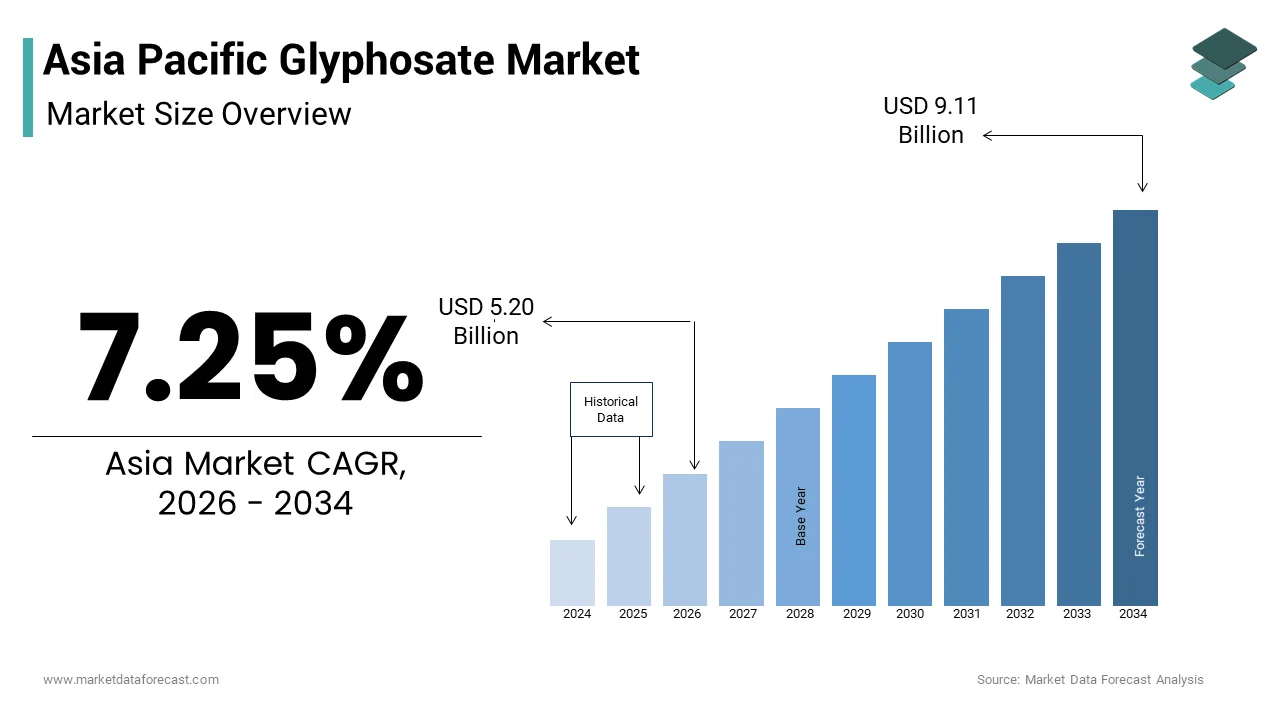
The Asia Pacific glyphosate market size valued at USD 4.85 billion in 2025 and is anticipated to reach USD 5.20 billion in 2026 to reach USD 9.11 billion by 2034, growing at a CAGR of 7.25% from 2026 to 2034.
Glyphosate is an organophosphorus compound that finds use as a broad-spectrum herbicide. It is used for killing weeds and grasses that compete with commercial crops. Weed and grass growth control remain key benefits, stimulating product penetration. By volume, it is one of the most widely used herbicides.
Glyphosate is mainly used in maize, wheat, tea, cotton, sunflower, and sorghum to enhance the crop yield. Other applications include farming, parks, orchards, and vineyards. Glyphosates adsorb strongly into the soil, and the ground and surface water pollution is minimal. It is also easily degraded by soil microbes. Glyphosate is also used extensively in invasive species eradication and habitat restoration, especially for the enhancement of native plants in prairie ecosystems. In many cities also the product is also used as a spray on pavements and sidewalks, as a measure to kill the weeds that grow between the pavements and damage them.
MARKET DRIVERS
The major driver of the Asia-Pacific Glyphosate market is the demand for increased productivity. The region has the highest population growth as well as the highest population at the time. Hence, the demand for food is very high, and the loss of crop productivity to weeds is not acceptable. Not only this, but the region is more open to the adoption of genetically modified crops as opposed to other markets. The increase in crop feeding among livestock and the rising application scope of fuel will also drive the market. Other factors include the use of the product in non-agricultural activities such as forests and woodlots, industry, and domestic vegetation control. However, the stringent regulations on the use of agrochemicals and other environmental concerns may adversely affect the growth of the market.
REPORT COVERAGE
| REPORT METRIC | DETAILS |
| Market Size Available | 2025 to 2034 |
| Base Year | 2025 |
| Forecast Period | 2026 to 2034 |
| CAGR | 7.25% |
| Segments Covered | By Crop Type, Application, and Region |
| Various Analyses Covered | Global, Regional & Country Level Analysis, Segment-Level Analysis, DROC, PESTLE Analysis, Porter’s Five Forces Analysis, Competitive Landscape, Analyst Overview on Investment Opportunities |
| Regions Covered | India, China, Japan, South Korea and Australia, South Africa, New Zealand, Thailand, Malaysia, Vietnam, Philippines, Indonesia, Singapore, and the Rest of the Asia Pacific |
| Market Leaders Profiled | Monsanto company (U.S.), Syngenta AG (Switzerland), Bayer AG (Germany), E.I. Du Pont De Nemours & Company (U.S.), The Dow Chemical Company (U.S.), Nufarm limited (Australia), Nantong Jiangshan Agrochemical & Chemical, Inc. (China), Adama Agricultural Solutions Ltd (Israel), UPL Limited (India), and Zhejiang Xinan Chemical Industrial Group Co., Ltd. (China). |
COUNTRY ANALYSIS
Based on geography, the Asia-Pacific market consists of China, India, Japan, South Korea, Australia, and the Rest of APAC. The Glyphosate Market was dominated by Asia-Pacific in 2016, with the region accounting for 38% of the overall market share. The changing agricultural patterns in developing economies such as China and India are the major contributors to the growth of the market.
KEY MARKET PLAYERS
The key players that are present in the glyphosate industry include
- Monsanto company (U.S.)
- Syngenta AG (Switzerland)
- Bayer AG (Germany)
- E.I. Du Pont De Nemours & Company (U.S.)
- The Dow Chemical Company (U.S.)
- Nufarm limited (Australia)
- Nantong Jiangshan Agrochemical & Chemical, Inc. (China)
- Adama Agricultural Solutions Ltd (Israel)
- UPL Limited (India)
- Zhejiang Xinan Chemical Industrial Group Co., Ltd. (China).
SEGMENT ANALYSIS
This research report on the Asia Pacific glyphosate market is segmented and sub-segmented into the following categories.
By Crop Type
- GM Crops
- Conventional Crops
By Application
- Crop based
- Grains & Cereals
- Oil Seeds
- Fruits & Vegetables
- Non-Crop
- Turf & Ornamental Grass
- Others
By Country
- India
- China
- Japan
- South Korea
- Australia
- New Zealand
- Thailand
- Malaysia
- Vietnam
- Philippines
- Indonesia
- Singapore
- Rest of APAC