- Product Description Description
- Table of Contents TOC
- List of Table & Figure LOT
- Get Free Sample PDF Sample PDF
Market Size, 2025
$686.03 MnMarket Estimate, 2026
$762.32 MnMarket Forecast, 2034
$1772 MnCAGR, 2026–2034
11.12%Asia-Pacific Greenhouse Irrigation Systems Market Size, Growth, Trends & Forecast (2026–2034)
The Asia-Pacific greenhouse irrigation systems market size was valued at USD 686.03 million in 2025, is anticipated to reach USD 762.32 million in 2026, and is projected to reach USD 1,772.04 million by 2034, growing at a robust CAGR of 11.12% during the forecast period from 2026 to 2034. Driven by rapid Controlled Environment Agriculture (CEA) adoption, supportive government subsidies for smart agriculture, and pressing climate resilience needs, the regional market continues to expand dynamically.
Key Executive Metrics (At-a-Glance)
- 2025 Base Valuation: USD 686.03 Million
- 2026 Current Valuation: USD 762.32 Million
- 2034 Forecast Valuation: USD 1,772.04 Million
- Compound Annual Growth Rate (CAGR): 11.12% (2026–2034)
- Dominant Irrigation Type Segment: Drip Irrigation Systems (58.3% share in 2025)
- Fastest-Growing Irrigation Type Segment: Micro-Sprinkler Irrigation Systems (14.7% CAGR)
- Dominant Application Segment: Vegetables (47.4% share in 2024)
- Fastest-Growing Application Segment: Flowers & Ornamentals (16.2% CAGR)
- Leading Country Market: India (25.3% share in 2024)
- Fastest-Growing Country Market: Japan (AI-integrated systems integration)
Core Market Drivers
- Controlled Environment Agriculture (CEA): Over 400,000 hectares of greenhouse area operating under regional climate-controlled setups to counteract shrinking arable land.
- Government Modernization Schemes: Major financial injections like India's PMKSY subsidies and China's Smart Agriculture Development Plan ($2B+ allocation).
Primary Market Restraints & Challenges
- High Capital Expenditure: Setup costs ranging from $20,000 to $50,000 per hectare, restricting accessibility for smallholder farmers.
- Technical Expertise & Infrastructure Gaps: Limited operational knowledge among rural farmers and power supply constraints across off-grid areas.
Asia-Pacific Greenhouse Irrigation Systems Market Segmentation Breakdown
| Segment Category | Dominant / Leading Segment | Fastest-Growing / High-Potential Segment |
|---|---|---|
| By Type | Drip Irrigation System (58.3% share) | Micro-Sprinkler Irrigation System (14.7% CAGR) |
| By Application | Vegetables (47.4% share) | Flowers & Ornamentals (16.2% CAGR) |
| By Country | India (25.3% share) & China (22.3% share) | Japan (AI & Smart Tech Adoption) |
Major Industry Players Profiled
Key enterprises shaping the Asia-Pacific greenhouse irrigation systems market include Netafim Ltd., Jain Irrigation Systems Ltd., Rain Bird Corporation, Rivulis Irrigation Ltd., Valmont Industries Inc., The Toro Company, Lindsay Corporation, EPC Industries Limited, Nelson Irrigation Corporation, and Irritec S.P.A..
Asia Pacific Greenhouse Irrigation Systems Market Size
The Asia Pacific greenhouse irrigation systems market size was valued at USD 686.03 million in 2025, and is anticipated to reach USD 762.32 million in 2026 to reach USD 1772.04 million by 2034, growing at a CAGR of 11.12% during the forecast period from 2026 to 2034.

The greenhouse irrigation systems are designed to optimize water usage, enhance crop yield, and ensure sustainable cultivation practices in greenhouse settings. In addition, government initiatives aimed at promoting smart agriculture and reducing dependency on erratic monsoon patterns have catalyzed the adoption of greenhouse-based farming. The Indian Ministry of Agriculture, for example, launched a national program in 2023 to subsidize greenhouse installations for smallholder farmers.
MARKET DRIVERS
Increasing Adoption of Controlled Environment Agriculture (CEA)
One of the primary drivers of the Asia-Pacific Greenhouse Irrigation Systems Market is the rapid expansion of Controlled Environment Agriculture (CEA), which allows for year-round crop production regardless of external climatic conditions. According to the Asia Pacific Horticulture Association, over 400,000 hectares of greenhouse area were under operation in the region in 2023, with a significant portion utilizing advanced irrigation systems to manage water and nutrient delivery efficiently.
This shift toward CEA is being driven by rising urbanization and shrinking arable land, particularly in densely populated countries such as China and India. In response, governments and private investors are establishing large-scale greenhouse complexes that integrate automated irrigation to maximize productivity while minimizing water waste. Moreover, precision irrigation methods such as drip and fertigation systems allow for tailored water and nutrient application based on plant needs, enhancing both yield quality and sustainability.
Government Support and Agricultural Modernization Initiatives
Government-backed agricultural modernization programs have played a crucial role in boosting the Asia-Pacific Greenhouse Irrigation Systems Market. Many regional governments have introduced subsidies, training programs, and financial incentives to encourage farmers to adopt greenhouse farming integrated with precision irrigation technologies. According to the Indian Ministry of Agriculture, over 150,000 farmers benefited from state-sponsored greenhouse projects in 2023, many of which included automated irrigation components. China has also been proactive in this domain, allocating more than $2 billion through its Smart Agriculture Development Plan to support greenhouse infrastructure and water-efficient irrigation systems. Similarly, in Southeast Asia, Thailand and Vietnam have launched rural development schemes that promote greenhouse adoption with integrated irrigation solutions to combat droughts and erratic rainfall. These policy-driven interventions not only reduce the financial burden on farmers but also accelerate the deployment of advanced irrigation systems, making them more accessible and scalable across the region.
MARKET RESTRAINTS
High Initial Investment and Maintenance Costs
A major restraint affecting the Asia-Pacific Greenhouse Irrigation Systems Market is the high initial capital required for setting up technologically advanced irrigation infrastructure. According to the International Water Management Institute (IWMI), the cost of installing a fully automated greenhouse irrigation system can range between $20,000 and $50,000 per hectare, which depends on the level of automation and system complexity. These costs pose a significant barrier for smallholder farmers who constitute a large portion of the agricultural workforce in countries like India, Indonesia, and the Philippines. Even though long-term benefits include higher yields and reduced water consumption, the upfront investment remains prohibitive without sufficient access to credit or government assistance. Additionally, maintenance expenses, including filter replacements, pump servicing, and system calibration, add ongoing financial pressure.
Limited Awareness and Technical Expertise Among Farmers
Another critical challenge hindering the growth of the Asia-Pacific Greenhouse Irrigation Systems Market is the limited awareness and lack of technical expertise among traditional farmers regarding modern irrigation technologies. According to the Food and Agriculture Organization (FAO), over 70% of smallholder farmers in South and Southeast Asia still rely on conventional flood or furrow irrigation methods due to limited exposure to advanced alternatives. Greenhouse irrigation systems require precise knowledge of water scheduling, nutrient mixing, and system troubleshooting skills that many rural farmers lack. As per the Indian Council of Agricultural Research (ICAR), only 15% of surveyed farmers had received formal training on greenhouse irrigation management by leading to suboptimal system utilization and reduced returns on investment. Furthermore, inadequate extension services and limited availability of localized technical support exacerbate the problem. In regions like Nepal and Myanmar, where institutional capacity for agritech education is weak, farmers often revert to traditional methods even when modern systems are available. Addressing this gap through targeted training programs and farmer advisory services is essential for expanding market reach and ensuring sustainable adoption.
MARKET OPPORTUNITIES
Integration with Smart Farming and IoT Technologies
An emerging opportunity for the Asia-Pacific Greenhouse Irrigation Systems Market lies in the integration with smart farming and Internet of Things (IoT) technologies. In the Asia-Pacific region, companies are increasingly offering cloud-connected irrigation controllers that adjust watering schedules based on soil moisture levels, weather forecasts, and crop-specific requirements. For instance, in Japan, Netafim and local agritech firms have deployed AI-driven irrigation platforms that optimize water usage in greenhouse strawberry farms. Similarly, startups in India and Thailand are developing low-cost IoT-enabled irrigation kits tailored for smallholder use. These advancements are transforming greenhouse irrigation into a data-centric process, opening new avenues for innovation and market expansion across the region.
Expansion into Emerging Economies with Climate Resilience Focus
The Asia-Pacific Greenhouse Irrigation Systems Market presents a significant opportunity in emerging economies, where climate resilience and food security concerns are driving investments in controlled environment agriculture. Countries such as Bangladesh, Vietnam, and the Philippines are experiencing increased frequency of extreme weather events, which is prompting governments and private stakeholders to explore greenhouse-based farming supported by precision irrigation. According to the United Nations Economic and Social Commission for Asia and the Pacific (UNESCAP), over 60 million hectares of farmland in the region are vulnerable to climate-induced stressors such as floods, droughts, and salinity. Greenhouse irrigation systems offer a viable solution by protecting crops from environmental fluctuations while optimizing water use.
In response, several regional governments have launched climate-smart agriculture initiatives. For example, the Vietnamese Ministry of Agriculture introduced a national program in 2023 to install solar-powered drip irrigation systems in coastal farming zones affected by saltwater intrusion. These developments indicate a growing readiness to adopt greenhouse irrigation technologies in climate-vulnerable areas, which is creating a favorable market landscape for future growth.
MARKET CHALLENGES
Regulatory and Policy Fragmentation Across the Region
A significant challenge facing the Asia-Pacific Greenhouse Irrigation Systems Market is the lack of harmonized regulatory frameworks and inconsistent policy implementation across different countries. While some nations have robust agricultural modernization policies, others suffer from fragmented governance, unclear subsidy guidelines, and bureaucratic inefficiencies that hinder technology adoption. According to the World Bank’s 2023 Agricultural Policy Review for Asia, only five out of the twelve major economies in the region have comprehensive national strategies for promoting precision irrigation in greenhouse farming. In countries like Cambodia and Laos, unclear land tenure laws and limited access to formal credit prevent farmers from investing in permanent irrigation infrastructure. Moreover, varying import duties and technical standards for irrigation equipment create trade barriers for international suppliers. In Indonesia, for instance, multiple certification processes delay the entry of foreign-made irrigation systems, increasing costs and limiting product availability.
Infrastructure and Power Supply Limitations in Rural Areas
Inadequate infrastructure and unreliable power supply remain persistent challenges for the Asia-Pacific Greenhouse Irrigation Systems Market in rural and off-grid locations. According to the International Energy Agency (IEA), over 100 million people in the region still lack consistent electricity access, severely restricting the deployment of automated irrigation systems that rely on electric pumps and control units.
In many parts of India, Bangladesh, and Papua New Guinea, intermittent power availability forces farmers to depend on costly diesel generators or manual irrigation methods, diminishing the economic viability of greenhouse setups. To mitigate this issue, some companies are exploring solar-powered irrigation systems. However, the high upfront cost and technical complexity of integrating renewable energy with greenhouse irrigation limit widespread adoption.
REPORT COVERAGE
| REPORT METRIC | DETAILS |
| Market Size Available | 2025 to 2034 |
| Base Year | 2025 |
| Forecast Period | 2026 to 2034 |
| CAGR | 11.2% |
| Segments Covered | By Type, Application, And Region. |
| Various Analyses Covered | Global, Regional and Country Level Analysis, Segment-Level Analysis, DROC, PESTLE Analysis, Porter’s Five Forces Analysis, Competitive Landscape, Analyst Overview of Investment Opportunities |
| Regions Covered | North America, Europe, APAC, Latin America, Middle East & Africa |
| Market Leaders Profiled | include Netafim Ltd., Nelson Irrigation Corporation, Rivulis Irrigation Ltd., Valmont Industries Inc., Jain Irrigation Systems Ltd., The Toro Company, EPC Industries Limited, Lindsay Corporation, Rain Bird Corporation, Irritec S.P.A. |
SEGMENTAL ANALYSIS
By Type Insights
The drip irrigation systems segment accounted in holding 58.3% of the Asia-Pacific Greenhouse Irrigation Systems Market share in 2025. One of the key drivers behind this dominance is the growing emphasis on water conservation in agriculture, particularly in arid and semi-arid regions such as India, China, and Australia. Additionally, government-backed subsidy programs have played a significant role in accelerating adoption. As per the Indian Ministry of Agriculture, these initiatives have significantly lowered the cost burden for farmers, which is making drip systems more accessible and scalable across greenhouse operations.
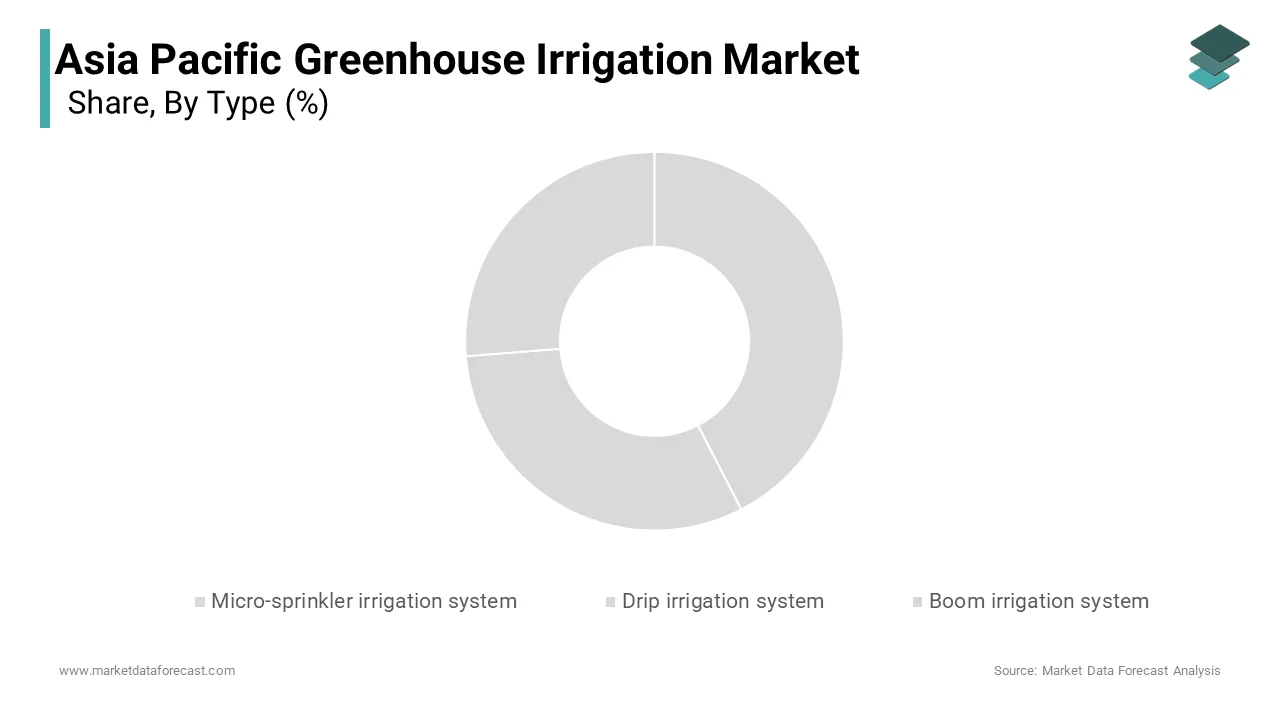
The micro-sprinkler irrigation systems segment is swiftly emerging with a CAGR of 14.7% from 2025 to 2033. Unlike traditional sprinklers, micro-sprinklers operate at low pressure and deliver fine droplets that minimize evaporation loss while ensuring even coverage. According to the Food and Agriculture Organization (FAO), micro-sprinkler systems can improve irrigation efficiency by up to 85%, which is making them ideal for cultivating nursery crops, ornamental plants, and certain fruit-bearing vines in controlled environments. Moreover, their adaptability to uneven terrain and compatibility with fertigation techniques have made them increasingly popular among commercial greenhouse operators. In Thailand and Vietnam, where greenhouse flower cultivation has expanded rapidly, micro-sprinkler systems are being widely adopted to maintain optimal humidity levels and enhance plant health.
By Application Insights
The vegetable application segment accounted in holding 47.4% of the Asia-Pacific Greenhouse Irrigation Systems Market share in 2024. Vegetable crops such as tomatoes, cucumbers, bell peppers, and lettuce are highly sensitive to water stress, making precision irrigation essential for maintaining yield quality and consistency. Additionally, urbanization and food security concerns have prompted governments to promote greenhouse-based vegetable farming in densely populated countries like China and India. As per the Chinese Academy of Agricultural Sciences, vegetable output from greenhouses increased by 22% between 2020 and 2023, with drip and micro-sprinkler irrigation playing a central role in optimizing water and nutrient delivery.
The flowers and ornamentals application segment is likely to experience a CAGR of 16.2% in the coming years. Precision irrigation is critical for maintaining aesthetic quality, bloom uniformity, and disease prevention in ornamental plants. According to the International Society for Horticultural Science (ISHS), improper watering practices can lead to up to 30% yield loss in greenhouse-grown flowers, reinforcing the importance of automated irrigation solutions. Countries like Thailand and Malaysia have seen a surge in export-oriented greenhouse flower farms, many of which utilize drip and micro-sprinkler systems to ensure optimal moisture levels. The Thai Department of Agriculture reported a 40% increase in greenhouse flower exports in 2023 compared to the previous year, attributing much of this success to improved irrigation management.
COUNTRY-LEVEL ANALYSIS
India Greenhouse Irrigation Systems Market Analysis
India was the top performer in the Asia-Pacific Greenhouse Irrigation Systems Market by capturing 25.3% of the share in 2024. A major driver is the implementation of national programs such as the Pradhan Mantri Krishi Sinchayee Yojana (PMKSY), which provides financial assistance for micro-irrigation systems, including drip and sprinkler setups. Additionally, rising domestic demand for off-season vegetables and fruits has spurred investment in greenhouse infrastructure. States like Maharashtra, Gujarat, and Karnataka have emerged as hotspots for commercial greenhouse farming integrated with precision irrigation.
China Greenhouse Irrigation Systems Market Analysis
China was ranked second in the Asia-Pacific Greenhouse Irrigation Systems Market by holding 22.3% of the share in 2024. One of the primary growth catalysts is the Smart Agriculture Development Plan, launched by the Chinese Ministry of Agriculture and Rural Affairs. Furthermore, China’s dominance in vegetable exports has reinforced the need for efficient water management systems. The National Engineering Research Center for Information Technology in Agriculture notes that greenhouse vegetable exports grew by 18% in 2023, largely due to the integration of automated irrigation technologies.
Japan Greenhouse Irrigation Systems Market Analysis
The Japan Greenhouse Irrigation Systems Market is expected to showcase the highest CAGR by the end of the forecast period. Japanese firms such as Kubota and Netafim Japan have pioneered AI-integrated irrigation controllers that optimize water use based on real-time sensor data. In addition, the Japanese government promotes sustainable farming through subsidies and R&D funding.
Australia Greenhouse Irrigation Systems Market Analysis
Australia's greenhouse irrigation systems market growth is driven by its focus on sustainable agriculture in a water-stressed environment. The country faces frequent droughts, prompting growers to adopt greenhouse farming with efficient irrigation to ensure reliable crop production. According to the Australian Bureau of Agricultural and Resource Economics and Sciences (ABARES), over 60% of greenhouse farms in the country use drip or micro-sprinkler systems to conserve water and enhance yield. The New South Wales Government also offers grants under the "Water Efficiency Program" to encourage farmers to switch to micro-irrigation. Additionally, Australia’s export-oriented horticulture sector relies heavily on greenhouse-grown vegetables and berries, necessitating precision irrigation to maintain international quality standards.
South Korea Greenhouse Irrigation Systems Market Analysis
South Korea's Greenhouse Irrigation Systems Market growth is due to its rapid adoption of smart agriculture technologies. The government has prioritized digital farming as part of its national food security strategy, leading to increased deployment of automated irrigation systems in greenhouse settings. According to the Rural Development Administration (RDA) of South Korea, over 1,200 smart greenhouses were installed nationwide in 2023, each equipped with IoT-enabled irrigation controllers for real-time water management. These systems are designed to integrate with AI analytics platforms that adjust irrigation schedules based on weather forecasts and soil conditions.
COMPETITIVE LANDSCAPE
The Asia-Pacific Greenhouse Irrigation Systems Market is marked by intense competition driven by the convergence of global agritech giants and regional manufacturers vying for dominance in a rapidly evolving landscape. Established multinational firms such as Netafim and Rain Bird bring extensive expertise and technological leadership, while local players like Jain Irrigation leverage cost advantages and deep-rooted distribution networks to capture market share.
Additionally, the growing integration of smart technologies such as IoT-enabled controllers, AI-based water scheduling, and remote monitoring systems is reshaping product offerings and service models. As demand for sustainable agriculture intensifies due to water scarcity and climate change, competition extends beyond product performance to include after-sales services, farmer education, and digital ecosystem integration. Governments also play a pivotal role through subsidies and policy incentives, further influencing market positioning.
KEY MARKET PLAYERS
Some of the major companies dominating the market, by their products and services, include
- Netafim Ltd.
- Nelson Irrigation Corporation
- Rivulis Irrigation Ltd.
- Valmont Industries Inc.
- Jain Irrigation Systems Ltd.
- The Toro Company
- EPC Industries Limited
- Lindsay Corporation
- Rain Bird Corporation
- Irritec S.P.A
TOP PLAYERS IN THE MARKET
- Netafim is a global leader in precision irrigation technology and a dominant force in the Asia-Pacific Greenhouse Irrigation Systems Market. The company has been instrumental in pioneering drip irrigation solutions that enhance water efficiency and crop yield. In the Asia-Pacific region, Netafim collaborates with governments and agricultural institutions to promote sustainable farming practices. Its localized product development and strong distribution network have made it a preferred choice for greenhouse operators seeking reliable and efficient irrigation systems.
- Jain Irrigation is a key player in the Asia-Pacific market, particularly in India and Southeast Asia. The company offers a comprehensive range of greenhouse irrigation products tailored to smallholder farmers and large agribusinesses alike. Known for its affordability and adaptability to regional farming conditions, Jain's systems are widely adopted under government-supported irrigation programs. Its commitment to research and farmer education has significantly contributed to the widespread adoption of micro-irrigation technologies across the region.
- Rain Bird is a globally recognized brand with a strong presence in the Asia-Pacific greenhouse irrigation sector. The company provides technologically advanced irrigation solutions, including smart controllers and automated drip systems suited for commercial greenhouse operations. Rain Bird’s emphasis on innovation and sustainability has positioned it as a trusted partner in modern agricultural development projects across the region. Its collaborations with local agritech firms help tailor solutions for diverse climatic and crop-specific needs.
Top Strategies Used By Key Market Participants
Localized Product Development and Customization
Leading players focus on designing irrigation systems that cater to specific regional climates, soil types, and crop requirements. This approach ensures better performance and higher adoption rates among local farmers and commercial growers.
Strategic Partnerships with Governments and Agritech Startups
Companies collaborate with governmental bodies and emerging agritech firms to integrate irrigation systems into national agricultural development plans and leverage digital farming platforms for enhanced system functionality.
Expansion of After-Sales Support and Farmer Training Programs
To improve customer retention and ensure effective system usage, companies are investing in technical support networks and training initiatives aimed at educating farmers on optimal irrigation practices and maintenance techniques.
RECENT MARKET NEWS
- In January 2024, Netafim launched a new line of solar-powered drip irrigation kits specifically designed for off-grid greenhouse farms in rural India, aiming to expand access to sustainable irrigation solutions for smallholder farmers.
- In March 2024, Jain Irrigation Systems announced a partnership with a leading agritech startup in Thailand to develop mobile app-based irrigation control systems that allow farmers to manage water schedules remotely using smartphones.
- In June 2024, Rain Bird Corporation introduced an AI-integrated irrigation controller in Japan, enabling real-time adjustments based on weather forecasts, soil moisture levels, and plant growth stages to optimize water usage in high-tech greenhouses.
- In September 2024, Lindsay Corporation (maker of RoadRunner Drip) expanded its distribution network into Vietnam, targeting commercial greenhouse operators seeking efficient, durable, and scalable irrigation solutions.
- In November 2024, Toro Ag & Turf, through its subsidiary Rubicon Water, launched a cloud-based irrigation analytics platform in Australia, allowing greenhouse managers to monitor water consumption patterns and receive predictive maintenance alerts.
MARKET SEGMENTATION
This research report on the Asia Pacific greenhouse market is segmented and sub-segmented into the following categories.
By Type
- Micro-sprinkler irrigation system
- Drip irrigation system
- Boom irrigation system
By Application
- Vegetables
- Fruit plants
- Flowers & ornaments
- Nursery crops
By Country
- India
- China
- Japan
- South Korea
- Australia
- New Zealand
- Thailand
- Malaysia
- Vietnam
- Philippines
- Indonesia
- Singapore
- Rest of APAC