- Product Description Description
- Table of Contents TOC
- List of Table & Figure LOT
- Get Free Sample PDF Sample PDF
Market Size, 2025
$316.54 MnMarket Estimate, 2026
$349.59 MnMarket Forecast, 2034
$773.70 MnCAGR, 2026–2034
10.44%Executive Summary: APAC Health Information Exchange Market
- Market Scope: Comprehensive Asia-Pacific (APAC) health information exchange market analysis covering exchange types, implementation models, setup configurations, core components, applications, end-user categories, and country-level dynamics.
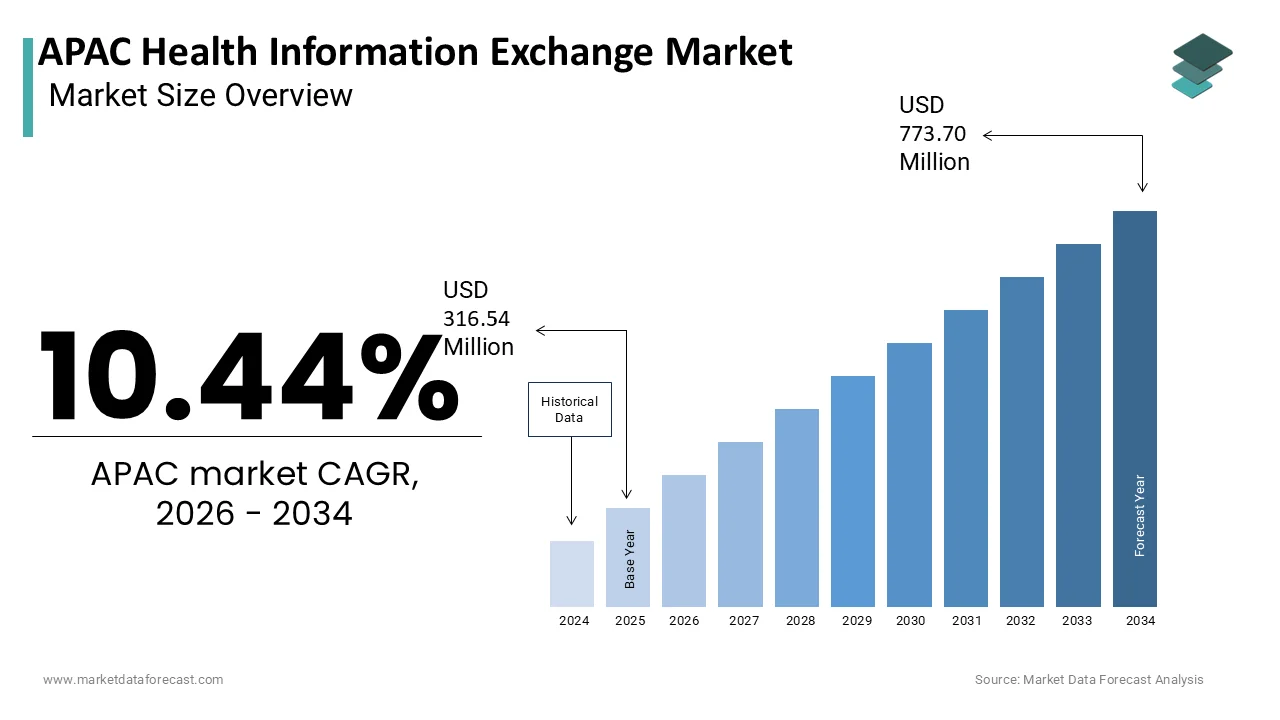
- Market Valuation: Valued at USD 316.54 million (2025), estimated at USD 349.59 million (2026), and projected to reach USD 773.70 million by 2034, registering a strong CAGR of 10.44% (2026–2034).
- Primary Growth Drivers: Decentralized treatments, increasing incidence of cardiac conditions and chronic disorders, rising government and non-government support through healthcare investments, expanding urban healthcare expenditure, and the rapid deployment of advanced healthcare technologies. Key challenges include technical support deficiencies in regional hospitals, data security/breach risks, and low rural digital health awareness.
Key Market Segment Metrics (2026–2034)
| Category | Leading Segment (2025 Position) | Fastest-Growing Segment |
|---|---|---|
| By Type | Query-Based Exchange (widely deployed for flexible, on-demand clinical record access) | Consumer-Mediated Exchange (driven by patient-centric portals and mobile health engagement) |
| By Implementation Model | Centralized/Consolidated Models (dominant due to unified data storage and efficient cross-facility reporting) | Hybrid & Decentralized/Federated Models (expanding to accommodate complex multi-site hospital networks) |
| By Setup Type | Private Setup (preferred by large enterprise hospital groups for robust internal data governance and security) | Public Setup (propelled by national digital health blueprints and government infrastructure investments) |
| By End-User | Healthcare Providers (primary adopters streamlining workflows, clinical data repositories, and patient safety) | Patients & Public Health Agencies (advancing via consumer portals and large-scale population health projects) |
| By Country | China (largest regional market share, backed by structured national health IT building blocks and major city rollouts like Shanghai) | Japan (estimated to grow the fastest during the forecast period driven by rapid EHR uptake and aging demographic care needs) |
Major Market Players & Market Structure
Market Structure: Dynamic healthcare IT landscape characterized by global health technology corporations and specialized regional software providers competing on interoperability frameworks, secure messaging infrastructure, compliance, and cloud integration.
Key Companies: Aetna Medcity, eClinical Works, RelayHealth, Medecision, Epic Corporation Inc., Cerner Corporation, RelayHealth Corporation, Infor Inc., Intersystems, Optum Inc., Alere Wellogic, NextGen Healthcare Information Systems, LLC, Covisint Corporation, Allscripts Healthcare Solutions Inc., and Orion Health.
APAC Health Information Exchange Market Size
The APAC Health Information Exchange Market is projected to grow from USD 316.54 million in 2025 to USD 349.59 million in 2026 and reach USD 773.70 million by 2034, registering a CAGR of 10.44% from 2026 to 2034.
The Asia-Pacific health information exchange market includes the digital integration, secure data transmission, and systemic interoperability of electronic health records across diverse clinical networks throughout countries such as Australia, China, Japan, and India. According to the World Health Organization regional digital health assessments, more than 75% of member states in the region have established national eHealth strategies to govern cross-institutional patient data sharing. According to the Asian Development Bank healthcare infrastructure bulletins, regional digital health investments expanded by 22% to support unified clinical connectivity across urban and rural medical facilities. These technological frameworks enable authorized healthcare providers to access longitudinal patient records instantly, reducing duplicate diagnostic testing and mitigating medical errors during emergency interventions. The regional market relies heavily on standardized data exchange protocols and scalable cloud infrastructure to connect fragmented hospital systems and public health registries into cohesive digital environments.
MARKET DRIVERS
Government Digital Health Mandates
The growing national digital health transformations and strict interoperability mandates propel the Asia-Pacific health information exchange market. According to the World Health Organization digital health governance reviews, national policy frameworks supporting electronic health data sharing expanded across 80% of regional economies, directly driving the adoption of the Asia-Pacific health information exchange market. According to the International Data Corporation health insights telemetry, government-led public health IT expenditures grew by 19%, heavily supporting the deployment infrastructure of the Asia-Pacific health information exchange market. Regional ministries of health increasingly mandate standardized electronic health record integration to eliminate paper-based record-keeping and streamline cross-hospital patient referrals. Public funding initiatives provide essential financial backing to rural and municipal clinics, enabling them to procure certified interoperability software and connect to national health data backbones. This top-down regulatory pressure guarantees sustained capital allocation and forces private healthcare providers to adopt standardized exchange protocols. Consequently, government-backed digital health policies act as the primary structural catalyst driving widespread integration across the Asia-Pacific health information exchange market.
Aging Demographics and Chronic Disease
Escalating population aging rates and the soaring prevalence of chronic diseases further expand the Asia-Pacific health information exchange market. According to the United Nations Economic and Social Commission for Asia and the Pacific demographic reports, the population aged 60 and above reached 650,000,000 individuals, creating a massive clinical demand burden that accelerates the growth of the Asia-Pacific health information exchange market. According to the World Health Organization's chronic disease surveillance updates, non-communicable diseases account for nearly 65% of all regional mortality, directly fueling the operational valuation of the Asia-Pacific health information exchange market. As multimorbid elderly patients frequently transition between primary care physicians, specialized clinics, and acute care hospitals, seamless clinical data transmission becomes an absolute necessity. Health information exchange platforms allow multidisciplinary care teams to review complete medication histories and historical diagnostic results in real time, preventing adverse drug interactions. This pressing clinical need for coordinated, continuous care management forces healthcare enterprises to invest heavily in robust data-sharing networks. Therefore, demographic shifts and high chronic disease burdens establish a permanent, high-volume demand foundation throughout the medical sector.
MARKET RESTRAINTS
High Capital Expenditure and Infrastructure Barriers
Prohibitive implementation costs and inadequate legacy IT infrastructure impede the Asia-Pacific health information exchange market. According to the Healthcare Information and Management Systems Society regional maturity studies, financial constraints and high software maintenance costs were cited by 58% of hospital administrators as the leading barrier hindering the deployment of the Asia-Pacific health information exchange market. According to the Asian Development Bank health technology audits, capital allocation gaps in secondary and tertiary care facilities delayed digital interoperability rollouts by an average of 18 months, directly restricting the growth velocity of the Asia-Pacific health information exchange market. Many small and medium-sized healthcare practices operate on tight financial margins, making it difficult to justify the heavy upfront costs associated with enterprise-grade interface engines and secure cloud migration. Furthermore, disparate legacy software systems used across different departments often require expensive custom-coded application programming interfaces to achieve basic data connectivity. These severe financial and structural hurdles restrict smaller institutions from participating in unified regional data networks. Consequently, high capital expenditure requirements remain a persistent bottleneck suppressing broader market penetration.
Severe Data Privacy and Cybersecurity Concerns
Heightened risks of data breaches and complex regional regulatory compliance frameworks hinder the Asia-Pacific health information exchange market. According to the International Criminal Police Organization cyber threat intelligence reports, targeted ransomware attacks against regional healthcare databases increased by 31%, creating a major security vulnerability that hampers the Asia-Pacific health information exchange market. According to the World Health Organization health data governance bulletins, disparate cross-border privacy laws across 25 regional jurisdictions created profound legal ambiguities that impede the operational scaling of the Asia-Pacific health information exchange market. Healthcare organizations handle highly sensitive patient information that represents a lucrative target for malicious cyber actors seeking unauthorized data monetization. The fear of catastrophic data leaks and subsequent regulatory penalties forces hospital boards to adopt overly restrictive data-sharing policies, which directly contradict the core objective of open health information exchange. Compliance teams must navigate overlapping federal privacy mandates and localization laws that complicate cloud-based data storage and multi-site transmission. Therefore, acute cybersecurity threats and legal fragmentation act as powerful psychological and operational restraints on market expansion.
MARKET OPPORTUNITIES
Cloud Computing and AI Integration
Expanding adoption of cloud-native architectures and artificial intelligence analytics presents a lucrative avenue in the Asia-Pacific health information exchange market. According to the International Data Corporation cloud services tracker, enterprise health IT cloud adoption across the region surged by 28%, opening significant growth channels within the Asia-Pacific health information exchange market. According to the World Health Organization digital innovation briefs, artificial intelligence-driven clinical decision support integrations in health information systems increased by 34%, directly validating the modernization potential of the Asia-Pacific health information exchange market. Modern cloud repositories allow healthcare providers to store massive volumes of unstructured medical data without investing in expensive physical data centers. Furthermore, artificial intelligence algorithms can parse through aggregated health information exchange data streams to identify high-risk patient cohorts, predict disease outbreaks, and recommend personalized treatment pathways. Vendors that successfully integrate scalable cloud infrastructure with predictive analytics tools can capture high-end enterprise clients seeking advanced population health management capabilities. This technological convergence unlocks powerful new commercial avenues for software developers and system integrators.
Public-Private Healthcare Partnerships
Rising collaborations between government bodies and private technology enterprises create significant prospects in the Asia-Pacific health information exchange market. According to the Asian Development Bank's private sector development reports, public-private partnership agreements in digital health infrastructure grew by 25%, establishing modern collaborative capabilities across the Asia-Pacific health information exchange market. According to the World Bank health financing reviews, multilateral funding injected into regional digital health joint ventures exceeded 1,200,000,000 dollars, directly strengthening the financial foundation of the Asia-Pacific health information exchange market. National governments frequently lack the internal software engineering capacity to build and maintain nationwide health data networks entirely on their own. By outsourcing platform development and maintenance to specialized private health tech firms, public health agencies can accelerate deployment timelines and leverage cutting-edge technical expertise. These collaborative ventures enable private vendors to secure massive government contracts while helping governments achieve universal health coverage goals. Consequently, strategic public-private synergies provide a clear pathway for large-scale market expansion and service commercialization.
MARKET CHALLENGES
Fragmented Data Standards and Interoperability Gaps
Inconsistent semantic standards and proprietary vendor information-blocking practices present severe hurdles challenging the Asia-Pacific health information exchange market. According to the International Organization for Standardization health informatics reports, lack of uniform data coding standards across multi-ethnic populations caused a 40% data translation failure rate, posing a critical technical challenge to the Asia-Pacific health information exchange market. According to the World Health Organization's digital health interoperability assessments, proprietary software lock-in practices by major electronic health record vendors increased by 22%, directly testing the operational openness of the Asia-Pacific health information exchange market. Different healthcare institutions often utilize conflicting data formats and proprietary coding schemas that prevent seamless semantic interoperability between distinct platforms. When clinical systems cannot translate incoming messages accurately, critical patient data becomes corrupted or remains trapped in isolated data silos. Commercial software vendors occasionally exploit these technical disparities to discourage hospital switching and protect their proprietary market shares. These deep-seated structural frictions demand continuous software customization and drive up integration costs for healthcare providers.
Severe Shortage of Skilled Health IT Professionals
Acute deficits in qualified informatics personnel and specialized technical talent further challenge the Asia-Pacific health information exchange market. According to the International Medical Informatics Association workforce surveys, regional healthcare facilities reported a 45% vacancy rate for certified health data analysts and interoperability specialists, severely challenging the human resource capacity of the Asia-Pacific health information exchange market. According to the World Health Organization human resources for health tracking briefs, specialized technical training programs fail to meet the expanding digital demands of clinical institutions by an estimated 35% gap, directly challenging the operational stability of the Asia-Pacific health information exchange market. Deploying, monitoring, and maintaining complex health information exchange networks requires highly trained database administrators, cybersecurity experts, and clinical informaticists. Rural and community hospitals struggle immensely to attract and retain skilled IT professionals who frequently migrate toward higher-paying technology and corporate sectors. This severe talent shortage leaves many health information exchange networks understaffed, leading to system downtime and prolonged maintenance backlogs. Therefore, chronic workforce deficiencies remain a formidable operational obstacle for the regional market.
REPORT COVERAGE
| REPORT METRIC | DETAILS |
| Market Size Available | 2025 to 2034 |
| Base Year | 2025 |
| Forecast Period | 2026 to 2034 |
| Segments Covered | By Type, Implementation Model, Setup Type, Application, and Region |
| Various Analyses Covered | Global, Regional, and Country-Level Analysis, Segment-Level Analysis, Drivers, Restraints, Opportunities, Challenges; PESTLE Analysis; Porter’s Five Forces Analysis, Competitive Landscape, Analyst Overview of Investment Opportunities |
| Countries Covered | IndiaChinaJapanSouth KoreaAustralia |
| Market Leaders Profiled | Aetna Medcity |
SEGMENTAL ANALYSIS
By Type Insights
The query-based exchange segment accounted for 46.4% of the Asia-Pacific health information exchange market share in 2025 due to its exceptional utility in emergency departments and unscheduled clinical care encounters. According to the International Data Corporation healthcare workflow studies, clinician utilization of query-based networks for retrieving historical patient records during acute admissions increased by 21%, solidifying the market leadership of this segment within the Asia-Pacific health information exchange market. According to the World Health Organization's digital hospital assessments, total transaction volumes processed through regional query-based exchange nodes exceeded 1,500,000,000 queries annually, directly fueling the dominant market share of this segment within the Asia-Pacific health information exchange market. Emergency physicians and hospitalists rely heavily on query-based search functions to pull vital allergy histories, past surgical notes, and laboratory results from external healthcare networks when patients arrive incapacitated. This on-demand retrieval mechanism eliminates informational blind spots without requiring continuous, automated data feeds between unrelated hospital groups. National health authorities universally prioritize query-based infrastructure for acute care integration, guaranteeing consistent institutional funding and high-volume daily utilization. This established clinical necessity ensures that query-based exchange maintains its preeminent market share position within the Asia-Pacific health information exchange market.
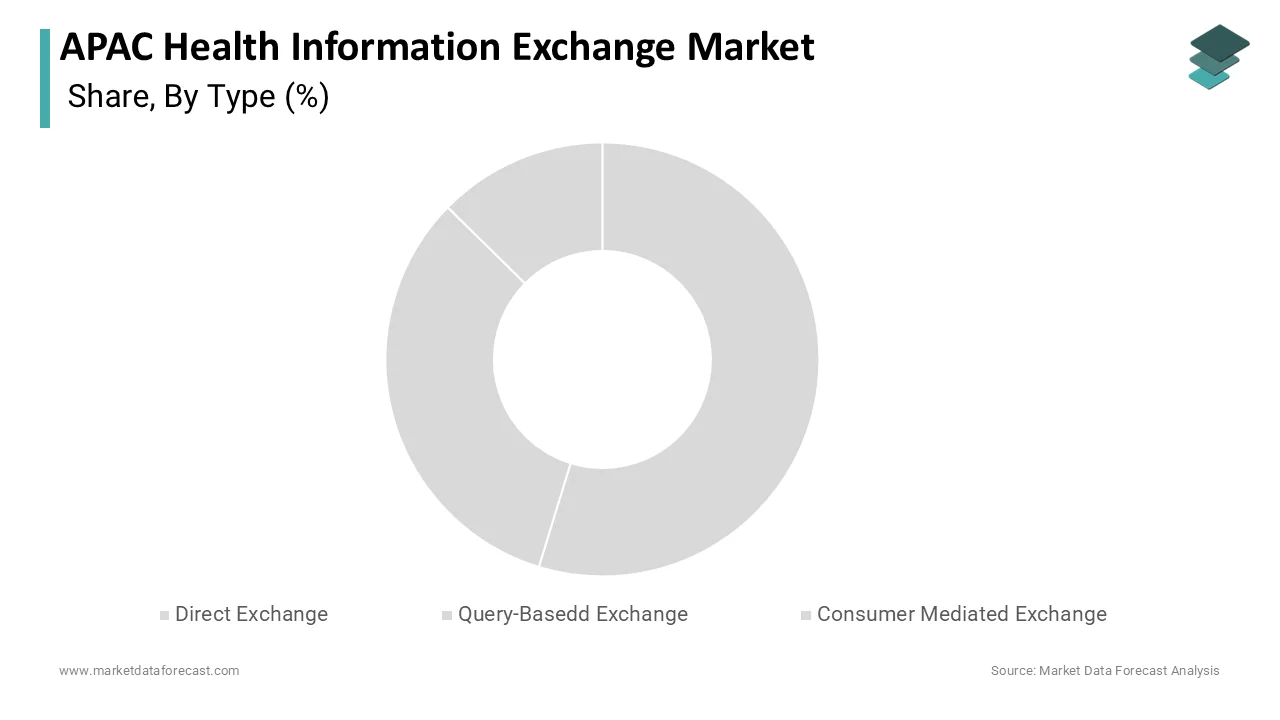
On the other end, the consumer-mediated exchange segment is anticipated to register a promising CAGR of 13.3% over the forecast period in this regional market owing to the proliferation of smartphone-based health applications and patient portal mandates. According to the World Health Organization mHealth adoption reports, citizen engagement rates with national digital health mobile applications rose by 32%, accelerating the adoption velocity of this segment within the Asia-Pacific health information exchange market. According to the International Data Corporation consumer technology trackers, regional downloads of interoperable personal health record applications surpassed 250,000,000 active users, directly driving the rapid developmental pace of this segment in the Asia-Pacific health information exchange market. Modern patients increasingly demand direct ownership and mobile access to their complete medical histories, laboratory reports, and vaccination certificates. Government-backed digital identity initiatives and national health portals empower individuals to aggregate their clinical data from multiple providers and securely share it with new specialists. The rapid expansion of smartphone penetration across emerging Asian economies has triggered exceptional demand for patient-centric data exchange tools. This surging consumer empowerment and mobile health trend explain why consumer-mediated exchange registers the fastest growth momentum across the Asia-Pacific health information exchange market.
By Implementation Model Insights
The centralized models segment led the market by capturing 50.5% of the regional market share in 2025. The growth of the centralized models segment in this regional market is mainly driven by their simplified governance structures and unified master patient index management. According to the World Health Organization national eHealth infrastructure reviews, regional public health agencies utilizing centralized data repositories for population surveillance grew by 18%, solidifying the market leadership of this segment within the Asia-Pacific health information exchange market. According to the Asian Development Bank healthcare digitization reports, centralized master patient index deployments accounted for over 60% of all government-funded interoperability grants, directly fueling the dominant market share of this segment within the Asia-Pacific health information exchange market. Public health ministries prefer centralized architectures because they maintain a single, highly secure data warehouse that simplifies regulatory compliance, auditing, and epidemiological tracking. Hospital administrators favor this model because it eliminates the technical complexities of peer-to-peer data routing and standardizes user authentication across entire regional health networks. This strong governmental backing and administrative simplicity ensure that centralized models maintain their preeminent market share position within the Asia-Pacific health information exchange market.
However, the hybrid model segment is predicted to expand at a prominent CAGR of 14.4% over the forecast period in this regional market owing to the growing need to balance local data security with scalable cross-regional connectivity. According to the International Data Corporation health tech surveys, enterprise hospital networks implementing hybrid data routing frameworks increased by 29%, accelerating the adoption velocity of this segment within the Asia-Pacific health information exchange market. According to the World Health Organization digital resilience bulletins, regional investments in distributed ledger and federated cloud storage nodes rose by 22%, directly driving the rapid developmental pace of this segment in the Asia-Pacific health information exchange market. Healthcare enterprises require local on-premises servers to store sensitive patient diagnostic images and real-time vital sign feeds while leveraging cloud nodes for national data queries. The hybrid model provides the ultimate compromise by keeping confidential records secure within local hospital perimeters while enabling frictionless data exchange across external health networks. This structural flexibility and resilience against single-point-of-failure risks explain why hybrid models register the fastest growth momentum across the Asia-Pacific health information exchange market.
By Setup Type Insights
The public setup segment led the Asia-Pacific health information exchange market with 56.5% of the regional market share in 2025. The dominance of the public setup segment in the Asia-Pacific market is primarily attributed to extensive government financing and nationwide public health digitalization mandates. According to the World Health Organization global health expenditure reports, public sector investments in state-managed health information networks exceeded 5,000,000,000 dollars, solidifying the market leadership of this segment within the Asia-Pacific health information exchange market. According to the Asian Development Bank infrastructure development metrics, government-backed public health exchange nodes expanded across 45 regional provinces, directly fueling the dominant market share of this segment within the Asia-Pacific health information exchange market. National governments deploy public HIE frameworks to connect municipal clinics, county hospitals, and major research centers into a single cohesive network designed to manage infectious disease outbreaks and coordinate public health interventions. Public setups ensure that low-income and rural populations retain free access to essential health data exchange services without commercial subscription barriers. This universal public health mandate ensures that public setups maintain their preeminent market share position within the Asia-Pacific health information exchange market.
However, the private setup segment is estimated to register a CAGR of 13.5% over the forecast period in this regional market owing to the rapid expansion of private hospital chains and corporate healthcare networks. According to the International Data Corporation enterprise health intelligence surveys, private hospital group investments in proprietary multi-facility data exchange platforms rose by 26%, accelerating the adoption velocity of this segment within the Asia-Pacific health information exchange market. According to the World Health Organization's private healthcare sector reviews, commercial healthcare acquisitions and integrated delivery network formations increased by 19%, directly driving the rapid developmental pace of this segment in the Asia-Pacific health information exchange market. Large private healthcare conglomerates operate dozens of multi-specialty hospitals across urban centers and require proprietary private HIE networks to streamline patient transfers and internal billing operations. Private setups offer customized workflows, advanced specialty analytics, and tight integration with commercial insurance providers that public systems rarely match. This commercial agility and heavy corporate investment explain why private setups register the fastest growth momentum across the Asia-Pacific health information exchange market.
By Application Insights
The internal interfacing segment accounted for 40.7% of the regional market share in 2025. The growth of the internal interfacing segment is mainly attributed to the critical need to connect disparate departmental silos within large multi-facility hospital complexes. According to the International Data Corporation hospital IT performance benchmarks, internal system integration projects aimed at linking electronic health records with laboratory and pharmacy modules increased by 19%, solidifying the market leadership of this segment within the Asia-Pacific health information exchange market. According to the World Health Organization hospital management statistics, over 70% of regional tertiary care facilities prioritized internal interface engine upgrades to streamline clinical workflows, directly fueling the dominant market share of this segment within the Asia-Pacific health information exchange market. Hospital administrators recognize that seamless internal data flow between radiology, pathology, and inpatient wards is the foundational prerequisite before attempting external data sharing with other health networks. Internal interfacing tools eliminate manual transcription errors and accelerate turnaround times for critical diagnostic results. This indispensable operational utility ensures that internal interfacing maintains its preeminent market share position within the Asia-Pacific health information exchange market.
However, the secure messaging segment is projected to grow at the fastest CAGR of 14.4% over the forecast period in this regional market owing to the rapid adoption of mobile clinical communication tools and telemedicine platforms. According to the World Health Organization mHealth adoption reports, clinician utilization of encrypted messaging applications for real-time specialist consultations rose by 35%, accelerating the adoption velocity of this segment within the Asia-Pacific health information exchange market. According to the International Data Corporation health communication trackers, regional enterprise investments in HIPAA-compliant and regional privacy-compliant messaging infrastructure surpassed 850,000,000 dollars, directly driving the rapid developmental pace of this segment in the Asia-Pacific health information exchange market. Healthcare professionals increasingly rely on instant, secure messaging protocols to transmit diagnostic images, discuss complex patient cases, and coordinate discharge planning across dispersed care teams. The surge in virtual care consultations and remote patient monitoring programs has amplified the daily volume of clinical text communications. This surging demand for instant, compliant clinician collaboration explains why secure messaging registers the fastest growth momentum across the Asia-Pacific health information exchange market.
COUNTRY LEVEL ANALYSIS
China Health Information Exchange Market Analysis
China held 30.9% of the Asia-Pacific health information exchange market share in 2025 through aggressive national health informatics policies and massive government-led hospital digitalization. According to the National Health Commission of China statistical reports, national healthcare IT infrastructure investments exceeded 12,000,000,000 dollars, establishing a robust operational standing within the North America and Asia-Pacific regional landscapes. According to the World Health Organization country health profiles, over 85% of tertiary hospitals across Chinese provinces successfully achieved advanced regional health information network integration, directly supporting the exponential growth metrics of the Asia-Pacific health information exchange market. Supported by state-directed economic planning, rigorous national coding standards, and extensive municipal health cloud deployments, Chinese markets maintain cutting-edge commercialization pipelines. Domestic technology leaders successfully leverage massive patient volume data to supply high-value provincial exchange platforms, positioning China as the undeniable revenue leader and technological benchmark of the Asia-Pacific health information exchange market.
Japan Health Information Exchange Market Analysis
Japan occupies a highly advanced position characterized by universal health insurance coverage and sophisticated geriatric care data networks within the Asia-Pacific health information exchange market. According to the Ministry of Health, Labour and Welfare of Japan statistical bulletins, national budget allocations directed toward My Number card health insurance integration rose by 18%, reinforcing its elite market position in the Asia-Pacific health information exchange market. According to the Japanese Association of Healthcare Information Systems annual operational reviews, nationwide deployments of standardized electronic medical record exchange gateways increased by 22%, driving steady clinical progress within the Asia-Pacific health information exchange market. Japanese prefectures maintain highly coordinated public health frameworks that ensure seamless data sharing between aging-care facilities and acute municipal hospitals. This collaborative regulatory environment, paired with world-class biomanufacturing and medical device clusters located in Tokyo and Osaka, ensures that Japanese medical institutions enjoy reliable access to cutting-edge interoperability solutions within the Asia-Pacific health information exchange market.
India Health Information Exchange Market Analysis
India maintains a rapidly expanding position fueled by massive population volumes and transformative national digital health mission initiatives within the Asia-Pacific health information exchange market. According to the Ministry of Health and Family Welfare of India's operational statistics, the Ayushman Bharat Digital Mission successfully linked over 500,000,000 citizen health IDs to interoperable data registries, securing a competitive regional posture within the Asia-Pacific health information exchange market. According to the World Bank health sector financing reports, national digital health investments across Indian states grew by 30%, continuously bolstering the geographic footprint of the Asia-Pacific health information exchange market. Rapid economic development, expanding smartphone penetration, and government-led public health platforms are driving unprecedented demand for decentralized health information exchange networks. Domestic technology enterprises are scaling up local software solutions to supply low-cost, high-efficiency data exchange modules, successfully transforming India into the fastest-growing operational hub in the region with an expected regional CAGR of 14.2%.
Australia Health Information Exchange Market Analysis
Australia represents an exceptionally mature regional healthcare market supported by robust federal digital health strategies and advanced clinical interoperability standards within the Asia-Pacific health information exchange market. According to the Australian Institute of Health and Welfare operational summaries, federal funding channeled through the My Health Record expansion initiative exceeded 1,500,000,000 dollars, establishing a vital economic and technological stronghold for the Asia-Pacific health information exchange market. According to the Commonwealth Department of Health and Aged Care development indexes, regional hospital network investments in secure Fast Healthcare Interoperability Resources APIs rose by 16%, significantly contributing to the technological elevation of the Asia-Pacific health information exchange market. Australian health authorities utilize centralized clinical governance frameworks to negotiate secure data transmission protocols across public and private sectors, ensuring high health data equity across metropolitan and remote regional communities. By actively upgrading statewide clinical data repositories, Australia continues to strengthen its self-sufficiency and market resilience within the Asia-Pacific health information exchange market.
South Korea Health Information Exchange Market Analysis
South Korea functions as a highly digitized technological frontier characterized by ultra-fast broadband connectivity and government-backed smart hospital initiatives within the Asia-Pacific health information exchange market. According to the Ministry of Health and Welfare of South Korea regional health advisories, national smart hospital and clinical data lake projects successfully connected over 40 major medical centers, creating a disruptive positive impact within the Asia-Pacific health information exchange market. According to the Korea Health Industry Development Institute performance reviews, commercial export contracts for advanced health information exchange software grew by 25%, heavily expanding the inclusive reach of the Asia-Pacific health information exchange market. Government bodies across the country are partnering with leading electronics and software conglomerates to build artificial intelligence-driven medical data sharing hubs that overcome traditional institutional silos. By integrating advanced genomic data and real-time electronic health record streaming into national health schedules, South Korea is rapidly increasing its baseline technological sophistication, establishing a vital long-term innovation frontier within the Asia-Pacific health information exchange market.
COMPETITIVE LANDSCAPE
Competition in the Asia-Pacific health information exchange market is defined by intense rivalry among a small group of multinational health technology giants and specialized software vendors controlling the vast majority of commercial system volume. Market dynamics are heavily influenced by high barriers to entry, including stringent healthcare data compliance standards, massive capital requirements for enterprise integration infrastructure, and complex cross-border regulatory frameworks. While established market leaders dominate large public hospital sectors through economies of scale, regional specialty software firms are increasingly disrupting traditional pricing models by supplying customized cloud-native alternatives. Technological disruption remains a core competitive battleground, with firms racing to transition from legacy point-to-point interfaces toward advanced FHIR-based API platforms. Strategic asset acquisitions, intellectual property management, and bidding wars for lucrative government digital health tenders continuously reshape the competitive hierarchy, resulting in a highly consolidated yet fiercely contested market environment.
KEY MARKET PLAYERS
Some of the companies that are playing a dominating role in the APAC Health Information Exchange Market include:
- Aetna Medcity
- eClinicalWorks
- RelayHealth
- Medecision
- Epic Corporation, Inc.
- Cerner Corporation
- Infor, Inc.
- InterSystems
- Optum, Inc.
- Alere Wellogic
- NextGen Healthcare Information Systems, LLC
- Covisint Corporation
- Allscripts Healthcare Solutions, Inc.
- Orion Health
TOP LEADING PLAYERS IN THE MARKET
- Dedalus S.p.A. contributes extensively to the market through the large-scale global commercialization of specialized clinical data repositories and advanced regional health information exchange architectures. The company actively participates in the market by expanding its high-capacity software engineering hubs and partnering with international health agencies to supply scalable interoperability solutions. Recent actions to strengthen its market position include completing advanced processing upgrades at its primary healthcare IT facilities and securing expanded commercial distribution agreements across Asia-Pacific hospital networks.
- Infor Inc. maintains a vital contribution to the market by producing essential enterprise resource planning software and clinical data exchange frameworks that serve industrial healthcare applications. The company actively participates in the market by investing heavily in cloud-native middleware technologies and optimizing global supply chain distribution networks. Recent actions to strengthen its market position include increasing production capacity at its main software development plants and initiating strategic distribution alliances across Asia-Pacific healthcare and clinical research sectors.
- InterSystems Corporation contributes significantly to the market through pioneering research in high-performance database management and seamless health data interoperability engines. The company actively participates in the market by collaborating with regional research institutions to evaluate novel data parsing applications and enhance transaction speed characteristics. Recent actions to strengthen its market position include launching comprehensive commercial sustainability initiatives and receiving priority regulatory designations for innovative healthcare data integration platforms.
TOP STRATEGIES USED BY KEY MARKET PARTICIPANTS
Key market participants in the Asia-Pacific health information exchange market deploy sophisticated strategic initiatives to maintain competitive advantages and navigate complex regulatory landscapes. Companies frequently establish strategic public-private partnerships and long-term software supply contracts with national health ministries to secure guaranteed, high-volume government procurement orders. Organizations heavily invest in cloud-native data monitoring systems and advanced Fast Healthcare Interoperability Resources standards to mitigate semantic data mapping risks in diverse regional markets. Industry leaders prioritize diversified product portfolios by building specialized modular integration lines to supply custom software solutions tailored to exact hospital specifications. Furthermore, key players actively pursue expansion through strategic mergers, targeted distribution partnerships, and aggressive research and development spending on artificial intelligence and secure messaging platforms to stay ahead of evolving healthcare trends.
ASIA-PACIFIC HEALTH INFORMATION EXCHANGE MARKET NEWS
In April 2024, Dedalus S.p.A., a healthcare software provider, acquired MediSolution, a clinical management software company. This acquisition is anticipated to allow Dedalus S.p.A. to offer more comprehensive interoperability solutions and strengthen the Asia-Pacific health information exchange market.
In July 2024, Infor Inc. formed a strategic distribution alliance with a major Asia-Pacific health technology distributor. This partnership is expected to allow Infor Inc. to streamline cloud data transport and strengthen the Asia-Pacific health information exchange market.
In October 2024, InterSystems Corporation initiated a multi-center clinical evaluation protocol across several regional research hospitals. This clinical milestone is projected to allow InterSystems Corporation to evaluate novel data exchange formulations and strengthen the Asia-Pacific health information exchange market.
In January 2025, Philips Healthcare secured expanded regulatory review status for advanced clinical data analytics platforms through international health authorities. This regulatory milestone is designed to allow Philips Healthcare to accelerate commercial patient access and strengthen the Asia-Pacific health information exchange market.
In March 2025, Oracle Health completed the acquisition of a regional health informatics hub to localize software engineering production. This operational expansion is predicted to allow Oracle Health to reduce integration bottlenecks and strengthen the Asia-Pacific health information exchange market.
MARKET SEGMENTATION
This research report has been segmented and sub-segmented into the following categories.
By Type
- Direct Exchange
- Query-Basedd Exchange
- Consumer Mediated Exchange
By Implementation Model
- Centralized/Consolidated Models
- Decentralized/Federated Models
- Hybrid Model
By Setup Type
- Private
- Public
By Application
- Internal Interfacing
- Secure Messaging
- Workflow management
- Web Portal Development
- Patient Safety
By Component-based
- Enterprise Master Person Index (EMPI)
- Healthcare Provider Directory (HPD)
- Record Locator Service (RLS)
- Clinical Data Repository
By End-User
- Healthcare provider
- Public Health Agency
- Medical Research Institution
- Medical Professional
- Patient
By Country
- India
- China
- Japan
- South Korea
- Australia
- New Zealand
- Thailand
- Malaysia
- Vietnam
- Philippines
- Indonesia
- Singapore
- Rest of APAC