Asia Pacific High Speed Blowers Market Size, Share, Growth, Trends, And Forecast Research Report, Segmented By Technology, End-User, And Country (India, China, Japan, South Korea, Australia, New Zealand, Thailand, Malaysia, Vietnam, Philippines, Indonesia, Singapore and Rest of APAC), Industry Analysis From (2026 to 2034)
Market Size, 2025
$217.92 MnMarket Estimate, 2026
$233.98 MnMarket Forecast, 2034
$413.28 MnCAGR, 2026–2034
7.37%Executive Summary: Asia Pacific High Speed Blowers Market
- Market Scope: Comprehensive regional market analysis covering technology types, end-use sectors, country-level leadership frameworks, and wastewater treatment/industrial pneumatic metrics for the Asia-Pacific high-speed blowers sector.
- Market Valuation: Valued at USD 217.92 million (2025), estimated at USD 233.98 million (2026), and projected to reach USD 413.28 million by 2034, registering a robust CAGR of 7.37% (2026–2034).
- Primary Growth Drivers: Wastewater treatment infrastructure expansion, industrial pneumatic conveying systems, stringent environmental energy-efficiency regulations, food processing/chemical manufacturing demand, and smart city/IoT-enabled monitoring investments. Market challenges include high initial investment costs and rural technical expertise limitations, while opportunities lie in magnetic bearing efficiency, chemical manufacturing growth, and urban sanitation initiatives.
Key Market Segment Metrics (2026–2034)
| Category | Leading Segment Position | Fastest-Growing Segment |
|---|---|---|
| By Technology / End-Use | Airfoil bearings segment (dominated with 58.2% share in 2025 for reliability) & Water & wastewater treatment segment (held largest share of 45.3% in 2025 across over 5,000 facilities in China) | Magnetic bearings segment (projected CAGR of 13.6% from 2025–2033 driven by energy efficiency) & Chemical & petrochemical segment (expected CAGR of 12.4%) |
| By Region / Country | China (largest national market commanding 30.3% share in 2025 supported by industrial base and wastewater mandates) | India (held second position with 20.3% share driven by initiatives like the Jal Jeevan Mission) |
Major Market Players & Market Structure
Market Structure: Highly competitive Asia-Pacific high-speed blowers landscape centering on innovative airfoil/magnetic bearing technology launches, regional manufacturing expansions, municipal wastewater strategic engineering alliances, and digital monitoring systems.
Key Companies: AERZEN Maschinenfabrik GmbH, APG-Neuros, Atlas Copco, Fuji Electric Co., Ltd., Gardner Denver, Howden Group, Raetts Group, Shandong Zhangqiu Blower Co., Ltd., United Blowers Inc., Spencer Turbine Company, Xylem Inc., Ingersoll Rand, Hitachi Ltd., Piller Blowers & Compressors GmbH, Hoffman & Lamson, Ebara Corporation, and Kobelco Eco-Solutions.
Asia Pacific High Speed Blowers Market Size
The Asia Pacific high-speed blowers market was valued at USD 217.92 million in 2025 and is anticipated to reach a valuation of USD 233.98 million in 2026 and USD 413.28 million by 2034, growing at a CAGR of 7.37%, from 2026 to 2034.
High-speed blowers are a specialized industrial air-moving equipment that operates at significantly higher rotational speeds than conventional blowers, delivering enhanced efficiency and compact design. These blowers are widely used in wastewater treatment, pneumatic conveying, food processing, chemical processing, and energy generation, where continuous and high-volume air flow is essential. Additionally, as per the United Nations Economic and Social Commission for Asia and the Pacific, rapid urbanization is leading to increased demand for modern wastewater management systems, further supporting the adoption of high-efficiency air-moving technologies.
MARKET DRIVERS
Expansion of Wastewater Treatment Infrastructure
The rapid expansion of wastewater treatment infrastructure across the region is fuelling the growth of the Asia Pacific high-speed blowers market. Governments are investing heavily in modernizing sewage and industrial wastewater treatment facilities as urbanization accelerates and environmental regulations become more stringent. In China, the Ministry of Ecology and Environment has mandated stricter discharge standards for industrial and municipal wastewater, which is leading to a surge in the adoption of energy-efficient aeration systems that rely on high-speed blowers. High-speed blowers with their lower energy consumption and reduced maintenance needs are increasingly being preferred over traditional blower technologies.
Increasing Adoption in Industrial Pneumatic Conveying Systems
The growing adoption of these systems in industrial pneumatic conveying applications is also driving the growth of the Asia Pacific high-speed blowers market. Pneumatic conveying is widely used in sectors such as food processing, pharmaceuticals, cement, and chemical manufacturing to transport bulk materials through pipelines using air pressure. High-speed blowers offer distinct advantages in these applications, including reduced energy consumption, compact design, and higher operational efficiency compared to conventional systems. According to the Food and Agriculture Organization, the Asia Pacific region accounts for nearly 40% of global food processing activities, with countries like Thailand, Vietnam, and China leading in the production and export of processed food products.
MARKET RESTRAINTS
High Initial Investment and Equipment Costs
The high initial investment and equipment costs associated with these systems are restricting the growth of the Asia Pacific high-speed blowers market. Compared to conventional blower technologies, high-speed blowers, especially those with magnetic or air bearings, require significant capital expenditure due to their advanced engineering and precision components. According to the International Energy Agency, the upfront cost of a high-speed blower can be up to 50% higher than that of a traditional centrifugal blower by making it a barrier for small and medium-sized enterprises (SMEs). In countries like India, Indonesia, and the Philippines, where budget constraints are a major concern for municipal and industrial projects, the high cost of high-speed blowers often leads to the continued use of older, less efficient systems.
Limited Availability of After-Sales Support and Technical Expertise
The limited availability of after-sales support and technical expertise in certain parts of the region will additionally hinder the growth of the Asia Pacific high-speed blowers market. High-speed blowers, particularly those with magnetic bearings and advanced control systems, require specialized maintenance, diagnostics, and repair services, which are not widely available in rural and semi-urban areas. According to the Association of Southeast Asian Nations (ASEAN) Industrial Development Outlook, many countries in the region face challenges in developing a skilled workforce capable of handling advanced industrial equipment. In India, despite the presence of a growing industrial base, after-sales service networks for high-speed blowers remain concentrated in major cities, leaving a gap in rural and regional markets. These limitations in service infrastructure and technical expertise hinder the broader adoption of high-speed blowers in countries where maintenance and repair capabilities are still developing.
MARKET OPPORTUNITIES
Growth of Green and Energy-Efficient Industrial Practices
The growing adoption of green and energy-efficient industrial practices is creating new opportunities for the growth of the Asia Pacific high-speed blowers market. Governments and industries across the region are increasingly prioritizing energy conservation and emissions reduction, aligning with global sustainability goals. According to the International Renewable Energy Agency, the Asia Pacific region is expected to account for over 50% of global energy efficiency investments by 2030. In China, the Ministry of Industry and Information Technology has introduced energy efficiency standards for industrial equipment, encouraging manufacturers to adopt high-speed blowers that offer lower power consumption and reduced carbon footprints. Additionally, in Australia, industrial operators in the mining and food processing sectors are increasingly adopting high-speed blowers to meet corporate sustainability targets and reduce operational costs.
Increasing Demand for Smart and Connected Blower Systems
The rising demand for smart and connected blower systems that integrate digital monitoring, predictive maintenance, and real-time performance analytics is additionally to further escalate the growth of the Asia Pacific high-speed blowers market. According to the World Economic Forum, the Asia Pacific region is among the fastest adopters of smart industrial technologies, with countries like South Korea, Singapore, and Japan leading in digital manufacturing integration. This trend toward smart and connected blower systems presents a lucrative opportunity for manufacturers in the Asia Pacific region, as industries seek advanced, data-driven solutions to enhance operational efficiency.
MARKET CHALLENGES
Regulatory and Compliance Variability Across the Region
The variability in regulatory and compliance standards across different countries is a challenging factor for the growth of the Asia Pacific high-speed blowers market. According to the United Nations Economic and Social Commission for Asia and the Pacific, regulatory harmonization remains a challenge in the region, with countries like China, India, and Indonesia implementing distinct standards for industrial equipment. In China, the Ministry of Ecology and Environment has introduced strict emissions control policies, requiring blowers to meet high energy efficiency benchmarks. These regulatory discrepancies increase compliance costs and delay market entry, posing a significant challenge for companies seeking to expand their presence across the Asia Pacific high-speed blowers market.
Supply Chain and Component Availability Constraints
The supply chain and component availability constraints, particularly for high-tech components such as magnetic bearings, variable frequency drives, and precision control systems. Many of these components are sourced from a limited number of global suppliers, making the market vulnerable to disruptions in the global supply chain. In 2022, the shortage of electronic components affected multiple industries, including industrial equipment manufacturing, which is delaying product deliveries and increasing production costs. In China, where a significant portion of industrial blower manufacturing takes place, companies have reported difficulties in sourcing high-quality magnetic bearings and control modules due to global supply bottlenecks. These supply chain challenges not only affect production timelines but also impact pricing strategies, which is making it difficult for manufacturers to maintain consistent cost structures across different markets in the Asia Pacific region.
REPORT COVERAGE
| REPORT METRIC | DETAILS |
| Market Size Available | 2025 to 2034 |
| Base Year | 2025 |
| Forecast Period | 2026 to 2034 |
| CAGR | 7.37% |
| Segments Covered | By Technology, End-User, and By Country |
| Various Analyses Covered | Global, Regional & Country Level Analysis, Segment-Level Analysis, DROC, PESTLE Analysis, Porter’s Five Forces Analysis, Competitive Landscape, Analyst Overview on Investment Opportunities |
| Regions Covered | India, China, Japan, South Korea, Australia, New Zealand, Thailand, Malaysia, Vietnam, Philippines, Indonesia, Singapore, and the Rest of APAC |
| Market Leaders Profiled | AERZEN Maschinenfabrik GmbH, APG-Neuros, Atlas Copco, Fuji Electric Co., Ltd., Gardner Denver, Howden Group, Raetts Group, Shandong Zhangqiu Blower Co., Ltd., United Blowers Inc., Spencer Turbine Company, Xylem Inc., Ingersoll Rand, Hitachi Ltd., Piller Blowers & Compressors GmbH, Hoffman & Lamson |
SEGMENTAL ANALYSIS
By Technology Insights
The airfoil bearings segment was the largest and held 58.2% of the Asia Pacific high-speed blowers market share in 2025, with the widespread use of airfoil bearing-based high-speed blowers in municipal wastewater treatment and industrial aeration applications, where cost-effectiveness and proven reliability are key considerations. According to the United Nations Economic and Social Commission for Asia and the Pacific, rapid urbanization and increasing investments in sanitation infrastructure have led to a surge in wastewater treatment plant installations across the region. Additionally, in Southeast Asia, countries like Indonesia and the Philippines are increasingly deploying airfoil bearing-based systems in municipal projects due to their compatibility with existing infrastructure and ease of integration.
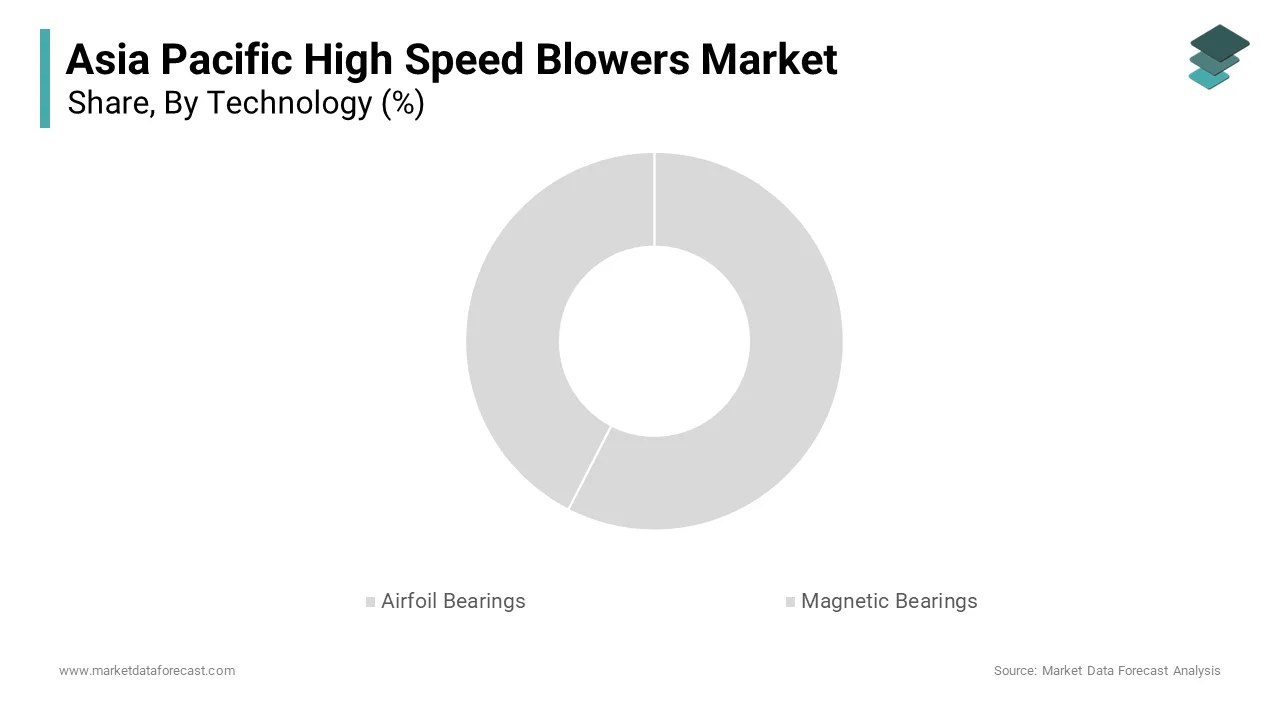
The magnetic bearings segment is expected to grow with an expected CAGR of 13.6% from 2025 to 2033, owing to the increasing adoption of magnetic bearing-based blowers in high-precision industrial applications in chemical processing, power generation, and advanced wastewater treatment systems. According to the International Energy Agency, magnetic bearing technology offers up to 30% higher energy efficiency compared to traditional bearing systems, which is making it an attractive option for industries aiming to reduce operational costs and carbon emissions.
By End Use Insights
The water & wastewater treatment segment accounted in holding 45.3% of the Asia Pacific high speed blowers market share in 2025, with the rapid urbanization, growing population, and increasing investments in sanitation infrastructure. In China, the Ministry of Ecology and Environment has mandated stricter wastewater discharge standards, leading to a surge in the deployment of energy-efficient aeration systems that rely on high-speed blowers. The country has been investing heavily in upgrading municipal wastewater treatment plants, with over 5,000 facilities in operation as of 2023. In Indonesia and the Philippines, government-led sanitation programs have spurred demand for modern wastewater infrastructure.
The chemical & petrochemical segment is likely to grow with a CAGR of 12.4% from 2025 to 2033, owing to the expanding chemical manufacturing sector and the need for efficient air-moving solutions in production processes such as oxidation, aeration, and gas compression. In China, the National Development and Reform Commission has been promoting the development of high-tech chemical parks, where energy-efficient air-moving equipment, such as high-speed blowers, is increasingly being adopted. Additionally, in Japan and South Korea, chemical manufacturers are adopting magnetic bearing-based high-speed blowers to reduce energy consumption and maintenance costs.
COUNTRY ANALYSIS
China
China was the top performer of the Asia Pacific high-speed blowers market by accounting for 30.3% the hare in 2025 with its massive industrial base, extensive wastewater treatment infrastructure, and aggressive government policies promoting energy-efficient industrial equipment. According to the Ministry of Housing and Urban-Rural Development, China has over 5,000 wastewater treatment plants, with new facilities being commissioned annually to meet rising urban sanitation demands. Additionally, the National Development and Reform Commission has been promoting the development of high-tech industrial parks, where chemical, pharmaceutical, and food processing industries rely on high-speed blowers for process air applications.
India
India ranked second by holding 22.3% of the Asia Pacific high-speed blowers market share in 2025. According to the Ministry of Jal Shakti, over 500 new sewage treatment plants were commissioned between 2020 and 2023 under the Jal Jeevan Mission and the National River Conservation Plan. These facilities increasingly integrate high-speed blowers for aeration and process air applications, boosting market demand. Additionally, the Bureau of Energy Efficiency has introduced energy-saving incentives under the Perform, Achieve, and Trade (PAT) scheme, encouraging industries to adopt high-efficiency blower systems. In the industrial sector, the Production-Linked Incentive (PLI) scheme for the chemical and pharmaceutical industries has led to the establishment of new manufacturing units that rely on high-speed blowers for efficient air-moving solutions.
Japan
high-speed blowers market growth is driven by the high technological adoption and a strong emphasis on industrial efficiency in chemical manufacturing, semiconductor fabrication, and wastewater treatment. According to the Ministry of Economy, Trade, and Industry, Japan has been a global leader in adopting energy-efficient industrial technologies, with a particular focus on magnetic bearing-based high-speed blowers. Additionally, Japan’s wastewater treatment infrastructure is among the most advanced in the region, with over 90% of the population connected to sewage systems, as reported by the Ministry of Land, Infrastructure, Transport, and Tourism. The country’s stringent environmental regulations and focus on sustainable manufacturing practices have further reinforced the demand for high-speed blowers.
South Korea
high-speed blowers market growth is likely to have steady growth in the coming year, with the strong industrial base and government-led smart manufacturing initiatives contributing to the increasing adoption of high-speed blowers in chemical processing, semiconductor manufacturing, and wastewater treatment. According to the Korea Institute of Industrial Technology, the country’s smart factory initiative has led to a surge in the adoption of energy-efficient industrial equipment, including high-speed blowers with magnetic bearings. In the chemical and pharmaceutical sectors, South Korean manufacturers are increasingly adopting high-speed blowers for precision aeration and gas transfer applications. Additionally, the country’s wastewater treatment infrastructure has been modernized with the deployment of high-efficiency aeration systems, aligning with national sustainability goals.
Australia
Australia's high-speed blowers market growth is driven by its extensive mining and mineral processing industries, where high-speed blowers are used for aeration, pneumatic conveying, and combustion air supply. According to the Department of Industry, Science and Resources, the Australian mining sector contributes over AUD 240 billion annually to the economy, with companies increasingly adopting energy-efficient industrial equipment to reduce operational costs and carbon emissions. High-speed blowers with magnetic bearings are gaining traction in mineral processing plants due to their low maintenance requirements and high efficiency. Additionally, the country’s wastewater treatment sector is undergoing modernization, with new facilities incorporating high-speed blowers to meet environmental compliance standards. In the food and beverage industry, manufacturers are also adopting high-speed blowers for clean air applications in packaging and drying processes.
KEY MARKET PLAYERS
AERZEN Maschinenfabrik GmbH, APG-Neuros, Atlas Copco, Fuji Electric Co., Ltd, Gardner Denver, Howden Group, Raetts Group, Shandong Zhangqiu Blower Co., Ltd., United Blowers Inc., Spencer Turbine Company, Xylem Inc., Ingersoll Rand, Hitachi Ltd., Piller Blowers & Compressors GmbH, Hoffman & Lamson. Are the market players that are dominating the Asia Pacific high-speed blowers market?
Top Players In The Market
One of the leading players in the Asia Pacific high-speed blowers market is Atlas Copco, a global leader in industrial air solutions. The company has a strong presence in the region, particularly in wastewater treatment and industrial applications, where its high-speed blowers are widely used for aeration and pneumatic conveying. Atlas Copco is known for its innovative airfoil and magnetic bearing technologies, which offer superior energy efficiency and reliability. The company continues to expand its regional footprint through strategic partnerships and localized service networks.
Ebara Corporation is another key player shaping the dynamics of the market. Based in Japan, Ebara specializes in high-speed, magnetic bearing-based blowers that are extensively used in municipal wastewater treatment and semiconductor manufacturing. The company’s emphasis on energy efficiency, precision engineering, and integration with digital monitoring systems has made its products a preferred choice in technologically advanced markets across the Asia Pacific.
Kobelco Eco-Solutions is a subsidiary of Kobe Steel, plays a crucial role in driving the growth of the high-speed blowers market in Asia. The company is known for its magnetic bearing-based turbo blowers that are widely adopted in environmental and industrial applications. Kobelco’s commitment to sustainability and technological innovation has positioned it as a key contributor to the global shift toward energy-efficient industrial air systems.
Top Strategies Used By Key Market Participants
A primary strategy employed by key players in the Asia Pacific high-speed blowers market is technology innovation and product differentiation, where manufacturers focus on developing advanced bearing systems, digital controls, and energy-efficient designs to meet evolving industrial and environmental demands.
Another major approach is strategic partnerships with local distributors and engineering firms by enabling companies to expand their market reach and provide tailored solutions for municipal and industrial applications across diverse regional markets.
The expanding service and support networks are gaining traction as companies invest in localized after-sales services, technical training, and predictive maintenance solutions to enhance customer satisfaction and ensure long-term equipment reliability in the Asia Pacific region.
COMPETITIVE LANDSCAPE
The Asia Pacific high-speed blowers market is characterized by a mix of global and regional players competing on technological innovation, energy efficiency, and application-specific customization. While multinational companies like Atlas Copco, Ebara Corporation, and Kobelco Eco-Solutions dominate due to their advanced engineering and global expertise, local manufacturers are increasingly gaining traction by offering cost-effective solutions tailored to regional industrial and municipal needs. The competition is not only centered on product performance but also on after-sales service, digital integration, and sustainability features that align with evolving environmental regulations.
Market participants are increasingly focusing on expanding their presence in emerging economies where infrastructure development and industrialization are accelerating. Additionally, the integration of smart technologies such as IoT-enabled monitoring and predictive maintenance is redefining competitive dynamics. As governments across the region push for energy efficiency and emissions reduction, the race to establish a dominant position in the high-speed blowers market is intensifying, with companies leveraging a mix of innovation, strategic partnerships, and localized business models to gain a competitive edge.
RECENT HAPPENINGS IN THE MARKET
- In March 2025, Atlas Copco launched a new line of magnetic bearing-based high-speed blowers tailored for wastewater treatment plants in Southeast Asia, which is aiming to meet the region’s growing demand for energy-efficient aeration systems.
- In July 2023, Ebara Corporation expanded its manufacturing facility in South Korea to increase local production of high-speed blowers by supporting faster delivery times and improved service capabilities in the industrial sector.
- In November 2023, Kobelco Eco-Solutions formed a strategic alliance with an Indian engineering firm to enhance its presence in municipal wastewater treatment projects, which is focusing on smart and energy-efficient blower solutions.
- In January 2025, Howden, a global industrial air solutions provider, introduced a digital monitoring system for high-speed blowers in Australia, which is targeting the mining and chemical processing industries for improved operational efficiency and predictive maintenance.
MARKET SEGMENTATION
This research report on the Asia Pacific high-speed blower market is segmented and sub-segmented into the following categories.
By Technology
- Airfoil Bearings
- Magnetic Bearings
By End Use
- Water & Wastewater Treatment
- Chemical & Petrochemical
- Oil & Gas
- Power
- Others
By Country
- India
- China
- Japan
- South Korea
- Australia
- New Zealand
- Thailand
- Malaysia
- Vietnam
- Philippines
- Indonesia
- Singapore
- Rest of APAC
Frequently Asked Questions
What are high-speed blowers used for?
High-speed blowers are compact, energy-efficient machines that generate strong airflow for industrial processes like wastewater treatment, pneumatic conveying, and aeration. They operate at significantly higher RPMs than traditional blowers, improving performance and reducing energy use.
Why is demand growing in the Asia Pacific region?
Rapid industrialization, stricter environmental regulations, and upgrades to municipal infrastructure—especially in wastewater plants—are driving adoption across countries like China, India, and Indonesia. Industries are also switching to energy-efficient solutions to cut operational costs.
How do high-speed blowers differ from conventional models?
They use advanced motor designs and often run without gears or oil, making them quieter, more reliable, and easier to maintain. Their compact size and precise control also make them ideal for modern, space-constrained facilities.
Which industries are the biggest users?
The wastewater treatment sector is the largest consumer, followed by food and beverage, pharmaceuticals, and chemical manufacturing. These industries rely on consistent, clean airflow for critical processes like aeration and material transport.
Are there local manufacturers in the region?
Yes, while global brands still dominate, local producers in China, India, and South Korea are developing competitive models tailored to regional needs. This is increasing affordability and after-sales support availability across emerging markets.
What role does energy efficiency play in adoption?
Energy costs are a major concern for industrial operators, and high-speed blowers can reduce power consumption by up to 30% compared to older systems. This makes them a smart long-term investment despite higher initial pricing.
How are smart technologies being integrated?
Modern high-speed blowers now come with digital controls, remote monitoring, and IoT connectivity to track performance and predict maintenance needs. This helps plant managers optimize operations and prevent unplanned downtime.
Are there challenges in market expansion?
Some end-users remain hesitant due to upfront costs and lack of awareness about long-term savings. Additionally, inconsistent power quality in certain areas can affect the performance of sensitive high-speed units.
What’s driving innovation in this market?
Demand for quieter, greener, and more automated industrial equipment is pushing manufacturers to improve materials, aerodynamics, and control systems. Magnetic and air-bearing technologies are also gaining interest for their durability.
What’s the outlook for the next five years?
The market is expected to grow steadily, led by infrastructure upgrades, environmental compliance needs, and rising industrial automation across the region. Expansion will be strongest in developing economies investing in modern utility systems.
Access the study in MULTIPLE FORMATS
Purchase options starting from
$ 2000
Didn’t find what you’re looking for?
TALK TO OUR ANALYST TEAM
Need something within your budget?
NO WORRIES! WE GOT YOU COVERED!
Call us on: +1 888 702 9696 (U.S Toll Free)
Write to us: sales@marketdataforecast.com