- Product Description Description
- Table of Contents TOC
- List of Table & Figure LOT
- Get Free Sample PDF Sample PDF
Market Size, 2025
$94.35 BnMarket Estimate, 2026
$99.28 BnMarket Forecast, 2034
$149.28 BnCAGR, 2026–2034
5.23%Asia Pacific Home Improvement Market Size, Growth, Trends & Forecast (2026–2034)
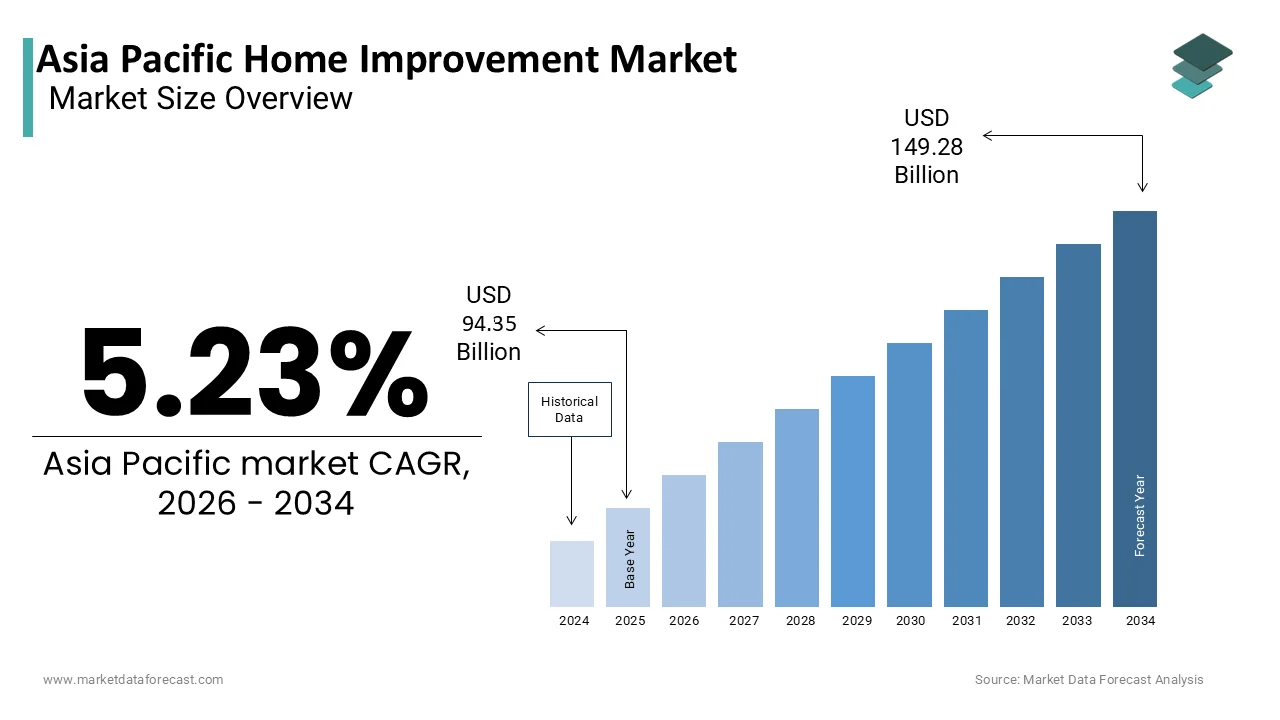
The Asia Pacific home improvement market size was valued at USD 94.35 billion in 2025, is estimated to reach USD 99.28 billion in 2026, and is projected to scale up to USD 149.28 billion by 2034, growing at a compound annual growth rate (CAGR) of 5.23% from 2026 to 2034. Propelled by rising disposable incomes, rapid urbanization, growing demand for green and smart home upgrades, and the proliferation of e-commerce platforms, the regional market continues to expand steadily across residential interiors, exteriors, and functional spaces.
Key Executive Metrics (At-a-Glance)
- 2025 Base Valuation: USD 94.35 Billion
- 2026 Current Valuation: USD 99.28 Billion
- 2034 Forecast Valuation: USD 149.28 Billion
- Compound Annual Growth Rate (CAGR): 5.23% (2026–2034)
- Top Performing Country: China (Maintains a commanding regional presence supported by its massive construction sector, extensive domestic manufacturing, and widespread smart home integration).
Core Market Drivers
- Rising Disposable Incomes & Urban Middle-Class: Expansion of urban middle classes investing in modular kitchens, smart technologies, and modern interior décor.
- E-Commerce & DIY Culture Growth: Proliferation of digital retail platforms (Tmall, JD.com, Tokopedia) offering virtual design visualization and direct-to-consumer delivery.
Primary Market Restraints & Challenges
- High Costs & Labor Shortages: Premium material expenses and skilled trade labor shortages driving up installation and project costs.
- Regulatory Hurdles & Unregulated Competition: Inconsistent building code enforcement and widespread informal manufacturers offering counterfeit or substandard goods.
Asia Pacific Home Improvement Market Segmentation Highlights
| Segment Category | Largest Segment | Fastest-Growing / Key Segment |
|---|---|---|
| By Product Type | Flooring, Repair, and Replacement (22.3% share in 2025) | Electrical Work Segment (Fastest-growing at 13.6% CAGR) |
| By Distribution Channel | DIY Home Improvement Stores (35.4% share in 2025) | Online Distribution Channels (Fastest-growing at 18.2% CAGR) |
| By Country | China & Japan (Mature and high-scale manufacturing hubs) | India (Booming real estate and organized retail expansion) |
Major Industry Players Profiled
Key global and regional retail leaders shaping the Asia Pacific home improvement market include IKEA, The Home Depot, Lowe's, Bunnings Warehouse, Mr. DIY, Ace Hardware, Asian Paints, Nippon Paint, Livspace, Houzz, Siam Global House, Dairy Farm International, Häfele, Kingfisher plc, and Godrej Interio.
Asia Pacific Home Improvement Market Size
The Asia Pacific home improvement market was valued at USD 94.35 billion in 2025, is estimated to reach USD 99.28 billion in 2026, and is projected to reach USD 149.28 billion by 2034, growing at a CAGR of 5.23% from 2026 to 2034.
Home Improvement is a broad spectrum of products and services aimed at enhancing residential interiors, exteriors, and functional spaces. This includes flooring, paints, kitchen and bathroom fixtures, smart home systems, electrical fittings, plumbing solutions, and energy-efficient upgrades. The sector is primarily driven by rising disposable incomes, urbanization, and shifting consumer preferences toward modern, sustainable, and aesthetically appealing living environments.
MARKET DRIVERS
Rising Disposable Incomes and Urban Middle-Class Expansion
The steady increase in disposable incomes and the expansion of the urban middle class are one of the primary drivers of the Asia Pacific home improvement market. In countries like Indonesia, Thailand, and Vietnam, where economic growth has been robust, homeowners are increasingly investing in interior décor, modular kitchens, and smart home technologies. In India, household expenditure on home improvement rose, particularly among young professionals residing in Tier-1 and Tier-2 cities. This growing financial capacity allows consumers to prioritize aesthetics, comfort, and functionality when renovating their homes, reinforcing the long-term momentum of the home improvement sector across the region.
Growth of E-Commerce and DIY Culture
The rapid growth of e-commerce and the expanding do-it-yourself (DIY) culture among homeowners are other significant drivers influencing the Asia Pacific home improvement market. In China, platforms such as Tmall, JD.com, and Pinduoduo have introduced dedicated sections for home decor and renovation supplies, making it easier for consumers to access premium products without visiting physical stores. Like many millennials in Shanghai and Beijing preferred purchasing DIY kits online rather than hiring contractors for small-scale improvements. Similarly, in Australia, Bunnings Warehouse expanded its online presence, offering virtual design consultations and augmented reality-based visualization tools to assist customers in planning renovations.
MARKET RESTRAINTS
High Cost of Premium Materials and Labor
The high cost of premium materials and skilled labor, which limits widespread adoption, especially in lower-income segments, is a key restraint affecting the Asia Pacific home improvement market. Also, in Japan and Australia, labor shortages have led to higher installation costs, discouraging potential buyers from undertaking extensive renovation projects. As per the Australian Bureau of Statistics, hourly wages for tradespeople in the construction sector increased, contributing to overall project expenses. These factors hinder market penetration, particularly in regions where price sensitivity remains a critical decision-making criterion.
Regulatory Hurdles and Building Code Compliance
Regulatory hurdles and inconsistent enforcement of building codes pose a major challenge to the Asia Pacific home improvement market, particularly in developing economies where compliance frameworks are still evolving. Also, only a few APAC countries have mandatory certification processes for fire-rated doors and insulation materials, limiting market penetration of high-performance products. In Indonesia, the Ministry of Public Works and Housing acknowledged gaps in the enforcement of SNI (Indonesian National Standard) norms for building materials, allowing substandard products to enter local markets unchecked. Moreover, inconsistent regulations hinder cross-border trade and discourage foreign investment in the sector.
MARKET OPPORTUNITIES
Surge in Green and Sustainable Home Upgrades
The growing demand for green and sustainable home upgrades. Governments across the region are promoting environmentally responsible construction practices through policy incentives and certification programs gives a prominent opportunity in the Asia Pacific home improvement market. According to the World Green Building Council (WorldGBC), over 5,000 buildings in the Asia Pacific received green certifications in 2025, including LEED, BREEAM, and Green Mark ratings, all of which encourage the use of recycled and low-carbon materials. In Australia, the Green Building Council of Australia (GBCA) mandates the use of sustainably sourced wood and non-toxic finishes in certified structures, prompting manufacturers to adopt FSC-certified timber and water-based coatings. Sustainability becoming a core criterion in both public and private construction projects is expected to increase significantly the demand for green-certified home improvement products in the coming years.
Rise of Smart Home Integration and Automation
The increasing integration of smart home technology presents a substantial opportunity for the Asia Pacific home improvement market. As digital transformation permeates the built environment, consumers and developers alike are prioritizing enhanced security features, remote control, and automation in home systems. Moreover, smart home technology adoption in the Asia Pacific grew notably, with electronic locks, voice-controlled lighting, and AI-based climate management gaining traction among middle- and upper-income households. In South Korea, leading manufacturers such as Samsung and LG have integrated AI-based facial recognition and smartphone-controlled access into residential entry systems, particularly in high-end apartment complexes. Similarly, in Australia, the rise in cyber-enabled burglary incidents has led to increased installation of reinforced smart locks and surveillance-integrated doorbell systems. These developments show the growing importance of connected home technologies in shaping consumer purchasing behavior across the region.
MARKET CHALLENGES
Intense Competition from Informal and Unregulated Manufacturers
The prevalence of informal and unregulated manufacturers who offer low-cost alternatives without adhering to quality or safety standards is one of the most pressing challenges facing the Asia Pacific home improvement market. In many parts of South and Southeast Asia, small-scale producers dominate local markets by selling substandard products that undercut established brands. In Bangladesh and Nepal, the absence of strict enforcement mechanisms allows counterfeit or poorly constructed home improvement goods to flood local markets, posing risks to both consumers and legitimate businesses. The widespread reliance on informal suppliers hampers the ability of reputable firms to scale operations and maintain profitability. Also, weak intellectual property protections enable copycat brands to mimic premium designs, eroding brand equity.
Supply Chain Disruptions and Raw Material Cost Volatility
The volatility in raw material prices and disruptions in global supply chains are also a persistent challenge in the Asia Pacific home improvement market. The sector relies heavily on commodities such as timber, steel, aluminum, polymers, and glass, all of which have experienced fluctuating availability and pricing in recent years. According to the International Monetary Fund (IMF), global commodity prices saw an increase in recent years, driven by geopolitical tensions, trade restrictions, and inflationary pressures. Besides, logistics bottlenecks caused by port congestion and container shortages have delayed deliveries and increased freight expenses, as highlighted by the World Trade Organization (WTO). These challenges have constrained profit margins for small and medium-sized enterprises (SMEs), many of whom struggle to pass on increased costs to price-sensitive consumers.s
SEGMENTAL ANALYSIS
By Product Type Insights
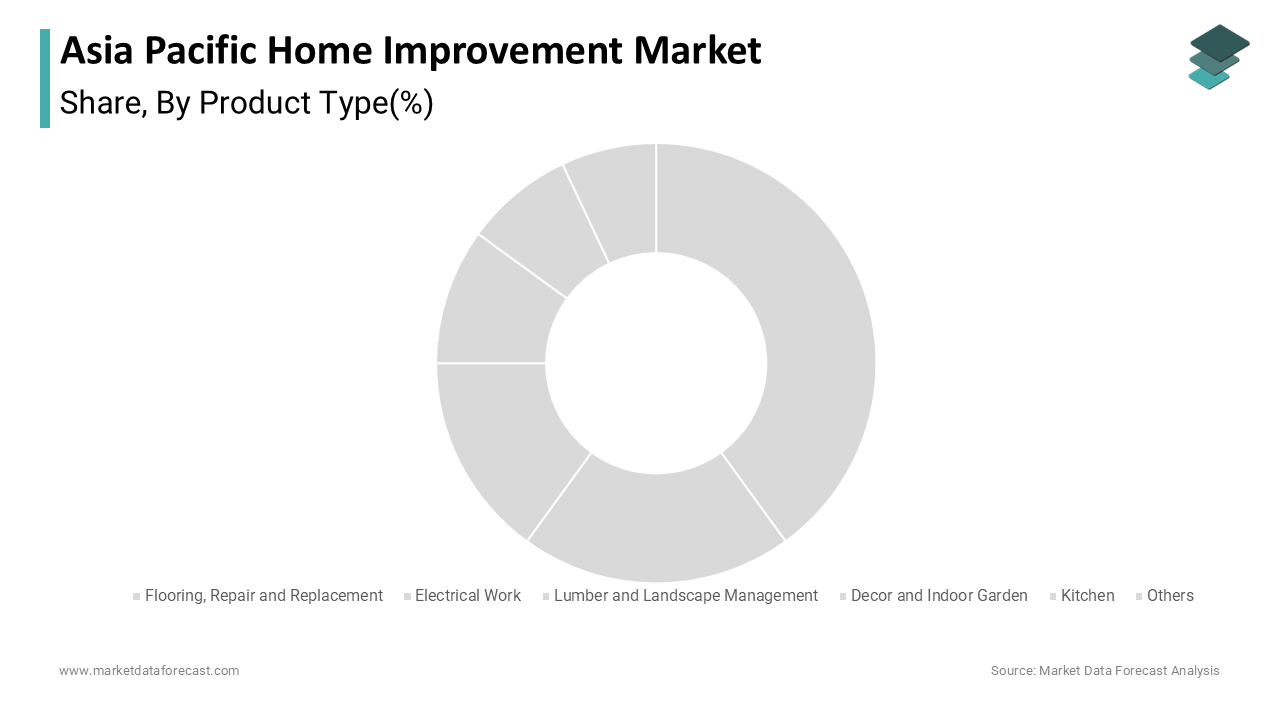
The flooring segment constituted the strongest product category in the Asia Pacific home improvement market by capturing 22.3% of the total share in 2025. This dominance of the segment is attributed to flooring’s essential role in both aesthetic enhancement and functional durability across residential spaces. The increasing preference for high-quality, durable, and easy-to-maintain flooring solutions such as laminate, vinyl, engineered wood, and ceramic tiles is also contributing to the rise of the flooring segment.
According to the China Building Materials Federation, over 800 million square meters of residential flooring were installed in new homes in 2025, with a growing shift toward water-resistant and eco-friendly materials. In Australia, Green Building Council-certified flooring products saw an increase in sales, reflecting growing environmental consciousness. These trends show flooring’s entrenched position as a critical component of modern home improvement initiatives across the Asia Pacific.
The electrical work segment is emerging as the fastest-growing product segment in the Asia Pacific home improvement market, registering a CAGR of 13.6% in the coming years. This surge of the segment is driven by rising demand for smart home automation, energy-efficient lighting, and integrated electrical systems in both new and renovated homes. With continued digital transformation and regulatory support, this segment is expected to maintain its upward trajectory across the Asia Pacific.
By Distribution Channel Insights
The DIY segment represented the dominant distribution channel in the Asia Pacific home improvement market by accounting for 35.4% of total retail transactions in 2025. The widespread presence of organized retail chains and the growing inclination toward self-driven renovations have strengthened the development of this segment. The expansion of large-format DIY retailers like Bunnings Warehouse in Australia, Leroy Merlin in China, and Home Centre in India, which offer comprehensive product ranges under one roof, is also adding to the factors assisting the segment’s growth. Additionally, these stores provide expert advice counters, workshops, and visual merchandising strategies that enhance customer engagement and trust. These factors reinforce the sustained dominance of DIY home improvement stores across the region.
The online distribution channels are witnessing the fastest growth in the Asia Pacific home improvement market and are recording a CAGR of 18.2% in the coming years. This rapid expansion of the segment is fueled by digital transformation, improved logistics infrastructure, and shifting consumer behavior toward e-commerce platforms. In China, platforms such as Tmall, JD.com, and Pinduoduo have introduced dedicated sections for home decor and renovation supplies, making it easier for consumers to access premium products without visiting physical stores. Similarly, in Indonesia, Tokopedia expanded its inventory to include specialized tools, plumbing fixtures, and smart home devices, catering to first-time homeowners. With ongoing advancements in augmented reality-based visualization and same-day fulfillment, the online channel is poised to further disrupt traditional retail models across the Asia Pacific.
REGIONAL ANALYSIS
China Home Improvement Market Insights
China commanded the Asia Pacific home improvement industry. The country's massive construction sector, coupled with robust domestic manufacturing capabilities, positions it as the dominant player in the regional market. The government’s push for standardized housing through urban renewal and public housing projects has further strengthened the need for cost-effective and sustainable home improvement solutions. Also, the rise of smart home technologies has led to increased integration of intelligent lighting, automated climate control, and energy-efficient electrical systems, particularly in Tier-1 cities like Beijing and Shanghai.
India Home Improvement Market Insights
India is another key player in the Asia Pacific home improvement market. The country’s booming real estate sector, supported by government-led housing initiatives, is a key contributor to its growing prominence. In addition, rapid urbanization and rising disposable incomes have spurred renovations and home upgrades, fueling the aftermarket segment. Furthermore, the expansion of organized retail and e-commerce platforms has made branded home improvement tools more accessible to consumers in Tier-2 and Tier-3 cities. With sustained policy support and infrastructure development, India is positioned to maintain strong momentum in the home improvement market across the Asia Pacific.
Japan Home Improvement Market Insights
Japan commands a significant share of the Asia Pacific home improvement market. Known for its high-quality construction standards and emphasis on sustainability, Japan maintains a mature and technologically advanced home improvement market. The country’s aging population has also driven demand for accessibility-friendly home modifications, particularly in senior-friendly housing projects. Also, the Ministry of Economy, Trade and Industry (METI) has promoted the use of FSC-certified wood and low-emission composites to align with environmental regulations. The continued innovation in green building materials and connected home technologies has allowed Japan to remain a key player in shaping future trends in the regional home improvement market.
South Korea Home Improvement Market Insights
South Korea is a notable player in the Asia Pacific home improvement market. The country’s compact urban living spaces and technological advancements have led to a growing preference for smart and space-saving home improvement solutions. In response to rising security concerns, leading manufacturers such as Samsung and LG have introduced AI-powered smart locks and remote-controlled lighting. Additionally, the government’s Green Building Certification Program has encouraged the adoption of thermally insulated windows, LED lighting, and eco-friendly paints.
Australia Home Improvement Market Insights
Australia’s well-regulated construction industry and focus on sustainability have shaped its distinctive market dynamics. The Green Building Council of Australia mandates the use of sustainably sourced materials and non-toxic finishes in certified structures, influencing manufacturers to adopt environmentally responsible practices. With strong institutional support and rising consumer awareness, Australia continues to lead in sustainable and compliant home improvement solutions within the Asia Pacific.
KEY MARKET PLAYERS AND COMPETITIVE LANDSCAPE
Key players in the Asia Pacific Home Improvement Market include
- IKEA
- The Home Depot
- Lowe's
- Bunnings Warehouse
- Mr. DIY
- Ace Hardware
- Asian Paints
- Nippon Paint
- Livspace
- Houzz
- Siam Global House
- Dairy Farm International
- Häfele
- Kingfisher plc
The competition in the Asia Pacific home improvement market is intensifying as multinational corporations and regional players vie for dominance in an expanding and diversified industry. Established global giants leverage their technological expertise, extensive distribution networks, and brand equity to maintain leadership positions, particularly in developed economies like Australia, Japan, and South Korea. At the same time, domestic manufacturers in India, China, and Southeast Asia are gaining traction by offering cost-effective, locally tailored solutions that cater to specific architectural styles and budget constraints.
Market participants are increasingly focused on differentiation through innovation, sustainability, and enhanced user experiences. Companies are investing in research and development to introduce energy-efficient, durable, and aesthetically appealing home improvement products that align with evolving consumer preferences and green building certifications. Strategic acquisitions, partnerships, and digital marketing initiatives are also shaping the competitive landscape, enabling firms to expand their reach and reinforce brand loyalty. Additionally, rising demand for smart home integration and automation is prompting traditional home improvement retailers to adapt their business models. As urbanization accelerates and disposable incomes rise across the region, the battle for market share is expected to grow more dynamic, with technology adoption and environmental responsibility playing decisive roles in long-term success.
Top Players in the Asia Pacific Home Improvement Market
The Home Depot
The Home Depot is a global leader in home improvement retail and has been expanding its influence in the Asia Pacific region through strategic partnerships and digital initiatives. While not operating large-format stores across all APAC countries, the company has leveraged its strong supply chain and e-commerce expertise to support regional partners and distributors. Its focus on offering a vast range of products, from tools and flooring to smart home systems, has made it a key player in shaping market trends. The Home Depot also emphasizes customer education through online guides and virtual design tools, enhancing consumer engagement and supporting DIY culture in emerging markets.
Bunnings Group
Bunnings Group, part of Wesfarmers Limited, is a dominant force in the Australian and New Zealand home improvement markets and has been extending its reach into other parts of the Asia Pacific through wholesale and franchise models. Known for its extensive product portfolio and value-driven offerings, Bunnings has set benchmarks in organized retail for home improvement goods. The company's emphasis on convenience, affordability, and in-store experiences—such as workshops and expert advice counters—has strengthened its brand loyalty. Bunnings has also invested heavily in digital transformation, enhancing its online presence to cater to evolving consumer preferences and support both DIY and professional tradespeople.
Godrej Interio
Godrej Interio is one of India’s leading home improvement brands and plays a pivotal role in shaping the South Asian home improvement landscape. Specializing in modular furniture, kitchen systems, and interior solutions, the company has successfully blended aesthetics with functionality to meet urban lifestyle demands. Godrej Interio has expanded beyond residential applications into commercial interiors and smart living solutions, reinforcing its innovation-led positioning. Through strategic acquisitions and a strong omnichannel distribution strategy, it has established a significant footprint across Tier-1 and Tier-2 cities. Its integration of sustainability and digital customer engagement further enhances its appeal in the evolving Asia Pacific home improvement sector.
Top Strategies Used by Key Market Participants
One major strategy employed by key players in the Asia Pacific home improvement market is product diversification and customization. Companies are increasingly offering a wide array of solutions tailored to different consumer needs, including eco-friendly materials, smart home integrations, and space-saving designs. This allows them to cater to diverse preferences across urban and rural markets while maintaining relevance in a competitive environment.
Another critical approach is digital transformation and omnichannel retailing. Leading firms are investing in e-commerce platforms, augmented reality visualization tools, and mobile applications to enhance customer experience and streamline purchasing processes. By integrating online and offline channels, companies ensure seamless access to products and services, boosting engagement and conversion rates among tech-savvy consumers.
Lastly, strategic partnerships and localized expansion play a crucial role in strengthening market presence. Home improvement retailers and manufacturers are forming alliances with local suppliers, real estate developers, and government agencies to improve supply chain efficiency and gain insights into regional demand patterns, ensuring long-term competitiveness.
RECENT MARKET DEVELOPMENTS
- In March 2025, Bunnings Group expanded its e-commerce platform in Australia, introducing an AI-powered room design tool to help customers visualize renovations using specific product selections.
- In February 2025, Godrej Interio launched a new line of smart modular kitchen systems in India, integrating voice-controlled appliances and touchless faucets to cater to evolving consumer preferences.
- In January 2025, Toto expanded its smart bathroom fixture production facility in Thailand, aiming to meet rising demand for sensor-based toilets and automatic faucets in Southeast Asian markets.
- In November 2025, Home Depot partnered with local distributors in Indonesia to establish a regional supply chain hub, enabling faster delivery of imported home improvement products to urban centers.
- In October 2025, Saint-Gobain introduced a range of bio-based insulation materials in Japan, targeting green-certified residential developments and supporting national carbon neutrality goals.
MARKET SEGMENTATION
This research report on the Asia Pacific Home Improvement market is segmented and sub-segmented into the following categories.
By Product Type
- Flooring, Repair, and Replacement
- Electrical Work
- Lumber and Landscape Management
- Decor and Indoor Garden
- Kitchen
- Others
By Distribution Channel
- DIY Home Improvement Stores
- Specialty Stores
- Online
By Country
- India
- China
- Japan
- South Korea
- Australia
- New Zealand
- Thailand
- Malaysia
- Vietnam
- Philippines
- Indonesia
- Singapore
- Rest of APAC