- Product Description Description
- Table of Contents TOC
- List of Table & Figure LOT
- Get Free Sample PDF Sample PDF
Market Size, 2025
$1.38 BnMarket Estimate, 2026
$1.78 BnMarket Forecast, 2034
$13.72 BnCAGR, 2026–2034
29.08%Executive Summary: Asia Pacific Human Centric Lighting Market
- Market Scope: Comprehensive regional analysis of the Asia Pacific human centric lighting (HCL) sector, detailing offerings (hardware, software, services), installation types (new and retrofit), intelligent infrastructure integration, circadian rhythm benefits, and country-level profiles.
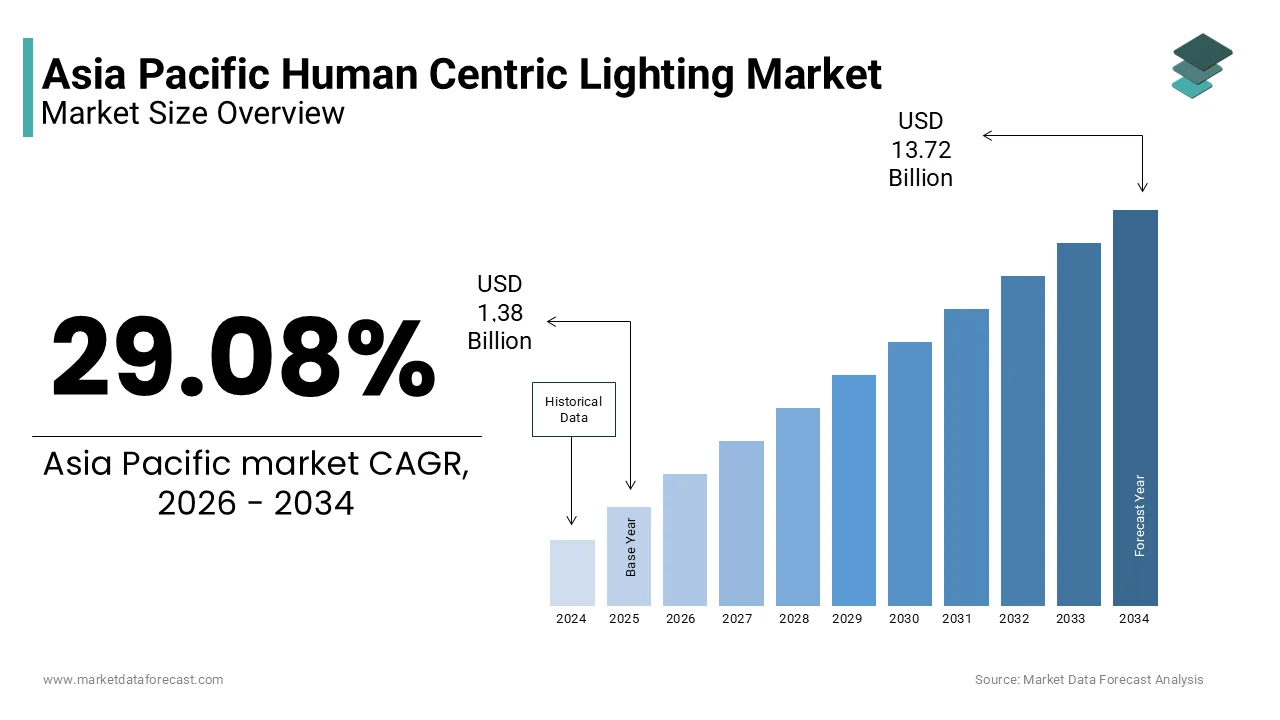
- Market Valuation: Valued at USD 1.38 billion in 2025, reaching USD 1.78 billion in 2026, and projected to expand to USD 13.72 billion by 2034, growing at a robust CAGR of 29.08% from 2026 to 2034.
- Primary Growth Drivers: Rising awareness of health and well-being in indoor environments, and the rapid expansion of smart city initiatives and intelligent infrastructure projects.
Key Market Segment Metrics
| Category | Leading Segment (Base Position) | Fastest-Growing / High-Growth Segment |
|---|---|---|
| By Offering | Hardware (held 64.3% market share in 2025, driven by tunable LED luminaires, sensors, and intelligent fixtures) | Services (projected at a 15.8% CAGR, fueled by rising demand for professional system design, consultancy, and compliance monitoring) |
| By Installation Type | New Installations (held 59.8% market share in 2025, anchored by urban expansion, smart city projects, and green building developments) | Retrofit Installations (projected at a 16.3% CAGR, driven by aging commercial and institutional building upgrades) |
| By Country | China (market leader with a 31.2% share in 2025, backed by smart city pushes, Tier-1 commercial construction, and health-focused building codes) | India & Australia (key high-growth regional hubs propelled by Smart Cities Missions, wellness-based architectural standards, and healthcare investments) |
Major Market Players & Industry Landscape
Market Structure: Highly dynamic ecosystem comprising global lighting giants and regional innovators focusing on IoT-enabled controls, circadian rhythm optimization, and wellness-aligned building standards (WELL and LEED).
Key Companies: Signify N.V., ams-OSRAM AG, Panasonic Corporation, Acuity Brands, Inc., and Zumtobel Group AG.
 Download Free Sample Report
Asia Pacific Human Centric Lighting Market Size
Asia Pacific Human centric lighting market size was valued at USD 1.38 billion in 2025, and is expected to reach USD 13.72 billion by 2034 from USD 1.78 billion in 2026. The market's promising CAGR for the predicted period is 29.08%.
The Asia Pacific human centric lighting (HCL) market refers to the deployment of intelligent lighting systems that align with the natural circadian rhythm of individuals, enhancing well-being, productivity, and comfort in indoor environments. These lighting solutions dynamically adjust color temperature and intensity throughout the day to mimic natural daylight patterns, thereby supporting physiological and psychological health. HCL is increasingly being integrated into commercial buildings, healthcare facilities, educational institutions, and residential spaces across the region.
According to the International WELL Building Institute, over 40% of new commercial constructions in Singapore and Australia now incorporate circadian lighting principles as part of wellness-focused building certifications.
MARKET DRIVERS
Rising Awareness of Health and Well-Being in Indoor Environments
One of the primary drivers of the Asia Pacific human centric lighting market is the growing awareness of how lighting affects health, mood, and productivity in indoor environments. According to the World Green Building Council, studies conducted in South Korea and China show that employees working in offices with dynamic lighting experienced up to a 15% improvement in alertness and cognitive performance compared to those in static lighting conditions. In Japan, the Ministry of Health, Labour and Welfare has encouraged the adoption of circadian lighting in corporate and healthcare settings to address issues such as sleep disorders and stress-related illnesses. Additionally, as per the Singapore Building and Construction Authority, over 30% of newly certified green buildings in 2023 included HCL systems to enhance occupant well-being.
Expansion of Smart Cities and Intelligent Infrastructure Projects
Another major driver fueling the growth of the human centric lighting market in the Asia Pacific is the rapid expansion of smart city initiatives and intelligent infrastructure projects. Governments across the region are investing heavily in digitized urban development programs that integrate energy-efficient and health-conscious lighting solutions into public and private buildings. In India, the Ministry of Housing and Urban Affairs reports that over 60 cities under the Smart Cities Mission have incorporated tunable LED lighting in municipal buildings, hospitals, and educational institutions to enhance user experience and reduce energy consumption. Furthermore, as per Frost & Sullivan, the adoption of HCL-enabled street lighting in South Korea’s Busan and Incheon has contributed to improved nighttime safety while reducing energy usage.
MARKET RESTRAINTS
High Initial Investment and Implementation Costs
A significant restraint affecting the Asia Pacific human centric lighting market is the high initial investment required for system design, installation, and integration with existing building management infrastructures. According to Deloitte, the average cost premium for implementing HCL in a mid-sized commercial building in the region ranges between 20% and 35% higher than standard LED lighting setups. In emerging economies such as Indonesia and the Philippines, as noted by Frost & Sullivan, budget constraints often lead developers and facility managers to opt for basic lighting systems rather than invest in dynamic, circadian-aligned alternatives. Moreover, according to PwC, small and medium-sized enterprises frequently find it difficult to justify the return on investment for human centric lighting without clear short-term benefits. These economic barriers hinder broader market penetration, particularly in price-sensitive segments across the Asia Pacific.
Lack of Standardization and Technical Expertise
Another key restraint impacting the Asia Pacific human centric lighting market is the lack of standardized regulations and technical expertise for designing and deploying effective HCL systems. Unlike traditional lighting metrics, human centric lighting requires precise tuning of color temperature, intensity variation, and timing synchronization with biological rhythms which is making implementation complex. According to the International Electrotechnical Commission, inconsistencies in regional certification procedures often result in prolonged time-to-market and increased compliance costs for industry participants. These technical and regulatory hurdles not only increase operational complexity but also limit market expansion opportunities for both global and regional players operating in the Asia Pacific human centric lighting space.
MARKET OPPORTUNITIES
Integration of Human Centric Lighting in Healthcare Facilities
An emerging opportunity in the Asia Pacific human centric lighting market is the increasing integration of these systems in healthcare facilities to improve patient outcomes and staff efficiency. Research has shown that exposure to appropriate lighting conditions can influence recovery rates, sleep quality, and overall well-being in hospital environments. According to the World Health Organization, clinical trials conducted in Japan and South Korea indicate that patients exposed to dynamic circadian lighting experienced shorter hospital stays and reduced reliance on sedatives. Additionally, as per the Singapore Health Services Group, healthcare providers are increasingly using human centric lighting in rehabilitation centers and mental health clinics to regulate circadian rhythms and reduce anxiety. The demand for human centric lighting in medical institutions across the Asia Pacific is expected to rise significantly with growing emphasis on holistic healthcare approaches.
Adoption of Human Centric Lighting in Educational Institutions
Another promising opportunity in the Asia Pacific human centric lighting market is the rising adoption of these lighting solutions in educational institutions to enhance student concentration, learning efficiency, and overall well-being. Studies have demonstrated that exposure to dynamic lighting that mimics natural daylight cycles can positively impact cognitive performance, attention span, and mood among students. According to UNESCO, several pilot programs in China and India have shown measurable improvements in academic performance following the introduction of tunable LED lighting in classrooms. Additionally, as per the Australian Council for Educational Research, universities in Melbourne and Sydney have started incorporating HCL in study areas and lecture halls to create more conducive learning environments.
MARKET CHALLENGES
Complexity in Measuring and Validating Health Benefits
One of the foremost challenges facing the Asia Pacific human centric lighting market is the difficulty in quantifying and validating the health and productivity benefits associated with circadian lighting. While scientific studies suggest that exposure to dynamic lighting aligned with natural daylight cycles can improve sleep, mood, and cognitive function, translating these findings into measurable business or policy outcomes remains complex. According to the World Green Building Council, organizations in Australia and New Zealand report challenges in attributing workplace performance gains directly to lighting changes, limiting investment justification. Moreover, as per Frost & Sullivan, policymakers and facility managers require robust data to justify capital expenditure on HCL systems. The absence of standardized metrics for assessing physiological and psychological outcomes hampers widespread acceptance and slows down decision-making processes across the Asia Pacific region.
Compatibility Issues with Existing Lighting Control Systems
Another critical challenge confronting the Asia Pacific human centric lighting market is the issue of compatibility with existing lighting control systems and building automation platforms. Many commercial and institutional buildings still rely on legacy infrastructure that lacks interoperability with modern HCL technologies, making seamless integration difficult. According to McKinsey Global Institute, retrofitting older buildings with tunable LED systems and dynamic controls often requires extensive modifications, which is increasing project complexity and cost. In India, as per the Indian Green Building Council, over 60% of commercial real estate assets were constructed before 2015, posing significant challenges for upgrading to smart lighting ecosystems. Additionally, as per GSMA Intelligence, inconsistencies in communication protocols across different vendors complicate the deployment of unified lighting networks. Addressing these integration challenges requires enhanced collaboration between lighting manufacturers, building automation providers, and software developers to ensure seamless compatibility and scalable deployment of human centric lighting solutions across the Asia Pacific.
REPORT COVERAGE
| REPORT METRIC | DETAILS |
| Market Size Available | 2025 to 2034 |
| Base Year | 2025 |
| Forecast Period | 2026 to 2034 |
| CAGR | 29.08% |
| Segments Covered | By Offering, Installation Type, and Region |
|
Various Analyses Covered | Regional & Country Level Analysis, Segment-Level Analysis, DROC, PESTLE Analysis, Porter’s Five Forces Analysis, Competitive Landscape, Analyst Overview on Investment Opportunities |
| Regions Covered | India, China, Japan, South Korea, Australia, New Zealand, Thailand, Malaysia, Vietnam, Philippines, Indonesia, Singapore, and the Rest of Asia-Pacific |
| Market Leaders Profiled | Signify N.V., ams-OSRAM AG, Acuity Brands, Inc., Cree, Inc. (SMART Global Holdings, Inc.), Legrand S.A. (Legrand Group), Hubbell Incorporated, Lutron Electronics Co., Inc., Zumtobel Group AG, Koninklijke Philips N.V., Wipro Limited., and others |
SEGMENTAL ANALYSIS
By Offering Insights
The hardware segment was the largest and held 64.3% of the Asia Pacific human centric lighting market share in 2025 with the essential role of tunable LED luminaires, sensors, control systems, and intelligent lighting fixtures that form the backbone of HCL installations across commercial, healthcare, and educational facilities. According to McKinsey Global Institute, over 75% of newly constructed office buildings in Singapore and Australia now incorporate advanced LED-based circadian lighting systems as part of green building certifications. The increasing adoption of smart lighting controls and occupancy sensors further reinforces the dominance of the hardware segment in shaping the regional human centric lighting ecosystem.
The services segment is lucratively growing with a CAGR of 15.8% from 2026 to 2034 with the rising demand for professional services such as system design, integration, commissioning, maintenance, and performance monitoring of HCL solutions. According to Deloitte, more than 60% of commercial real estate developers in India and Southeast Asia now prefer outsourced lighting consultancy services to ensure compliance with wellness-focused building standards like WELL and LEED.
By Installation Type Insights
The new installations segment was the largest and held 59.8% of the Asia Pacific human centric lighting market share in 2025 with the rapid expansion of urban infrastructure, government-backed smart city initiatives, and the incorporation of human centric lighting principles into modern architectural designs. According to the World Green Building Council, over 45% of new commercial developments in Singapore and Australia now include circadian lighting systems as part of mandatory sustainability guidelines. In India, the Ministry of Housing and Urban Affairs reports that under the Smart Cities Mission, more than 60 urban projects launched since 2021 have integrated HCL solutions in municipal buildings, hospitals, and educational institutions.
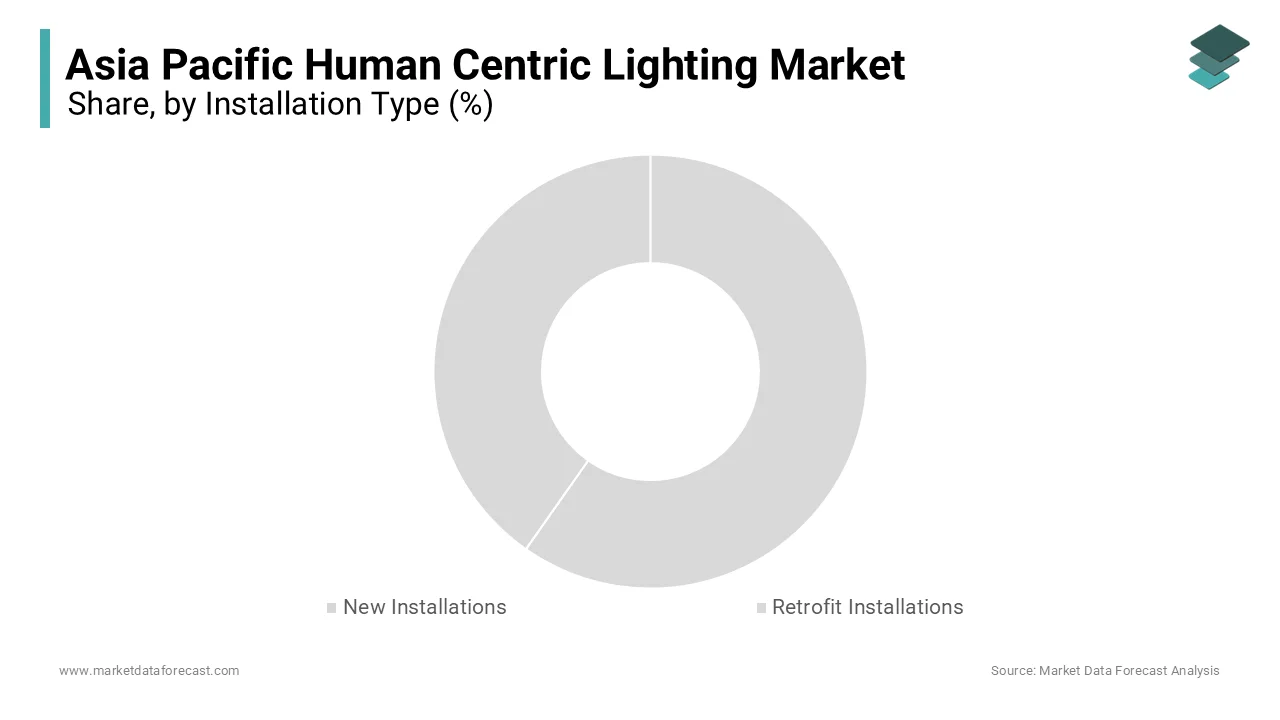
Additionally, as per the Japan Lighting Committee, over 300 new corporate offices in Tokyo and Osaka adopted tunable LED lighting in 2023 to align with evolving workplace wellness trends. The retrofit installations segment is swiftly emerging with a CAGR of 16.3% during the forecast period. This expansion is fueled by the increasing need to upgrade aging commercial and institutional buildings with modern lighting solutions that enhance occupant well-being and reduce energy consumption without requiring complete structural overhaul. In Australia, the Australian Institute of Architects reports that over 200 heritage-listed buildings underwent lighting retrofits to meet contemporary health and sustainability standards while preserving architectural integrity. Additionally, as per the Indian Green Building Council, retrofitting programs in major metropolitan cities like Mumbai and Bengaluru have gained momentum, with property developers seeking to enhance tenant satisfaction and comply with evolving energy efficiency regulations.
REGIONAL ANALYSIS
China was the largest and 31.2% of the Asia Pacific human centric lighting market share in 2025. The country's dominant position stems from its aggressive push toward smart city development, government-led sustainability initiatives, and expanding investments in commercial and healthcare infrastructure. According to the Ministry of Housing and Urban-Rural Development, over 40% of new commercial buildings launched in Tier-1 cities such as Shanghai and Shenzhen in 2023 included integrated human centric lighting systems. A key driver behind this growth is the Chinese government’s emphasis on healthy indoor environments, supported by national building codes promoting energy-efficient and biologically optimized lighting. As reported by the China Building Materials Federation, more than 200 hospitals and research institutions have adopted tunable LED lighting to improve patient outcomes and staff productivity.
Japan was positioned next by holding 19.7% of the Asia Pacific human centric lighting market share in 2025. The country maintains a strong presnce due to its early adoption of circadian lighting technologies, deep integration into healthcare and education sectors, and a regulatory environment that encourages sustainable and people-centric building design. According to the Japan Lighting Committee, over 250 schools have implemented tunable white LED lighting since 2021 to improve student focus and reduce eye strain. Similarly, in the healthcare sector, as per the Japanese Society of Medical Electronics, hospitals incorporating human centric lighting report improved patient recovery times and reduced medication dependency.
India human centric lighting market growth is lucratively growing with the country’s growth is primarily fueled by increasing government focus on sustainable infrastructure, smart city development, and rising awareness of the impact of lighting on health and productivity. According to the Ministry of Housing and Urban Affairs, over 60 cities under the Smart Cities Mission have incorporated HCL principles in public buildings, hospitals, and educational institutions since 2021.
India is emerging as a key growth hub for human centric lighting applications in the Asia Pacific with ongoing investments in AIoT-enabled lighting controls and growing participation from domestic lighting manufacturers.
Australia is likely to grow with prominent growth opportunities by stringent building regulations, widespread adoption of wellness-based design principles, and significant investments in healthcare and education infrastructure. According to the Australian Institute of Architects, over 40% of new commercial buildings certified in 2023 incorporated circadian lighting systems to enhance occupant well-being. A key factor behind market expansion is the growing integration of human centric lighting in healthcare facilities. As reported by the Australian Institute of Health and Welfare, several aged care centers and rehabilitation clinics have adopted tunable LED lighting to regulate sleep cycles and improve mental health among patients.
South Korea human centric lighting market growth is growing with its early adoption of smart lighting technologies, government-backed urban renewal programs, and deep integration of HCL in both commercial and residential settings. According to the Korea Institute of Science and Technology, over 200 new office buildings in Seoul and Busan launched in 2023 featured dynamic lighting systems designed to enhance cognitive performance and reduce stress. Additionally, as per the Korean Lighting Society, residential developers are increasingly incorporating tunable lighting in smart homes to support better sleep and daily activity patterns.
COMPETITIVE LANDSCAPE
The competition in the Asia Pacific human centric lighting market is highly dynamic, driven by rapid advancements in lighting technology, increasing demand for healthier indoor environments, and growing regulatory emphasis on occupant well-being. A mix of global lighting giants and emerging regional players coexist, each striving to capture market share through differentiated product offerings, strategic alliances, and localized implementation strategies. Governments and urban planners are increasingly recognizing the importance of lighting that supports circadian rhythms, prompting widespread adoption in healthcare, education, and commercial sectors. At the same time, rising consumer awareness regarding the impact of artificial lighting on health and productivity is influencing purchasing decisions. Emerging economies are witnessing increased participation from domestic manufacturers seeking to develop cost-effective, locally adapted HCL solutions. As the demand for biophilic and intelligent lighting grows, vendors are focusing on customization, interoperability, and user experience to differentiate themselves in an evolving marketplace.
KEY MARKET PLAYERS
Signify N.V., ams-OSRAM AG, Acuity Brands, Inc., Cree, Inc. (SMART Global Holdings, Inc.), Legrand S.A. (Legrand Group), Hubbell Incorporated, Lutron Electronics Co., Inc., Zumtobel Group AG, Koninklijke Philips N.V., and Wipro Limited Asia Pacific human centric lighting market.
TOP PLAYERS IN THE MARKET
- Signify is a global leader in lighting solutions and plays a pivotal role in shaping the Asia Pacific human centric lighting market. The company offers a comprehensive portfolio of tunable LED systems, smart controls, and circadian lighting technologies tailored for commercial, healthcare, and educational environments. In the Asia Pacific region, Signify has been instrumental in driving awareness and adoption of human-centric design principles through strategic partnerships with architects, developers, and government bodies. Its focus on innovation, sustainability, and occupant well-being positions it as a key influencer in both regional and global markets.
- OSRAM is a major contributor to the development and deployment of human centric lighting across the Asia Pacific region. The company specializes in intelligent lighting systems that adapt to natural daylight cycles, enhancing productivity and comfort in indoor spaces. OSRAM collaborates closely with building automation providers and real estate developers to integrate HCL into smart infrastructure projects. OSRAM continues to drive technological advancements that influence global standards in biologically optimized lighting environments with a strong R&D foundation and a commitment to advancing lighting neuroscience.
- Panasonic is a leading player in the Asia Pacific human centric lighting market, offering innovative lighting solutions designed to support health, well-being, and energy efficiency. The company integrates HCL into residential, commercial, and public infrastructure projects, leveraging its expertise in IoT-enabled lighting controls and ambient intelligence. Panasonic’s deep presence in Japan and expanding footprint in Southeast Asia reinforce its influence in promoting lighting solutions that align with human biological rhythms and environmental sustainability goals.
TOP STRATEGIES USED BY KEY PLAYERS
One of the primary strategies adopted by key players in the Asia Pacific human centric lighting market is strategic partnerships and ecosystem collaboration , where companies work closely with architects, lighting designers, and building management system providers to ensure seamless integration of HCL solutions. Another crucial approach is product innovation and R&D investment , focusing on developing adaptive lighting systems that respond dynamically to human needs and environmental conditions. Additionally, market education and certification alignment are widely pursued, allowing firms to raise awareness about the benefits of circadian lighting and align product offerings with wellness-based building standards such as WELL and LEED.
RECENT HAPPENINGS IN THE MARKET
- In March 2025, Signify launched a new line of circadian lighting modules specifically designed for office environments in South Korea. Developed in partnership with Seoul-based architectural firms, this initiative aimed to enhance workplace well-being and support flexible working schedules aligned with natural light cycles.
- In July 2023, OSRAM announced a collaboration with WSP Global to integrate human centric lighting into large-scale infrastructure projects across Australia. This partnership was intended to standardize biologically optimized lighting in commercial and civic buildings, reinforcing OSRAM's dominance in wellness-focused illumination.
- In November 2023, Panasonic introduced an AI-powered lighting control system in Japan that adjusts illumination based on individual activity patterns and sleep-wake cycles. This innovation was targeted at smart homes and elderly care facilities aiming to improve daily living conditions through personalized lighting experiences.
- In February 2025, Acuity Brands expanded its presence in India by launching a dedicated HCL division focused on healthcare and educational institutions. This move was aimed at addressing the growing demand for dynamic lighting in hospitals and schools seeking improved patient and student outcomes.
- In August 2023, Zumtobel partnered with the National University of Singapore to conduct research on the cognitive effects of tunable white lighting in academic settings. The findings were intended to inform future lighting design guidelines for universities and research centers across the region.
MARKET SEGMENTATION
This research report on the Asia Pacific human centric lighting market has been segmented and sub-segmented based on the following categories.
By Offering
- Hardware
- Fixtures
- Controllers
- Sensors
- Drivers
- Microprocessors & Microcontrollers
- Switches & Dimmers
- Transmitters & Receivers
- Software
- Services
By Installation Type
- New Installations
- Retrofit Installations
By Country
- India
- China
- Japan
- South Korea
- Australia
- New Zealand
- Thailand
- Malaysia
- Vietnam
- Philippines
- Indonesia
- Singapore
- Rest of Asia-Pacific