- Product Description Description
- Table of Contents TOC
- List of Table & Figure LOT
- Get Free Sample PDF Sample PDF
Asia Pacific Hyperscale Data Center Market Size
The Asia Pacific Hyperscale Data Center Market is projected to grow from USD 33.74 billion in 2024 to USD 277.2 billion by 2033, at a CAGR of 26.36%.
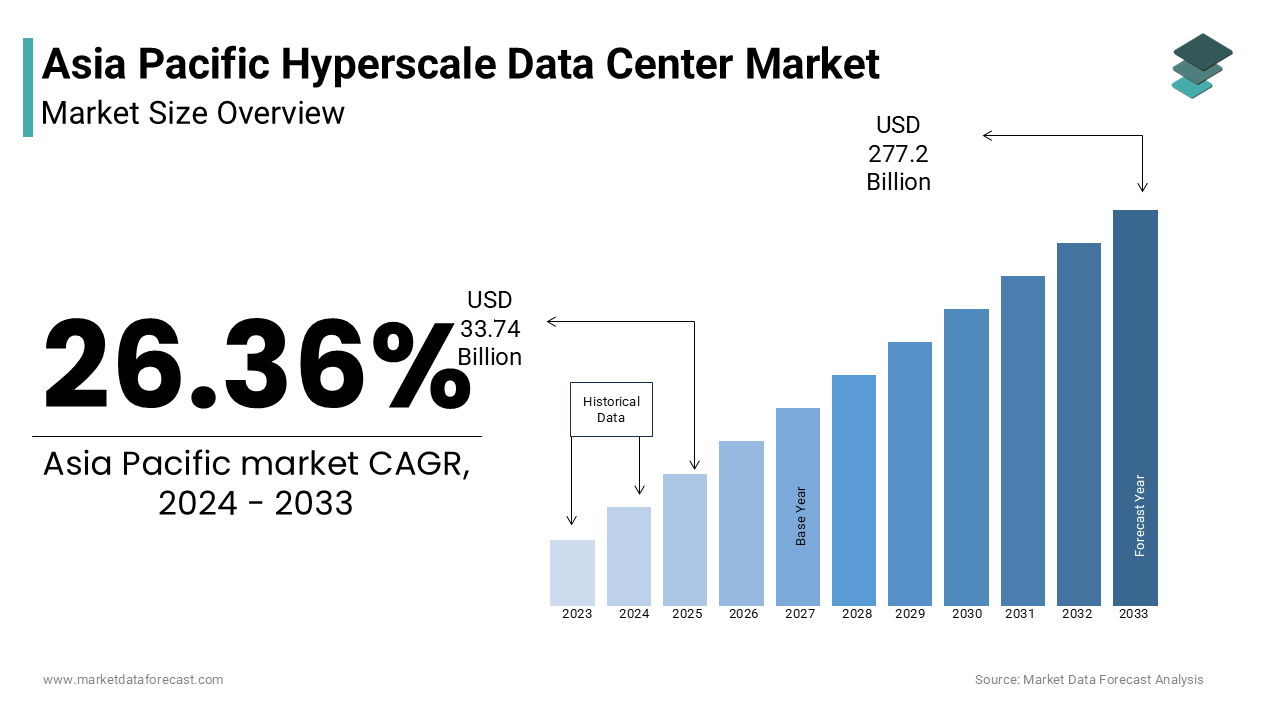
The Hyperscale data centers refer to large-scale computing infrastructures typically operated by global technology firms and cloud service providers to support high-volume data processing, storage, and distribution. These facilities are characterized by their modular design, scalable architecture, and advanced cooling and power management systems designed to handle massive workloads efficiently. The growth of the Asia Pacific hyperscale data center market is being driven by increasing internet penetration, mobile device adoption, and the proliferation of cloud-based services. According to the International Telecommunication Union, over 60% of the population in the Asia Pacific region now has access to the internet, with countries like China, India, and Indonesia witnessing exponential growth in online activity. Moreover, governments across the region are promoting digital economies through policy frameworks that encourage data localization and infrastructure investment.
MARKET DRIVERS
Surge in Cloud Adoption Across Enterprises
One of the primary drivers of the Asia Pacific hyperscale data center market is the rapid adoption of cloud computing by enterprises across sectors such as banking, retail, manufacturing, and logistics. Businesses are increasingly shifting from traditional IT infrastructure to cloud-based solutions to enhance scalability, reduce operational costs, and improve agility. This transition is particularly evident in emerging markets like India, where government initiatives such as Digital India and Startup India have accelerated the demand for cloud-hosted applications and services. Cloud service providers such as Amazon Web Services, Microsoft Azure, and Google Cloud have responded by expanding their hyperscale data center footprints in the region. As per CBRE, Asia Pacific accounted for nearly 40% of global data center investments in 2023, with Singapore, Sydney, and Tokyo emerging as key hubs.
Growth of Edge Computing and 5G Network Deployment
Another significant driver fueling the expansion of the Asia Pacific hyperscale data center market is the rise of edge computing and the widespread rollout of 5G networks. Hyperscale operators are strategically deploying regional data centers to support this shift toward distributed computing.
According to GSMA Intelligence, by 2025, more than 300 million people in the Asia Pacific region will be using 5G networks, generating an immense volume of data requiring immediate processing. Countries such as China, South Korea, and Australia are leading the way in 5G deployment, with telecom operators partnering with hyperscale providers to establish edge-ready infrastructure. Additionally, industrial automation and smart city initiatives are accelerating the need for proximity-based data centers. For instance, in China, the Ministry of Industry and Information Technology has mandated that critical data from AI-driven manufacturing units be processed locally to ensure network efficiency and cybersecurity.
MARKET RESTRAINTS
Regulatory Complexity and Data Localization Requirements
A major restraint affecting the Asia Pacific hyperscale data center market is the increasing complexity of regulatory frameworks around data sovereignty and localization requirements. Governments across the region are imposing strict mandates regarding where data can be stored, processed, and transferred, which directly impacts the operational flexibility of hyperscale providers.
For example, China’s Cybersecurity Law requires that personal and critical business data generated within the country must be stored on local servers, limiting the ability of international cloud providers to operate without establishing domestic data centers. Similarly, India’s Personal Data Protection Bill mandates that sensitive personal data be processed only within the country, compelling multinational firms to invest heavily in localized infrastructure. According to the Asia Cloud Computing Association, compliance with these varying legal landscapes can increase capital expenditures by up to 20% for hyperscale operators entering new markets. In Southeast Asia, countries like Indonesia and Vietnam have also introduced restrictive data governance policies, creating uncertainty for foreign investors.
High Capital and Operational Expenditures
Another critical challenge impeding the growth of the Asia Pacific hyperscale data center market is the substantial capital and operational expenditures associated with building and maintaining large-scale facilities. In developed markets such as Japan and Australia, where land and labor costs are high, the financial burden is even greater. According to McKinsey Global Institute, the average cost per megawatt of data center capacity in Tokyo is approximately USD 12 million, compared to USD 8 million in Singapore and USD 6 million in India. Furthermore, ongoing operational expenses including energy consumption, maintenance, and staffing add to the overall financial strain. Power-hungry data centers require reliable electricity sources, often leading to increased dependency on diesel generators or premium grid access in areas with unreliable power supply.
MARKET OPPORTUNITIES
Expansion of AI and Machine Learning Workloads
A major opportunity emerging in the Asia Pacific hyperscale data center market is the exponential growth of artificial intelligence (AI) and machine learning (ML) workloads. As businesses across sectors from finance to healthcare adopt AI-driven analytics, predictive modeling, and automation, the demand for high-performance computing infrastructure has surged. Governments in the region are actively promoting AI research and development, further stimulating the need for robust data center ecosystems. China, for instance, has launched national AI innovation plans under its 14th Five-Year Strategy, aiming to build multiple AI research parks equipped with high-capacity computing resources. Similarly, South Korea and Japan are investing heavily in AI-powered manufacturing and robotics, necessitating real-time data processing capabilities.
Rise of Smart Cities and IoT-Driven Infrastructure
The proliferation of smart cities and Internet of Things (IoT)-enabled infrastructure presents a significant opportunity for the Asia Pacific hyperscale data center market. Governments and private entities across the region are investing heavily in intelligent urban planning, traffic management, public safety, and environmental monitoring systems that generate vast volumes of real-time data requiring centralized processing and storage. China leads the charge in smart city development, having established over 500 pilot smart cities under its National Urbanization Plan. According to the Ministry of Housing and Urban-Rural Development, these projects rely extensively on hyperscale data centers to manage surveillance feeds, transportation data, and energy consumption metrics. In Southeast Asia, countries like Singapore and Malaysia are deploying smart grid technologies and connected public transport systems, all of which depend on hyperscale infrastructure for seamless operations. Hyperscale providers are responding by setting up regional hubs with ultra-low latency capabilities to support mission-critical smart applications.
MARKET CHALLENGES
Energy Sustainability and Environmental Concerns
One of the foremost challenges confronting the Asia Pacific hyperscale data center market is the growing scrutiny around energy sustainability and environmental impact. Hyperscale facilities consume vast amounts of electricity, contributing significantly to carbon emissions and resource depletion. According to Greenpeace, data centers in the Asia Pacific region collectively consumed over 500 terawatt-hours of electricity in 2023, equivalent to the annual energy usage of Germany.
In response to climate change concerns, governments and stakeholders are pushing for greener alternatives. The European Union’s Corporate Sustainability Reporting Directive (CSRD), though not directly applicable to Asia, has influenced investor expectations globally, pressuring hyperscale operators to disclose their environmental footprint. However, transitioning to sustainable energy sources remains a complex endeavor, particularly in countries with limited green energy infrastructure. In India and Indonesia, where coal still dominates the energy mix, achieving carbon neutrality poses logistical and financial hurdles.
Talent Shortage and Technical Workforce Constraints
A growing challenge for the Asia Pacific hyperscale data center market is the scarcity of skilled technical professionals required to design, operate, and maintain highly complex infrastructure environments. According to the Asia Pacific Data Centre Association, nearly 60% of hyperscale operators reported difficulties in recruiting qualified personnel for roles ranging from facility engineers to data center architects. In Japan and Australia, aging demographics and a shrinking pool of STEM graduates have exacerbated the talent gap. Meanwhile, in emerging markets like Vietnam and the Philippines, the lack of standardized training programs and certification frameworks hinders workforce readiness.
SEGMENTAL ANALYSIS
By Power Capacity Insights
The 50–100 MW power capacity segment was accounted in holding 42.3% of the Asia Pacific hyperscale data center market share in 2024. One of the primary drivers behind its dominance is the increasing demand for mid-sized data centers that can support regional cloud hubs without the excessive capital outlay associated with ultra-large facilities. According to CBRE, over 60% of hyperscale investments in Southeast Asia between 2021 and 2023 were allocated to data centers within this power range, particularly in countries like Malaysia, Indonesia, and Thailand, where land availability and lower regulatory barriers make 50–100 MW projects more viable. Additionally, this segment aligns well with the needs of colocation providers who serve a diverse client base ranging from local startups to multinational corporations. As per JLL, colocation-based hyperscale facilities accounted for nearly 70% of new 50–100 MW deployments in the region during the same period, reinforcing the segment’s leadership position.
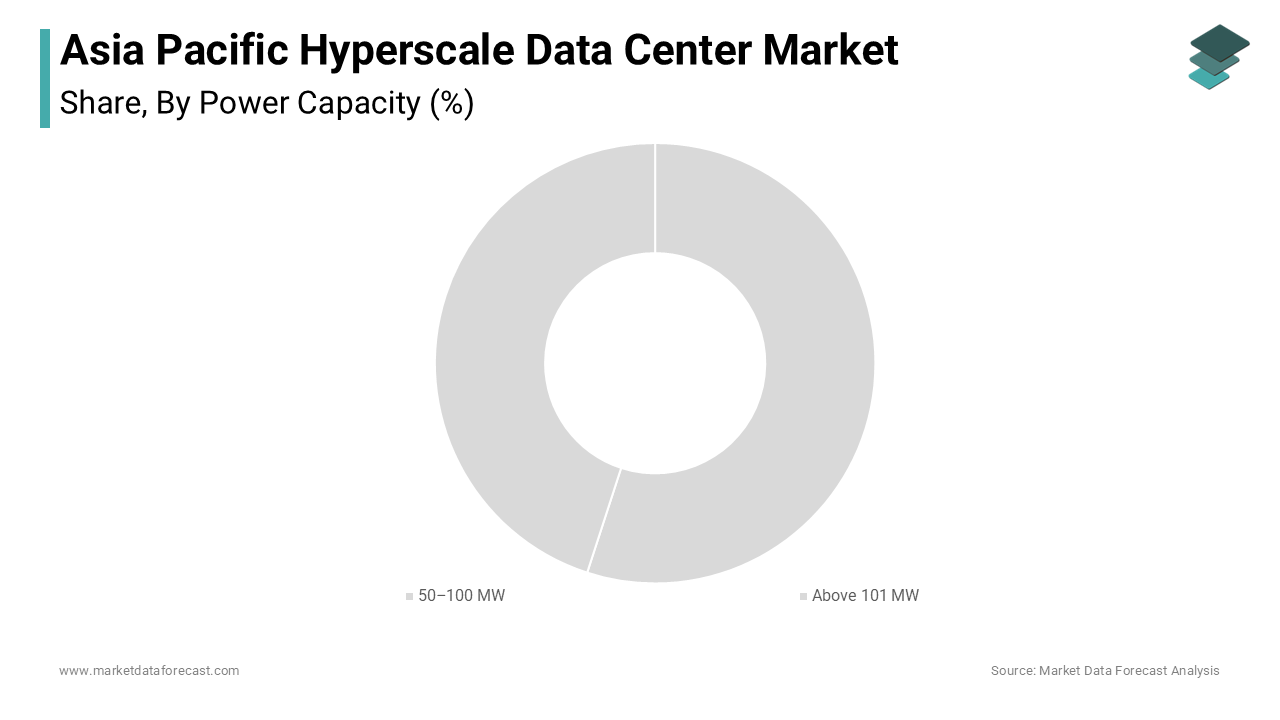
The above 101 MW power capacity segment is likely to grow with an expected CAGR of 15.4% from 2025 to 2033. According to McKinsey & Company, the number of hyperscale projects exceeding 100 MW in APAC increased by 22% in 2023 alone, with Singapore, South Korea, and Japan witnessing significant uptakes. These mega-scale facilities are strategically located near fiber optic backbones and undersea cable landing points to ensure low-latency connectivity for financial services, content delivery networks, and enterprise SaaS platforms. Furthermore, governments in markets like India and Vietnam are offering tax incentives and streamlined permitting processes for large-scale data centers to attract foreign investment and boost digital infrastructure development. These combined factors are positioning the above 101 MW segment as the most dynamic in the evolving hyperscale landscape of the Asia Pacific.
By IT Infrastructure Insights
The server infrastructure constitutes the largest segment in the Asia Pacific hyperscale data center market, capturing approximately 48% of total revenue in 2023. Servers form the backbone of data processing and application hosting, making them an essential component of any hyperscale facility aiming to deliver high-performance computing capabilities.
This segment's dominance is largely attributed to the exponential increase in data-intensive applications such as artificial intelligence, big data analytics, and real-time transaction processing. According to IDC, server shipments in the Asia Pacific region grew by 12% in 2023, with China, India, and Australia accounting for the majority of demand. In particular, hyperscale operators are increasingly deploying high-density rack servers equipped with GPUs and TPUs to handle AI-driven workloads efficiently. Moreover, the widespread adoption of virtualization and containerized applications has led to greater reliance on scalable server architectures. Additionally, advancements in liquid cooling and modular server racks have enabled higher compute densities without compromising energy efficiency.
The storage infrastructure segment is likely to grow with an expected CAGR of 16.8% during the forecast period. Cloud-native companies and SaaS providers are leading the charge in adopting distributed storage solutions to support real-time analytics, backup, and disaster recovery. As per IDC, over 60% of hyperscale operators in China and South Korea have deployed hyper-converged storage infrastructures to optimize performance and reduce latency.
Additionally, the rise of AI and deep learning applications which require extensive datasets for model training is accelerating the adoption of high-capacity storage systems. Governments in the region are also mandating data retention policies for regulated industries, further boosting demand for secure, scalable storage.
By Electrical Infrastructure Insights
The uninterruptible Power Supply (UPS) systems segment in the Asia Pacific hyperscale data center electrical infrastructure market was the largest by capturing 39.3% of share in 2024. This segment’s dominance is driven by the rising complexity of data center power requirements, especially in regions with unstable grid infrastructure. Countries like India, Indonesia, and the Philippines face frequent power fluctuations, making UPS systems essential for ensuring seamless uptime. Moreover, the shift toward modular and scalable data center designs has spurred demand for compact, high-efficiency UPS units that can be easily integrated into expanding infrastructures. Additionally, environmental regulations promoting energy-efficient power solutions are influencing procurement decisions. Governments in Japan and South Korea have mandated compliance with Tier III and Tier IV reliability standards, further reinforcing the necessity of advanced UPS configurations.
The Power Distribution Units (PDUs) segment is expected to register a CAGR of 14.6% from 2025 to 2033. A key driver behind this segment’s rapid growth is the increasing deployment of high-density computing racks that require precise power monitoring and distribution. Additionally, the adoption of smart and metered PDUs equipped with remote monitoring capabilities is gaining traction among hyperscale operators seeking to enhance energy efficiency and predictive maintenance. Furthermore, the integration of AI-driven power management platforms with PDUs is enabling dynamic load optimization and fault detection, reducing downtime risks.
REGIONAL ANALYSIS
China Hyperscale Data Center Market Insights
China was the largest contributor to the Asia Pacific home improvement market with a 28.3% share in 2024. According to the National Bureau of Statistics of China, residential property sales reached RMB 13.5 trillion (USD 1.9 trillion) in 2023, supporting a parallel surge in home furnishing and renovation demand. The urban homeownership rate exceeds 70%, and many residents undertake periodic renovations to enhance aesthetics and functionality. Moreover, the government’s push for sustainable housing and green building practices has spurred demand for energy-efficient appliances, insulation materials, and water-saving fixtures.
India Hyperscale Data Center Market Insights
India was positioned next with 14.3% of the Asia Pacific home improvement market share in 2024. According to the National Sample Survey Office (NSSO), Indian households spent over INR 1.2 lakh crores (USD 15 billion) on home improvement products and services in 2023. The real estate boom, particularly in Tier-I and Tier-II cities, has further stimulated demand for flooring, paints, kitchen fittings, and smart home automation devices. Government initiatives such as Pradhan Mantri Awas Yojana (PMAY), which aims to provide housing for all by 2024, have also contributed to the growth of the home improvement sector. As per the Housing and Urban Development Corporation (HUDCO), over 12 million houses were constructed under PMAY in 2023 alone, generating significant after-sales demand for décor and renovation.
Japan Hyperscale Data Center Market Insights
Japan home improvement market is likely to show huge growth opportunities during the forecast period. Positioning it among the top five contributors in the region. According to the Japan Housing and Wood Technology Center, Japanese homeowners spend an average of JPY 800,000 (USD 5,200) annually on home renovations, with particular emphasis on bathroom, kitchen, and flooring upgrades. The country’s seismic activity also necessitates frequent retrofitting and structural reinforcement, further stimulating demand. The presence of well-established home improvement retailers such as Tokyu Hands, Nitori, and Daikokuya supports widespread consumer access to renovation supplies and services. Additionally, the Tokyo Olympics and subsequent international events have spurred renovation of hotels, restaurants, and commercial spaces, indirectly benefiting the home improvement supply chain.
South Korea Hyperscale Data Center Market Insights
South Korea home improvement market growth is likely to grow with high consumer awareness, advanced technology integration, and a strong preference for aesthetic customization. According to the Korea Housing Finance Corporation, Korean households invested over KRW 25 trillion (USD 19 billion) in home renovations in 2023, with a particular focus on smart home systems, modular kitchens, and eco-friendly materials. The popularity of home renovation TV shows and social media influencers has further influenced consumer behavior. The government’s Green New Deal policy, launched in 2020, has encouraged energy-efficient home improvements, including insulation, LED lighting, and solar panel installations. E-commerce platforms such as Coupang and 11Street have expanded access to DIY tools and home décor products, enabling a younger demographic to engage in self-led renovations.
Australia Hyperscale Data Center Market Insights
Australia home improvement market growth is driven by a combination of high homeownership rates, favorable financing options, and a cultural emphasis on home aesthetics and outdoor living. The country’s stable economy and rising property values have fostered a consistent demand for renovations and extensions. Retail giants like Bunnings Warehouse, owned by Wesfarmers, dominate the local market, offering a vast array of DIY tools, hardware, and décor products.
KEY MARKET PLAYERS AND COMPETITIVE LANDSCAPE
The key market players in the Asia Pacific Hyperscale Data Center Market include Amazon Web Services (AWS), Microsoft Corporation, Google LLC, Alibaba Cloud, Tencent Cloud, IBM Corporation, Oracle Corporation, Huawei Technologies Co., Ltd., NTT Communications, Equinix, Inc., Digital Realty, and ST Telemedia Global Data Centres (STT GDC).
The competition in the Asia Pacific hyperscale data center market is intensifying due to the rapid digitalization across industries and increasing reliance on cloud-based infrastructure. As demand surges from sectors such as finance, healthcare, telecommunications, and e-commerce, both global giants and regional players are vying for dominance through differentiated service offerings and localized strategies. The market is witnessing a convergence of international hyperscalers expanding their footprints and domestic firms leveraging regulatory familiarity and cost advantages to capture market share.
A key differentiator among competitors is the ability to offer scalable, secure, and energy-efficient infrastructure tailored to specific client needs. Companies are investing heavily in modular designs, advanced cooling systems, and intelligent monitoring tools to improve operational efficiency and reduce downtime. Additionally, the rise of data sovereignty laws and localization mandates has made compliance a critical competitive factor, which is influencing where and how operators establish their facilities. This dynamic environment fosters innovation but also heightens pressure on firms to maintain agility, sustainability, and long-term scalability in an increasingly crowded and competitive market landscape.
Top Players in the Asia Pacific Hyperscale Data Center Market
One of the leading players in the Asia Pacific hyperscale data center market is Digital Realty. Known for its extensive global footprint and carrier-neutral colocation services, Digital Realty plays a crucial role in enabling enterprises and cloud providers to deploy scalable infrastructure across key APAC markets. The company’s emphasis on strategic partnerships, interconnection capabilities, and sustainable facility design has reinforced its leadership position.
Another key player is Equinix, a global leader in digital infrastructure with a strong presence in the Asia Pacific region. Equinix operates multiple International Business Exchange (IBX) data centers across major cities like Singapore, Sydney, and Tokyo, offering high-density computing environments tailored for hyperscalers. Its focus on hybrid cloud integration, low-latency connectivity, and ecosystem-driven solutions makes it a preferred partner for multinational corporations.
Keppel Corporation’s Keppel Data Centres division is also a dominant force in the APAC hyperscale landscape. Leveraging Singapore as a regional hub, Keppel has built a reputation for developing energy-efficient, modular data centers that cater to both local and global clients. The company's expertise in design innovation, sustainability, and green financing models positions it as a key enabler of next-generation digital infrastructure in the region.
Top Strategies Used by Key Market Participants
Key players in the Asia Pacific hyperscale data center market are increasingly adopting strategic expansion through joint ventures and local partnerships to enhance their regional reach while navigating regulatory complexities and land acquisition challenges.
Another prevalent strategy is the integration of sustainable and energy-efficient technologies, including liquid cooling, renewable energy sourcing, and AI-driven power management, to align with global ESG goals and meet evolving environmental regulations in the region.
The companies are prioritizing digital transformation through edge-ready infrastructure deployment, which is aiming to support the growing demand for low-latency applications driven by 5G, IoT, and AI workloads across the enterprise and government sectors in the Asia Pacific.
RECENT MARKET DEVELOPMENTS
- In February 2024, Equinix announced the expansion of its SG6 International Business Exchange (IBX) facility in Singapore by reinforcing its commitment to meeting rising demand for interconnected digital infrastructure in Southeast Asia. The expansion supports hyperscalers and enterprises seeking high-density computing capabilities and low-latency connectivity.
- In May 2024, Digital Realty launched a new data center campus in Sydney by positioning Australia as a strategic gateway for trans-Pacific data traffic. This development aims to strengthen the company’s presence in the Southern Hemisphere and support cloud and AI-driven workloads for multinational clients.
- In July 2024, Keppel Data Centres entered into a strategic collaboration with a Japanese technology firm by focusing on co-developing next-generation modular data centers equipped with liquid cooling and integrated power solutions tailored for high-performance computing.
- In September 2024, Google Cloud signed a long-term lease agreement with a major APAC data center provider, which is securing capacity in key locations across India and Indonesia to expand its cloud services footprint and better serve enterprise clients in emerging markets.
- In November 2024, Amazon Web Services initiated construction on a second availability zone in South Korea by enhancing redundancy and performance for enterprise and government customers. This move promotes AWS’s continued investment in the Asia Pacific region’s hyperscale infrastructure.
MARKET SEGMENTATION
This research report on the Asia Pacific hyperscale data center market is segmented and sub-segmented into the following categories.
By Power Capacity
- 50–100 MW
- Above 101 MW
By IT Infrastructure
- Server Infrastructure
- Storage Infrastructure
By Electrical Infrastructure
- Uninterruptible Power Supply (UPS) Systems
- Power Distribution Units (PDUs)
By Country
- India
- China
- Japan
- South Korea
- Australia
- New Zealand
- Thailand
- Malaysia
- Vietnam
- Philippines
- Indonesia
- Singapore
- Rest of APAC