- Product Description Description
- Table of Contents TOC
- List of Table & Figure LOT
- Get Free Sample PDF Sample PDF
Market Size, 2025
$4,930.27 BnMarket Estimate, 2026
$5,212.28 BnMarket Forecast, 2034
$8,133.65 BnCAGR, 2026–2034
5.72%Asia Pacific Logistics Market Size, Growth, Trends & Forecast (2026–2034)
The Asia Pacific logistics market size was valued at USD 4,930.27 billion in 2025, is estimated to reach USD 5,212.28 billion in 2026, and is projected to scale up to USD 8,133.65 billion by 2034, growing at a compound annual growth rate (CAGR) of 5.72% from 2026 to 2034. Propelled by rapid urbanization, massive industrial expansion, an e-commerce boom, and the widespread adoption of automation and digital supply chain technologies, the regional market continues to expand dynamically across multi-modal transport and warehousing networks.
Key Executive Metrics (At-a-Glance)
- 2025 Base Valuation: USD 4,930.27 Billion
- 2026 Current Valuation: USD 5,212.28 Billion
- 2034 Forecast Valuation: USD 8,133.65 Billion
- Compound Annual Growth Rate (CAGR): 5.72% (2026–2034)
- Top Performing Country: China (Maintains a commanding regional share of 32.4% in 2025, driven by massive e-commerce volumes and strategic infrastructure initiatives like the Belt and Road).
Core Market Drivers
- Rapid Urbanization & Industrial Growth: Expansion of urban middle classes and manufacturing output (accounting for nearly 60% of the global total in 2025).
- E-Commerce Boom: Exploding online retail sales and escalating consumer expectations for rapid last-mile fulfillment across Southeast Asia, China, and India.
Primary Market Restraints & Challenges
- Infrastructure Gaps & Fuel Costs: Uneven transport networks in developing nations, coupled with volatile crude oil prices and tightening decarbonization norms.
- Labor Shortages & Geopolitical Tensions: Workforce skill gaps, aging demographics in East Asia, and trade disruptions impacting cross-border maritime lanes.
Asia Pacific Logistics Market Segmentation Highlights
| Segment Category | Largest Segment | Fastest-Growing / Key Segment |
|---|---|---|
| By Model | Third-Party Logistics (3PL) (45.3% share in 2025) | Fourth-Party Logistics (4PL) (Fastest-growing at 9.6% CAGR) |
| By Transportation Mode | Road Transportation (48.3% share in 2025) | Air Transportation (Fastest-growing at 8.4% CAGR) |
| By End-Use Industry | FMCG Sector (28.3% share in 2025) | Healthcare Segment (Fastest-growing at 10.2% CAGR) |
| By Country | China (32.4% share in 2025) | India, South Korea, and Southeast Asian logistics hubs |
Major Industry Players Profiled
Key global and regional logistics operators shaping the Asia Pacific market include Agility Public Warehousing Co. K.S.C.P., BCR Australia Pty Ltd., C.H. Robinson Worldwide, Inc., CJ CheilJedang Corp., CMA CGM SA Group, FedEx Corp., Hellmann Worldwide Logistics SE & Co. KG, Hitachi Ltd., Japan Post Holdings Co. Ltd., Nippon Express Holdings Inc., DHL Supply Chain, COSCO Shipping Lines, and Yamato Transport.
Asia Pacific Logistics Market Size
The Asia Pacific Logistics Market Size was valued at USD 4930.27 billion in 2025, is expected to have 5.72 % CAGR from 2026 to 2034, and be worth USD 8133.65 billion by 2034 from USD 5212.28 billion in 2026.
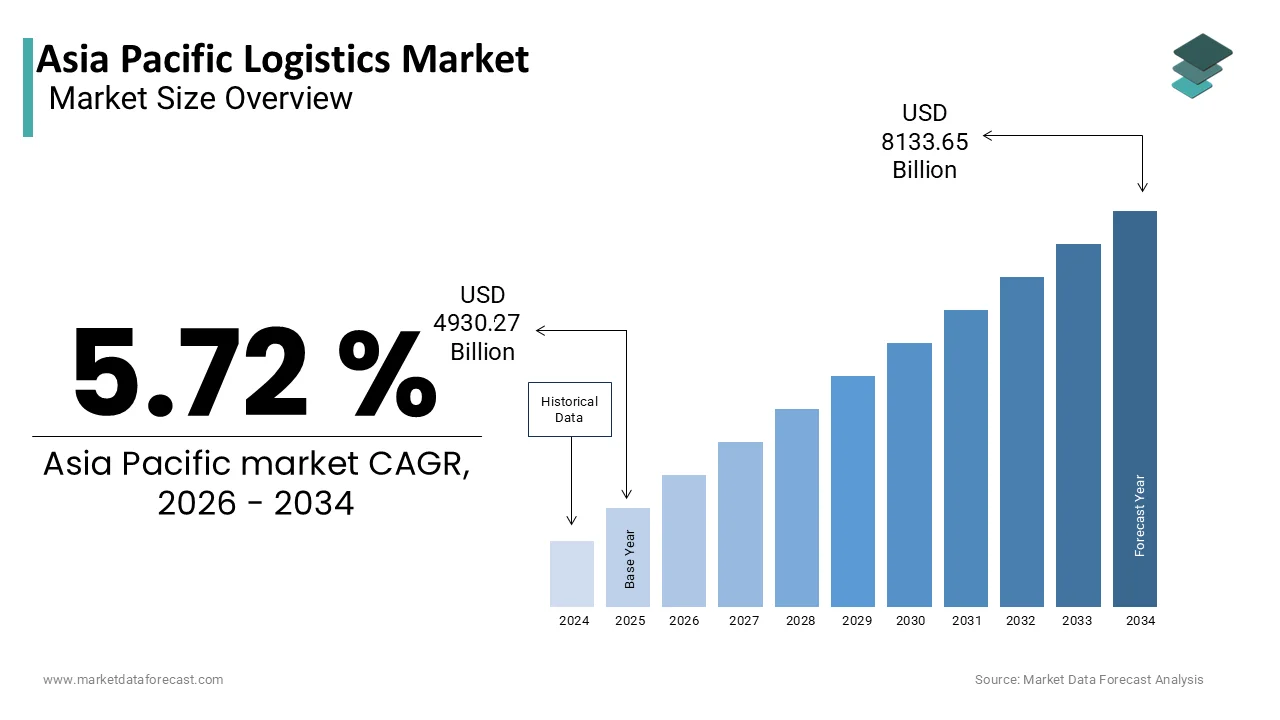
The logistics is a vast and intricate network of transportation, warehousing, supply chain management, and distribution services that facilitate domestic and international trade. This high performance promotes the region's growing capability to support complex logistics operations. Additionally, the rise in e-commerce in China and India has significantly increased demand for efficient last-mile delivery systems and automated warehousing solutions.
MARKET DRIVERS
Rapid Urbanization and Industrial Growth
One of the key drivers of the Asia Pacific logistics market is the rapid pace of urbanization and industrial expansion across emerging economies. Countries like India, Indonesia, Vietnam, and the Philippines are experiencing significant population migration to urban centers, leading to higher consumer demand and the need for more structured supply chain systems. Simultaneously, industrial output in the region continues to rise. The International Monetary Fund reported that manufacturing value added (MVA) inthe Asia Pacific accounted for nearly 60% of the global total in 2025, up from just 25% in 2000. This industrial surge necessitates enhanced logistics capabilities to manage raw material procurement, production coordination, and final product distribution. Moreover, governments are investing heavily in industrial corridors and smart cities. For example, India’s Delhi-Mumbai Industrial Corridor spans over 1,500 kilometers and involves an investment of $90 billion, directly boosting demand for integrated logistics solutions.
E-commerce Boom and Consumer Demand Shifts
The second major driver fueling the Asia Pacific logistics market is the explosive growth of e-commerce and evolving consumer expectations regarding speed, accuracy, and transparency in deliveries. As per the e-Conomy SEA report by Google, Temasek, and Bain & Company in 2025, Southeast Asia's e-commerce market alone is expected to reach $230 billion by 2025, growing at a compound annual rate of 11%. Similarly, in China, the world's largest e-commerce market, online retail sales reached $2.3 trillion in 2025, according to data from the National Bureau of Statistics of China. In response, companies have been expanding fulfillment centers and deploying drone and autonomous delivery technologies. For instance, JD.com operates over 1,400 warehouses across China, while Flipkart in India has invested over $1.2 billion in logistics infrastructure since 2020. These developments indicate a structural shift in how logistics services are designed and executed, which is driven primarily by the e-commerce boom across the Asia Pacific.
MARKET RESTRAINTS
Infrastructure Gaps in Developing Economies
A significant restraint impacting the Asia Pacific logistics market is the uneven development of infrastructure, particularly in developing nations such as Bangladesh, Myanmar, and parts of Indonesia. While countries like Singapore and Japan boast world-class logistics infrastructure, others face persistent challenges related to poor road conditions, outdated port facilities, and inadequate rail connectivity. In these regions, less than 50% of rural roads are paved, which hampers the timely delivery of goods and increases transportation costs. Moreover, inefficient customs procedures and fragmented regulatory frameworks across borders add to delays and operational inefficiencies. For example, a 2025report by the ASEAN Secretariat found that cross-border cargo clearance in some member states takes up to three times longer than in developed economies.
Rising Fuel Costs and Environmental Regulations
The volatility in fuel prices and increasingly stringent environmental regulations aimed at reducing carbon emissions are likely to propel the growth of the Asia Pacific logistics market. Diesel and fuel oil constitute a substantial portion of operating costs for logistics companies, often accounting for up to 30% of total expenses. Since 2022, global crude oil prices have experienced sharp fluctuations due to geopolitical tensions and supply chain disruptions. In 2025, the average price of Brent crude was around $85 per barrel, up from $72 in 2022, directly increasing freight costs across land and sea routes in the region. At the same time, governments across the Asia Pacific are implementing stricter emission norms to align with climate goals. Similarly, Australia introduced a national carbon offset program for freight carriers.
MARKET OPPORTUNITIES
Adoption of Digital Technologies in Supply Chain Management
A major opportunity shaping the future of the Asia Pacific logistics market is the accelerating adoption of digital technologies such as artificial intelligence, blockchain, IoT, and big data analytics to enhance supply chain visibility and efficiency. Companies are leveraging real-time tracking systems to monitor shipments, predictive analytics to forecast demand, and robotic process automation to streamline warehouse operations. For instance, DB Schenker, a leading logistics provider in the region, has deployed AI-powered forecasting tools to optimize inventory levels and reduce stockouts. Meanwhile, in India, startups like Rivigo and BlackBuck are using telematics and cloud-based platforms to improve fleet utilization and reduce idle time for trucks.
Expansion of Free Trade Agreements and Regional Integration
The growing number of free trade agreements (FTAs) and regional economic integration efforts in the Asia Pacific is creating a favorable environment for cross-border logistics growth. The Regional Comprehensive Economic Partnership (RCEP), which came into force in 2022, is a prime example, covering 15 Asia-Pacific countries and representing nearly 30% of global GDP and population. Additionally, bilateral FTAs such as the India-Australia Economic Cooperation and Trade Agreement (IndAus ECTA), signed in 2022, are opening new trade corridors. These trade liberalization efforts, combined with improved transport linkages under initiatives like the Belt and Road, are positioning the Asia Pacific logistics market to capitalize on deeper regional integration, which is offering long-term growth prospects for logistics players specializing in cross-border solutions.
MARKET CHALLENGES
Labor Shortages and Workforce Skill Gaps
The growing shortage of skilled labor and workforce attrition in countries that are experiencing demographic shifts and labor migration trends. The logistics sector relies heavily on human resources for roles ranging from truck drivers and warehouse staff to customs brokers and IT specialists managing digital supply chains. According to a 2025report by Deloitte Access Economics, Australia faces a shortfall of over 30,000 truck drivers, a crisis mirrored in parts of Japan and South Korea, where aging populations are shrinking the available workforce. In Southeast Asia, although the labor pool is larger, there remains a mismatch between the skills required and those available. A study by the International Labour Organization (ILO) in 2025revealed that only 35% of logistics workers in Indonesia had formal training in supply chain management or digital tools.
Geopolitical Tensions and Trade Disruptions
Geopolitical instability and trade disputes pose a growing challenge to the Asia Pacific logistics market, affecting cross-border trade flows, investment confidence, and supply chain planning. The region, home to both major economic powers and emerging markets, is frequently impacted by shifting political alliances, sanctions, and territorial disputes. The U.S.-China trade war, though partially stabilized in recent years, continues to influence sourcing strategies and logistics routing. Furthermore, tensions in the South China Sea, where about one-third of global maritime trade passes annually, as per the U.S. Department of Defense, pose risks to shipping lanes. Incidents involving naval standoffs or trade embargoes could disrupt freight movements, delay deliveries, and increase insurance and transit costs.
REPORT COVERAGE
| REPORT METRIC | DETAILS |
| Market Size Available | 2025 to 2034 |
| Base Year | 2025 |
| Forecast Period | 2026 to 2034 |
| Segments Covered | By Model, Transportation Mode, End-Use Industry, y and Country. |
| Various Analyses Covered | Global, Regional & Country Level Analysis, Segment-Level Analysis; DROC, PESTLE Analysis, Porter's Five Forces Analysis, Competitive Landscape, Analyst Overview of Investment Opportunities |
| Country Covered | China, India, Japan, South Korea, Australia, New Zealand, Thailand, Indonesia, Philippines, Vietnam, Singapore, Rest of APAC. |
| Market Leader Profiled | Agility Public Warehousing Co. K.S.C.P, BCR Australia Pty Ltd., C H Robinson Worldwide Inc |
SEGMENTAL ANALYSIS
By Model Insights
The third-party logistics (3PL) segment was the largest by capturing 45.3% of the Asia Pacific logistics market share in 2025, with the increasing complexity of global supply chains, especially in countries like China and India, where e-commerce expansion has intensified demand for warehousing, freight forwarding, and distribution services. Additionally, rising investments in smart logistics infrastructure, such as automated warehouses and real-time tracking systems, are enhancing the appeal of 3PL services. In Japan, for example, DHL and Yamato Transport have deployed AI-driven inventory management tools across their 3PL networks, improving delivery accuracy by 22% in 2025alone.

The fourth-party logistics (4PL) segment is projected to grow with a CAGR of 9.6% in the coming years. This rapid growth is driven by the increasing need for comprehensive supply chain visibility and optimization, particularly among multinational corporations operating across diverse regulatory and infrastructural environments. Furthermore, the adoption of digital twin technologies and blockchain-enabled traceability systems by 4PLs is gaining traction.
By Transportation Mode Insights
The road transportation segment accounted in holding 48.3% of the Asia Pacific logistics market share in 2025, with the extensive road network across both developed and emerging economies in the region. Moreover, the rise of e-commerce has amplified demand for fast and reliable delivery services, pushing logistics firms to invest in modern fleets and intermodal hubs.
The air transportation segment is likely to grow with an expected CAGR of 8.4% from 2025 to 2033. One key driver is the surge in cross-border e-commerce, which requires expedited shipping solutions. According to a 2025report by Alibaba Group, international express shipments via air accounted for nearly 22% of all cross-border orders processed through its platform, up from 15% in 2021. Additionally, governments in the region are expanding air cargo infrastructure to meet rising demand. In China, the Civil Aviation Administration noted that air freight volumes grew by 12.3% in 2025, with new cargo terminals opening at Shanghai Pudong and Guangzhou airports.
By End-Use Industry Insights
The FMCG sector was the largest by capturing 28.3% of the Asia Pacific logistics market share in 2025. One key driver is the massive consumption base in populous countries like India and Indonesia, where rising disposable incomes have led to increased spending on packaged foods, personal care products, and household essentials. Additionally, the proliferation of omnichannel retailing has created complex distribution requirements. For instance, in Australia, Woolworths and Coles expanded their same-day delivery networks in 2025, relying heavily on third-party logistics providers to handle order fulfillment.
The healthcare segment is growing with an expected CAGR of 10.2% in the coming years. One major factor propelling this growth is the expansion of government-funded healthcare programs and private sector investments in hospital infrastructure. According to the World Health Organization, healthcare expenditures in the Asia Pacific rose by 8.7% annually between 2020 and 2025, with countries like India and Vietnam allocating larger portions of their GDP to public health initiatives. Moreover, the rise in biopharmaceutical production has intensified the need for specialized logistics. In 2025, India exported over $25 billion worth of pharmaceutical products, as reported by the Department of Pharmaceuticals, requiring robust cold-chain networks and real-time monitoring systems.
COUNTRY LEVEL ANALYSIS
China was the largest contributor in the Asia Pacific logistics market with 32.4% of the share in 2025. Driven by e-commerce growth and policy initiatives such as the Belt and Road Initiative (BRI), China has invested heavily in multimodal transport systems and digital logistics platforms. In 2025, the State Post Bureau reported that over 130 billion parcels were delivered, 10.3% increase from the previous year domestically.

IIndia'slogistics market held 14.4% of the share in 2025. The implementation of the National Logistics Policy in 2022 streamlined customs procedures and integrated logistics data across ministries, reducing freight costs by an estimated 8% by 2025, as noted by NITI Aayog. India’s multi-modal freight corridors, including the Delhi-Mumbai Industrial Corridor and Chennai-Bangalore corridor, have enhanced connectivity between production hubs and ports. Private players like Delhivery and Rivigo have expanded their fleets and tech capabilities by enabling better route optimization and fuel efficiency.
JaJapan'sogistics market growth is driven by its advanced logistics technology and precision-based supply chain practices. Japan excels in urban logistics, cold chain management, and just-in-time delivery models. The country benefits from a well-developed transport infrastructure, including high-speed rail networks and automated port facilities. E-commerce growth, particularly through platforms like Rakuten and Amazon Japan, has also spurred investment in robotics and warehouse automation. Moreover, the government’s push for carbon-neutral logistics through hydrogen-fueled transport and electric delivery fleets is reshaping the sector. Japan’s commitment to innovation and sustainability ensures its continued relevance in the evolving logistics landscape of the region.
South Korea's logistics market growth is likely to grow with the rapid adoption of smart logistics solutions. In 2025, the Ministry of Land, Infrastructure, and Transport launched the “Smart Logistics Innovation Strategy,” aiming to deploy AI, drones, and IoT across the logistics spectrum. E-commerce expansion is another catalyst, with local players like Coupang and Kurly offering same-day delivery services using hyperlocal warehouses. Incheon International Airport, one of the busiest cargo hubs in the world, handled over 4.2 million tons of freight in 2025by maintaining its status as a key gateway for intra-Asia trade. Australia'sa logistics market growth is driven by the smaller population; the country plays a crucial role in regional trade due to its rich natural resources and strong import/export linkages. Additionally, Australia’s participation in trade agreements such as RCEP and the Comprehensive and Progressive Agreement for Trans-Pacific Partnership (CPTPP) has boosted cross-border freight movements. In 2025, total international freight handled at Australian ports increased by 6.4%, according to the Department of Infrastructure, Transport, Regional Development, and Communications.
KEY MARKET PLAYERS
Overview of Competition in the Asia Pacific Logistics Marketise
- Agility Public Warehousing Co. K.S.C.P.
- BCR Australia Pty Ltd.
- C. H. Robinson Worldwide, Inc.
- CJ CheilJedang Corp.
- CMA CGM SA Group
- FedEx Corp.
- Hellmann Worldwide Logistics SE & Co. KG
- Hitachi Ltd.
- Japan Post Holdings Co. Ltd.
- Nippon Express Holdings Inc.
COMPETITIVE LANDSCAPE
The competition in the Asia Pacific logistics market is intense and multifaceted, driven by a mix of global giants, regional champions, and emerging local players. As trade volumes grow and supply chains become more complex, companies are continuously innovating to differentiate themselves through service quality, technological integration, and operational efficiency. Established multinational logistics providers leverage their global networks and advanced infrastructure to maintain dominance, while regional players focus on localized expertise, cost-effectiveness, and agile response mechanisms. The rise of e-commerce has further intensified rivalry, prompting firms to invest in faster delivery systems, warehouse automation, and customized fulfillment solutions. Additionally, sustainability is becoming a critical battleground, with firms competing to offer greener alternatives and comply with tightening regulations.
Top Players in the Market
DHL Supply Chain (Germany-based, with strong APAC presence)
DHL is a leading global logistics provider with a dominant footprint across the Asia Pacific region. It offers end-to-end supply chain solutions, including warehousing, freight forwarding, and contract logistics. In the Asia Pacific market, DHL plays a pivotal role in supporting e-commerce, automotive, and healthcare industries by leveraging its regional hubs in Singapore, China, and India. The company’s investment in automation, green logistics, and digital tracking systems has positioned it as a preferred partner for multinational corporations seeking reliable and scalable logistics support.
COSCO Shipping Lines (China)
As one of the largest shipping companies globally, COSCO Shipping holds a strategic position in the Asia Pacific logistics sector. It operates an extensive fleet that connects major trade routes across the region and beyond. COSCO plays a crucial role in maritime logistics, offering container shipping, port management, and integrated supply chain services. Its alignment with China’s Belt and Road Initiative enhances its regional influence, enabling seamless cargo movement between Asia, Africa, and Europe. COSCO's integrated logistics model supports industrial growth and international trade expansion in the region
Yamato Transport (Japan)
Yamato Transport is a key player in domestic and regional logistics within the Asia Pacific, particularly known for its efficient small-parcel delivery network in Japan. The company has expanded its operations into Southeast Asia, offering tailored logistics solutions for e-commerce and retail clients. Yamato emphasizes customer-centric service models, same-day delivery, and eco-friendly transportation methods. Its innovative approach to last-mile delivery and cold-chain logistics has made it a trusted name in urban logistics by contributing significantly to the evolution of smart logistics practices in the Asia Pacific region.
Top Strategies Used by Key Market Participants
Digital Transformation and Automation
Leading logistics companies are investing heavily in digital technologies such as AI, IoT, and blockchain to enhance operational efficiency and visibility. These tools enable real-time tracking, predictive analytics, and automated warehouse management, which improves decision-making and reduces human error.
Strategic Partnerships and Mergers & Acquisitions
To expand their reach and capabilities, logistics firms are forming alliances or acquiring regional players. This strategy allows them to integrate local expertise with global standards by enhancing service offerings and strengthening market presence across diverse geographies.
Sustainable and Green Logistics Initiatives
With growing environmental concerns, companies are adopting electric vehicles, optimizing fuel consumption, and implementing carbon offset programs. These initiatives not only reduce environmental impact but also align with regulatory requirements and evolving consumer expectations regarding sustainability in supply chain operations.
RECENT HAPPENINGS IN THE MARKET
- In February 2025, DB Schenker, a leading global logistics provider, launched a new multimodal transport corridor connecting southern China with Central Asia. This initiative was aimed at enhancing cross-border freight efficiency and reducing transit times for shippers operating in the region.
- In May 2025, CJ Logistics announced the expansion of its automated warehouse facility in Seoul, integrating AI-driven inventory management and robotics to improve order fulfillment speed and accuracy for e-commerce clients across the Asia Pacific.
- In July 2025, Rivigo, an Indian logistics startup, introduced a drone-based delivery pilot program for remote regions in the Himalayan states, which is aiming to strengthen its last-mile connectivity and serve underpenetrated markets more effectively.
- In September 2025, SF Express opened a new regional logistics hub in Singapore, designed to serve as a central distribution point for cross-border e-commerce shipments between Southeast Asia, North America, and Europe.
- In November 2025, Kerry Logistics partnered with a Japanese tech firm to deploy blockchain-enabled supply chain tracking systems across its operations in Thailand and Vietnam by enhancing transparency and traceability for pharmaceutical and high-value goods.
MARKET SEGMENTATION
This research report on the Asia Pacific Logistics Market has been segmented and sub-segmented into the following.
By Model
- third-party logistics (3PL)
- fourth-party logistics (4PL)
By Transportation Mode
- road transportation
- air transportation
By End-Use Industry
- FMCG sector
- Healthcare
By Country
- China
- India
- Japan
- South Korea
- Australia
- New Zealand
- Thailand
- Indonesia
- Philippines
- Vietnam
- Singapore
- Rest of APAC