- Product Description Description
- Table of Contents TOC
- List of Table & Figure LOT
- Get Free Sample PDF Sample PDF
Market Size, 2025
$0.44 BnMarket Estimate, 2026
$0.50 BnMarket Forecast, 2034
$1.50 BnCAGR, 2026–2034
14.56%Asia-Pacific Long-Term Care Software Market Size, Share, Trends & Forecast (2026–2034)
- Market Scope: Comprehensive analysis of the Asia-Pacific long-term care software market covering product classifications, delivery modes, end-user care settings, country-level growth frameworks, and digital health drivers.
- Market Valuation: Valued at USD 0.44 billion (2025), estimated at USD 0.50 billion (2026), and projected to reach USD 1.50 billion by 2034, growing at a compound annual growth rate (CAGR) of 14.56% (2026–2034).
- Primary Growth Drivers: Rapid expansion of the aging demographic (projected to shift from 12.7% to 21.3% between 2017 and 2050), rising prevalence of chronic conditions, shortage of healthcare professionals, and government healthcare reforms promoting digital transformation and cost reduction.
Asia-Pacific Long-Term Care Software Market Segment Metrics (2026–2034)
| Category | Leading Segment (2025 Position) | Fastest-Growing Segment |
|---|---|---|
| By Product | Clinical Long-Term Care Software (EMR/EHR & Electronic Medication Administration Records) | Non-clinical Solutions (Remote Patient Monitoring & Billing Systems) |
| By Mode of Delivery | Web-Based & On-Premises Platforms | Cloud-Based Software Solutions |
| By End-User | Nursing Care & Assisted Living Facilities (primary institutional users) | Home Healthcare Settings |
| By Country / Region | China (dominating market share due to eldercare infrastructure buildout and tech adoption) | Japan & India (witnessing high growth rates from rapid aging and healthcare modernization) |
Major Industry Players & Market Structure
Market Structure: Highly competitive regional digital healthcare landscape characterized by the widespread acceptance of web-based and cloud-based platforms, addressing nurse shortages, and navigating traditional provider reluctance in emerging economies.
Key Companies: AOD Software, Cerner Corporation, Allscripts Healthcare Solutions, Inc., McKesson Corporation, Omnicare, Inc., Omnicell, Inc., Kronos incorporated, HealthMEDX, PointClickCare, Matrix Care, Sigma Care, and Optimus EMR.
 Download Free Sample Report
Asia Pacific Long-term Care Software Market Size
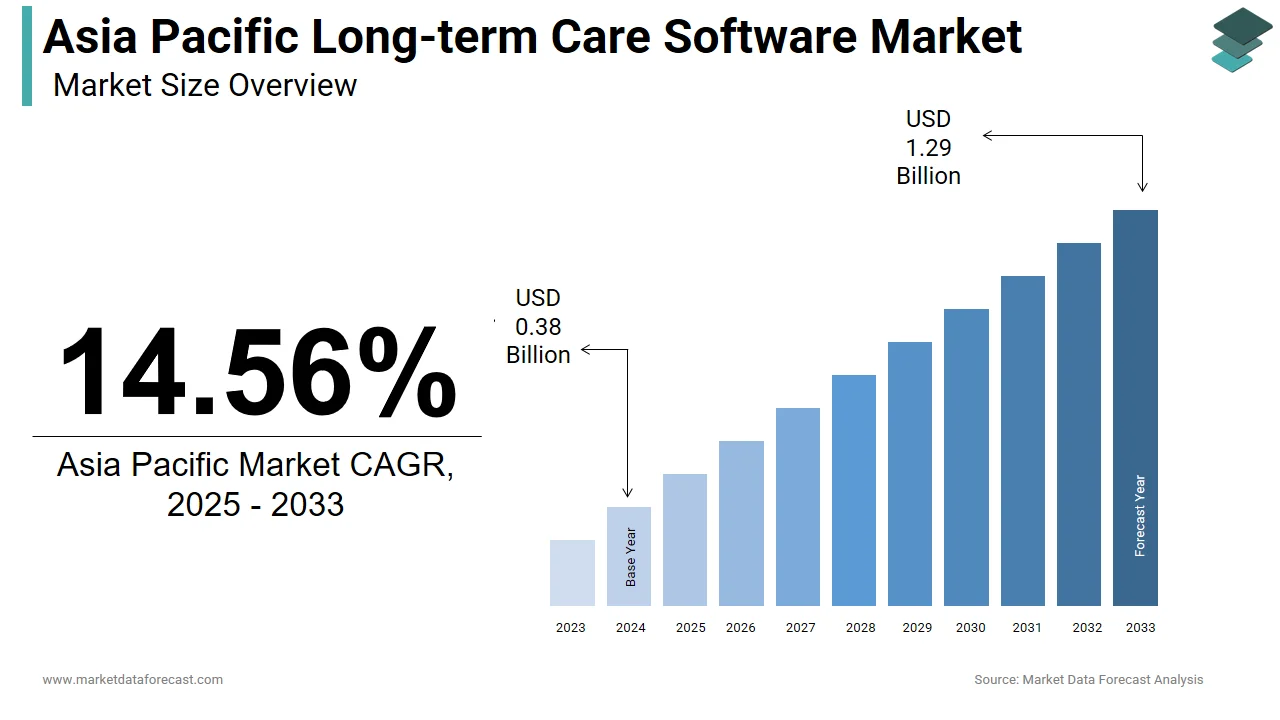
The Asia-Pacific long-term care software market was valued at USD 0.44 billion in 2025. The market is estimated at USD 0.50 billion in 2026 and is projected to reach USD 1.50 billion by 2034, growing at a CAGR of 14.56% from 2026 to 2034.
MARKET DRIVERS
Growing Aging Population and Chronic Disease Burden Fuel Software Adoption
The rising burden of chronic diseases, and improving healthcare quality, the growing senior population safety and management are driving the long-term care software market in this region. The aging population is significantly growing in the Asia Pacific region. It is critical to have them monitor at-home care, nursing facilities, community centers, and assisted living facilities to control and monitor such a large proportion of the elderly population who are susceptible to any chronic condition, even if the disease has only occurred once. As a result, the need for software and technology to connect to these centers and patients becomes one of the key market drivers. Between 2017 to 2050, the aged population in the Asia Pacific is expected to expand from 12.7 percent to 21.3 percent, directly increasing the demand for nursing homes and assistance facilities, where long-term care of software facilities is vital for the efficient management of patient care.
On the other hand, the healthcare reforms and government initiatives, the aging population, the rising burden of chronic diseases, a growing shortage of nurses and doctors, and an increasing need to cut healthcare costs are fuelling the long-term care software market growth in the Asia Pacific region. Moreover, a growing need to raise disease awareness, improve healthcare infrastructure, change demographic trends, and raise government funding is expected to drive the long-term care software market forward.
Other factors projected to accelerate the market growth pace include demographic trends, a shortage of healthcare specialists, and various government schemes to minimize medical expenditures. Furthermore, rising acquisition levels and a wide range of software applications are expected to fuel market expansion.
MARKET RESTRAINTS
High Costs and Skilled Staff Shortage Limit Software Adoption in Long-Term Care
The high expenses connected with software are expected to slow down the market growth pace in this region to a small extent. In addition, the availability of adequate healthcare services is being hampered by a shortage of experienced staff and professionals. Furthermore, low software acquisition in underdeveloped nations and the reluctance of traditional long-term care providers to acquire software stifle industry growth during the forecast period.
REPORT COVERAGE
| REPORT METRIC | DETAILS |
| Market Size Available | 2025 to 2034 |
| Base Year | 2025 |
| Forecast Period | 2026 to 2034 |
| Segments Covered | By Product, Mode of Delivery, End-User, and Country. |
| Various Analyses Covered | Global, Regional and Country-Level Analysis, Segment-Level Analysis, Drivers, Restraints, Opportunities, Challenges; PESTLE Analysis; Porter’s Five Forces Analysis, Competitive Landscape, Analyst Overview of Investment Opportunities |
| Countries Covered | India, China, Japan, South Korea, Australia, New Zealand, Thailand, Malaysia, Vietnam, Philippines, Indonesia, Singapore, and Rest of APAC |
| Market Leaders Profiled | AOD Software, Cerner Corporation, Allscripts Healthcare Solutions, Inc., McKesson Corporation, Omnicare, Inc., Omnicell, Inc., Kronos incorporated, HealthMEDX, PointClickCare, Matrix Care, Sigma Care, and Optimus EMR. |
COUNTRY LEVEL ANALYSIS
The Asia Pacific is the fastest growing area in the worldwide market. As a result of expanding economies and shifting population demographics. The long-term care software market in the Asia Pacific is anticipated to have the highest CAGR and fastest growth rate over the forecast period. The regional market growth is attributed to increased healthcare investments and funding, improving healthcare infrastructure, and favorable reimbursement policies.
However, the market is more likely to witness significant growth due to the rapid healthcare sector expansion and widespread acceptance of web-based and cloud-based long-term care software in emerging nations. The major growth contributors in the region are China, Japan, and India.
China dominated the Long-term software market and is anticipated to continue its growth throughout the forecast period. Factors such as increased medical tourism, healthcare infrastructure development, and technological advancements in the healthcare sector significantly contribute to the country's market growth.
During the forecast period, Japan is expected to have a significant growth rate in the long-term care software expenses, which are expected to accelerate the expansion of the market. Japan has witnessed technological advancements in the healthcare sector over the years. In addition, the growing geriatric population, expanding disposable income, and growing demands for lower healthcare pricing are expected to drive the Long-term care software market in Japan. Therefore, the market is projected to witness a promising share in the coming years.
On the other hand, the Indian Long-term care software market is anticipated to witness a promising share during the forecast period. Growing awareness of chronic diseases, improving healthcare infrastructure, and supportive government policies are expected to fuel the market growth.
KEY MARKET PLAYERS
A few of the noteworthy companies operating in the Asia Pacific long-term care software market profiled in the report are AOD Software, Cerner Corporation, Allscripts Healthcare Solutions, Inc., McKesson Corporation, Omnicare, Inc., Omnicell, Inc., Kronos incorporated, HealthMEDX, PointClickCare, Matrix Care, Sigma Care, and Optimus EMR.
MARKET SEGMENTATION
The Long-term care software market in the Asia Pacific has been segmented and sub-segmented into the following categories.
By Product
- Clinical Long Term Care Software
- EMR/HER
- e-Prescribing
- Electronic Medication Administration Records
- Clinical Decision Support Systems
- Non-clinical Long Term Care Software
- Payroll Management and Billing
- Remote Patient Monitoring Systems
- Real-Time Location Systems
- Remote Training and Supervision Systems
- Invoicing And Scheduling Software
By Mode of Delivery
- Cloud Bases
- Web-Based
- On-Premises
By End-User
- Home Healthcare
- Nursing Care
- Assisted Living Facilities
By Country
- India
- China
- Japan
- South Korea
- Australia
- New Zealand
- Thailand
- Malaysia
- Vietnam
- Philippines
- Indonesia
- Singapore
- Rest of Asia Pacific