- Product Description Description
- Table of Contents TOC
- List of Table & Figure LOT
- Get Free Sample PDF Sample PDF
Market Size, 2025
$1.28 BnMarket Estimate, 2026
$1.37 BnMarket Forecast, 2034
$2.31 BnCAGR, 2026–2034
6.80%Executive Summary: Asia Pacific Lubricant Packaging Market
- Market Scope: Comprehensive regional lubricant packaging market analysis covering material types, packaging formats, lubricant categories, country-specific leadership frameworks, and key strategic developments.
- Market Valuation: Valued at USD 1.28 billion (2025), estimated at USD 1.37 billion (2026), and projected to reach USD 2.31 billion by 2034, registering a robust CAGR of 6.80% (2026–2034).
- Primary Growth Drivers: Robust automotive expansion in China and India, rapid industrial machinery manufacturing in South Korea and Southeast Asia, and e-commerce penetration. Opportunities include sustainable packaging (recyclable HDPE, mono-material laminates), stand-up pouches, and tamper-evident designs.
Key Market Segment Metrics (2026–2034)
| Category | Leading Segment (2025 Position) | Fastest-Growing Segment |
|---|---|---|
| By Material & Type | Plastic segment (held 65.8% market share); Drums (held largest packaging share at 40.7%) | Metal-based packaging (CAGR of 5.9%); Stand-up pouches (fastest-growing type CAGR of 7.2%) |
| By Lubricant & Region | Engine oil segment (led with ~60% share); China (led regional market with a 38.4% share) | Transmission and hydraulic fluid (fastest-growing category with a CAGR of 6.8%) |
Major Market Players & Market Structure
Market Structure: Highly competitive Asia-Pacific industrial packaging landscape featuring major packaging corporations and converters competing intensely on lightweight HDPE solutions, tamper-evident innovations, and sustainable materials.
Key Companies: Amcor Limited, BAM Packaging, Berry Plastics, CDF, Glenroy Inc, Graham Packaging, Greif Inc, Mold Tek Packaging, SCHUTZ GmbH & Co. KGaA, and Scholle IPN.
Asia Pacific Lubricant Packaging Market Size
The Asia Pacific lubricant packaging market size was valued at USD 1.28 billion in 2025 and is anticipated to reach a valuation of USD 1.37 billion in 2026 and USD 2.31 billion by 2034, growing at a CAGR of 6.80%, from 2026 to 2034.
The Asia Pacific lubricant packaging market encompasses a wide range of containers and materials used for the safe storage, transportation, and dispensing of industrial and automotive lubricants. These include metal drums, plastic jerricans, bulk tanks, aerosol cans, and flexible pouches, each designed to meet specific performance and safety standards. The market is influenced by the region’s expanding manufacturing base, growing automotive industry, and increasing demand for packaged industrial oils in both formal and informal sectors.
China is a major player in the regional market due to its dominance in automotive production and heavy machinery manufacturing. According to the China Association of Automobile Manufacturers, the country produced over 27 million vehicles in 2023, driving consistent demand for engine oils and associated packaging solutions. India follows closely, with strong growth in two-wheeler and commercial vehicle production, as reported by the Society of Indian Automobile Manufacturers.
Japan and South Korea remain key contributors due to their advanced industrial ecosystems and high reliance on precision-engineered lubricants in electronics, robotics, and shipbuilding. Meanwhile, Southeast Asian nations such as Thailand, Vietnam, and Indonesia are witnessing rising local demand driven by urbanization and infrastructure development.
MARKET DRIVERS
Expansion of the Automotive Industry
One of the primary drivers of the Asia Pacific lubricant packaging market is the robust expansion of the automotive industry across countries like China, India, Thailand, and Indonesia. The production and after-sales servicing of vehicles require significant quantities of engine oils, gear oils, and hydraulic fluids, all of which depend on efficient and durable packaging solutions. This massive scale of production translates into extensive demand for packaged motor oils used in initial fill applications and periodic replacements. Thailand, often referred to as the "Detroit of Southeast Asia," continues to be a key hub for automotive exports. The Thai Auto Parts Manufacturers Association noted that the country exported auto components worth USD 28 billion in 2023, many of which included lubricants in branded packaging.
Growth in Industrial Machinery and Equipment Manufacturing
Another significant driver of the Asia Pacific lubricant packaging market is the rapid expansion of industrial machinery and equipment manufacturing, particularly in China, India, and South Korea. Lubricants play a crucial role in ensuring the smooth operation of manufacturing equipment, construction machinery, and agricultural tools, necessitating reliable and standardized packaging for efficient handling and distribution. This growth directly correlates with increased consumption of industrial lubricants, which in turn drives demand for specialized packaging formats such as large-volume drums, intermediate bulk containers, and resealable jerricans. In India, the Ministry of Heavy Industries has been promoting the adoption of advanced manufacturing technologies under initiatives like Production-Linked Incentive (PLI) schemes. Similarly, South Korea’s focus on smart factories and robotics has led to higher usage of synthetic and semi-synthetic lubricants, which require premium-grade packaging to maintain purity and performance.
MARKET RESTRAINT
Regulatory Pressure on Plastic Packaging Usage
A key restraint affecting the Asia Pacific lubricant packaging market is the increasing regulatory pressure on the use of single-use plastics and non-recyclable materials in packaging. Governments across the region are implementing stringent environmental policies aimed at reducing plastic waste and promoting sustainable alternatives, which pose challenges for traditional packaging formats such as polyethylene jerricans and shrink-wrapped multipacks. For example, China's Ministry of Ecology and Environment introduced new guidelines under the 14th Five-Year Plan that mandate reduced plastic content in industrial packaging and encourage the adoption of recyclable or biodegradable materials. Similarly, India’s Ministry of Environment, Forest, and Climate Change implemented extended producer responsibility (EPR) norms requiring manufacturers to manage post-consumer packaging waste. As per the Confederation of Indian Industry, this regulation has prompted several lubricant producers to invest in alternative materials such as HDPE bottles with recyclability certifications.
Volatility in Raw Material Prices
Another notable constraint on the Asia Pacific lubricant packaging market is the volatility in raw material prices, particularly for plastics, metals, and adhesives used in container manufacturing. Fluctuations in crude oil prices, geopolitical tensions, and supply chain disruptions have made it difficult for packaging manufacturers to maintain stable pricing structures. Also, importing dependencies in countries like India and Indonesia exposes domestic producers to exchange rate risks and freight cost variations.
MARKET OPPORTUNITY
Rise in Demand for Sustainable and Eco-Friendly Packaging Solutions
A promising opportunity for the Asia Pacific lubricant packaging market lies in the growing demand for sustainable and eco-friendly packaging formats. With increasing awareness around environmental impact and government mandates pushing for circular economy practices, manufacturers are exploring biodegradable materials, reusable containers, and lightweight packaging options that reduce carbon footprints without compromising functionality. Companies like Shell and Castrol have already begun introducing HDPE bottles with integrated recycling codes and refill packs in markets such as Singapore and Malaysia, responding to shifting consumer expectations.
Expansion of E-commerce and Direct-to-Consumer Distribution Channels
The growing penetration of e-commerce and direct-to-consumer (D2C) distribution channels is creating new opportunities for the Asia Pacific lubricant packaging market. Online retail platforms are increasingly offering automotive and industrial lubricants in consumer-friendly packaging formats, encouraging manufacturers to innovate in terms of design, convenience, and brand visibility. Platforms like Amazon and Flipkart saw a rise in demand for small-format bottles, drip-proof caps, and tamper-evident seals that enhance user experience and product safety. In China, Tmall and JD.com have seen a surge in private-label lubricant sales, necessitating customized packaging that supports branding, shelf appeal, and ease of transport.
MARKET CHALLENGES
Compliance with Diverse Regional Regulations
One of the most pressing challenges facing the Asia Pacific lubricant packaging market is the complexity of complying with diverse regional regulations governing labeling, material sourcing, and waste management. Each country in the region imposes distinct requirements regarding packaging composition, hazardous material warnings, and recycling obligations, making it difficult for suppliers to standardize their offerings. As regulatory frameworks continue to evolve, companies must invest in compliance capabilities to maintain competitive positioning in the regional market.
Intensifying Competition from Private Label and Local Brands
Another significant challenge for the Asia Pacific lubricant packaging market is the intensifying competition from private label and local packaging brands, which offer lower-cost alternatives to established multinational suppliers. As original equipment manufacturers (OEMs) and independent distributors seek to cut operational expenses, they are increasingly turning to cost-effective packaging solutions that match functional requirements but lack brand premiums. These local producers often replicate international designs while leveraging lower labor and material costs, enabling them to undercut global players in price-sensitive segments. In Southeast Asia, countries like Thailand and Vietnam have seen an influx of contract packaging firms catering to niche lubricant producers, further fragmenting the market.
REPORT COVERAGE
| REPORT METRIC | DETAILS |
| Market Size Available | 2025 to 2034 |
| Base Year | 2025 |
| Forecast Period | 2026 to 2034 |
| CAGR | 6.80% |
| Segments Covered | By Material, Packaging, Lubricant, and Region. |
|
Various Analyses Covered | Global, Regional, and Country-Level Analysis, Segment-Level Analysis, DROC, PESTLE Analysis, Porter’s Five Forces Analysis, Competitive Landscape, Analyst Overview of Investment Opportunities |
| Regions Covered | India, China, Japan, South Korea, Australia, New Zealand, Thailand, Malaysia, Vietnam, Philippines, Indonesia, Singapore, and the Rest of APAC |
|
Market Leaders Profiled | Amcor Limited (Switzerland), BAM Packaging (US), Berry Plastics (US), CDF (US), Glenroy Inc (US), Graham Packaging (US), Greif Inc (US), Mold Tek Packaging (India), SCHUTZ GmbH & Co. KGaA (Germany), Scholle IPN (US) |
SEGMENTAL ANALYSIS
By Material Insights
The plastic segment dominated the Asia Pacific lubricant packaging market by capturing 65.8% of total consumption in 2025. This segment includes polyethylene (PE), polypropylene (PP), and high-density polyethylene (HDPE) used for manufacturing bottles, jerricans, and small-format containers. One of the primary drivers behind this dominance is the widespread adoption of plastic packaging in both industrial and consumer-grade lubricant applications due to its lightweight nature, cost-effectiveness, and ease of molding into complex shapes. Similarly, in Southeast Asia, countries like Thailand and Vietnam have seen a shift from metal drums to plastic containers for small and mid-sized lubricant volumes. With ongoing advancements in recyclability and barrier properties, plastic remains the most preferred material across multiple end-use sectors.
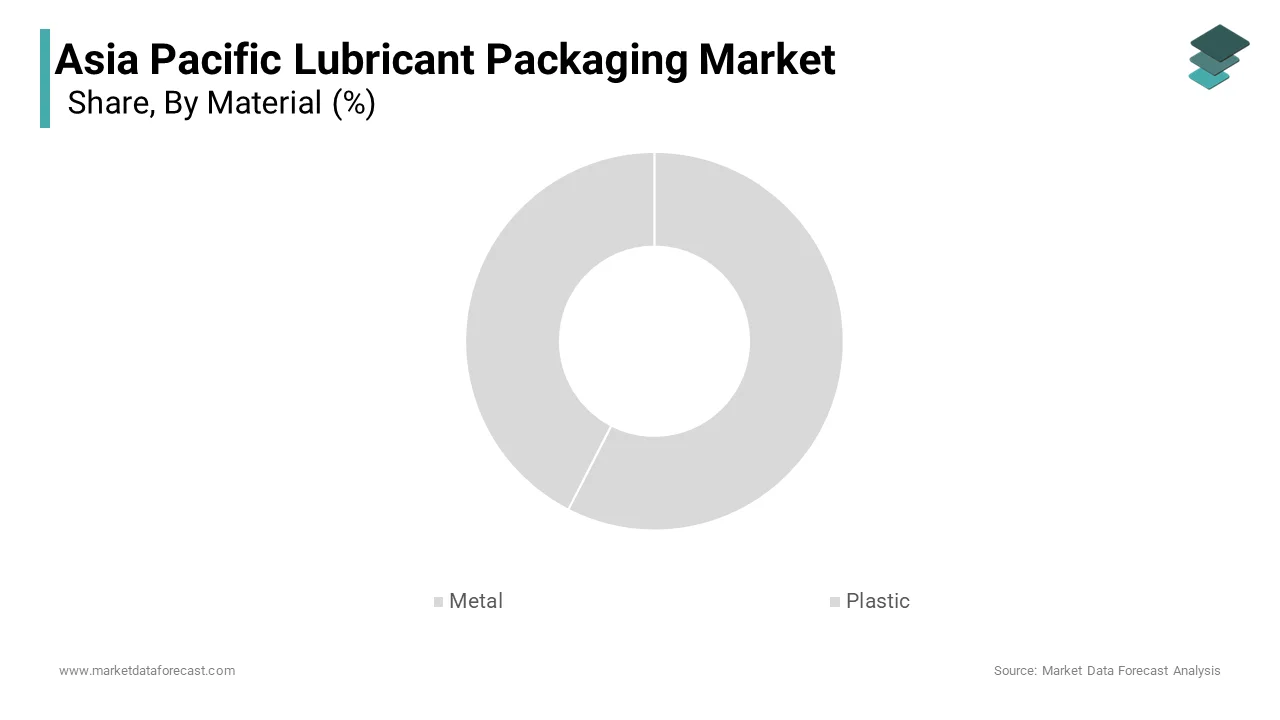
Metal-based lubricant packaging is emerging as the fastest-growing segment in the Asia Pacific market, projected to expand at a CAGR of 5.9%. This includes steel and aluminum drums, cans, and aerosol containers used primarily in heavy-duty and industrial applications. A key factor driving this growth is the increasing demand for bulk lubricants in construction, mining, and marine industries, where metal drums offer superior durability and protection against oxidation and contamination. In addition, the rise in synthetic and semi-synthetic lubricant consumption in Japan and South Korea has reinforced the need for metal packaging, which provides better sealing and resistance to chemical degradation. With growing investments in infrastructure and machinery maintenance, the metal packaging segment is gaining momentum across the region.
By Packaging Type Insights
Drums held the largest share of the Asia Pacific lubricant packaging market by accounting for 40.7% in 2025. These include both steel and plastic variants, typically available in 200-liter sizes, and are widely used for bulk storage and transportation of industrial lubricants, engine oils, and hydraulic fluids. The dominance of this segment is largely attributed to the extensive use of drums in manufacturing plants, refineries, and fleet maintenance centers. Like, a large share of industrial lubricants in China was distributed in drums in 2023, ensuring minimal contamination and efficient handling in production environments. South Korea also relies heavily on drum packaging for shipbuilding and automotive assembly lines, where large volumes of lubricants are required for machinery operation and testing. With continued expansion in energy, transport, and manufacturing sectors, drum packaging remains central to the regional lubricant supply chain.
Stand-up pouches are the fastest-growing packaging type in the Asia Pacific lubricant packaging market, expected to grow at a CAGR of 7.2%. These flexible packages are increasingly being adopted for low-viscosity oils, greases, and specialty lubricants due to their lightweight design, space-saving structure, and environmental benefits. A major driver of this trend is the rising popularity of single-use and portion-controlled lubricant packaging in the motorcycle and small-engine markets, particularly in India and Indonesia. In addition, e-commerce platforms such as Amazon and Flipkart have begun offering lubricants in stand-up pouch formats to reduce shipping costs and enhance customer experience. With growing emphasis on sustainability and logistics efficiency, stand-up pouches are gaining traction across multiple lubricant categories.
By Lubricant Type Insights
The Engine oil accounts for the largest segment of the Asia Pacific lubricant packaging market, holding approximately 60% of the total share in 2025. This is primarily due to the massive scale of automotive production and aftermarket servicing across the region, where engine oil remains a critical consumable. China leads in engine oil packaging demand. Most of these vehicles require factory-fill and periodic replacement oils, necessitating standardized packaging formats ranging from small bottles to bulk drums. Japan and South Korea also maintain steady demand for engine oil packaging due to high vehicle ownership rates and strict maintenance schedules in urban areas.
The transmission & Hydraulic Fluid is the fastest-growing category in the Asia Pacific lubricant packaging market, projected to expand at a CAGR of 6.8%. This development is driven by increasing mechanization in agriculture, construction, and logistics, which rely heavily on transmission and hydraulic systems for optimal performance. One of the key contributors to this growth is the expanding construction equipment industry in India and Southeast Asia. In Indonesia, government-led infrastructure projects have led to higher procurement of excavators, bulldozers, and cranes, all of which require frequent replenishment of transmission and hydraulic fluids. Companies are responding by introducing tamper-evident bottles and resealable containers tailored for these fluids.
COUNTRY-LEVEL ANALYSIS
China Lubricant Packaging Market Analysis
China was the largest share of the Asia Pacific lubricant packaging market, accounting for 38.4% in 2025. As the world’s top automobile manufacturer and exporter, the country’s automotive and industrial sectors drive substantial demand for lubricant packaging in various formats, including drums, bottles, and flexible pouches.
A key contributor to this dominance is the scale of vehicle production. This output supports a vast aftermarket ecosystem, where packaged engine oils and industrial lubricants are essential for routine maintenance. Furthermore, regulatory initiatives under the 14th Five-Year Plan emphasize sustainable packaging, prompting companies like Sinopec and Shell to introduce recyclable HDPE bottles and eco-friendly labeling.
India Lubricant Packaging Market Analysis
India’s rapid urbanization, growing automotive sector, and expanding industrial base have been instrumental in driving demand for diverse packaging solutions. The automotive industry is a major consumer. The two-wheeler segment alone accounted for a major share of total production, all requiring packaged engine oil for initial fill and after-sales service. Moreover, the government’s push for infrastructure development under the National Infrastructure Pipeline has spurred demand for industrial lubricants, leading to greater use of jerricans and intermediate bulk containers. With sustained economic growth and policy support, India remains a pivotal player in the regional lubricant packaging market.
Japan Lubricant Packaging Market Analysis
Japan’s mature automotive and industrial ecosystems ensure steady demand for high-quality lubricant packaging, particularly in premium formats suitable for precision engineering and export-oriented manufacturing. A major contributor to this demand is Japan’s reliance on advanced manufacturing technologies in robotics, electronics, and shipbuilding, all of which require high-performance lubricants and leak-proof packaging. Additionally, the automotive aftermarket remains robust, with the Japan Automobile Manufacturers Association noting that domestic vehicle sales exceeded 5 million units in the same year. The country’s focus on hydrogen economy initiatives and fuel cell vehicles has also led to new packaging requirements for synthetic lubricants.
South Korea Lubricant Packaging Market Analysis
South Korea is positioning itself as a key player due to its strong presence in automotive manufacturing, shipbuilding, and semiconductor fabrication, all of which rely on high-performance lubricants and associated packaging. Automotive production remains a cornerstone of lubricant demand. Many of these cars were exported, requiring standardized packaging for both factory-fill and after-sales servicing. In particular, the rise in synthetic and semi-synthetic oils has led to increased adoption of HDPE bottles and tamper-evident closures, enhancing brand differentiation and user safety. The shipbuilding sector also plays a significant role, with companies like Hyundai Heavy Industries and Samsung Heavy Industries securing major international contracts.
Australia Lubricant Packaging Market Analysis
Australia and New Zealand together account for a notable share of the Asia Pacific lubricant packaging market in 2025. The region’s demand is primarily driven by the mining, agricultural, and transport sectors, where reliability and durability of packaging are critical for operational efficiency. Australia's mining industry remains a major consumer of lubricants. Mining firms prefer large-volume drums and intermediate bulk containers for engine oils, hydraulic fluids, and gear oils due to their ability to withstand harsh conditions and minimize leakage risks. New Zealand benefits from infrastructure development programs. Additionally, the agricultural sector, a key part of the economy, relies on packaged lubricants for farm equipment maintenance.
COMPETITIVE LANDSCAPE
The competition in the Asia Pacific lubricant packaging market is shaped by the presence of global packaging giants alongside rapidly growing regional players, creating a highly fragmented yet dynamic environment. International firms leverage their technological expertise, established brand recognition, and global supply chain networks to maintain a strong foothold, particularly in premium segments such as synthetic lubricant packaging and industrial-grade containers. At the same time, local manufacturers are gaining traction by offering cost-effective alternatives and adapting quickly to domestic demand patterns.
This dual-market structure fosters continuous innovation and pricing pressure across segments. The presence of numerous small and medium-sized enterprises further intensifies rivalry, especially in emerging economies where price sensitivity is high. Additionally, the increasing emphasis on environmental compliance and digital commerce is compelling companies to differentiate themselves through product design, sustainability initiatives, and value-added services. As industries across the region evolve, market participants must continuously refine their strategies to sustain growth and capture larger shares in this competitive environment.
KEY MARKET PLAYERS
These are the market players that are dominating the Asia Pacific lubricant packaging market.
- Amcor Limited (Switzerland)
- BAM Packaging (US)
- Berry Plastics (US)
- CDF (US)
- Glenroy Inc (US)
- Graham Packaging (US)
- Greif Inc (US)
- Mold Tek Packaging (India)
- SCHUTZ GmbH & Co. KGaA (Germany)
- Scholle IPN (US)
Top Players In The Market
- One of the leading players in the Asia Pacific lubricant packaging market is Amcor, a global leader in responsible packaging solutions. Amcor has a strong presence across the region, particularly in India, China, and Southeast Asia, where it supplies high-quality HDPE bottles, jerricans, and flexible pouches tailored for engine oils and industrial lubricants. The company’s emphasis on sustainable packaging innovation has positioned it as a preferred partner for major lubricant brands seeking eco-friendly alternatives.
- Another key player is Sinopec, one of China’s largest integrated energy and chemical companies. Sinopec plays a dominant role in both lubricant production and packaging, leveraging its extensive distribution network to supply branded motor oil in various formats, including drums, bottles, and specialty containers. Its vertical integration allows for streamlined logistics and consistent product quality, making it a formidable force not only in the domestic market but also in regional exports.
- Uflex Limited, based in India, is another major contributor to the Asia Pacific lubricant packaging market. As one of South Asia’s largest multinational flexible packaging companies, Uflex offers innovative multilayer films and stand-up pouches designed for small-volume lubricants and greases. The company’s investment in advanced extrusion and lamination technologies enhances its ability to meet evolving packaging demands in emerging markets across Southeast Asia.
Top Strategies Used by Key Market Participants
A primary strategy adopted by key players in the Asia Pacific lubricant packaging market is product innovation with a focus on sustainability. Companies are investing heavily in R&D to develop recyclable materials, lightweight containers, and biodegradable alternatives that align with environmental regulations and consumer expectations. This approach helps them differentiate their offerings in a competitive landscape.
Another crucial tactic is an expansion of local manufacturing and distribution capabilities. Leading firms are setting up or expanding production units in high-growth countries to reduce lead times, lower logistics costs, and comply with regional packaging standards. A localized footprint also allows better responsiveness to customer needs and regulatory shifts.
Lastly, strategic partnerships and collaborations with lubricant manufacturers are being pursued to enhance market penetration. By working closely with OEMs and aftermarket suppliers, packaging companies can co-develop customized solutions that meet specific performance and branding requirements, ensuring long-term competitiveness and customer retention.
RECENT MARKET NEWS
- In February 2024, Amcor launched a new line of lightweight HDPE bottles specifically designed for engine oil packaging in India. This initiative was aimed at reducing material waste while maintaining structural integrity, aligning with growing environmental concerns among lubricant manufacturers and end consumers.
- In May 2024, Sinopec expanded its partnership with local packaging firms to develop tamper-evident bottle designs for branded motor oils. This move was intended to improve product security and consumer trust in the rapidly growing after-sales lubricant market across China and neighboring markets.
- In July 2024, Uflex invested in a new extrusion coating facility in Vietnam to produce multilayer stand-up pouches for specialty lubricants. This step was taken to cater to the rising demand for lightweight, flexible packaging solutions in Southeast Asia.
- In September 2024, Sonoco Thermoform Recycling Solutions formed a joint venture with a Japanese converter to recycle post-consumer HDPE lubricant bottles. This collaboration was designed to support circular economy goals and meet tightening environmental regulations in the region.
- In November 2024, Mondi Group introduced a fully recyclable paper-based pouch for small-format lubricants in Australia. This innovation was aimed at reducing plastic dependency and appealing to environmentally conscious consumers in niche applications such as gardening tools and light industrial equipment.
MARKET SEGMENTATION
This research report on the Asia Pacific lubricant packaging market is segmented and sub-segmented into the following categories.
By Material Insights
- Metal
- Plastic
By Type Insights
- Stand Up Pouch
- Bottle
- Drum
- Intermediate Bulk Container
By Lubricant Insights
- Engine Oil
- Transmission & Hydraulic Fluid
By Country
- India
- China
- Japan
- South Korea
- Australia
- New Zealand
- Thailand
- Malaysia
- Vietnam
- Philippines
- Indonesia
- Singapore
- Rest of APAC