- Product Description Description
- Table of Contents TOC
- List of Table & Figure LOT
- Get Free Sample PDF Sample PDF
Asia Pacific Luxury Wines and Spirits Market Size
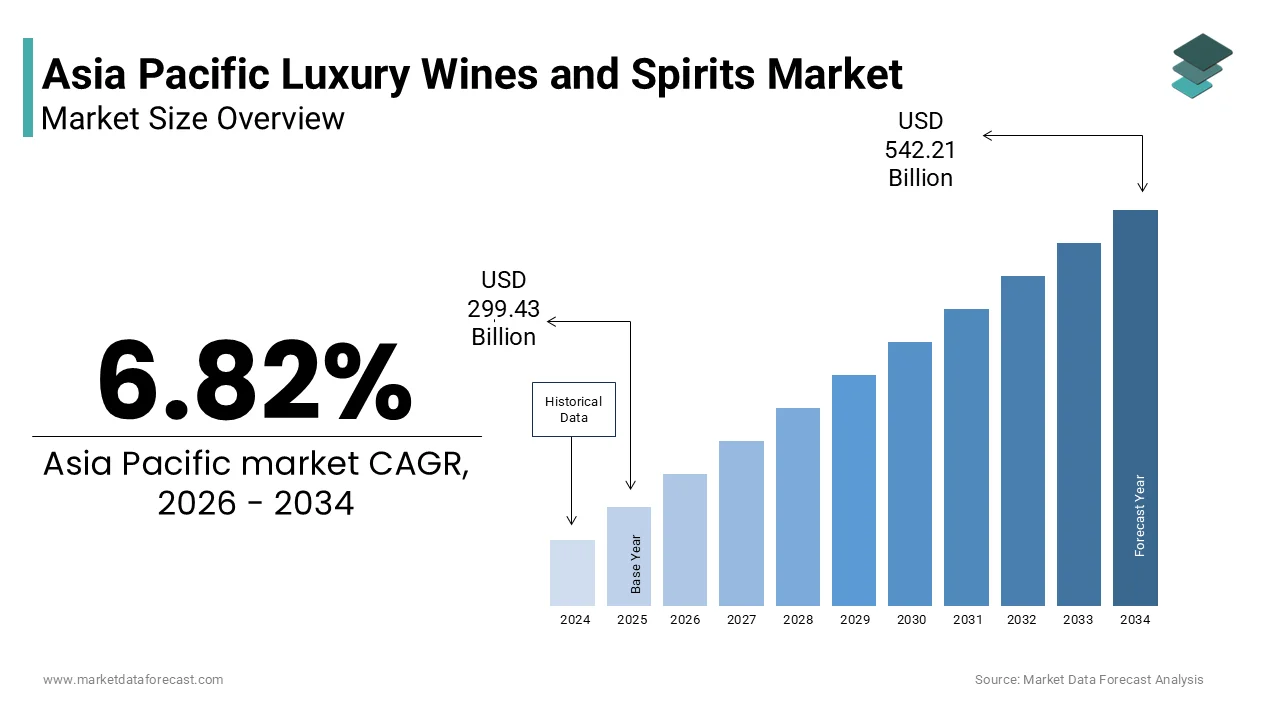
The Asia Pacific luxury wines and spirits market size was valued at USD 299.43 billion in 2025, and is projected to reach USD 542.21 billion by 2034 from USD 319.85 billion in 2026, growing at a CAGR of 6.82%.
Luxury wines and spirits are a premium consumer goods market that focuses on quality rather than price-oriented consumers. The products offered in this market are high quality fermented wines and distilled spirits such as rum, vodka and brandy. In general, they are distinguished by their alcohol content by volume (ABV), which usually ranges between 3 and 40% in these products. Its consumption is usually associated with events of great importance in the life of the consumer, for example, celebrations, birthdays, parties, gatherings and personal moments. Currently, the products offered in this market are wines extracted from different fruit juices, for example grape, apple and pomegranate. Products that contain spirits include distilled beverages such as vodka, whiskey, and tequila. Also, with the growing popularity of innovative drinks like cocktails, there are many combinations of liquors and juices.
With the rapid improvement in the standard of living of consumers around the world, the preference for high-end luxury goods has also increased. The consumption of luxury goods is highly dependent on occasions such as parties, social gatherings and weddings, and the growing number of these is proving favorable for the global market. High-end luxury brands see the opportunity and embrace goal-based social media metrics to engage young tech-savvy consumers seeking more personalization, better value for money, as well as integrated digital access. The massive increase in the number of Internet users and the high penetration of the Internet are some of the main growth factors of the luxury wine and spirits market. Developing countries offer a multitude of lucrative opportunities for luxury spirits and winemakers, given the increasing acceptance and consumption of these products. The increased preference for vintage wines, especially during special events, is also driving market expansion in these countries. Another key opportunity may be the growing influence of social media on Gen Z and Millennials, encouraging them to spend generously on high-end products. One of the main limitations in the global market can be the strict government regulations and rules that restrict alcohol sales in some countries. Wines and spirits can also see low consumer demand, as excessive consumption can lead to diabetes, heart disease, high blood pressure, and stroke.
REPORT COVERAGE
| REPORT METRIC | DETAILS |
| Market Size Available | 2025 to 2034 |
| Base Year | 2025 |
| Forecast Period | 2026 to 2034 |
| CAGR | 6.82% |
| Segments Covered | By Type, Distribution Channel, And Region. |
| Various Analyses Covered | Global, Regional and Country Level Analysis; Segment-Level Analysis; DROC; PESTLE Analysis; Porter’s Five Forces Analysis; Competitive Landscape; Analyst Overview of Investment Opportunities |
| Regions Covered | India, China, Japan, South Korea, Australia, New Zealand, Thailand, Malaysia, Vietnam, the Philippines, Indonesia, Singapore, and the Rest of Asia Pacific. |
| Market Leaders Profiled | Thai Beverage PLC, Brown-Forman, Beam Suntory Inc., William Grant & Sons Limited, Diageo PLC, Bayadera Group, Campari-Milano S.p.A, Bacardi & Company Limited, and Pernod Ricard SA |
SEGMENTAL ANALYSIS
By Type Insights
By type, the market can be segmented into spirits and wines/champagnes. The spirits segment has the largest share of the Asia Pacific Luxury Wines and Spirits Market. This growth can be attributed to the increasing popularity of cocktails. Luxury spirits include rum, gin, vodka, and brandy.
By Distribution Channel Insights
By distribution channel, the Asia Pacific Luxury Wines and Spirits Market can be segmented into e-commerce, retail, wholesale, and others. The retail segment accounts for the majority of the Asia Pacific Luxury Wines and Spirits Market due to growth in the adoption of retail stores around the world. Additionally, the one-stop-shop solution offered by retailers makes it easy for consumers to source their alcoholic beverages of choice. In addition, the retailers also offer a large number of products to the customers at a very competitive price.
REGIONAL ANALYSIS
The market for Asia Pacific Luxury Wines and Spirits has been categorized on the basis of geography to offer a clear understanding of the market. The Market for Asia Pacific Luxury Wines and Spirits has been divided into China, Taiwan, South Korea, India, Japan, Australia, and New Zealand, and the rest of the Asia-Pacific. APAC, with the largest share of 39.07%, is the most lucrative market for luxury wines and spirits, with India and China contributing significantly to this growth. The growing number of small vineyards, combined with advances in wine quality in China, are some of the main reasons for the strong growth of the market. Singapore, India, Australia, and Hong Kong are some other promising markets in the region, given rising per capita income, the growing influence of Western culture, and growing consumer interest in luxury goods.
KEY MARKET PLAYERS
The Asia Pacific Luxury Wines and Spirits Market is concentrated with well-established players. Key players in the Asia Pacific Luxury Wines and Spirits Market include Thai Beverage PLC, Brown-Forman, Beam Suntory Inc., William Grant & Sons Limited, Diageo PLC, Bayadera Group, Campari-Milano S.p.A, Bacardi & Company Limited, and Pernod Ricard SA
RECENT HAPPENINGS IN THE MARKET
- In December 2020, Arbikie recently released 1794 Highland Rye, a five-year-old rye that is a blend of various flavors of charred American oak and rye. The new liquor imparts rich flavor and color and is a promising addition to the range of wheat, malted barley and rye.
- In November 2020, Château Climens has partnered with Salcombe to launch the latest limited edition gin. The new Salcombe Gin Voyager Series Phantom is made from various herbs, including marigold flowers, nettles, cypresses, bay leaves, fennel, and rose petals, combined with orange peel, Macedonian juniper, iris root, coriander seeds, as well as orange blossom and apricots and lavender.
- The Bollinger family, known for their namesake brand of Champagne and other luxury French wines and spirits, is preparing to make its first acquisition outside of France, agreeing to acquire the Oregon Ponzi Vineyards mainstay for an undisclosed fee. Established by Willamette Valley pioneers Dick and Nancy Ponzi in the late 1960 s, Ponzi is recognized as one of Oregon's top producers, firmly positioned in the high-end.New York-based importer and distributor Vintus operates both Bollinger and Ponzi in the United States. Quinttus told SND.
- Constellation Brands agreed to buy The Prisoner Wine Company in a $ 285 million deal, and the US beverage company reported a 14% increase in fourth-quarter sales. The Prisoner Wine Company's purchase from Huneeus Vintners marks Constellation Brands' third acquisition in the past 12 months. The deal includes five wine brands, topping its flagship Prisoner brand, as well as Saldo, Cuttings, Blindfold and Thorn, which all sell at premium prices. All five wine brands have seen their volume increase by more than 30 percent in recent years. The deal is expected to be finalized in late April.
MARKET SEGMENTATION
This research report on the Asia Pacific Luxury Wines and Spirits market has been segmented and sub-segmented into the following categories.
By Type
- Wines/Champagnes
- Spirits
By Distribution Channel
- Wholesale
- Retail
- E-Commerce
By Country
- India
- China
- Japan
- South Korea
- Australia
- New Zealand
- Thailand
- Malaysia
- Vietnam
- Philippines
- Indonesia
- Singapore
- Rest of APAC