- Product Description Description
- Table of Contents TOC
- List of Table & Figure LOT
- Get Free Sample PDF Sample PDF
Market Size, 2025
$4.05 BnMarket Estimate, 2026
$4.32 BnMarket Forecast, 2034
$7.11 BnCAGR, 2026–2034
6.43%Asia Pacific Medical Waste Management Market Size, Growth, Trends & Forecast (2026–2034)
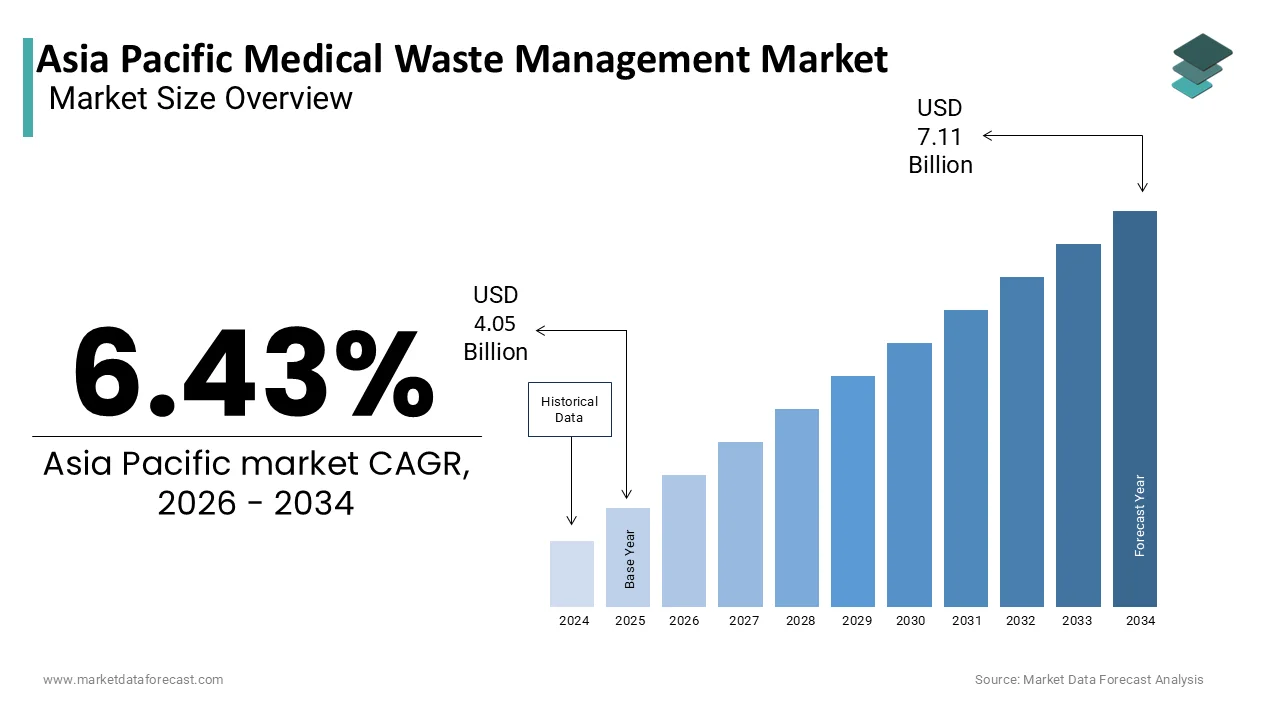
The Asia Pacific medical waste management market size was valued at USD 4.05 billion in 2025, is estimated to reach USD 4.32 billion in 2026, and is projected to reach USD 7.11 billion by 2034, registering a compound annual growth rate (CAGR) of 6.43% during the forecast period from 2026 to 2034. Driven by expanding healthcare infrastructure, rising hospitalization rates, and increasingly stringent regulatory frameworks, the market continues to experience robust growth across the region.
Key Executive Metrics (At-a-Glance)
- 2025 Base Valuation: USD 4.05 Billion
- 2026 Current Valuation: USD 4.32 Billion
- 2034 Forecast Valuation: USD 7.11 Billion
- Compound Annual Growth Rate (CAGR): 6.43% (2026–2034)
- Leading Country Market: China (28.3% market share in 2025)
- Core Service Offerings: Systematic handling, collection, transportation, storage, treatment (incineration and autoclaving), and disposal of infectious, pathological, sharps, and pharmaceutical waste.
Core Market Drivers
- Healthcare Infrastructure Expansion: Rising hospitalization rates, growing numbers of hospital beds, and an aging demographic driving higher biomedical waste generation.
- Strengthening Regulatory Frameworks: Government mandates and revised safety protocols (such as revised waste management rules and digital tracking systems) compelling healthcare facilities to adopt compliant disposal methods.
Primary Market Restraints & Challenges
- Rural Implementation Gaps: Limited awareness, inadequate training, and weak enforcement of waste protocols in rural and semi-urban areas.
- High Technological Costs: High capital expenditure required for advanced treatment technologies (like autoclaves and plasma gasification) constraining adoption among smaller clinics and lower-income economies.
Asia Pacific Medical Waste Management Market Segmentation Breakdown
| Segment Category | Largest Segment | Fastest-Growing Segment |
|---|---|---|
| By Type of Waste | Non-Hazardous Waste | Hazardous Waste (CAGR 9.6%) |
| By Treatment Method | Incineration (45.3% share in 2025) | Autoclaving (CAGR 11.2%) |
| By Service | Treatment and Disposal (40.2% share in 2025) | Collection, Transportation, & Storage (CAGR 10.5%) |
| By Country | China (28.3% share) | Japan / India |
Major Industry Players Profiled
Key market participants shaping the Asia Pacific medical waste management landscape include Stericycle, Inc., Suez, VEOLIA ENVIRONNEMENT SA, Remondis SE & Co. KG, Clean Harbors, Inc., BioMedical Waste Solutions, LLC, Daniels Sharpsmart Inc., Triumvirate Environmental, Ecomed, BWS Incorporated, and MEDPRO Disposal.
Asia Pacific Medical Waste Management Market Size
The Asia Pacific Medical Waste Management Market Size was valued at USD 4.05 billion in 2025, is expected to have 6.43 % CAGR from 2026 to 2034, and be worth USD 7.11 billion by 2034 from USD 4.32 billion in 2026.
Medical waste management refers to the systematic handling, treatment, and disposal of waste generated from healthcare activities, including hospitals, clinics, laboratories, and pharmaceutical facilities. This encompasses infectious, pathological, sharps, pharmaceutical, and radioactive waste, which require specialized collection, transportation, and processing to prevent environmental contamination and public health risks. Governments in several Asia Pacific countries have introduced stringent regulations to ensure safe disposal and minimize occupational hazards associated with biomedical waste. For instance, India revised its Bio-Medical Waste Management Rules in 2022 to enhance segregation and treatment standards.
MARKET DRIVERS
Rising Healthcare Infrastructure and Hospitalization Rates
One of the primary drivers of the Asia Pacific medical waste management market is the rapid expansion of healthcare infrastructure and rising hospitalization rates. In China, the National Health Commission reported that the number of hospital beds per 1,000 people rose from 4.3 in 2018 to 6.7 in 2023, significantly boosting clinical activity and, consequently, biomedical waste output. Similarly, Japan’s aging population has led to higher healthcare utilization, with over 1.5 million surgeries performed annually, generating substantial volumes of infectious and sharps waste. To manage this influx, governments and private entities are investing in centralized waste treatment facilities and automated sterilization technologies.
Strengthening Regulatory Frameworks and Compliance Enforcement
Another significant driver of the Asia Pacific medical waste management market is the strengthening of regulatory frameworks and the enforcement of compliance standards. Governments across the region have been increasingly focused on aligning national policies with global best practices to mitigate health and environmental risks associated with improper waste disposal. The United Nations Environment Programme (UNEP) has emphasized the importance of structured medical waste regulation, particularly in low- and middle-income countries where informal disposal methods remain prevalent. Australia, South Korea, and Singapore have some of the most rigorous biomedicalwaste regulations in the region, mandating strict classification, labeling, transport tracking, and treatment protocols. In India, the Ministry of Environment, Forest, nd Climate Change revised its Biomedical Waste Management Rules in 2022, requiring all healthcare institutions to implement online monitoring of waste generation and disposal. According to the World Health Organization (WHO), these regulatory enhancements have resulted in a noticeable decline in needle-stick injuries among healthcare workers and reduced groundwater contamination from improperly treated waste.
MARKET RESTRAINTS
Limited Awareness and Poor Implementation in Rural Areas
A key restraint affecting the Asia Pacific medical waste management market is the limited awareness and poor implementation of waste management protocols in rural and semi-urban areas. Despite the existence of national regulations in many countries, enforcement remains weak outside major metropolitan centers. According to the World Health Organization (WHO), nearly 50% of healthcare facilities in rural parts of India, Bangladesh, and Myanmar lack proper waste segregation and disposal systems. This gap stems from inadequate training for healthcare staff, a lack of funding for compliant disposal units, and insufficient government monitoring. Additionally, small clinics and private nursing homes often resort to open burning or landfill dumping due to cost constraints and limited access to authorized treatment facilities. As per the United Nations Children's Fund (UNICEF), such unsafe practices contribute to soil and water contamination, which poses serious public health risks.
High Cost of Advanced Waste Treatment Technologies
The high cost of implementing and maintaining advanced medical waste treatment technologies presents a significant barrier to market growth in the Asia Pacific region. While modern solutions such as autoclaves, plasma gasification, and microwave treatments offer safer and more sustainable alternatives to traditional incineration, their capital-intensive nature limits widespread adoption, especially in lower-income economies. In Vietnam, despite government incentives to promote non-incineration waste treatment, only 12% of hospitals had installed autoclaves by 2023 due to budgetary limitations. Similarly, in the Philippines, the Department of Health reported that less than 20% of private clinics could afford to invest in compliant waste processing equipment. As a result, many smaller healthcare providers continue to rely on outdated and environmentally harmful methods.
MARKET OPPORTUNITIES
Adoption of Digital Monitoring and Smart Waste Tracking Systems
A significant opportunity within the Asia Pacific medical waste management market is the growing adoption of digital monitoring and smart waste tracking systems. As regulatory scrutiny intensifies and compliance requirements become more complex, healthcare institutions and waste handlers are turning to digital platforms to ensure transparency and accountability throughout the waste lifecycle. In Singapore, the National Environment Agency (NEA) launched an electronic manifest system in 2023 to digitally track biomedical waste movement from source to disposal, ensuring full compliance with local regulations. Similarly, in Japan, companies like Kubota Corporation have introduced AI-powered waste sorting systems that optimize segregation at the point of generation. In India, startups such as MedWell Ventures have developed mobile apps that allow hospitals to schedule pickups, generate reports, and monitor real-time waste data.
Expansion of Public-Private Partnerships (PPPs) in Waste Handling
The increasing collaboration between government agencies and private waste management firms through public-private partnerships (PPPs) is emerging as a key opportunity in the Asia Pacific medical waste management market. Given the rising volume of biomedical waste and the limitations of existing municipal waste infrastructure, many governments are leveraging private expertise and resources to improve service delivery. In Indonesia, the Ministry of Health initiated a pilot program in 2023 involving private operators to manage waste from district hospitals in Sumatra and Java, resulting in improved segregation and reduced landfill burden. Similarly, in the Philippines, the Department of Environment and Natural Resources (DENR) partnered with CleanTech Solutions to establish mobile treatment units in underserved regions. In India, the Tamil Nadu government signed agreements with multiple waste management companies to handle biomedical waste from over 5,000 clinics and nursing homes.
MARKET CHALLENGES
Fragmented Waste Collection and Disposal Networks
One of the most pressing challenges facing the Asia Pacific medical waste management market is the fragmentation of waste collection and disposal networks. Unlike developed markets such as Australia and Japan, where centralized systems ensure seamless waste flow from generation to treatment, many countries in Southeast Asia and South Asia still rely on informal and decentralized waste handling practices. In India, despite the presence of over 200 common biomedical waste treatment facilities (CBWTFs), accessibility remains uneven, particularly in rural and hilly regions.
Lack of Skilled Personnel and Training Programs
A persistent challenge in the Asia Pacific medical waste management market is the lack of trained personnel and structured training programs for waste handlers. Proper management of biomedical waste requires specialized knowledge in categorization, handling, and treatment to minimize exposure risks and ensure compliance with safety protocols. In Nepal, a 2023 survey conducted by the Ministry of Health and Population found that only 15% of hospital staff were adequately trained in biomedical waste segregation and disposal. Similarly, in Indonesia, the Indonesian Hospital Association reported that less than 20% of private clinics had implemented mandatory waste management training for employees. This skills gap increases the likelihood of occupational injuries and disease transmission. Addressing this issue requires sustained investment in workforce education, certification programs, and on-site training initiatives to build a competent and safety-conscious waste management workforce across the region.
REPORT COVERAGE
| REPORT METRIC | DETAILS |
| Market Size Available | 2025 to 2034 |
| Base Year | 2025 |
| Forecast Period | 2026 to 2034 |
| Segments Covered | By Type of Waste, Treatment Method, Service, and Country. |
| Various Analyses Covered | Global, Regional & Country Level Analysis, Segment-Level Analysis; DROC, PESTLE Analysis, Porter's Five Forces Analysis, Competitive Landscape, Analyst Overview of Investment Opportunities |
| Country Covered | China, India, Japan, South Korea, Australia, New Zealand, Thailand, Indonesia, Philippines, Vietnam, Singapore, Rest of APAC. |
| Market Leader Profiled | Stericycle, Inc., Suez, VEOLIA ENVIRONNEMENT SA, BioMedical Waste Solutions |
SEGMENTAL ANALYSIS
By Type of Waste Insights
The non-hazardouswaste segments was the largest segment in the Asia Pacific medical waste management market with a dominant share in 2025. One key driver is the increasing number of healthcare facilities across the region, particularly in countries like India and Indonesia, where hospital bed capacity has expanded significantly. According to the Asian Development Bank (ADB), the number of registered hospitals in Southeast Asia grew by 18% between 2019 and 2023, leading to a proportional increase in non-hazardous waste generation. Additionally, rising awareness about proper segregation practices has resulted in better categorization of waste at the source by ensuring that even large volumes of non-hazardous material are managed through formal collection systems.
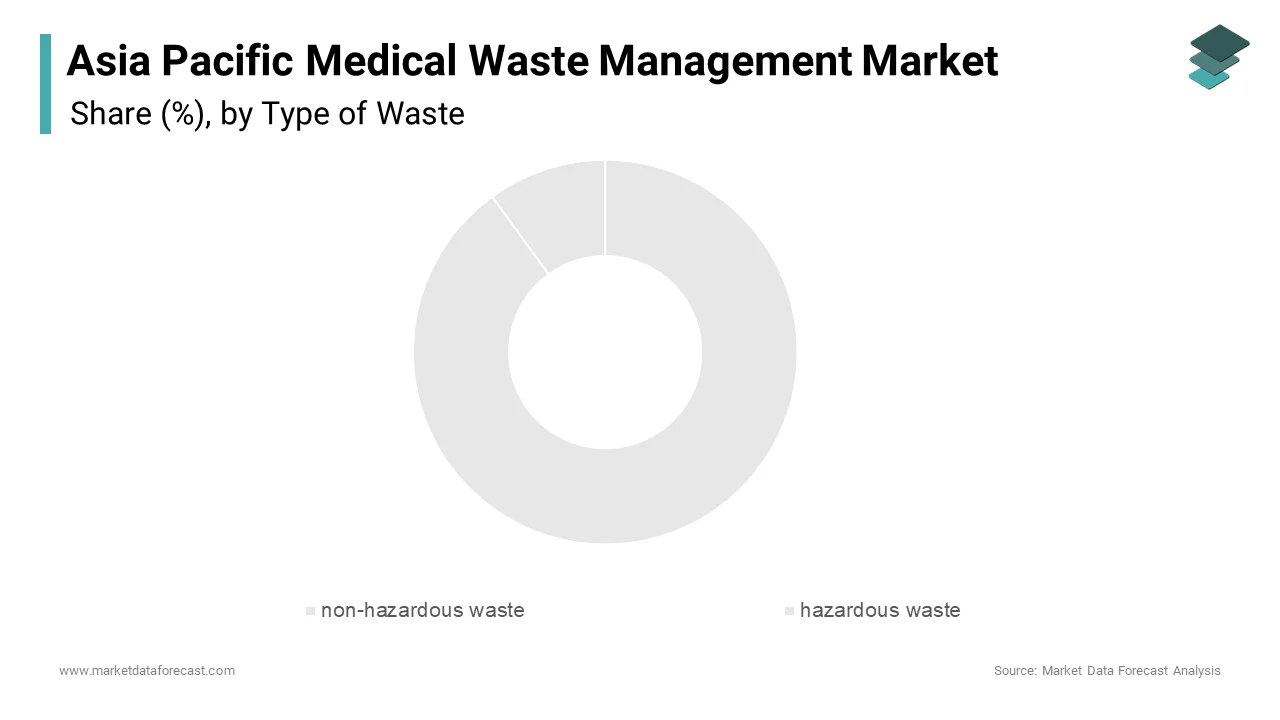
The hazardous waste segment is swiftly emerging with a projected CAGR of 9.6% from 2025 to 2033. In China, the National Medical Products Administration reported a 20% surge in production of single-use medical devices in 2023, contributing to a significant rise in infectious and sharps waste. Similarly, in Japan, the Ministry of the Environment noted an uptick in chemotherapy-related waste due to aging demographics and rising cancer incidence rates. In response, governments across the region have mandated stricter handling and disposal protocols for hazardous waste, driving demand for specialized treatment services.
By Treatment Method Insights
The incineration segment was the largest and held 45.3% of the Asia Pacific medical waste management market share in 2025. A major factor behind its dominance is the long-standing reliance on incinerators in healthcare settings across South and Southeast Asia. According to the World Bank, over 60% of hospitals in Vietnam and Bangladesh still utilize on-site incineration for treating infectious and sharps waste. In India, despite regulatory pushback against traditional incineration due to dioxin emissions, many rural health centers continue to depend on low-cost, decentralized incinerators.
The autoclaving segment is likely to grow with an expected CAGR of 11.2% from 2025 to 2033. In Australia, the Department of Health mandated the phase-out of mercury-based and old-style incinerators by 2025, prompting a shift toward autoclave-based processing. As per the Australian Medical Association, over 80% of private hospitals now use autoclaves for treating infectious waste. Similarly, in South Korea, the Ministry of Environment introduced subsidies in 2023 to encourage small clinics to adopt mobile autoclave units, resulting in a 30% increase in installations compared to the previous year. In India, common biomedical waste treatment facilities (CBWTFs) have increasingly incorporated autoclaves to meet regulatory standards while minimizing environmental impact.
By Service Insights
The treatment and disposal segment was the largest and held 40.2% of the Asia Pacific medical waste management market share in 2025, with the stringent regulatory mandates requiring healthcare institutions to treat biohazardous waste before landfilling or recycling. In Japan, the Ministry of Health mandates that all infectious waste must undergo sterilization prior to disposal, reinforcing the need for dedicated treatment services. Similarly, in Singapore, the National Environment Agency enforces strict guidelines that necessitate third-party treatment for most clinical waste generated outside government hospitals. As per the World Health Organization (WHO), improper disposal remains a significant public health risk, especially in densely populated regions like India and Indonesia, where untreated waste often ends up in open dumps.
The collection, transportation, and storage segment is likely to grow with an expected CAGR of 10.5% in the coming years. In India, the Central Pollution Control Board (CPCB) reported a 25% increase in authorized waste transporters in 2023, driven by stricter enforcement of waste tracking regulations. Similarly, in the Philippines, the Department of Environment and Natural Resources (DENR) launched a digital manifest system in 2022 to monitor waste movement, enhancing transparency in the supply chain. As per the International Labour Organization (ILO), secure storage and transport also reduce occupational exposure risks for healthcare workers and sanitation staff.
COUNTRY LEVEL ANALYSIS
China was the top performer in the Asia Pacific medical waste management market with 28.3% of the share in 2025. According to the National Health Commission of China, the number of hospitals nationwide reached over 35,000 in 2023,g enerating a substantial volume of medical waste daily. The Ministry of Ecology and Environment implemented the revised "Medical Waste Environmental Management Regulations" in 2022, mandating real-time monitoring of waste movement and treatment. Additionally, the government launched the "Green Hospitals Initiative," encouraging the adoption of advanced waste treatment technologies such as autoclaving and microwave sterilization.

India was positioned next to Thina by holding the second place in the Asia Pacific medical waste management market with 18.3% of the share in 2025. As per the Central Pollution Control Board (CPCB), India generated over 600 tons of biomedical waste daily in 2023, with a significant portion coming from urban hospitals and diagnostic centers. The Ministry of Environment, Forest, and Climate Change updated the Bio-Medical Waste Management Rules in 2022, introducing mandatory online tracking of waste flow and promoting decentralized treatment models.
Japan medical waste management market is substantially to grow with significanCAGRAR during the forecast period. According to the Ministry of the Environment, Japan generates approximately 350,000 tons of medical waste annually, with over 90% being treated using environmentally sound methods such as autoclaving and plasma gasification. The country enforces strict waste categorization and traceability measures under the Waste Management Act and the Infectious Diseases Act. In 2023, the Ministry of Health launched a pilot program integrating blockchain technology into medical waste tracking to enhance transparency and accountability. Additionally, local municipalities have invested heavily in compact, modular treatment units to serve smaller clinics and nursing homes.
South KKorea'smedical waste management market. According to the Ministry of Environment, South Korea produces around 200,000 tons of medical waste annually, with a rising proportion classified as infectious due to the aging population and increased surgical procedures. In 2023, the government introduced the "Smart Medical Waste Management System," which uses IoT-enabled bins and real-time data analytics to optimize collection routes and monitor waste levels. Additionally, the Korean Food and Drug Administration (KFDA) mandated the phase-out of mercury-containing medical devices, aligning with global best practices. As per the Korea Environment Corporation, over 40% of hospitals in Seoul and Busan now use mobile autoclave units to pre-treat waste before central disposal. These initiatives reflect South Korea’s commitment to innovation and sustainability in medical waste management.
AuAustralia'sedical waste management market growth is driven by the comprehensive regulatory frameworks in the region, ensuring high levels of compliance and environmental safety. According to Safe Work Australia, the nation generates approximately 150,000 tons of clinical waste annually, with stringent guidelines governing its handling, transport, and treatment. The National Health and Medical Research Council (NHMRC) mandates that all healthcare facilities follow AS/NZS 3816:2016 standards for managing and disposing of medical waste. In 2023, the Australian Government introduced the "National Clinical Waste Strategy," aimed at reducing landfill dependency and promoting circular economy principles. As per the Australian Medical Association, nearly 70% of private hospitals have adopted reusable sterilization containers and autoclave-compatible packaging to minimize plastic waste.
KEY MARKET PLAYERS AND COMPETITIVE LANDSCAPE
Overview of Competition in the Asia Pacific Medical Waste Management Market includes
Stericycle, Inc., Suez, VEOLIA ENVIRONNEMENT SA, BioMedical Waste Solutions, LLC, REMONDIS SE & Co. KG, WM Intellectual Property Holdings, L.L.C., Daniels Sharpsmart Inc., Triumvirate Environmental, CLEAN HARBORS, INC., Ecomed, BWS Incorporated, and MEDPRO Disposal.
The competition in the Asia Pacific medical waste management market is intensifying as multinational corporations and regional players vie for dominance in an expanding sector. Established global firms leverage their technological expertise, extensive service networks, and compliance-oriented solutions to maintain dominant positions, particularly in developed economies like Japan, Australia, and South Korea. At the same time, domestic enterprises are gaining traction by offering cost-effective, localized services tailored to the unique regulatory and logistical challenges of emerging markets such as India, Indonesia, and Vietnam.
Market participants are increasingly focused on differentiating themselves through innovation, digital integration, and sustainable practices. Companies are investing in advanced treatment technologies, real-time tracking systems, and mobile processing units to enhance operational efficiency and meet rising demand. Strategic acquisitions and joint ventures are also shaping the competitive landscape, enabling firms to expand their reach and strengthen service portfolios. Additionally, growing awareness around safe waste handling and stricter enforcement of regulations are compelling smaller operators to either upgrade their capabilities or collaborate with larger entities. As the region continues to witness healthcare expansion and urbanization, the battle for market share is expected to grow more dynamic, with technology adoption and environmental responsibility playing decisive roles in long-term success.
Top Players in the Market
Suez
Suez is a leading global player with a strong presence in the Asia Pacific medical waste management market. The company offers end-to-end solutions, including collection, treatment, and disposal of biomedical waste. In the region, Suez has been instrumental in introducing sustainable and compliant waste handling practices through advanced technologies such as autoclaving and plasma gasification. Its strategic partnerships with municipal authorities and healthcare institutions have helped modernize waste infrastructure in countries like China and India, which is making it a key contributor to the regional market's evolution.
Remondis
Remondis is a major international waste management company that has expanded its footprint in the Asia Pacific by focusing on integrated medical waste solutions. The firm emphasizes resource efficiency and environmental compliance, offering tailored services for hospitals, laboratories, and pharmaceutical companies. In the region, Remondis has invested heavily in setting up centralized treatment facilities and digital tracking systems to enhance transparency and regulatory adherence. Its commitment to innovation and sustainability has positioned it as a trusted partner for governments and private healthcare providers seeking reliable waste management solutions.
Clean Harbors
Clean Harbors is recognized for its expertise in hazardous waste treatment and has extended its capabilities to medical waste management in the Asia Pacific. The company provides comprehensive services ranging from secure transportation to high-temperature incineration and sterilization. With a focus on safety and compliance, Clean Harbors supports both public and private healthcare sectors in managing infectious and pathological waste effectively. Its adoption of digital monitoring tools and mobile treatment units has strengthened its ability to offer scalable and efficient waste handling solutions across diverse geographic conditions in the region.
Top Strategies Used by Key Market Participants
One major strategy employed by key players in the Asia Pacific medical waste management market is technology integration and digitalization.n Companies are increasingly adopting smart tracking systems, IoT-enabled waste bins, and AI-driven analytics to improve traceability, optimize logistics, and ensure regulatory compliance. These innovations help streamline operations while reducing human error and exposure risks.
Another crucial approach is expanding through partnerships and local collaboration. Leading firms are forming alliances with government agencies, hospital networks, and environmental organizations to enhance service delivery and access new markets.
Investing in sustainable and eco-friendly treatment methods is a priority for industry leaders. There is a growing shift toward non-incineration technologies such as autoclaving, microwave treatment, and chemical disinfection to minimize environmental impact. This not only supports corporate sustainability goals but also aligns with evolving regulatory standards across the Asia Pacific.
RECENT HAPPENINGS IN THE MARKET
In March 2025, Suez launched a new integrated medical waste processing plant in Shanghai,which is i designed to handle 100 tons of biomedical waste daily using advanced autoclave and shredding technologies.
In February 2025, Remondis expanded its operations in India by acquiring a stake in Cleanmax EnviroTech, aiming to enhance its footprint in hospital waste collection and treatment across major metropolitan cities.
In January 2025, Clean Harbors announced a strategic partnership with the Singapore General Hospital to implement AI-driven waste segregation and tracking systems by improving compliance and operational efficiency.
In November 2023, Zenklub opened a state-of-the-art medical waste recycling facility in Sydney by focusing on converting treated plastic waste into raw materials for industrial reuse.
In October 2023, Becton Dickinson partnered with the Indonesian Ministry of Health to deploy mobile medical waste treatment units in remote islands, which are supporting decentralized waste processing and infection control.
MARKET SEGMENTATION
This research report on the Asia Pacific Medical Waste Management Market has been segmented and sub-segmented into the following.
By Type of Waste
- non-hazardous waste
- hazardous waste
By Treatment Method
- Incineration
- Autoclaving
By Service
- treatment and disposal
- collection
- transportation
- storage
By Country
- China
- India
- Japan
- South Korea
- Australia
- New Zealand
- Thailand
- Indonesia
- Philippines
- Vietnam
- Singapore
- Rest of APAC