- Product Description Description
- Table of Contents TOC
- List of Table & Figure LOT
- Get Free Sample PDF Sample PDF
Market Size, 2025
$113 BnMarket Estimate, 2026
$120 BnMarket Forecast, 2034
$192 BnCAGR, 2026–2034
5.98%Asia Pacific Metal Casting Market Size
Asia Pacific metal casting market size was valued at USD 113.94 billion in 2025, and is expected to reach USD 192.17 billion by 2034 from USD 120.75 billion in 2026. The market's promising CAGR for the predicted period is 5.98%.
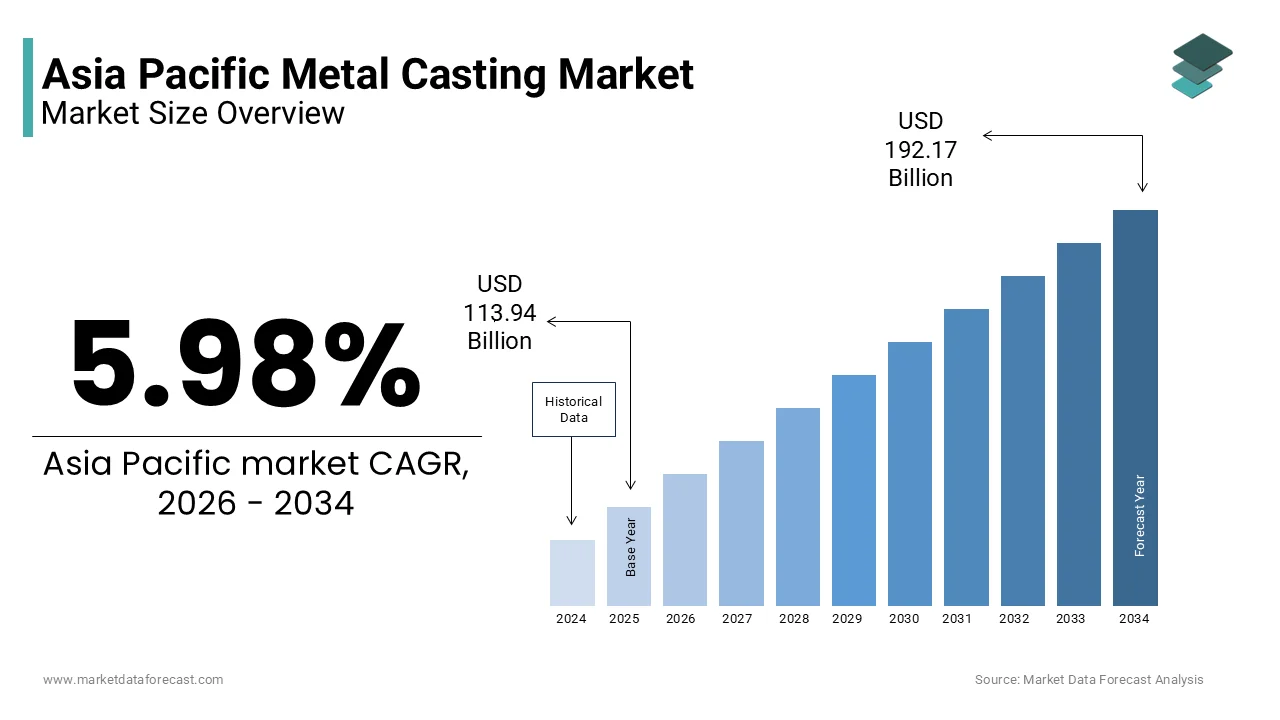
Metal casting in the Asia Pacific region involves the production of metal components through processes such as sand casting, die casting, investment casting, and centrifugal casting. These components are essential for industries like automotive, construction, energy, aerospace, and industrial machinery. The Asia Pacific region dominates global metal casting due to its strong industrial base, rapid urbanization, and rising infrastructure development. Countries such as China, India, Japan, and South Korea are leading contributors, with China alone accounting for over 40% of global metal casting output.
Environmental regulations are also shaping the industry, with governments pushing for lighter and more efficient materials in manufacturing. This has led to increased use of aluminum and magnesium alloys in castings, particularly in the automotive sector. As per the Asian Foundry Association, over 12 million tons of non-ferrous castings were produced across the region in 2023, noting the growing shift toward lightweight metals.
MARKET DRIVERS
Growth in Automotive Production Across Asia Pacific
The automotive industry remains one of the most significant drivers of the metal casting market in the Asia Pacific region. With countries like China, India, Thailand, and Indonesia witnessing substantial growth in vehicle production, the demand for engine blocks, transmission cases, and other structural components has surged.
Moreover, the transition toward electric vehicles (EVs) in countries like Japan, South Korea, and China is increasing the need for lightweight aluminum and magnesium castings. These materials help reduce overall vehicle weight, thereby enhancing battery efficiency and range. The China Association of Automobile Manufacturers reported that EV sales in China grew notably in 2023 compared to the previous year, which significantly boosted demand for precision metal castings tailored for electric drivetrains. In addition, government initiatives promoting local manufacturing—such as "Make in India" and "Thailand 4.0"—are encouraging automakers to establish or expand production facilities in the region. This, in turn, supports foundries and casting units by ensuring steady procurement contracts.
Expansion of Infrastructure and Industrial Machinery Demand
Infrastructure development and the expansion of industrial machinery manufacturing are critical catalysts for the Asia Pacific metal casting market. Governments across the region are investing heavily in urban infrastructure, transportation networks, and energy systems. This surge in infrastructure activity has directly fueled the demand for heavy-duty machinery such as excavators, bulldozers, and cranes—all of which require extensive use of metal castings in their engines, chassis, and hydraulic systems. In India, the Ministry of Road Transport and Highways reported that over 10,000 kilometers of national highways were constructed in fiscal year 2023, driving equipment procurement and thus boosting foundry orders. Similarly, Southeast Asia's growing industrial base, especially in Vietnam and Indonesia, has led to an increase in factory automation and machinery production.
MARKET RESTRAINTS
Rising Raw Material Prices and Supply Chain Disruptions
One of the major restraints affecting the Asia Pacific metal casting industry is the volatility in raw material prices, particularly for metals such as aluminum, copper, and iron scrap. Over the past few years, global supply chain disruptions caused by geopolitical tensions, trade restrictions, and pandemic-related logistics bottlenecks have led to sharp price increases. These cost escalations place immense pressure on foundries, especially small and medium-sized enterprises (SMEs), which often lack the financial cushion to absorb such fluctuations. In India, input costs for foundries rose in 2023, forcing many to either pass on the burden to customers or reduce profit margins. Additionally, supply chain instability continues to disrupt operations.
Stringent Environmental Regulations and Emission Standards
Environmental regulations are becoming increasingly stringent across the Asia Pacific region, posing a challenge to traditional metal casting operations. Many governments are enforcing tighter emission norms and waste management protocols, compelling foundries to invest in cleaner technologies and pollution control systems. For example, China’s Ministry of Ecology and Environment implemented new industrial emission standards in 2023, mandating all foundries to reduce particulate matter emissions. Such regulatory pressures are particularly burdensome for smaller foundries that may lack the capital to upgrade facilities. Furthermore, the push for decarbonization is influencing material choices and production techniques. These evolving standards necessitate continuous investment in green technologies, which can strain financial resources and slow down capacity expansion in the short term.
MARKET OPPORTUNITIES
Adoption of Additive Manufacturing and Digital Technologies in Foundries
The integration of advanced digital technologies and additive manufacturing (AM) presents a transformative opportunity for the Asia Pacific metal casting sector. Traditional casting methods are being supplemented with 3D printing-based sand mold and core-making solutions, enabling faster prototyping, complex geometries, and reduced material wastage. Japan and South Korea are leading this transformation, with companies such as Toshiba and Hyundai actively incorporating digital twin technology and AI-driven simulation software into casting processes. These tools enhance precision, optimize cooling cycles, and reduce defect rates. In addition, smart manufacturing initiatives supported by governments in India and Malaysia are encouraging foundries to adopt IoT-enabled sensors and predictive maintenance systems. This technological evolution not only enhances competitiveness but also positions the Asia Pacific region as a global leader in next-generation casting capabilities.
 Growing Demand for Lightweight Components in Aerospace and Defense Sectors
The aerospace and defense industries are emerging as key growth avenues for the Asia Pacific metal casting market, driven by the increasing demand for lightweight, high-strength components. Countries such as India, Japan, and Australia are ramping up indigenous defense manufacturing programs, while commercial aircraft production hubs in China and South Korea are expanding their capacities. Aluminum and titanium-based casting components are gaining preference due to their strength-to-weight ratios and corrosion resistance. Moreover, additive casting and investment casting techniques are being increasingly used to produce turbine blades, structural brackets, and landing gear components. As per the Singapore Economic Development Board, the country's aerospace manufacturing sector grew in 2023.
MARKET CHALLENGES
Skilled Labor Shortage and Workforce Aging in Key Markets
A significant challenge facing the Asia Pacific metal casting industry is the shortage of skilled labor and the aging workforce in traditional manufacturing hubs such as Japan, South Korea, and parts of China. The physically demanding nature of foundry work, combined with limited interest from younger generations, has led to a decline in available expertise. According to Japan’s Ministry of Economy, Trade and Industry, over 40% of workers in Japanese foundries were aged 55 or above in 2023, with fewer young professionals entering the field. This demographic imbalance threatens productivity and innovation in the sector. In South Korea, labor shortages caused production delays in 2023 for a notable share of surveyed casting companies. The issue is compounded by the lack of formal training programs tailored to modern foundry practices, making it difficult to onboard new talent effectively. To address this, several governments and private institutions are launching vocational training initiatives.
Intensifying Global Competition and Price Pressures
The Asia Pacific metal casting market faces intensifying competition from both domestic and international players, resulting in downward pricing pressure and margin compression. Chinese and Indian foundries, traditionally known for cost-effective production, now face stiff competition from emerging low-cost producers in Bangladesh, Vietnam, and Indonesia. According to the DHL Trade Atlas, exports of castings from Vietnam to North America and Europe grew in 2023, driven by competitive labor costs and improved production capabilities. Moreover, global buyers are increasingly leveraging sourcing diversification strategies to mitigate risks associated with geopolitical instability and trade tariffs. This trend has led to intensified bidding wars among foundries, with many forced to lower prices to retain contracts. At the same time, Western competitors are investing in high-end, value-added casting segments, leaving Asia Pacific manufacturers under pressure to move up the value chain without compromising on cost efficiency.
REPORT COVERAGE
| REPORT METRIC | DETAILS |
| Market Size Available | 2025 to 2034 |
| Base Year | 2025 |
| Forecast Period | 2026 to 2034 |
| CAGR | 5.98% |
| Segments Covered | By Process, Application, Material, Component, and Region |
|
Various Analyses Covered | Regional & Country Level Analysis, Segment-Level Analysis, DROC, PESTLE Analysis, Porter’s Five Forces Analysis, Competitive Landscape, Analyst Overview on Investment Opportunities |
| Regions Covered | India, China, Japan, South Korea, Australia, New Zealand, Thailand, Malaysia, Vietnam, Philippines, Indonesia, Singapore, and the Rest of Asia-Pacific |
| Market Leaders Profiled | BorgWarner, Rio Tinto, Aalberts Industries, Eisenmann, Kosei Aluminum, Bharat Forge, Foundry Group, Friedrichs GmbH, Tata Steel, Amcor, Japan Casting, Dowa Holdings, Hitachi Metals, Aluminium Bahrain, and Foseco, and others |
SEGMENTAL ANALYSIS
By Process Insights
The sand casting segment held the largest share of the Asia Pacific metal casting market by accounting for a 48.8% of total production volume in 2025. This dominance is primarily due to its cost-effectiveness, adaptability to complex shapes, and suitability for both small-scale and large-scale manufacturing across various industries such as automotive, industrial machinery, and construction equipment. One key driver of sand casting’s prominence is its widespread use in the production of heavy-duty components like engine blocks, cylinder heads, and structural parts in the automotive industry. According to the China Foundry Association, a large share of castings used in Chinese automotive manufacturing are produced using sand casting techniques, owing to their flexibility and lower tooling costs. Additionally, sand casting remains a preferred method in infrastructure-related sectors.
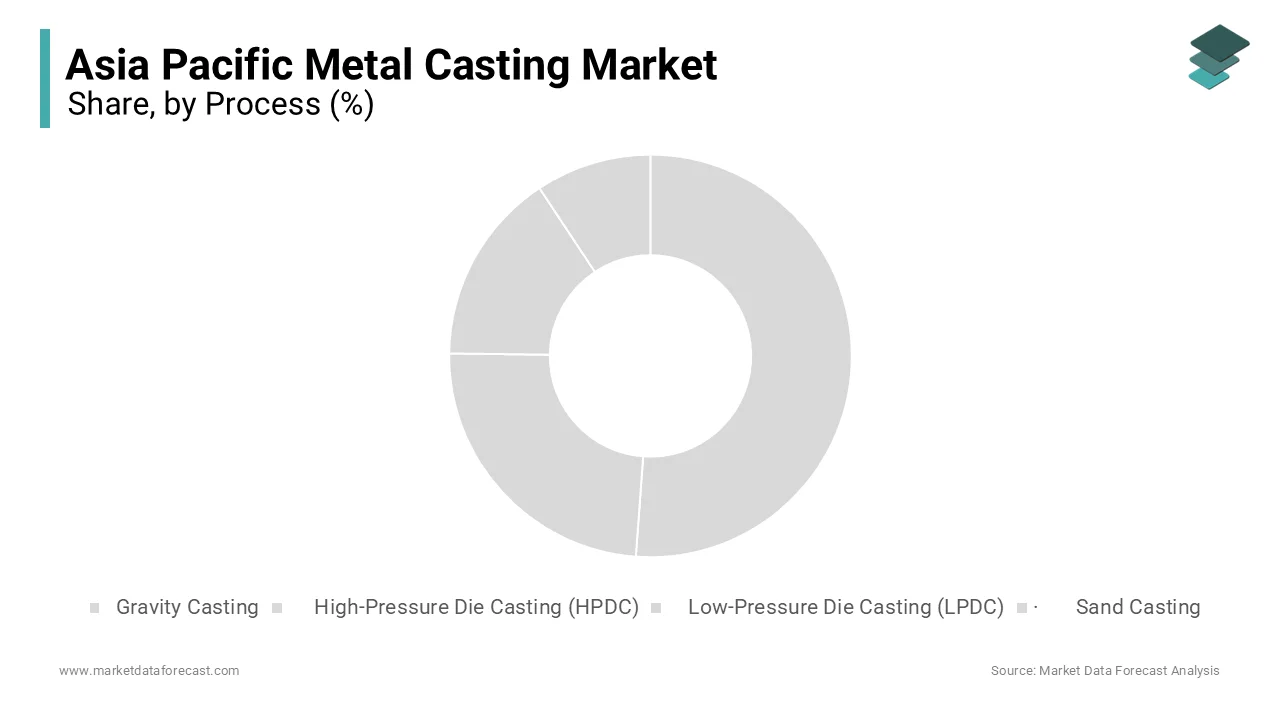
The High-pressure die casting (HPDC) is the fastest-growing segment within the Asia Pacific metal casting market, projected to expand at a CAGR of 9.2%. This is largely driven by the increasing adoption of lightweight aluminum and magnesium components in electric vehicles (EVs), consumer electronics, and aerospace applications. China has been at the forefront of this trend, with EV manufacturers demanding precision-engineered, thin-walled components that can only be efficiently manufactured through HPDC. Moreover, Japan and South Korea are investing heavily in automation and high-speed die casting technologies. Like, the number of fully automated HPDC units installed in Japanese foundries increased in 2023, enhancing productivity and reducing scrap rates.
By Application Insights
The engine components segment represented the largest application segment in the Asia Pacific metal casting market by holding a 37.9% of the total market share in 2025. This dominance is due to the continued reliance on internal combustion engines (ICEs) in commercial vehicles and off-road machinery, despite the rise of electric mobility. The demand for iron and aluminum engine blocks, cylinder heads, and pistons remains strong, particularly in countries like India and Indonesia, where ICE-based transportation still dominates. According to the Federation of Automobile Dealers Associations (FADA) in India, over 3 million passenger vehicles sold in 2023 were powered by internal combustion engines, sustaining demand for engine casting components. Furthermore, the expansion of two-wheeler and three-wheeler markets in Southeast Asia, especially in Thailand and Vietnam has contributed significantly to engine casting volumes.
Transmission components are coming up as the swiftest advancing application segment in the Asia Pacific metal casting industry, expected to grow at a CAGR of 8.4%. This progress is being fueled by the transition toward automatic and hybrid transmission systems in both traditional and electric vehicles. In China, the push for advanced vehicle transmissions has led to a surge in demand for precision-cast gearboxes and housing units. The China Automotive Technology and Research Center indicated that automatic transmission adoption in new cars surged in 2023, as compared to that in 2020, signaling a structural shift in component requirements. Similarly, in India, the Ministry of Road Transport and Highways mandated enhanced safety standards, including mandatory automatic transmission features in certain vehicle categories.
By Material Insights
The iron segment remains the most widely used material in the Asia Pacific metal casting market, capturing a 42.9% of the total market share in 2025. This is attributed to its high durability, affordability, and extensive use in critical industrial and automotive components such as engine blocks, brake discs, and structural frames. China, the world’s largest producer of cast iron, accounted for a large majority of the region’s iron casting output in 2023. According to the China Foundry Association, domestic foundries produced more than 40 million tons of iron castings annually, primarily catering to the automotive and machinery sectors. Additionally, India’s reliance on iron castings for railway infrastructure and agricultural equipment further reinforces its market leadership. Another contributing factor is the continued demand from energy and utility sectors.
Aluminum casting is the fastest-growing material segment in the Asia Pacific metal casting market, expanding at a CAGR of 9.6%. This growth is mainly driven by the rising demand for lightweight materials in the automotive and aerospace industries, especially in response to stringent emission norms and fuel efficiency targets. Japan and South Korea are leading adopters of aluminum casting for automotive applications. According to the Japan Light Metal Casting Association, aluminum usage in Japanese vehicle manufacturing rose in 2023, with automakers prioritizing weight reduction strategies to meet carbon neutrality goals. Beyond automotive, the aerospace sector is also accelerating aluminum casting demand.
By Component Insights
Internal combustion engine (ICE) vehicles continued to be at the forefront in the Asia Pacific metal casting market by representing a 45.6% of total casting consumption in 2025. Despite the global shift toward electrification, ICEs continue to dominate the automotive landscape in emerging economies due to existing infrastructure, affordability, and regulatory timelines. India and Indonesia, in particular, rely heavily on ICE-based transport, with ICE vehicles accounting for a notable share of total automotive sales in 2025. According to the Society of Indian Automobile Manufacturers (SIAM), India alone produced more than 4 million ICE vehicles during the year, each requiring multiple cast components such as engine blocks, transmission cases, and cylinder heads.
Moreover, the commercial vehicle sector, especially in China and Thailand, sustains robust demand for ferrous and non-ferrous castings.
The Battery electric vehicles (BEVs) is quickly moving ahead component segment in the Asia Pacific metal casting market, projected to expand at a CAGR of 12.8%. This rapid surge is driven by aggressive government policies promoting clean mobility, coupled with significant investments in EV manufacturing infrastructure. China leads the BEV casting boom, with the China This surge has created substantial demand for lightweight aluminum castings used in motor housings, battery enclosures, and chassis components. South Korea and Japan are also scaling up BEV casting capabilities. These developments underline the BEV segment’s trajectory as a key growth engine for the regional casting industry.
REGIONAL ANALYSIS
China remained the undisputed leader in the Asia Pacific metal casting market by contributing a 40.5% of the region’s total output in 2025. As the world’s largest automotive and machinery manufacturing hub, China’s foundries produce vast quantities of both ferrous and non-ferrous castings for domestic and export markets. Government initiatives such as “Made in China 2026” have facilitated the modernization of foundries, encouraging automation and green casting technologies. Moreover, the rapid growth of the electric vehicle industry has spurred demand for aluminum die-casting components.
Indian market benefits from a growing automotive sector, infrastructure development, and a thriving SME-based foundry ecosystem. The Indian automotive industry saw a resurgence post-pandemic, with SIAM reporting over 4.5 million vehicle sales in FY2023. This includes a mix of ICE and emerging EV segments, both of which require substantial casting components. Infrastructure expansion under schemes like "Bharatmala" and "Sagarmala" has also boosted demand for construction and mining equipment, further supporting casting demand.
Japan is a technologically advanced casting base and distinguished by its focus on high-precision and technologically advanced casting methods. The country’s foundries specialize in producing components for automotive, aerospace, and electronics industries. Japanese automakers such as Toyota and Honda continue to invest in lightweight casting technologies to improve fuel efficiency and reduce emissions. Additionally, Japan plays a crucial role in supplying casting equipment and technologies to other Asia Pacific nations.
South Korea is a key player in precision and export-oriented casting. The country’s foundries serve both domestic automakers and global clients, particularly in North America and Europe. Hyundai and Kia’s global footprint has driven consistent demand for high-quality cast components, including engine blocks and transmission cases. South Korea is also advancing in electric vehicle casting technologies.
Australia represents a smaller but steadily growing segment of the Asia Pacific metal casting market. While not among the largest producers, the country plays a strategic role in supplying cast components to the mining, defense, and energy sectors. Additionally, the defense modernization program launched by the Department of Defence is creating opportunities for local foundries.
COMPETITIVE LANDSCAPE
The competition in the Asia Pacific metal casting market is marked by a mix of large multinational corporations and a vast network of regional and local foundries. While global players leverage technological superiority and scale to dominate high-end applications, smaller firms capitalize on cost advantages and localized expertise to serve niche markets. The market remains highly fragmented, particularly in countries like India, China, and Indonesia, where thousands of small-scale foundries operate alongside organized sector leaders. Innovation is a key battleground, with companies racing to adopt advanced casting techniques, automation, and sustainable practices to stay relevant. The shift toward electric vehicles has further intensified rivalry, prompting traditional casting firms to pivot rapidly or risk obsolescence. Additionally, geopolitical factors, raw material availability, and fluctuating labor costs continue to shape competitive dynamics across the region. As customer demands evolve and environmental regulations tighten, companies must continuously adapt their strategies to maintain relevance and growth in this dynamic landscape.
KEY MARKET PLAYERS
BorgWarner, Rio Tinto, Aalberts Industries, Eisenmann, Kosei Aluminum, Bharat Forge, Foundry Group, Friedrichs GmbH, Tata Steel, Amcor, Japan Casting, Dowa Holdings, Hitachi Metals, Aluminium Bahrain, and Foseco Asia Pacific metal casting market.
TOP PLAYERS IN THE MARKET
- Nemak is a global leader in lightweight metal casting solutions, particularly for the automotive industry. With strong manufacturing presence across China and India, Nemak plays a pivotal role in supplying aluminum engine blocks, transmission housings, and structural components. The company is known for its innovation in high-pressure die casting and commitment to sustainability through material recycling and energy-efficient foundries.
- Georg Fischer, through its subsidiary GF Casting Solutions, maintains a strong presence in the Asia Pacific region, especially in Japan and China. The company specializes in precision castings for automotive, industrial, and fluid systems. Its contribution lies in advanced casting technologies, digital process optimization, and a focus on high-quality, complex components that meet evolving mobility demands.
- Ryobi Limited is a leading Japanese manufacturer of aluminum die-cast parts, serving both domestic and international automakers. With a significant production base in Southeast Asia, Ryobi supports the growing demand for lightweight components in passenger vehicles and electric mobility platforms. The company emphasizes automation, lean manufacturing, and continuous R&D to maintain its competitive edge in the regional market.
TOP STRATEGIES USED BY KEY PLAYERS
Adoption of Advanced Manufacturing Technologies
Leading players are increasingly investing in digitalization, automation, and simulation tools to enhance production efficiency and product quality. By integrating AI-driven design software and IoT-enabled monitoring systems, companies are optimizing casting processes, reducing defects, and enabling predictive maintenance across their foundries in the region.
Expansion into High-Growth Segments Like Electric Vehicles
As the automotive industry transitions toward electrification, key participants are realigning their portfolios to cater to EV-specific casting needs such as battery casings and motor housings. This includes setting up dedicated EV component lines and forming strategic partnerships with electric vehicle manufacturers across Asia.
Strategic Mergers, Acquisitions, and Regional Partnerships
To strengthen their foothold, companies are engaging in mergers and acquisitions to gain access to new technologies and regional markets. Additionally, they are forming joint ventures and local collaborations to enhance supply chain resilience and reduce operational costs while aligning with evolving regulatory standards in different countries.
RECENT HAPPENINGS IN THE MARKET
- Nemak announced an expansion of its manufacturing facility in Pune, India, focusing on increasing output for lightweight aluminum castings tailored for hybrid and electric vehicles, reinforcing its presence in South Asia’s growing automotive sector.
- Ryobi set up an automated die-casting unit in Ho Chi Minh City to support rising demand from Japanese automakers operating in Southeast Asia, enhancing its ability to deliver high-precision components efficiently.
- GF Casting Solutions collaborated with Japanese technology providers to implement AI-based simulation tools in its foundries, aiming to improve casting accuracy and reduce production lead times.
- Mazda Foundry introduced eco-friendly sand reclamation systems at its South Korean plant, aligning with regional sustainability mandates while improving resource efficiency and reducing emissions.
- Fujian Dajin partnered with a Malaysian industrial group to establish a new casting facility aimed at expanding exports to ASEAN markets, leveraging lower production costs and proximity to key automotive hubs.
MARKET SEGMENTATION
This research report on the Asia Pacific metal casting market has been segmented and sub-segmented based on the following categories.
By Process
- Gravity Casting
- High-Pressure Die Casting (HPDC)
- Low-Pressure Die Casting (LPDC)
- Sand Casting
By Application
- Body Assemblies
- Engine Parts
- Transmission Parts
By Material Type
- Aluminum
- Cast iron
- Magnesium
- Zinc
- Others
By Components
- Alloy Wheels
- Battery Housing
- Cross Car Beam
- Clutch Casing
- Crank Cases
- Cylinder Heads
- Engine Block
- Differential Cover Housing
- Engine Mount
- Flywheel Housing
- Front Door Frame
- Exhaust Manifold
- Intake Manifold
- Gearbox Housing
- Ignition & Lock Housing
- Oil Pan
- Rear Door Frame
- Seat Frame
- Transmission Housing
- Turbocharger housing
By Country
- India
- China
- Japan
- South Korea
- Australia
- New Zealand
- Thailand
- Malaysia
- Vietnam
- Philippines
- Indonesia
- Singapore
- Rest of Asia-Pacific