- Product Description Description
- Table of Contents TOC
- List of Table & Figure LOT
- Get Free Sample PDF Sample PDF
Market Size, 2025
$1.74 BnMarket Estimate, 2026
$1.87 BnMarket Forecast, 2034
$3.30 BnCAGR, 2026–2034
7.35%Executive Summary: Asia Pacific Metal Packaging Coatings Market
- Market Scope: Comprehensive regional analysis of the Asia Pacific metal packaging coatings sector, detailing material types (steel and aluminum), product types (beverage cans, food cans, aerosol cans, bulk containers), end-user industries, sustainability transitions away from BPA/VOCs, and country-level profiles.
- Market Valuation: Valued at USD 1.74 billion in 2025, reaching USD 1.87 billion in 2026, and projected to expand to USD 3.30 billion by 2034, growing at a robust CAGR of 7.35% from 2026 to 2034.
- Primary Growth Drivers: Robust growth of the food and beverage industry across emerging economies, increasing consumption of ready-to-eat and canned goods, and the rapid expansion of e-commerce and consumer goods packaging.
Key Market Segment Metrics
| Category | Leading Segment (Base Position) | Fastest-Growing / High-Growth Segment |
|---|---|---|
| By Material Type | Steel (dominated with 58.3% share in 2025, driven by cost-effectiveness and heavy reliance for bulk industrial and chemical drums) | Aluminum (projected at a fastest 6.8% CAGR, fueled by beverage can manufacturing expansions and eco-friendly branding shifts) |
| By Product Type | Beverage Cans (captured a leading 34.2% share in 2025, anchored by high-volume carbonated/packaged drink consumption and food-grade safety) | Aerosol Cans (expected to register a 7.2% CAGR, driven by personal care deodorants, air fresheners, and healthcare inhaler delivery systems) |
| By End-User Industry | Food (largest sector with 38.4% share in 2025, backed by shelf-stable food demands and strict heavy metal migration compliance) | Cosmetics & Personal Care (predicted to register the highest 8.1% CAGR, propelled by premium decorative tins and luxury beauty packaging) |
| By Country | China (market leader with a 32.5% share in 2025, backed by massive packaged food production, e-commerce booms, and stringent VOC standards) | India & South Korea (key high-growth regional hubs propelled by modern retail expansion, organized FMCG channels, and K-beauty packaging demands) |
Major Market Players & Industry Landscape
Market Structure: Competitive regional landscape comprising global chemical giants and local suppliers focusing on BPA-free formulations, water-based technology transitions, and custom packaging solutions.
Key Companies: The Sherwin-Williams Company, PPG Industries Inc., AkzoNobel N.V., Kansai Paint Co., Ltd., and Altana AG (Actega).
 Download Free Sample Report
Asia Pacific Metal Packaging Coatings Market Size
Asia Pacific Metal Packaging Coatings market size was valued at USD 1.74 billion in 2025, and the market size is expected to reach USD 3.30 billion by 2034 from USD 1.87 billion in 2026. The market's promising CAGR for the predicted period is 7.35%.

The Asia Pacific metal packaging coatings market refers to the industry segment focused on supplying protective and functional coatings applied to metal substrates used in packaging applications such as food cans, beverage containers, aerosol cans, and industrial containers. These coatings serve critical roles in preventing corrosion, ensuring food safety, enhancing shelf life, and providing aesthetic appeal. The demand for coated metal packaging has grown significantly due to rising urbanization, changing consumer lifestyles, and an expanding middle-class population across key economies like China, India, Japan, and South Korea.
According to a recent assessment by Smithers Pira, Asia Pacific accounts for over 40% of global metal packaging consumption, with coatings playing a vital role in maintaining product integrity. In 2023, China alone consumed approximately 18 million metric tons of steel for packaging purposes, much of which required coating treatments. As per the Food and Agriculture Organization (FAO), packaged food sales in Southeast Asia have increased at a compound annual growth rate of nearly 7% since 2019, further stimulating the need for safe and durable packaging solutions. Environmental concerns are also prompting innovation in water-based and low-VOC coating technologies, reflecting a shift toward sustainable practices in the region’s packaging sector.
MARKET DRIVERS
Rising Demand from the Food & Beverage Industry
One of the most significant drivers of the Asia Pacific metal packaging coatings market is the robust growth of the food and beverage industry, particularly in emerging economies. Urbanization, disposable income growth, and shifting dietary habits have led to increased consumption of ready-to-eat foods and canned beverages, necessitating high-quality metal packaging that ensures product safety and longevity. Metal containers remain a preferred choice for packaging beverages, dairy products, and processed foods due to their durability and recyclability. However, direct contact between metal and food content can lead to corrosion or contamination, making the use of protective coatings indispensable. As per the Can Manufacturers Institute, over 85% of canned food products in Asia now require internal epoxy coatings to prevent metal leaching. Additionally, regulatory bodies such as Australia's Therapeutic Goods Administration (TGA) have reinforced food safety standards, compelling manufacturers to adopt advanced, non-reactive coatings. This evolving compliance landscape, combined with strong consumer demand, continues to drive investment in innovative coating technologies across the region.
Expansion of E-commerce and Consumer Goods Sector
The rapid expansion of e-commerce and the consumer goods sector across the Asia Pacific region has significantly contributed to the growth of the metal packaging coatings market. This surge has led to a parallel increase in demand for durable and visually appealing packaging solutions, especially for premium products such as cosmetics, electronics, and specialty foods.
Metal packaging, often used for luxury items and branded consumer goods, requires specialized coatings not only for protection but also for branding and aesthetics. According to Euromonitor International, decorative metal packaging accounted for over 12% of total rigid packaging sales in the region in 2023, driven largely by sectors like personal care and confectionery. Moreover, logistics demands associated with e-commerce such as stacking, handling, and exposure to varied climates require coatings that offer enhanced resistance to abrasion and moisture. This has spurred innovation among coating suppliers, who are increasingly offering UV-curable and powder-based coatings that meet both performance and sustainability criteria. Thus, the booming e-commerce ecosystem in Asia Pacific is reshaping the metal packaging coatings market by creating sustained demand for high-performance formulations.
MARKET RESTRAINTS
Regulatory Scrutiny Over BPA-Based Coatings
A major restraint in the Asia Pacific metal packaging coatings market is the growing regulatory scrutiny surrounding bisphenol A (BPA)-based coatings, particularly in food-contact applications. BPA, traditionally used in epoxy resins for internal can coatings, has come under intense regulatory and consumer pressure due to its potential endocrine-disrupting effects. Several countries in the region have introduced restrictions or voluntary phase-outs of BPA in food-grade packaging.
As per the Ministry of Health, Labour and Welfare in Japan, BPA usage in infant formula packaging was banned as early as 2008, and similar regulations have since been adopted in parts of Australia and New Zealand. In 2022, India’s Food Safety and Standards Authority (FSSAI) proposed stricter limits on BPA migration levels in food packaging materials, aligning more closely with European Union standards. These regulatory shifts have forced coating manufacturers to reformulate products, leading to increased R&D costs and production complexities. Alternatives such as polyvinyl chloride (PVC) copolymers, acrylics, and olefin-based coatings are gaining traction, but they often come with higher price tags and limited performance capabilities compared to traditional epoxy systems.
Volatility in Raw Material Prices
Another significant restraint affecting the Asia Pacific metal packaging coatings market is the volatility in raw material prices, particularly for petrochemical-derived inputs such as resins, solvents, and additives. Since coatings are chemically intensive, fluctuations in crude oil prices directly impact manufacturing costs. For instance, in 2022, Brent crude oil prices spiked above USD 120 per barrel due to geopolitical tensions, which is leading to a sharp rise in the cost of epoxy resins and polyester-based formulations, as noted by ICIS Chemical Business.
China, being one of the largest producers and consumers of coating raw materials, experienced a 15% year-on-year increase in resin prices during the first half of 2023. This inflationary trend was further exacerbated by supply chain disruptions caused by environmental crackdowns on chemical manufacturing zones. According to Sinochem Corporation, over 30% of Chinese coating resin plants were temporarily shut down in 2023 due to stricter emission norms, contributing to shortages and pricing instability.
This volatility creates uncertainty for coating manufacturers, many of whom operate on thin margins. Small-scale producers struggle to absorb sudden cost increases, while larger firms face challenges in passing on these costs to brand owners without risking long-term contracts. Consequently, the unpredictability of raw material prices remains a persistent headwind, which is discouraging investment in capacity expansion and delaying the adoption of newer coating technologies in the region.
MARKET OPPORTUNITIES
Growth of Sustainable and Bio-Based Coating Solutions
A significant opportunity emerging in the Asia Pacific metal packaging coatings market is the rising adoption of sustainable and bio-based coating solutions. Growing environmental awareness, coupled with stringent government mandates on volatile organic compound (VOC) emissions, has prompted manufacturers to explore greener alternatives. As per the Asian Development Bank, over 60% of consumers in Southeast Asia prefer eco-friendly packaging options, driving demand for water-based, solvent-free, and plant-derived coatings.
In response to this shift, companies are investing heavily in research to develop biodegradable and renewable resource-based coatings. For example, in 2023, AkzoNobel launched a new line of bio-based can coatings derived from soybean and castor oil in collaboration with Australian food processors. Governments in the region are also promoting green initiatives. South Korea’s Ministry of Environment mandated a 30% reduction in VOC emissions from industrial coating operations by 2026, encouraging formulators to transition away from solvent-based systems.
Increasing Use of Metal Packaging in Pharmaceutical Applications
The pharmaceutical sector in Asia Pacific is witnessing a surge in demand for metal packaging, presenting a lucrative opportunity for the metal packaging coatings market. With rising healthcare expenditures and a growing geriatric population, there is an increasing need for secure, tamper-proof, and moisture-resistant packaging solutions. According to the World Health Organization, pharmaceutical sales in Asia Pacific exceeded USD 350 billion in 2023, with India and China accounting for nearly 50% of the region’s output.
Metal containers are widely used for blister packs, inhalers, and topical ointments due to their excellent barrier properties and ability to preserve drug integrity. However, direct contact between metal and sensitive pharmaceutical compounds necessitates the application of specialized coatings. As per the Indian Drug Manufacturers’ Association, over 65% of solid-dose medications now utilize coated metal packaging to prevent oxidation and extend shelf life.
Regulatory bodies such as the Central Drugs Standard Control Organization (CDSCO) in India and the National Medical Products Administration (NMPA) in China have implemented strict packaging guidelines, further reinforcing the need for high-performance coatings. Moreover, the expansion of contract development and manufacturing organizations (CDMOs) across Southeast Asia is fueling demand for customized coating solutions tailored to specific drug delivery formats.
MARKET CHALLENGES
Technological Complexity in Developing High-Performance Coatings
One of the foremost challenges facing the Asia Pacific metal packaging coatings market is the technological complexity involved in developing high-performance coatings that meet evolving performance and regulatory requirements. Formulating coatings that perform consistently across different metal substrates and manufacturing processes is technically demanding. For instance, according to the Japan Paint Manufacturers Association, achieving uniform cross-linking density in epoxy coatings for two-piece food cans requires precise control over curing temperatures and dwell times. Additionally, the shift toward BPA-free and low-VOC formulations has introduced formulation challenges. Alternative resins such as acrylics and polyesters often exhibit inferior thermal stability and may require complex multi-layer architectures to match the performance of conventional systems. These technical hurdles necessitate significant investments in R&D infrastructure and skilled personnel. Smaller regional players often lack the resources to innovate at scale, leaving them vulnerable to competition from multinational coating suppliers.
Intense Competition and Price Pressures from Local Suppliers
The Asia Pacific metal packaging coatings market faces intense competition and downward pricing pressures, primarily driven by the proliferation of local and regional coating suppliers. Countries like China and India host a large number of domestic manufacturers that offer lower-cost alternatives to international brands, leveraging cheaper labor, raw material access, and minimal overheads. According to the China Coatings Industry Association, over 1,200 coating manufacturers operated in China in 2023, with more than 60% of them specializing in commodity-grade packaging coatings.
This saturation has resulted in aggressive pricing strategies that undercut global players seeking to maintain profitability. For instance, in the Indian market, local suppliers have captured nearly 70% of the low-end can coating segment by offering formulations priced up to 20% lower than those of multinational corporations, as reported by ChemAnalyst India. Furthermore, the fragmented nature of the market makes it difficult for international players to enforce pricing discipline or achieve economies of scale. Many multinational companies are compelled to localize their production facilities to remain competitive, adding to capital expenditure burdens.
REPORT COVERAGE
| REPORT METRIC | DETAILS |
| Market Size Available | 2025 to 2034 |
| Base Year | 2025 |
| Forecast Period | 2026 to 2034 |
| CAGR | 7.35% |
| Segments Covered | By Material Type, Product Type, End-User Industry, and Region |
|
Various Analyses Covered | Regional & Country Level Analysis, Segment-Level Analysis, DROC, PESTLE Analysis, Porter’s Five Forces Analysis, Competitive Landscape, Analyst Overview on Investment Opportunities |
| Regions Covered | India, China, Japan, South Korea, Australia, New Zealand, Thailand, Malaysia, Vietnam, Philippines, Indonesia, Singapore, and the Rest of Asia-Pacific |
| Market Leaders Profiled | The Sherwin-Williams Company, PPG Industries Inc., AkzoNobel N.V., Kansai Paint Co., Ltd., Altana AG (Actega), Henkel AG & Co. KGaA, Axalta Coating Systems Ltd., Eason & Co., Toyochem Co., Ltd., Kangnam Jevisco Co., Ltd., and others |
SEGMENTAL ANALYSIS
By Material Type Insights
The steel segment dominated theAsia Pacific metal packaging coatings market by accounting for 58.3% of total share in 2025. One major driver behind steel’s leading position is its affordability compared to aluminum. According to the World Steel Association, the average production cost of tinplate steel is about 20–30% lower than that of aluminum alloys, making it a preferred choice for mass-market applications. Another significant factor is the continued reliance on steel for bulk packaging in industrial sectors. As per Frost & Sullivan, over 75% of chemical and agrochemical products in Southeast Asia are transported in steel drums, necessitating protective coatings to prevent corrosion and contamination.
The aluminum segment is swiftly emerging with a CAGR of 6.8% from 2026 to 2034. A primary growth catalyst is the expanding beverage can industry. According to Can Manufacturers Institute, aluminum can production in Asia Pacific increased by nearly 12% year-on-year in 2023, driven by strong demand from China, Japan, and South Korea. Additionally, advancements in coating technologies tailored for aluminum substrates have enhanced their functional properties. For instance, UV-curable and water-based coatings now offer superior adhesion and resistance to acidic beverages, addressing previous limitations. BASF noted a 25% increase in inquiries for aluminum-specific can coatings from Asian converters in 2023, indicating a structural shift in material preference among premium beverage manufacturers aiming for eco-friendly branding.
By Product Type Insights
The beverage cans segment was the largest by capturing 34.2% of the Asia Pacific metal packaging coatings market share in 2025. The sheer volume of canned beverage consumption, coupled with stringent regulatory requirements for internal coatings, makes this segment a dominant force in the industry. The rapid urbanization and changing lifestyle patterns across developing economies is amplifying the growth of the segment. Countries like China and India have seen double-digit growth in per capita consumption of canned beverages over the past five years.
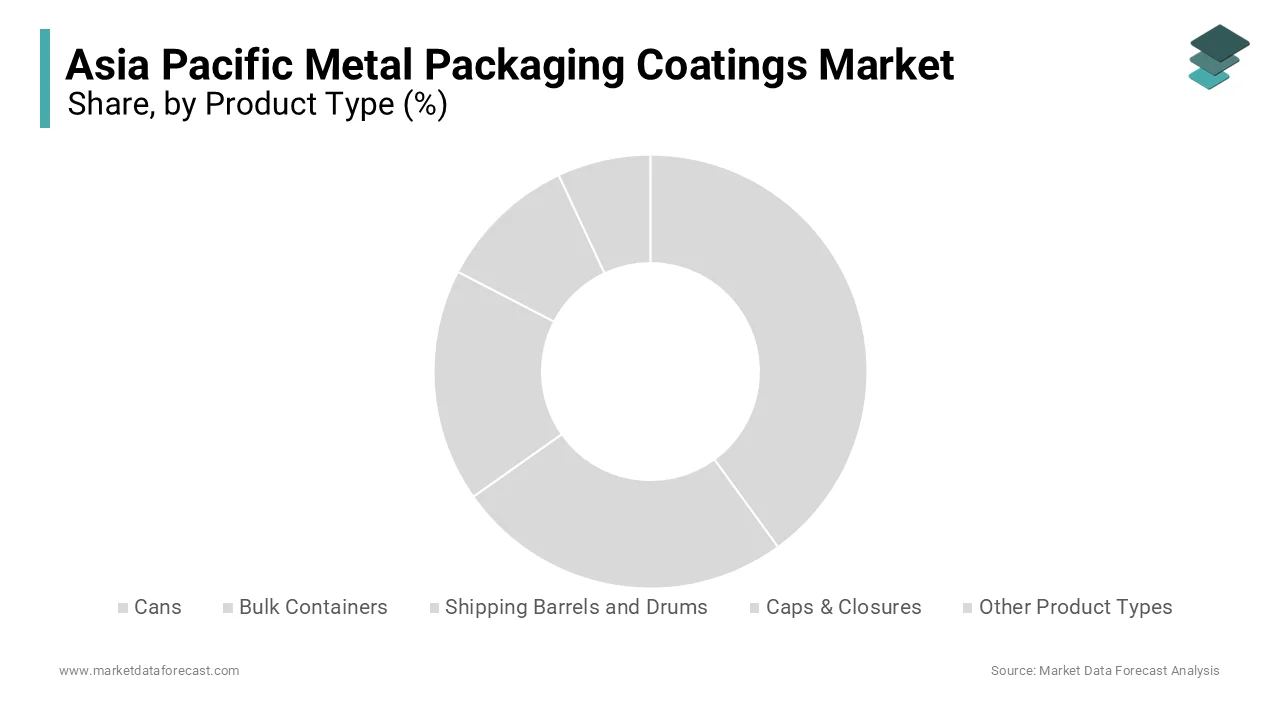
Moreover, beverage cans require specialized internal coatings to prevent direct contact between acidic or carbonated contents and the metal surface. As per the Food Standards Australia New Zealand (FSANZ), over 90% of beverage cans sold in the region must be lined with food-grade epoxy or alternative BPA-free coatings. Regulatory enforcement and brand owner commitments to consumer safety have ensured consistent demand for high-performance can coatings, which is reinforcing the dominance of this product category.
The aerosol cans segment is poised to grow with a CAGR of 7.2% throughout the forecast period. One major growth driver is the increasing adoption of deodorants, air fresheners, and insecticides in both urban and rural settings. These products rely heavily on coated metal cans to ensure leak-proof containment and resistance to pressurized propellants. Another contributing factor is the expansion of the pharmaceutical and healthcare industries. In India, for example, the government has promoted nebulizer and inhaler usage for respiratory ailments, boosting aerosol-based drug delivery systems. As per the Indian Pharmaceutical Alliance, aerosol-based medicines accounted for nearly 15% of all respiratory treatments in 2023.
By End-User Industry Insights
The food industry was the largest in the Asia Pacific metal packaging coatings market with 38.4% of share in 2025. One of the primary drivers of this segment’s dominance is the growing dependence on shelf-stable food products, particularly in rapidly urbanizing markets. According to the Food and Agriculture Organization (FAO), packaged food consumption in Asia Pacific rose by 6.5% annually between 2020 and 2023, with canned goods playing a critical role in ensuring long-term storage viability. Additionally, stringent food safety regulations are reinforcing the need for high-quality internal coatings. The Australian Government’s Department of Health mandates that all canned food products sold domestically must feature coatings compliant with migration limits for heavy metals and bisphenols. In response, major food processors like Nestlé and Unilever have mandated BPA-free coatings for their supply chains across the region.
The cosmetic & personal care industry is likely to experience a CAGR of 8.1% in the next coming years owing to the rising popularity of premium skincare, fragrance, and luxury beauty products that utilize decorative metal packaging for aesthetic appeal and brand differentiation. Another factor is the innovation in decorative coating technologies. Companies such as PPG Industries and Axalta Coating Systems have introduced high-gloss, matte, and textured finishes specifically designed for cosmetic tins and caps.
REGIONAL ANALYSIS
China was the largest contributor in the Asia Pacific metal packaging coatings market by accounting for 32.5% of share in 2025. One of the key growth drivers is the country’s thriving food and beverage sector. According to the National Bureau of Statistics of China, packaged food production exceeded 200 million metric tons in 2023, much of which relied on coated metal cans and containers. Moreover, China’s e-commerce boom has spurred demand for durable and visually appealing packaging, which is further boosting metal container usage. Additionally, regulatory developments are shaping the coatings landscape. The Ministry of Ecology and Environment has imposed stricter VOC emission standards, prompting a shift toward low-solvent and water-based coating technologies.
India was positioned second by holding 14.3% of the Asia Pacific metal packaging coatings market share in 2025. The country’s rapid industrialization, population growth, and rising disposable incomes have collectively contributed to a surge in packaged food and beverage consumption, directly benefiting the metal packaging coatings sector.
A major growth factor is the expansion of organized retail and modern trade channels. According to NielsenIQ, modern grocery retail in India grew by 11% in 2023, replacing traditional kirana stores as the primary distribution channel for FMCG products. This shift has increased reliance on shelf-ready metal packaging for items such as dairy products, edible oils, and snack foods.
Japan held the Asia Pacific metal packaging coatings market by accounting for 11.3% of total share in 2025. One of the key strengths of Japan’s market is its advanced coating technology ecosystem. Japanese companies such as Toyo Seikan and Daiwa Can Company have pioneered the development of ultra-thin, high-barrier coatings that enhance can recyclability while maintaining food safety. According to the Japan Can Manufacturers Association, over 80% of beverage cans produced in Japan now use eco-friendly internal coatings. Moreover, Japan’s aging population has boosted demand for ready-to-eat meals and health-focused packaged foods, which often rely on coated metal containers. As per the Cabinet Office of Japan, per capita consumption of canned food increased by 4% in 2023, reflecting sustained demand.
South Korea metal packaging coatings market growth is driven by its strong consumer goods and electronics packaging industries. The country’s compact urban population and high standard of living contribute to consistent demand for premium packaging solutions, including coated metal containers for cosmetics, beverages, and luxury food items.
A major growth driver is the Korean beauty industry, which relies heavily on metal packaging for skincare and makeup products. This trend has spurred demand for decorative and functional coatings that combine aesthetics with durability.
Australia metal packaging coatings market growth is attributed to be driven by distinguished by its strong regulatory environment and commitment to sustainability. One of the main drivers is the country’s strict food safety laws. The Therapeutic Goods Administration (TGA) and Food Standards Australia New Zealand (FSANZ) enforce stringent migration limits for substances like BPA and heavy metals. As per FSANZ, over 95% of canned food products sold in Australia must undergo coating compliance testing before reaching shelves. In addition, Australia leads in the adoption of bio-based and low-VOC coatings. According to the Australian Paint Manufacturers’ Federation, the market for environmentally friendly industrial coatings expanded by 10% in 2023, driven by consumer demand and retailer commitments to sustainability.
COMPETITIVE LANDSCAPE
The competition in the Asia Pacific metal packaging coatings market is marked by a blend of global giants and dynamic regional players striving to capture a larger share through differentiation and innovation. As consumer preferences shift toward sustainable and safe packaging, companies are under pressure to continuously evolve their product offerings while maintaining cost efficiency. The market sees intense rivalry not only in pricing but also in technological advancements, with firms competing to introduce high-performance, environmentally friendly coatings tailored for diverse applications. Regulatory compliance plays a critical role in shaping competitive strategies, particularly concerning food safety and emissions standards. Additionally, the expansion of local manufacturers offering cost-effective alternatives further intensifies the market dynamics, compelling multinational corporations to adapt through localization, strategic partnerships, and continuous R&D investment. The convergence of these factors creates a complex yet opportunity-rich environment where agility and innovation determine long-term success.
KEY MARKET PLAYERS
The Sherwin-Williams Company, PPG Industries Inc., AkzoNobel N.V., Kansai Paint Co., Ltd., Altana AG (Actega), Henkel AG & Co. KGaA, Axalta Coating Systems Ltd., Eason & Co., Toyochem Co., Ltd., Kangnam Jevisco Co., Ltd are the key players in the Asia Pacific metal packaging coatings market.
TOP PLAYERS IN THE MARKET
- One of the leading players in the market is PPG Industries, known for its extensive portfolio of protective and functional coatings tailored for metal packaging applications. The company has a strong presence across key markets in Asia, including China, Japan, and South Korea. PPG continues to invest in sustainable coating technologies and collaborates closely with major beverage and food can manufacturers to meet evolving regulatory standards while enhancing performance and aesthetics.
- Another dominant player is BASF SE, a global chemical giant that offers a wide range of high-performance coatings for metal packaging. In the Asia Pacific region, BASF leverages its innovation centers to develop advanced formulations that align with environmental regulations and customer-specific needs. Its strategic partnerships and localized production facilities enable it to cater efficiently to diverse end-use industries such as food, beverages, and personal care.
- AkzoNobel is also a major contributor to the market, recognized for its commitment to sustainable and eco-friendly coating solutions. With a growing focus on water-based and powder coatings, the company supports the region’s transition toward greener manufacturing practices.
TOP STRATEGIES USED BY KEY PLAYERS
A primary strategy adopted by leading companies in the Asia Pacific metal packaging coatings market is product innovation and sustainability development. Firms are focusing on creating low-VOC, BPA-free, and bio-based coatings to align with stringent environmental regulations and consumer demand for safer packaging options.
Another crucial approach is strategic collaborations and partnerships with local manufacturers and packaging converters. These alliances allow global players to enhance their regional presence, understand specific market requirements, and streamline supply chain operations effectively.
RECENT HAPPENINGS IN THE MARKET
- In February 2025, PPG Industries launched a new line of ultra-thin internal can coatings designed specifically for acidic beverage applications, targeting major beverage can manufacturers in Southeast Asia. This initiative aimed at improving corrosion resistance while complying with emerging food safety norms.
- In June 2023, BASF SE expanded its existing facility in Shanghai to include a dedicated center for metal packaging coating research and development, reinforcing its ability to serve large-scale Chinese food and beverage packagers with customized solutions.
- In October 2025, AkzoNobel entered into a strategic partnership with a leading Indonesian metal container manufacturer to co-develop water-based coatings for aerosol cans, aligning with regional sustainability goals and reducing reliance on solvent-based formulations.
- In March 2023, Sherwin-Williams established a technical service hub in South Korea to provide real-time support to metal packaging producers, ensuring optimal coating performance and faster response to client-specific challenges.
- In August 2025, Axalta Coating Systems introduced a new UV-curable metal decorating system for cosmetic packaging in Japan, which is catering to premium beauty brands seeking high-quality finishes while adhering to strict environmental guidelines.
MARKET SEGMENTATION
This research report on the Asia Pacific metal packaging coatings market has been segmented and sub-segmented based on the following categories.
Material Type
- Aluminium
- Steel
By Product Type
- Cans
- Food Cans
- Beverage Cans
- Aerosol Cans
- Bulk Containers
- Shipping Barrels and Drums
- Caps & Closures
- Other Product Types
By End-User Industry
- Beverage
- Food
- Cosmetics & Personal Care
- Household
- Paints & Varnishes
- Other End-user Industries
By Country
- India
- China
- Japan
- South Korea
- Australia
- New Zealand
- Thailand
- Malaysia
- Vietnam
- Philippines
- Indonesia
- Singapore
- Rest of Asia-Pacific