- Product Description Description
- Table of Contents TOC
- List of Table & Figure LOT
- Get Free Sample PDF Sample PDF
Market Size, 2025
$3.39 BnMarket Estimate, 2026
$3.66 BnMarket Forecast, 2034
$6.79 BnCAGR, 2026–2034
8.03%Asia Pacific Metal Trauma Implant Market Size
The Asia Pacific Metal Trauma Implant Market size was valued at USD 3.39 billion in 2025 and is anticipated to reach USD 3.66 billion in 2026 from USD 6.79 billion by 2034, growing at a CAGR of 8.03% during the forecast period from 2026 to 2034.
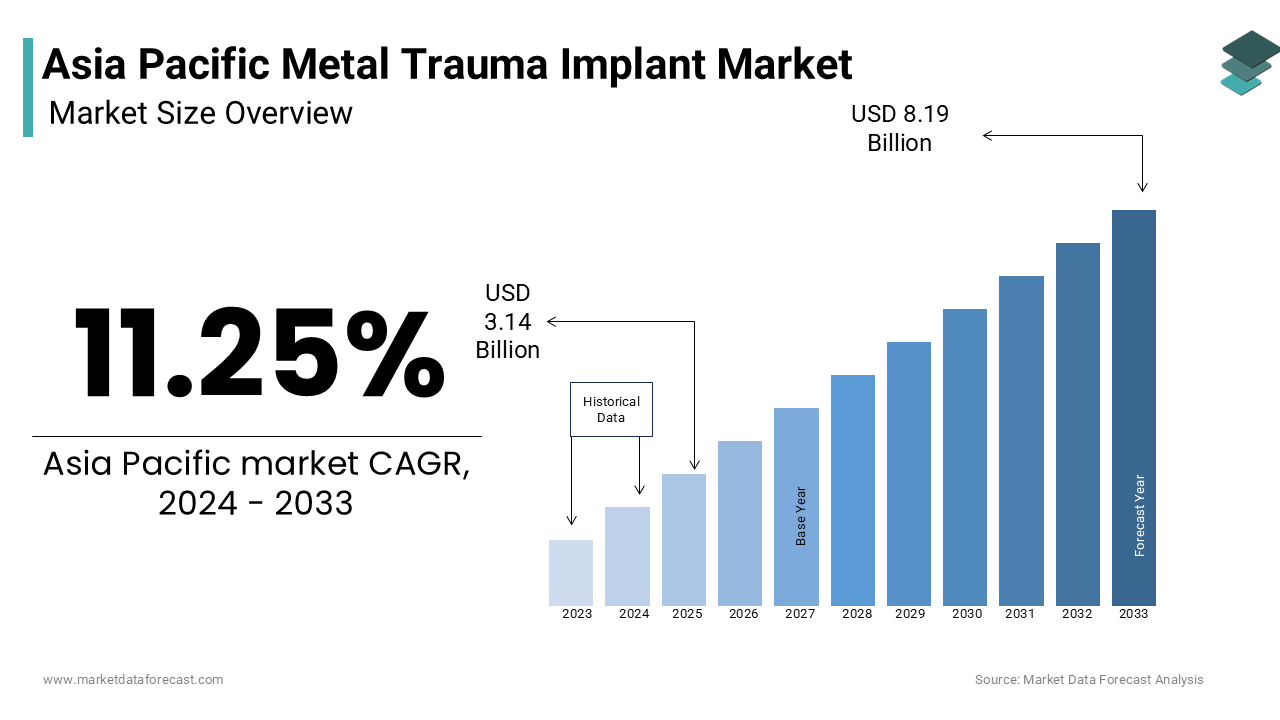
The Asia Pacific metal trauma implant market encompasses medical devices fabricated primarily from stainless steel, titanium, and cobalt-chromium alloys, designed to stabilize and repair fractures resulting from musculoskeletal injuries. These implants, including intramedullary nails, plates, and screws, are integral in orthopedic trauma care, particularly in cases involving long bone fractures, pelvic injuries, and complex joint trauma. The region’s escalating burden of accidental injuries plays a pivotal role in shaping demand. A significant number of road traffic injuries occur annually in Southeast Asia alone, contributing significantly to the need for advanced trauma care infrastructure. Additionally, the growing geriatric population in countries like Japan and South Korea, where individuals over 65 constitute nearly 30% of the population in Japan, as per the Japan’s Ministry of Health, Labour and Welfare, amplifies fracture incidence due to osteoporosis and fall-related trauma, thereby reinforcing clinical reliance on durable metal implants.
MARKET DRIVERS
Rising Incidence of Road Traffic Accidents and Industrial Injuries
The surge in road traffic accidents and occupational injuries across emerging economies in the Asia Pacific region has directly intensified the demand for metal trauma implants. India records over 400,000 road accidents annually, resulting in approximately 150,000 fatalities and millions of non-fatal injuries requiring surgical intervention, according to India’s Ministry of Road Transport and Highways. In parallel, rapid industrialization in countries like Indonesia and Vietnam has led to increased workplace accidents; as per the International Labour Organization, nearly 3 million occupational injuries occur yearly in globally in manufacturing and construction sectors. These trauma cases frequently involve complex fractures necessitating internal fixation with metal implants. The durability and load-bearing capacity of metallic devices make them the preferred choice in acute trauma settings, especially in under-resourced hospitals where cost and mechanical reliability are critical. Consequently, the persistent injury burden sustains a robust clinical demand for metal-based solutions over biodegradable or polymeric alternatives.
Expanding Geriatric Population and Age-Related Fracture Prevalence
The demographic shift toward an aging population in the Asia Pacific region is a key catalyst for the metal trauma implant market. This aging cohort faces a heightened risk of osteoporotic fractures, particularly hip and distal radius fractures. As per the International Osteoporosis Foundation, more than 4.5 million fragility fractures occur annually across Asia, with hip fracture rates in East Asia projected to double by 2050. Metal implants such as proximal femoral nails and locking compression plates are standard in geriatric trauma surgery due to their immediate structural support and compatibility with compromised bone quality. The preference for metallic constructs in elderly patients, combined with increasing life expectancy in countries like South Korea and Thailand, ensures sustained procedural volume and long-term market expansion for metal-based trauma fixation systems.
MARKET RESTRAINTS
High Cost of Advanced Metal Implants and Limited Reimbursement
Despite growing clinical demand, the adoption of premium metal trauma implants is hindered by prohibitive costs and inadequate reimbursement frameworks, particularly in low- and middle-income countries. A single locking compression plate can cost between USD 800 and USD 1,500 in private hospitals across India and the Philippines, a sum that exceeds the monthly income of a significant portion of the population. As per the Asian Development Bank, 13-18% of households in in low and middle income countries face catastrophic health expenditure when undergoing surgical procedures, discouraging elective or delayed trauma interventions. Public healthcare systems in nations like Indonesia and Bangladesh often prioritize basic surgical supplies over advanced implants, limiting access to high-performance titanium or coated stainless-steel devices. Additionally, inconsistent insurance coverage for orthopedic trauma surgeries further restricts patient access, especially in rural areas where out-of-pocket payments dominate, thereby constraining market penetration despite high injury rates.
Stringent Regulatory Pathways and Prolonged Approval Timelines
The regulatory landscape for medical devices in the Asia Pacific region remains fragmented and complex, significantly delaying the commercialization of new metal trauma implants. In China, the National Medical Products Administration mandates a minimum of 18 to 24 months for Class III implant approval, while India’s Central Drugs Standard Control Organization has historically lacked a standardized classification system for orthopedic devices, causing uncertainty for manufacturers. These delays increase time-to-market and R&D costs, discouraging innovation and limiting the availability of next-generation implants such as antimicrobial-coated or patient-specific metal constructs. The absence of harmonized regulatory standards across ASEAN nations further exacerbates the challenge, impeding regional scalability and equitable access to advanced trauma solutions.
MARKET OPPORTUNITIES
Integration of Digital Technologies in Trauma Implant Design
The convergence of digital health technologies with orthopedic trauma care presents a transformative opportunity for the metal implant sector. Advanced imaging, 3D printing, and AI-driven surgical planning are enabling the development of patient-specific metal implants with enhanced anatomical fit and biomechanical efficiency. In South Korea, hospitals like Asan Medical Center have adopted 3D-printed titanium plates for complex craniofacial and long bone reconstructions, reducing operative time by up to 30% as per data published in the Journal of Orthopaedic Surgery and Research. Similarly, Australia’s Stryker and India’s Meril Life Sciences have launched digitally guided trauma systems that integrate preoperative CT scans with implant design. This technological shift not only improves clinical outcomes but also strengthens the value proposition of metal implants in precision trauma care, opening new revenue streams for innovators.
Expansion of Trauma Care Infrastructure in Underserved Regions
Governments across the Asia Pacific are investing heavily in upgrading trauma care networks, creating fertile ground for metal implant market growth. India’s National Health Mission has allocated over USD 2.3 billion to strengthen emergency medical services and establish 100- 150 new trauma centers, as reported by the Ministry of Health and Family Welfare. These initiatives are increasing access to timely fracture management, particularly in rural and semi-urban areas where trauma care was previously limited. As per the Lancet Commission on Global Surgery, only 15-25% of surgical procedures in low-resource Asian settings were performed in adequately equipped facilities. The ongoing infrastructure expansion directly correlates with rising procedural volumes for internal fixation, thereby driving demand for reliable, cost-effective metal implants and creating strategic entry points for manufacturers aiming to capture emerging market segments.
MARKET CHALLENGES
Risk of Implant-Related Infections and Long-Term Complications
Postoperative infections remain a critical clinical challenge in metal trauma implant procedures, particularly in tropical and high-burden regions of the Asia Pacific. These infections are frequently caused by multidrug-resistant organisms. Biofilm formation on metal surfaces further complicates treatment, often necessitating implant removal and revision surgeries. The financial and clinical burden of such complications undermines patient outcomes and increases healthcare costs.
Supply Chain Disruptions and Raw Material Volatility
The production of metal trauma implants is highly dependent on a stable supply of high-grade titanium, cobalt, and medical-grade stainless steel, the availability of which is vulnerable to geopolitical and economic fluctuations. In 2022, global titanium sponge prices surged by 22% due to export restrictions and energy shortages, as reported by the U.S. Geological Survey, directly impacting manufacturing costs in China and India, which source over 60% of their titanium from Japan and Kazakhstan. Additionally, the Russia-Ukraine conflict disrupted palladium and nickel supplies, critical for alloying and coating processes. These disruptions delay production, increase inventory costs, and threaten consistent supply to public hospitals, especially in nations reliant on imported components. The lack of localized material processing infrastructure further exacerbates dependency, making the regional metal implant market susceptible to external shocks and undermining long-term scalability.
REPORT COVERAGE
| REPORT METRIC | DETAILS |
| Market Size Available | 2025 to 2034 |
| Base Year | 2025 |
| Forecast Period | 2026 to 2034 |
| CAGR | 8.03% |
| Segments Covered | By Type, Application, End-Use and Country |
| Various Analyses Covered | Regional & Country Level Analysis, Segment-Level Analysis, DROC, PESTLE Analysis, Porter’s Five Forces Analysis, Competitive Landscape, Analyst Overview on Investment Opportunities |
| Countries Covered | India, China, Japan, South Korea, Australia, New Zealand, Thailand, Malaysia, Vietnam, the Philippines, Indonesia, Singapore, and the rest of APAC. |
| Market Leaders Profiled | Johnson & Johnson (DePuy Synthes), Stryker Corporation, Zimmer Biomet Holdings Inc., Smith & Nephew plc, Medtronic plc, B. Braun Melsungen AG, Orthofix Medical Inc., NuVasive Inc., Globus Medical Inc., and Aesculap Implant Systems. |
SEGMENTAL ANALYSIS
By Type Insights
The metal plates segment commanded the largest share of the Asia Pacific at 38.5% of total revenue in 2025. This dominance is due to their extensive use in stabilizing complex fractures of the long bones, peri-articular regions, and mandibular trauma, particularly in high-injury-burden countries. The widespread clinical reliance on locking compression plates (LCPs) and anatomically contoured plates in diaphyseal and metaphyseal fractures drives their market leadership. The versatility of metal plates in both osteoporotic and polytrauma cases, combined with rising surgical standardization in public hospitals, reinforces their entrenched position in trauma care protocols.
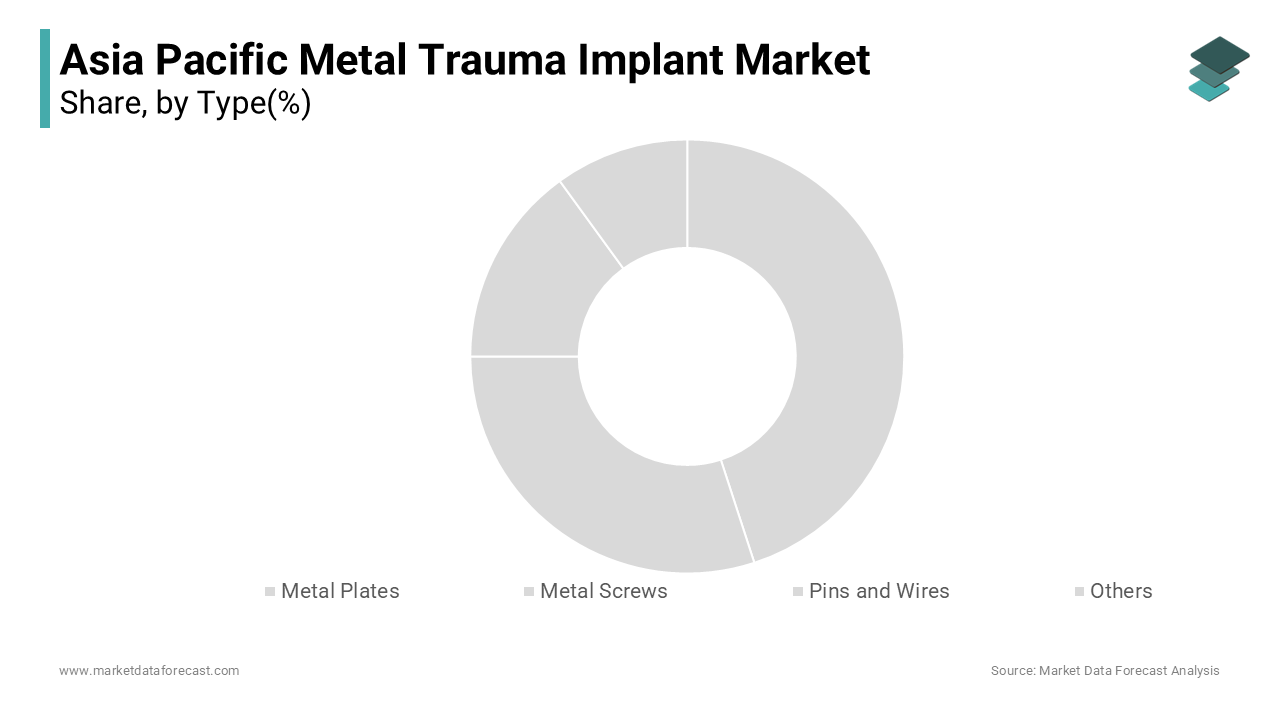
The pins and wires segment is expanding at the fastest pace and is projected to register a CAGR of 7.9% from 2025 to 2033. This accelerated growth is primarily fueled by their increasing use in minimally invasive fixation techniques and external fixation systems, especially in pediatric and emergency orthopedic settings. In rural healthcare facilities across Indonesia and the Philippines, where access to advanced surgical instrumentation is limited, Kirschner wires (K-wires) and Steinmann pins are preferred due to their low cost, ease of application, and compatibility with temporary stabilization. Additionally, the surge in road traffic injuries requiring rapid immobilization has amplified demand for pin-based systems in trauma triage, further accelerating adoption.
By Application Insights
The reconstructive joint replacements segment led by contributing 32.5% of total revenue in the Asia Pacific metal trauma implant market in 2025. This dominance is anchored in the rising incidence of post-traumatic arthritis and joint instability following high-energy fractures, particularly in the hip and knee. In trauma patients with intra-articular fractures, delayed reconstructive arthroplasty is often necessary to restore mobility and reduce chronic pain. Japan alone performs over 120,000 hip and knee replacement surgeries annually, with nearly 28% linked to prior trauma rather than primary osteoarthritis, as per the Japanese Orthopaedic Association. The aging population, coupled with improved survival rates from severe accidents due to better emergency care, has increased the pool of candidates requiring secondary joint reconstruction. Moreover, the integration of modular metal components in revision implants enhances durability, making this segment a cornerstone of long-term trauma rehabilitation.
The spinal implants segment is experiencing the most rapid expansion and is growing at a CAGR of 8.4% during the forecast period. This growth is propelled by the rising prevalence of traumatic spinal injuries from falls, vehicular accidents, and occupational hazards, particularly in densely populated urban centers. The increasing adoption of pedicle screw-rod systems and vertebral body fusion cages, fabricated from titanium alloys, has enhanced surgical precision and fusion success rates. Additionally, the expansion of specialized spine centers in South Korea and Australia, supported by advanced imaging and navigation systems, has elevated procedural volume. Also, the number of spine trauma surgeries in tertiary hospitals increased between 2019 and 2023, reflecting a systemic shift toward definitive surgical management over conservative care.
By End-User Insights
The Hospitals segment represented the prominent end-user by capturing 63.2% of the share in 2025. This dominance is because of the trauma care, particularly involving metal implants, requires multidisciplinary coordination, intensive care support, and access to advanced imaging and surgical suites—resources predominantly centralized in hospitals. Furthermore, national health programs in countries like Indonesia and Vietnam channel funding toward hospital-based surgical units, reinforcing their role as primary implant consumers. The integration of trauma networks and emergency response systems within hospital ecosystems ensures that metal implants are deployed at scale, cementing their position as the principal end-user segment.
The Ambulatory Surgical Centers (ASCs) segment is emerging as the fastest-growing end-user segment and is projected to expand at a CAGR of 9.1% through 2033. This surge is driven by the increasing shift of low-complexity orthopedic procedures, such as fracture fixation in extremities and minor plating surgeries, from inpatient hospitals to outpatient facilities. In Australia and South Korea, regulatory reforms now permit ASCs to perform Class II and III implant procedures under strict accreditation, accelerating service diversification. As per the Australian Institute of Health and Welfare, over 40% of minor orthopedic surgeries were conducted in accredited day-surgery centers in 2022, a figure that has doubled since 2017. The economic advantage of reduced hospital stays, combined with rising patient preference for same-day discharge, has incentivized private healthcare providers to invest in ASC infrastructure. Additionally, partnerships with implant manufacturers for bundled pricing models have improved cost efficiency, making ASCs a viable and scalable channel for trauma implant utilization.
REGIONAL ANALYSIS
China stood as the dominant force in the Asia Pacific metal trauma implant market by securing an estimated 28.3% share in 2025. The country’s position is underpinned by its massive population, high incidence of industrial and traffic-related injuries, and rapid modernization of orthopedic care infrastructure. The government’s “Healthy China 2030” initiative has spurred investment in tier-2 and tier-3 city hospitals, expanding access to surgical implants. Additionally, domestic manufacturers such as Aipu Instrument and Kanghui Medical are gaining market share by offering cost-competitive titanium and stainless-steel implants, reducing reliance on imports.
Japan is distinguished by its mature healthcare system and one of the world’s most aged populations. With 29.1% of its citizens aged 65 or older, as reported by Japan’s Ministry of Internal Affairs and Communications, the country faces a disproportionate burden of osteoporotic fractures, particularly hip and vertebral injuries. The country’s universal health coverage ensures high procedural accessibility, while stringent quality standards favor premium titanium-based devices. Moreover, Japan’s leadership in robotic-assisted orthopedic surgery, evidenced by the adoption of systems like ROBODOC in major hospitals, has enhanced implant precision and reduced revision rates. As per the Japan Implant Registry, implant survival rates exceed 95% at five years, reinforcing clinician confidence and sustaining demand for high-performance metal constructs.
India commands a significant share of the regional market which is driven by a confluence of high trauma incidence and expanding surgical capacity. The country records over 400,000 road accidents annually, resulting in more than 1.5 million fracture cases requiring surgical intervention, according to India’s Ministry of Road Transport and Highways. A critical factor bolstering market growth is the government’s National Trauma Care System initiative, which aims to establish 150 integrated trauma centers by 2025. Additionally, the rise of domestic manufacturers like Siora Surgicals and Trice Implants has reduced prices by up to 40% compared to imported devices, improving affordability.
South Korea is distinguished by its advanced medical technology adoption and high healthcare expenditure. The country’s trauma implant market is characterized by rapid integration of innovation, including patient-specific 3D-printed plates and navigation-guided screw placement. The government’s digital health roadmap has accelerated the use of AI-based surgical planning, enhancing implant accuracy and reducing complications. Additionally, South Korea’s universal insurance coverage includes reimbursement for most metal trauma implants, ensuring high patient access. The presence of globally competitive manufacturers like Core Dynamics further strengthens the domestic ecosystem, making South Korea a technology leader in the regional market.
Australia is functioning as a high-value, innovation-driven node within the Asia Pacific landscape. Despite its smaller population, the country exhibits one of the highest per capita utilizations of metal trauma implants, particularly in rural and remote areas where falls among the elderly are a leading cause of hospitalization. The country’s robust regulatory framework under the Therapeutic Goods Administration ensures high implant quality, favoring premium devices from global players like Stryker and Zimmer Biomet. Additionally, Australia’s participation in international trauma registries, such as the Australian Orthopaedic Association National Joint Replacement Registry, enables real-world data collection that informs clinical best practices and implant selection. This data-driven approach, combined with strong public-private partnerships, positions Australia as a benchmark for clinical excellence and post-market surveillance in trauma care.
COMPETITIVE LANDSCAPE
The competition in the Asia Pacific metal trauma implant market is intensifying as global leaders and regional manufacturers vie for dominance across diverse healthcare landscapes. Multinational corporations leverage technological innovation, clinical evidence, and extensive distribution networks to maintain influence in high-income markets such as Japan, Australia, and South Korea. At the same time, domestic players from India, China, and Malaysia are gaining traction by offering cost-effective alternatives that meet regulatory standards, challenging pricing models of global brands. The competitive landscape is further shaped by increasing demand for anatomically specific implants, prompting companies to invest in localized R&D. Strategic collaborations with academic institutions and public health systems are becoming critical differentiators. Additionally, the rise of value-based healthcare is pushing firms to demonstrate long-term clinical outcomes, driving a shift from product-centric to solution-oriented competition across the region.
KEY MARKET PLAYERS
Some of the companies that are playing a dominating role in the Asia Pacific Metal Trauma Implant Market include
- Johnson & Johnson (DePuy Synthes)
- Stryker Corporation
- Zimmer Biomet Holdings Inc.
- Smith & Nephew plc
- Medtronic plc
- B. Braun Melsungen AG
- Orthofix Medical Inc.
- NuVasive Inc.
- Globus Medical Inc.
- Aesculap Implant Systems
Top Players in the Asia Pacific Metal Trauma Implant Market
Stryker Corporation has established a formidable presence in the Asia Pacific metal trauma implant market through its focus on innovation and localized clinical support. The company offers a comprehensive portfolio of trauma fixation devices, including locking plates, intramedullary nails, and minimally invasive surgical systems. In recent years, Stryker has intensified its engagement with regional hospitals by launching surgeon training programs in countries like India and South Korea, enhancing adoption of its advanced implant platforms. Additionally, the integration of its Mako robotic technology with trauma planning software in Australia has positioned Stryker at the forefront of precision orthopedic care, reinforcing its reputation for high-performance, clinically validated devices.
Zimmer Biomet plays a pivotal role in shaping the metal trauma implant landscape across Asia Pacific by leveraging its global expertise and region-specific product development. The company’s trauma division has introduced anatomically contoured plates and bio-compatible screw systems tailored to Asian bone morphology, improving surgical outcomes in markets like Japan and Thailand. The company has also strengthened its digital footprint by introducing augmented reality (AR)-assisted surgical planning tools in collaboration with hospitals in South Korea. Furthermore, its investment in local manufacturing capabilities in Malaysia has reduced lead times and import dependency, enabling faster market responsiveness and enhanced customer engagement across emerging economies.
Smith & Nephew has solidified its position in the Asia Pacific metal trauma implant market through strategic innovation and deep clinical integration. The company’s Anthem Trauma System, featuring low-profile locking plates and angular-stable screws, has gained widespread acceptance in high-volume trauma centers across Australia and Southeast Asia. Smith & Nephew has prioritized education by establishing the Asia Pacific Orthopaedic Academy, which conducts hands-on workshops for surgeons on trauma implant techniques, directly influencing clinical preference. Additionally, its collaboration with public health institutions in Thailand to supply cost-optimized trauma kits has expanded access in underserved areas, combining commercial growth with public health impact and reinforcing long-term brand loyalty.
Top Strategies Used by Key Market Participants
Key players in the Asia Pacific metal trauma implant market are deploying multifaceted strategies to consolidate their positions. Major companies are investing heavily in product localization, adapting implant designs to match the anatomical variations prevalent among Asian populations. Strategic partnerships with regional distributors and hospitals are enabling faster market penetration, particularly in rural and semi-urban areas. Companies are also expanding their digital ecosystems by integrating AI-driven surgical planning, robotic assistance, and remote training platforms to enhance clinical adoption. Mergers and acquisitions are being leveraged to acquire niche technologies, especially in 3D printing and smart implants. Furthermore, manufacturers are focusing on cost-optimized product lines to compete with domestic players while maintaining premium offerings for private healthcare segments, ensuring a balanced approach to volume and value across diverse healthcare economies.
RECENT MARKET DEVELOPMENTS
- In March 2023, Stryker launched its next-generation intramedullary nailing system in Australia and New Zealand, specifically designed for femoral and tibial fractures, incorporating enhanced locking mechanisms and reduced insertion force, improving surgical efficiency and patient recovery times in trauma centers across the region.
- In July 2022, Zimmer Biomet partnered with a leading orthopedic hospital in Bangkok to establish a Center of Excellence for extremity trauma, enabling real-world data collection, surgeon training, and rapid feedback loops for implant optimization, strengthening its clinical integration in Southeast Asia.
- In October 2023, Smith & Nephew inaugurated a regional innovation hub in Singapore focused on developing trauma implants tailored to Asian skeletal anatomy, combining 3D imaging data and biomechanical modeling to accelerate the launch of region-specific fixation devices.
- In January 2025, DePuy Synthes expanded its distribution agreement with a major Indonesian medical supplier to enhance reach in tier-2 and tier-3 cities, ensuring broader access to its titanium-based trauma plates and screws in underserved areas with rising trauma care demand.
- In May 2023, Integra LifeSciences acquired a Chennai-based orthopedic device manufacturer to strengthen its local manufacturing capabilities in India, enabling faster regulatory approvals, reduced production costs, and improved competitiveness against domestic brands in the price-sensitive trauma implant market.
MARKET SEGMENTATION
This research report on the Asia Pacific metal trauma implant market is segmented and sub-segmented into the following categories.
By Type
- Metal Plates
- Metal Screws
- Pins and Wires
- Others
By Application
- Reconstructive Joint Replacements
- Spinal Implants
- Dental Implants
- Others
By End-user
- Hospitals
- Orthopedic Clinics
- Ambulatory Surgical Centers
- Others
By Country
- India
- China
- Japan
- South Korea
- Australia
- New Zealand
- Thailand
- Malaysia
- Vietnam
- Philippines
- Indonesia
- Singapore
- Rest of APAC