- Product Description Description
- Table of Contents TOC
- List of Table & Figure LOT
- Get Free Sample PDF Sample PDF
Market Size, 2025
$1.51 BnMarket Estimate, 2026
$1.78 BnMarket Forecast, 2034
$6.75 BnCAGR, 2026–2034
18.14%Asia Pacific Microdisplay Market Size
The Asia Pacific Microdisplay Market size was calculated to be USD 1.51 billion in 2025 and is anticipated to be worth USD 6.75 billion by 2034, from USD 1.78 billion in 2026, growing at a CAGR of 18.14% during the forecast period.
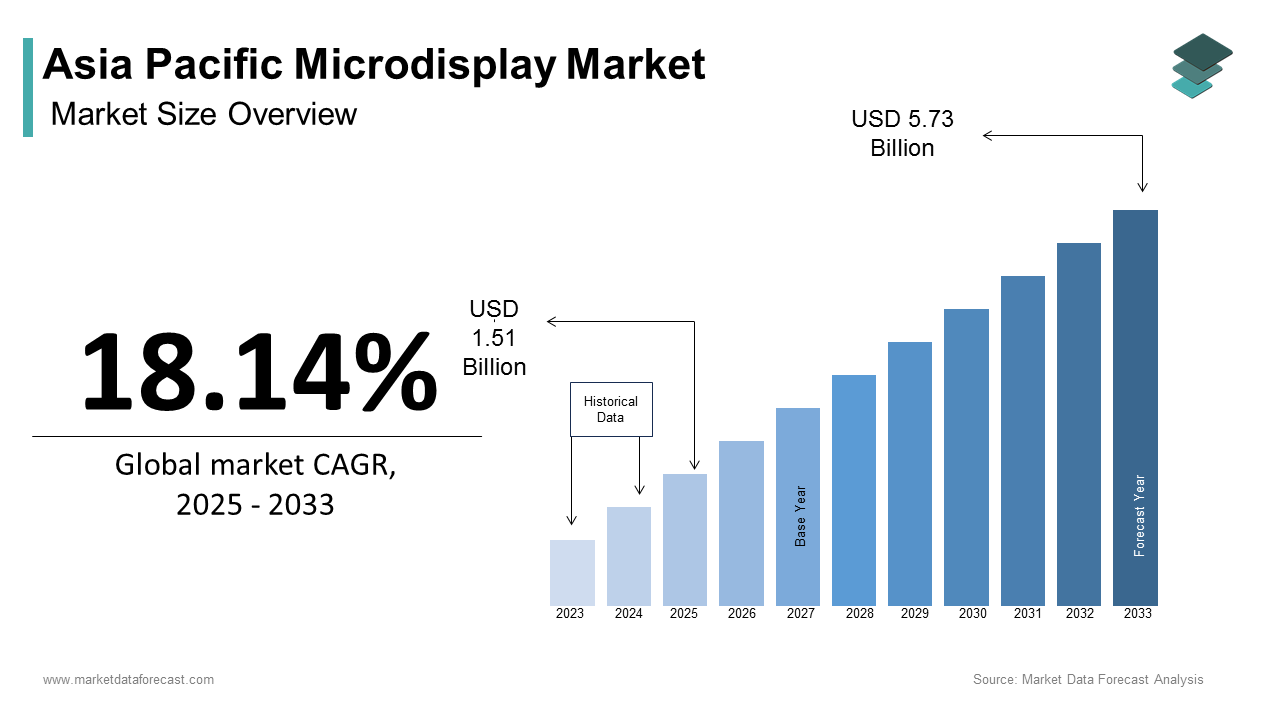
The Asia Pacific microdisplay market refers to the section of display technology that involves small-sized, high-resolution screens typically used in near-to-eye applications such as augmented reality (AR), virtual reality (VR), head-mounted displays, and digital cameras. These displays are vital components in consumer electronics, military equipment, healthcare devices, and industrial automation. In addition, the expansion of the semiconductor industry in Southeast Asia is enabling localized production of advanced display components.
MARKET DRIVERS
Expansion of Consumer Electronics and Smart Wearable Devices
One of the key drivers influencing the growth of the Asia Pacific microdisplay market is the rapid expansion of the consumer electronics and smart wearable device industry. The increasing penetration of wearable gadgets such as smart glasses, fitness trackers, and VR headsets has created a surge in demand for compact, high-resolution microdisplays. According to the International Data Corporation, shipments of wearable devices in the Asia Pacific region notably grew year-over-year in 2023, with China and India being the major contributors. The rise in disposable income and growing health consciousness among consumers have accelerated the adoption of smart wearables, especially in urban areas. Additionally, the demand for immersive entertainment experiences has boosted the use of microdisplays in AR and VR applications. Local manufacturers in countries like South Korea and Japan are investing heavily in next-generation display technologies such as OLED-on-silicon and LCoS (Liquid Crystal on Silicon) to meet performance demands. Moreover, government-led programs in China and India are supporting the localization of advanced electronic components, including microdisplays, further strengthening the supply chain and reducing dependency on imports.
Rising Demand in Military and Aerospace Applications
Another significant driver of the Asia Pacific microdisplay market is the growing adoption of microdisplay technology in military and aerospace applications. These displays are extensively used in night vision goggles, helmet-mounted displays, weapon sights, and cockpit instrumentation systems due to their ability to deliver high-resolution visuals in compact form factors. According to the study, military expenditure in the Asia Pacific region exceeded USD 580 billion in 2023, marking an increase of nearly 4% compared to the previous year. This substantial investment has led to modernization initiatives across defense forces, particularly in countries like China, India, Japan, and South Korea. In line with these efforts, governments in the region are prioritizing indigenous defense manufacturing. Similarly, Japan’s Self-Defense Forces are integrating OLED microdisplays into next-generation fighter jet helmets and surveillance equipment.
MARKET RESTRAINTS
High Manufacturing Costs and Technological Complexity
Despite the growing demand for microdisplay technologies in the Asia Pacific region, one of the primary restraints is the high cost associated with their design and production. Microdisplays, particularly those based on OLED-on-Silicon or Liquid Crystal on Silicon (LCoS) architectures, require highly specialized fabrication processes that involve precision engineering and cleanroom environments. This increases the overall manufacturing complexity and significantly impacts production scalability. Moreover, the shortage of skilled labor and limited access to advanced semiconductor equipment in certain parts of the region further complicates mass production. In emerging economies like Vietnam and Indonesia, local companies face difficulties in establishing fabrication facilities that meet international standards. As per the Semiconductor Industry Association, Asia Pacific accounted for a large share of global semiconductor consumption in 2023, yet only a fraction of this capacity was dedicated to microdisplay-specific components. Also, fluctuations in raw material prices, particularly for silicon wafers and rare-earth metals, add to the financial burden on manufacturers.
Supply Chain Disruptions and Component Shortages
A major restraint impacting the growth of the Asia Pacific microdisplay market is the ongoing instability in the global supply chain, exacerbated by component shortages and logistical bottlenecks. The region heavily relies on a complex network of suppliers for critical materials such as silicon wafers, organic light-emitting diode (OLED) substrates, and optical coatings. However, disruptions caused by geopolitical tensions and pandemic-related shutdowns have affected production timelines. According to the World Trade Organization, global trade volume growth decelerated in 2023, down from that in 2022, contributing to delays in semiconductor and display component deliveries. Furthermore, the concentration of manufacturing capabilities in a few countries, primarily South Korea, Japan, and Taiwan, creates vulnerability to regional disruptions. In addition, freight costs remain elevated compared to pre-pandemic levels, with rates higher than the five-year average.
MARKET OPPORTUNITIES
Integration of Microdisplays in Automotive and Smart Mobility Solutions
A promising opportunity in the Asia Pacific microdisplay market lies in the integration of microdisplay technology within automotive and smart mobility applications. As vehicles become increasingly connected and autonomous, manufacturers are adopting advanced driver assistance systems (ADAS), heads-up displays (HUDs), and digital instrument clusters that require high-resolution, low-latency visual interfaces. According to BloombergNEF, the Asia Pacific region accounted for over 60% of global electric vehicle (EV) sales in 2023, with China alone representing nearly half of this figure. This surge in EV adoption is driving demand for innovative display solutions, including near-eye microdisplays used in augmented reality HUDs. Japanese automakers such as Toyota and Honda are incorporating OLED microdisplay-based HUDs that project real-time navigation data onto windshields, enhancing driver visibility and safety. Similarly, Chinese EV startups like BYD and NIO are partnering with local display manufacturers to develop customized dashboard systems using microdisplay modules.
Growth of Healthcare and Medical Imaging Technologies
The expanding healthcare infrastructure in the Asia Pacific region is opening up significant opportunities for microdisplay technology, particularly in medical imaging, diagnostics, and surgical equipment. Microdisplays are increasingly deployed in endoscopic cameras, digital surgical loupes, and wearable diagnostic devices that require high-resolution visuals in compact formats. A notable trend is the adoption of head-mounted displays in minimally invasive surgeries, where surgeons require real-time, high-definition visual input. Hospitals in Japan and Singapore are integrating microdisplay-equipped surgical visualization tools that offer superior brightness and contrast compared to conventional monitors. Additionally, the proliferation of telemedicine services, especially in rural areas of India and Indonesia, is boosting the use of microdisplay-based mobile diagnostic kits.
MARKET CHALLENGES
Rapid Technological Obsolescence and Innovation Pressure
One of the foremost challenges facing the Asia Pacific microdisplay market is the swift pace of technological obsolescence and the intense pressure to continuously innovate. The display industry is characterized by rapid advancements in resolution, refresh rates, power efficiency, and integration capabilities, necessitating frequent R&D upgrades. Manufacturers must invest heavily in research and development to stay competitive, given the evolving expectations of consumers and industries alike. Like, companies in the semiconductor and display sectors allocate a major share of their annual revenue toward R&D, with many firms struggling to keep pace with breakthroughs in micro-OLED, micro-LED, and quantum dot technologies. Moreover, the dominance of a few global display giants—such as Sony, Samsung, and eMagin—creates a challenging environment for smaller manufacturers in the Asia Pacific region. These large firms possess extensive resources to develop next-generation products, making it difficult for regional players to match their innovation speed. This consolidation intensifies the need for continuous investment in talent acquisition, process optimization, and intellectual property development.
Regulatory and Standardization Hurdles Across Diverse Markets
A significant challenge in the Asia Pacific microdisplay market stems from the varying regulatory frameworks and standardization requirements across different countries. Unlike mature markets such as the United States or the European Union, where certification norms are relatively unified, the Asia Pacific region presents a fragmented landscape with distinct compliance procedures for electronics exports and imports. Countries like China, India, and Indonesia enforce stringent import controls, quality certifications, and electromagnetic compatibility (EMC) testing, which can delay product approvals and increase time-to-market. Also, the lack of harmonized standards for display performance metrics, such as luminance, pixel density, and color accuracy, complicates product development strategies for multinational display manufacturers. While Japan follows JIS (Japanese Industrial Standards) and South Korea adheres to KGS (Korean Government Standards), other countries in the ASEAN bloc apply ISO or less formalized guidelines.
REPORT COVERAGE
| REPORT METRIC | DETAILS |
| Market Size Available | 2025 to 2034 |
| Base Year | 2025 |
| Forecast Period | 2026 to 2034 |
| CAGR | 18.14% |
| Segments Covered | By Product, Technology, Vertical, and Region |
| Various Analyses Covered | Global, Regional & Country Level Analysis; Segment-Level Analysis; DROC, PESTLE Analysis; Porter’s Five Forces Analysis; Competitive Landscape; Analyst Overview of Investment Opportunities |
| Regions Covered | India, China, Japan, South Korea, Australia, New Zealand, Thailand, Malaysia, Vietnam, Philippines, Indonesia, Singapore, Rest of Asia-Pacific |
| Market Leaders Profiled | Sony Corporation, Samsung Electronics Co., Ltd., LG Display Co., Ltd., Seiko Epson Corporation, Kopin Corporation, Himax Technologies, Inc., AUO Corporation, BOE Technology Group Co., Ltd., Innolux Corporation, Jade Bird Display, WiseChip Semiconductor Inc., Yunnan OLiGHTEK Opto-Electronic Technology Co., Ltd., Raystar Optronics, Inc., Winstar Display Co., Ltd., HOLOEYE Photonics AG, eMagin Corporation, MicroOLED SAS, SeeYA Technology, Microtips Technology LLC, Vuzix Corporation, Sharp Corporation, Kyocera Corporation, Panasonic Corporation, Toshiba Corporation, Konica Minolta Inc., MicroVision Inc., Syndiant Inc., Pixel Display Inc. |
SEGMENTAL ANALYSIS
By Product Insights
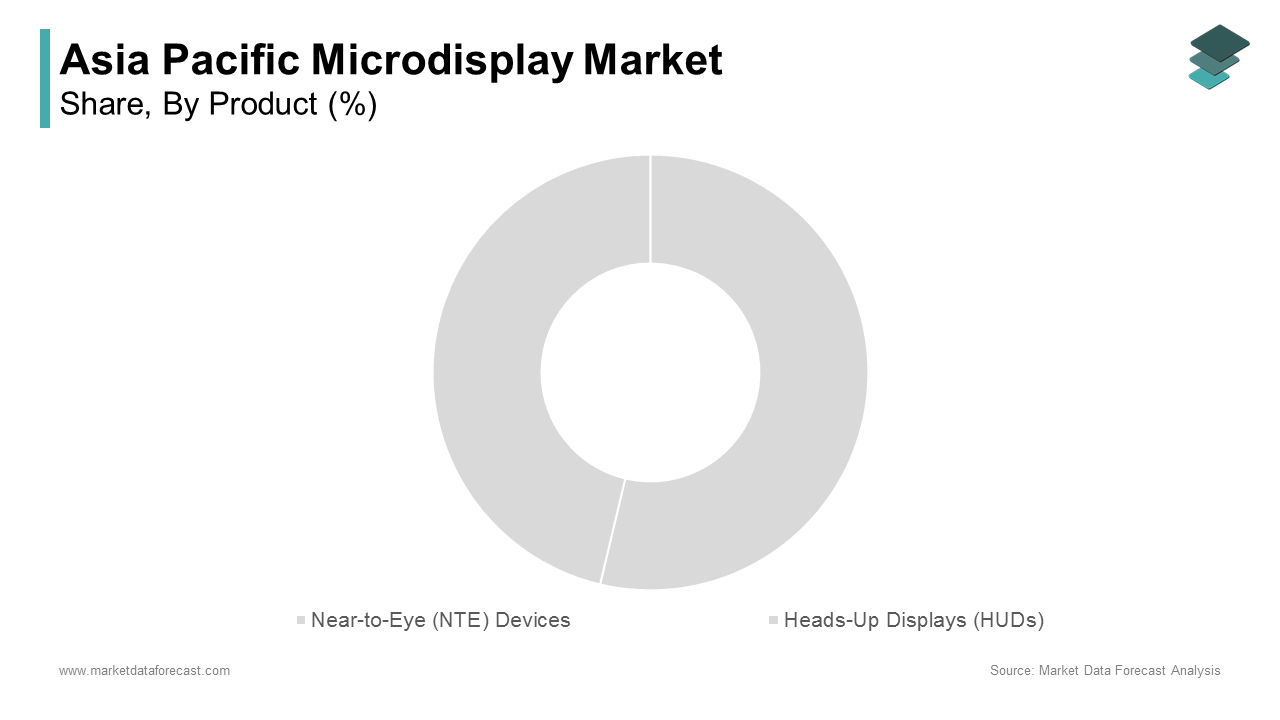
The near-to-eye devices segment had the largest share of the Asia Pacific microdisplay market i.e. 52.4% of total revenue in 2025. This dominance is due to widespread adoption across consumer and enterprise applications such as augmented reality headsets, virtual reality goggles, smart glasses, and professional training equipment. Also, the expansion of the gaming and entertainment industries is a major catalyst. In South Korea, where digital entertainment is deeply embedded in the culture, per capita spending on gaming reached USD 350 annually as reported by Newzoo in 2023. In addition, enterprises are increasingly leveraging NTE technologies for remote assistance, field service management, and immersive training solutions.
Heads-Up Displays (HUDs) are emerging as the fastest-growing product segment within the Asia Pacific microdisplay market, projected to expand at a CAGR of 19.3% between 2026 and 2034. This rapid traction is primarily fueled by the growing integration of HUD technology in automotive applications, especially in mid to high-end passenger vehicles and electric mobility platforms. According to BloombergNEF, Asia Pacific accounted for a major percentage of global electric vehicle sales in 2023, with countries like China and India leading the transition towards connected and autonomous driving features. Automotive manufacturers in Japan and South Korea have been early adopters of advanced HUD systems that utilize microdisplays to project critical driving data onto windshields without diverting driver attention. Toyota, for instance, has incorporated OLED-based microdisplay units into its latest hybrid models, enhancing situational awareness and road safety.
By Technology Insights
The Organic Light-Emitting Diode (OLED)-based microdisplays segment dominated the Asia Pacific microdisplay market by capturing 58.6% of total market value in 2025. Their superior contrast ratios, faster response times, and ability to deliver high pixel densities make them the preferred choice across consumer electronics, industrial wearables, and military applications. The proliferation of virtual and augmented reality headsets, which rely heavily on OLED-on-silicon technology, has significantly bolstered their market position. These companies have invested heavily in expanding 8-inch wafer fabrication facilities, allowing for greater economies of scale. In addition, Japanese firms like Sony continue to supply high-resolution OLED microdisplays for aviation and defense applications, reinforcing regional technological leadership. Moreover, the increasing penetration of smart wearable devices—in line with rising disposable incomes and urban digitization—has further solidified OLED’s dominance.
MicroLED microdisplays represent the swiftest advancing technology segment in the Asia Pacific microdisplay market, anticipated to register a CAGR of 24.6%. Unlike traditional LCD or OLED counterparts, MicroLED offers superior brightness, longer lifespan, and lower power consumption, making it ideal for next-generation near-eye applications such as AR glasses, wearables, and vehicular HUDs. One of the primary drivers is the aggressive R&D investments being made by key players in the region. According to Yole Développement, Chinese and Korean semiconductor firms allocated over USD 2 billion collectively in 2023 toward scaling up MicroLED manufacturing capabilities. Companies including Samsung and AU Optronics are actively developing ultra-compact MicroLED microdisplay prototypes for commercial deployment within the next few years. Additionally, strategic collaborations between chipmakers and display integrators are accelerating innovation cycles. For example, in 2023, Apple-backed JBD expanded its Shanghai-based MicroLED facility to cater to both consumer and industrial clients.
By Vertical Insights
The consumer electronics vertical possessed the biggest share of the Asia Pacific microdisplay market, i.e. 47.8% of overall revenue in 2025. This influence is attributed to the region's status as a global hub for manufacturing and consuming electronic goods, particularly smartphones, smartwatches, VR headsets, and digital cameras. Countries like China, India, and South Korea have witnessed rapid adoption of wearable and mobile technologies, directly fueling demand for high-resolution microdisplays. While not all smartphones incorporate microdisplays, accessories such as AR glasses and smart headsets used in conjunction with mobile devices are increasingly dependent on microdisplay components. In addition, the gaming and entertainment sector continues to be a major contributor. The presence of major OEMs such as Xiaomi, Oppo, and Sony further strengthens the region’s supply chain advantages.
The automotive sector is the rapidly progressing vertical in the Asia Pacific microdisplay market, projected to grow at a CAGR of 20.8%. This surge is driven by the increasing integration of microdisplays in heads-up displays (HUDs), digital instrument clusters, and rear-seat entertainment systems, particularly in electric and premium vehicles. Chinese automakers are incorporating OLED-based microdisplays into HUD systems, enabling real-time projection of navigation, speed, and battery information without requiring drivers to shift focus. Similarly, Japanese and South Korean manufacturers are deploying microdisplay modules in luxury sedans and SUVs to enhance driver interaction and infotainment experiences. As per Strategy Analytics, Asian automakers accounted for over 45% of global HUD-equipped vehicle production in 2023, reflecting a growing emphasis on advanced cockpit electronics. In addition, regulatory mandates in several countries, including India and Australia, are pushing for enhanced vehicle safety systems, indirectly boosting demand for microdisplay-integrated driver assistance technologies.
REGIONAL ANALYSIS
China held the largest share of the Asia Pacific microdisplay market by accounting for 31.4% of total revenue in 2025. As the world’s largest electronics manufacturing and consumption base, the country benefits from a well-established supply chain infrastructure and robust governmental support for high-tech industries. The Ministry of Industry and Information Technology has prioritized semiconductor and display manufacturing under its Made in China 2026 initiative, facilitating the growth of domestic microdisplay producers such as Visionox and EverDisplay. In addition to consumer electronics, China's expanding military modernization programs are integrating microdisplay-based optics into night vision equipment and pilot helmet-mounted displays. Furthermore, the rise of domestic VR headset brands like Pico and DPVR has spurred demand for high-resolution microdisplays in immersive entertainment.
Japan occupied a prominent position in the Asia Pacific microdisplay market. The country’s strength lies in its legacy of precision engineering and long-standing expertise in semiconductor and display manufacturing. Japanese firms such as Sony, Epson, and Seiko Instruments lead in supplying high-performance OLED-on-Silicon and LCoS microdisplays, particularly for niche applications in aerospace, medical imaging, and professional-grade AR equipment. Sony, for example, supplies custom-built OLED microdisplays for military and avionics use, with products deployed in fighter jet helmets and surveillance drones. Also, the aging population and increasing healthcare expenditures have driven demand for microdisplay-enabled surgical visualization tools and diagnostic devices.
South Korea has innovation and export strength. The nation’s strong electronics infrastructure, spearheaded by global giants like Samsung Display and LG Display, ensures a steady flow of high-quality OLED and AMOLED panels that serve as foundational components for microdisplay assembly. A notable driver is the convergence of microdisplay technology with the burgeoning metaverse and extended reality (XR) markets. Samsung has partnered with startups to develop lightweight AR glasses suitable for both consumer and enterprise applications. In addition, the South Korean government is supporting the development of next-generation microLED microdisplays through public-private collaborations involving KAIST and other research institutions.
India is emerging as a key growth engine due to rising consumer demand, government-led digital transformation initiatives, and expanding electronics manufacturing capabilities. The country’s electronics system design and manufacturing (ESDM) sector has received significant policy impetus under the Production Linked Incentive (PLI) scheme, encouraging local production of display components. Beyond consumer electronics, the Indian defense forces are integrating microdisplay-based optical systems into soldier modernization programs, including night vision gear and tactical headgear. Moreover, the healthcare sector is adopting microdisplay-equipped endoscopy and telemedicine equipment, especially in rural areas.
Australia is distinguishing itself through specialized applications in defense, mining, and healthcare sectors rather than mass-market consumer electronics. The country’s mature defense procurement cycle has seen increased deployment of microdisplay-based thermal imaging and night vision systems. In the mining industry, which is a cornerstone of the Australian economy, microdisplay-integrated AR headsets are being used for remote diagnostics and field maintenance. Also, hospitals in Sydney and Melbourne are leveraging microdisplay-based surgical visualization tools for minimally invasive procedures.
LEADING PLAYERS IN THE ASIA PACIFIC MICRODISPLAY MARKET
Sony Corporation
Sony is a dominant player in the Asia Pacific microdisplay market, particularly known for its OLED-on-silicon technology. The company supplies high-resolution microdisplays to industries such as defense, medical imaging, and professional augmented reality equipment. Sony’s emphasis on innovation and precision manufacturing has positioned it as a preferred supplier for applications requiring superior image quality and reliability.
Samsung Display Co., Ltd.
Samsung Display plays a crucial role in shaping the global and regional microdisplay landscape through its advanced OLED and emerging MicroLED technologies. The company's strong presence in consumer electronics enables large-scale production and integration of microdisplays into next-generation wearables and head-mounted devices. Samsung collaborates with key tech firms to develop compact display solutions tailored for extended reality (XR) applications.
Epson Toyocom Corporation (Seiko Epson)
Epson contributes significantly to the microdisplay market through its development of Liquid Crystal on Silicon (LCoS) technology. Widely adopted in projection systems and AR headsets, Epson’s microdisplays offer high brightness and resolution with low power consumption. The company focuses on industrial and enterprise applications, supporting advancements in simulation, training, and wearable visualization tools. Epson's engineering excellence and strategic partnerships have made it a key innovator in specialized microdisplay segments.
TOP STRATEGIES USED BY KEY MARKET PARTICIPANTS
One major strategy employed by key players is continuous investment in R&D to drive innovation. Companies are focused on developing next-generation microdisplays with enhanced brightness, resolution, and energy efficiency. This includes exploring technologies like MicroLED and hybrid display architectures to stay ahead of evolving industry demands.
Another key approach is strategic collaborations and partnerships with component suppliers, OEMs, and research institutions. By forming alliances, companies can accelerate product development cycles, access new markets, and co-develop customized microdisplay solutions tailored to specific verticals such as automotive, healthcare, and defense.
Lastly, the expansion of localized manufacturing capabilities is gaining traction. Many firms are establishing or expanding fabrication units in Asia Pacific to reduce costs, shorten supply chains, and comply with regional regulations.
KEY MARKET PLAYERS AND COMPETITION OVERVIEW
Major Players in the Asia Pacific microdisplay market include Sony Corporation, Samsung Electronics Co., Ltd., LG Display Co., Ltd., Seiko Epson Corporation, Kopin Corporation, Himax Technologies, Inc., AUO Corporation, BOE Technology Group Co., Ltd., Innolux Corporation, Jade Bird Display, WiseChip Semiconductor Inc., Yunnan OLiGHTEK Opto-Electronic Technology Co., Ltd., Raystar Optronics, Inc., Winstar Display Co., Ltd., HOLOEYE Photonics AG, eMagin Corporation, MicroOLED SAS, SeeYA Technology, Microtips Technology LLC, Vuzix Corporation, Sharp Corporation, Kyocera Corporation, Panasonic Corporation, Toshiba Corporation, Konica Minolta Inc., MicroVision Inc., Syndiant Inc., Pixel Display Inc.
The competition in the Asia Pacific microdisplay market is marked by intense rivalry among established global leaders and rapidly emerging regional players. With the increasing demand for high-resolution, compact visual interfaces across diverse sectors, companies are continuously striving to innovate and differentiate their offerings. Major players leverage technological expertise, extensive R&D resources, and well-established supply chains to maintain dominance. However, local manufacturers are making strides by capitalizing on cost advantages, government incentives, and proximity to growing end-user industries. Strategic moves such as mergers, acquisitions, joint ventures, and vertical integrations are becoming common as firms seek to expand their market reach and enhance product portfolios. Additionally, there is a strong focus on developing scalable solutions tailored for niche applications in defense, healthcare, and smart mobility.
RECENT HAPPENINGS IN THE MARKET
- In January 2025, Sony announced a collaboration with a leading European defense contractor to integrate its OLED microdisplay technology into next-generation pilot helmet-mounted display systems. This partnership is expected to strengthen Sony’s position in the defense segment by enhancing its global export potential.
- In March 2025, Samsung Display unveiled a new R&D center in South Korea dedicated exclusively to MicroLED microdisplay development. The facility is anticipated to support faster commercialization of ultra-compact, high-brightness displays for augmented reality glasses and other wearable applications.
- In June 2025, Epson partnered with a Japanese medical device manufacturer to incorporate its LCoS microdisplay technology into minimally invasive surgical visualization systems. This initiative aims to expand Epson’s footprint in the healthcare sector by offering high-resolution, real-time imaging solutions.
- In September 2025, Visionox, a Chinese microdisplay manufacturer, launched a new production line in Chengdu to scale up OLED microdisplay output for the domestic smart eyewear market. This move is expected to enhance localized supply chain resilience and meet rising consumer demand.
- In November 2025, AU Optronics entered into a joint venture with a Taiwanese semiconductor firm to develop integrated driver chips for microdisplay panels. This collaboration is anticipated to improve performance efficiency and time-to-market for next-generation display modules.
MARKET SEGMENTATION
This research report on the Asia Pacific Microdisplay Market has been segmented and sub-segmented based on product, technology, vertical, and region.
By Product
- Near-to-Eye (NTE) Devices
- Heads-Up Displays (HUDs)]
By Technology
- OLED Microdisplays
- MicroLED Microdisplays
By Vertical
- Consumer Electronics
- Automotive
By Region
- India
- China
- Japan
- South Korea
- Australia
- New Zealand
- Thailand
- Malaysia
- Vietnam
- Philippines
- Indonesia
- Singapore
- Rest of Asia-Pacific