- Product Description Description
- Table of Contents TOC
- List of Table & Figure LOT
- Get Free Sample PDF Sample PDF
Asia Pacific Microspheres Market Size
The Asia Pacific Microspheres Market size was calculated to be USD 1.84 billion in 2024 and is anticipated to be worth USD 4.24 billion by 2033, from USD 2.02 billion in 2025, growing at a CAGR of 9.70% during the forecast period.
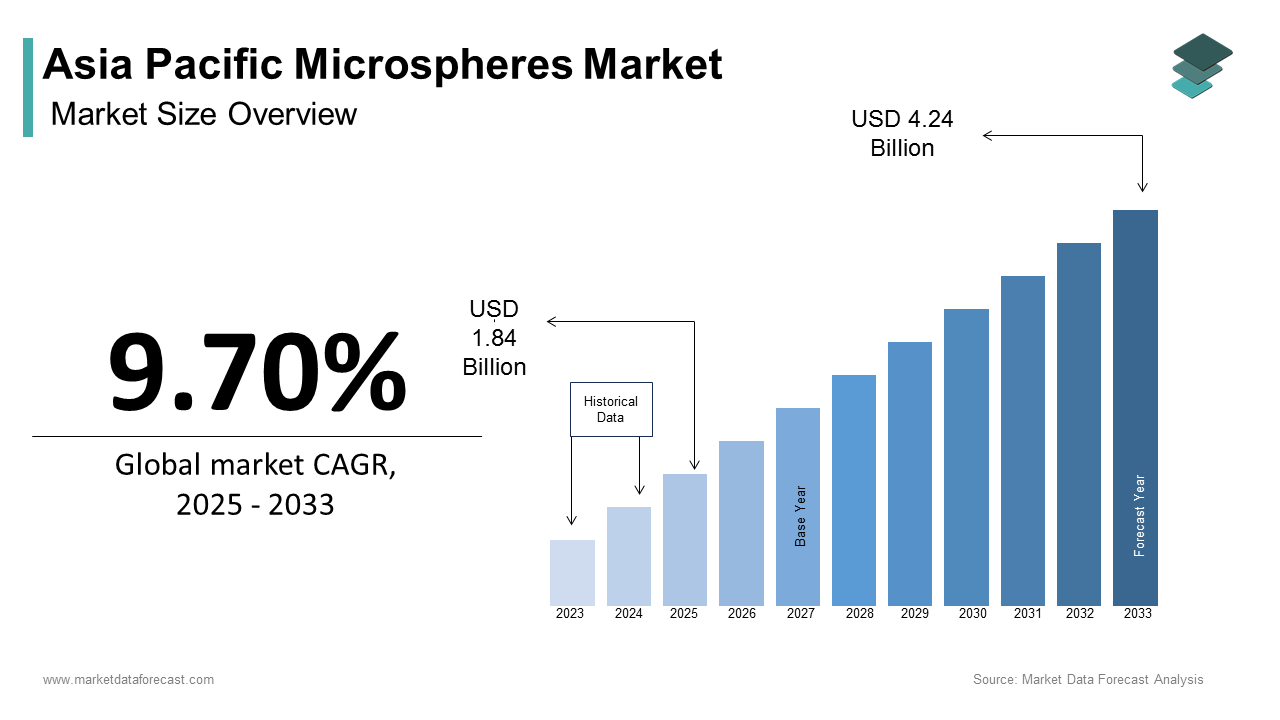
The Asia Pacific microsphere market refers to the industry involved in the production and application of microscopic spherical particles, typically ranging from 1 to 1000 micrometers in diameter. These particles are manufactured from a variety of materials such as glass, polymer, ceramic, and carbon, and are used across diverse sectors including healthcare, construction, aerospace, electronics, and personal care. In recent years, the demand for microspheres has surged due to their growing use in lightweight composites, particularly in automotive and aerospace industries aiming for fuel efficiency improvements. According to a report by the International Energy Agency, vehicle lightweighting initiatives have led to a 6% reduction in fuel consumption per 10% weight decrease with the importance of microsphere-based materials in achieving sustainability goals. Moreover, the pharmaceutical sector in the Asia Pacific is leveraging microspheres for targeted drug delivery systems. As per the Indian Drug Manufacturers’ Association, over 25% of new injectable drugs developed in India since 2020 incorporate microsphere-based delivery mechanisms to enhance bioavailability and therapeutic efficacy. These developments illustrate how technological advancements and cross-industry applications are shaping the trajectory of the Asia Pacific microsphere market.
MARKET DRIVERS
Growth in Aerospace and Automotive Lightweighting Demand
One of the primary drivers of the Asia Pacific microsphere market is the increasing demand for lightweight materials in the aerospace and automotive sectors. Governments across the region have introduced stringent emission norms aimed at reducing carbon footprints by prompting manufacturers to adopt composite materials that integrate hollow glass or polymer microspheres to reduce weight without compromising structural integrity.
According to the Ministry of Road Transport and Highways in India, new passenger vehicles must achieve a 30% improvement in fuel efficiency by 2025 compared to 2020 levels. In response, automakers like Toyota and Hyundai have significantly increased their usage of microsphere-infused thermoplastics in body panels and under-the-hood components. Similarly, China’s Civil Aviation Administration reported a 15% increase in the use of composite materials in commercial aircraft interiors between 2021 and 2023, which is driven by the adoption of syntactic foam cores containing glass microspheres.
Expansion of Medical Applications Using Microsphere-Based Therapies
Another significant driver of the Asia Pacific microsphere market is the expanding use of microsphere-based technologies in medical treatments drug delivery and minimally invasive procedures. Hollow and biodegradable microspheres are increasingly being utilized in controlled-release pharmaceuticals, embolization therapies, and dermal fillers by offering precision and enhanced patient outcomes. For instance, according to the Japanese Society of Interventional Radiology, over 40,000 patients in Japan underwent uterine artery embolization using polyvinyl alcohol (PVA) microspheres in 2023 alone, which demonstrates the growing clinical acceptance of microsphere-based interventions. Beyond therapeutics, the cosmetic industry is also adopting microspheres in topical formulations for skin rejuvenation and volume restoration. With rising healthcare expenditure and an aging population across countries like China and Australia, the demand for microsphere-integrated medical and aesthetic solutions is expected to continue growing rapidly.
MARKET RESTRAINTS
Regulatory Hurdles and Compliance Challenges
A major restraint affecting the Asia Pacific microsphere market is the complex and evolving regulatory landscape governing the use of engineered particulate materials in medical, environmental, and industrial applications. For example, the European Chemicals Agency's guidelines on microplastics have influenced policy discussions in several Asia Pacific nations, leading to potential restrictions on certain polymer-based microspheres used in consumer goods. According to the Australian Department of Agriculture, Water and the Environment, a draft policy released in 2023 proposed limits on non-biodegradable microspheres in personal care products, citing ecological concerns. Additionally, in China, the Ministry of Ecology and Environment has mandated stricter testing requirements for synthetic microspheres used in biomedical applications, extending approval timelines and increasing compliance costs for manufacturers. As per a report by SGS Group, these regulatory shifts have delayed product launches by up to 12 months in some cases, making it more challenging for companies to maintain rapid innovation cycles while adhering to safety standards.
High Production Costs and Limited Raw Material Availability
Another key challenge facing the Asia Pacific microsphere market is the relatively high production costs associated with specialty microsphere types, such as ceramic and biodegradable variants. The synthesis of high-performance microspheres requires precise control over particle size, porosity, and surface characteristics, which is often involving complex chemical processes and expensive raw materials.
According to the Chemical Weekly magazine, the average production cost of silica-based ceramic microspheres is approximately three times higher than that of conventional glass microspheres due to the need for high-temperature sintering and specialized feedstock. This cost disparity limits widespread adoption, particularly among small and medium-sized enterprises operating in price-sensitive markets like India and Indonesia.
MARKET OPPORTUNITIES
Rising Demand for Microspheres in 3D Printing and Additive Manufacturing
A promising opportunity emerging in the Asia Pacific microsphere market is the growing adoption of microsphere-based materials in 3D printing and additive manufacturing. As industries shift toward customized, lightweight, and high-performance components, microspheres are increasingly being incorporated into resin and powder-based printing materials to enhance mechanical properties and reduce overall weight. Polymer and glass microspheres are being used in stereolithography and selective laser sintering to produce parts with improved thermal resistance and dimensional stability. According to the Singapore Economic Development Board, the country saw a 20% increase in investments in additive manufacturing facilities in 2023, with many firms integrating microsphere-enhanced feedstocks to meet aerospace and medical device specifications.
Similarly, in Japan, the National Institute of Advanced Industrial Science and Technology (AIST) has been conducting extensive research on microsphere-filled composites for use in printed electronics and flexible sensors. These innovations are attracting attention from automotive and electronics manufacturers seeking next-generation fabrication techniques.
Increasing Use in Construction and Insulation Materials
The construction industry in Asia Pacific presents a substantial opportunity for the mimicrospherearket, particularly in the development of high-performance insulation and lightweight concrete materials. As urbanization accelerates and green building initiatives gain momentum, there is a growing emphasis on energy-efficient construction solutions that leverage microsphere technology to improve thermal performance and reduce material weight.
In China, the Ministry of Housing and Urban-Rural Development has mandated stricter energy efficiency standards for new buildings, prompting developers to incorporate aerogel-based insulation panels filled with silica microspheres. According to the China Building Materials Federation, over 40% of newly constructed commercial buildings in Tier-1 cities now use microsphere-infused insulation materials to comply with national energy codes.
MARKET CHALLENGES
Technological Complexity in Customized Formulations
One of the foremost challenges confronting the Asia Pacific microspheres market is the technological complexity involved in developing customized formulations tailored to specific industry needs. Unlike commodity materials, microspheres require precise engineering to achieve desired attributes such as particle size distribution, surface chemistry, and mechanical strength, which vary widely depending on the end-use application.
This complexity necessitates advanced R&D capabilities and continuous process optimization, which can be a barrier for smaller players lacking sufficient technical expertise. According to the Korea Institute of Science and Technology, formulating biodegradable microspheres with controlled degradation rates for pharmaceutical applications requires multi-stage encapsulation techniques and rigorous analytical validation.
Moreover, scaling up laboratory-developed microsphere compositions to commercial production remains a persistent challenge. As noted by the Indian Institute of Chemical Technology, batch-to-batch consistency issues in polymer microsphere synthesis have resulted in rejection rates exceeding 10% in some cases.
Intense Regional Competition and Pricing Pressures
The Asia Pacific microsphere market faces intense competition from both global leaders and regional manufacturers, resulting in pricing pressures that constrain profitability and limit investment in innovation. Countries such as China and India host a large number of domestic producers offering cost-effective alternatives to multinational suppliers, leveraging lower labor and production costs.
According to the China Plastics Processing Industry Association, the number of local microsphere manufacturers increased by over 25% between 2020 and 2023, intensifying market saturation and triggering aggressive pricing strategies. In India, domestic firms have captured nearly 60% of the general-purpose microspheres segment by undercutting international brands by up to 20%, as reported by ChemAnalyst India.
REPORT COVERAGE
| REPORT METRIC | DETAILS |
| Market Size Available | 2024 to 2033 |
| Base Year | 2024 |
| Forecast Period | 2025 to 2033 |
| CAGR | 9.70% |
| Segments Covered | By Type, Raw material, Application, and Region |
| Various Analyses Covered | Global, Regional & Country Level Analysis; Segment-Level Analysis; DROC, PESTLE Analysis; Porter’s Five Forces Analysis; Competitive Landscape; Analyst Overview of Investment Opportunities |
| Regions Covered | India, China, Japan, South Korea, Australia, New Zealand, Thailand, Malaysia, Vietnam, Philippines, Indonesia, Singapore, Rest of Asia-Pacific |
| Market Leaders Profiled | 3M, Akzo Nobel N.V., Matsumoto Yushi-Seiyaku Co. Ltd., Trelleborg AB, Momentive Performance Materials Inc., Chase Corporation, Potters Industries LLC, Sigmund Lindner GmbH, Luminex Corporation, Mo-Sci Corporation, Sekisui Kasei Co. Ltd., Nippon Shokubai Co. Ltd., Kuraray Co. Ltd., Dynea AS, HEYO Enterprises Co. Ltd., Cospheric LLC, Microbeads AS, Trinseo, Imperial Microspheres, Microchem, Lab261, Kureha Corporation, Mitsubishi Corporation, Marubeni Corporation, Sirtex Medical Limited, Polysciences Inc., Dennert Poraver GmbH, Omya International AG, Nouryon. |
SEGMENTAL ANALYSIS
By Type Insights
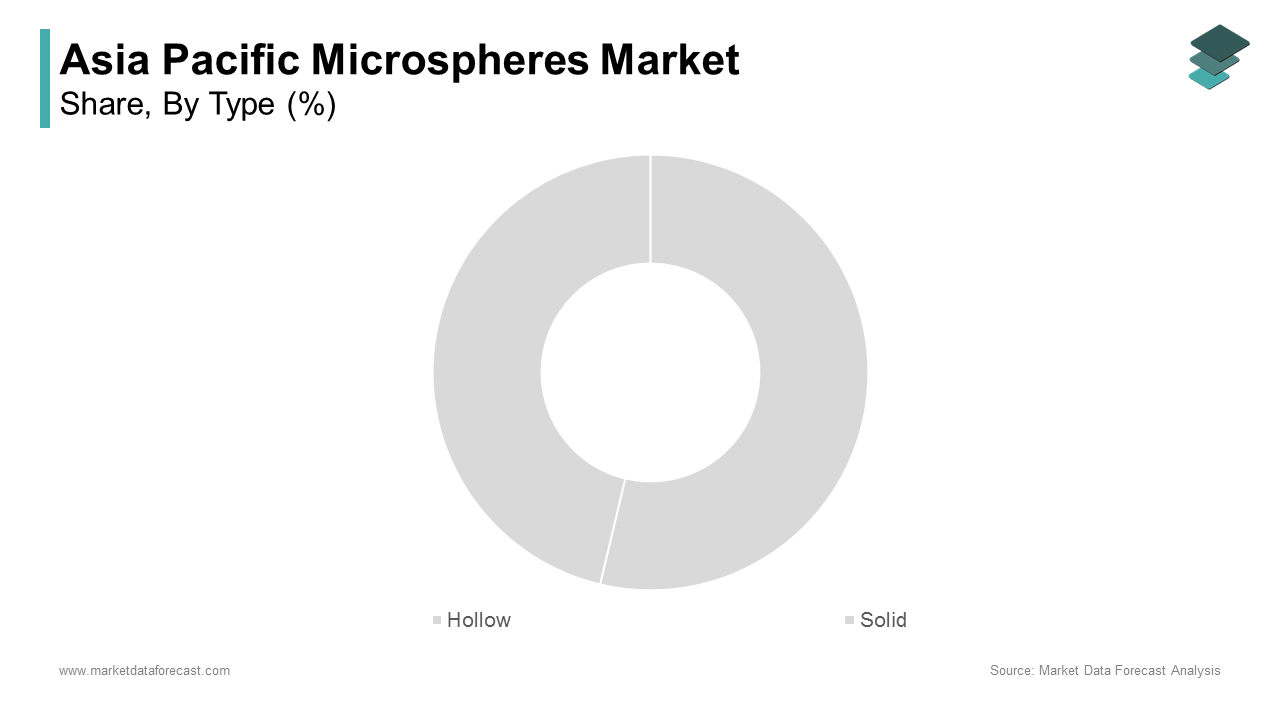
The hollow microspheres segment accounted in holding 57.6% of the Asia Pacific microspheres market share in 2024 due to their widespread use across industries that prioritize weight reduction and enhanced material performance, particularly in aerospace, automotive, and construction sectors. The growing demand for lightweight composites in transportation applications. According to the Japan Automobile Manufacturers Association, the average weight of new vehicles produced in Japan has decreased by 12% since 2018 due to the increased incorporation of hollow microsphere-infused materials in structural components and insulation panels.
Another key factor is the adoption of hollow microspheres in syntactic foams used for deep-sea buoyancy modules and offshore oil exploration equipment. As per the China Offshore Oil Engineering Company, over 80% of newly deployed subsea pipelines in the South China Sea now incorporate microsphere-based syntactic foam for thermal insulation and pressure resistance. These combined industrial applications reinforce hollow microspheres as the most extensively utilized type in the region.
The solid microspheres segment is swiftly emerging with a projected CAGR of 9.4% from 2025 to 2033. Unlike hollow variants, solid microspheres are valued for their mechanical strength, abrasion resistance, and controlled surface properties, which is making them ideal for precision-driven applications such as medical diagnostics, electronics, and high-performance coatings.
A primary growth catalyst is the expanding use of solid polymer microspheres in drug delivery systems and diagnostic assays. According to the Indian Drug Manufacturers’ Association, nearly 30% of biopharmaceutical R&D projects initiated in India in 2023 involved solid microsphere-based formulations for targeted therapies and vaccine delivery. Additionally, the electronics industry in South Korea and Taiwan is increasingly utilizing silica-based solid microspheres in semiconductor packaging and printed circuit boards to improve thermal conductivity and dimensional stability.
By Raw Material Insights
The glass microspheres segment held 38.6% of the Asia Pacific microspheres market share in 2024 with the widespread adoption stems from their favorable combination of low density, high compressive strength, and excellent thermal insulation properties making them indispensable in construction, aerospace, and automotive applications. Additionally, the construction sector in India and Southeast Asia has seen a surge in demand for lightweight concrete using glass microspheres to meet green building certification standards. As per the Indian Green Building Council, buildings incorporating microsphere-enhanced insulation materials achieved up to 20% higher energy efficiency ratings compared to conventional counterparts.
The polymer microspheres segment is lucratively to grow with an anticipated CAGR of 10.2% throughout the forecast period with their increasing application in healthcare, cosmetics, and specialty coatings where tunable particle size, biocompatibility, and controlled release characteristics are essential. A significant growth driver is the pharmaceutical industry’s reliance on polymer microspheres for encapsulation and sustained drug delivery. According to the Japanese Pharmaceutical Association, over 25 novel injectable drugs launched in Japan between 2021 and 2023 incorporated polymer-based microsphere technology to enhance bioavailability and reduce dosing frequency.
By Application Insights
The construction composites segment was top performer in the Asia Pacific microspheres market with 35.3% of share in 2024 with the rising emphasis on energy-efficient building materials and lightweight infrastructure solutions in rapidly urbanizing economies like China and India.
One of the key growth factors is the integration of microsphere-based insulation panels and lightweight concrete blocks in government-backed smart city initiatives. According to the Ministry of Housing and Urban-Rural Development in China, over 45% of new commercial buildings constructed in Tier-1 cities in 2023 included microsphere-enhanced insulation materials to comply with national energy efficiency codes. Additionally, the Indian Smart Cities Mission has spurred demand for aerogel-insulated panels filled with silica microspheres, which offer superior thermal resistance and fireproofing capabilities. As per the Indian Concrete Institute, these materials have contributed to a 12% reduction in structural load in recent infrastructure projects.
The medical technology segment is expected to grow with a CAGR of 11.3% in the coming years. This rapid expansion is fueled by the increasing adoption of microsphere-based solutions in diagnostics, targeted drug delivery, and minimally invasive surgical procedures. The development of embolic microspheres for treating vascular diseases and tumors is enhancing the growth of the market. According to the Korean Society of Interventional Radiology, over 50,000 patients in South Korea underwent microsphere-assisted embolization treatments between 2021 and 2023, demonstrating the clinical acceptance of these technologies. Moreover, the rise in personalized medicine and advanced wound healing techniques has led to increased use of biodegradable microspheres in regenerative therapies. As per the Australian Institute of Health and Welfare, hospital admissions related to chronic wounds increased by 14% between 2020 and 2023, prompting greater investment in microsphere-integrated wound dressings.
REGIONAL ANALYSIS
China was the largest in the Asia Pacific microspheres market accounting for 34.4% of the share in 2024. One of the main growth drivers is the rapid expansion of the electric vehicle industry. According to the China Association of Automobile Manufacturers, EV production exceeded 7 million units in 2023, with manufacturers incorporating microsphere-based composites to reduce battery housing weight and improve thermal management. Additionally, the Chinese government’s focus on sustainable construction practices has spurred demand for lightweight concrete and insulation materials containing glass microspheres.
India was next by holding 15.4% of the Asia Pacific microspheres market share in 2024. The country’s rapid industrialization, coupled with government initiatives promoting smart infrastructure and advanced healthcare, has significantly boosted the adoption of microsphere-based materials.
A major growth factor is the expansion of the pharmaceutical industry, where microspheres are increasingly used in controlled-release drug formulations. According to the Indian Drug Manufacturers’ Association, over 20 new injectable medicines incorporating microsphere-based delivery systems were approved between 2021 and 2023. Furthermore, the Indian Smart Cities Mission has driven demand for lightweight construction materials, including aerogel insulation and microsphere-reinforced concrete blocks. As per the National Institution for Transforming India (NITI Aayog), more than 200 smart city projects implemented in 2023 integrated microsphere-based composites to enhance energy efficiency and durability.
Japan microspheres market growth is likely to have significant growth opportunities throughput the forecast period. One of the key strengths of Japan’s market is its advanced biomedical research sector. According to the Japan Agency for Medical Research and Development, over 30 new microsphere-based drug delivery patents were filed in 2023 by reflecting the country’s dominance in pharmaceutical innovation.
Additionally, Japanese automotive manufacturers are integrating microsphere-infused materials into next-generation vehicle designs to meet stringent fuel efficiency targets. As per the Japan Automobile Manufacturers Association, lightweight thermoplastics containing glass microspheres reduced component weight by up to 15% in 2023 models. With continuous investment in R&D and material science, Japan maintains a strong competitive edge in the microspheres domain.
South Koreanmicrospheres market growth is driven by robust demand from the electronics, healthcare, and beauty industries. The country’s compact yet highly developed industrial ecosystem enables the swift adoption of cutting-edge materials, including microsphere-based solutions tailored for niche applications. A major growth driver is the electronics sector, where silica microspheres are used in semiconductor packaging and printed circuit board manufacturing. According to the Korea Electronics Industry Association, domestic semiconductor companies increased their use of microsphere-enhanced thermal interface materials by 14% in 2023 to improve heat dissipation and reliability.
Australia will capture around 6% of the Asia Pacific microspheres market in 2023, distinguished by its strong regulatory framework and commitment to sustainable material development. Though not the largest in terms of volume, Australia plays a pivotal role in setting benchmarks for environmental compliance and product safety standards.
LEADING PLAYERS IN THE ASIA PACIFIC MICROSPHERES MARKET
One of the leading players in the Asia Pacific microsphere market is 3M, a global innovator known for its extensive portfolio of engineered microsphere solutions. The company offers a wide range of glass and polymer-based microspheres used across industries such as aerospace, electronics, healthcare, and construction. In the Asia Pacific region, 3M has been instrumental in advancing high-performance materials that support lightweight and thermal management applications.
Another key player is Sigmund Lindner GmbH, a German-based manufacturer with a strong presence in Asia due to its specialized production of hollow glass and ceramic microspheres. The company caters to niche markets requiring precision-engineered particles, particularly in insulation, composites, and industrial fillers. Its strategic partnerships with local distributors have enabled it to serve growing demand in China and India effectively.
Mo-Sci Corporation is also a prominent participant, recognized for its expertise in custom-designed microspheres for medical, optical, and electronic applications. Its expansion into contract manufacturing services has strengthened its foothold in the Asia Pacific market.
TOP STRATEGIES USED BY KEY MARKET PARTICIPANTS
A primary strategy adopted by leading companies in the Asia Pacific microsphere market is product innovation and customization by focusing on developing tailored microsphere formulations that meet the specific performance requirements of different industries such as healthcare, automotive, and electronics.
Another significant approach is expanding regional presence through localized production and distribution networks by allowing firms to better serve diverse customer bases while reducing lead times and logistics costs in fast-growing economies like China and India.
Lastly, companies are increasingly engaging in strategic collaborations and joint ventures with research institutions and industry partners to accelerate R&D efforts, improve material sustainability, and enhance application-specific functionalities of microspheres across high-growth sectors.
KEY MARKET PLAYERS AND COMPETITION OVERVIEW
Major Players in the Asia Pacific microspheres market include 3M, Akzo Nobel N.V., Matsumoto Yushi-Seiyaku Co. Ltd., Trelleborg AB, Momentive Performance Materials Inc., Chase Corporation, Potters Industries LLC, Sigmund Lindner GmbH, Luminex Corporation, Mo-Sci Corporation, Sekisui Kasei Co. Ltd., Nippon Shokubai Co. Ltd., Kuraray Co. Ltd., Dynea AS, HEYO Enterprises Co. Ltd., Cospheric LLC, Microbeads AS, Trinseo, Imperial Microspheres, Microchem, Lab261, Kureha Corporation, Mitsubishi Corporation, Marubeni Corporation, Sirtex Medical Limited, Polysciences Inc., Dennert Poraver GmbH, Omya International AG, Nouryon.
The competition in the Asia Pacific microsphere market is shaped by a dynamic mix of global leaders and emerging regional players striving to capture a larger share through differentiation and technological advancement. As industries increasingly rely on microsphere-based materials for performance enhancement and functional optimization, companies are under pressure to innovate continuously while maintaining cost-effectiveness. The market sees intense rivalry not only in pricing but also in product development, with firms competing to introduce high-performance, sustainable, and application-specific microsphere solutions. Regulatory compliance plays a crucial role in shaping competitive strategies, especially concerning environmental impact and biocompatibility standards. Additionally, the growing presence of domestic manufacturers offering cost-effective alternatives further intensifies the market dynamics, compelling multinational corporations to adapt through localization, strategic alliances, and investment in advanced manufacturing capabilities. This evolving landscape fosters both opportunity and challenge, where agility, innovation, and regulatory foresight determine long-term success.
RECENT HAPPENINGS IN THE MARKET
- In January 2024, 3M launched a new line of ultra-lightweight glass microspheres designed specifically for marine and aerospace composites, targeting major shipbuilding and aircraft manufacturers in South Korea and Japan. This initiative aimed at improving buoyancy and structural efficiency while complying with international safety standards.
- In May 2023, Sigmund Lindner expanded its existing facility in Shanghai to include a dedicated technical service center for Asia Pacific clients, reinforcing its ability to provide customized microsphere solutions for industrial insulation and composite reinforcement.
- In September 2024, Mo-Sci Corporation entered into a collaborative agreement with a leading Indian pharmaceutical research institute to co-develop biodegradable microspheres for controlled-release injectable drugs, aligning with the country’s growing focus on precision medicine and advanced drug delivery systems.
- In February 2023, Akrochem established a regional distribution hub in Singapore to streamline supply chain operations and ensure faster delivery of specialty microspheres to customers across Southeast Asia, enhancing responsiveness and logistical efficiency.
- In July 2024, Matsumoto Yushi-Seiyaku introduced a new line of eco-friendly polymer microspheres for use in Japanese cosmetic products, catering to premium beauty brands seeking sustainable ingredients while maintaining high-performance aesthetics.
MARKET SEGMENTATION
This research report on the Asia Pacific Microspheres Market has been segmented and sub-segmented based on type, raw material, application, and region.
By Type
- Hollow
- Solid
By Raw Material
- Glass
- Ceramic
- Fly Ash
- Polymer
- Metallic
By Application
- Construction Composites
- Medical Technology
- Cosmetics & Personal Care
- Automotive
- Oil & Gas
By Region
- India
- China
- Japan
- South Korea
- Australia
- New Zealand
- Thailand
- Malaysia
- Vietnam
- Philippines
- Indonesia
- Singapore
- Rest of Asia-Pacific