- Product Description Description
- Table of Contents TOC
- List of Table & Figure LOT
- Get Free Sample PDF Sample PDF
Market Size, 2025
$16.17 BnMarket Estimate, 2026
$17.05 BnMarket Forecast, 2034
$26.05 BnCAGR, 2026–2034
5.44%Asia Pacific Oil Storage Tank Service Market Summary
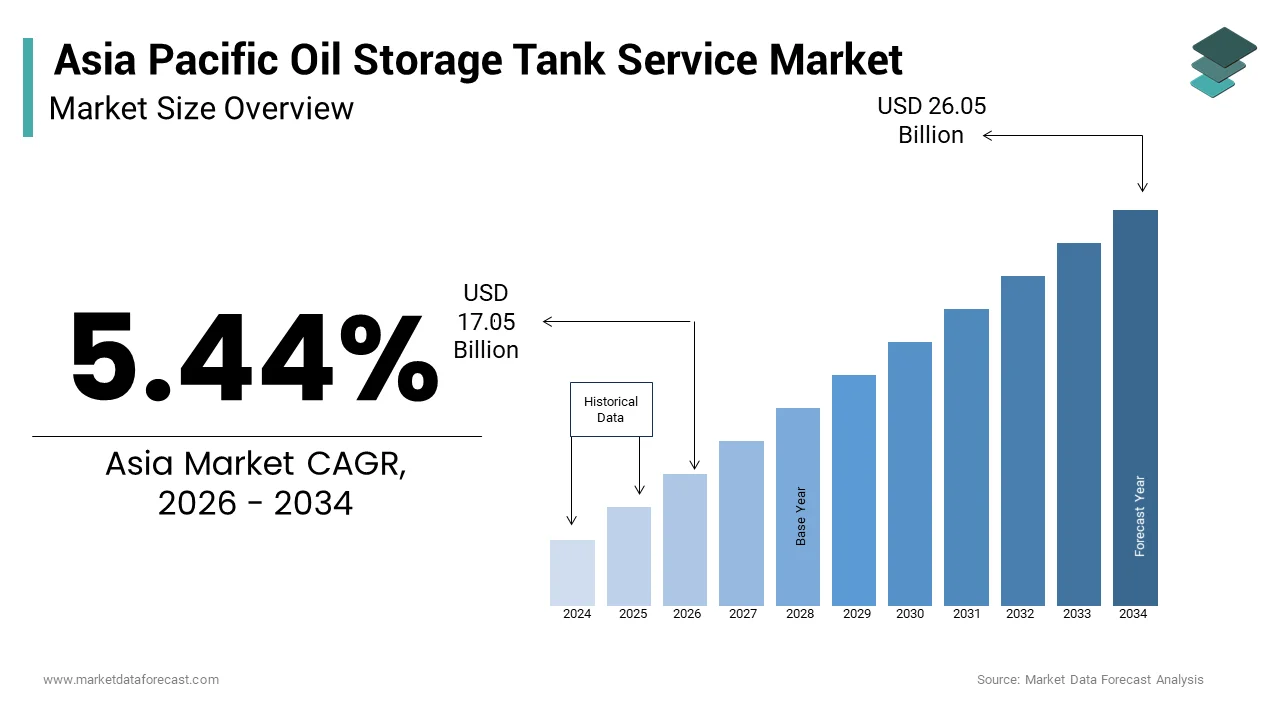
The Asia Pacific oil tank storage service market was valued at USD 16.17 billion in 2025 and is anticipated to reach USD 17.05 billion in 2026 to reach USD 26.05 billion by 2034, growing at a CAGR of 5.44% during the forecast period from 2026 to 2034.
Key Market Trends & Insights
- China was the top performer in the Asia Pacific Market in 2025
- The Indian oil storage tank service market held 21.4% of the share in 2025.
- Japan is expected to showcase significant growth in the Asia Pacific market in 2025.
- Based on Service, the inspection and repair segment was the largest market in 2025.
- Based on Storage Tank, the above-ground storage tanks segment led the market in 2025.
- Based on Application, the oil and gas segment accounted in holding 58.3 of % market in 2025
Market Size & Forecast
2025 Market Size: USD 16.17 Billion
2034 projected Market Size: USD 26.05 Billion
CAGR (2026 to 2034): 5.44%
China: Largest Market in 2025
India: Strongest Growth Region
Asia Pacific Oil Storage Tank Service Market Size
The Asia Pacific oil storage tank service market size was valued at USD 16.17 billion in 2025 and is anticipated to reach USD 17.05 billion in 2026 to reach USD 26.05 billion by 2034, growing at a CAGR of 5.44% during the forecast period from 2026 to 2034.
The oil storage tank services are for refineries, petrochemical plants, terminals, and strategic petroleum reserves, ensuring structural integrity, environmental safety, and regulatory adherence. In India, the government has expanded its strategic crude reserves to 5.33 million metric tons across three locationss, such as Visakhapatnam, Mangalore, and Padur, requiring continuous inspection and maintenance, as reported by the Ministry of Petroleum and Natural Gas. Japan maintains emergency oil stocks equivalent to 154 days of net imports, one of the highest reserves globally, according to the Agency for Natural Resources and Energy, mandating rigorous tank integrity assessments. With aging infrastructure in countries like Australia and South Korea, where over 40% of storage tanks exceed 25 years of service life, as documented by the Australian Institute of Petroleum, the demand for non-destructive testing (NDT), cathodic protection, and internal lining repairs has intensified. Additionally, stringent environmental regulations across the region are driving the adoption of vapor recovery systems and leak detection services, which is reinforcing the strategic importance of comprehensive tank maintenance.
MARKET DRIVERS
Expansion of Strategic Petroleum Reserves and Energy Security Initiatives
Governments are expanding their strategic oil storage capacity to enhance energy security amid geopolitical volatility and supply disruptions is escalating the growth of the Asia Pacific. In China, the National Development and Reform Commission has directed the expansion of emergency crude reserves to cover 90 days of consumption by 2027, up from 72 days in 2023, as reported by the China National Petroleum Corporation. This requires continuous third-party inspections, internal cleaning, and corrosion monitoring for over 1,200 new and existing storage tanks. India’s Strategic Petroleum Reserve expansion includes the addition of two new sites in Chandrapur and Padur, increasing total capacity by 6.5 million barrels, according to the Ministry of Petroleum and Natural Gas, all of which require biannual integrity assessments. As per the International Energy Agency, regional stockpiling efforts have added over 80 million barrels of new storage capacity since 2020, each requiring recurring service cycles.
Aging Infrastructure and Mandatory Regulatory Inspections
A significant portion of oil storage infrastructure has surpassed its intended service life, which is necessitating frequent inspections, repairs, and upgrades to prevent leaks, corrosion, and catastrophic failures is also fueling the growth of the Asia Pacific. In Australia, the Australian Institute of Petroleum reports that 43% of terminal storage tanks are over 25 years old, with many exhibiting signs of bottom plate corrosion and weld degradation. This has led to a surge in ultrasonic testing, robotic internal inspections, and cathodic protection renewals. In Japan, where many storage facilities were built in the 1970s and 1980s, the Ministry of Economy, Trade, and Industry mandates API 653-compliant inspections every five years, with full internal assessments required every 10–15 years. As per the Japan Petroleum Institute, over 600 large-diameter tanks underwent major refurbishment between 2020 and 2023. Similarly, in India, the Petroleum and Explosives Safety Organization (PESO) enforces biannual inspections for all operational tanks, with non-compliance resulting in facility shutdowns. The Indian Oil Corporation reported that 38% of its tank farms required structural repairs in 2022 due to corrosion and foundation settlement.
MARKET RESTRAINTS
High Operational Costs and Budget Constraints in State-Owned Enterprises
The cost-intensive nature of oil storage tank services, particularly internal inspections, robotic cleaning, and structural repairs, is limiting the growth of the Asia Pacific oil storage tank service market. A single internal tank inspection using robotic crawlers and ultrasonic testing can cost between $50,000 and $120,000, depending on tank size and location, according to the Society of Petroleum Engineers. In Indonesia, Pertamina, the state-owned energy company, delayed maintenance on 40% of its storage tanks in 2022 due to budget shortfalls, as reported by the Ministry of Energy and Mineral Resources, increasing the risk of unplanned outages. In the Philippines, the Department of Energy noted that only 55% of scheduled tank inspections were completed in 2023 due to funding limitations. Smaller terminals in Vietnam and Bangladesh often rely on manual cleaning and visual checks, which are less effective but significantly cheaper. Additionally, the need for tank shutdowns during major services disrupts supply chains and revenue generation, further discouraging timely maintenance.
Shortage of Skilled Technicians and Certified Inspection Personnel
The shortage of qualified personnel capable of performing advanced oil storage tank inspections and repairs in non-destructive testing (NDT), robotic operations, and API 653 certification is restricting the growth of the industry. In India, the National Skill Development Corporation estimates that fewer than 8,000 technicians are certified in API 653 tank inspection standards, despite over 15,000 tanks requiring periodic assessment. This gap forces operators to rely on foreign contractors or delay maintenance cycles. In Indonesia, the Ministry of Manpower reports that only 12% of NDT technicians in the oil and gas sector hold international certifications, which is limiting the reliability of inspection data.
MARKET OPPORTUNITIES
Adoption of Robotic and Remote Inspection Technologies
The integration of robotic crawlers, drones, and remote visual inspection (RVI) systems presents a transformative opportunity for the Asia Pacific oil storage tank service market by enhancing safety, accuracy, and operational efficiency. Traditional internal inspections require tank entry, posing significant health and safety risks due to confined spaces and residual hydrocarbons. In response, companies like Shell and ExxonMobil have deployed robotic inspection systems in their Singapore and Australia terminals, reducing human exposure and inspection time by up to 50%, as reported by the International Association of Oil & Gas Producers. In Japan, JXTG Nippon Oil & Energy uses magnetic crawler robots equipped with ultrasonic sensors to assess tank floor corrosion without entry, improving data resolution and repeatability. As per the Society of Petroleum Engineers, robotic inspections reduce downtime by 30–40% compared to manual methods. China’s Sinopec has implemented drone-based external tank surveys across 12 refineries, detecting structural deformations and coating failures with 95% accuracy, according to the China Petroleum & Chemical Industry Federation.
Growth in Floating Storage and Offshore Terminal Maintenance
The expansion of floating storage units (FSUs) and offshore oil terminals in the Asia Pacific is creating a specialized niche for subsea and marine-based tank services. Countries like Malaysia, Indonesia, and the Philippines are increasingly utilizing floating storage and regasification units (FSRUs) and single-point mooring (SPM) systems to support remote refining and import operations. Indonesia’s Pertamina operates over 15 FSUs for crude and LPG storage, each requiring underwater hull inspections, cathodic protection checks, and pipeline integrity assessments, as documented by the Ministry of Energy and Mineral Resources. In the South China Sea, offshore terminals serving deepwater oil fields necessitate diver-assisted and remotely operated vehicle (ROV)-based inspections, with maintenance cycles dictated by harsh marine conditions. As per the International Maritime Organization, offshore storage units face corrosion rates 2.5 times higher than onshore tanks due to saltwater exposure. Singapore’s Jurong Island hosts multiple offshore support bases where service providers conduct dry-dock inspections and coating repairs for floating units. In India, the government’s Sagarmala program includes plans for offshore crude terminals, which will require continuous underwater NDT and mooring system checks. As per the Offshore Technology Conference, the Asia Pacific accounts for over 40% of global floating storage capacity, which is creating sustained demand for marine-specific inspection, cleaning, and repair services.
MARKET CHALLENGES
Environmental Regulations and Zero-Liquid Discharge Compliance
The oil storage tank cleaning and maintenance operations are increasingly constrained by stringent environmental regulations for those mandating zero-liquid discharge (ZLD) and vapor recovery. In China, the Ministry of Ecology and Environment enforces strict limits on hydrocarbon emissions during tank cleaning, requiring closed-loop vacuum systems and on-site water treatment, which can increase service costs by 35–50%, as reported by the China Environmental Protection Industry Association. As per the International Oil Tanker Owners Pollution Federation, improper tank cleaning contributes to 18% of hydrocarbon spills in Asian ports. In Australia, the Environment Protection Authority of Victoria imposes fines of up to AUD 1 million for non-compliance with waste handling protocols. Service providers must now invest in advanced filtration, bioremediation, and emission control technologies, increasing capital and operational burdens. Additionally, the disposal of sludge and contaminated water remains a logistical challenge in countries lacking dedicated hazardous waste treatment facilities.
Geopolitical Risks and Supply Chain Disruptions
Geopolitical tensions in key maritime zones such as the South China Sea and the Strait of Malacca are creating operational uncertainties for oil storage and service activities in the Asia Pacific. These chokepoints handle over 30% of global oil shipments, according to the U.S. Energy Information Administration, making storage terminals in Malaysia, Indonesia, and the Philippines vulnerable to disruptions. In 2023, heightened naval activity in the South China Sea delayed maintenance schedules for offshore storage units operated by CNOOC and Petronas, as reported by the Asia Maritime Transparency Initiative. Political instability in Myanmar has affected pipeline-linked storage facilities in the Ayeyarwady Delta, limiting access for inspection teams. As per the International Energy Agency, regional oil infrastructure faces a 22% higher risk of supply interruption compared to other global regions. In 2022, sanctions impacted the delivery of robotic inspection systems to certain terminals, forcing operators to use less reliable alternatives. As per the World Bank, geopolitical risk premiums have increased insurance costs for tank services by 15–25% in high-tension zones.
REPORT COVERAGE
| REPORT METRIC | DETAILS |
| Market Size Available | 2025 to 2034 |
| Base Year | 2025 |
| Forecast Period | 2026 to 2034 |
| CAGR | 5.68% |
| Segments Covered | By Service, Storage Tank, Application, Contract, Type, Country |
| Various Analyses Covered | Global, Regional and Country Level Analysis; Segment-Level Analysis; DROC; PESTLE Analysis; Porter’s Five Forces Analysis; Competitive Landscape; Analyst Overview of Investment Opportunities |
| Regions Covered | India, China, Japan, South Korea, Australia, New Zealand, Thailand, Malaysia, Vietnam, Philippines, Indonesia, Singapore, and the Rest of APAC |
| Market Leaders Profiled | Worley, Jacobs Engineering, Wood, KBR, Bechtel, Saipem, McDermott International, Fluor, Amec Foster Wheeler, SNCLavalin, Aker Solutions, Jacobs Engineering Group, TechnipFMC. |
SEGMENTAL ANALYSIS
By Service Insights
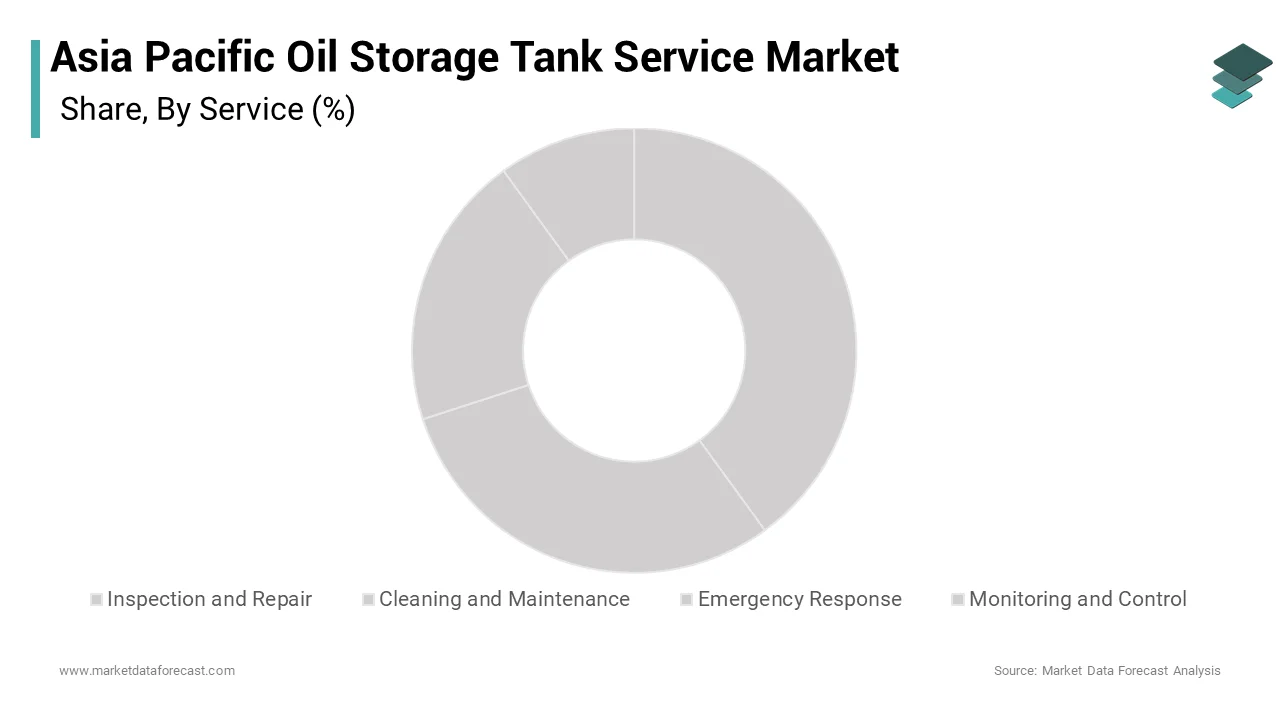
The inspection and repair segment was the largest and held 42.3% of the Asia Pacific oil storage tank service market in 2025, owing to the stringent national and international regulations requiring periodic structural assessments to prevent leaks, spills, and catastrophic failures. Similarly, in Japan, the Ministry of Economy, Trade, and Industry enforces API 653-compliant inspections every 10 years, with intermediate ultrasonic thickness testing required every five years. As per the Japan Petroleum Institute, over 600 large-diameter tanks underwent major structural repairs between 2020 and 2023 due to bottom plate corrosion. The Australian Institute of Petroleum notes that 43% of storage tanks are over 25 years old, significantly increasing the likelihood of weld degradation and foundation settlement. As per the American Petroleum Institute, tanks beyond 20 years of age require 3.5 times more repair interventions than newer units.
The monitoring and control segment is projected to expand with a CAGR of 11.6% from 2025 to 2033. The integration of Internet of Things (IoT) sensors, wireless transmitters, and cloud-based platforms is revolutionizing tank farm operations by enabling continuous remote monitoring of level, temperature, pressure, and vapor emissions. As per the Singapore Petroleum Authority, over 90% of Jurong Island’s 600+ storage tanks are now equipped with automated level gauging and leak detection systems. In Australia, Viva Energy has deployed IoT-enabled tank monitoring across its Geelong refinery, reducing manual inspection frequency by 60% and improving response time to anomalies, as reported by the Australian Institute of Petroleum. China’s Sinopec has installed over 15,000 smart sensors in its storage network by enabling predictive maintenance and early fault detection, according to the China Petroleum & Chemical Industry Federation.
By Storage Tank Insights
The above-ground storage tanks (ASTs) segment was the largest and held a dominant share of the Asia Pacific oil storage tank service market in 2024. ASTs are the standard for large-scale liquid hydrocarbon storage due to their scalability, ease of inspection, and compatibility with high-capacity transfer systems. India’s strategic petroleum reserves at Visakhapatnam, Mangalore, and Padur consist entirely of ASTs with a combined capacity of 5.33 million metric tons, according to the Ministry of Petroleum and Natural Gas. Singapore, a global oil trading hub, stores over 80 million barrels of crude and refined products in ASTs on Jurong Island, managed by over 100 terminal operators, as documented by the Maritime and Port Authority of Singapore. In Australia, the majority of fuel supply for major cities is stored in ASTs at facilities like the Kurnell and Geelong terminals.
The floating roof tanks segment is deemed to register a CAGR of 10.2% from 2025 to 2033. Floating roof tanks are increasingly favored for storing volatile liquids like crude oil and gasoline due to their ability to minimize vapor losses by 85–95% compared to fixed roof tanks, as reported by the U.S. Environmental Protection Agency. Similarly, in India, the Central Pollution Control Board enforces strict VOC (volatile organic compound) emission limits, prompting Indian Oil Corporation and Reliance Industries to convert over 120 fixed roof tanks to floating roof designs between 2020 and 2023. In Singapore, the National Environment Agency requires all gasoline storage tanks to have internal floating roofs with vapor recovery systems, achieving 95% emission capture. As per the International Oil Tanker Owners Pollution Federation, which is floating roof tanks reduce hydrocarbon emissions by 90% compared to fixed roof designs.
By Application Insights
The oil and gas segment accounted in holding 58.3% of the Asia Pacific oil storage tank service market share in 2024. The oil and gas sector operates the vast majority of large-diameter storage tanks used for crude oil, diesel, gasoline, and LPG, which creates substantial demand for inspection, cleaning, and monitoring services. Singapore’s Jurong Island hosts over 600 storage tanks serving global trading firms, with a total capacity exceeding 80 million barrels, as documented by the Maritime and Port Authority. In Australia, the government’s Fuel Security Program includes upgrades to 14 strategic fuel depots, all requiring recurring tank services. As per the International Energy Agency, the Asia Pacific accounts for over 35% of global refined product demand, necessitating extensive storage networks.
The chemicals and petrochemicals segment is lucratively to grow lucratively with an anticipated CAGR of 9.8% from 2025 to 2033. The rapid development of integrated petrochemical complexes in China, India, and Southeast Asia is increasing demand for specialized storage and service solutions. In China, the Zhejiang Petrochemical Complex has added over 100 new tanks for aromatics and olefins, requiring corrosion-resistant linings and inerting systems, as reported by the China Petroleum & Chemical Industry Federation. India’s PMAY Petrochemicals Project in Gujarat includes a $4 billion investment in storage infrastructure for paraxylene and ethylene, all requiring API-compliant inspection and cleaning. In Malaysia, the Pengerang Integrated Complex operates over 80 tanks for specialty chemicals, each requiring customized maintenance protocols.
COUNTRY-LEVEL ANALYSIS
China Oil Storage Tank Services Market Analysis
China was the top performer of the Asia Pacific oil storage tank service market by accounting for 34.2% of share in 2024. The National Oil and Gas Pipeline Network Group manages over 800 million barrels of storage capacity, including strategic reserves and commercial terminals, as reported by the China National Petroleum Corporation. The government’s directive to achieve 90 days of oil reserve coverage by 2027 has triggered a wave of tank inspections, structural upgrades, and robotic cleaning deployments. In 2023, Sinopec and PetroChina commissioned over 150 new tanks, all requiring API 653-compliant assessments. The China Petroleum & Chemical Industry Federation notes that 38% of existing tanks exhibit significant corrosion, necessitating frequent repair. Additionally, environmental regulations mandate vapor recovery and zero-liquid discharge during cleaning, which is driving adoption of advanced service technologies.
Indian Oil Storage Tank Services Market Analysis
The Indian oil storage tank service market held 21.4% of the share in 2024. The Indian Strategic Petroleum Reserves Limited (ISPRL) operates 5.33 million metric tons of crude storage in Visakhapatnam, Mangalore, and Padur, all requiring biannual inspections and robotic cleaning, as documented by the Ministry of Petroleum and Natural Gas. Indian Oil Corporation and Bharat Petroleum manage over 1,200 tanks nationwide, with 38% requiring structural repairs in 2022 alone. The Petroleum and Explosives Safety Organization (PESO) enforces strict API standards, creating recurring service demand. The government’s $1.2 billion fuel security program includes the modernization of 14 fuel depots and, enhancement of tank integrity.
Japan Oil Storage Tank Services Market Analysis
Japan oil storage tank service market is anticipated to grow eventually with significant growth opportunities in the coming years. The country’s high reliance on imported oil and extensive emergency reserves drives continuous tank maintenance. The Ministry of Economy, Trade, and Industry mandates API 653 compliance every 10 years, with intermediate assessments every five years. The Japan Petroleum Institute reports that over 600 tanks underwent major repairs between 2020 and 2023. JXTG Nippon Oil & Energy and ENEOS use robotic crawlers and drones for internal inspections, reducing human risk.
Australia Oil Storage Tank Services Market Analysis
Australian oil storage tank service market is likely to grow steadily throughout the forecast period. The country’s strategic fuel security initiatives and aging infrastructure are key demand drivers. The Australian Institute of Petroleum reports that 43% of storage tanks exceed 25 years of service life, increasing corrosion risk. Viva Energy and Ampol have adopted robotic inspection systems at their Geelong and Lytton refineries to enhance safety. The National Offshore Petroleum Safety and Environmental Management Authority (NOPSEMA) enforces strict integrity management programs. As per the Australian Strategic Policy Institute, fuel reserves are being expanded to cover 180 days of consumption.
Singapore Oil Storage Tank Services Market Analysis
Singapore's oil storage tank service market is expected to grow in the coming years. Companies like MODEC, Oiltanking, and Vopak operate highly automated tank farms requiring advanced inspection and SCADA integration. The Singapore Petroleum Authority notes that over 90% of tanks are equipped with vapor recovery systems, necessitating specialized maintenance. With plans to expand storage capacity by 15% by 2028, according to the Economic Development Board, Singapore remains a high-integrity, high-compliance market for premium tank services.
KEY MARKET PLAYERS
These are the market players that are dominating the Asia Pacific oil storage tank service market.
- Worley
- Jacobs Engineering
- Wood
- Petrofac Ltd
- SNC-Lavalin Group Inc
- KBR
- Bechtel
- Saipem
- McDermott International
- Fluor
- Amec Foster Wheeler
- SNCLavalin
- Aker Solutions
- Jacobs Engineering Group
- TechnipFMC
Top Players in the Market
- Worley Limited is a leading engineering and professional services company deeply involved in the Asia Pacific oil storage tank service market. The company provides comprehensive engineering, construction, and maintenance solutions for oil and gas infrastructure, including storage tank inspections, integrity assessments, and lifecycle management. With a strong presence across Australia, Southeast Asia, and India, Worley supports major energy operators in enhancing operational safety and compliance. Recently, the company has intensified its focus on digital transformation by integrating advanced inspection technologies and predictive analytics into tank asset management. In 2023, Worley launched a digital twin initiative for storage facilities in Malaysia, improving monitoring efficiency. Their strategic collaborations with local partners and investment in sustainability-driven asset integrity programs have strengthened their reputation as a trusted service provider in the region’s evolving energy landscape.
- Petrofac is a prominent player in the Asia Pacific oil storage tank service market, delivering engineering, maintenance, and asset integrity services for upstream and midstream oil and gas facilities. The company operates across key markets such as Indonesia, Malaysia, and India, offering turnkey solutions for tank inspection, repair, and revamp projects. Petrofac emphasizes safety, compliance, and technological innovation in its service delivery. In 2023, it deployed robotic inspection tools in Singaporean storage terminals to enhance data accuracy and reduce downtime. The company also expanded its local workforce and partnered with regional technology firms to improve service responsiveness.
- SNC-Lavalin is a global engineering and construction firm with significant involvement in the Asia Pacific oil storage tank service market. The company delivers end-to-end services, including tank design, inspection, maintenance, and decommissioning, with operations in China, Australia, and Southeast Asia. SNC-Lavalin supports national oil companies and private operators in maintaining safe and compliant storage infrastructure. In 2023, the company introduced a mobile inspection unit equipped with drone-based scanning technology in Australia to enhance on-site assessment efficiency. It also strengthened its regional partnerships and invested in training centers to build local technical capacity.
Top Strategies Used By The Key Market Participants
Key players in the Asia Pacific oil storage tank service market employ several strategic initiatives to maintain competitiveness. Another major approach is geographic expansion through local partnerships and joint ventures, enabling firms to navigate regional regulations and improve service delivery. Capacity building via workforce training and certification programs ensures compliance with international safety standards. Strategic acquisitions and alliances allow integration of specialized capabilities, such as advanced NDT techniques. Additionally, companies are focusing on sustainability by offering lifecycle management and corrosion prevention services, aligning with environmental regulations. These strategies collectively enhance service quality, client retention, and operational resilience across the region’s diverse energy infrastructure landscape.
200 Words Overview About the Competition in the Asia Pacific Oil Storage Tank Service Market
The competition in the Asia Pacific oil storage tank service market is intense, driven by the region’s growing energy demand, aging infrastructure, and stringent safety regulations. Numerous international and regional players compete to offer engineering, inspection, maintenance, and integrity management services. Established firms leverage technological expertise and global experience, while local companies benefit from regulatory familiarity and cost advantages. Differentiation is achieved through innovation in inspection technologies, including drones, robotics, and digital monitoring systems. Companies are increasingly investing in digital transformation to provide predictive maintenance and real-time data analytics, improving asset reliability. Strategic collaborations, workforce development, and localized service networks are for maintaining client trust and operational efficiency. The market also sees competition intensifying as national oil companies prioritize vendor reliability and compliance. Environmental and safety standards are shaping service offerings, with firms enhancing corrosion control and lifecycle management solutions.
RECENT MARKET NEWS
- In March 2023, Worley Limited launched a digital twin initiative for oil storage tanks in Malaysia, integrating real-time monitoring and predictive analytics to enhance asset integrity and reduce maintenance costs.
- In June 2023, Petrofac deployed robotic inspection systems at storage terminals in Singapore, improving inspection accuracy and minimizing human intervention in confined spaces.
- In September 2023, SNC-Lavalin introduced a mobile inspection unit equipped with drone-based scanning technology in Australia by enabling rapid and comprehensive tank assessments.
- In November 2023, Worley expanded its partnership with a local Indian engineering firm to strengthen service delivery for tank maintenance projects across South Asia.
- In February 2024, Petrofac completed the integration of AI-powered data analytics into its tank integrity management platform by enhancing predictive maintenance capabilities across its Asia Pacific operations.
MARKET SEGMENTATION
This research report on the Asia Pacific oil storage tank service market is segmented and sub-segmented into the following categories.
By Service Type
- Inspection and Repair
- Cleaning and Maintenance
- Emergency Response
- Monitoring and Control
By Storage Tank Type
- Above-Ground Storage Tanks (ASTs)
- Underground Storage Tanks (USTs)
- Floating Roof Tanks
- Fixed Roof Tanks
By Application Type
- Oil and Gas
- Chemicals and Petrochemicals
- Water and Wastewater
- Industrial and Manufacturing
By Contract Type
- One-Time Services
- Scheduled Contracts
- Emergency Contracts
By Tank Capacity
- Small (Less than 10,000 Gallons)
- Medium (10,000 - 100,000 Gallons)
- Large (Over 100,000 Gallons)
By Country
- India
- China
- Japan
- South Korea
- Australia
- New Zealand
- Thailand
- Malaysia
- Vietnam
- Philippines
- Indonesia
- Singapore
- Rest of APAC