- Product Description Description
- Table of Contents TOC
- List of Table & Figure LOT
- Get Free Sample PDF Sample PDF
Market Size, 2025
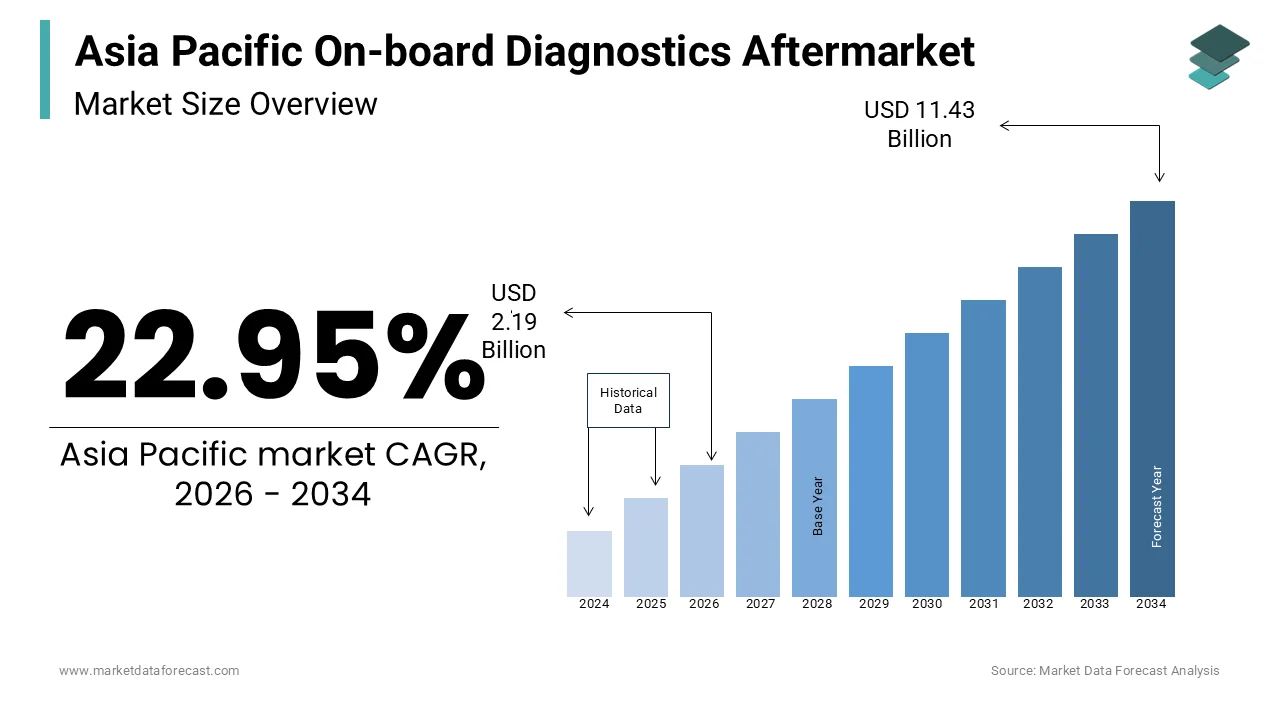
$1.78 BnMarket Estimate, 2026
$2.19 BnMarket Forecast, 2034
$11.43 BnCAGR, 2026–2034
22.95%Executive Summary: Asia Pacific On-board Diagnostics Aftermarket
- Market Scope: Regional Asia Pacific on-board diagnostics (OBD) aftermarket analysis covering hardware and software components, application categories, OBD platform standards, end-user segments, and country leadership frameworks.
- Market Valuation: Valued at USD 1.78 billion in 2025, estimated at USD 2.19 billion in 2026, and projected to reach USD 11.43 billion by 2034, registering a CAGR of 22.95% from 2026 to 2034.
- Primary Growth Drivers: Rapid growth in vehicle ownership and an aging vehicle fleet, expansion of independent repair networks, increasing adoption of OBD-enabled diagnostics in commercial fleets, rising demand for predictive maintenance and real-time vehicle monitoring, alongside growing preventive maintenance awareness.
Key Market Segment Metrics (2026–2034)
| Category | Leading Segment (Position) | Fastest-Growing / Key Growth Segment |
|---|---|---|
| By Component & Platform | Hardware (largest component) & OBD-II (largest platform standard) | Software (fastest-growing component) |
| By Application Area | Fleet Management (largest application) | Usage-Based Insurance (UBI) (fastest-growing application) |
| By End-User Segment | Aftermarket (largest end user) | Fleet Operators (fastest-growing end user) |
| By Technology & Innovation | Standard standalone diagnostic hardware and traditional handheld scan tools | AI-powered diagnostic platforms, smartphone-enabled Bluetooth solutions, and cloud-connected telematics systems |
| By Region / Country | China (leading country with 37.6% market share in 2025) | India (fastest-growing country market) |
Major Market Players & Market Structure
Market Structure: Rapidly evolving Asia Pacific automotive aftermarket sector characterized by AI-assisted diagnostic apps, cloud-connected software, smartphone Bluetooth OBD integration, telematics ecosystems, and electric/connected vehicle solution innovations.
Key Companies: Magneti Marelli S.p.A., Intel Corporation, Innova Electronics Corporation, Hella GmbH & Co. KGaA, Geotab Inc., Electronic System LTD, Continental AG, CalAmp Corporation, Danlaw Inc., Bosch Diagnostic (Robert Bosch GmbH), Azuga Inc., AVL DiTEST GmbH, and Autel Intelligent Technology Corp., Ltd.
 Download Free Sample Report
Asia Pacific On-board Diagnostics Aftermarket Size
The Asia Pacific on-board diagnostics aftermarket was valued at USD 1.78 billion in 2025 and is anticipated to reach a valuation of USD 2.19 billion in 2026 and USD 11.43 billion by 2034, growing at a CAGR of 22.95%, from 2026 to 2034.
On-board diagnostics (OBD) aftermarket refers to the ecosystem of third-party diagnostic tools, software, and services designed to interface with a vehicle’s built-in OBD system for real-time performance monitoring, fault detection, and repair facilitation. Unlike OEM-centric solutions, the aftermarket segment caters to independent repair shops, fleet operators, and individual vehicle owners seeking cost-effective, accessible, and versatile diagnostic capabilities. With over 320 million light and commercial vehicles in operation across the region in 2023, as per the International Organization of Motor Vehicle Manufacturers, the demand for post-warranty vehicle maintenance has surged. In India, more than 78% of vehicles are serviced outside authorized dealerships, according to the Automotive Skills Development Council, highlighting the critical role of OBD-enabled tools in enabling accurate, efficient repairs. Japan’s mandatory biennial vehicle inspection (Shaken) further amplifies reliance on OBD-II compliance, with over 95% of passenger cars undergoing diagnostic checks annually, as documented by the Ministry of Land, Infrastructure, Transport and Tourism.
MARKET DRIVERS
Proliferation of Vehicle Ownership and Aging Fleet Base
The rapid expansion of vehicle ownership across the Asia Pacific, particularly in emerging economies, has led to a growing base of aging vehicles that require frequent maintenance and diagnostic intervention. In Indonesia, the number of registered motor vehicles surpassed 160 million in 2023, with over 42% exceeding eight years of age, as per the Directorate General of Land Transportation. Older vehicles are more prone to engine, emissions, and transmission faults, increasing reliance on OBD scanners for early diagnosis. In Thailand, the average vehicle age rose to 9.4 years in 2023, up from 7.1 years in 2018, according to the Thai Automotive Institute, extending the service lifecycle and boosting demand for affordable diagnostic tools. Similarly, in the Philippines, over 60% of vehicles on the road are over a decade old, as per the Land Transportation Office, creating sustained demand for OBD-II-compatible devices in independent garages and roadside repair units.
Expansion of Independent Repair and Maintenance Networks
The dominance of independent service providers in the Asia Pacific automotive aftercare sector has significantly amplified demand for accessible and reliable OBD diagnostic tools. In China, over 85% of vehicle maintenance is conducted outside OEM dealerships, according to the China Association of Automobile Manufacturers, driven by cost sensitivity and geographic accessibility. This decentralized repair landscape relies heavily on handheld OBD scanners and mobile diagnostic platforms to identify engine codes, reset warning lights, and optimize performance. In India, the unorganized repair sector comprises more than 2.5 million workshops, as documented by the Society of Indian Automobile Manufacturers, many of which now use smartphone-linked OBD dongles to offer professional-grade diagnostics. Platforms have expanded across Southeast Asia, equipping independent mechanics with multilingual, cloud-updated diagnostic software, further institutionalizing OBD technology in non-franchise service environments.
MARKET RESTRAINTS
Lack of Standardization Across Vehicle Brands and Diagnostic Protocols
A major impediment to the seamless adoption of OBD aftermarket tools is the absence of uniform diagnostic protocols across vehicle manufacturers, particularly in hybrid and electric models. While OBD-II mandates basic fault code standardization, proprietary systems used by brands such as Toyota, Hyundai, and Geely restrict access to advanced diagnostics without licensed software. In South Korea, over 68% of diagnostic functions in Kia and Genesis vehicles remain locked behind manufacturer-specific tools, as per the Korea Automobile Service Association in 2023. This limits the functionality of generic OBD devices, reducing their appeal to professional mechanics. In Australia, the Australian Automotive Aftermarket Association found that 55% of independent workshops require multiple scanners to service different brands, increasing operational costs. Without regulatory enforcement of open-access diagnostics, the aftermarket remains fragmented, constraining scalability and user confidence in third-party tools.
Rising Integration of Embedded Telematics and OEM Lock-In Strategies
Automotive original equipment manufacturers are increasingly embedding proprietary telematics and remote diagnostics into vehicles, reducing reliance on external OBD ports and limiting aftermarket access. In Japan, over 70% of new passenger vehicles sold in 2023 came equipped with factory-installed connected car systems such as Toyota’s G-Link and Nissan’s CarWings, as documented by the Japan Automobile Manufacturers Association. These systems transmit real-time vehicle health data directly to OEM service centers, bypassing third-party tools. Similarly, in China, Geely’s Zeekr and NIO vehicles use over-the-air (OTA) diagnostics to predict faults and schedule service appointments automatically, according to the China Internet Network Information Center. This shift toward closed-loop ecosystems restricts data access for independent repairers and diminishes the utility of plug-in OBD devices. As vehicles become more software-defined, the physical OBD port risks obsolescence without regulatory intervention to ensure data portability.
MARKET OPPORTUNITY
Integration of AI-Powered Diagnostic Platforms in Mobile Applications
The convergence of OBD technology with artificial intelligence and mobile computing is creating new avenues for predictive maintenance and user empowerment. Startups and tech firms across the region are developing AI-driven apps that interpret OBD-II data to forecast component failures, optimize fuel efficiency, and recommend repair actions. In India, platforms like OtoNexus and MyCarDost have achieved over 2 million downloads by offering multilingual, AI-assisted diagnostics via low-cost Bluetooth OBD dongles. In Singapore, the Land Transport Authority has endorsed the use of smart OBD devices for fleet monitoring, enabling real-time emissions tracking and compliance reporting.
Government-Led Emissions and Vehicle Fitness Testing Programs
Mandatory emissions and roadworthiness testing regimes are creating institutional demand for certified OBD diagnostic tools across the Asia Pacific. These regulatory frameworks not only standardize diagnostic procedures but also legitimize the use of aftermarket tools in official compliance processes, opening institutional procurement channels and fostering long-term market stability.
MARKET CHALLENGES
Cybersecurity Vulnerabilities in Connected OBD Devices
As OBD-II devices become increasingly connected via Bluetooth and cellular networks, they are exposed to cybersecurity threats that can compromise vehicle control and user data. In 2023, a joint study by the University of New South Wales and the Australian Cyber Security Centre demonstrated that certain low-cost OBD dongles could be remotely exploited to access engine control units, potentially enabling unauthorized acceleration or braking. Many aftermarket tools lack encryption, firmware updates, or secure authentication, making them entry points for hackers. As vehicles become more networked, consumer and regulatory scrutiny of OBD device security is intensifying, threatening the credibility of unregulated products and increasing compliance burdens for manufacturers.
Rapid Technological Obsolescence Due to EV and Software-Defined Architectures
The shift toward electric vehicles (EVs) and software-defined vehicle platforms is rendering traditional OBD-II systems less relevant, as diagnostics migrate from engine-centric codes to battery management, regenerative braking, and OTA software health. In China, EVs accounted for 37% of new car sales in 2023, according to the China Passenger Car Association, many of which use proprietary diagnostic interfaces that bypass the standard 16-pin OBD port. In Australia, Tesla vehicles do not provide full OBD-II access, limiting third-party diagnostics to basic functions. Similarly, Hyundai’s E-GMP platform uses a centralized domain controller that restricts external data extraction. As automotive electronics evolve, aftermarket OBD tools face diminishing utility unless they adapt to new communication protocols such as Ethernet-based automotive networks and UDS (Unified Diagnostic Services). Without significant R&D investment, many existing OBD solution providers risk technological irrelevance in the next decade.
REPORT COVERAGE
| REPORT METRIC | DETAILS |
| Market Size Available | 2025 to 2034 |
| Base Year | 2025 |
| Forecast Period | 2026 to 2034 |
| CAGR | 22.95% |
| Segments Covered | By Component, Application, Platform, End-User, Country |
| Various Analyses Covered | Global, Regional, and Country Level Analysis; Segment-Level Analysis; DROC; PESTLE Analysis; Porter’s Five Forces Analysis; Competitive Landscape; Analyst Overview of Investment Opportunities |
| Regions Covered | India, China, Japan, South Korea, Australia, New Zealand, Thailand, Malaysia, Vietnam, Philippines, Indonesia, Singapore, and the Rest of APAC |
| Market Leaders Profiled | Magneti Marelli S.p.A., Intel Corporation, Innova Electronics Corporation, Hella GmbH & Co. KGaA, Geotab Inc., Electronic System LTD, ERM, Continental AG, CalAmp Corporation, Danlaw Inc., Bosch Diagnostic (Robert Bosch GmbH), Azuga Inc., AVL DiTEST GmbH, Autel Intelligent Technology Corp., Ltd. |
SEGMENTAL ANALYSIS
By Application Insights
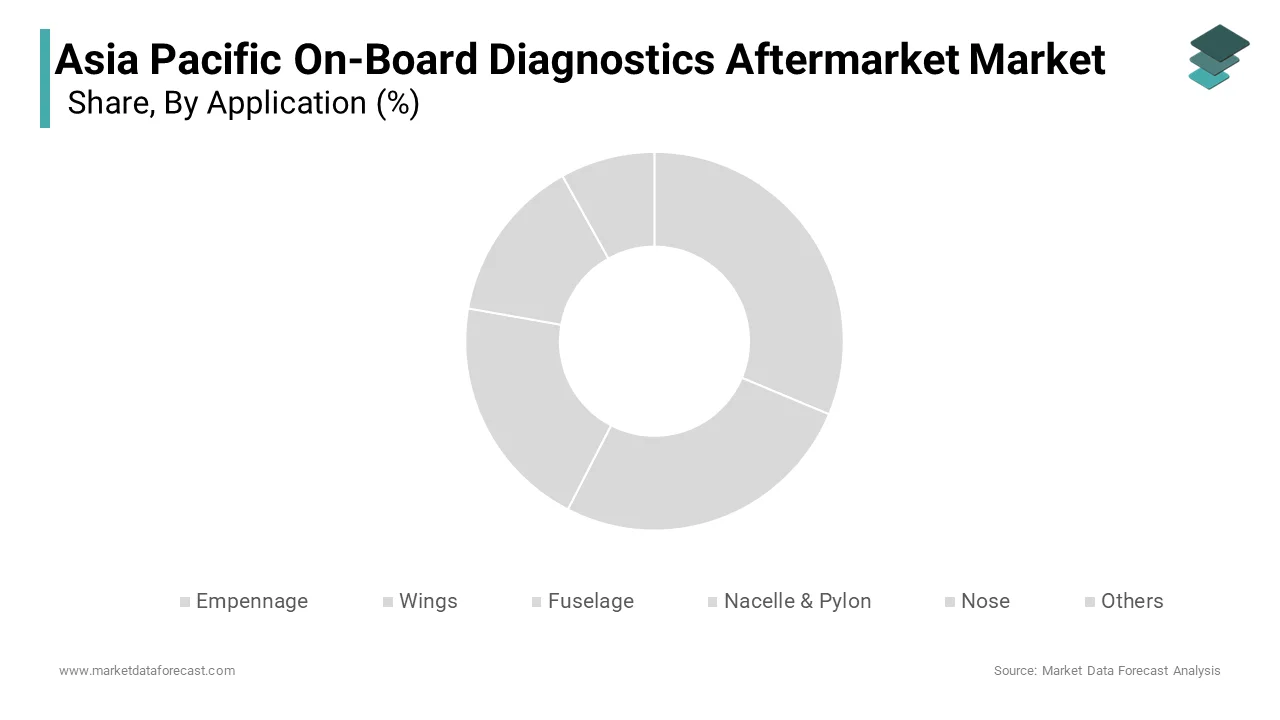
The Fleet Management segment was the largest application in the Asia Pacific on-board diagnostics aftermarket by capturing 45.7% of the total value in 2025. This dominance is driven by the region’s expanding commercial logistics networks and regulatory mandates for vehicle monitoring. These systems use OBD data to track engine health, fuel efficiency, and driver behavior in real time. In Australia, most medium and heavy-duty fleets now use OBD-integrated telematics for maintenance scheduling and compliance reporting.
The Usage-Based Insurance (UBI) segment is the fastest-growing application within the Asia Pacific OBD aftermarket and is projected to expand at a CAGR of 18.3% from 2025 to 2033. This growth is fueled by the rise of telematics-driven insurance models that assess risk based on actual driving behavior rather than static profiles. In Singapore, the General Insurance Association launched a pilot UBI scheme, offering discounts for safe drivers monitored via OBD devices. The integration of OBD data with mobile apps and AI analytics has made UBI more transparent and consumer-friendly, accelerating adoption.
By End-User Insights
The Aftermarket end-user segment held the largest share of the Asia Pacific on-board diagnostics market by accounting for a substantial share of total revenue in 2025. This dominance is due to the region’s reliance on independent repair networks and the high volume of vehicles operating beyond OEM warranty periods. In Thailand, over 80% of vehicle servicing occurs in non-dealer workshops, according to the Thai Automotive Parts Manufacturers Association, most of which depend on third-party OBD tools for accurate diagnostics. In the Philippines, the Land Transportation Office estimates that 6.8 million vehicles are over five years old, creating sustained demand for affordable, portable OBD scanners. Chinese e-commerce platforms like Alibaba and JD.com report over 1.2 million annual sales of OBD code readers, primarily to individual users and small garages. The affordability, versatility, and ease of use of aftermarket tools have made them indispensable in a region where cost-effective vehicle maintenance is a priority for millions of owners and operators.
The OEM (Original Equipment Manufacturer) segment is the fastest-growing end-user category in the Asia Pacific OBD aftermarket and is anticipated to grow at a CAGR of 11.7% in the coming years. This growth is driven by OEMs integrating OBD data into connected car platforms and post-sale service ecosystems. In Japan, Toyota and Honda have launched proprietary telematics services, G-Link and Honda Connect, that use OBD-equivalent data to offer remote diagnostics, predictive maintenance alerts, and automated service scheduling. By 2023, over 65% of new vehicles sold in Japan included factory-fitted telematics, as reported by the Japan Automobile Manufacturers Association. Similarly, in South Korea, Hyundai’s Bluelink system leverages OBD-derived data to provide real-time vehicle health reports to owners and dealers. Chinese EV makers like NIO and BYD are embedding OBD-like diagnostics into their cloud platforms, enabling over-the-air updates and personalized service recommendations. As OEMs monetize vehicle data and enhance customer retention, their role in the OBD ecosystem is expanding beyond hardware into value-added digital services.
COUNTRY-LEVEL ANALYSIS
China held the largest share of the Asia Pacific on-board diagnostics aftermarket at 37.6% of regional revenue in 2025. The country’s position is underpinned by its massive vehicle parc, aggressive EV adoption, and government-backed smart mobility initiatives. The Chinese government mandates OBD-II compliance for all light-duty vehicles and has integrated OBD data into national emissions monitoring systems like I/M (Inspection and Maintenance). Independent repair shops, which handle over 80% of vehicle servicing, rely heavily on low-cost, high-functionality OBD tools sourced from domestic manufacturers such as Autel and Launch Tech. The proliferation of UBI, fleet tracking, and connected car platforms has further amplified OBD adoption across urban and rural areas.
India is another key player in the Asia Pacific OBD aftermarket. The market is being propelled by regulatory mandates, rising vehicle ownership, and the digitization of transport logistics. The Bharat Stage VI (BS-VI) emission norms, implemented in 2020, require all new vehicles to be equipped with OBD systems. The government’s FASTag and Green Highways initiatives have accelerated the integration of OBD-linked telematics in commercial fleets. As of 2023, over 10 million trucks and buses use OBD-based tracking for tolling and compliance, as per the National Highways Authority of India. Domestic startups like Fleetr and OtoNexus are leveraging OBD data for AI-driven fleet optimization, while insurers are piloting UBI models in metropolitan hubs. The combination of policy enforcement and technological innovation is transforming India into a high-growth OBD ecosystem.
Japan holds a significant share of the Asia Pacific on-board diagnostics aftermarket. The market is characterized by technological sophistication, high vehicle connectivity, and stringent regulatory oversight. Over 95% of passenger vehicles undergo mandatory biennial inspections (Shaken), which require comprehensive OBD-II diagnostics to verify emissions and engine performance, as documented by the Ministry of Land, Infrastructure, Transport and Tourism. Independent repairers, however, still rely on third-party scan tools due to proprietary system limitations. The country’s aging vehicle fleet, average age exceeding 13 years, further sustains demand for diagnostic services. Japan’s focus on precision, reliability, and data security has made it a benchmark for high-integrity OBD solutions in the region.
Australia captures a notable share of the regional OBD aftermarket. The market is defined by strong regulatory enforcement, high vehicle ownership, and advanced fleet telematics adoption. All light vehicles in Australia must comply with ADR 79/02, which mandates OBD-II functionality for emissions control, ensuring universal diagnostic access. The rise of usage-based insurance, led by insurers like IAG and Allianz, has driven consumer adoption of OBD dongles, with over 400,000 devices deployed in personal vehicles. Additionally, the Australian government’s Heavy Vehicle National Law requires electronic work diaries linked to OBD data for fatigue management. These regulatory and commercial drivers have established Australia as a mature, compliance-driven OBD market.
South Korea accounts for a small share of the Asia Pacific OBD aftermarket. The country’s market is shaped by high vehicle connectivity, advanced manufacturing, and government-led smart mobility programs. The Ministry of Land, Infrastructure, and Transport mandates OBD-II compliance for all vehicles over eight years old undergoing safety inspections. In Seoul, a city-wide smart traffic management pilot uses OBD data from taxis and delivery vehicles to optimize congestion pricing and route planning. Domestic firms like Autobacs and Innoway have developed AI-enhanced OBD platforms for fleet operators, while insurers are expanding UBI offerings. South Korea’s integration of OBD data into urban mobility and insurance ecosystems underscores its role as a technology-forward market in the region.
KEY MARKET PLAYERS
Magneti Marelli S.p.A., Intel Corporation, Innova Electronics Corporation, Hella GmbH & Co. KGaA, Geotab Inc., Electronic System LTD, ERM, Continental AG, CalAmp Corporation, Danlaw Inc., Bosch Diagnostic (Robert Bosch GmbH), Azuga Inc., AVL DiTEST GmbH, Autel Intelligent Technology Corp., L,... are the market players that are dominating the Asia Pacific on-board diagnostics aftermarket market.
Top Players In The Market
Autel Robotics has emerged as a dominant force in the Asia Pacific on-board diagnostics aftermarket through its advanced, user-centric diagnostic tools tailored for both professional mechanics and individual vehicle owners. The company offers a comprehensive suite of handheld scanners, such as the MaxiCOM and MaxiSys series, featuring high-resolution touchscreens, extensive vehicle coverage, and real-time bi-directional control. It also established regional training centers in Thailand and Australia to support technicians with certification programs. By partnering with independent repair networks and e-commerce platforms like Lazada and Flipkart, Autel has expanded its reach across tier-2 and tier-3 cities. Its investment in multilingual interfaces and localized vehicle databases has strengthened its relevance in linguistically diverse markets.
Bosch Automotive Aftermarket plays a pivotal role in shaping the technical standards of the Asia Pacific OBD aftermarket through its diagnostic solutions, service platforms, and deep OEM-level expertise. The company’s Diagnostic Tool (DS1) and ESI[tronic] 2.0 software provide mechanics with precise fault detection and repair guidance for a wide range of Asian, European, and American vehicles. It also collaborated with government agencies in India to support BS-VI emission compliance through certified OBD training for 50,000 technicians. Bosch’s emphasis on data accuracy, cybersecurity, and integration with connected vehicle systems has positioned it as a trusted partner for high-integrity diagnostics across commercial and passenger vehicle segments.
Launch Tech has solidified its presence in the Asia Pacific OBD aftermarket by delivering high-performance, cost-competitive diagnostic equipment with broad vehicle compatibility. The company’s X431 series, widely adopted in China, India, and the Middle East, supports over 100 vehicle brands and offers bi-directional control, ECU coding, and live data streaming. It also expanded its cloud-based diagnostic database to include electric vehicle models from NIO, BYD, and Tata, addressing the region’s EV growth. By investing in local distribution networks and multilingual customer support, Launch Tech has bridged the gap between affordability and advanced functionality, making professional-grade diagnostics accessible across emerging markets.
Top Strategies Used By Key Market Participants
Key players in the Asia Pacific on-board diagnostics aftermarket are prioritizing product innovation, regional localization, and digital integration to strengthen their market foothold. Companies are developing AI-enhanced diagnostic tools with cloud connectivity and over-the-air updates to improve accuracy and usability. Expansion into e-commerce and mobile platforms is broadening access in underserved areas. Strategic collaborations with repair networks, insurers, and government bodies are enabling integration into fleet management, emissions compliance, and usage-based insurance programs. Investment in technician training and multilingual support enhances trust and adoption. Additionally, firms are adapting tools for electric and hybrid vehicles, ensuring relevance in evolving automotive ecosystems across diverse regulatory and operational environments.
COMPETITION OVERVIEW
The competition in the Asia Pacific on-board diagnostics aftermarket is intensifying as global technology leaders and regional innovators vie for dominance in a fragmented, rapidly evolving landscape. Established players like Autel, Bosch, and Launch Tech leverage technical depth and brand credibility, while local startups focus on affordability and mobile integration. Differentiation is increasingly based on software intelligence, vehicle coverage, and ecosystem integration rather than hardware alone. The rise of connected vehicles and OEM telematics poses a challenge, but also creates opportunities for third-party tools that offer open access and multi-brand compatibility. Regulatory mandates for emissions and safety are standardizing OBD adoption, leveling the playing field. Success hinges on adaptability to electric mobility, data security, and localized service delivery across diverse markets.
RECENT HAPPENINGS IN THE MARKET
- In February 2023, Autel launched the MaxiCOM MK908P Pro in India and Thailand, featuring AI-powered diagnostics and cloud-based updates to enhance repair accuracy for petrol, diesel, and hybrid vehicles.
- In May 2023, Bosch Automotive Aftermarket introduced the Fixico digital platform in Indonesia, integrating OBD diagnostics with spare parts ordering and workshop management for independent repair shops.
- In July 2023, Launch Tech upgraded its X431 V+ scanner with 5G connectivity and expanded EV compatibility, enabling real-time diagnostics for BYD and NIO models across Australia and Southeast Asia.
- In September 2023, Autel established technical training centers in Sydney and Ho Chi Minh City, offering certified OBD diagnostics programs to over 5,000 technicians across the region.
- In January 2025, Bosch partnered with India’s Automotive Skills Development Council to train 50,000 mechanics on BS-VI-compliant OBD systems, strengthening its role in emission regulation enforcement.
MARKET SEGMENTATION
This research report on the on-board diagnostics (OBD) aftermarket is segmented and sub-segmented into the following categories.
By Components
- Empennage
- Wings
- Fuselage
- Nacelle & Pylon
- Nose
- Others
By Application
- Fleet Management
- Consumer Telematics
- Car Sharing
- Used-based Insurance
By Platform
- Fixed-Wing Aircraft
- Military
- Commercial
- General Aviation Aircraft
- Business Jet
- Rotary-Wing Aircraft
- Military Helicopters
- Commercial Helicopters
- UAVs
By End-User
- OEM
- Aftermarket
By Country
- India
- China
- Japan
- South Korea
- Australia
- New Zealand
- Thailand
- Malaysia
- Vietnam
- Philippines
- Indonesia
- Singapore
- Rest of APAC