Asia Pacific Paints and Coatings Market Size, Share, Growth, Trends, and Forecast Report – Segmented By Technology (Water-Borne, Solvent-Borne, Powder Coating, and Other Technologies), Resin Type, End-User Industry, and Region (India, China, Japan, South Korea, Australia & New Zealand, Thailand) - Industry Analysis from 2026 to 2034
Market Size, 2025
$82.05 BnMarket Estimate, 2026
$86.23 BnMarket Forecast, 2034
$128.28 BnCAGR, 2026–2034
5.09%Executive Summary: Asia Pacific Paints and Coatings Market
- Market Scope: Comprehensive regional Asia-Pacific paints and coatings market analysis covering technology segments, resin types, end-use applications, country-level leadership frameworks, and industrial/urbanization metrics.
- Market Valuation: Valued at USD 82.05 billion (2025 base year), estimated at USD 86.23 billion (2026), and projected to reach USD 128.28 billion by 2034, registering a steady CAGR of 5.09% (2026–2034).
- Primary Growth Drivers: Urbanization expansion, major infrastructure investments, and booming automotive and architectural sectors. Key economic and industrial highlights include >56% of the Asia-Pacific population living in urban areas in 2023 (up from 43% in 2000), India’s National Infrastructure Pipeline featuring >7,400 projects valued at USD 1.4 trillion, the Philippines allocating USD 100 billion for 2023–2034 infrastructure, China producing >26 million vehicles annually (with EV output reaching 8.8 million units or 35% of total output in 2023), India producing ~4.5 million vehicles annually, 60% of Southeast Asian coating producers still relying on solvent-based tech, and India’s unorganized sector accounting for ~40% of its decorative paints market.
Key Market Segment Metrics (2026–2034)
| Category | Leading Segment (2025 Position) | Fastest-Growing Segment |
|---|---|---|
| By Technology Segment | Water-Borne Technology (dominated with 47.4% of total volume consumption in 2025) | Powder Coatings (projected to grow at a robust 9.6% CAGR through 2034) |
| By Resin Type | Acrylic Resin (led with 32.5% of total resin consumption in 2025) | Eco-Friendly, Bio-Based, & Low-VOC Specialized Resin Systems |
| By End-User Application | Architectural & Decorative Segment (represented 54.5% of total demand in 2025) | Automotive Coatings (projected to expand at a 7.8% CAGR from 2026 to 2034) |
| By Country / Region | China (dominated geographically with 37.4% of regional demand in 2025) | India & Southeast Asian Industrial & Infrastructure Hubs |
Major Market Players & Market Structure
Market Structure: Highly competitive Asia-Pacific coatings landscape featuring major global and regional chemical manufacturing enterprises competing intensely on low-VOC formulations, water-borne and bio-based products, advanced industrial coatings, and localized manufacturing footprints.
Key Companies: Asian Paints, Kansai Paint, Nippon Paint Holdings, PPG Industries, and Akzo Nobel.
Asia Pacific Paints and Coatings Market Size
The Asia Pacific paints and coatings market size was valued at USD 82.05 billion in 2025, and the market size is expected to reach USD 128.28 billion by 2034 from USD 86.23 billion in 2026. The market's promising CAGR for the predicted period is 5.09%.
Paints and coatings refers to the protective and decorative finishes used across construction, automotive, industrial manufacturing, and infrastructure sectors. These formulations serve not only aesthetic purposes but also critical functional roles, including corrosion resistance, thermal insulation, and surface durability. The region’s demand is intrinsically linked to urban development, industrial output, and evolving consumer preferences for quality and sustainability.
As of 2023, over 56% of the Asia Pacific population resided in urban areas, a figure that has risen steadily from 43% in 2000, according to the United Nations Department of Economic and Social Affairs, reflecting sustained construction activity. Countries such as India, Indonesia, and Vietnam are witnessing a surge in residential and commercial building projects, directly stimulating demand for architectural coatings. Simultaneously, manufacturing hubs in China, Thailand, and South Korea require high-performance industrial and coil coatings for machinery, appliances, and transportation equipment. The automotive sector, though facing transitional pressures from electrification, continues to drive demand for durable, high-gloss finishes. Additionally, government initiatives promoting infrastructure resilience—such as Japan’s seismic retrofitting programs and Australia’s bushfire-resistant building standards—are shaping formulation requirements. The region also faces increasing regulatory scrutiny on volatile organic compound (VOC) emissions, prompting a shift toward water-based and low-VOC technologies.
MARKET DRIVERS
Expansion of Infrastructure and Urban Development Projects
The proliferation of large-scale infrastructure and urbanization initiatives across Asia Pacific is a primary catalyst for paints and coatings demand. Governments are investing heavily in transportation networks, affordable housing, and smart city development, all of which require extensive surface protection and aesthetic finishes. In India, the National Infrastructure Pipeline includes over 7,400 projects valued at USD 1.4 trillion, with construction activity accelerating in sectors such as railways, airports, and urban housing, as per the Ministry of Finance. These projects demand high-performance coatings for steel structures, concrete surfaces, and interior finishes. In Vietnam, urbanization rates have climbed to 39.2% in 2023, up from 30% in 2015, as reported by the General Statistics Office, fueling residential and commercial real estate growth. The Philippines’ “Build Better More” program has allocated PHP 5.7 trillion (USD 100 billion) for infrastructure between 2023 and 2028, covering bridges, highways, and public buildings, all requiring corrosion-resistant and weatherproof coatings. As cities expand vertically and horizontally, the need for durable, low-maintenance finishes intensifies. Moreover, public infrastructure projects often mandate compliance with international coating standards, such as ISO 12944 for corrosion protection, further elevating product specifications and value. This infrastructural momentum ensures sustained demand for both decorative and industrial coatings across the region.
Growth in Automotive and Industrial Manufacturing Output
The expansion of automotive production and industrial manufacturing across Asia Pacific is a significant driver of demand for performance-driven coatings. China remains the world’s largest automobile producer, manufacturing over 26 million vehicles in 2023, as reported by the China Association of Automobile Manufacturers, many of which require high-gloss, scratch-resistant, and UV-stable finishes. In Thailand, the automotive industry produced 1.8 million vehicles in 2023, according to the Federation of Thai Industries, maintaining its position as Southeast Asia’s manufacturing hub. Similarly, South Korea produced 3.9 million vehicles, with Hyundai and Kia exporting to global markets, each requiring premium paint systems. Beyond automotive, industrial manufacturing in sectors such as electronics, appliances, and heavy machinery demands coil, powder, and protective coatings. In Japan, the production of industrial robots reached 180,000 units in 2023, as per the Japan Robot Association, many of which are coated for durability and aesthetics. This industrial momentum necessitates coatings that offer resistance to heat, chemicals, and mechanical stress, driving demand for technologically advanced formulations and reinforcing the sector’s strategic importance in the regional economy.
MARKET RESTRAINTS
Stringent Environmental Regulations on Volatile Organic Compounds (VOCs)
The Asia Pacific paints and coatings industry faces increasing regulatory pressure to reduce volatile organic compound (VOC) emissions, which are linked to air pollution and health risks. Governments across the region have implemented strict limits on solvent-based formulations, compelling manufacturers to reformulate products or face penalties. In China, the Ministry of Ecology and Environment mandated VOC content limits of 420 grams per liter for architectural coatings and 550 grams per liter for industrial finishes as of 2023, significantly affecting traditional alkyd and solvent-borne systems. Similarly, India’s Bureau of Indian Standards revised IS 10248 in 2023 to cap VOC levels in decorative paints at 50 grams per liter for water-based and 420 grams for solvent-based variants. Australia’s National Environmental Protection Measure sets VOC thresholds for industrial coatings, with non-compliant products barred from sale. These regulations increase R&D and production costs, particularly for small and medium-sized enterprises lacking the resources to transition to water-based, high-solids, or powder coating technologies. In Japan, the Air Pollution Control Act requires manufacturers to report VOC emissions annually, with non-compliance leading to public disclosure and reputational damage. According to the Asian Development Bank, over 60% of coating producers in Southeast Asia still rely on solvent-based technologies due to cost and technical constraints. The transition to compliant formulations requires new application equipment, training, and supply chain adjustments, slowing adoption. While necessary for environmental protection, these regulations impose significant operational and financial burdens, particularly in price-sensitive markets.
Volatility in Raw Material Supply and Pricing
The paints and coatings industry in Asia Pacific is highly sensitive to fluctuations in the prices and availability of key raw materials such as titanium dioxide (TiO₂), resins, solvents, and pigments. In 2022, titanium dioxide prices surged by over 30% due to supply chain disruptions and increased energy costs in China and Europe, where 60% of global TiO₂ is produced, as per the CRU Group. This directly impacted formulation costs, with TiO₂ accounting for up to 25% of decorative paint expenses. Similarly, acrylic and epoxy resins, derived from petrochemical feedstocks, experienced price volatility due to geopolitical tensions and crude oil fluctuations—the average price of benzene, a key precursor, rose from USD 850 to USD 1,200 per ton between 2021 and 2022, according to ICIS. In India, the domestic paint industry faced a 15–20% increase in input costs in 2023, forcing companies like Asian Paints and Kansai Nerolac to implement multiple price hikes, as per the Federation of Indian Chambers of Commerce and Industry. Supply chain bottlenecks were exacerbated by port congestion and shipping delays during the pandemic. Smaller regional players, lacking long-term supply contracts, are particularly vulnerable. Additionally, China’s periodic environmental crackdowns on chemical plants have disrupted domestic output, affecting regional availability. These instabilities undermine profit margins, complicate inventory planning, and hinder investment in innovation, constraining the industry’s ability to scale sustainably.
MARKET OPPORTUNITIES
Rising Demand for Sustainable and Eco-Friendly Coating Solutions
A growing emphasis on environmental sustainability is creating a robust market for low-VOC, bio-based, and recyclable coating technologies across Asia Pacific. Consumers and regulatory bodies are increasingly favoring green building certifications such as LEED, Green Mark in Singapore, and GRIHA in India, which mandate the use of environmentally responsible materials. In Singapore, over 50% of buildings were certified under Green Mark by 2023, as per the Building and Construction Authority, driving demand for eco-friendly architectural coatings. Similarly, Australia’s National Construction Code now encourages low-emission materials in public infrastructure projects. Companies are responding with innovations. PPG introduced bio-based resins derived from soy and castor oil for industrial applications in China and Japan. In India, the Green Pro certification has been adopted by over 1,200 products, including paints, as per the Confederation of Indian Industry. Government procurement policies in Japan and South Korea now prioritize low-carbon materials, creating institutional demand. As ESG compliance becomes a competitive differentiator, manufacturers investing in sustainable chemistries are gaining market traction, particularly in urban and premium segments where environmental consciousness is highest.
Penetration of High-Performance Coatings in Emerging Industrial Sectors
The emergence of advanced manufacturing, renewable energy, and specialized infrastructure is opening new avenues for high-performance protective coatings in Asia Pacific. Offshore wind farms, which require anti-corrosive and anti-fouling coatings for turbine towers and substructures, are expanding rapidly—China installed 6.8 gigawatts of offshore wind in 2023 alone, as per the Global Wind Energy Council, creating demand for marine-grade epoxy and polyurethane systems. Similarly, hydrogen production and storage facilities necessitate coatings resistant to hydrogen embrittlement, a niche but growing segment. In India, the National Green Hydrogen Mission aims to establish 5 million metric tons of annual production capacity by 2030, according to the Ministry of New and Renewable Energy, requiring specialized linings for pipelines and tanks. The semiconductor industry, with new fabs under construction in Japan, South Korea, and Malaysia, demands ultra-pure, electrostatic-dissipative coatings for cleanroom environments. In Thailand, the Eastern Economic Corridor is attracting high-tech investments, including battery and EV manufacturing, which rely on conductive and thermal-resistant coatings. According to the International Energy Agency, Asia Pacific accounted for 75% of global solar PV installations in 2023, many of which use anti-reflective and weather-resistant coatings on panels. These applications require superior durability, chemical resistance, and longevity, commanding higher price points and margins. As industrial diversification accelerates, the shift from commodity paints to engineered coating solutions presents a strategic growth frontier for innovators.
MARKET CHALLENGES
Intense Competition from Unorganized and Local Manufacturers
The Asia Pacific paints and coatings market is characterized by a fragmented landscape, with a significant presence of unbranded, informal sector producers offering low-cost alternatives to established brands. In India, the unorganized sector accounts for approximately 40% of the decorative paints market, according to the Indian Paint Association, leveraging regional distribution networks and price sensitivity to capture volume. These manufacturers often bypass regulatory compliance, use inferior raw materials, and offer products with higher VOC content and lower durability. This undercuts premium players’ market share and distorts pricing expectations. Established companies like Nippon Paint and Kansai Nerolac must invest heavily in consumer education and brand trust to differentiate quality. Besides, enforcement of product standards remains weak in rural and semi-urban areas, allowing substandard products to proliferate. The persistence of cash-based transactions in these segments further complicates tracking and regulation. While organized players focus on innovation and sustainability, the unorganized sector thrives on affordability and accessibility, creating a dual-market dynamic that limits premiumization and constrains industry-wide profitability.
Technological Adaptation and Skilled Labor Shortage in Application Processes
The shift toward advanced coating technologies, such as water-based, powder, and self-cleaning formulations, requires skilled labor and specialized application equipment, a capability gap prevalent across much of Asia Pacific. Water-based paints, though environmentally favorable, demand precise surface preparation, humidity control, and curing conditions, which are often absent in field applications. Japan faces a shortage of certified applicators. Misapplication of high-performance coatings not only reduces effectiveness but can lead to premature failure, damaging brand reputation. Manufacturers are forced to invest in training programs, technical support teams, and demonstration centers to ensure proper usage. However, scaling these initiatives across diverse geographies with varying labor standards remains a persistent operational hurdle, limiting the adoption of next-generation products despite their technical superiority.
REPORT COVERAGE
| REPORT METRIC | DETAILS |
| Market Size Available | 2025 to 2034 |
| Base Year | 2025 |
| Forecast Period | 2026 to 2034 |
| CAGR | 5.09% |
| Segments Covered | By Technology, Resin Type, End-User Industry, and Region |
| Various Analyses Covered | Regional & Country Level Analysis, Segment-Level Analysis, DROC, PESTLE Analysis, Porter’s Five Forces Analysis, Competitive Landscape, Analyst Overview on Investment Opportunities |
| Regions Covered | India, China, Japan, South Korea, Australia, New Zealand, Thailand, Malaysia, Vietnam, Philippines, Indonesia, Singapore, and the Rest of Asia-Pacific |
| Market Leaders Profiled | Asian Paints, Kansai Paint Co., Ltd., Nippon Paint Holdings Co., Ltd, PPG Industries, Inc., Akzo Nobel N.V., and others |
SEGMENTAL ANALYSIS
By Technology Insights
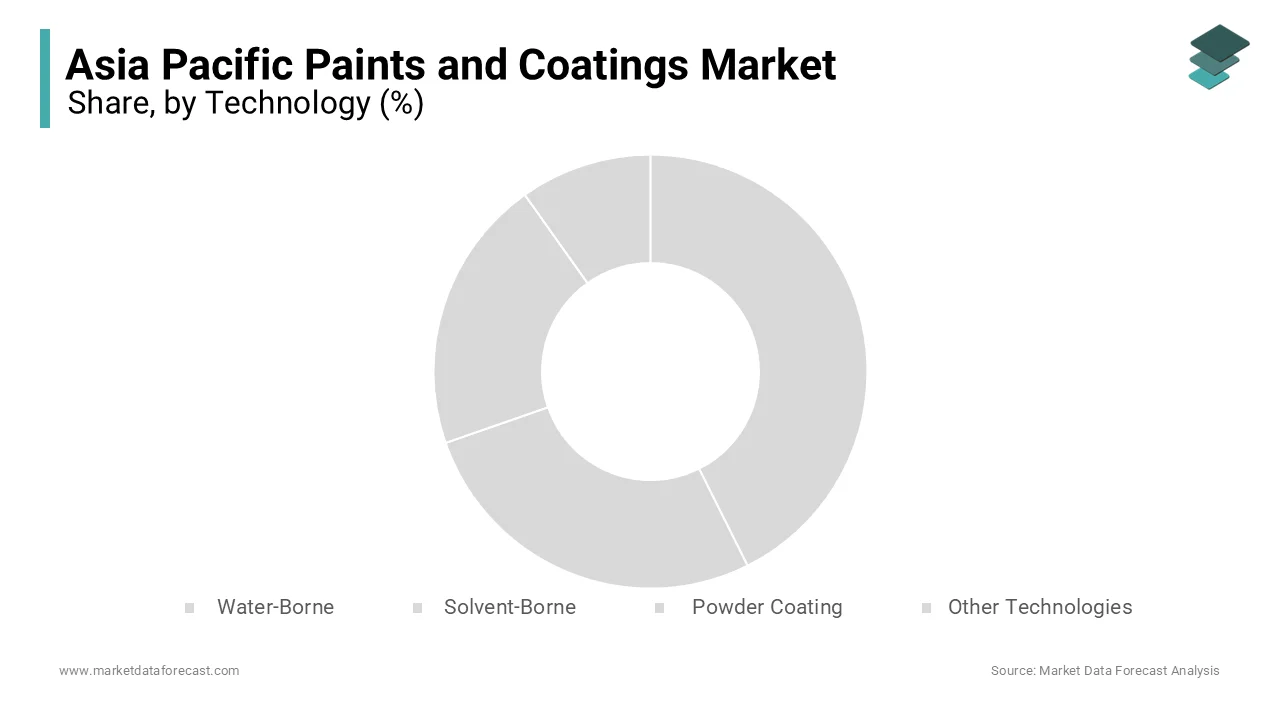
The water-borne technology segment dominated the Asia Pacific paints and coatings market by capturing an estimated 47.4% of total volume consumption in 2025. This lead position is due to its alignment with environmental regulations, consumer health awareness, and technological advancements in formulation stability. Governments across Asia Pacific are enforcing stringent limits on volatile organic compounds (VOCs), favoring water-borne coatings due to their significantly lower emissions. In China, the Ministry of Ecology and Environment implemented GB 18582-2020, capping VOC content in interior decorative paints at 80 grams per liter, effectively phasing out most solvent-borne alternatives. Similarly, India’s revised BIS standard IS 10248:2023 mandates VOC levels below 50 g/L for water-based architectural paints, accelerating their adoption in urban construction. In Japan, the Air Pollution Control Act requires manufacturers to report and reduce solvent emissions, with non-compliant firms facing public disclosure. These policies are institutionalizing water-borne systems in public infrastructure, government housing, and commercial developments. The regulatory environment has shifted from voluntary compliance to mandatory enforcement, making water-borne technology the default choice for large-scale and institutional applications.
Growing public awareness of indoor air quality is driving demand for low-odor, non-toxic coatings, particularly in residential and healthcare settings. In urban centers across India, China, and Southeast Asia, middle-class homeowners are increasingly opting for odorless, quick-drying water-borne paints to minimize disruption and health risks during renovations. In Australia, the National Asthma Council recommends water-based paints for homes with respiratory-sensitive occupants, influencing builder specifications. Hospitals and schools in South Korea are mandated to use low-emission coatings. Water-borne formulations also offer improved safety for applicators, reducing exposure to hazardous solvents. Hence, the demand for healthier coating solutions is no longer niche but mainstream, reinforcing water-borne technology’s dominance.
The powder coatings segment is the fastest-growing in the technology classification and is projected to expand at a CAGR of 9.6% from 2026 to 2034. This growth is driven by superior performance characteristics and environmental advantages over liquid systems. Powder coatings emit no volatile organic compounds during application and cure, making them inherently compliant with the region’s tightening environmental standards. Unlike liquid paints, which rely on solvents that evaporate and contribute to air pollution, powder coatings are applied electrostatically and then thermally cured, resulting in near-zero emissions. In Japan, the Ministry of the Environment promotes powder coatings under its Green Procurement Law, which mandates government agencies to prioritize low-emission materials. The technology also achieves transfer efficiency, minimizing waste compared to that of conventional spray methods, as per the Federation of Electrostatic Coating Technology. Recycling of overspray further enhances sustainability, reducing raw material consumption. In India, the Central Pollution Control Board has identified powder coating as a “cleaner technology” under its consent mechanism, offering regulatory incentives. With landfill space shrinking and waste management costs rising, the closed-loop nature of powder systems offers a compelling advantage, driving adoption in regulated and export-oriented industries.
The powder coatings offer exceptional resistance to chipping, scratching, corrosion, and UV degradation, making them ideal for demanding industrial and outdoor applications. In the automotive sector, manufacturers in Thailand and Indonesia use powder coatings for wheels, bumpers, and underbody components, where durability is critical. In electronics, powder coatings protect enclosures and housings from thermal stress and electrical conductivity. The technology is also expanding into architectural aluminum extrusions for windows and facades, particularly in high-rise buildings in China and Malaysia, where weather resistance is paramount. With a service life exceeding 20 years in outdoor conditions, powder coatings reduce maintenance and lifecycle costs. As industries prioritize asset longevity and total cost of ownership, the performance premium of powder coatings is translating into sustained market growth.
By Resin Type Insights
The acrylic resin segment led the Asia Pacific paints and coatings market by accounting for a 32.5% of total resin consumption in 2025. Its dominance is rooted in versatility, cost-effectiveness, and compatibility with evolving environmental standards. Acrylic resins are widely used in water-borne architectural paints due to their excellent color retention, UV resistance, and adhesion to diverse substrates such as concrete, wood, and metal. In India, over 70% of premium exterior emulsions are based on acrylic technology, as reported by the Indian Paint Association, owing to their ability to withstand monsoon conditions and high solar exposure. The resin’s compatibility with titanium dioxide and pigments ensures vibrant, long-lasting finishes, making it a preferred choice for residential and commercial buildings. Beyond architecture, acrylics are used in industrial maintenance coatings, automotive refinishes, and protective topcoats. In Japan, acrylic-based coatings are specified for seismic retrofitting projects due to their flexibility and crack-bridging properties. The resin’s fast drying time and low odor also enhance user experience, particularly in occupied buildings. With urban construction activity remaining robust across Southeast Asia, acrylic resins continue to benefit from sustained demand in the largest end-use segment.
Acrylic resins are inherently suited for water-borne systems, aligning with regional regulatory and consumer trends toward eco-friendly products. They can be synthesized with minimal or no co-solvents, enabling formulations that meet strict VOC limits in China, India, and Australia. BASF and Dow have developed low-VOC acrylic dispersions specifically for the Asia Pacific market, achieving VOC levels below 30 g/L while maintaining performance. In Australia, the National Construction Code now references low-emission acrylic coatings for public infrastructure. Additionally, bio-based acrylics derived from renewable feedstocks are entering the market. These innovations extend the resin’s lifecycle and relevance in a decarbonizing economy. This synergy between performance, cost, and sustainability ensures acrylic resin’s entrenched market leadership.
The polyurethane resin segment is the fastest-growing in the resin category, projected to grow at a CAGR of 8.9% from 2023 to 2028, according to CRU Group. This acceleration is driven by demand for high-performance, durable coatings in advanced industrial applications.
The polyurethane resins are favored for their superior abrasion resistance, flexibility, and protection against chemicals, making them essential in automotive, aerospace, and heavy industrial sectors. In China, polyurethane coatings are standard for high-speed rail carriages, offshore platforms, and wind turbine blades, where exposure to extreme weather and mechanical stress is common. In India, the oil and gas sector uses polyurethane linings for pipelines and storage tanks to resist corrosion from sulfur compounds and saline environments. With industrial modernization accelerating, the demand for coatings that extend asset life and reduce maintenance is rising, positioning polyurethane as a critical enabler of operational resilience.
The growth of wind energy, electric vehicles, and semiconductor fabrication is increasing the need for specialized polyurethane coatings. In wind turbines, polyurethane is used for blade protection due to its ability to resist rain erosion and thermal cycling. China installed 6.8 gigawatts of offshore wind in 2023. In EVs, polyurethane is used for battery enclosures, providing thermal insulation and impact resistance. In semiconductor cleanrooms, polyurethane floor coatings offer electrostatic dissipation and chemical resistance, critical for contamination control. The resin’s adaptability to functional requirements, such as flame retardancy, anti-static properties, and optical clarity, makes it indispensable in high-value manufacturing. As Asia Pacific becomes the global hub for advanced industries, polyurethane resins are gaining strategic importance beyond traditional applications.
By End-User Industry Insights
The architectural/decorative segment remained the prominent end-user category in the Asia Pacific paints and coatings market by representing a 54.5% of total demand in 2023. This dominance is driven by continuous construction activity and urbanization across the region. The ongoing development of housing, office complexes, and retail spaces generates massive demand for interior and exterior decorative coatings. In India, the Pradhan Mantri Awas Yojana has facilitated the construction of over 30 million homes since 2015, with 12 million completed by 2023, as per the Ministry of Housing and Urban Affairs. Each unit requires multiple coats of emulsion paint, driving volume consumption. In Southeast Asia, countries like Vietnam and the Philippines are experiencing a construction boom. Commercial real estate is also expanding. These projects require high-quality, durable, and aesthetically pleasing coatings, often with added functionalities like mold resistance and washability. The sheer scale of construction activity, coupled with repainting cycles every 5–7 years, ensures that architectural coatings remain the largest and most stable segment.
Beyond new construction, there is growing demand for renovation and aesthetic enhancement, particularly among the expanding middle class. Social media platforms such as Instagram and Xiaohongshu are influencing color trends, with “mood walls” and textured finishes gaining popularity. This shift from functional to experiential consumption is elevating the value and frequency of decorative paint applications, reinforcing the segment’s market leadership.
The automotive segment is the fastest-growing end-user industry and is projected to expand at a CAGR of 7.8% from 2026 to 2034. This growth is fueled by rising vehicle production and technological advancements in coating systems. The rapid rise of electric vehicle (EV) production across Asia Pacific is driving demand for specialized, high-performance coatings. Unlike conventional vehicles, EVs require additional protection for battery packs, electric motors, and charging components. In China, EV production reached 8.8 million units in 2023, accounting for 35% of total vehicle output, as reported by the China Association of Automobile Manufacturers. These vehicles use thermally conductive, electrically insulating coatings to manage battery heat and prevent short circuits. NIO and BYD have adopted multi-layer polyurethane and epoxy systems for underbody protection, increasing coating weight per vehicle. As governments mandate higher EV adoption, the demand for sophisticated coating solutions is accelerating.
Countries like Thailand, India, and Indonesia are expanding their automotive manufacturing ecosystems, creating localized demand for industrial coatings. India’s Production Linked Incentive (PLI) scheme has attracted global EV manufacturers, including Foxconn and Tesla suppliers, to set up assembly units, increasing demand for coil, primer, and topcoat systems. This localization reduces import dependency and strengthens domestic coating supply chains. As production scales, so does the need for consistent, high-quality finishes, driving investment in application technology and quality control, further boosting the segment’s growth trajectory.
REGIONAL ANALYSIS
China
China held the most dominant position in the Asia Pacific paints and coatings market by accounting for 37.4% of regional demand in 2025. As the world’s largest manufacturing and construction hub, China’s coating consumption is deeply integrated into its industrial and urban development fabric. The country consumed a significant million metric tons of paints and coatings, driven by its vast infrastructure projects, including the renovation of old residential communities and the construction of kilometers of high-speed rail. The automotive sector, producing over 26 million vehicles annually, as per the China Association of Automobile Manufacturers, remains a major consumer of OEM and refinish coatings. Additionally, China leads in industrial manufacturing. The government’s dual-carbon strategy has accelerated the shift to water-borne and powder coatings, with the Ministry of Ecology and Environment mandating VOC reductions across sectors. Domestic players like AkzoNobel’s joint ventures and Oriental Zhenzhou are expanding production capacity, while foreign firms such as PPG and Sherwin-Williams have localized R&D centers in Shanghai and Guangzhou. With strong policy support, technological investment, and scale, China’s market is both voluminous and increasingly sophisticated.
India
India is another key market which is driven by rapid urbanization and a booming construction sector. The country’s paints and coatings consumption continues to increase, with the architectural segment accounting for a key share. The Pradhan Mantri Awas Yojana has spurred housing construction, with substantial number of homes completed under the scheme by 2023. India’s automotive industry, producing 4.5 million vehicles annually, as per the Society of Indian Automobile Manufacturers, also drives industrial coating demand. The rise of organized players like Asian Paint has professionalized distribution and brand trust. Regulatory changes, including the BIS VOC norms, are pushing the industry toward water-borne systems. The government’s PLI scheme for electronics and EVs is creating new industrial coating applications. Hence, there is significant growth headroom. India’s combination of volume potential and structural modernization makes it a key growth engine in the region.
Japan
Japan holds a significant share of the Asia Pacific paints and coatings market and is distinguished by its focus on high-performance, technologically advanced formulations. The market is mature and is characterized by premiumization and innovation. Japanese manufacturers prioritize durability, seismic resilience, and environmental compliance. The country’s aging infrastructure requires extensive maintenance and retrofitting, with the Ministry of Land, Infrastructure. Automotive OEMs like Toyota and Honda use advanced polyurethane and anti-corrosion coatings for export vehicles. Japan is also a leader in functional coatings, including self-cleaning, anti-fog, and antimicrobial variants used in healthcare and transportation. With limited domestic growth, Japanese firms like Kansai Paint and Nippon Paint are expanding overseas, leveraging their technical expertise. The market’s strength lies in quality, not volume, setting benchmarks for performance and sustainability.
South Korea
South Korea commands a notable share of the regional market and is driven by its advanced industrial base and export-oriented manufacturing. The country has strong emphasis on automotive, electronics, and shipbuilding applications. Hyundai and Kia produced 3.9 million vehicles in 2023, as per the Korea Automobile Manufacturers Association, requiring high-gloss, scratch-resistant finishes. The electronics sector, led by Samsung and LG, uses specialized coatings for displays, circuit boards, and appliances. South Korea is also advancing in smart coatings, including thermochromic and anti-graffiti variants for urban infrastructure. The government’s Green New Deal promotes low-carbon materials, with the Ministry of Environment certifying eco-friendly products. With a highly skilled workforce and strong IP framework, South Korea excels in high-value, niche applications, differentiating itself from volume-driven markets.
Australia
Australia holds a small share of the Asia Pacific paints and coatings market and is distinguished by its regulatory rigor and focus on durability in harsh climates. The architectural coatings dominate due to residential construction and renovation activity. The Housing Industry Association reported 180,000 new dwellings commenced in 2023, each requiring multiple coats of exterior and interior paint. Australia’s extreme weather, bushfires, UV exposure, and coastal salinity, demands high-performance finishes, with the CSIRO developing fire-retardant and UV-stable formulations. The National Construction Code mandates low-VOC materials in public buildings, accelerating water-borne adoption. Mining and industrial sectors also drive demand for protective coatings, with BHP and Rio Tinto using specialized systems for equipment and infrastructure. According to the Clean Energy Council, over 3 million homes have rooftop solar, requiring weatherproof coatings for mounting structures. With strong environmental standards and a focus on lifecycle performance, Australia’s market is premium-oriented, serving as a testing ground for innovative, sustainable products in the region.
COMPETITIVE LANDSCAPE
The competition in the Asia Pacific paints and coatings market is marked by a blend of global technological leaders and regionally entrenched players, creating a multi-tiered battleground. Multinational corporations such as AkzoNobel, PPG, and Sherwin-Williams leverage their R&D capabilities, sustainability credentials, and high-performance industrial coatings to dominate premium and export-oriented sectors. At the same time, homegrown giants like Asian Paints, Kansai Nerolac, and Nippon Paint maintain strong brand loyalty and distribution advantages in the high-volume architectural segment. The market is further fragmented by a vast unorganized sector, particularly in India, Indonesia, and the Philippines, where low-cost, informal producers compete on price. Differentiation is achieved through product innovation, digital customer engagement, and compliance with environmental standards. Companies are increasingly competing on lifecycle value rather than upfront cost, especially in industrial applications. Mergers, localized production, and eco-labeling are reshaping brand perception. The rise of electric vehicles, green buildings, and smart infrastructure is creating new niches, intensifying competition for technological leadership. With varying regulatory environments, consumer preferences, and economic conditions across countries, success depends on agility, regional insight, and long-term investment in sustainable and functional coatings.
KEY MARKET PLAYERS
Some of the key players in the Asia Pacific paints and coatings market are
- Asian Paints
- Kansai Paint Co., Ltd.
- Nippon Paint Holdings Co., Ltd.
- PPG Industries, Inc.
- Akzo Nobel N.V.
TOP PLAYERS IN THE MARKET
- AkzoNobel is a dominant force in the Asia Pacific paints and coatings sector, delivering innovative, sustainable solutions across decorative, industrial, and automotive segments. The company operates extensive manufacturing and R&D facilities in China, India, and Singapore, enabling localized product development for regional needs. It expanded its specialty coatings portfolio for marine and protective applications in Australia and China, serving infrastructure and energy clients. The company strengthened its digital engagement through the “Dulux Decorator Hub,” enhancing contractor support in Australia and Malaysia. AkzoNobel also partnered with recyclers to pilot paint waste recovery programs in Japan and New Zealand, reinforcing its circular economy commitment. By integrating sustainability, digital tools, and high-performance chemistry, AkzoNobel continues to shape market standards and deepen customer loyalty across diverse Asia Pacific economies.
- PPG Industries has established a robust presence in Asia Pacific through technological leadership and strategic expansion in high-growth industrial and automotive sectors. The company operates advanced manufacturing sites in China, South Korea, and India, focusing on OEM and refinish coatings for vehicles, aerospace, and electronics. It introduced BADCHEM water-borne automotive primers in Thailand and Vietnam, supporting regional EV manufacturers in meeting emission standards. PPG also enhanced its digital color-matching systems for body shops across Indonesia and the Philippines, improving repair efficiency. The company invested in powder coating capacity in Japan to serve industrial clients seeking sustainable alternatives. Through collaborations with automakers like Hyundai and BYD, PPG ensures its formulations meet evolving performance demands. Its focus on innovation, environmental compliance, and customer-centric solutions enables PPG to maintain a competitive edge in both mature and emerging markets across the region.
- Asian Paints stands as a leading regional player with deep penetration in the architectural and decorative coatings market across South and Southeast Asia. Headquartered in India, the company has extended its influence through subsidiaries such as Apco Coatings in Vietnam and Berger International in Malaysia, offering region-specific products. It expanded its premium product line with “Luxury Gold” and “Anti-Bacterial” emulsions, targeting health-conscious homeowners. The company enhanced its retail footprint with over 50,000 exclusive outlets and introduced robotic mixing kiosks in flagship stores. Asian Paints also invested in sustainable packaging, reducing plastic use across its supply chain in 2023. By blending digital innovation, brand trust, and localized marketing, the company has solidified its position as a consumer-first brand, setting benchmarks in customer experience and distribution efficiency across diverse cultural and economic landscapes.
TOP STRATEGIES USED BY THE KEY MARKET PLAYERS
Key players in the Asia Pacific paints and coatings market are deploying integrated strategies to sustain growth and adapt to evolving demands. Companies are investing in R&D to develop low-VOC, water-borne, and bio-based formulations in response to tightening environmental regulations. Expansion of regional manufacturing and R&D centers ensures product localization and faster time-to-market. Strategic acquisitions and joint ventures are being leveraged to enhance technology portfolios and geographic reach. Digital transformation is a priority, with firms adopting AI-driven color tools, e-commerce platforms, and contractor engagement apps. Sustainability initiatives, including circular economy models and carbon footprint reduction, are becoming central to brand positioning. Partnerships with construction firms, automakers, and government bodies help secure large-scale project contracts. Additionally, companies are strengthening distribution networks, particularly in rural and semi-urban areas, to counter competition from unorganized players. Talent development and technical training programs are being scaled to support advanced application methods. These strategies collectively emphasize innovation, compliance, customer engagement, and operational resilience in a dynamic and fragmented market.
RECENT HAPPENINGS IN THE MARKET
- In January 2023, AkzoNobel launched its Sustainovation product line in India and Southeast Asia, introducing low-VOC, water-based decorative paints to align with regional environmental regulations and expand its sustainable portfolio.
- In March 2023, PPG inaugurated a new R&D center in Shanghai focused on developing eco-friendly and high-performance coatings for the Chinese automotive and industrial markets, enhancing its local innovation capabilities.
- In August 2023, Asian Paints introduced AI-powered color visualization tools on its mobile application, enabling consumers across India and Bangladesh to digitally preview paint finishes and improve purchase confidence.
- In November 2023, Nippon Paint partnered with Singapore’s Building and Construction Authority to supply Green Mark-certified coatings for public housing projects, strengthening its position in sustainable infrastructure.
- In February 2025, Kansai Nerolac expanded its manufacturing capacity in Indonesia with a new plant in Cikarang, aimed at serving growing demand from automotive and industrial clients in Southeast Asia.
MARKET SEGMENTATION
This research report on the Asia Pacific paints and coatings market has been segmented and sub-segmented based on the following categories.
By Technology
- Water-Borne
- Solvent-Borne
- Powder Coating
- Other Technologies
By Resin Type
- Acrylic
- Alkyd
- Polyurethane
By End-User Industry
- Architectural/Decorative
- Automotive
- Wood
By Country
- India
- China
- Japan
- South Korea
- Australia
- New Zealand
- Thailand
- Malaysia
- Vietnam
- Philippines
- Indonesia
- Singapore
- Rest of Asia-Pacific
Frequently Asked Questions
1. What is the Asia Pacific paints and coatings market?
The Asia Pacific paints and coatings market includes decorative and industrial coatings used in construction, automotive, packaging, and other sectors.
2. What factors are driving the growth of the market in Asia Pacific?
Rapid urbanization, infrastructure development, and rising automotive production are the main drivers.
3. Which country holds the largest share of the Asia Pacific paints and coatings market?
China leads the market due to massive construction and manufacturing activities.
4. What role does India play in the paints and coatings market?
India is experiencing strong growth, fueled by infrastructure projects and demand for decorative paints.
5. What are the major applications of paints and coatings in Asia Pacific?
Applications include building & construction, automotive, packaging, industrial equipment, and wood coatings.
6. How does industrialization impact the paints and coatings market in the region?
Industrialization increases demand for protective and performance coatings in manufacturing and infrastructure.
7. How is the trend of eco-friendly coatings influencing the market?
Growing environmental regulations are pushing demand for water-based and low-VOC coatings.
8. What challenges does the market face in the Asia Pacific region?
Challenges include fluctuating raw material prices and stricter environmental regulations.
Related Reports
Access the study in MULTIPLE FORMATS
Purchase options starting from
$ 2000
Didn’t find what you’re looking for?
TALK TO OUR ANALYST TEAM
Need something within your budget?
NO WORRIES! WE GOT YOU COVERED!
Call us on: +1 888 702 9696 (U.S Toll Free)
Write to us: sales@marketdataforecast.com