- Product Description Description
- Table of Contents TOC
- List of Table & Figure LOT
- Get Free Sample PDF Sample PDF
Market Size, 2025
$1.98 BnMarket Estimate, 2026
$2.04 BnMarket Forecast, 2034
$2.61 BnCAGR, 2026–2034
3.11%Asia Pacific Photoresist and Photoresist Ancillaries Market Size
The Asia Pacific Photoresist and Photoresist Ancillaries Market size was calculated to be USD 1.98 billion in 2025 and is anticipated to be worth USD 2.61 billion by 2034, from USD 2.04 billion in 2026, growing at a CAGR of 3.11% during the forecast period.

Photoresists are light-sensitive materials that enable precise patterning on silicon wafers or substrates, while ancillary chemicals such as developers, removers, and anti-reflective coatings support the overall lithography process. With the region serving as the global epicenter for electronics production and chip fabrication, demand for high-performance photoresist solutions has surged, particularly in countries like China, South Korea, Japan, and Taiwan.
Like, as per the Semiconductor Industry Association, the country alone invested a substantial amount in domestic foundry expansion projects between 2021 and 2023, further reinforcing its role as a key consumer of photoresist and related chemicals. Japanese firms continue to lead in extreme ultraviolet (EUV) and deep ultraviolet (DUV) photoresist development, while South Korean manufacturers have intensified procurement of resist materials for memory and display applications.
MARKET DRIVERS
Expansion of Semiconductor Manufacturing Capacity in Asia Pacific
A primary driver of the Asia Pacific photoresist and photoresist ancillaries market is the rapid expansion of semiconductor manufacturing capacity across the region. Governments and private enterprises are investing heavily in new wafer fabrication plants (fabs), process node upgrades, and domestic supply chain resilience, all of which require significant volumes of photoresist materials and supporting chemicals.
China has emerged as the most aggressive investor, with state-backed initiatives such as the National Integrated Circuit Industry Investment Fund facilitating the establishment of multiple 12-inch wafer fabs. According to the China Electronics Components Association, the country added a significant number of new semiconductor production lines between 2021 and 2023, each requiring extensive procurement of g-line, i-line, KrF, and ArF photoresists. Meanwhile, Japan’s Ministry of Economy, Trade and Industry (METI) continues to support local suppliers in refining high-purity resist formulations essential for cutting-edge lithography. The ongoing shift toward localized chip manufacturing and the rise of mature and leading-edge nodes are fueling sustained demand for photoresist and ancillary products across the Asia Pacific.
Growth of Display and Advanced Packaging Technologies
Another critical factor propelling the Asia Pacific photoresist and photoresist ancillaries market is the growth of display technologies and advanced packaging applications. As consumer electronics evolve toward higher resolution, flexible form factors, and enhanced performance, the demand for precision photolithography in OLED, LCD, and microLED manufacturing has escalated. In China, BOE Technology and Visionox have significantly expanded their AMOLED production footprints, further intensifying demand for high-resolution resist materials. In addition, the proliferation of fan-out wafer-level packaging (FOWLP) and 2.5D/3D ICs in smartphones, AI chips, and automotive semiconductors has driven the adoption of thick-film and back-end-of-line (BEOL) compatible resists.
MARKET RESTRAINTS
Supply Chain Volatility and Raw Material Shortages
One of the foremost restraints affecting the Asia Pacific photoresist and photoresist ancillaries market is the volatility in the chemical supply chain and persistent raw material shortages. Photoresist production relies on high-purity organic compounds, polymers, and solvents sourced from a limited number of global suppliers, making the industry vulnerable to disruptions. This shortage was exacerbated by Japan’s export controls on certain semiconductor-grade chemicals following geopolitical tensions, directly impacting South Korean and Chinese fabricators. Moreover, environmental regulations in China have led to intermittent closures of chemical processing facilities, disrupting the steady flow of resist precursors. As a result, manufacturers in the region faced elevated costs and production delays, forcing some to seek alternative formulations or adjust procurement strategies.
High Cost and Complexity of EUV Photoresists
The prohibitive cost and technical complexity associated with extreme ultraviolet (EUV) photoresists presents another significant restraint to the growth of the Asia Pacific photoresist and photoresist ancillaries market. Unlike conventional DUV resists, EUV variants require specialized molecular structures and ultra-low defect tolerances to withstand the high-energy 13.5nm wavelength exposure used in sub-7nm semiconductor processes. Like, EUV photoresists can be up to five times more expensive than ArF immersion resists due to the intricate synthesis required to achieve sufficient sensitivity, resolution, and line edge roughness control. In Japan, where most of the world's EUV resists are developed and produced, only a handful of companies possess the capability to manufacture these high-end materials at scale. This concentration of expertise limits accessibility for smaller Asian manufacturers, particularly those in India and Southeast Asia looking to enter the advanced process node ecosystem. Furthermore, compatibility challenges with EUV-specific ancillary chemicals such as top coats, underlayers, and post-exposure treatments add to the complexity of integration.
MARKET OPPORTUNITIES
Rise of Domestic Resist Manufacturing in China
A transformative opportunity emerging in the Asia Pacific photoresist and photoresist ancillaries market is the accelerated development of domestic resist manufacturing capabilities in China. Amid growing trade restrictions and concerns over supply chain security, Chinese semiconductor and display companies are aggressively investing in indigenous resist technologies to reduce dependency on foreign suppliers. Some have already achieved commercialization of i-line and KrF resists used in analog, power, and CMOS image sensor applications. The Chinese government’s “Made in China 2026” strategy includes targeted incentives for semiconductor material localization, offering tax breaks and R&D funding to qualified enterprises.
Expansion of Chiplet-Based Designs and 3D Integration
The growing adoption of chipset-based architectures and 3D integration techniques presents a compelling opportunity for the Asia Pacific photoresist and photoresist ancillaries market. As Moore’s Law slows, semiconductor designers are increasingly turning to heterogeneous integration and package-level miniaturization to enhance performance without relying solely on process node shrinks. These designs rely heavily on advanced packaging technologies such as FOWLP, CoWoS, and hybrid bonding, all of which require novel resist formulations capable of forming ultra-thin layers, fine redistribution lines, and precise micro-bump patterns. Similarly, in Japan, academic institutions and industrial consortia are collaborating on new chemically amplified resists tailored for temporary bonding and debonding processes in 3D stacking.
MARKET CHALLENGES
Environmental and Regulatory Compliance Pressures
Environmental and regulatory compliance pressures pose a major challenge to the Asia Pacific photoresist and photoresist ancillaries market, as governments intensify scrutiny over chemical safety, waste disposal, and emissions standards. Photoresist materials often contain hazardous substances such as aromatic solvents, sensitizers, and developer agents, prompting stricter oversight from environmental protection agencies.
In China, the Ministry of Ecology and Environment has implemented tighter discharge norms for semiconductor and PCB manufacturing zones, requiring companies to adopt cleaner production practices and invest in resist waste recycling infrastructure. Countries like India and Thailand are also introducing mandatory eco-labeling and chemical registration requirements under REACH-like frameworks.
Technological Barriers in Next-Generation Lithography
A formidable challenge facing the Asia Pacific photoresist and photoresist ancillaries market is the difficulty in advancing resist materials to meet the demands of next-generation lithography technologies such as high numerical aperture (High-NA) EUV and directed self-assembly (DSA). These emerging techniques require unprecedented levels of resolution, sensitivity, and uniformity—parameters that current resist platforms struggle to achieve simultaneously. According to a report by the International Roadmap for Devices and Systems (IRDS), achieving sub-3nm feature sizes using high-NA EUV exposes fundamental limitations in existing polymer-based resist chemistry, including stochastic printing defects and pattern collapse risks. In response, research institutions and manufacturers across the region—particularly in Japan and South Korea—are exploring metal oxide-based resists and hybrid systems that offer improved etch resistance and reduced line edge roughness. However, these alternatives introduce new complexities in terms of compatibility with existing lithography tools and integration into mass production flows. Also, uncertainties around future lithography roadmaps complicate long-term investment decisions for resist developers.
REPORT COVERAGE
| REPORT METRIC | DETAILS |
| Market Size Available | 2025 to 2034 |
| Base Year | 2025 |
| Forecast Period | 2026 to 2034 |
| CAGR | 3.11% |
| Segments Covered | By Photoresist Type, Photoresist Ancillaries Type, Application, and Region |
| Various Analyses Covered | Global, Regional & Country Level Analysis; Segment-Level Analysis; DROC, PESTLE Analysis; Porter’s Five Forces Analysis; Competitive Landscape; Analyst Overview of Investment Opportunities |
| Regions Covered | India, China, Japan, South Korea, Australia, New Zealand, Thailand, Malaysia, Vietnam, Philippines, Indonesia, Singapore, Rest of Asia-Pacific |
| Market Leaders Profiled | TOKYO OHKA KOGYO CO., LTD., JSR Corporation, DuPont, Fujifilm Electronics Materials Co., Ltd., Shin-Etsu Chemical Co., Ltd., Merck KGaA, Sumitomo Chemical Co., Ltd., Allresist GmbH, Microchemicals GmbH, DONGJIN SEMICHEM CO., LTD. |
SEGMENTAL ANALYSIS
By Photoresist Type Insights
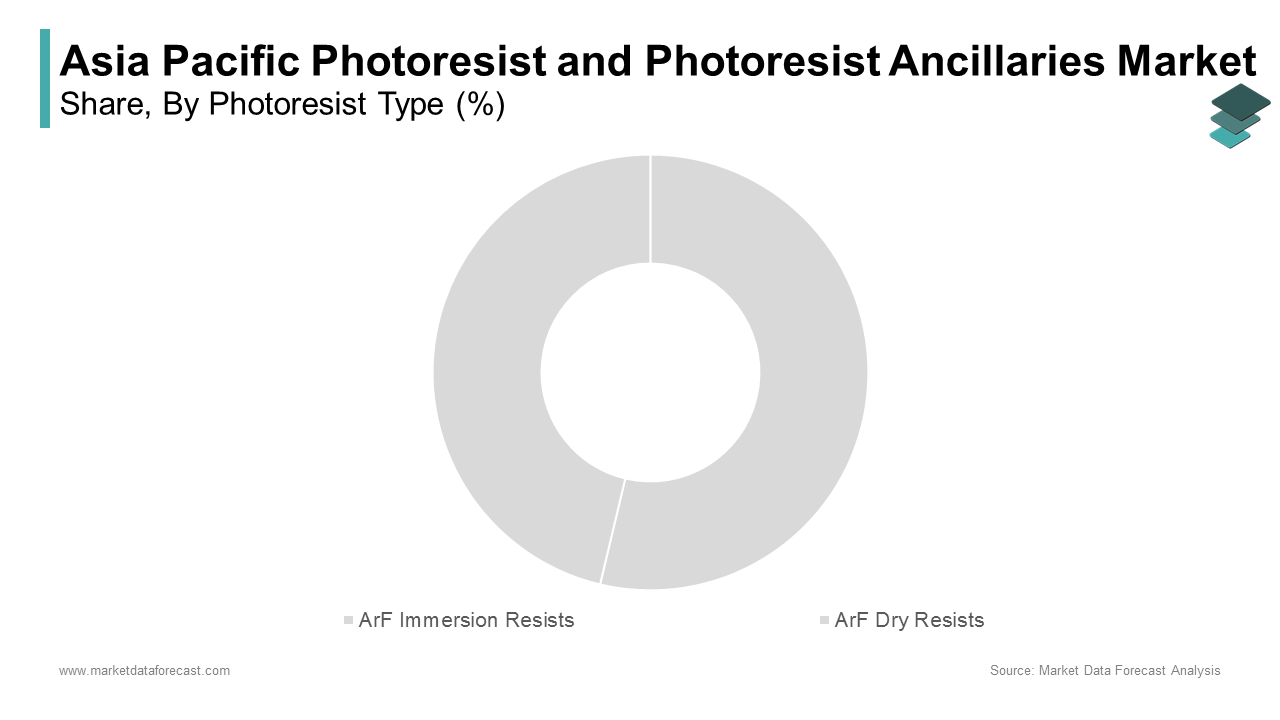
The ArF immersion resists dominated the Asia Pacific photoresist and photoresist ancillaries market by accounting for 41.4% of total revenue in 2025. This segment’s growth is primarily driven by its widespread use in advanced semiconductor manufacturing, particularly for sub-65nm logic and memory devices. The immersion lithography process allows for higher-resolution patterning by reducing the effective wavelength of exposure light using a liquid medium. In China, domestic memory manufacturers such as YMTC and CXMT have significantly scaled up their immersion lithography lines to support indigenous production of high-density storage solutions. Also, Japanese resist suppliers like JSR Corporation and Shin-Etsu Chemical have focused on optimizing ArF immersion formulations to improve defectivity performance and process window margins.
The ArF dry resists segment is projected to register the highest growth in the Asia Pacific photoresist market, expanding at a CAGR of 12.8% from 2026 to 2034. This rapid expansion is attributed to increasing adoption in mature-node logic and analog IC manufacturing, where cost efficiency and process simplicity take precedence over extreme miniaturization. In India, emerging startup fabless companies are leveraging ArF dry technology for sensor and connectivity chip development under government-backed semiconductor initiatives. Moreover, rising investments in silicon carbide (SiC) and gallium nitride (GaN) power device manufacturing in Japan and South Korea are further boosting demand for ArF dry resists tailored for thick-film applications.
By Photoresist Ancillaries Type Insights
The developer segment represented the largest ancillary product category in the Asia Pacific photoresist market by capturing 37.7% of total ancillary-related revenues in 2025. These alkaline solutions play an essential role in the photolithography process by selectively removing exposed or unexposed portions of the resist layer after pattern exposure. Like, the demand for high-purity TMAH (tetramethylammonium hydroxide)-based developers has surged alongside the proliferation of EUV and ArF immersion lithography, which require precise control over post-exposure development steps to maintain critical dimension uniformity. In South Korea, major semiconductor manufacturers such as Samsung and SK Hynix have mandated tighter developer purity specifications to minimize contamination risks in sub-5nm node processing.
The anti-reflective coatings (ARCs) segment is expected to grow at the fastest CAGR of 14.2% throughout the forecast period due to their critical role in enhancing lithographic accuracy and reducing optical distortions caused by substrate reflection. As reported by the International Electronics Manufacturing Initiative (iNEMI), ARCs are increasingly being deployed in both front-end-of-line (FEOL) and back-end-of-line (BEOL) patterning applications to enable finer geometries and lower defect densities, especially in advanced packaging and display technologies. In Japan, academic institutions and material suppliers have been collaborating on novel organic and inorganic ARC formulations compatible with EUV and high-NA lithography systems, improving pattern fidelity without adding process complexity. These cross-industry advancements underscore why anti-reflective coatings are emerging as the most dynamic segment within the Asia Pacific photoresist ancillaries market.
By Application Insights
The semiconductors and integrated circuits (ICs) account for the largest application segment in the Asia Pacific photoresist and photoresist ancillaries market by contributing 59.7% of total revenue in 2025. This dominance is due to the region’s entrenched role as the global hub for advanced chip manufacturing, packaging, and design activities. According to the Semiconductor Industry Association, a major portion of global wafer fabrication capacity resides in the Asia Pacific region, with foundries in South Korea, Taiwan, and China operating at near-full utilization rates. The rise of heterogeneous integration and fan-out packaging techniques is further driving demand for specialized resist solutions. As semiconductor miniaturization progresses and new nodes enter mass production, the photoresist and ancillaries market remains deeply intertwined with the industry’s evolution.
The liquid crystal displays (LCDs) segment is poised to grow at the highest CAGR of 13.5% during the forecast period, reflecting renewed investment in large-area flat panel display manufacturing, particularly in China and India. Despite the increasing adoption of OLED technology, LCDs continue to dominate in sectors such as automotive infotainment, industrial monitors, and commercial signage where cost and longevity remain key considerations. According to Display Supply Chain Consultants (DSCC), Chinese panel makers accounted for over 70% of global LCD production in 2023, with companies investing heavily in next-generation Gen 8.6 and Gen 10.5 glass lines designed to produce larger, higher-resolution panels. These advanced fabrication processes rely extensively on high-resolution photoresists and negative-tone coatings to define fine pixel structures and color filters. In India, the government’s Production-Linked Incentive (PLI) scheme for electronics manufacturing has spurred local LCD module production, indirectly boosting demand for resist and ancillary chemicals used in FPD fabrication.
REGIONAL ANALYSIS
China held the top position in the Asia Pacific photoresist and photoresist ancillaries market by commanding a market share of 35.8% in 2025. As the world’s largest consumer of semiconductors and flat panel displays, China drives demand for both mature and advanced-node lithography materials. Government-backed initiatives such as the National Integrated Circuit Industry Investment Fund have accelerated domestic fab construction, prompting aggressive procurement of photoresists and associated chemicals. According to the China Semiconductor Industry Association, domestic semiconductor production grew by nearly 12% year-on-year in 2023, supported by expansions at SMIC, YMTC, and other national champions. The country also leads in LCD manufacturing, with companies deploying new Gen 10.5 lines that consume significant volumes of resist and anti-reflective coating.s
South Korea maintains a strong foothold due to its leadership in advanced memory, logic, and display manufacturing, all of which require high-performance resist materials and supporting chemicals. Also, South Korean companies invested d humongous amount in semiconductor R&D and capital expenditures between 2021 and 2023, with Samsung and SK Hynix leading the charge in next-generation DRAM, NAND, and foundry technologies. These developments necessitate extensive usage of ArF immersion, EUV, and metal oxide resists optimized for sub-5nm and high-NA EUV lithography. LG Display and Samsung Display are also among the largest consumers of photoresists in OLED and microLED production, where fine-line patterning is critical. Also, South Korea’s focus on domestic supply chain resilience has led to collaborations between chemical firms and equipment vendors to co-develop resist-compatible process flows. The
Japanese market is distinguished by its deep expertise in resist formulation, polymer chemistry, and high-purity chemical synthesis. As a long-standing leader in semiconductor materials, Japan plays an outsized role in supplying advanced resists and ancillaries not only domestically but across the broader Asia Pacific region. According to the Electronic Industries Association of Japan, the country hosts several of the world’s top resist manufacturers, including JSR Corporation, Shin-Etsu Chemical, and Tokyo Ohka Kogyo. These firms dominate the EUV and ArF immersion resist markets, supplying critical materials to global foundries and memory producers. The Japanese government, through METI, has funded joint research ventures between universities and industry players to accelerate the development of next-generation resists suitable for high-NA EUV and directed self-assembly lithography. In addition, Japan’s strong chemical industry provides a stable supply of monomers, solvents, and additives essential for resist production.
India is positioned as an emerging destination for electronics and semiconductor manufacturing. While direct wafer fabrication remains limited, the country’s growing investments in PCB assembly, display modules, and packaging operations are creating incremental demand for resist materials and related chemicals.
According to the India Electronics & Semiconductor Association, the government’s Production-Linked Incentive (PLI) scheme has attracted over USD 10 billion in cumulative investment since 2020, particularly in mobile phone and IT hardware manufacturing. This includes the establishment of local LCD and AMOLED module plants that rely on resist-based photolithography for backlight unit patterning and touch sensor fabrication. Besides, Indian startups engaged in MEMS, sensors, and RF IC development are beginning to leverage domestic prototyping labs equipped with KrF and i-line lithography tools.
Vietnam is playing a pivotal role as a preferred outsourcing location for global electronics brands. Though it lacks front-end wafer fabrication capabilities, the country’s expanding footprint in PCB assembly, smartphone manufacturing, and component testing has generated steady demand for resist and ancillary chemicals. These production lines utilize resist-based photolithography in circuit board imaging and flex connector patterning. Moreover, Vietnamese fabricators involved in LED and camera module production are adopting fine-line resist processes to meet quality standards for consumer devices.
LEADING PLAYERS IN THE ASIA PACIFIC PHOTORESIST AND PHOTORESIST ANCILLARIES MARKET
JSR Corporation (Japan)
JSR Corporation is a global leader in photoresist materials, particularly known for its pioneering work in advanced lithography solutions. The company plays a central role in supplying resist technologies to semiconductor manufacturers across the Asia Pacific region. JSR's strong R&D capabilities enable it to maintain leadership in EUV and ArF immersion resists, which are essential for sub-7nm node production.
Shin-Etsu Chemical Co., Ltd. (Japan)
Shin-Etsu Chemical is one of the largest suppliers of photoresist materials, especially for leading-edge memory and logic devices. The company maintains an extensive product portfolio covering KrF, ArF, and EUV resists, along with complementary ancillary chemicals. In the Asia Pacific market, Shin-Etsu’s high-purity resist offerings are widely adopted by foundries and integrated device manufacturers. Its deep expertise in polymer synthesis gives it a competitive edge in developing next-generation resist platforms.
Dongjing Materials (China)
Dongjing Materials is a rising domestic force in China’s evolving photoresist industry. As part of broader government-backed efforts to localize semiconductor supply chains, the company has made significant strides in producing mature-node resists for LCD panels and printed circuit boards. It is also expanding into advanced semiconductor-grade resists through strategic partnerships and joint ventures. Dongjing’s growth reflects China’s ambition to reduce reliance on foreign suppliers for critical photolithography materials.
TOP STRATEGIES USED BY KEY MARKET PARTICIPANTS
One key strategy employed by major players in the Asia Pacific photoresist and photoresist ancillaries market is enhanced R&D investment focused on next-generation resist technologies. Companies are directing significant resources toward developing resist materials compatible with high-NA EUV, directed self-assembly, and other emerging lithography techniques that will define future semiconductor manufacturing nodes.
Another crucial approach is strategic partnerships and joint development agreements with equipment makers, foundries, and academic institutions. These alliances allow resisting suppliers to align their material innovations with tooling advancements and process integration requirements, ensuring seamless adoption at customer sites.
Lastly, localized production and supply chain localization serve as a core growth tactic. By establishing or expanding chemical synthesis and formulation facilities within key Asia Pacific markets, companies can reduce logistical dependencies, enhance responsiveness to regional demand fluctuations, and comply with evolving environmental and trade regulations specific to individual countries.
KEY MARKET PLAYERS AND COMPETITION OVERVIEW
Major Players in the Asia Pacific photoresist and photoresist ancillaries market include TOKYO OHKA KOGYO CO., LTD., JSR Corporation, DuPont, Fujifilm Electronics Materials Co., Ltd., Shin-Etsu Chemical Co., Ltd., Merck KGaA, Sumitomo Chemical Co., Ltd., Allresist GmbH, Microchemicals GmbH, DONGJIN SEMICHEM CO., LTD.
The competition in the Asia Pacific photoresist and photoresist ancillaries market is highly dynamic, shaped by technological innovation, supply chain resilience, and geopolitical shifts. Japanese firms continue to lead in advanced resist development, particularly in EUV and ArF immersion segments, leveraging decades of expertise in polymer chemistry and ultra-pure chemical processing. South Korean and Taiwanese manufacturers rely heavily on these suppliers while also exploring alternative sourcing strategies to mitigate geopolitical risks.
At the same time, Chinese companies are making rapid progress in localizing resist production for mature and mid-range nodes, supported by government incentives and growing domestic demand from semiconductor and display industries. This shift is prompting established players to reinforce their foothold through localized R&D centers, customer-specific formulations, and vertical integrations. Emerging economies like India and Vietnam are also witnessing increased activity in PCB and packaging applications, creating new opportunities for niche players.
Startups and specialty chemical firms are entering the space with tailored resist solutions for advanced packaging and display technologies, further intensifying competition.
RECENT HAPPENINGS IN THE MARKET
- In March 2025, JSR Corporation announced a collaborative research initiative with TSMC to co-develop next-generation EUV photoresists optimized for high-NA lithography. This partnership aimed to align material properties with scanner parameters for improved patterning accuracy and yield in advanced semiconductor nodes.
- In July 2025, Shin-Etsu Chemical expanded its resist formulation facility in Kumamoto, Japan, focusing on increasing capacity for ArF immersion and metal oxide resists. The expansion was designed to meet rising demand from memory manufacturers in South Korea and Taiwan seeking high-performance resist solutions for DRAM and NAND fabrication.
- In October 2025, Dongjing Materials signed a technology-sharing agreement with a Russian chemical institute to accelerate its development of chemically amplified resists for KrF and i-line applications. This move was intended to support China’s domestic photolithography ecosystem and reduce dependency on foreign suppliers for resist monomers and solvents.
- In January 2026, Tokyo Ohka Kogyo launched a new line of ultra-thick resists specifically tailored for fan-out wafer-level packaging and redistribution layer processes. The product rollout targeted growing demand in automotive and AI chip packaging applications across Malaysia and Singapore.
- In May 2026, LG Chem entered into a joint venture with a South Korean equipment manufacturer to develop anti-reflective coatings compatible with both OLED microdisplay and semiconductor lithography tools. The collaboration sought to strengthen LG Chem’s position in the fast-expanding flat panel display and advanced packaging markets within the Asia Pacific region.
MARKET SEGMENTATION
This research report on the Asia Pacific Photoresist and Photoresist Ancillaries Market has been segmented and sub-segmented based on Photoresist Type, Photoresist Ancillaries Type, Application, and region.
By Photoresist Type
- ArF Immersion Resists
- ArF Dry Resists
By Photoresist Ancillaries Type
- Developer Chemistries
- Anti-Reflective Coatings (ARC)
By Application
- Semiconductors & Integrated Circuits
- LCDs
By Region
- India
- China
- Japan
- South Korea
- Australia
- New Zealand
- Thailand
- Malaysia
- Vietnam
- Philippines
- Indonesia
- Singapore
- Rest of Asia-Pacific