- Product Description Description
- Table of Contents TOC
- List of Table & Figure LOT
- Get Free Sample PDF Sample PDF
Market Size, 2025
$116.03 MnMarket Estimate, 2026
$123.75 MnMarket Forecast, 2034
$207.12 MnCAGR, 2026–2034
6.65%Asia Pacific Plant Growth Chambers Market Size, Share & Growth Analysis (2026–2034)
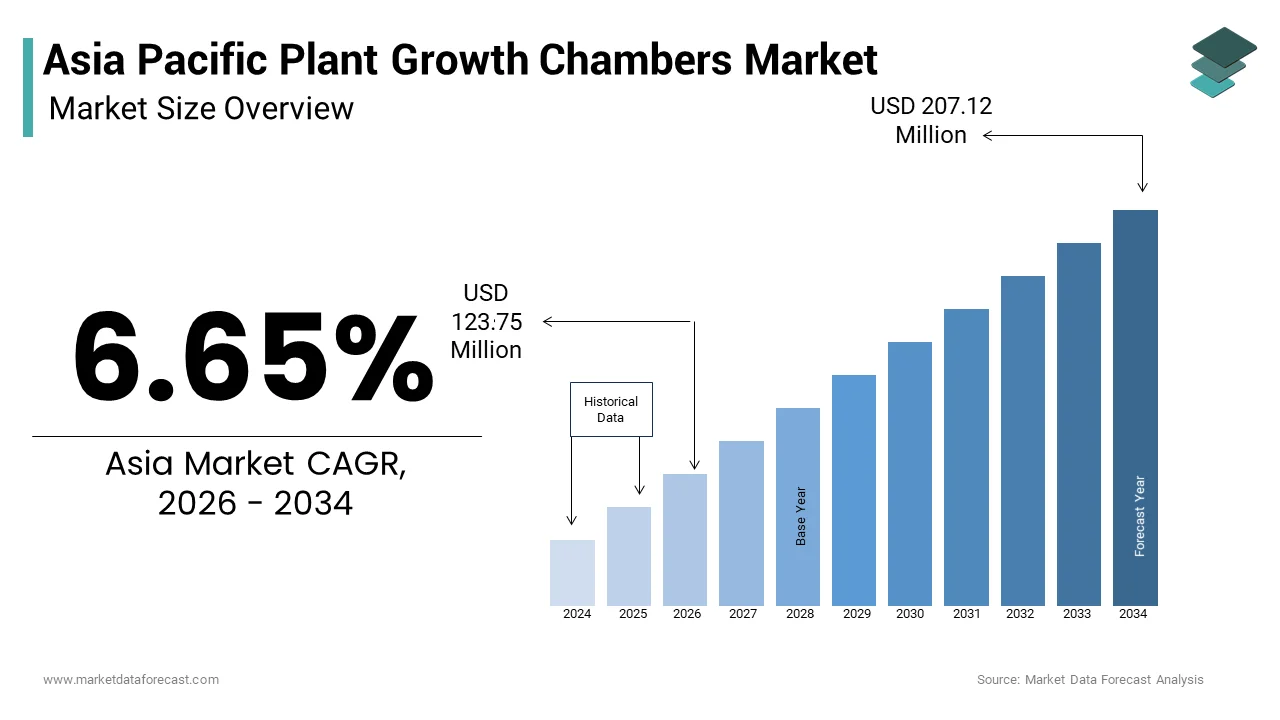
The Asia Pacific plant growth chambers market was valued at USD 116.03 million in 2025, reaching USD 123.75 million in 2026, and is projected to expand to USD 207.12 million by 2034, registering a compound annual growth rate (CAGR) of 6.65% during the forecast period from 2026 to 2034.
- Market Scope: Comprehensive regional evaluation spanning equipment configurations (reach-in vs. walk-in), functional and application categories, and key country markets across China, India, Japan, South Korea, Australia, and other regional economies.
- Primary Growth Drivers: Escalating investments in agricultural biotechnology research, food security initiatives, climate-resilient crop development, and the integration of smart farming systems.
Key Market Segment Metrics
| Category | Leading Segment | Fastest-Growing / Promising Segment |
|---|---|---|
| By Equipment Type | Reach-In Plant Growth Chambers (Preferred for space-saving design, ease of use, and cost-effectiveness in labs) | Walk-In Plant Growth Chambers (Projected to grow at a CAGR of 9.7%, accommodating tall plants and large-scale studies) |
| By Application & Country | Plant Growth Studies (Captured 38.6% of total revenue in 2024) & China (dominating with 33.5% regional share) | Tissue Culture Applications (Expanding at a rapid 10.4% CAGR) & India and Japan advancing tech adoption |
Major Market Players & Industry Landscape
Competitive Structure: A competitive landscape featuring prominent global equipment manufacturers competing with local agritech innovators through AI integration, IoT connectivity, and custom regional configurations.
Leading Companies: Aralab, BINDER GmbH, Brs Bvba, CARON Products & Services Inc., Conviron, Darwin Chambers, Freezers India, Hettich Benelux BV, Percival Scientific Inc., Saveer Biotech Limited, Thermo Fisher Scientific, and Weiss Technik.
Asia Pacific Plant Growth Chambers Market Size
The Asia Pacific plant growth chambers market was valued at USD 116.03 million in 2025 and is anticipated to reach USD 123.75 million in 2026 to reach USD 207.12 million by 2034, growing at a CAGR of 6.65% during the forecast period from 2026 to 2034.
Plant growth chambers are a precisely controlled-environment agricultural and research equipment designed for cultivating plants under precisely regulated conditions. These chambers allow researchers, agronomists, and biotechnologists to manipulate variables such as temperature, humidity, light intensity, CO₂ levels, and photoperiods to study plant physiology, genetics, and responses to environmental stressors. As scientific research in agriculture, horticulture, and biotechnology expands across the region, the demand for high-precision plant growth chambers has surged.
The increasing focus on food security, climate-resilient crops, and sustainable farming practices has led to the proliferation of plant biotechnology laboratories and seed research centers that rely on plant growth chambers.
MARKET DRIVERS
Expansion of Agricultural Biotechnology Research
The rapid expansion of agricultural biotechnology research aimed at enhancing crop productivity and resilience remains a significant driver of the Asia Pacific plant growth chambers market. Governments and private institutions across the region are investing heavily in genetic modification, hybrid breeding, and tissue culture studies, all of which require highly controlled environments for accurate experimentation.
In addition, over 25 million hectares of biotech crops were cultivated in the Asia Pacific region in 2023, with China and India leading in genetically modified (GM) cotton and rice development. This surge in biotech crop research necessitates the use of plant growth chambers to simulate various climatic conditions and evaluate plant responses under controlled settings.
In China, as per the Ministry of Science and Technology, more than 40 new agricultural biotechnology labs were established between 2021 and 2023, each equipped with state-of-the-art plant growth chambers to support crop improvement programs. Similarly, in India, the Indian Council of Agricultural Research (ICAR) has expanded its network of biosafety level-II laboratories, further boosting demand for precision-controlled plant growth systems.
Rising Investments in Academic and Government Research Institutions
The growing investment in academic and government-led research initiatives focused on plant sciences and sustainable agriculture also contributes to the growth of the Asia Pacific plant growth chambers market. Universities, national agricultural research councils, and botanical institutes are increasingly incorporating plant growth chambers into their experimental workflows to advance discoveries in plant physiology, pathology, and developmental biology.
Countries such as Australia, Japan, and South Korea have prioritized funding for plant science laboratories, integrating advanced growth chambers to support long-term agricultural innovation.
In Australia, as per the Commonwealth Scientific and Industrial Research Organisation (CSIRO) launched a dedicated plant phenomics facility in 2023, featuring automated plant growth chambers capable of simulating extreme weather conditions. In South Korea, the Rural Development Administration (RDA) has expanded its crop adaptation research centers, equipping them with programmable growth chambers to accelerate cultivar development.
These institutional investments not only enhance research capabilities but also create a sustained demand for high-performance plant growth chambers tailored to diverse scientific applications across the region.
MARKET RESTRAINTS
High Capital and Operational Costs
The high initial capital investment required to procure and install these sophisticated systems is restricting the growth of the Asia Pacific plant growth chambers market. Advanced plant growth chambers come with integrated control panels, LED lighting systems, climate regulation units, and data logging capabilities, making them expensive for smaller research institutions and educational facilities.
For budget-constrained universities and regional agricultural research centers, especially in Southeast Asia and parts of India, this presents a significant financial barrier.
Additionally, operational costs—including electricity consumption, maintenance, and calibration—add to the overall expense. As per the Energy Research Institute of Thailand notes that large-scale plant growth chambers can consume up to 30% more energy than conventional laboratory equipment due to continuous operation and climate control requirements.
Lack of Skilled Technical Personnel
The shortage of trained technical personnel capable of operating and maintaining these complex systems is also a constraint in the adoption of plant growth chambers across the Asia Pacific region. Plant growth chambers require skilled operators who understand both the biological needs of the plants and the technical specifications of the equipment, including software interfaces, sensor calibrations, and environmental programming.
According to the International Labour Organization (ILO), many agricultural research institutions in Southeast Asia face a significant skills gap, with less than 20% of field technicians formally trained in controlled-environment agriculture technologies. In Indonesia, as per the National Employment Agency, only a small percentage of agricultural graduates receive hands-on training in plant growth chamber usage, leading to suboptimal utilization of available equipment.
MARKET OPPORTUNITY
Integration with Smart Agriculture and Controlled Environment Farming
Integration with smart agriculture and controlled environment farming (CEA) presents a potential opportunity for the Asia Pacific plant growth chambers market. As urbanization accelerates and arable land becomes scarcer, governments and agribusinesses are turning to indoor farming solutions that leverage plant growth chambers for optimized plant cultivation.
Countries like Singapore, Japan, and South Korea are at the forefront of this shift, incorporating plant growth chambers into commercial hydroponic and aeroponic farms.
In Singapore, the Agri-Food and Veterinary Authority (AVA) has actively supported the development of indoor farms using modular plant growth chambers, allowing year-round production of leafy greens without reliance on seasonal weather patterns. Similarly, in Japan, companies like Mirai Co., Ltd. have deployed AI-integrated growth chambers to automate plant monitoring and nutrient delivery in large-scale indoor farms.
Adoption in Pharmaceutical and Herbal Medicine Research
The growing application in pharmaceutical and herbal medicine research is another emerging opportunity for the Asia Pacific plant growth chambers market. With the resurgence of interest in plant-based therapeutics and traditional medicine, research institutions and biopharmaceutical companies are utilizing plant growth chambers to cultivate medicinal plants under controlled conditions for consistent quality and potency.
According to the World Health Organization (WHO), approximately 80% of the population in some Asian countries relies on traditional herbal remedies for primary healthcare. To meet regulatory standards and ensure reproducibility, pharmaceutical researchers are increasingly using plant growth chambers to standardize the cultivation of medicinal species such as ginseng, turmeric, ashwagandha, and neem.
In India, as per the Ministry of AYUSH, over 20 new research centers focusing on Ayurvedic drug development have been established since 2021, many of which utilize plant growth chambers for cultivating medicinal herbs with controlled biochemical profiles.
MARKET CHALLENGES
Supply Chain Disruptions and Component Shortages
The ongoing disruption in global supply chains, which affects the timely procurement of critical components such as LED lighting modules, climate control sensors, and microprocessor-based controllers, is a significant challenge facing the Asia Pacific plant growth chambers market. The industry's reliance on imported electronic and mechanical parts makes it vulnerable to geopolitical tensions, trade restrictions, and logistical bottlenecks.
In India, as per the Confederation of Indian Industry (CII), import duties on key electronic components used in growth chamber controllers had risen by 12%, adding to the financial burden on local manufacturers. Additionally, in South Korea, as per the Korea Trade-Investment Promotion Agency, logistics disruptions caused by port congestion and shipping container shortages affected the availability of imported growth chamber units.
Limited Awareness and Underutilization in Emerging Markets
Plant growth chambers remain underutilized in many emerging markets across the Asia Pacific due to limited awareness and insufficient understanding of their applications beyond academic research. Many agricultural extension services, small-scale research centers, and private-sector growers are unaware of the benefits these chambers offer in accelerating plant breeding, disease resistance testing, and seed germination studies.
According to the Food and Agriculture Organization (FAO), less than 10% of agricultural research stations in Cambodia, Laos, and Myanmar have access to plant growth chambers, despite their potential to improve crop yields and climate adaptability. In rural parts of India and Indonesia, agricultural cooperatives often rely on open-field trials rather than controlled experiments, limiting the adoption of growth chamber technology.
Additionally, in Vietnam, as per the Ministry of Science and Technology, funding constraints and inadequate training prevent widespread integration of growth chambers in agricultural education.
REPORT COVERAGE
| REPORT METRIC | DETAILS |
| Market Size Available | 2025 to 2034 |
| Base Year | 2025 |
| Forecast Period | 2026 to 2034 |
| CAGR | 6.65% |
| Segments Covered | By Equipment, Application, and By Country |
| Various Analyses Covered | Global, Regional & Country Level Analysis, Segment-Level Analysis, DROC, PESTLE Analysis, Porter’s Five Forces Analysis, Competitive Landscape, Analyst Overview on Investment Opportunities |
| Regions Covered | India, China, Japan, South Korea, Australia, New Zealand, Thailand, Malaysia, Vietnam, Philippines, Indonesia, Singapore, and the Rest of APAC |
| Market Leaders Profiled | Aralab, BINDER GmbH, Brs Bvba, CARON Products & Services Inc., Conviron, Darwin Chambers, Freezers India, Hettich Benelux BV, Percival Scientific Inc., Saveer Biotech Limited, Thermo Fisher, Weiss Technik. |
SEGMENTAL ANALYSIS
By Equipment Insights
Reach-In Plant Growth Chambers
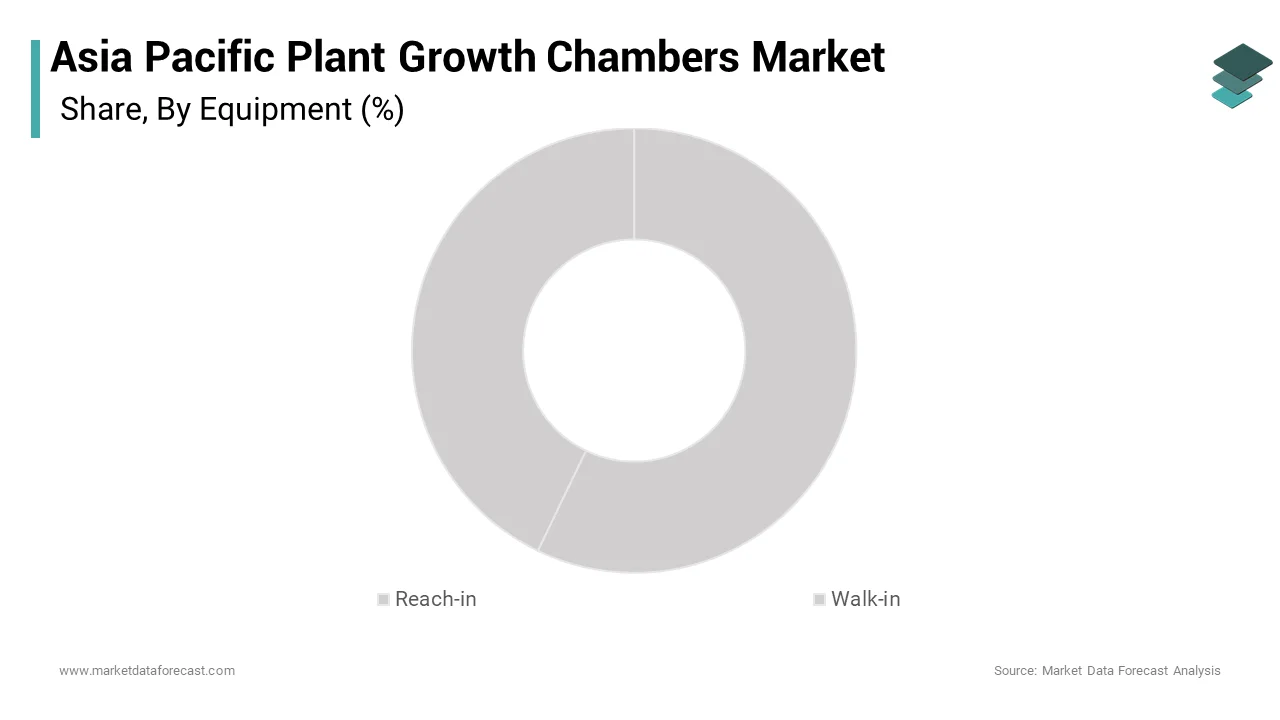
The Reach-in plant growth chambers segment led the Asia Pacific plant growth chambers market in 2024. These compact units are widely used in academic research laboratories, agricultural testing facilities, and small-scale biotech startups due to their space-saving design, ease of operation, and cost-effectiveness compared to larger walk-in models.
In India, as per the Indian Council of Agricultural Research (ICAR), more than 1,200 new plant physiology labs established between 2020 and 2023 were equipped with reach-in growth chambers to support seed germination and plant development studies. Additionally, in Australia, as per the Commonwealth Scientific and Industrial Research Organisation (CSIRO), these units are increasingly adopted by startup agritech firms engaged in tissue culture and micropropagation projects.
Walk-In Plant Growth Chambers
The Walk-in plant growth chambers represent the fastest-growing segment in the Asia Pacific market and are projected to expand at a CAGR of 9.7% from 2025 to 2033. These large-scale systems provide extensive environmental control capabilities and accommodate tall plants, making them ideal for advanced research on crop physiology, genetic modification, and climate adaptation.
In Japan, as per the National Agriculture and Food Research Organization (NARO), investment in multi-zone walk-in chambers has surged by 14% since 2021, supporting long-term food security programs.
Similarly, in China, the Chinese Academy of Agricultural Sciences (CAAS) has commissioned several modular walk-in units to study the impact of elevated CO₂ levels on staple crops.
By Application Insights
Plant Growth Studies
The plant growth studies segment constituted the prominent application of the Asia Pacific plant growth chambers market by capturing 38.6% of total revenue in 2024. This application involves monitoring plant development under controlled temperature, humidity, light intensity, and CO₂ conditions to assess physiological responses, nutrient uptake, and disease resistance.
In India, as per the Indian Agricultural Research Institute (IARI), nearly all national crop improvement initiatives incorporate plant growth chamber-based trials to standardize field performance data before large-scale deployment.
The Chinese Academy of Agricultural Sciences (CAAS) emphasizes that plant growth chambers are indispensable in evaluating transgenic crops for commercialization, ensuring regulatory compliance through precise environmental controls. Additionally, in Australia, the University of Queensland’s Centre for Crop Science utilizes growth chambers to study nitrogen fixation in legumes, aiming to reduce synthetic fertilizer dependency.
Tissue Culture Applications
The tissue culture applications segment is emerging as the fastest-growing functional segment in the Asia Pacific plant growth chambers market and is anticipated to grow at a CAGR of 10.4% through 2033. These chambers play a crucial role in micropropagation, somatic hybridization, and virus elimination processes, enabling the mass production of genetically uniform and disease-free planting material.
According to the Food and Agriculture Organization (FAO), tissue culture-based propagation of banana, sugarcane, and ornamental plants has expanded significantly in countries like India, Indonesia, and the Philippines, where smallholder farmers depend on high-quality planting stock. In India, as per the National Bureau of Plant Genetic Resources (NBPGR), tissue culture labs have increased by 18% since 2020, supported by government subsidies for horticultural and medicinal plant cultivation.
In Vietnam, as per the Vietnam Academy of Agricultural Sciences (VAAS), plant growth chambers are now integrated into large-scale tissue culture nurseries producing millions of disease-free banana and orchid plantlets annually. Similarly, in Thailand, the Department of Agriculture has mandated the use of certified tissue-cultured seedlings for export-oriented crops such as pineapple and ginger, further boosting demand.
COUNTRY-LEVEL ANALYSIS
China Plant Growth Chambers Market Analysis
China spearheaded the Asia Pacific plant growth chambers market by contributing 33.5% of the total regional revenue in 2024. As the world’s largest producer of agricultural commodities, China has prioritized scientific research to enhance crop yields, develop climate-resilient strains, and improve food security. The Chinese Academy of Agricultural Sciences (CAAS) has been at the forefront of utilizing these chambers for evaluating transgenic crops, including drought-tolerant wheat and pest-resistant cotton. Additionally, the National Natural Science Foundation of China (NSFC) has allocated significant funding toward plant developmental biology and photosynthesis efficiency studies, which rely heavily on plant growth chamber technology.
India Growth Chambers Market Analysis
India is rapidly expanding in the Asia Pacific plant growth chambers market. The country’s growing emphasis on agricultural modernization, coupled with increased public and private sector investments in plant biotechnology, has fueled demand for controlled-environment research equipment. According to the Department of Biotechnology (DBT, India has established more than 30 new biosafety level-II research facilities since 2021, many of which are equipped with plant growth chambers for seed germination, tissue culture, and abiotic stress analysis. As per the Indian Council of Agricultural Research (ICAR), state agricultural universities have expanded their plant physiology labs, integrating growth chambers to support national crop improvement programs.
Japan Growth Chambers Market Analysis
Japan is distinguished by its technological leadership and deep integration of controlled-environment agriculture into research and commercial practices. The country serves as a center for innovation in plant phenotyping, genetic engineering, and climate simulation studies. According to the National Agriculture and Food Research Organization (NARO), Japanese research institutions utilize plant growth chambers extensively for studying gene expression, photosynthetic efficiency, and plant-microbe interactions. The Ministry of Education, Culture, Sports, Science, and Technology (MEXT) mandates the inclusion of plant growth chambers in major biological research grants, ensuring consistent adoption across academic institutions. Additionally, Japan leads in the development of AI-integrated growth chambers that enable real-time monitoring and adaptive environmental adjustments. Companies like Panasonic and Hitachi have introduced smart-controlled units tailored for pharmaceutical plant cultivation and bioactive compound extraction.
South Korea Growth Chambers Market Analysis
South Korea is characterized by a strong regulatory push toward scientific advancement and sustainable agriculture. The country has been proactive in enforcing research funding policies and promoting the use of controlled-environment systems in plant biotechnology and food security initiatives. The Korean Institute of Planning and Evaluation for Technology in Food, Agriculture, and Forestry (IPET) provides financial incentives for research institutions adopting advanced plant growth chamber setups. Additionally, the Ministry of Trade, Industry, a nd Energy encourages partnerships between universities and agritech companies to develop automated growth chambers for indoor farming and medicinal plant cultivation.
Australia Growth Chambers Market Analysis
Australian market is marked by a strong emphasis on sustainability, biodiversity conservation, and precision agriculture. The country's research institutions and agritech firms leverage plant growth chambers to advance climate-adapted crop breeding and ecological restoration projects. According to the Commonwealth Scientific and Industrial Research Organisation (CSIRO), Australia has launched several plant phenomics initiatives aimed at developing drought-resistant wheat and carbon-sequestering pasture species using controlled-environment chambers. The Australian Research Council (ARC) funds numerous botanical studies that rely on plant growth chambers for understanding plant-soil interactions and microbial symbiosis. Furthermore, the Department of Agriculture, Fisheries and Forestry supports the use of plant growth chambers in native plant restoration programs, particularly for endangered flora species affected by bushfires and land degradation.
COMPETITIVE LANDSCAPE
- The Asia Pacific plant growth chambers market is highly competitive, characterized by the presence of both global leaders and regional players striving to capture a larger share of a rapidly expanding sector. International firms leverage their brand strength, technological expertise, and established distribution channels to maintain dominance, particularly in developed markets such as Japan, South Korea, and Australia. At the same time, domestic manufacturers in China and India are gaining traction by offering cost-effective alternatives tailored to local research needs.
- Innovation remains a key battleground, with companies racing to introduce smart, energy-efficient, and scalable plant growth chamber solutions. As governments across the region prioritize food security, sustainable agriculture, and climate resilience, research funding continues to rise, fueling demand for advanced controlled-environment systems. Additionally, the convergence of plant science with agritech and biopharma is opening new avenues for growth.
- Market participants are also strengthening their foothold through strategic expansions, joint ventures, and product customization to cater to diverse applications, including seed germination, tissue culture, and plant phenotyping. With increasing awareness among academic and industry researchers about the importance of controlled environment studies, competition is expected to intensify further in the coming years.
KEY MARKET PLAYERS
These are the market players that are dominating the Asia Pacific plant growth chambers market.
- Aralab
- BINDER GmbH
- Brs Bvba
- CARON Products & Services Inc.
- Conviron
- Darwin Chambers
- Freezers India
- Hettich Benelux BV
- Percival Scientific Inc.
- Saveer Biotech Limited
- Thermo Fisher
- Weiss Technik
Top Players In The Market
- Percival Scientific is a globally recognized leader in controlled-environment research equipment and holds a strong presence in the Asia Pacific plant growth chambers market. The company is known for its high-precision, customizable chambers that support advanced plant research in academic, governmental, and commercial institutions. Percival’s contribution lies in setting global standards for environmental control accuracy, reliability, and energy efficiency in plant growth systems.
- Conviron is a key player with a long-standing reputation for manufacturing high-performance plant growth chambers tailored to meet diverse scientific needs. In the Asia Pacific region, Conviron has been instrumental in equipping major agricultural and biotech research centers with scalable and programmable growth environments. Its commitment to innovation has made it a preferred choice for large-scale research projects focused on food security and climate adaptation.
- Thermo Fisher Scientific plays a pivotal role in the Asia Pacific plant growth chambers market through its comprehensive range of laboratory equipment and integrated solutions. The company supports plant science research by offering modular, user-friendly, and technologically advanced growth chambers. Thermo Fisher’s global distribution network and integration of smart technologies have significantly influenced the adoption of controlled-environment systems across the region’s research and agritech sectors.
Top Strategies Used By Key Market Participants
- One major strategy employed by leading players is product innovation and technological advancement, focusing on precision control, automation, and integration with digital platforms such as IoT and AI. Companies are investing heavily in R&D to develop next-generation plant growth chambers that offer real-time monitoring, remote access, and adaptive environmental controls.
- Another crucial approach is strategic partnerships and collaborations with research institutions, universities, and government agencies. By aligning with key stakeholders in the agricultural and life sciences sectors, manufacturers ensure that their products meet evolving scientific requirements while gaining early access to emerging research applications.
- Lastly, expanding regional presence through localized production and service networks allows companies to better serve the growing demand in the Asia Pacific. This includes establishing regional distribution hubs, technical support teams, and after-sales service centers to enhance customer experience and reduce lead times.
RECENT MARKET NEWS
- In May 2024, Conviron launched an AI-integrated plant growth chamber platform specifically designed for university and biotech research labs across the Asia Pacific. This initiative aimed to provide enhanced environmental control and real-time data analytics, reinforcing its leadership in precision plant research solutions.
- In March 2024, Thermo Fisher Scientific expanded its regional service center in Singapore to include a dedicated plant growth chamber demonstration and training facility, supporting academic and industrial clients in adopting advanced growth technologies.
- In February 2024, Percival Scientific announced a partnership with a leading Indian agricultural research institute to co-develop customized plant growth chambers tailored for tropical crop studies, enhancing accessibility and application-specific design in emerging markets.
- In July 2024, Panasonic introduced a compact, solar-powered plant growth chamber model for off-grid agricultural research in rural areas of Indonesia and the Philippines, targeting sustainability-focused research and extension programs.
- In September 2024, LG Electronics unveiled a modular, multi-zone plant growth chamber system at a major agritech expo in South Korea, integrating smart controls and remote monitoring features to support precision breeding and indoor farming initiatives.
MARKET SEGMENTATION
This research report on the Asia Pacific plant growth chambers market is segmented and sub-segmented into the following categories.
By Equipment Type
- Reach-in
- Walk-in
By Application
- Short Plants
- Tall Plants
By Function
- Plant Growth
- Seed Germination
- Environment Optimization
- Tissue Culture
By Country
- India
- China
- Japan
- South Korea
- Australia
- New Zealand
- Thailand
- Malaysia
- Vietnam
- Philippines
- Indonesia
- Singapore
- Rest of APAC